


Introduction
The cognitive behavioural approach to the understanding and treatment of obsessive compulsive disorder (OCD) is well established (e.g. Salkovskis, Reference Salkovskis1985, Reference Salkovskis1999; Rachman, Reference Rachman1993). OCD can present in a range of idiosyncratic constellations of symptoms ranging from fears of contamination to persistent and distressing intrusive thoughts of perverse sexual behaviours. The associated compulsions include many variations such as keeping scrupulously clean, repeated checking or counting, or being unable to discard items that are of little or no use to the person. Although typically included within a diagnosis of OCD, there is an on-going debate as to whether this latter symptom, compulsive hoarding, belongs within the diagnostic category of OCD, or should be viewed as a separate subtype or even a distinct disorder (Rachman, Elliott, Shafran and Radomsky, Reference Rachman, Elliott, Shafran and Radomsky2009). Often cited is the association of hoarding with positive affect rather than the negative affect more typically associated with other OCD behaviours including checking or washing (Abramowitz, Wheaton and Storch, Reference Abramowitz, Wheaton and Storch2008). Indeed, a diagnosis of “hoarding” is not derived from any standardized diagnostic interview (e.g. DSM-IV; APA, 1994) and diagnosis is based on clinician judgement (see Frost and Hartl, Reference Frost and Hartl1996) for a systematic definition. Recent debate in this respect has focused on how best to classify OCD in the upcoming DSM-V (Abramowitz et al., Reference Abramowitz, Wheaton and Storch2008).
Grisham, Brown, Liverant and Campbell-Sills (Reference Grisham, Brown, Liverant and Campbell-Sills2005) acknowledge the heterogeneity of hoarding, suggesting that hoarding can occur either as a distinct syndrome or as mixed presentation of OCD and hoarding. In a sample of 162 patients with OCD, the distinct hoarding group reported significantly less anxiety, worry, stress and negative affect than patients in the mixed group and the non-hoarding group. They also reported significantly more positive affect in relation to hoarding, which is consistent with the theoretical view of Abramowitz et al. (Reference Abramowitz, Wheaton and Storch2008) that hoarding is associated with positive rather than the negative emotion associated with other OCD symptoms.
There is some empirical support for attempting to understand the heterogeneity of OCD by reducing complex clinical presentations to a number of symptom dimensions. Mataix-Cols, Rosario-Campos and Leckman (Reference Mataix-Cols, Rosario-Campos and Leckman2005) examined factor analytic studies and found that hoarding, symmetry/ordering, contamination/cleaning and obsessions/checking were consistently extracted, and were associated with distinct patterns of comorbidity, genetic transmission, neural substrates and treatment response. Abramowitz et al. (Reference Abramowitz, Wheaton and Storch2008) found that hoarding was the only Obsessive Compulsive Inventory (OCI; Foa, Kozak, Salkovskis, Coles and Amir, Reference Foa, Kozak, Salkovskis, Coles and Amir1998) subscale not significantly related to the overall severity of obsessions and compulsions. However, other studies have reported that a high proportion of patients with OCD have hoarding symptoms (e.g. Coles, Frost, Heimberg and Steketee, Reference Coles, Frost, Heimberg and Steketee2003). Similarly, Frost, Krause and Steketee (Reference Frost, Krause and Steketee1996) found elevated levels of OCD in a self-identified community sample of people with hoarding problems.
Given the very different experiences and beliefs that underpin topographically similar presentations, a cognitive understanding of hoarding is likely to hold promise for successful treatment. Cognitive models for hoarding problems have emerged (Steketee and Frost, Reference Steketee and Frost2003) and cognitive behavioural treatment strategies have been outlined in detail for clinicians (e.g. Frost, Steketee and Greene, Reference Frost, Steketee and Greene2003) and in self-help literature (e.g. Steketee and Frost, Reference Steketee and Frost2007). We consider that such models require further elaboration given that there appears to be considerable variability in terms of the pattern of symptoms seen in hoarding.
Relevant not only to the debate of whether hoarding is part of a homogenous syndrome of OCD but also to the theoretical understanding of hoarding itself is the surprising heterogeneity in presentation of those reporting hoarding problems. It is clear that for some patients the phenomenology of hoarding symptoms is closely related to that experienced by those suffering from OCD where the compulsions (washing, checking and ruminative rituals) are motivated by ideas of their needing to prevent harm coming to themselves or others (Salkovskis, Reference Salkovskis1999). The person who fears that they may spread contamination to others sometimes keeps (hoards) objects they believe to be contaminated as a way of being sure that they are not responsible for otherwise avoidable harm. However, in other instances, the functional/cognitive relationship between the person's beliefs and appraisals and their hoarding behaviour appears to follow a different pattern. For example, patient A, a high achieving, well educated person from a poor background, believes that if they throw away their collection of newspapers and magazines, they will miss out on reading a potentially life-changing article, they will be mediocre for the rest of their life, and will die having lost their chance for success. Patient B, a refugee who has suffered massive material deprivation and loss (including of possessions), saves everything in case it comes in handy some day and can see a number of potential uses for items others would consider as rubbish. Patient C, who was brought up in a disruptive and abusive environment where their attachment to their carers was insecure at best, feels a strong emotional attachment to her possessions, considering that things can be trusted in a way that people cannot. All of these patients have homes that are cluttered and full of possessions to the point of rooms being unusable for their normal purpose. Whilst a link with harm aversion can be discerned, the level of direct harm involved and feared in this group may be lower than that typically seen in OCD and is more likely to be “symbolic” than actual.
We therefore take the view that there are three main dimensions underpinning hoarding. These are (i) harm avoidance where objects are acquired and kept because to not do so might result in harm to the person or other people (“Something bad will happen if I throw this away, and it will be my fault”); (ii) hoarding motivated by early material deprivation, where the person's earlier experience of being substantially deprived of belongings is linked to a sense of dread that this may happen again, so objects are acquired or kept against such an eventuality (“I have to make sure that I always have what I need and more”); and (iii) hoarding linked to disturbances of attachment, so that inanimate objects are regarded as emotionally hyper-significant. This emotional significance means that the person cannot bear the idea of losing their belongings, experiencing this as a separation experience (“To lose this is to lose part of myself and my life”).
Although not firmly established, there is a growing body of evidence to tentatively conclude the outcome of cognitive-behavioural treatment for hoarding may be poorer than that for OCD itself. Some have suggested that this is due to hoarding (as opposed to other obsessional symptoms) involving a different disturbance of brain mechanisms (An et al., Reference An, Mataix-Cols, Lawrence, Wooderson, Giampietro, Speckens, Brammer and Phillips2009). The alternative proposed here is that to improve treatment outcomes in hoarding, there needs to be greater attention to specific meanings attached to acquisition and discarding of hoarded items, particularly the type of cognitive-behavioural mechanisms outlined above. Recently described treatments have been largely pragmatic, based on a relatively general/descriptive cognitive behavioural model of hoarding that includes over-acquisition of items, information processing deficits that exacerbate disorganized clutter, and difficulty in discarding items due to hoarding related beliefs (such as their potential usefulness), the avoidance of distress and/or reinforcement of hoarding via positive emotions related to not discarding (Steketee and Frost, Reference Steketee and Frost2003).
Research examining hoarding as a predictor of outcome in the treatment of OCD has concluded that the prognosis where hoarding symptoms are present is poor. In a randomized controlled trial of computer versus clinician-guided behaviour therapy for OCD, Mataix-Cols, Marks, Greist, Kobak and Baer (Reference Mataix-Cols, Marks, Greist, Kobak and Baer2002) reported that patients who were high on the hoarding dimension were more likely to drop out of the study compared, for example, to patients who scored highly on the “contamination/cleaning” dimension. Patients with hoarding symptoms also responded significantly less well than other patients to a treatment that involved exposure and ritual prevention. A similar picture was found with patients presenting with sexual and religious obsessions. In a sample of 132 adults with a primary diagnosis of OCD (Abramowitz, Franklin, Schwartz and Furr, Reference Abramowitz, Franklin, Schwartz and Furr2003), although patients identified as having higher levels of hoarding symptoms improved significantly on the Y-BOCS when treated with exposure and response prevention (ERP) treatment, they showed significantly less improvement at post-treatment than patients presenting with other OCD symptoms, with the exception of those with elevated symmetry symptoms. Rufer, Fricke, Moritz, Kloss and Hand (Reference Rufer, Fricke, Moritz, Kloss and Hand2006) found that in an in-patient sample presenting with hoarding symptoms in the context of OCD, only 36.8% of patients with hoarding symptoms responded to multimodal cognitive therapy, including exposure and response management, compared to 62.7% of patients without hoarding symptoms. These findings would suggest that hoarding symptoms are associated with poorer treatment outcome in patients with a primary diagnosis of OCD when protocol based CBT is used.
The present study seeks to evaluate whether the relative effectiveness of formulation driven CBT for OCD is an effective treatment for hoarding where hoarding forms part of OCD. We are thus testing the association between the presence of hoarding and the outcome of treatment in CBT for OCD. All patients included in this study had a main diagnosis of OCD; one group showed clear evidence of additional hoarding symptoms, whereas the second group did not have evidence of such symptoms. This design was intended to test the hypothesis that OCD patients with additional hoarding symptoms have a poorer outcome than those without such symptoms.
Method
Design
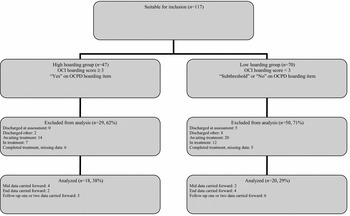
The study is a comparison of two groups of patients with a main diagnosis of OCD. The index (high hoarding) group met predefined criteria indicating the presence of significant levels of hoarding symptoms, whilst the comparison (low hoarding) group met criteria for such symptoms being very low or absent. Participants were systematically identified from all patients with a diagnosis of OCD at the Centre for Anxiety Disorders and Trauma (see Figure 1). For the purposes of the present study, only those patients who had completed treatment were included in the analyses (one patient in each group dropped out of treatment in the latter stages). The data included in the present study were extracted from the clinic's patient current and past clinical archive; therefore clinicians were unaware of the study at the time of treatment. Patients ranged in age from 17 to 64 years (M = 36.53, SD = 11.86). Within the high hoarding group, patients ranged in age from 23 to 59 years (M = 40.83, SD = 11.21) and within the low hoarding group, patients ranged from 17 to 64 years (M = 32.65, SD = 11.86). Groups differed significantly in terms of age; t(36) = 2.23, p = .032. Within the sample, 55.3% was male and 44.7% female. Within the high hoarding group, 11 (61.1%) were male and 7 (38.9%) were female. Within the low hoarding group, 10 (50%) were male and 10 (50%) were female. Chi square analysis indicated no significant relation between gender and group, χ2 (1) = 0.130, p = >.05. Demographic data detailing patients' ethnicity revealed that the majority of the sample (n = 31, 83.8%) were Caucasian. There were no significant differences between groups. A high proportion of the overall sample had never been married; 12 (66.7%) of the patients in the high hoarding group and 11 (55.0%) of patients in the low hoarding group had never been married. Three (16.7%) patients in the high hoarding group and 7 (35.0%), were married or living as married at assessment.
Consort diagram presenting the treatment of data

Measures
Assessor measures. Trained assessors completed the Structured Clinical Interview for DSM-IV for Axis I disorders Version 2.0 (First, Spitzer, Gibbon and Williams, Reference First, Gibbon, Spitzer, Williams and Benjamin1997) for OCD with a clinician screener to assess for other Axis I diagnoses. Where patients screened positive for other Axis I disorders, the appropriate SCID module was conducted. On the same basis, patients were also asked to complete a self-report screener to determine any Axis II diagnoses followed up where appropriate by the relevant module of the Structured Clinical Interview for DSM-IV Axis II Personality Disorders (SCID-II; First, Gibbon, Spitzer, Williams and Benjamin, Reference First, Spitzer, Gibbon and Williams1997). Regardless of screening scores, all patients were interviewed using the Obsessive Compulsive Personality Disorder module of the Axis II SCID.
All participants provided demographic information. Information was collected on date of birth, ethnicity and marital status. Information was also collected regarding years in education, employment details and number of children under 18 years.
Obsessive Compulsive Inventory (OCI; Foa et al., Reference Foa, Kozak, Salkovskis, Coles and Amir1998). The OCI is a self-report measure of obsessive compulsive disorder. It consists of 42 items with 7 sub-scales: washing, checking, doubting, ordering, obsessing, hoarding, and neutralizing. The items are rated on a 5-point Likert scale, measuring symptom distress. The maximum total score across the subscales is 168. The maximum score for the hoarding subscale is 12. The hoarding items are:
1. I have saved up so many things that they get in the way
2. I collect things I don't need
3. I avoid throwing things away because I'm afraid I might need them later.
Beck Depression Inventory (BDI; Beck and Steer, Reference Beck and Steer1988) and Beck Anxiety Inventory (BAI; Beck, Epstein, Brown and Steer, Reference Beck, Epstein, Brown and Steer1988). The BDI and BAI are both widely used self-report scales, used to measure the intensity of depression and state anxiety respectively.
Responsibility Attitude Scale (RAS; Salkovskis et al., Reference Salkovskis, Wroe, Gledhill, Morrison, Forrester, Richards, Reynolds and Thorpe2000). This scale is a 26-item self-report questionnaire designed to assess general beliefs about responsibility. Each item is measured by a 7-point Likert scale, with responses ranging from “totally agree” to “totally disagree”. In a study of 231 participants; 57 of whom were asked to complete the RAS two weeks apart (40 of which were non-clinical participants, 5 obsessional and 12 anxious controls), test-retest reliability was excellent at .94, and the internal consistency of the 26 items was also high at .92. It has also been shown to be a valid measure.
Client ratings scale
Patients also completed the Client Ratings Scale (internal clinic scale, based on Watson and Marks, Reference Watson and Marks1971) which provides specific ratings of the discomfort and interference associated with the patient's most troublesome thought and ritual over the previous week on a scale of 0 to 8 (0 indicates “not at all” or “absent” and 8 indicates extreme discomfort or interference). Additionally, patients report the amount of time taken up by their obsessional problems as a whole, and rate their general distress and interference associated with their anxiety difficulties. These ratings are on a similar 0–8 scale. Finally, patients are requested to rate how OCD has impaired various areas of their lives, including work, home life and relationships.
Procedure
All patients were assessed using a structured clinical diagnostic interview (Structured Clinical Interview for DSM-IV, SCID-IV) by an appropriately trained clinical psychologist or cognitive behaviour therapist. All patients also completed the aforementioned self-report questionnaires at assessment. Self-report measures were re-administered to patients at the end of weekly treatment and end of follow-up.
Inclusion criteria therefore consisted of a primary diagnosis of OCD for both groups. The high hoarding group was composed of all patients who endorsed the Obsessive Compulsive Personality Disorder (OCPD) hoarding item on the SCID-II: “You've said that [Do] you have trouble throwing things out because they might come in handy some day. Give me some examples of things that you're unable to throw out. (How cluttered does your place get because you don't throw things out?)” For inclusion in the high hoarding group patients also scored a total of 3 or higher on the distress scale of the Obsessive Compulsive Inventory (OCI) hoarding sub-scale at initial assessment. The low hoarding group was composed of those who did not endorse the SCID-II item or fell into the “sub threshold” category on the SCID-II OCPD hoarding item and scored a total of less than 3 on the OCI hoarding sub-scale at initial assessment. Only one participant in the low hoarding group fell into the “sub threshold” category on the SCID-II hoarding item. The final sample included a total of 38 individuals; 18 (47.4%) in the high hoarding group and 20 (52.6%) in the low hoarding group.
Patients received 12–18 hours of CBT delivered by experienced cognitive behaviour therapists with weekly peer supervision. Treatment was an integrated cognitive-behavioural treatment (based on the cognitive model of OCD of Salkovskis, Reference Salkovskis1985). Generally, within the initial 2 hours of treatment, a shared formulation was drawn up with the patient. This collaborative formulation would consist of a key responsibility appraisal of an intrusive thought and maintenance factors. An alternative less threatening belief would be collaboratively devised. Behavioural experiments would be agreed to build up evidence to support an alternative belief and facilitate belief change. Home visits or field trips were included in the majority of cases. Patients were offered three follow-up sessions at one month intervals after the end of treatment. All sessions were videotaped for supervision purposes and audio-taped for the patient.
An independent-samples t-test was conducted to compare the number of weekly and booster sessions completed by both groups. There were no significant differences in the number of weekly sessions attended by the high hoarding group (M = 12.78, SD = 2.73) and the low hoarding group M = 12.80, SD = 2.04; t(36) = .029, p = .977. There was no significant difference in the number of booster sessions attended by the high hoarding group (M = 2.11, SD = 1.49) and the low hoarding group M = 1.90, SD = 1.41; t(36) = .448, p = .657.
Treatment of data
Where post-treatment data were missing, the closest time point was used to fill in the missing data (see Figure 1). For example, many patients had mid treatment questionnaires. Where post-treatment data were missing, mid treatment data were carried forward. Where all follow-up data were missing, post-treatment data were carried forward and where end of follow-up data were missing, follow-up one or follow-up two data were carried forward.
Data analytic plan
Statistical analysis used SPSS version 15.0. The initial between-group differences were analyzed using a one-way analysis of variance (ANOVA) with the low and high hoarding groups as the between groups factor. For categorical data, a chi-square analysis was used. For the treatment outcome between group differences, a repeated measures ANOVA was used with the repeats factor being before treatment, after treatment and end of follow-up and the group being the grouping factor. Where evidence of serial dependency was present, the Greenhouse Geisser coefficient was used. Where the time factor interacts with the group factor appropriate multi-comparisons were carried out. For the OCI analysis, a repeated measures ANOVA was conducted using time and subscale as the within-subjects factor and group as the grouping factor. The intended strategy was to conduct individual analyses of the subscales in the event of a significant group × time × subscale interaction. This analysis did not include the hoarding subscale (or hoarding items in the total), since it needed to be analyzed separately. The client impairment ratings on the client rating scale were also analyzed using a repeated measures ANOVA and was conducted using time and subscale as the within-subjects factor and group as the grouping factor.
Results
To ensure that one of our inclusion criteria for the high hoarding group (an OCI hoarding cut-off score of 3 or more from a maximum score of 12) was not overly inclusive, more detailed analysis revealed that 50% of the high hoarding group scored at least 9 whilst 80% of the low hoarding group scored 1 or 0. As described above, this was, of course, in addition to a positive clinician rating of the OCPD hoarding item on the SCID II.
Initial between group differences
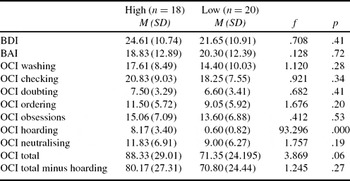
Measures of co-morbid psychopathology. The statistics of initial comparisons between the high and low hoarding groups are presented in Table 1. A one-way between-groups analysis of variance (ANOVA) showed no significant difference between the mean scores of the high and low hoarding groups on the Beck Depression Inventory (BDI), the Beck Anxiety Inventory (BAI), the Obsessive Compulsive Inventory (OCI) total, and the Obsessive Compulsive Inventory (OCI) total minus the hoarding subscale. Comparison of all OCI subscales also showed no significant difference between mean scores, with the predictable exception of the OCI hoarding subscale, F(1,36) = 93.29, p < .0001.
Initial group comparisons

Initial diagnoses: AXIS I
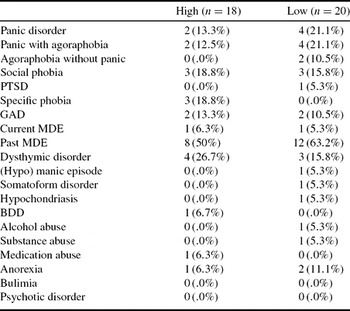
Chi-square analysis indicated no significant relation between group and Axis I disorders (see Table 2). For the purpose of analysis, the data from participants who presently met diagnosis of each Axis I disorder were combined with the data of patients who met criteria for each Axis I disorder in the past.
Other past or current diagnoses of AXIS I disorders

Note: PTSD = Posttraumatic stress disorder; GAD = Generalized Anxiety disorder; MDE = Major Depressive episode; BDD = Body Dysmorphic disorder. Missing data meant that in some cases the numbers were smaller and the percentages reflect this.
Initial diagnoses: AXIS II
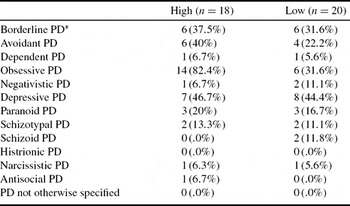
In addition, chi-square analysis indicated no significant relation between group and Axis II disorders (see Table 3). However, as expected, a significant relation was found between group and obsessive personality disorder, χ2(1) = 7.424, p < .006.
Number and percentage of participants meeting diagnosis of comorbid Axis II personality disorders (PD)

Note: *The data of participants who met a diagnosis of Borderline PD currently or in the past six months were combined for this analysis.
Missing data meant that in some cases the numbers were smaller and the percentages reflect this.
Treatment outcome between group differences
General mood measures: Beck Depression Inventory (BDI). A repeated measures analysis of variance (ANOVA) showed a significant main effect of time on the BDI (F [2, 72] = 20.14, p < .0001), but not of group (F < 1); the group x time interaction was also not significant (F < 1).
Beck Anxiety Inventory (BAI). A repeated measures analysis of variance (ANOVA) showed a significant main effect of time on the BAI (F [1.53, 55.25] = 6.89, Greenhouse Geisser p < .005, but not of group (F < 1); the group x time interaction was also not significant (F<1).
OCD specific measures
The OCI analysis (all subscales excluding hoarding) found a significant main effect of time (F [1.2, 72] = 33.8, Greenhouse Geisser p < .0001). The main effect of group was not significant, F < 1. All group related interactions failed to reach significance (F < 1) in each instance.
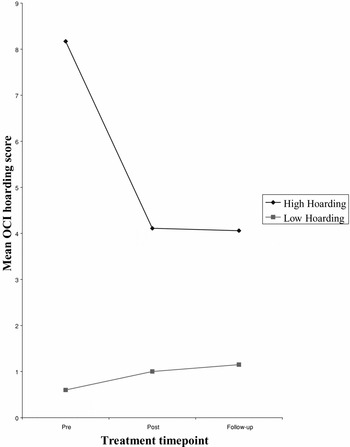
OCI hoarding subscale. A repeated measures analysis of variance (ANOVA) showed a significant main effect of time (F [1.55, 55.72] = 12.88, Greenhouse Geisser p < .001). There was a main effect of group (F [1, 36] = 40.29, Greenhouse Geisser p < .001). The group × time interaction was also significant (F [1.55, 55.7] = 20.6, Greenhouse Geisser p < .0001). Multiple comparisons indicate that, before treatment, the high hoarding group had a significantly higher hoarding score, t(18.8) = 9.2, p < .001, which was also elevated at the end of treatment t(24.6) = 3.5, p < .005 and at follow-up, t(24.9) = 3.1, p = .005). Paired samples t-tests were then carried out separately for the two groups. For the low hoarding group, pre-treatment to the end of treatment showed no significant difference, t(19) = 0.97, p > 0.3. For the end of treatment to follow-up, again there was no significant difference, t(19) = 0.6, p > 0.5). However, for the high hoarding group, there was a significant change from pre-treatment to the end of treatment, t(17) = 5.0, p = <.0001. For the end of treatment to follow-up there was not a significant difference for the high hoarding group, t(17) = 0.1, p > 0.9. (See Figure 2)
Mean score group differences on the OCI hoarding subscale

Impairment ratings on the client rating scale. A repeated-measures ANOVA showed a significant main effect of time (F [2, 66] = 14.9, p < .0001). No main effect of group was found, F < 1 and no interaction involving group were significant, F < 1.
Responsibility Attitudes Scale (RAS). A repeated measures analysis of variance (ANOVA) showed a significant main effect of time (F [1.45, 52.25] = 13.98, Greenhouse Geisser p < .0001). There was no main effect of group (F < 1). The group × time interaction was also not significant (F < 1).
Distress overall. A repeated measures analysis of variance (ANOVA) showed a significant main effect of time (F [2, 70] = 18.65, p < .0001). There was no main effect of group (F < 1). The group × time interaction was also not significant (F < 1).
Interference overall. A repeated measures analysis of variance (ANOVA) showed a significant main effect of time (F [2, 68] = 13.1, p < .0001). There was no main effect of group (F < 1). The group x time interaction was also not significant (F < 1).
Discussion
It has been suggested that hoarding, as a subtype of OCD, may be less responsive to treatment than other types of OCD. In an open trial of CBT that directly addressed compulsive hoarding, 50% of treatment completers were rated as improved. Results revealed a significant decrease on standardized measures of saving and clutter (Tolin, Frost and Steketee, Reference Tolin, Frost and Steketee2007). These results are poorer than those obtained for non-hoarding OCD. For example, in a study comparing ERP and CBT, a recovery rate of 76% was found at 3-month follow-up in participants who had received CBT (Whittal, Thordarson and McLean, Reference Whittal, Thordarson and McLean2005). The present study sought to address whether, in patients treated in a specialist OCD clinic, the presence of hoarding symptoms as part of OCD is associated with a poorer response to CBT. With the exception of age (patients with hoarding symptoms were significantly older in this sample) there was little evidence of differences in patient characteristics between those with hoarding symptoms and those without. No distinctive pattern of differences in terms of comorbidity was found between the two groups. Contrary to previous findings there was no evidence of higher levels of generalized anxiety disorder or social phobia, or greater number of personality disorders in the high hoarding group (Frost, Steketee, Williams and Warren, Reference Frost, Steketee, Williams and Warren2000; Samuels et al., Reference Samuels, Joseph Bienvenu, Grados, Cullen, Riddle, Liang, Eaton and Nestadt2008).
The treatment responses of the two groups were very similar, with no evidence that the presence of hoarding symptoms adversely affected treatment response. There were some differences in the magnitude of treatment response in terms of hoarding symptoms themselves, mainly accounted for by initial differences being reduced by treatment. These symptoms remained elevated relative to the low hoarding group at the end of treatment and follow-up despite being much improved relative to pre-treatment levels.
There are limitations to this study; there are no systematic data on how much hoarding was or was not the focus of treatment. However, the treatment delivered will have been consistent within the whole sample as the clinicians involved were trained and supervised in the specific treatment of OCD based on the cognitive model of Salkovskis (Reference Salkovskis1985), modified by our group's theoretical view of hoarding subtypes and related psychopathology (Oldfield, Salkovskis and Forrester, in preparation). Patients were not given specific measures of hoarding symptoms other than the OCI subscale. The samples are relatively small, and it is possible that a larger sample would have resulted in differences emerging. However, we would expect that clinically significant differences between patient subgroups should be detectable with the present sample size.
These results provide some evidence that when hoarding is present as a symptom dimension in the context of DSM IV diagnosed OCD, cognitive behavioural therapy is at least as effective in the treatment of the patient's symptoms as when it is not present. We thus urge caution with respect to the widely propagated view that the presence of hoarding symptoms may be associated with a poor prognosis. We consider it highly likely that such therapist expectations will impact on patient outcomes. At a scientific level, these results also raise doubts about whether hoarding symptom “dimensions” in the context of OCD indicate a separate phenotype. As often appears to be the case (e.g. Lomax, Oldfield and Salkovskis, Reference Lomax, Oldfield and Salkovskis2009) conclusions drawn from research into factors modulating pharmacological treatment of OCD do not apply to research in the context of psychological treatments.
This is not to say, of course, that in a group of patients where the main problem is hoarding, different results might be found. However, from the perspective of cognitive theories and the way CBT is conducted, we suggest that it is possible that hoarding may simply have been poorly conceptualized within the constellation of concerns seen in OCD patients. We take the view that CBT for OCD depends on the development and sharing of a semi-idiographic formulation, which is then used to guide therapy efforts, and is likely to be key to the success or failure of treatment (Salkovskis, Reference Salkovskis1999; Salkovskis, Forrester, Richards and Morrison, Reference Salkovskis, Forrester, Richards, Morrison, Tarrier, Wells and Haddock1998). For example, seeking to apply treatment strategies suited to contamination fears to patients who predominantly check or ruminate is unlikely to be completely effective and may be completely ineffective. By the same token, we suggest that insufficient attention may often be paid to the specific understanding of hoarding symptoms and the implications such an understanding have for treatment strategies. We suggest that the less prescriptive approach characteristic of cognitive therapy may well have overcome such problems in the present study. Abramowitz et al. (Reference Abramowitz, Wheaton and Storch2008) discuss their treatment outcome findings in the context of the limitations of defining disorders on the basis of symptoms as opposed to their function; that is, not all hoarding behaviour is performed to reduce anxiety or feared consequences. The underlying cognitive constructs that are common to hoarding presentations should be the focus of further investigation. This may highlight useful distinctions between different types of hoarding behaviour with implications for treatment (see Steketee, Frost and Kyrios, Reference Steketee, Frost and Kyrios2003).
Acknowledgements
Paul Salkovskis received support from the NIHR Biomedical Research Centre at the South London and Maudsley NHS Foundation Trust/Institute of Psychiatry (King's College London). Thanks to Natalie Carter for help with identifying some of the data used here.



Comments
No Comments have been published for this article.