Introduction
Studies on bilingual language acquisition have shown that there is a strong relationship between language experience and acquisition outcomes (Unsworth, Reference Unsworth, Silva-Corvalán and Treffers-Daller2015; Carroll, Reference Carroll2017). This relationship has been observed across a wide variety of linguistic domains, including phonetics/phonology (e.g., Mora & Nadeu, Reference Mora and Nadeu2012), vocabulary (e.g., Daller, van Hout & Treffers-Daller, Reference Daller, van Hout and Treffers-Daller2003; Gathercole & Thomas, Reference Gathercole and Thomas2009; Thordardottir, Reference Thordardottir2011), morphosyntax (e.g., Chondrogianni & Marinis, Reference Chondrogianni and Marinis2011; Paradis, Reference Paradis2010; Unsworth, Reference Unsworth2013) and discourse (e.g., Bongartz & Torregrossa, Reference Bongartz and Torregrossa2020; Paradis & Navarro, Reference Paradis and Navarro2003). Different types of language experience have been reported to also have an impact on cognitive development (Bialystok & Majumder, Reference Bialystok and Majumder1998). For instance, balanced language experience is associated with advantages in executive functioning (De Cat, Gusnanto & Serratrice, Reference De Cat, Gusnanto and Serratrice2018; Vega & Fernandez, Reference Vega and Fernandez2011; Weber, Johnson, Riccio & Liew, Reference Weber, Johnson, Riccio and Liew2016). Cognitive development, in turn, affects language outcomes (Hendriks, Reference Hendriks2016 for an overview), which makes a full circle, as far as the interaction between language experience, cognitive functions and language outcomes is concerned. The effects of this interaction are modulated by other factors, including patterns of cross-linguistic influence of one language on the other (e.g., Serratrice, Sorace, Filiaci & Baldo, Reference Serratrice, Sorace, Filiaci and Baldo2011) as well as bilinguals’ levels of proficiency in each language (e.g., Blom, Paradis & Duncan, Reference Blom, Paradis and Duncan2012).
The aim of this paper is to examine the role of language experience, cognitive skills (executive functions) and cross-linguistic effects in bilingual children's language outcomes. We operationalize language experience in terms of a continuous index, which considers, for each language, proficiency and quantity of input across different contexts. The linguistic phenomenon on which we focus concerns the production of referring expressions (REs, henceforth), given its interface nature, which involves both mastering of language-specific syntax-to-discourse mappings as well as cognitive processes such as (discourse) updating. Moreover, because of its interface nature, bilingual acquisition of reference has been reported to be more sensitive to language experience than the acquisition of core, narrowly syntactic phenomena, which seems to be more dependent on age of onset (Tsimpli, Reference Tsimpli2014). Therefore, bilingual reference production is particularly appropriate to show how cognition and language experience contribute to the process of its acquisition.
To conduct the analysis, we compare bilingual children to each other without relying on either monolingual control groups or group results. Rather, we focus on variation in bilingual reference production at the individual level, as reflecting graded variation in both language experience and cognitive variables. We will thus outline a continuum of bilingual grammars (Kupisch & Rothman, Reference Kupisch and Rothman2016), as emerging from the interaction between child-internal (language proficiency, patterns of cross-linguistic effects, cognitive maturity) and child-external (e.g., features of the environment, such as quantity of input in the target language) factors (Paradis, Reference Paradis2011).
Linguistic, cognitive and input factors involved in bilingual reference production
Producing a cohesive narrative involves establishing and maintaining reference to story referents, as well as switching reference between one referent and another. Each of these discourse functions corresponds to differences in the degree of a referent's discourse activation (Arnold, Reference Arnold2010): referents that are maintained are more activated than referents that are reintroduced into discourse after a hiatus (Ariel, Reference Ariel1990; Givón, Reference Givón1983).
It is generally assumed that the use of REs reflects the activation of the corresponding referent in discourse (Ariel, Reference Ariel1990; Cardinaletti & Starke, Reference Cardinaletti, Starke and van Riemsdijk1999; Gundel, Hedberg & Zacharski, Reference Gundel, Hedberg and Zacharski1993): highly activated referents tend to be referred to by means of reduced REs (i.e., pronouns instead of full nouns). For instance, the pronoun ‘she’ in the third sentence in (1) – adapted from Arnold (Reference Arnold2010) – exhibits a strong tendency to refer to Elsi, which is the subject of the previous sentence and is established as the discourse topic in the first sentence (see the Analysis section on grammatical and discourse factors affecting a referent's activation).
(1) Elsi was in her bedroom. She called Sarah. She asked many questions.
Although it is in principle possible to refer to Sarah by using a pronoun, the use of a more explicit form (i.e., the proper name ‘Sarah’) would be more appropriate in this context, given the (relatively) low activation of the corresponding referent, which is the object of the previous sentence and is not the discourse topic.
However, speakers are not always ‘optimally’ informative in their use of REs (Hendriks, Reference Hendriks2016). For example, they may produce an explicit RE when the use of a reduced form would be more appropriate (under a high degree of reference activation). In (1), this would correspond to the use of the proper name ‘Elsi’ (instead of ‘she’), which would result in the production of an overspecified, redundant RE. The opposite tendency might also be observed, i.e., the production of reduced REs in association with (relatively) low degrees of reference activation. For example, as already mentioned, a speaker might use the pronoun ‘she’ in the third sentence in (1) to refer back to Sarah. This would correspond to the production of an underspecified form, which may be ambiguous for the listener.
Among the factors affecting variation in reference production, recent studies have recognized the importance of working memory capacity (WM) and executive functions skills (EFs) (Hendriks, Reference Hendriks2016; Serratrice & De Cat, Reference Serratrice and De Cat2019; Torregrossa, Reference Torregrossa, Choi, Dimirdache, Lungu and Voeltzel2017). The information associated with a discourse referent (e.g., its gender) is maintained and stored in memory along with linguistic and discourse features corresponding to its last mention (grammatical role, syntactic position, distance from the current point in discourse, etc.). This information is retrieved and updated at the point in discourse where the referent is mentioned again. Crucially, the former function (storing) is associated with WM, while the latter (retrieving and updating) with EFs (De Cat, Reference De Cat, Serratrice and Allen2015; Lewis, Vasishth & Van Dyke, Reference Lewis, Vasishth and Van Dyke2006). Therefore, low WM and EFs may explain the abovementioned mismatches between the degree of a referent's activation and the corresponding use of REs (i.e., under- and overspecification).
On the one hand, limitations in WM may lead to difficulty in computing discourse and, more specifically, remembering the information related to a certain discourse referent, such as the grammatical role of its previous mention (i.e., antecedent). Under these conditions, pronouns may be used as ‘default’ forms, since they are in general easier (i.e., more economic) to produce (cf. Burzio, Reference Burzio, Barbosa, Fox, Hagstrom, McGinnis and Pesetsky1998; Almor, Reference Almor1999, Almor et al., Reference Almor, Kempler, MacDonald, Andersen and Tyler1999; Hendriks, Reference Hendriks2014). If pronouns are used in association with low-activated referents, ambiguity emerges. On the other hand, low EFs seem to be associated with overspecification. EFs are responsible for retrieving and updating discourse information, which involves, for instance, linking the current mention of a referent to its previous mention and integrating new information about this referent to prior information, during ongoing discourse (De Cat, Reference De Cat, Serratrice and Allen2015). Thus, under reduced EFs, speakers may use REs that lack connection to prior discourse, even if they are appropriate at the local (sentence) level. This corresponds to the production of full nouns, even in association with highly activated referents. At this stage, the correlation between the use of overspecified REs and low EFs can be regarded as just a hypothesis, since no existing study investigates this issue specifically. The present study aims to fill this gap. However, indirect evidence for this correlation comes from studies analyzing the production and processing of long-distance dependencies involving the establishment of a link between a moved constituent (filler) and its original argument position (gap). Under low EFs, speakers may use full resumptive nouns in the gap position (e.g., “This is the boy that the girl likes the boy”) – McKee & McDaniel (Reference McKee and McDaniel2001). This tendency indicates lack of integration of the head of the relative clause (the boy) with its subcategorizer (the verb ‘like’), which resembles the lack of discourse integration motivating the use of redundant full nouns. The parallelism between these two linguistic domains is supported by the observation that the production of long-distance dependencies is based on analogous mechanisms of memory storage and retrieval as the production of REs (King & Just, Reference King and Just1991; Lewis & Vasishth, Reference Lewis and Vasishth2005).
On conclusion, underspecification and overspecification seem to be related to possible limitations in the cognitive mechanisms underlying reference use, i.e., storing (as a function of WM) and updating (as a function of EFs), respectively. However, the picture is more complex than this suggests, since WM and EFs interact with other factors: most notably, the mastery of the syntactic options for reference production (i.e., pronouns vs. full nouns) and the amount of experience that a speaker has with a language.
The analysis of bilingual reference production may contribute to a more precise understanding of these interactions, by observing how individual variation in EFs interfaces with a continuum of language profiles and experiences, giving rise to different patterns of use of underspecified and overspecified forms among bilinguals. Due to the complexity of these interactions, researchers on bilingual reference production thus far have reported mixed findings (cf. Sorace & Serratrice, Reference Sorace and Serratrice2009 and Serratrice & Hervé, Reference Serratrice, Hervé, Serratrice and Allen2015 for a review), even within the same study (Montrul, Reference Montrul2004). Also, not all studies have found evidence for specific uses of REs by bilinguals – that differentiate them, for instance, from monolinguals (Silva-Corvalán, Reference Silva-Corvalán2014; Rinke, Flores & Barbosa, Reference Rinke, Flores and Barbosa2018). Overspecification has been first observed in the production of bilinguals speaking a null-subject and clitic-language (e.g., Greek) and a non-null-subject and non-clitic-language (e.g., English). In the null-subject and clitic-language, these bilinguals tend to produce full pronouns in both subject and object position, in contexts in which a null-subject or a clitic would be more appropriate (Belletti, Bennati & Sorace, Reference Belletti, Bennati and Sorace2007; Serratrice, Sorace & Paoli, Reference Serratrice, Sorace and Paoli2004; Tsimpli et al., Reference Tsimpli, Sorace, Heycock and Filiaci2004; Tsimpli & Sorace, Reference Tsimpli, Sorace, Bamman and Zaller2006). This pattern has been interpreted as a cross-linguistic effect from English to Greek – Müller and Hulk (Reference Müller and Hulk2001), Serratrice et al. (Reference Serratrice, Sorace and Paoli2004) and Belletti et al. (Reference Belletti, Bennati and Sorace2007) for different accounts of these cross-linguistic structures. Across the studies on bilingual reference production, another form of overspecification has been attested, consisting in the production of full nouns instead of pronouns (null-subjects, strong pronouns and clitics) (Lozano, Reference Lozano and Alonso-Ramos2016; Ryan, Reference Ryan2015; Serratrice, Reference Serratrice2007; Torregrossa & Bongartz, Reference Torregrossa and Bongartz2018). Any analysis of this pattern of production in terms of cross-linguistic influence is problematic, even when considering the combination between a non-null-subject/non-clitic-language (such as English and German) and null-subject/clitic-language (such as Greek), as considered above. In fact, both languages in these pairs have full nouns. Furthermore, the use of full nouns in context of reference maintenance (which license the use of pronouns) has been attested also among bilinguals of two null-subject and clitic-languages (e.g., Greek and Spanish in Georgopoulos, Reference Georgopoulos2017) or two non-null-subject languages (e.g., English and French – which is a clitic-language, though – in Leclercq & Lenart, Reference Leclercq and Lenart2013). These findings have been interpreted either in terms of the avoidance of the syntactic options for reference available in the L2 (e.g., clitics, as in Serratrice, Reference Serratrice2007) or as an unconscious pragmatic strategy ensuring clarity for the listener, “to compensate for other non-target-like features of the participants’ interlanguage” (Ryan, Reference Ryan2015: 853). More in general, this literature review suggests that it is methodologically advisable to distinguish between different types of overspecification, since different factors (e.g., cross-linguistic effects or level of proficiency) may underlie the production of full nouns and full pronouns, respectively.
At the opposite end of the spectrum, some recent studies (Torregrossa et al., Reference Torregrossa, Bongartz and Tsimpli2019 and Serratrice & De Cat, Reference Serratrice and De Cat2019) have found that bilinguals use underspecified REs (i.e., ambiguous pronouns instead of full nouns). Torregrossa et al. (Reference Torregrossa, Bongartz and Tsimpli2019) show that underspecification is the result of limited speed in lexical retrieval: if the lexical word corresponding to the noun phrase in a full null is not immediately available, children rely on the most economic forms, i.e., pronouns (instead of full nouns). Reduced speed in lexical retrieval may be an effect of bilingualism, due to language competition or reduced frequency of language use, but may be, in principle, observed also among monolinguals (Hendriks, Reference Hendriks2016).
Apart from the results in favor of one or the other pattern of use of REs among bilinguals, all the studies considered above refer to bilingual language experience as a factor contributing to variation in the use of REs (Sorace, Serratrice, Filiaci & Baldo, Reference Sorace, Serratrice, Filiaci and Baldo2009). For example, the overuse of full nouns is usually associated with intermediate adult second language learners (Ryan, Reference Ryan2015) and heritage language experience (Montrul, Reference Montrul2004; Torregrossa & Bongartz, Reference Torregrossa and Bongartz2018). On the contrary, underspecified uses of REs are mainly attested among balanced bilingual groups (Torregrossa et al., Reference Torregrossa, Bongartz and Tsimpli2019). However, beyond the observation of these patterns, no systematic investigation of the association between different types of language experience and reference use has been conducted yet. To this aim, we propose a fine-grained operationalization of language experience, which takes into account the child's linguistic proficiency as well as amount of exposure to each language in different contexts. Furthermore, the role of language experience will be studied in interaction with cognitive development (EFs) and cross-linguistic effects, in order to identify the relative contribution of each factor to reference production and shed some new light on the synergy between child-internal and child-external factors as predictors of bilinguals’ language outcomes.
The study
We analyze reference production in a story-retelling task performed in Greek by Greek–Albanian, Greek–English and Greek–German children. Our investigation is based on the triangulation between a fine-grained coding of REs aiming to identify instances of over- and underspecification, a methodology to calculate, for each child, her degree of dominance in one or the other language (based on proficiency and exposure measures), and the assessment of children's executive function skills by means of an updating task.
We assess dominance in language experience on a continuum of values, from 0 to any positive value in the case of Greek-dominant children and from 0 to any negative value in the case of children that are dominant in the other language (Albanian, English or German). The value ‘0’ in this continuum corresponds to a hypothetical perfectly balanced bilingual. Our analysis will differentiate between Greek-dominant children, i.e., children whose value of dominance is above 0, and children that are dominant in the other language, whose value of dominance is below 0. However, within these two groups, results will not be based on group comparisons (e.g., Greek-dominant children vs. balanced children). This would have required us to arbitrarily establish a threshold value above (or below) which a child is considered as dominant in one language or another, or balanced across the two languages. Rather, we assume a relative notion of dominance, according to which the closer is the child's dominance-value to 0, the more balanced between the two languages the child is, and vice versa, the more distant is the dominance-value from 0, the more dominant the child in the corresponding language (Greek if the value is positive, Albanian, English or German, otherwise) is. We formulate our hypotheses on the effects of dominance in language experience on bilingual use of REs accordingly.
As for overspecification, we expect that the more dominant are the children in Albanian, English or German, the more overspecified REs they tend to produce in Greek, based on the literature reported in the previous section showing that overspecification is mostly visible under reduced levels of language exposure and proficiency (e.g., Ryan, Reference Ryan2015). By contrast, based on Torregrossa et al. (Reference Torregrossa, Bongartz and Tsimpli2019), we expect to observe a greater tendency to produce underspecified forms among children who are more balanced. While language dominance in the non-target language should affect mainly the production of full nouns, the type of language combination should play a crucial role in the production of overspecified pronouns, since it is expected to occur to a greater extent among bilinguals speaking a combination of a null-subject and a non-null-subject language (Greek–English and Greek–German, respectively) than among those speaking two null-subject languages (Greek–Albanian). However, it is not excluded that the type of language combination modulates the effects of language dominance in the production of overspecified full nouns and dominance modulates the effects of type of language combination in the production of overspecified full pronouns.
Before presenting the study, it should be mentioned that Albanian is the only ‘other’ language (as compared to English and German) that displays clitics as in the case of Greek. The comparison between (2) and (3) shows that both Greek and Albanian allow for the alternation between pre-verbal clitic pronouns (e.g., ton in Greek and i in Albanian) and full pronouns in postverbal position (e.g., aftón in Greek and atij in Albanian). The use of a clitic (vs. a full pronoun) depends on the activation of the corresponding referent, which is lower in association with full pronouns than with clitics, or the expression of a contrastive reading (by full pronouns; Cardinaletti & Starke, Reference Cardinaletti, Starke and van Riemsdijk1999).

In Greek, clitics and full pronouns are marked for gender (masculine, feminine and neuter), number (singular and plural) and case (nominative, genitive, accusative and vocative for full pronouns and only genitive and accusative for clitics). Albanian has gender-marking (masculine and feminine, even if clitics have the same form for masculine and feminine in both singular and plural), number-marking (singular and plural) and case-marking (nominative, accusative and dative for full pronouns and accusative and dative for clitics) – see Kabashi (Reference Kabashi, Herbst and Götz-Votteler2007), from which (3) has been taken.
As for the role of EFs, previous literature does not provide enough evidence of any particular relationship between different EF-skills and patterns of reference use. However, we expect low EFs to be associated with the use of overspecified expressions, given that previous studies have demonstrated the central role of EFs in discourse integration processes.
Participants
We tested 125 bilingual children (68 females) of three different language combinations: 24 Greek–Albanian living in Tirana (Albania), 49 Greek–English living in London (UK) or in Charlotte (North Carolina, US), and 52 Greek–German living in Cologne, Düsseldorf or Krefeld (Germany). They ranged in age from 7;2 to 13;1 (mean age: 10;8). We recruited the children from bilingual schools, differing in the amount of hours dedicated to Greek and the majority community language (Albanian, English or German), as shown in Table S1 (Supplementary Material).
Materials and procedure
Before conducting the study, the parents of the children were administered a questionnaire targeting the children's relative exposure to the two languages in different situations. We formulated questions concerning children's language experience in the following contexts: i) home language history (amount of exposure before the age of three, between three and six and after six); ii) early literacy (book reading by parents in the child preliterate years); iii) current language use (language currently spoken with family members and friends and during after-school activities); iv) current literacy (literacy practices outside school, such as writing e-mails, reading books or playing video-games) (Mattheoudakis et al., Reference Mattheoudakis, Chatzidaki, Maligkoudi and Agathopoulou2016; Torregrossa & Bongartz, Reference Torregrossa and Bongartz2018).
We tested the children for verbal abilities in both their languages, using the productive vocabulary tasks normed for monolinguals in English (Renfrew, Reference Renfrew1995), German (Petermann et al., Reference Petermann, Metz and Fröhlich2010) and Greek (Vogindroukas, Protopapas & Sideridis, Reference Vogindroukas, Protopapas and Sideridis2009), respectively. For Albanian, we used the adaptation of the Renfrew Vocabulary Test, which has been designed by Kapia and Kananaj (Reference Kapia and Kananaj2013). We considered the scores in the vocabulary test as a proxy for language proficiency (Daller, Milton & Treffers-Daller, Reference Daller, Milton and Treffers-Daller2007; Schmitt, Reference Schmitt2014; Treffers-Daller, Reference Treffers-Daller2019). We combined the information extracted from the analysis of the questionnaires with the vocabulary test scores to derive, for each child, an index of relative language experience, according to the procedure explained below.
The testing session included a narrative elicitation task in Greek, targeting the production of REs. We elicited retellings by means of the Edmonton Narrative Norms Instrument (ENNI) (Schneider, Dubé & Hayward, Reference Schneider, Dubé and Hayward2005), using its two most complex stories (A3 and B3), counterbalancing between participants. A3 and B3 have been designed to be structurally equivalent, each consisting of 13 pictures (with no text). They represent a series of events involving two major characters (an elephant girl and a giraffe boy in A3, and a dog girl and a rabbit boy in B3) and two minor ones (of different gender, too). The retelling mode was used to facilitate the decoding of the pictures and the comprehension of the story (Gagarina, Reference Gagarina2016). We administered the task as a sequence of Power Point slides on a computer screen. The participants had to look at the story pictures two by two, while listening to the model story on the headphones. Finally, once the 13-picture synopsis had appeared on the screen, they had to tell the story to the experimenter, who did not have visual access to the pictures. The stories were audio-recorded and then transcribed into CHAT format (MacWhinney, Reference MacWhinney2000) by a Greek native speaker (the second author of the paper) and were later checked by another native speaker. Disagreements were resolved by listening to the audio-recordings again. The final corpus consisted of 125 Greek narratives.
EFs were tested by using a 2-back task (Kirchner, Reference Kirchner1958; Jaeggi, Buschkuehl, Perrig & Meier, Reference Jaeggi, Buschkuehl, Perrig and Meier2010). The participants were shown a series of numbers appearing one after another on a computer screen at a constant rate of 4/s, and had to press a key whenever the currently presented number was the same as the number that appeared 2 items back. The task consisted of 60 items, i.e., 20 correct hits (same number) and 40 false alarms (different number) and was preceded by a practice block of 20 items. Several studies have used N-back as a measure of updating, which is one of the subcomponents of EFs (Bettcher et al., Reference Bettcher, Mungas, Patel, Elofson, Dutt, Wynn, Watson, Stephens, Walsh and Kramer2016). In particular, performance in the N-back task involves more than the passive storing of information, for which WM is essentially required. Rather, information stored in WM is manipulated “dynamically” (i.e., monitoring of incoming information and updating of the content of WM). Therefore, although the updating component of EFs is linked to WM, it is considered as independent from it (St Clair-Thompson & Gathercole, Reference Clair-Thompson and & Gathercole2006; see also Miyake et al., Reference Miyake, Friedman, Emerson, Witzki, Howerter and Wager2000).
The three tasks (vocabulary in Greek, story retelling in Greek and 2-back) were administered to the children in a randomized order, for a duration of approximatively 30 minutes. The vocabulary task in Albanian, English or German was performed in a separate session together with other activities, including narrative retelling in the respective other language (only for Greek–English and Greek–German bilinguals). The order of the two sessions was counterbalanced across participants.
Analysis
Assessing bilinguals’ language experience
We intend language experience as a gradient construct encompassing “a linguistic proficiency component, an external component (input), and a functional component (context of use)” (Montrul, Reference Montrul, Silva-Corvalán and Treffers-Daller2015: 16). In particular, we want to derive for each child an index of language experience that combines a measure of relative language proficiency with a cumulative measure of relative language exposure in different contexts over time (currently and in the past) (Unsworth, Reference Unsworth2013; Treffers-Daller, Reference Treffers-Daller2019). The calculation of this index is based on a regression model with our measure for relative proficiency as dependent variable and our measures of relative language exposure as independent ones. For (relative) proficiency, we subtracted the child's vocabulary score (expressed as proportion of correct answers) in Albanian, English or German from her score in Greek, whereby a positive score indicates a greater proficiency in Greek and a score close to zero a (relatively) balanced proficiency. For language exposure, we derived a score for each module in the questionnaires (home language history, early literacy, current language use and current literacy) subtracting the score obtained in the other language from the score obtained in Greek. The score assigned to each language was the sum of the scores from the individual answers. For answers stating that both languages were used in equal proportion, we split the associated scores between the two languages. All the scores were expressed in proportion (i.e., as the ratio between the language specific score and the total score of the corresponding module). A positive score indicates dominance in Greek, while a negative score reflects dominance in the other language (see the explanation under Table S2, Supplementary Material for additional details).
Our index of language experience was calculated as the weighted sum of the difference scores corresponding to each module of the questionnaire. The weights were the standardized ß-coefficients corresponding to each independent variable (each module in the questionnaire) in the multiple linear regression model presented above (R = .57, R2 = .33, p < .001). The regression analysis shows that each independent variable contributes to the dependent variable (difference scores in vocabulary) to different degrees, and not all variables make a significant contribution to the model. In particular, home language history is the most relevant factor (weight: .30), followed by current literacy (weight: .22), early literacy (weight: .17) and current language use (weight: .07), respectively (cf. Table S2, Supplementary Material for additional details on the regression model).
Once we had extracted the weights, we calculated the child's index of language experience (ILE) according to the following formula (where w indicates the weight and n the score for each module in the questionnaire, as in Torregrossa & Bongartz, Reference Torregrossa and Bongartz2018):
 $${\rm ILE} = ( {w_{{\rm history}}\cdot n_{{\rm history}}} ) + ( {w_{{\rm early\_lit}}\cdot n_{{\rm early\_lit}}} ) + ( {w_{{\rm current\_lang}}\cdot n_{{\rm current\_lang}}} ) + ( {w_{{\rm current\_lit}}\cdot n_{{\rm current\_lit}}} ) $$
For example, the ILE corresponding to child 1 (CH1), who is Greek–Albanian and whose difference score in home language history is -.81, in early literacy -.75, in current language use -.36 and in current literacy -.21, is derived as follows:
 $$\eqalign{{\rm ILE\ }( {{\rm CH}1} ) &= ( .30 \cdot -.81) + ( {.17 \cdot -.75} ) \cr&\quad+ ( {.07 \cdot -.36} ) + ( {.22 \cdot -.21} ) = -.44}$$
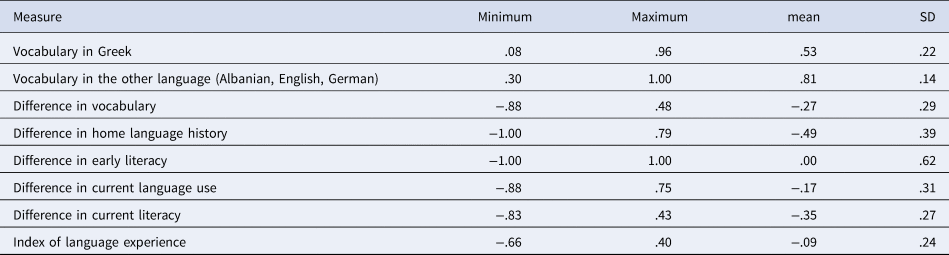
The negative score in the result reflects a dominant language experience in Albanian. Table 1 reports the minimum and maximum values, means and standard deviations for vocabulary scores in Greek and the other language, for their differences, for the difference scores obtained in the four modules and for the ILE-scores.
Descriptive statistics for vocabulary scores in Greek and the other language (Albanian, English or German), for their differences, for difference scores in the four modules of the questionnaires and for the index of language experience

The data reported in Table 1 show that, overall, the children have greater language experience and proficiency in the majority language. However, our sample includes also children that are dominant in Greek (N: 45). Table S3 reports, for each language combination, the exact number of children that are dominant in Greek or in the other language, respectively, as well as the descriptive statistics for their ILE (Supplementary Material).
Over- and underspecified referring expressions in Greek
The analysis presented in this section aims to identify overspecified and underspecified uses of REs, based on a reasoned selection of grammatical and discourse factors that have been shown to affect a referent's activation. In particular, we consider the antecedent's grammatical role (subject vs. non-subject) and the number of referents referred to between two mentions of a certain referent. Table S4 (Supplementary Material) and the following text provide details of our coding scheme.
Across the literature on reference production and comprehension, several factors have been shown to increase or decrease activation of discourse referents. Some of these factors are related to the referent's lexical properties. For example, animate referents are usually more activated than inanimate ones (e.g., Fukumura & van Gompel, Reference Fukumura and van Gompel2011). Other factors include the referent's thematic role (e.g., proto-agents, i.e., agents and experiencers, are more easily picked up by personal pronouns than proto-patients; Schumacher et al., Reference Schumacher, Roberts and Järvikivi2016) and information status (with sentence and discourse topics being more activated than non-topics; e.g., Sanford & Garrod, Reference Sanford and Garrod1981 and Grosz & Sidner, Reference Grosz and Sidner1986). Furthermore, more recently mentioned referents are more activated in discourse and, hence, more likely to be pronominalized. Recency of mention has been operationalized in different ways across studies, considering the number of clauses (or words, paragraphs, discourse units, etc.) intervening between the current mention of a referent and its previous mention (Kibrik, Reference Kibrik2011). Finally, the more frequently a referent is mentioned, the more activated it is in discourse (Hendriks, Reference Hendriks2016).
For this study, we decided to consider only a subset of these activation-lending (or demoting) features, based on theoretical and empirical considerations. It should be mentioned that this coding procedure (with the corresponding selection of features) has been validated against a large dataset consisting of narratives told in many different languages (English, German, Greek and Italian) by different types of speakers (adult and child monolinguals and child bilinguals). These narratives were elicited by using the ENNI and, hence, are comparable with each other (Torregrossa et al., Reference Torregrossa, Bongartz and Tsimpli2015; Torregrossa & Bongartz, Reference Torregrossa and Bongartz2018; Torregrossa et al., Reference Torregrossa, Bongartz and Tsimpli2019; Torregrossa, Andreou & Bongartz, Reference Torregrossa, Andreou and Bongartz2020). We decided to include only animate characters in our analysis, in order to control for the effect of animacy. Furthermore, the use of the ENNI narratives allows us to control for frequency of mention of different characters, too, since the narratives are checked for number of switches from one character to the other and degree of involvement of the main characters in the events represented in the pictures.
Our decision to focus on the referent's grammatical role (independently of its thematic role or information status) was mainly motivated by the nature of the material to be coded: in the narratives produced by the children, the argument role, thematic role and information status of the referent tend to align with each other, with subjects being most frequently proto-agents and sentence topics. Considering these three factors together would lead to a certain degree of redundancy in the analysis. Likewise, in previous analyses, we observed that distance (in terms of clauses) and number of referents intervening between a RE and its antecedent tend to correlate strongly with each other: the greater is the distance, the greater the number of intervening referents is. Therefore, we included only one of these two measurements in the analysis. We chose the number of intervening animate referents for two reasons. First, it makes it easier to identify over- and underspecified uses of REs: while distance (as measured on a clause-basis) can potentially take on a continuum of values (ranging from one to several clauses), the number of intervening animate referents ranges over a more limited set of values, since the ENNI narratives include at most four animate referents. Second, in Torregrossa et al. (Reference Torregrossa, Bongartz and Tsimpli2019) and Torregrossa and Bongartz (Reference Torregrossa and Bongartz2018), we showed that, although distance and number of intervening characters are both relevant factors in reference production, the number of intervening referents is a slightly better predictor of the use of REs (pronouns vs. full nouns), especially if their gender (as compared to the gender of the target referent) is taken into account.
After coding all narratives, we identified all combinations between the features ‘antecedent's grammatical role’ and ‘number of intervening referents’ that in association with a full noun (or a full pronoun) or a null subject (or a clitic) lead to overspecification or underspecification, respectively. The list of these combinations has been the outcome of a trial-and-error heuristic procedure: first, we identified single cases in which – according to our intuitions – an over- or underspecified RE was used. In particular, for overspecification, we considered contexts in which a full noun or pronoun could be replaced by a null-subject or clitic without generating ambiguity. For underspecification, we considered cases in which a reduced form (null-subject or clitic) was ambiguous between two or more referents. As a second step, based on a subset of 20 narratives, we verified whether the identified feature combinations (for overspecified or underspecified uses of REs) were successful in accounting for all occurrences of overspecified and underspecified uses of REs, removing problematic combinations or adding new ones, when necessary. Based on this new set of combinations of activation-related features, we extracted automatically (by means of Excel formulas) from the 125 narratives of our corpus the number of REs corresponding to the identified combinations, distinguishing between overspecified and underspecified uses. Appendix I in S5 (Supplementary Material) provides a complete list of all feature combinations that – in association with full nouns (or full pronouns) and pronouns (null-subjects and clitics) – lead to overspecification or underspecification, respectively, with examples from our corpus. Finally, we asked two Greek native speakers (two student assistants), who were not aware of our coding, to read all 125 narratives and identify all cases of overspecified and underspecified REs based on their intuitions, after providing them the definitions of overspecification and underspecification as reported above (i.e., the possibility of replacing a full noun with a null-subject or clitic without generating ambiguity or the perception of ambiguity between two or more referents, respectively). This was made in order to verify whether the results of the automatic classification procedure corresponded to the actual intuitions of native speakers and, thus, validate the final outcome of our analysis. We found an excellent degree of reliability between the automatic extraction of overspecified and underspecified forms and the two independent raters, with the average ICC (3,1) = .998, 95% CI [.997, .998] for overspecified REs and ICC (3,1) = .993, 95% CI [.990, .995] for underspecified REs.
For each child, we counted the number of underspecified and overspecified REs that she produced. For overspecified REs, we distinguished between full pronouns and full nouns appearing in subject or non-subject position. The distinction between full pronouns and full nouns is motivated by the above observation that the production of overspecified full pronouns or full nouns may be motivated by different factors (e.g., cross-linguistic influence vs. language exposure). The distinction between overspecified forms in subject and non-subject position allows us to understand whether overspecified REs are used to replace null-subjects or clitics (or both), which would reveal if children have difficulty with a specific type of RE. The distinction between subject and non-subject positions was also considered for underspecified REs, corresponding to null-subjects and clitics, respectively. Each value (overspecified full pronouns in subject and non-subject position, overspecified full nouns in subject and non-subject position and underspecified REs in subject and non-subject position) was normalized for the square root of the amount of narrative units produced by the childFootnote 1. Thus, each child was associated with different indexes of underspecification and overspecification, which will be used as dependent variables in our statistical model.
Updating task
For the analysis of the updating task, each participant was assigned a score for the 2-back task by subtracting the percentage of incorrect false alarms (‘same’ responses for non-hits) from the percentage of correct hits. The score may range between -100% (the lowest score) and +100% (the highest score) – Cohen et al. (Reference Cohen, Perlstein, Braver, Nystrom, Noll, Jonides and Smith1997).
Results
We will present our results dividing the children in bilinguals whose language experience is greater than 0 and those whose language experience is below 0. However, our sample contains more children that are dominant in the other language (N: 80) than in Greek (N: 45), which should be taken into account when interpreting the results. For each group, we will run three different analyses, for overspecified full nouns, overspecified full pronouns and underspecified pronouns, respectively. It should be observed that the children in our sample tend to produce full nouns to a greater extent than full pronouns: Table S6 (Supplementary Material) reports the frequency of different types of REs in the corpus of narratives of this study. Table S7 (Supplementary Material) reports how many of these REs are overspecified and underspecified. We will first present the results related to the production of overspecified REs (for full nouns and pronouns) and then turn to underspecification.
The production of overspecified full nouns
The first two analyses concern the production of overspecified full nouns by children who are dominant in Greek and in the other language, respectively. In both cases, we used R (R Core Team, 2012) and lme4 (Bates, Maechler & Bolker, Reference Bates, Maechler and Bolker2012) to perform a linear mixed effects analysis with the normalized frequency of overspecified REs as outcome variable. As fixed effects, we entered syntactic position (subject vs. non-subject), ILE, EFs and language combination. Since the effects of syntactic position (whether overspecified REs appear in subject or non-subject position) can be modulated by the language combination (e.g., Greek–Albanian children may experience less difficulties with the syntax of clitics than Greek–English or Greek–German children), the interaction between language combination and syntactic position was included in the modelFootnote 2. As random effects, we had intercepts for participants, but we did not specify random slopes, since the model failed to converge. We chose the subject syntactic position and Greek–Albanian bilingual group to be the reference levels of the respective variables. We used emmeans in R (Lenth, Reference Lenth2020) to compute pairwise comparisons. We will refer to these pairwise comparisons whenever this will be helpful to interpret the interaction effects. Finally, for both analyses (with Greek-dominant children and children dominant in the other language), we conducted a Likelihood Ratio Test using the anova-function in R, to compare the model described so far with a model including the interaction between ILE and EFs (Winter, Reference Winter2013). Based on the p-value of the chi-square-distributed likelihood ratio, we will observe if the new model (comprising ILE x EFs) is significantly better than the former (fn. 2). The analysis of the interaction between ILE and EFs is not central for our analysis. However, we decided to take it into account, since some studies have shown that these two variables interact with each other, which may be reflected in certain patterns of reference use.
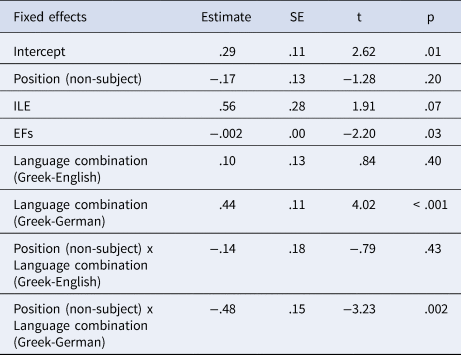
First, we consider the results of the LME-analysis for overspecified full nouns as produced by children who are Greek-dominant. Table 2 shows a main effect of EFs: greater EF-skills lead to the production of less overspecified full nouns (as reflected by the negative estimate). Greek–German bilinguals produce a significantly greater amount of overspecified full nouns in subject position than Greek–Albanian children (positive estimate), while Greek–English and Greek–Albanian children do not differ in this respect. We also found a significant Position x Language Combination (Greek–Albanian vs. Greek–German) interaction: while Greek–German children produce more full nouns in subject position than Greek–Albanian children, the two groups do not differ in the production of overspecified full nouns in non-subject position. This was also confirmed by a pairwise comparison between the production of overspecified full nouns in non-subject position by Greek–Albanian and Greek–German children (β = .04, SE = .11, t = .36, p = .98). Finally, the anova analysis comparing the model reported in Table 2 with a model comprising the interaction between ILE and EFs shows that the interaction between ILE and EFs does not affect the production of overspecified full nouns (χ2(1) = .18, p = .66).
Parameters of the linear mixed effects analysis concerning the production of overspecified full nouns in subject or non-subject position by children that are dominant in Greek. The fixed effects, their estimates, standard errors (SE), t-scores and p-values are given.

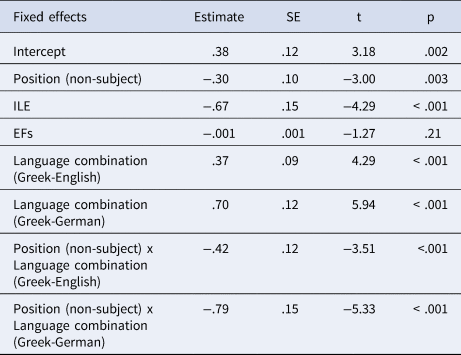
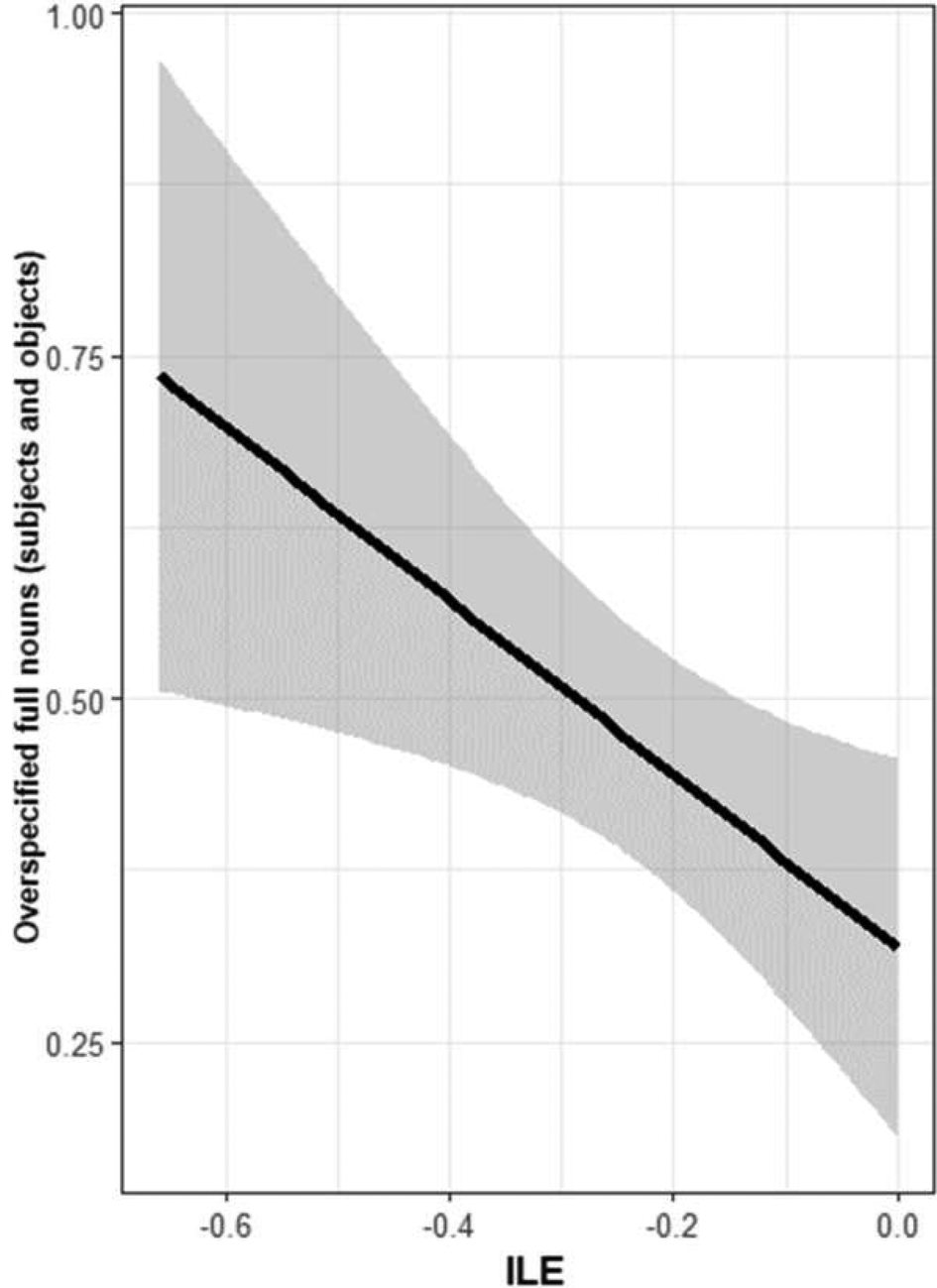
Table 3 reports the results of the LME-analysis for overspecified full nouns as produced by children that are dominant in Albanian, English or German. We found a main effect of ILE, with less overspecified full nouns being produced under higher ILEs (negative estimate). Figure 1 shows how ILE motivates variation in the amount of produced overspecified full nouns (in both subject and non-subject position). The significant lower-order effect of syntactic position reveals that Greek–Albanian bilingual children produce less overspecified full nouns in non-subject than subject position. The analysis reveals also a significant Position x Language Combination interaction: while Greek–English and Greek–German children produced a greater amount of overspecified full nouns in subject position than Greek–Albanian children (as shown by the positive estimate corresponding to “Language Combination (Greek–English)” and “Language Combination (Greek–German)”), they do not differ from Greek–Albanian children in the amount of overspecified full nouns produced in non-subject position, as also revealed by pairwise comparisons (Greek–Albanian vs. Greek–English: β = .05, SE = .09, t = .54, p = .99; Greek–Albanian vs. Greek–German: β = .09, SE = .12, t = .81, p = .96). Finally, the anova-analysis comparing the model reported in Table 3 with a model comprising the interaction between ILE and EFs shows that the interaction between ILE and EFs does not affect the production of overspecified full nouns (χ2(1) = 1.53, p = .21).
Parameters of the linear mixed effects analysis concerning the production of overspecified full nouns in subject or non-subject position by children that are dominant in Albanian, English or German. The fixed effects, their estimates, standard errors (SE), t-scores and p-values are given.

Linear regression line related to the effect of language experience (ILE in the x-axis) on the production of overspecified full nouns (in the y-axis) in subject and object position. The figure concerns the children that are dominant in Albanian, English or German. Lower levels of ILE (on the left-side of the figure) indicate higher degrees of dominance.

The production of overspecified full pronouns
The analysis related to the production of overspecified full pronouns did not reveal any significant effect. It is reported in S8 (Supplementary Material).
The production of underspecified pronouns
For underspecified pronouns (null-subjects and clitics), we conducted the same LME-analysis as with overspecified REs. Here, the variable ‘syntactic position’ coincides with the variable ‘type of referring expression’, since null-subjects can appear only in subject position and clitics only in non-subject position. We will conduct this analysis with both Greek-dominant children and children who are dominant in the other language. The analysis is based on the normalized frequencies of underspecified pronouns.
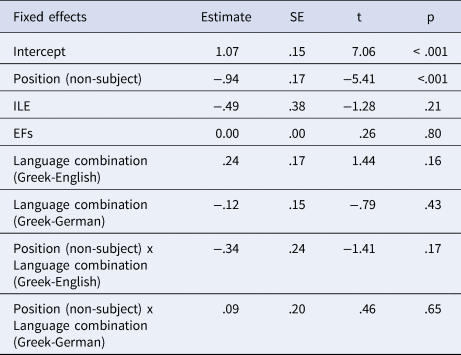
The results of the LME-analysis for underspecified pronouns produced by children who are Greek-dominant shows that no effect is significant, except for the lower-order effect of Position, as indicated in Table 4. This indicates that Greek–Albanian children produce less underspecified REs in non-subject position as compared to subject position. Pairwise comparisons show that this holds for Greek–English and Greek–German children, too (comparison between underspecified forms in subject vs. non-subject position for Greek–English children: β = 1.27, SE = .16, t = 7.80, p < .001; for Greek–German children: β = .85, SE = .10, t = 8.64, p < .001). Furthermore, the anova-analysis comparing the model reported in Table 4 with a model comprising the interaction between ILE and EFs shows that the interaction between ILE and EFs does not affect the production of underspecified pronouns (χ2(1) = .42, p = .52).
Parameters of the linear mixed effects analysis concerning the production of underspecified pronouns (null subjects and clitics) by children that are dominant in Greek. The fixed effects, their estimates, standard errors (SE), t-scores and p-values are given.

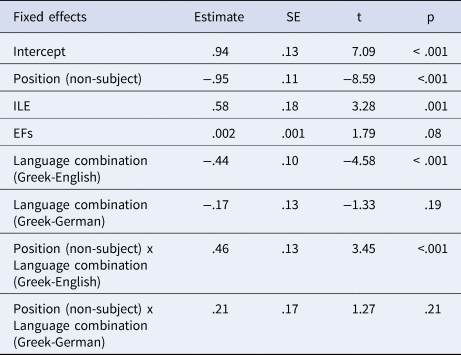
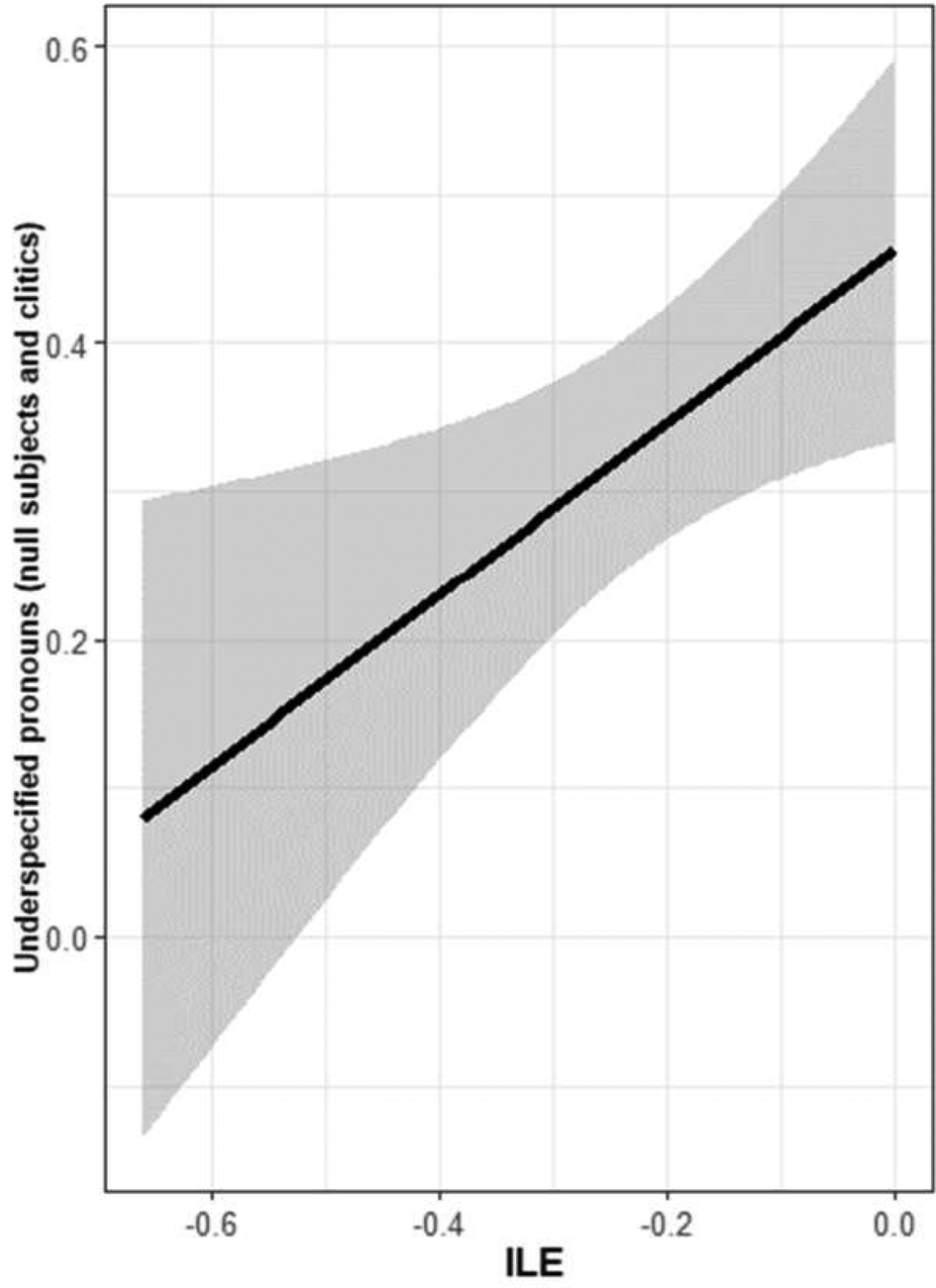
In Table 5, we report the results of the LME-analysis for underspecified pronouns produced by children who are dominant in the other language. The results show a main effect of ILE: as indicated by the positive estimate, children tend to produce more underspecified pronouns under higher levels of ILE (i.e., the closer they are to the value ‘0’). Figure 2 shows how ILE motivates variation in the production of underspecified pronouns. The significant lower-order effect of syntactic position reveals that Greek–Albanian bilingual children produce less underspecified pronouns in non-subject than subject position. Greek–English bilinguals produce a significantly lower amount of underspecified pronouns in subject position than Greek–Albanian children (negative estimate). On the contrary, Greek–German and Greek–Albanian children do not differ from each other in the production of underspecified pronouns in subject positionFootnote 3. We also found a significant Position x Language Combination (Greek–Albanian vs. Greek–English) interaction: the two groups differ from each other only in the production of underspecified pronouns in subject position (and not in the production of underspecified pronouns in non-subject position, i.e., clitics). This is also confirmed by a pairwise comparison between the production of underspecified pronouns in non-subject position by Greek–Albanian and Greek–English children (β = −.02, SE = .09, t = −.02, p = .99). Finally, the anova analysis comparing the model reported in Table 5 with a model comprising the interaction between ILE and EFs shows that the interaction between ILE and EFs does not affect the production of underspecified pronouns (χ2(1) = 1.79, p = .18).
Parameters of the linear mixed effects analysis concerning the production of underspecified pronouns (null subjects and clitics) by children that are dominant in Albanian, English or German. The fixed effects, their estimates, standard errors (SE), t-scores and p-values are given.

Linear regression lines related to the effect of language experience (ILE in the x-axis) on the production of underspecified pronouns (in the y-axis) in subject and object position (i.e., null subjects and clitics, respectively). The figure concerns the children that are dominant in Albanian, English or German. Lower levels of ILE (on the left-side of the figure) indicate higher degrees of dominance.

Discussion and conclusive remarks
The aim of this study was to understand which factors motivate variation in reference production among bilingual children, by looking at the triangulation between degrees of language experience, cross-linguistic effects and EF-skills.
The results highlight the significant role played by language experience in determining bilingual patterns of reference use. Consistent with the hypotheses of the study, bilingual reference use differed depending on whether the children were more or less dominant in Greek or the non-target language. The production of overspecified full nouns is correlated with lower levels of language experience in the target language (Table 3 and Figure 1). The use of full nouns in reference maintenance contexts (where a null or a clitic would be more appropriate) has been already identified as an L2/bilingual pattern of reference use (e.g., Ryan, Reference Ryan2015). The present study adds to previous literature by establishing a strong connection between use of overspecified full nouns and language experience: the production of overspecified full nouns in Greek is predicted by the degree of dominance of experience in the other language (Albanian, English or German). This finding sheds some new light on the mechanisms involved in the use of overspecified full nouns by bilingual speakers. Overspecification seems to be the expected ‘automatic’ outcome, if – under reduced degrees of language experience – the proceduralization of the grammatical options for reference available in the language (i.e., null-subjects and clitics in Greek) is not in place (DeKeyser, Reference DeKeyser2007 on the connection between proceduralized language knowledge and language experience)Footnote 4. Furthermore, the effects of language experience on the production of overspecified full nouns is modulated by the type of language combination, being more visible among Greek–English and Greek–German children than Greek–Albanian children. In other words, the presence of null-subjects in Albanian may play a facilitating role in the proceduralization of the grammatical knowledge related to null-subjects in Greek. The same conclusion cannot be drawn for overspecified full nouns in non-subject position (as produced instead of clitics), since the three language combinations do not differ from each other in this respect: the presence of clitics in Albanian does not seem to have the same facilitating role in clitic production in Greek as observed with null-subjects. This may be because the clitic system in Albanian is less complex than the Greek one, since it lacks gender distinctions (see above). In this sense, our interpretation is in line with some studies showing that positive cross-linguistic influence tends to take place from the more complex system (Greek, in this case) to the less complex one (Albanian), and not vice versa (Liceras et al., Reference Liceras, Fernández Fuertes and Alba de la Fuente2012). However, our considerations related to the production of full nouns in non-subject position should be taken with caution, since the amount of full nouns produced in non-subject position is significantly lower than the amount of full nouns in subject position (lower-order effect of position in Table 3). Furthermore, it should be noted that among the three language-combination groups, Greek–German bilinguals show the greatest tendency to produce overspecified full nouns in subject position, which is observable both among the children dominant in Greek and in the other language, respectively. The production of null-subjects relies on a full mastery of the inflectional system for encoding person agreement. We propose that, among Greek–German bilinguals, the proceduralization of this morphological knowledge in Greek is modulated by the complexity of the inflectional morphology of the two languages in contact (as compared to simpler systems like English). In both languages (Greek and German), all finite verbs are inflected for three persons and two numbers, which may generate a relatively high competition between forms, both within and across languages (Trenkic et al., Reference Trenkic, Mirkovic and Altmann2014 on a similar view on competition). Thus, this cross-linguistic effect occurs independently of children's dominance in one or the other language. The independence of cross-linguistic effects from bilingual children's dominance is consistent with what has been observed in other studies (e.g., Hsin et al., Reference Hsin, Legendre, Omaki, Baiz, Goldman and Hawkes2013).
Language experience motivates variation in the use of underspecified REs, too. Among the bilinguals whose language experience is dominant in the non-target languages (i.e., whose values of ILE are below 0), the more balanced were the children in their language experience, the more underspecified forms they produced (Table 5 and Figure 2). Underspecification has been already identified as a bilingual pattern of reference production (Montrul, Reference Montrul2004) and shown to depend on reduced speed in lexical retrieval (Torregrossa et al., Reference Torregrossa, Bongartz and Tsimpli2019). In particular, Torregrossa et al. (Reference Torregrossa, Bongartz and Tsimpli2019) deal with balanced bilinguals, which is compatible with the correlation between higher levels of balance (in language experience) across the two languages and production of underspecified forms as observed in the present study. Unlike bilinguals with dominant experience in the non-target language, more balanced bilinguals are likely to have developed a faster and more efficient proceduralization of grammatical knowledge and, thus, to be able to rely more consistently on the syntactic options for reference available in the language (null-subjects and clitics). The tendency to use underspecified REs is only visible among the children below the value 0 of language experience (dominant in the other language, albeit the most balanced ones in this group)Footnote 5. In other words, while children's higher degrees of balance are associated with the proceduralization of the syntactic options for reference, their overuse of these forms could be interpreted as an effect of dominance in the non-target language, probably due to a developing mastery of the discourse conditions of null-subjects in the target language.
Therefore, our results show that language experience plays a crucial role in bilingual reference use, motivating variation in the production of overspecified full nouns and underspecified null-subjects among children that are below the value ‘0’ for ILE, which corresponds to a hypothetical perfectly balanced bilingual. In particular, the more dominant are the children in the non-target language, the greater their tendency to overspecify is. On the contrary, the more balanced are the children across their two languages, the greater their tendency to underspecify is. Furthermore, we found the effect of language experience on the production of overspecified form to be modulated by the type of language combination. Based on the results of previous studies, we expected cross-linguistic effects to be visible in the overuse of overspecified full pronouns (instead of clitics and null-subjects), too, especially among Greek–English and Greek–German bilinguals. However, our results show a different trend as compared to previous studies, since we noticed that the production of overt pronouns is quite limited throughout our corpus of narratives (Tables S6 and S7, Supplementary Material). Due to the limited number of observations, the analysis related to the production of overspecified full pronouns does not reveal any significant result.
Our analysis has also investigated how bilingual reference production is affected by bilingual children's EF-skills. Bilingual children with lower EFs tend to produce a greater number of overspecified REs. In particular, we found this effect among Greek-dominant children (Table 2). This result suggests that low EFs lead to difficulties in discourse integration, as claimed above. Under this account, we expect low EFs to give rise to overspecification regardless of bilingualism. Bilingualism may aggravate processing issues that are also experienced by monolingual children (Sorace, Reference Sorace and Valore2011). One may wonder why the effect of low EF-skills on reference production is not visible among the children who are dominant in the other language (Table 3). Although in this group, we observed the same tendency as in the group of Greek-dominant children (with lower EF-skills leading to the production of a greater amount of full nouns, as revealed by the negative estimate), the results of the former group did not reach significance. It seems that, in this group, the effects of EF-skills are overshadowed by the effects of language exposure, given that dominant experience in the non-target language leads to the same outcome in terms of reference use as low EF-skills, i.e., production of overspecified full nouns. In other words, the more dominant are the children in the non-target language, the greater their tendency to produce overspecified full nouns is, regardless of their EF-skills. Finally, it should be pointed out that we did not observe any correlation between (low) EF-skills and production of underspecified REs (Tables 4 and 5). Previous studies have shown that the production of underspecified REs is a consequence of reduced WM-capacity (e.g., Hendriks et al., Reference Hendriks, Koster and Hoeks2014). Taken together, these results suggest that different components of EFs (WM and updating) are in charge of different cognitive operations underlying reference tracking.
While EFs and language experience have been shown to affect, in one way or another, reference production by bilingual children, we found that the interaction between these two variables does not contribute to the model in any significant manner. Given that previous studies have shown that variation in language exposure motivates variation in EF-skills (with more balanced children showing an advantage in EFs; De Cat et al., Reference De Cat, Gusnanto and Serratrice2018), we expected the effects of EFs on bilingual reference production to differ depending on whether the children were more or less balanced. However, the fact that we did not find any effect of the interaction between language experience and EFs on reference use may be because in the group of children considered here, we did not observe any advantage in EFs as motivated by language experience. It should be considered that De Cat et al. (Reference De Cat, Gusnanto and Serratrice2018) deal with younger children than the ones considered in this study. In the age range considered here, unbalanced bilinguals might well have caught up with their balanced peers. More in general, the literature is not consistent in showing that there is a correlation between certain types of language experience and advantages in EFs (Paap, Johnson & Sawi, Reference Paap, Johnson and Sawi2014).
By taking into account the triangulation between EFs, language experience and cross-linguistic structures, we identified the contribution of each variable to specific patterns of reference use. In particular, we placed particular emphasis on the assessment of individual variation in language outcomes, by developing a fine-grained analysis related to the conditions of use of REs in discourse. Furthermore, we identified the sources of this individual variation by relying on a continuous index of language experience and proficiency as coupled with a measure of the individual performance on cognitive tests. Our analysis can be extended beyond the study of bilingual language outcomes and used to model individual variation in reference production in view of the different factors that may affect this variation.
Supplementary material
For supplementary material accompanying this paper, visit https://doi.org/10.1017/S1366728920000826
Table S1. Hours of teaching dedicated to each language
Table S2. Multiple linear regression model with difference in vocabulary scores as dependent variable
Table S3. Language experience for each language combination by dominance in Greek or in the other language (Albanian, English, German)
Table S4. Example of coding of referring expressions
S5. Appendix I. Identification of overspecified and underspecified referring expressions based on grammatical and discourse features of the associated referents
Table S6. Raw frequencies and means (per child) of full nouns (full DPs), nulls, clitics and full pronouns (PRONs) occurring in the Greek narratives
Table S7. Raw frequencies and means (per child) of overspecified full nouns (full DPs), overspecified full pronouns (PRONs), underspecified nulls and underspecified clitics occurring in the Greek narratives
S8: Linear model of the factors affecting the production of overspecified full pronouns among children dominant in Greek and in the other language
Acknowledgements
This research has been funded by the Collaborative Center CRC 1252 “Prominence in Language” (Research project “Reference management in bilingual narratives”, PIs: Christiane Bongartz & Jacopo Torregrossa), the THALES Project (Bilingual Acquisition and Bilingual Education: The Development of Linguistic and Cognitive Abilities in Different Types of Bilingualism, PI: Ianthi Tsimpli) and the CoLiBi Project (Cognition, Literacy and Bilingualism in Greek–German speaking children (PIs: Christiane Bongartz & Ianthi Tsimpli). We are really grateful to the schools for their support during the experiments, the children for their enthusiasm in taking part to the experiment and their parents for their great collaboration.