The arts of the colonial Andes bear witness to a complex and contested story of evangelization that involved a variety of actors, including priests, artists, indigenous congregations, and confraternities. Sculptures of saints, sumptuous retablos (altarpieces), canvas paintings with elaborate gilded frames, and mural cycles devoted to a variety of biblical themes were employed in the religious instruction of indigenous communities, and as catalysts for sensorial modes of communication. The visual arts provided a tangible analogue to sermons and printed catechisms, offering parishioners a lens through which to envision the sacred. Adapted from European iconographic models and infused with local references and symbolism, religious art throughout the colonial Americas introduced new visual vocabularies to indigenous congregations, who quickly became conversant in these images of conversion.
A number of scholars have elaborated on the critical roles of priests, bishops, indigenous elites, and private patrons in commissioning religious artwork and the selection of specific themes to appeal to local viewers.Footnote 1 One aspect of artistic production and patronage that has received less attention, however, is the role of artists as intermediaries in the articulation of localized forms of Christianity.Footnote 2 In the Andean context, the question of artistic intent is a murky area of inquiry that remains nearly impossible to substantiate. While contracts stipulating the terms of an artistic transaction can enable us to better understand the wishes of a given patron for the way an artwork should appear, little documentation exists that would reveal the preferences or visual strategies of the artists in question. We must rely instead on the images themselves as evidence of the strategic and maneuvers undertaken by the artist to infuse religious images with local meaning. Identifying the source images that informed a given composition can provide a framework for understanding the desires of the patron; for instance, a number of artists’ contracts make reference to drawings or prints that the patron would give to the artist for reference.Footnote 3 Careful analysis of source prints in concert with the final painted product can also reveal the creative latitude that artists exercised to code biblical images with a diverse repertoire of local references.Footnote 4
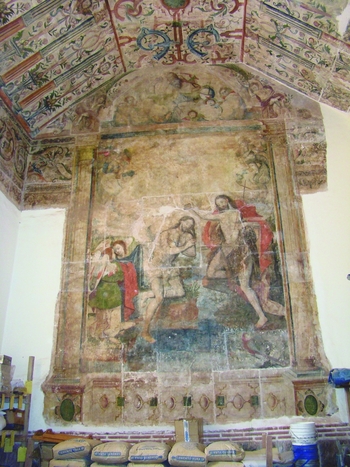
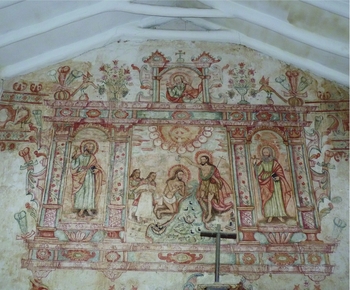
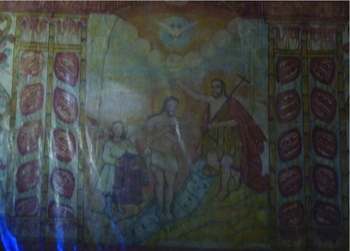
This article will examine two mural paintings of the Baptism of Christ located in Cuzco-area parish churches, and their sources; they are Diego Cusi Guaman's composition at the church of Urcos (ca. 1630s) and Pablo Gamarra's mural at the church of Pitumarca (1777). The two paintings are shown in Figures 1 and 2.
Diego Cusi Guaman, Baptism of Christ, Mural Painting, Church of Santiago Apóstol de Urcos, ca 1630s
Source: Photo courtesy of Jaime Chino Huanca. Reprinted with permission.

Pablo Gamarra, Baptism of Christ, Mural Painting, Church of San Juan Bautista de Pitumarca, 1777
Source: Photo by author.

Conceived more than a century apart but connected through their mutual reliance on a sixteenth-century source print, these murals offer a compelling case study of the diverse pictorial strategies that artists undertook in their efforts to produce religious images that would resonate with local viewers. By virtue of their fixity in architectural space, the two murals under consideration embodied local identities and religiosities in ways unparalleled by mobile forms of art such as sculptures or oil paintings. This comparative approach will allow us to chart the broad shifts that occurred in mural painting from the seventeenth to eighteenth centuries, through a focused analysis of Baptism of Christ imagery and its various permutations across Europe and the Andes, by way of a 1582 source engraving by the Flemish printmaker Pieter Perret (1555–1639). By tracing the transformation of one specific genre of religious imagery through time, we can gain a focused perspective on how muralists produced increasingly provocative compositions that drew liberally from European prototypes while also tapping into alternative repositories of knowledge, whether by referencing local landscapes or by conflating Christian and Inca stories of origin. This article also calls for a closer consideration of the ways in which Andean artists became brokers between the church and their constituent communities through their careful mediation of images and the palpable visual imaginaries they engendered.
As the most important sacramental rite of admission into the Catholic Church, baptism held special resonance in colonial Latin America. Priests administered baptisms en masse during the early stages of colonization to admit indigenous Andeans of all ages into the faith. Baptism marked the first symbolic step in the “spiritual conquest” of Peru, and as such, took on enhanced relevance as a symbol of the territory's transition from a pre-Columbian, pagan empire to a Christian viceroyalty. Artistic renditions of the sacrament of Baptism played a crucial role in the evangelization of indigenous communities, offering didactic visual aids to supplement sermons and religious texts. Paintings of the Baptism of Christ, typically located in the baptistery of the church, were of particular importance as backdrops for the performance of this induction into Christian life. Christ's baptism served as the ultimate model to which indigenous neophytes could aspire, owing to the proliferation of artistic representations of this biblical event throughout the Peruvian viceroyalty.
Diego Cusi Guaman's Baptism of Christ at the church of Santiago Apóstol de Urcos and Pablo Gamarra's mural of the same subject at the church San Miguel Arcángel de Pitumarca are located in Cuzco's rural provinces of Quispicanchi and Canchis, respectively. Close examination of their iconographical interconnections through the migration of artists and prints along transatlantic networks will facilitate a nuanced comprehension of both their adherence to and departures from the visual prototypes that informed their inception. The use of color and local iconography in each of the paintings reveals the efforts undertaken by Andean artists to conflate the Jordan River with local bodies of water that carried great historical significance and symbolic weight for local parishioners. In effect, these artists played an intermediary role in situating European religious imagery within Andean visual languages through subtle recourse to local regimes of knowledge and historical memory. The layered meanings projected onto Christ's baptism reveal both the degree to which Catholicism became “Andeanized” and the potential of sacred images to articulate community values and collective histories that extend far beyond their traditional parameters of meaning.
DIEGO CUSI GUAMAN AND PABLO GAMARRA
Diego Cusi Guaman (also spelled Cusihuaman) was an indigenous painter who worked throughout Cuzco in the first few decades of the seventeenth century.Footnote 5 He was most likely a member of the indigenous elite, given the fact that he ranked as a master painter at such an early date. Cusi Guaman's use of Latin in the signature accompanying his mural of the Baptism of Christ at Urcos, which reads “Don do. Cusi Guaman Me Fecit,” further indicates access to a formal education. His use of the honorific “don” also suggests elevated status. Indeed, Diego Cusi Guaman is the earliest known indigenous painter of the Cuzco region to include his signature in a painting.Footnote 6 Little documentation has been found on this seventeenth-century painter, but a document housed in the Archivo General de Indias in Seville references another don Diego Cusihuaman, “indio noble” and “Alférez Real de los yndios del Cusco” (Indian noble and royal ensign of the Indians of Cusco) who petitioned for special privileges in 1791 in return for his active service during the Tupac Amaru rebellion.Footnote 7 Other Cusihuamanes populate the historical record, including a don Cristóbal Cusi Guaman, the first alcalde of the parish of San Sebastián (1561) and don Cristóbal Cusi Guaman (perhaps the same individual), a descendant of Capac Yupanqui, of the Apomayta ayllu (1584).Footnote 8 Given the fact that Cusihuaman was a relatively common surname in colonial Cuzco, as were the separate surnames “Cusi” and “Guaman,” we cannot assume blood relations with the painter, although the possibility certainly exists.
The church of Santiago Apóstol de Urcos was likely founded in the last quarter of the sixteenth century.Footnote 9 The exterior of the church consists of a triple-arched narthex and balcony constructed entirely of brick.Footnote 10 While most of the interior decorations were destroyed in a fire in the early twentieth century, a description of the church provided in a 1788 inventory suggests that it was once richly decorated with mural paintings: “the entire church is painted, the ceiling is painted with gesso and the body [of the church] is painted in the form of [textile] hangings [colgaduras].”Footnote 11 Cusi Guaman's baptistery painting is all that remains from a once-extensive mural program that probably extended into the nave and sotacoro (area beneath the choir).Footnote 12
If little is known about the enigmatic career of Diego Cusi Guaman, even less is known about Pablo Gamarra.Footnote 13 The account book for the church of Pitumarca verifies the late date of his baptistery mural. Parish priest Antonio Joseph Villavicencio noted that in 1777, “I bought three large, thick sticks that cost a peso each to re-roof the Baptistery that collapsed. I did not spend anything on the roofing because the people did it, and it's ridiculous what I gave them for their coca to plaster and whitewash it. I paid the mason for eight days at three reales per day, which amounts to six pesos.”Footnote 14 This detail speaks to the rituals of reciprocity in the doctrinas de indios (Indian parishes) as part of their mita (forced rotational labor) responsibilities or their trabajos de república; the indigenous community members received coca leaves in exchange for their labor for the church, however begrudgingly this exchange was carried out. This ultimately demonstrates the degree of control that artists and community members wielded in the maintenance and appearance of their spaces of worship.Footnote 15 In the following entry in the account book, Villavicencio states, “In returning to paint [the baptistery], the Painter brought colors and [extra] hands, [which cost] twenty-five pesos.”Footnote 16 Although he does not mention the identity of the painter in this particular entry, we know from a previous page that his name was don Pablo Gamarra.Footnote 17 The account book entry from 1777 verifies that Gamarra almost certainly painted the baptism image we see today, as its style, color palette, and use of indigenous references all resonate with a late eighteenth-century Andean aesthetic tradition. Furthermore, no additional entries mentioning the baptistery exist in the inventory or account books, which extend to 1784.
Pitumarca is in the northwestern corner of the province of Canchis, surrounded to the south and east by the towns of Checacupe and Combapata.Footnote 18 Situated about 50 miles south of Cuzco, Pitumarca was relatively isolated from the city and its immediate orbit of doctrinas (territories established for Christian evangelization).Footnote 19 Urcos, on the other hand, is favorably located along the main thoroughfare that connected Cuzco to Lake Titicaca, situated less than 30 miles southeast of the city. Despite the large temporal and geographical distance separating them, Cusi Guaman and Gamarra's murals are closely interlinked through a chain of engravings and paintings of the same subject, as we will see below.
VECTORS OF TRANSMISSION: EUROPEAN PRINTS AND ANDEAN PAINTINGS
The murals of Urcos and Pitumarca are rooted in a web of visual sources that played a vital role in their inception. European prints, local paintings on canvas, and pre-existing mural paintings left an indelible mark on these mural compositions, through a number of different channels. In the absence of archival documentation that would afford a secure mapping of correspondences between murals and their various sources, we must instead harness the tools of visual analysis to hypothesize how images might have circulated through time, space, and media. These murals present the opportunity for an exceptionally rich and complex case study due to the proliferation of images of Christ's baptism throughout the Cuzco artistic circuit during the seventeenth and eighteenth centuries.
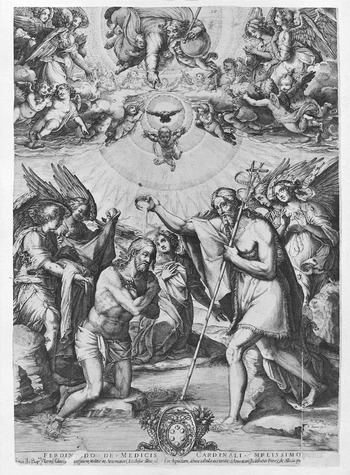
The visual construction of Christ's baptism at the churches of Urcos and Pitumarca begins with a copperplate engraving by Pieter Perret entitled Baptism of Christ from 1582 (Figure 3).
Pieter Perret, Baptism of Christ, Engraving after Mateo Pérez de Alesio's Painting at the Valetta Cathedral, Malta, 1582
Source: Istituto Nazionale per la Grafica, courtesy of the Ministero dei Beni e le Attività Culturali e del Turismo, Rome.

This source print stands as a testament to the dynamic transatlantic dialogues involved in the production and circulation of images across the colonial Americas. In 1580, Mateo Pérez de Alesio, an Italian painter who would eventually embark on a career in the viceroyalty of Peru, commissioned Perret to produce a series of engravings based on his paintings in Malta, where he was stationed in the years leading up to his journey to the New World. The Italian painter produced an enormous body of work there, including a mural cycle at the Palace of the Grand Masters in Valetta completed in 1565, which depicted scenes from the Siege of Malta by the Ottoman Turks.Footnote 20 Perret's 1582 print is a direct copy of Pérez de Alesio's Baptism of Christ, a canvas painting originally displayed on the high altar of St. John's Cathedral in Valetta, Malta, around 1577–1579.Footnote 21 Pérez de Alesio dedicated the image to Cardinal Ferdinando de’ Medici, as stated in the inscription at the bottom of the print, along with a declaration that he was responsible for producing an accurate drawing on the copper plate.Footnote 22 Perret's print may have been brought to Peru by Pérez de Alesio himself, who arrived in Lima at some point between 1588 and 1590.Footnote 23 In an alternate scenario, it is perhaps an interesting twist of fate that the Spanish monopoly on the Antwerp export market facilitated the arrival of a northern European copy of an Italian émigré's artwork in Malta to grace the walls of Peruvian churches.
Perret's Baptism of Christ provides the basic compositional format for the baptism murals of Urcos and Pitumarca. All three images feature a supplicating Christ receiving the baptism from St. John, who holds a cross with his left hand while pouring the baptismal water over Christ's head with his right. Christ's arms are crossed over his chest, and he wears nothing but a short loincloth knotted across the front. Of the two murals, Diego Cusi Guaman's painting more closely resembles Perret's print in its depiction of Christ. Both the painting and the print show him kneeling on a flat stone with arms crossed and his back slightly hunched forward on a slight diagonal axis that complements St. John the Baptist's tilted stance, the whole forming a strong compositional triangulation that converges in the depiction of God the Father at the top. Christ's right knee hovers just above the rock, with his foot wading in the shallow waters next to it.
Whereas Cusi Guaman's composition exhibits clear visual parallels with Perret's print, particularly in his rendering of Christ, Gamarra's mural bears more diffuse connections to the Perret prototype. Affinities between the two images can be found in St. John the Baptist's lunging stance, the faces of the two principal figures, and the stylized depiction of the sun's rays with the Holy Spirit at the center. In contrast to Cusi Guaman's mural, however, Gamarra's painting bears evidence of visual paraphrasing rather than direct copying, a point to which we will return shortly. Cusi Guaman and Gamarra's murals pare down the composition to its most essential elements; gone are the legions of angels surrounding and hovering over the scene. While Perret's print incorporates about twenty-three angels into the composition, both Cusi Guaman and Gamarra give the principal figures ample “breathing room” with emphasis placed only on the two figures standing behind Christ who hold garments with which to clothe him once the baptism is completed. Angels appear only in the upper portion of Cusi Guaman's mural and do not appear at all in Gamarra's composition.
Artists throughout colonial Latin America, particularly in the sixteenth and early seventeenth centuries, were expected to produce uncluttered religious images that communicated biblical narratives in a clear and accessible visual language.Footnote 24 Paintings participated in an overlapping evangelizing discourse that encompassed a variety of media; they could act as both substitutes and supplements for the written word, capitalizing on the ability of indigenous congregations to comprehend divinity through a tightly honed visual literacy. Perret's print offers the closest known compositional match for the murals. A close comparative analysis, however, reveals a number of departures from the Perret prototype. The next section examines additional image sources that played a role in their inception.
A number of canvas paintings of Christ's baptism produced in the Cuzco region place the Urcos and Pitumarca murals within a broader intervisual dialogue. Mateo Pérez de Alesio's colleague Bernardo Bitti produced a painting of the same subject for the church of San Juan de Juli near Lake Titicaca; it dates to the late sixteenth century and originally served as the central image of the main retablo of the church.Footnote 25 Bitti may have also consulted Perret's print of Pérez de Alesio's Malta composition, although there exist a number of differences to suggest that he utilized other models as well. Based on stylistic affinities, José de Mesa and Teresa Gisbert argue that Diego Cusi Guaman served as an assistant to Bitti in Juli before returning to Cuzco in the early seventeenth century.Footnote 26 The geometricized folds of St. John's cloak in Cusi Guaman's image pay direct homage to Bitti, suggesting that he was exposed to Bitti's painting either directly or through a drawn copy.Footnote 27 While the absence of clear documentary evidence makes it difficult to reconstruct Cusi Guaman's little-known career with much specificity, we can at least deduce that he and Bitti operated within overlapping artistic circles at the turn of the seventeenth century.Footnote 28
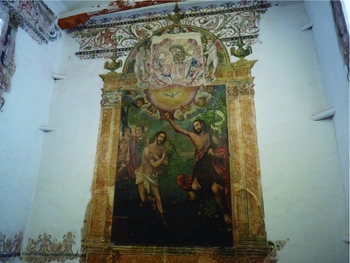
Despite their stylistic and compositional similarities, Cusi Guaman's access to Bitti's original painting in far-flung Juli proves difficult to substantiate in the absence of archival documentation to support this connection. Nevertheless, it is almost certain that he came into contact with Luis de Riaño's signed and dated Baptism of Christ (1626), located in the baptistery of the church of Andahuaylillas. It is shown in Figure 4.
Luis de Riaño, Baptism of Christ, Oil on Canvas, Church of Andahuaylillas, 1626
Source: Photo by author.

Luis de Riaño trained under the Italian émigré painter Angelino Medoro in Lima before embarking on an artistic career in the Cuzco region in the 1620s.Footnote 29 The most striking similarity between Diego Cusi Guaman's mural and Riaño's canvas is the depiction of St. John in an open stance with his right knee resting on a log. This compositional detail bears no correlation whatsoever with Perret's print or Bitti's painting. We can therefore postulate that Cusi Guaman modeled his mural in part from Riaño's painting, thus giving it a post-1626 date.Footnote 30 Another important element linking these images can be found not within the compositions themselves, but rather in the frames that delineate them. Riaño's canvas is set between two double pilasters topped with Corinthian capitals painted directly on the wall to imitate architectural detailing. The painting and the elaborate trompe l’oeil frame that surrounds it serve as an ideal backdrop for the baptismal font, which is situated at the exact midpoint of the composition. The baptistery mural at the church of Urcos features a similar layout. Diego Cusi Guaman painted the scene at the center of the facing wall of the baptistery, making it the first image one sees upon entering the room. Two columns flank the scene of the baptism of Christ—a simplification of the double pilasters found in Andahuaylillas. As at Andahuaylillas, a decorative frieze extends from both sides of the painting of the baptism, covering the entire upper portion of the wall up to the ceiling with repeating columns, strapwork, and cornucopia inspired by a seventeenth-century print by the Flemish architect Hans Vredeman de Vries.Footnote 31
Diego Cusi Guaman departs from Riaño's model, however, by transforming the canvas and frame into a single orchestrated piece, rendered in tempera applied directly to the surface of the wall. The shift from canvas to mural for depicting Christ's baptism was of no small consequence. Perhaps the most obvious explanation lies in the fact that murals served as inexpensive alternatives for the priests or cofradías (lay brotherhoods) that commissioned them. Paintings on canvas garnered higher prices than murals, despite the fact that mural paintings were often much larger in scale.Footnote 32 But this shift also demonstrates a growing aesthetic preference for murals in Cuzco-area churches. Diego Cusi Guaman's work set an important precedent for the deployment of the muralism to replace canvas paintings, architectural details, and even whole retablos.Footnote 33 Abundant examples can be found throughout the Cuzco region, as at the churches of Oropesa, Chinchero, and Sangarará. Generally speaking, mural paintings tended to proliferate in rural, indigenous-dominant spaces whereas canvas paintings reigned supreme in metropolitan centers. There exists a temporal division as well. While vestiges of mural paintings dating to the late sixteenth and early seventeenth century can be found in a number of colonial churches and administrative buildings in cities throughout the Peruvian viceroyalty, they were eventually replaced by framed paintings, which garnered greater prestige and connoted a certain cosmopolitanism. This was not always the case for rural districts, where murals continued to serve as a vital artistic medium well into the nineteenth century.Footnote 34 It may thus come as no surprise that Pablo Gamarra's mural was inspired not only by Perret's print, but also by other murals depicting the Baptism of Christ throughout Cuzco's southern provinces.
Pablo Gamarra's Baptism of Christ at the church of Pitumarca exhibits an almost complete departure from European print culture. The flattened composition disavows any attempt at illusionistic, perspectival space. The figures lack the Mannerist-inflected, elongated human forms found in earlier images of the same subject, while the idiosyncratic rendering of the Jordan River filled with fishermen and aquatic life bears no relationship to Perret's rather mundane treatment of water. The mural carries an evanescent quality that differs substantially from the dark, shadowy image produced by Diego Cusi Guaman. Nonetheless, the image draws loosely from the compositional dictates provided by Perret's print, indicating that Gamarra likely possessed a copy of the print from which he adopted the basic pictorial schema. Perhaps he had obtained it from the workshop in which he was trained or from the local priest. What is most remarkable is the fact that the same print, regardless of its exact trajectory, informed murals separated in time by over a century. This testifies to the longevity of prints and the great pains taken to conserve (and copy) them for generations after their initial arrival in the Americas. But what distinguishes the Pitumarca mural from earlier images by Bitti, Riaño, and Cusi Guaman is its visual affinity not only with European print culture, but also with contemporaneous murals of Christ's baptism at nearby churches.
The church of San Juan Bautista de Catca (also spelled Ccatca and Ccatcca) contains a mural of Christ's baptism remarkably similar to the Pitumarca image (see Figure 5).
Baptism of Christ, Mural Painting, Church of Catca, ca. 1750
Source: Photo by author.

The Catca mural was painted in the 1750s, about two decades before its Pitumarca counterpart.Footnote 35 Both feature St. John and Christ standing beneath a heavily stylized sunburst, separated by a river filled with fish. They show us a pared-down version of the biblical scene—the Catca composition is reduced to three figures, while the Pitumarca mural contains merely four. In both compositions, the baptism is configured within a larger painted retablo flanked by Solomonic columns. Another eighteenth-century baptistery mural at the nearby church of San Pablo de Ocongate (Figure 6) depicts the Baptism of Christ, also with a great emphasis on the brightly colored Jordan River, sparse composition, and location within a painted retablo.
Baptism of Christ, Mural Painting, Church of Ocongate, Late Eighteenth Century
Source: Photo by author.

The poorly preserved mural retains little of its original detail. Nevertheless, the vestiges that remain reveal a strong affinity with the Pitumarca and Catca murals. Each of the three murals appears to be painted by a distinct hand, but their close geographical and temporal proximity suggests that itinerant artists sought inspiration from neighboring parishes in the creation of their compositions. The Urcos and Pitumarca murals participated in networks of images that extended as far as Antwerp and Malta and as close as neighboring doctrinas scattered throughout the Quispicanchi and Canchis provinces.Footnote 36 The role of the print as a point of origin for these three images of Christ's baptism again demonstrates the diverse trajectories that paintings could take despite their allegiance to the same print source.
The Pitumarca Baptism of Christ, along with its analogues at Catca and Ocongate, reveals a new stage in the development of mural painting in the late colonial period. Muralists of the eighteenth century utterly transformed the print sources on which their predecessors so closely relied. This can partly be attributed to the formation of the Cuzco School of painting in the late seventeenth century, whose origins some scholars have traced to a legal dispute between indigenous and Spanish artists.Footnote 37 Through their participation in the justice system, indigenous artists secured their new position as agents in the administration of their own guilds and as intermediaries in the negotiation of contracts by ecclesiastical and private patrons.
The Cuzco School developed a unique artistic signature characterized by a bright color palette, flattened forms, indigenous symbolism, and a profusion of gold ornament. Cuzco School paintings acquired a palpable “Andeanness” never before seen in Peruvian painting.Footnote 38 The links between the Cuzco School artists specializing in paintings on canvas or panel to those with a specialty in mural painting are still unclear. We can say with certainty, however, that this new wave of artistic activity reverberated across a variety of media, including sculpture, oil painting, and mural painting. Like their colleagues working in oil paint, muralists began to exhibit a preference for flattened and geometricized forms. The figures in the Pitumarca mural, for instance, defy the rules of proportion, scale, and modulation that characterized colonial Andean art for much of the sixteenth and seventeenth centuries. The heavily outlined figures do not give the illusion of three-dimensionality. Moreover, the color palette, dominated by pastel earth tones, bears no relation to the rich coloration of Riaño's or Cusi Guaman's paintings.
Nevertheless, mural paintings of the eighteenth century developed their own visual language that was not fully wedded to the Cuzco School aesthetic. Perhaps most significantly, mural paintings, by virtue of their fixed location within rural churches, tended to contain direct references to local history. Canvases involved a different mode of manufacture in which dozens of relatively standardized paintings were churned out for various patrons, whether religious institutions or private buyers, and then exported to areas as distant as Chile and Argentina.Footnote 39 Mural paintings, on the other hand, were created with their specific locations in mind. Because there was a clear understanding of the painting's ultimate destination, muralists could make more explicit local references that would be easily understood by their intended viewers. By the eighteenth century, mural production ceased to exist as a unidirectional process in which expertise and materials flowed from Europe to Lima to Cuzco, but flowered as a multidirectional enterprise, producing new clusters of artistic activity in areas far beyond metropolitan spheres of influence.
DIEGO CUSI GUAMAN'S BAPTISM OF CHRIST
Having established the complex visual networks and artistic contexts out of which the Urcos and Pitumarca murals were conceived, we can now turn to specific qualities of the images to better understand their relevance to the local communities who viewed them, as well as the mediating role of Andean painters in the production of sacred visual imaginaries. Diego Cusi Guaman's Baptism of Christ, as discussed above, retained a fairly close adherence to the prototypes offered by Perret, Bitti, and Riaño. But as we begin to probe beyond the compositional skeleton of Cusi Guaman's work to consider its color and materiality, the Baptism of Christ emerges as an image deeply embedded in the local geography and historical memory of its seventeenth-century viewers. The interpretation that follows, while by no means definitive or conclusive, suggests new ways of seeing colonial paintings that take into consideration local histories, geographies, and regimes of knowledge to which contemporaries may have had access.
Just two colors dominate Cusi Guaman's composition: bright red and a deep, vibrant blue. Murals of the colonial Andes tend to possess limited color palettes consisting of muted earth tones, given that most of the pigments came from natural soils and minerals found in the local environment. The source of the red tones in Cusi Guaman's mural remains unknown.Footnote 40 They could have derived from local red tierras de colores (colored earth) or from imported mineral and organic pigments such as vermillion, hematite, cochineal, or red lake.Footnote 41 Red serves as an important accent color that creates a strong triangulation between St. John's cloak, the puffed breast of the parrot in the bottom right corner, and the cloak of one of the angels positioned to the left of Christ. The predominance of red in Cusi Guaman's Baptism of Christ may have resonated with the indigenous congregations of Urcos, as it figured strongly in Inca color symbolism. We need only recall the prized mascapaycha (royal Inca red-fringed headdress) to ascertain the political and religious significance of red in Inca aesthetics. Indeed, contemporaneous portraits of the Christ Child depict him wearing a bright red fringe across his forehead as a means of conflating Inca sovereign power with Christian divinity.Footnote 42
Blue also figures prominently in Cusi Guaman's painting. The blue pigment draws the viewer's attention to the scene's most significant symbolic element: the waters of the Jordan River from which Jesus receives the Holy Sacrament. The body of water takes up over half of the picture plane, cascading along the contours of the central figures and receding deep into the background. The subtle tonality in Cusi Guaman's application of blue pigment lends the water an aura of sacredness—a fitting choice for instructing indigenous congregations on the significance of the site in the Christian tradition. Cusi Guaman further accentuates the water with s-shaped waves that begin in the foreground and continue up to Christ's figure. These waves, which we do not find in Riaño's painting or Perret's print, draw our attention to the experiential properties of water. The water's color, movement, and texture take center stage as critical intercessors in the viewing experience. This close attention to the water inevitably places great emphasis on the space between Christ and St. John; that is, the watery surface is not mere negative space, but a constructed space in and of itself.Footnote 43 Christ's right foot does not dip into the water, as we see in Perret's print and Riaño's painting—it hovers instead right above the surface. We witness here Cusi Guaman's assertion of artistic license and agency in his decision to emphasize aspects of Christ's baptism that had no analogue in Perret's print. As art historian Gabriela Siracusano points out, the lack of color inherent in the artists’ print sources opened up new spaces of creativity for them to invent a complex color symbolism that imbued paintings with a culturally specific sacredness.Footnote 44
Access to blue pigments in the seventeenth-century Andes was limited, making Cusi Guaman's extensive use of blue all the more significant. The pigment could have derived from azurite, smalt, or indigo.Footnote 45 Indigo was produced in Nicaragua and Guatemala, where it was then distributed to the rest of the Americas and Europe. Andean artists working in the highland Cuzco region would have received shipments of indigo from Lima or as contraband from Buenos Aires in the eighteenth century.Footnote 46 Smalt came primarily from the region of Saxony, and would have made its long journey to the Americas through Venetian and Spanish traders.Footnote 47
Azurite is a more likely candidate for the source of the blue pigment in Cusi Guaman's painting, as it was locally available in the Andes through the late seventeenth century.Footnote 48 It also possessed deep pre-Hispanic roots; archaeologists have discovered azurite beads in northwestern Argentina as well as in the Inca heartland.Footnote 49 Local minerals served as pigment sources for pre-Columbian murals as well as ceramic and kero designs (flared wooden drinking vessels). In addition to their aesthetic utility, minerals also played an integral role in Andean ritual practice. Pedro de Villagómez, for instance, lists different types of polvos (powders) that were blown into the air at sacrificial sites: binzo, a fine blue powder (most likely azurite); paria, a vermillion-colored powder that came from the mines of Huancavelica; and llacsa, a green powder.Footnote 50 The material essence of polvos positioned them as ideal intercessors between the earthly and spiritual realms. Their ability to dance, disperse, and dissipate into thin air placed them in a liminal space of materiality and immateriality, of solidity and evanescence. Azurite in particular would have occupied a special role in these rituals for its ability to blend into—and effectively become—part of the sky. The transmutative qualities of pigments enabled them to embody a spectrum of material states, endowing the otherwise static image with a dynamic quality.
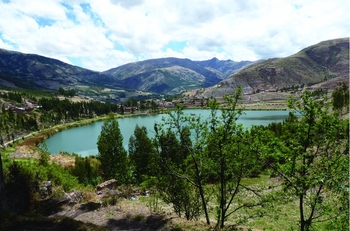
The extensive use of blue to evoke the site of Christ's baptism may also have encouraged viewers to contemplate it in relation to the geography of Urcos itself. A large lake located to the northwest of the town's colonial center serves as the town's most prominent geological feature and pacarina, or ancestral point of origin, for Urcos's inhabitants. It is shown in Figure 7.
Lake Urcos
Source: Photo by author.

Lake Urcos, known locally as Q'oyllur Urmana (roughly, “Place of the Fallen Star”), is located within walking distance from the plaza de armas on which the church of Urcos stands.Footnote 51 Early chronicles mention a 700-foot gold link chain made for Huascar, the half-brother of Atahualpa, who vied for the Inca throne at the time of the Spanish invasion, which was deposited into Lake Urcos toward the end of the Spanish conquest.Footnote 52 Huascar's father, Huayna Capac, had ordered the chain to be made in honor of the birth of his first son and apparent heir to the throne. Agustín de Zárate was the first to mention the famed gold chain in his Historia del descubrimiento y conquista del Perú, published in 1555. In his chapter on the deeds of Huayna Capac, he writes:
At the time of the birth of his first son, Guaynacaua ordered that a rope of gold be made so thick (according to the many living Indians that say so) that more than two hundred Indian nobles [orejones] could not carry it very easily, and in memory of so remarkable a jewel, he named the son Guasca, which in their language means ‘rope.’Footnote 53
“El Inca” Garcilaso de la Vega weaves his own testimony into Zárate's early account, in his seventeenth-century chronicle, Comentarios reales de los Incas. Garcilaso notes that the gold chain was intended to imitate the linked arms of the rows of dancers that performed at royal ceremonies: “The men took one another's hands, but each dancer gave his hand not to the one immediately in front of him but to the next one. They all did this, thus forming a chain.”Footnote 54 Once Huascar found out about Atahualpa's death, he ordered that all of the gold pieces being sent to Cajamarca for his ransom be hidden from the Spaniards. As for the fate of Huascar's golden chain, Garcilaso writes, “This superb and valuable piece was hidden by the Indians with the rest of the treasure which was spirited away as soon as the Spaniards came in, to such purpose that no trace of it has been found.”Footnote 55 He recounts that in 1557 the Spaniards ordered the draining of Lake Urcos in order to find the treasure, but quickly gave up when they encountered bedrock.Footnote 56
If we are to rely on Garcilaso's testimony, we can imagine that such an event would have remained fixed in the minds of local Urqueños and passed down orally as a significant event in the town's history. Local residents would have likely been aware of this story when Cusi Guaman's mural was completed about seven decades after the event. The depiction of the Jordan River, I argue, would have been read through an Urcos-centered geographic lens, not because of any explicit references to Q'oyllur Urmana in the painting, but by virtue of the lake's immediate proximity to the church and its indelible historical significance to local residents.
Questions of historical veracity aside, Diego Cusi Guaman's use of water as a pictorial focal point would have prompted contemporary viewers to draw an association with the nearby lake. Like the Jordan River, Lake Urcos marks a site of legend, religious power, and transformation. It was layered with meanings recalling the bookends of Inca history, from the empire's murky origins to its chaotic and contested capitulation. As the pacarina for the local community, the lake served as both a spatial and temporal marker for the emergence of human life and its descent in the afterlife. In her discussion of the Urcos variant of the Inca origin story as recounted by Cieza de León, Sabine MacCormack writes, “What distinguishes this myth from many others of its kind is the theme of the lake as the place whence the people of Urcos first came and also the place to which their souls returned at death and whence again they set forth for a new life. For the idea that the same place constitutes both beginning and end, origin and destiny, was merely hinted at in other Andean myths.”Footnote 57 The mural's fixity in architectonic space, which, in turn, is rooted in Urqueño social and physical geography, thus facilitates alternate readings of the image in which Christ's baptism is performed right outside the church doors along the shores of the community's auspicious site of origin. Cusi Guaman's pictorial narrative thus does not necessarily correspond with European or Mediterranean landscapes, but rather with Inca historical memory and the cultural and religious identities of local worshipers.
Other aspects of indigenous history and culture that Diego Cusi Guaman integrates into his Baptism of Christ mural further demonstrate his efforts to create multiple registers of legibility among the local parishioners. In the lower right-hand corner of the composition Cusi Guaman depicts a parrot hovering over a banner that reads, “Don do. Cusi Guaman Me Fecit.” Mesa and Gisbert have argued that the depiction of birds as signature-carriers was something that Cusi Guaman would have copied from Mateo Pérez de Alesio, whose most famous use of a parrot can be found in his fresco of St. Christopher in the cathedral of Seville.Footnote 58 Pérez de Alesio, in turn, emulated Albrecht Dürer's famous engraving of Adam and Eve, which contains an image of a bird perched on a branch supporting a cartouche with his name and the date.Footnote 59 Most important to our discussion, however, is the parrot's symbolic weight within the context of the composition as a whole. Parrots served as important symbols of the Americas, frequently populating European cartographic and allegorical representations of the newly “discovered” territory. As art historian Hiroshige Okada notes, parrots, monkeys, and mermaids formed a triumvirate of visual stereotypes for representing America.Footnote 60 Their origin in tropical environments contributed to the conflation of parrots with the “exotic” American landscape.Footnote 61
Parrots also occupied a distinct role in the Andean imagination. Parrots are indigenous to the eastern slopes of the Andes and the Amazonian basin. The Incas referred to this region, which made up the eastern quarter of the empire, as Antisuyu. Colonial-period writings often frame the people of Antisuyu as culturally backward, primitive, and savage. They served as cultural barometers for the civility of the Incas. Felipe Guaman Poma de Ayala described them in his famous manuscript El primer nueva corónica y buen gobierno (ca. 1615) as follows:
They [people of Antisuyu] were infidels until the present time, although they were at peace and friends of the Inca. Later the Indians here are warlike, Indians of the jungle; they eat human flesh. In their lands there are animals, serpents, jaguars, mountain lions, poisonous snakes, caiman, cows, wild donkeys, and other animals, many macaws, parrots, birds, monkeys, wild pigs, and many warlike Indians, some naked and others using loincloths, while others wear an anaco, both men and women.Footnote 62
As we can see from Guaman Poma's passage, parrots were frequently associated with the people of Antisuyu. The various cultural groups of this region were known by the catchall name of Chuncho, a label that seems to have been invented in the colonial period.Footnote 63 Chunchos paid tribute to the Inca crown in the form of wood, tropical foodstuffs, coca leaves, and feathers. The traditional iconography of the Chuncho Indian included a sparsely clothed individual, usually outfitted with no more than a loincloth, wearing a feather headdress. Representations of Chunchos wearing feathered crowns abound on kero vessels and in the drawings of Guaman Poma.Footnote 64 The feathers serve as stand-ins for the rich ornithological diversity of Antisuyu and call to mind the brilliantly colored parrots and macaws from which they derived. Returning to Cusi Guaman's image, we can see that a parrot rests directly below the left foot of St. John. The position of its head creates an unbroken line with St. John's leg, drawing the viewer's attention to his figure. He wears a tattered loincloth around his waist that bears little relation to the more polished robes with which he is depicted in the sister images of the Baptism of Christ mentioned above.
Cusi Guaman employed the visual iconography of the Chuncho, I would argue, to characterize St. John the Baptist as a true ascetic. In this respect, he diverges from the compositions of Riaño, Bitti, and Alesio, all of which heavily aestheticize John's robes. Riaño's composition in particular adds a component of elegance to his clothing. He transforms the loincloth into a tunic that covers one shoulder and depicts John with a red shawl that cascades down his left arm in billowing folds. In Cusi Guaman's image, however, John wears a tattered brown loincloth that takes on the appearance of ripped leather torn up the sides to reveal his thighs. In fact, Cusi Guaman's rendering of St. John's robes actually corresponds more closely to the biblical passage describing the baptism than to any of the other images: “Now John was clothed with camel's hair, and had a leather girdle around his waist, and ate locusts and wild honey” (Mark 1:6).
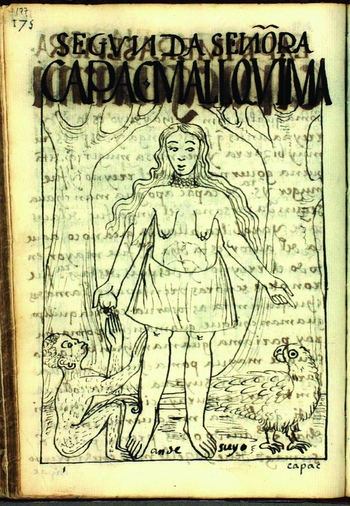
This representation of a semi-nude figure clothed in tatters dovetails with textual descriptions and visual iconography of the Chuncho. For instance, Guaman Poma gives us an illustration showing the second wife of an Inca captain from the Antisuyu quarter, named Capac Mallquima (Figure 8). She is wearing nothing but a skirt, with exposed breasts and bare feet.Footnote 65
Segunda Señora Capac Mallquima
Source: Felipe Guaman Poma de Ayala, El primer nueva corónica i buen gobierno, fol. 175 [177], ca. 1615. Photograph provided by the Royal Library, Copenhagen.

A parrot, with its right eye cocked toward the viewer, stands to her left side, mirroring the compositional organization of St. John and the parrot in Cusi Guaman's painting. In another drawing depicting the feast of the Antisuyus, the male participants wear feathered headdresses, recalling the parrots and other exotic birds that served as the sources for these vestments.Footnote 66 St. John's tattered robes make this an even more “orthodox” painting than the others that preceded it. But this can also serve as a source of agency for Cusi Guaman, who capitalized on the symbolic synchronicity between St. John the Baptist and the Chuncho Indian, demonstrating how visual languages can develop new registers of meaning. This is but one example in which colonial Andean images can carry radically opposed yet not necessarily contradictory messages.
Cusi Guaman brought together two prominent signifiers of Cuzco's “others”—the parrot and the tattered loincloth—as a means of bestowing local legibility to a biblical figure. Andean viewers would have been better able to understand John's historical role as a religious ascetic who relinquished his material possessions and lived a humble life. By equating him with a Chuncho devoid of elaborate clothing or man-made possessions, Cusi Guaman offers a recognizable analogue through which John's role could be understood. In his stoic and rather dignified representation of St. John, Cusi Guaman was able to remove the negative aspects associated with the Chuncho as they were understood in the highland Andean imagination. He thus engaged in a strategic act of adding and peeling away pervasive symbols embedded in Andean and Christian spheres of knowledge and myth-making: St. John the Baptist is shed of his normative identity and traditional iconography, which is replaced with symbols of the Chuncho located at the margins of the Inca empire. If taken from a different perspective, the Chuncho is emptied of his otherness and cast as a central figure in the biblical tradition. But regardless of the position from which we interpret this figure, we can see that Cusi Guaman has invented his own set of mixed symbols and metaphors in order to deepen the signifying capacity of Christian subjects. His subtle inclusion of Chuncho referents, I argue, underscores the artist's capacity to serve as an intermediary in the visual communication of Christian narratives to highland indigenous congregations. These legacies carry on into the twentieth century; in his ethnographic study of Urcos in 1971, Manuel Marzal notes that the term “Chuncho” was used to describe unbaptized children. Local residents stressed the necessity for them to receive the sacrament of baptism “so they don't become savages.”Footnote 67
We can also read Cusi Guaman's mural in light of Andean spatial hierarchies.Footnote 68 If we are to map out the image based on the spatial coordinates of the Inca empire, St. John represents the eastern Antisuyu quarter. Christ occupies the exact center of the composition—a subtle but significant shift from Riaños's, Bitti's and Perret's compositions that place Christ slightly left of center. We can thus interpret Christ as an axis mundi, the conceptual center of the new spiritual map of the Andes. This subtle repositioning of Christ carried great symbolic weight. In the Inca period, Cuzco was considered the navel of the universe and the center from which all territorial divisions emanated. Christ joins Cuzco/Urcos as the center of gravity, bridging geography and religion, and imperial cosmology and colonial spirituality.
An alternative but not necessarily mutually exclusive reading would posit St. John as a dualistic counterpart to Christ. The Incas framed Chunchos as their ontological opposite. The Incas possessed laws and reason; the Chunchos lacked government. Incas of high standing wore finely woven tunics and sandals; Chunchos wore little clothing and walked barefoot.Footnote 69 Such efforts at delineating these social boundaries also extended into the arena of ritualized warfare. The Incas frequently staged battles with the Chunchos as a means of maintaining strict moiety divisions and hierarchies. These battles form an important category of kero decoration, in which the ethnic Incas are depicted to the left and the Chunchos to the right, again in exactly the same positioning as we see in Cusi Guaman's painting.Footnote 70 As Tom Cummins argues:
The ritual battles do not only represent aspects of agriculture. They are a tacit acknowledgment of the competition and antagonism existing at the moiety level because one is always symbolically subordinate to the other. The ritual battles therefore controlled hostility by permitting the expression of this antagonism while at the same time reuniting the two moieties at the end through reciprocal drinking and feasting as well as the exchange of females.Footnote 71
This is not to imply, of course, that St. John was likewise staged in a ritual battle with Christ. But we can say with relative certainty that Cusi Guaman may have staged these two figures as complementary opposites through the structural paradigm offered by the Inca/Chuncho division. Christ as the axis mundi and central figure of the composition becomes conflated with “us,” that is, with the parishioners of Urcos. St. John assumes a role similar to that of the tribute-paying Chunchos: he bestows Christ with the sacrament of Baptism in order for him to cultivate a life of ultimate sanctity. That is, he granted Christ the raw material—baptismal water—to become the savior of humankind, just as the Chunchos offered tribute of feathers and other goods to be utilized by the divinely ordained Sapa Inca.
The placement of the two figures in this complementary, dualistic relationship appealed to pan-Andean understandings of reciprocity that continued to permeate social relations well into the colonial period and beyond.Footnote 72 Cusi Guaman's subtle use of color, symbolism, and composition communicated Christ's primacy through mutually reinforcing local channels of knowledge. As the creator of an alternative Andean visuality of the sacred, Diego Cusi Guaman mediates between a Europeanized rendition of St. John and a purposeful Andeanization of the very saint who initiated none other than Jesus Christ into Christianity—an event in the history of the faith brought into an Andean setting. We now turn to the church of Pitumarca, whose mural of Christ's baptism, while rooted in the same print source, responds to a unique set of historical factors that differed considerably from the realities of Diego Cusi Guaman's Cuzco of the 1630s.
PABLO GAMARRA'S BAPTISM OF CHRIST AT THE CHURCH OF PITUMARCA
The eighteenth century ushered in what John Rowe famously referred to as an era of “Inca Nationalism.”Footnote 73 With the Spanish conquest buried safely in the past by nearly two centuries, indigenous Andeans enjoyed relative freedom to reconstruct and reenact Inca history through literature, performance, and the visual arts.Footnote 74 Indeed, Inca history occupied an important space in the collective memory of indigenous Andeans. Oral history offered Andeans a vital link to the pre-Columbian past, even if the Inca narratives did become heavily modified over the course of the colonial period. But one of the most important developments in the resurrection of an “authentic” Inca identity was the publication of the second edition of Comentarios reales by “El Inca” Garcilaso de la Vega in 1723. This edition enjoyed wide readership throughout the Peruvian viceroyalty, particularly among indigenous elites.Footnote 75 Garcilaso's text offered Andeans a repository of Inca history and culture that strongly resonated with a society that attached great value to the written word.Footnote 76
While Cusi Guaman merely suggests a Jordan River/Lake Urcos connection in his mural, Gamarra draws an explicit connection to the Andes’ most famous lake in his mural at the church of Pitumarca. A heavily stylized body of water, teeming with life and activity, separates Christ from St. John the Baptist. Boats fashioned from totora reeds float on its surface, immediately identifying the body of water as Lake Titicaca, which straddles the modern-day border between Peru and Bolivia.Footnote 77 In fact, the indigenous residents of the area continue to fashion boats in similar style to those of their pre-Columbian ancestors. Lake Titicaca held enormous significance for pre-Columbian Andean peoples. It served as a sacred site or huaca to which pilgrims would pay their respects each year.Footnote 78 It is located in the heartland of the Aymara-speaking peoples, but despite its location on culturally foreign territory, the Incas considered the lake an important place of origin.
Several variants of the Inca origin myth circulated throughout the pre-Columbian and colonial periods. One version to which Garcilaso de la Vega dedicated substantial attention recounts Manco Capac and Mama Ocllo's emergence from the Island of the Sun on Lake Titicaca. Manco Capac and Mama Ocllo were the son and daughter of Inti, the sun god, and eventually became the mythical founders of the Inca empire. They were both siblings and a married couple, establishing a precedent for Inca policies of royal consanguinity. Garcilaso recounts the story as follows:
Our father the Sun set these two children of his in Lake Titicaca, eighty leagues from here, and bade them go where they would, and wherever they stopped to eat or sleep to try to thrust into the ground a golden wand . . . when this wand should sink into the ground at a single thrust, there our father the Sun wished them to stop and set up their court.Footnote 79
The golden wand with which the sibling couple was equipped eventually led them on a northward journey to found the city of Cuzco. Returning to the mural, Gamarra inserts a male/female couple to the right of Christ in the space occupied by a pair of angels in all of the previous images. He employs common conventions for depicting indigenous physiognomy and skin color, marking them as ethnically Andean, whereas the figures of Christ and St. John the Baptist have more Europeanized features and facial hair. I would suggest that the figures represent Manco Capac and Mama Ocllo themselves, witnessing the scene of Christ's baptism. This kind of revisionism became increasingly widespread in the late colonial period as a way for Andeans to unparadoxically claim both Christian and Inca roots.
Garcilaso set the stage for such conflations in his description of the origin of the Inca kings, in which he states:
While these peoples were living or dying in the manner we have seen, it pleased our Lord God that from their midst there should appear a morning star to give them in the dense darkness in which they dwelt some glimmerings of natural law, of civilization, and of the respect men owe to one another. The descendants of this leader should thus tame those savages and convert them into men, made capable of reason and of receiving good doctrine, so that when God, who is the sun of justice, saw fit to send forth the light of His divine rays upon those idolaters, it might find them no longer in their first savagery, but rendered more docile to receive the Catholic faith and the teaching and doctrine of our Holy Mother the Roman Church [. . .] It has been observed by clear experience how much prompter and quicker to receive the Gospel were the Indians subdued, governed, and taught by the Inca kings than the other neighboring peoples unreached by the Incas’ teachings.Footnote 80
Garcilaso follows a similar formula to that of contemporary indigenous and mestizo authors in his assertion that the Incas furnished the conditions under which the Gospel could be received once it was brought to Peru by the Spaniards. This historical construction posits the Incas as critical intermediaries in the transmission of Christianity to the Andes, without whom the colonial project might have failed.Footnote 81
If we are to accept this image as a direct reference to the Lake Titicaca origin story of Manco Capac and Mama Ocllo, then what are the implications of such a representation? By integrating the mythical couple into Christ's baptism at this important lake of origin, the artist makes the claim that the Incas were witnesses and perhaps even predecessors to the birth of Christianity. It grants legitimacy to Inca origin stories by bringing both the sacred site and the key figures associated with it into alignment with the Christian timeline, as we have also seen in the writings and illustrations of the indigenous chronicler Felipe Guaman Poma de Ayala. It thus participates in an ongoing struggle to establish commensurability between two pasts previously considered at odds with one another. Gamarra exercised agency not only in the choice of symbolism but also in the manner in which he represented it. The stylistic transition from Cusi Guaman's Mannerist-inflected naturalism to a total rejection of illusionistic space underscores Gamarra's investment in alternative modes of visual communication that diverged considerably from the European visual tradition. The resultant effect is a total acknowledgment of the “paintedness” of the wall and a rejection of material verisimilitude.
The disavowal of European conventions of three-dimensionality and proportion in favor of flatness and exuberant decorative flourishes harks back to Inca visual conventions. The mural's style, iconography, and depiction of figures resemble those found in colonial textiles and keros. The mural contains elements of an Inca visual language that would have likely reached the artist not through Inca images themselves, but through colonial objects caught up in a complex process of preservation and invention of “Incaness.” Nevertheless, what sets this mural apart from its material culture analogues is its scale and permanence. To paint Christ's baptism in such an explicitly Andean mythical landscape and in the visual language (as it was understood in the colonial period) of the Incas was a remarkable act of agency.
Such bold acts did not emerge from a vacuum. The cultural climate of Inca Nationalism in the years leading up to the Tupac Amaru Rebellion of 1780 offered opportunities for artists to explore the intersections of Inca and European origins in an era of increased artistic opportunity for indigenous painters.Footnote 82 Evocations of Incaness, whether in the realm of material culture, literature, or painting, were not practiced out of mere whim. As Alcira Dueñas notes, they “were institutionally promoted through royal decrees recognizing the noble privilege of those who demonstrated Inca ancestry and were also sought by Indian intellectuals and nobles who believed these practices would foster their struggles for political and cultural survival.”Footnote 83 In other words, there was a great deal at stake in the creation of such an image, which participated in a larger ideological battleground for the political primacy and recognition of native elites.Footnote 84 While the figure of Christ himself does not wear an Inca tunic or bear any visual markers of an Inca sovereign, the compositional elements work together to place Christ within Inca space and time. Conversely, they also place the Andes within a Christian history and teleology. The figures comingle in a wholly Other space that could exist only in the collective imagination of Andeans entrenched in both mytho-theological traditions. The Pitumarca mural participated in a shared dialogue on how Inca and Christian stories could approach, overlap, and ultimately, redefine one another.
CONCLUSIONS
These images of the baptism of Christ demonstrate the trajectory mural painting took as a medium and as a visual system equipped to participate in dialogues that were at once intensely local and universal, involving the negotiation of Christian and Andean origins and cross-cultural notions of sacredness and the divine. The murals demonstrate the different means by which seventeenth- and eighteenth-century Andean artists encoded Christ's baptism with a diverse set of local references. In spite of their common reliance on Pieter Perret's print, the murals take on dramatically different appearances as a result of the availability of visual source materials and the historical conditions in which they were conceived. Neither case presents a simple process of direct, literal copying—the visual evidence offered here points to a sophisticated system of transmission and exchange of source images as well as the physical movement of artists across the Andean landscape to view and emulate pre-existing paintings housed in parish churches throughout the region.
Cusi Guaman and Gamarra imbued these murals with local resonance through the inclusion of indigenous symbolism, the conflation of Christian sites with Andean sacred geographies, and the use of subtle compositional maneuvers that reorganized European religious imagery according to Andean spatial hierarchies. These images exploited the vast signifying capacity of sacred images culled from both European and pre-Columbian visual systems. As cultural intermediaries, Andean artists played active, intervening roles in the re-articulation of Catholicism to express local histories and value systems. They relied on their viewers’ fluency in both Christian iconography and local and pre-Columbian referents codified through a colonial visual rhetoric. While the issue of reception remains a notoriously difficult area of art historical inquiry for the early modern world, we can at the very least deduce that the sustained viewership of these murals by their local community invited ongoing reflection on the messages and meanings embedded in their brushstrokes. These murals were not simply static paintings on baptistery walls, but dynamic expressions of local identities filtered through iconic Christian scenes, signifying a plethora of meanings and possibilities for the assertion of Andean beliefs, visions, and counterclaims to colonial ideologies.
Further research in ecclesiastical and municipal archives would allow us to gain greater insight into the negotiations that took place in the patronage of mural paintings across the southern Andes and the precise peregrinations of muralists throughout the seventeenth and eighteenth centuries. As the collaborative work of Joanne Rappaport and Tom Cummins has demonstrated, great strides can be achieved by situating alphabetic and visual archives in dialogue with one another, not with the intent of merely substantiating an image with the “authority” of a text, but to witness their mutual participation in the construction of different ways of knowing and seeing in the colonial Andes.Footnote 85
This article has called for a consideration of colonial mural paintings as visible archives embedded into their very sites of inception, whose messages were transmitted along a spectrum of visual registers. The different meanings that viewers could extract from these paintings of the baptism of Christ did not rely on an essentialized “indigenous identity,” but instead depended on one's degree of access to certain forms of knowledge, whether it be theological expertise, oral histories of a particular place, or a honed eye for the intervisual relationships between different works of art. Artists and viewers served as critical stakeholders in the development of diverse visual registers for communicating the intersections of faith, temporality, geography, and historical memory in the colonial Andes. While the interconnections between texts and images is often treated as matter-of-fact, we must also consider their relationships to oral, aural, sonic, and tactile modes of expression—areas of inquiry that have received far less scholarly attention.Footnote 86 A methodological focus on intermediaries—whether artists, viewers, patrons, cofradías, curacas (indigenous rulers), or others—can allow for a more nuanced approach to issues of artistic production and spectatorship that considers the range of actors who held a stake in the contested realm of colonial representation.