





1. Introduction
Digital welfare platforms represent both a continuation of long-standing transformations in public governance and a significant departure from traditional welfare delivery mechanisms. Positioned at the intersection of technological innovation and welfare state restructuring, these platforms are often celebrated for their potential to integrate fragmented service ecosystems, enable user-centred service co-production, and expand access to public services. However, they also raise significant concerns regarding the reproduction of social inequalities, reductions in public accountability, and the entrenchment of technocratic models of governance. As such, advancing both empirical and theoretical understanding of digital welfare infrastructures is crucial to informing future governance models in this domain (Kenney et al., Reference Kenney, Bearson and Zysman2021; Zander et al., Reference Zander, Lu and Chimenti2025). Many welfare states currently operate within highly fragmented institutional arrangements in which service delivery responsibilities are dispersed across public agencies, private actors, and third-sector organisations (Koivusalo et al., Reference Koivusalo, Svynarenko, Mbare and Perkiö2024). This structural complexity frequently undermines coordination and obstructs equitable access, thereby leaving citizens to navigate opaque and disjointed systems (Novello and Garavaglia, Reference Novello and Garavaglia2026). Originating within the private sector, digital platforms offer an infrastructural solution by centralising information, streamlining transactions, and coordinating service actors through modular, interoperable designs that promise user-centric experiences (Chimenti et al., Reference Chimenti, Hagberg and Araujo2025). This paper addresses two primary research questions: (1) What are the defining characteristics of digital welfare platforms as revealed through a global, multidimensional descriptive analysis? and (2) How can these platforms be inductively classified based on their functional roles, and what typological categories emerge from such classification? The study offers two core contributions. First, it presents the first systematic global mapping of digital welfare platforms, based on a novel dataset encompassing 285 platforms across a range of geographical and institutional settings. Second, it introduces a structured classification framework grounded in a decision-tree model that reflects the functional diversity of welfare platforms. This framework ensures conceptual rigour through the application of the MECE principle (Mutually Exclusive, Collectively Exhaustive), facilitating clear analytical distinctions across cases.
2. Background
2.1. The ‘Platform Economy’ and its extension into public welfare
The ‘Platform Economy’ is typically understood as a system of digital infrastructures that mediate interactions among distinct user groups through the governance of access, participation, and data flows by platform operators (Kenney et al., Reference Kenney, Bearson and Zysman2021). While originally associated with commercial innovations – such as Amazon, Uber, and Airbnb – platforms have since evolved into an organisational paradigm that is reshaping institutional roles and service delivery mechanisms (Chimenti et al., Reference Chimenti, Hagberg and Araujo2025). In the public domain, platform logic is increasingly being adopted across welfare sectors, with modular and interoperable systems now permeating healthcare, employment services, and social assistance (Xue et al., Reference Xue, Tian and Zhao2020; Zander et al., Reference Zander, Lu and Chimenti2025). This development constitutes what Margetts and Dunleavy (Reference Margetts and Dunleavy2013) describe as a second wave of digital-era governance in which governments focus less on direct provision and more on orchestrating service interfaces and coordinating multi-actor ecosystems.
2.2. Digital welfare, co-production, and e-government platforms
Digital welfare platforms are frequently embedded within broader e-government strategies aimed at enhancing integration, accessibility, and user-centred approaches. Early iterations, such as one-stop government portals, emphasised administrative simplification and centralised access (Wimmer and Tambouris, Reference Wimmer, Tambouris and Traunmüller2002). More recent developments encompass a wider range of digital functionalities, including open data initiatives and algorithmic eligibility assessment tools (Kawabata and Camargo, Reference Kawabata and Camargo2023). The co-production literature offers a critical interpretive framework: Osborne et al. (Reference Osborne, Radnor and Strokosch2016) argue that public value is not simply delivered by institutions but is co-created through dynamic interactions among users, providers, and systems. Digital platforms may facilitate such interaction through participatory design and feedback mechanisms, but they also risk marginalising users when efficiency imperatives overshadow inclusivity (Novello and Garavaglia, Reference Novello and Garavaglia2026).
2.3. Fragmentation, integration, and recomposition of welfare provision
The governance of welfare services has become increasingly fragmented, marked by the disaggregation of roles among public, private, and third-sector actors (Powell, Reference Powell2019). Digital platforms have emerged as potential solutions to this fragmentation, functioning as integrative infrastructures capable of reconfiguring previously disjointed systems (Bennett and Meers, Reference Bennett and Meers2025). Longo and Maino (Reference Longo and Maino2021) distinguish between multichannel platforms, which aim to re-establish coordination by offering multiple points of access, and marketplace platforms, which standardise service supply by aggregating providers. Both configurations position platforms as institutional intermediaries that can bridge fragmented welfare landscapes, although their integrative capacity is contingent upon governance arrangements and normative commitments to equity.
2.4. Platform infrastructures and institutional logics
Platforms are not merely technical artefacts but are embedded within socio-technical infrastructures that embody specific institutional logics. These logics shape the rules and values that govern eligibility, participation, and performance evaluation (Frapporti, Reference Frapporti, Mezzadra, Cuppini, Frapporti and Pirone2024; Zuiderwijk et al., Reference Zuiderwijk, Chen and Salem2021). For example, marketplace platforms may generate quasi-markets in which public, private, and non-profit actors negotiate access and pricing, embedding competing values such as efficiency, equity, and profitability (Dulong de Rosnay and Stalder, Reference Dulong de Rosnay and Stalder2020). Alternatively, commons-based platforms prioritise transparency and participatory governance. These divergent architectures shift control from administrative discretion to codified digital processes (Lund-Tønnesen, Reference Lund-Tønnesen2026), with significant implications for user experience – including the potential for exclusion, frustration, or disempowerment (Oude Geerdink et al., Reference Oude Geerdink, Sewdas, van Kempen, van Weeghel, Anema and Huysmans2023).
2.5. Research gaps and the need for exploratory global mapping of digital welfare platforms
Despite a growing interest in digital welfare platforms, existing empirical research remains limited in scope. Most studies concentrate on individual countries, specific sectors, or flagship cases, while comparative analyses are often theoretical or conceptual in nature. A comprehensive, global mapping of welfare platforms is thus lacking. The present study addresses this empirical gap through the construction and analysis of a novel dataset encompassing 285 digital welfare platforms, categorised across seven analytical dimensions. This approach offers an empirical foundation for theorising emergent configurations of welfare digitalisation and contributes to ongoing debates on platform governance and the reconfiguration of welfare states.
3. Methodology
3.1. Research design and rationale
This study adopts an exploratory, inductive, and descriptive research design to investigate the global landscape of digital welfare platforms. Such an approach is particularly appropriate given the relative paucity of empirical studies in the field and the absence of widely accepted definitions of these platforms. The heterogeneity of digital infrastructures operating within the welfare domain further underscores the need for an open-ended analytical framework (Alexopoulou, Reference Alexopoulou2025). As such, rather than aiming for statistical representativeness, the study seeks to capture the breadth of emerging platform configurations, offering an empirically grounded basis for conceptual clarification and future theory-building. The research design prioritises analytical openness and iterative categorisation, allowing analytical criteria to evolve as new cases emerge. This methodological approach enables the development of a data-driven typology reflective of actual platform diversity and intended to identify significant patterns within this rapidly evolving domain. The resultant dataset of 285 validated cases offers a novel empirical basis for theorising emerging configurations of digital welfare governance. While primarily descriptive, the analysis incorporates a comparative lens across countries, institutional settings, and welfare domains, thereby offering a systematic foundation for future theoretical and normative inquiry into welfare digitalisation. This design involves trade-offs: it captures recurring platform configurations, but does not account for welfare services that are not accessible through online search, including informal or locally embedded initiatives. As a consequence, the methodological approach favours platforms with a clear and stable online presence and may overlook services that are less visible or operate through fragmented or non-digital settings.
3.2. Data collection and cleaning
Given the lack of centralised registries or standard taxonomies for digital welfare platforms, the study employed a multi-stage open web-based search strategy conducted over a 12-month period (January 2024–January 2025). This method aligns with recent scholarship on digital public services, which has emphasised the necessity of open-source discovery in under-regulated or fragmented policy domains (OECD, 2016; Urs et al., Reference Urs, Špaček and Nõmmik2025). Search queries were developed in English and tailored to reflect major welfare domains, including healthcare (medical and mental health), elderly care, disability services, youth policy (education and training), family and housing assistance, and general local citizenship services. In cases where platform content was not available in English, online translation tools were used to support interpretation and screening. For each target group, two queries were run (combined with country terms such as ‘Australia’, ‘Brazil’, ‘Italy’, ‘South Africa’) via Google, open data catalogues, and official directories, as follows:
-
• ‘digital platform for local citizens’ AND ‘digital welfare platform for local citizens’
-
• ‘digital platform for disabled people’ AND ‘digital welfare platform for disabled people’
-
• ‘digital platform for elderly people’ AND ‘digital welfare platform for elderly people’
-
• ‘digital platform for young people’ AND ‘digital welfare platform for young people’
-
• ‘digital platform for patients’ AND ‘digital welfare platform for patients’
-
• ‘digital platform for mental health patients’ AND ‘digital welfare platform for mental health patients’
The search process followed an iterative and adaptive logic aimed at achieving broad coverage of the phenomenon. For each query, at least the first five pages of search results were screened. Beyond this threshold, the search was extended when results were still relevant to the study scope. The stopping criterion was based on a qualitative assessment of relevance: searches were discontinued when additional results no longer yielded platforms consistent with the analytical focus and instead returned content outside the domain of digital welfare provision. In more information-rich contexts, the search was intentionally prolonged to ensure that no analytically distinct cases were emerging, approximating qualitative saturation in terms of empirical coverage, rather than theoretical saturation. The overall strategy combined structured query design with iterative expansion. While individual search strings were not modified during each execution, insights from completed searches informed subsequent query design, including the use of alternative terms, synonyms, and recombination of keywords, which enabled the identification of additional platforms that might not have been captured through a single formulation.
Platforms were included only if they met all of the following criteria:
-
• Focus on welfare-related services or collective enhancement of welfare ecosystems; AND
-
• Operational digital interface (i.e., website/app); AND
-
• Identifiable ownership (i.e., public, for-profit, not-for-profit, or combinations); AND
-
• Sufficient public information to enable classification.
Platforms were excluded if they were:
-
• Prototypes/inactive platforms; OR
-
• Internal/admin tools without a user-facing interface; OR
-
• No digital access channel; OR
-
• Purely commercial services unrelated to social welfare.
Out of 440 initially identified platforms, 155 were excluded during the data validation and cleaning phase – particularly those with static or non-functional digital presences. The final dataset comprises 285 fully validated platforms. All entries were manually reviewed using a standardised data collection template encompassing ten variables distributed across seven analytical dimensions: geographical scope, functional purpose, target population, ownership model, delivery channel, pricing structure, and reporting logic. Three dimensions (i.e., ownership, delivery, pricing) were each disaggregated into two sub-dimensions to improve granularity and coding precision. Classification criteria for these dimensions were based on the analytical framework and initially developed through discussion with a second researcher. They were subsequently refined during the data collection process, as described in the coding procedure below.
3.3. Coding protocol and variable design
Coding was conducted by a single researcher using a standardised protocol applied consistently across all cases. Each platform was coded across all variables before proceeding to the next case, ensuring completeness and comparability at the level of individual observations. While the analytical dimensions and corresponding variables were defined ex ante, the internal categorisation within each dimension was not fixed a priori. Instead, category definitions were refined through an iterative and inductive process aimed at capturing the empirical diversity of the cases. This process involved multiple cycles of coding and recoding. When the analysis of new cases led to the identification of additional categories or to the refinement of existing ones, previously coded platforms were systematically revisited and reclassified in light of the updated scheme. This recursive procedure ensured that category definitions were progressively stabilised and consistently applied across the dataset. Particular attention was paid to maintaining internal coherence, both by aligning similar cases within the same categories and by preserving meaningful distinctions between cases with subtle but analytically relevant differences. Ambiguous or borderline cases – where classification across one or more variables was not immediately clear – were identified throughout the coding process and subjected to a detailed analysis. These cases were independently reviewed by a second researcher and subsequently discussed between the researchers, leading to a consolidated final classification. Beyond these targeted assessments, the second researcher was involved in reviewing the overall structure and consistency of the final dataset following the data cleaning phase, providing an additional layer of qualitative validation. Given the exploratory and inductive nature of the study, emphasis was placed on ensuring internal consistency, transparency of the coding process, and iterative refinement of category definitions. Robustness was thus pursued through the combination of a structured coding protocol, iterative recoding, and researcher triangulation. The resulting classification should therefore be interpreted as an empirically grounded description of the identified cases, designed to offer a coherent representation rather than statistical generalizability. To enable systematic analysis, the study developed a coding protocol structured around seven core analytical dimensions. Each dimension captures a critical aspect of platform architecture and governance, while categorical distinctions within each dimension ensure comparability across cases. The first analytical dimension is geographic scope, distinguishing where platforms operate, with ‘international’ assigned to cross-national access. VPN tools were used to resolve ambiguous cases. The second dimension is functional purpose, reflecting the main role of the platform in mediating interactions:
-
• Service delivery: enables direct access to welfare services, such as booking care or making payments, often integrating providers.
-
• Information repository: curates structured information about welfare services, supporting navigation without direct service provision.
-
• Search engine: offers dynamic tools (i.e., filters, maps, keywords) to connect users with external providers.
-
• Value co-creation: engages citizens in collaborative processes (e.g., reporting barriers or co-designing initiatives).
-
• Community-building: fosters peer support, social cohesion, and mutual recognition among users with shared needs or conditions.
The third dimension is target population, identifying the intended user group:
-
• General population: broad access to services or information.
-
• Disabled people: tailored support ensuring accessibility and inclusion.
-
• Elderly people: platforms addressing autonomy, care, and social participation.
-
• Young people: initiatives for education, training, and youth services.
-
• Medical patients: tools supporting continuity of care and treatment management.
-
• Mental health patients: services providing timely, confidential psychological support.
-
• Mixed or multiple targets: modular infrastructures serving diverse groups.
The fourth dimension is ownership model, distinguishing governance and service roles:
-
• Public sector: ownership or provision by government authorities.
-
• For-profit sector: platforms managed by private firms or start-ups.
-
• Not-for-profit sector: actors such as NGOs or foundations.
-
• Multi-stakeholder governance: partnerships combining different sectors.
The fifth dimension is delivery channel, referring to how users access and consume services:
-
• Digital only: fully online access and service use.
-
• Hybrid: combination of digital and physical channels.
-
• Physical only: access limited to physical interaction, despite the presence of a supporting digital layer.
The sixth dimension is pricing structure, distinguishing financial models:
-
• Free of charge: no fees for access or use, often publicly funded.
-
• Freemium: basic services free, with paid premium options.
-
• Fee-paying: full payment required for access or consumption.
The seventh dimension is reporting logic, assessing accountability practices:
-
• No reporting: absence of data or evaluative content.
-
• Basic display of results: limited metrics or success stories.
-
• Performance evaluation: structured output/outcome reporting.
-
• Social impact reporting: evidence of broader societal contributions.
3.4. Analytical principles and theoretical grounding
All variables were treated as categorical (i.e., nominal), with each platform assigned a single, mutually exclusive value per dimension. The classification framework followed the MECE principle (Mutually Exclusive, Collectively Exhaustive) to prevent overlap and ensure analytical coherence. While not intended to establish a definitive classification of the field, the typology captures the empirical diversity of platform configurations through an exploratory approach. The seven analytical dimensions were derived from theoretical and methodological considerations. Dimensions such as functional purpose, ownership structure, and delivery channel are grounded in the literature on e-government and digital-era governance (Margetts and Dunleavy, Reference Margetts and Dunleavy2013; Wimmer and Tambouris, Reference Wimmer, Tambouris and Traunmüller2002). Ownership and service provision distinctions reflect the logic of the mixed economy of welfare (Powell, Reference Powell2019), while the target population variable operationalises concerns around user fragmentation and public value co-creation (Janowski et al., Reference Janowski, Estevez and Baguma2018; Osborne et al., Reference Osborne, Radnor and Nasi2013). The reporting dimension draws on emerging debates on transparency and accountability in digital public services (Leone de Castris, Reference Leone de Castris2025). The coding scheme was refined throughout data collection to align with the study’s exploratory and inductive orientation.
4. Results
4.1. Descriptive overview of the dataset
The validated dataset reveals a highly uneven and functionally concentrated ecosystem, both geographically and in functional terms. The 285 digital welfare platforms are distributed across all global regions, although with a strong geographical concentration in Europe (n = 144; 50.53%) and a more limited presence in other areas, particularly Africa (n = 2; 0.70%), Asia (n = 5; 1.75%), and South America (n = 10; 3.51%). A significant share of platforms operates across multiple continents (n = 52; 18.25%), indicating the existence of transnational digital infrastructures alongside nationally embedded initiatives. Across the dataset, digital welfare platforms are overwhelmingly structured around service provision, with service delivery representing the dominant configuration (n = 215; 75.44%), while information repositories (n = 31; 10.88%), search engines (n = 19; 6.67%), value co-creation platforms (n = 13; 4.56%), and community-building platforms (n = 7; 2.45%) remain comparatively marginal. The functional concentration is accompanied by a strong prevalence of platforms targeting specific user groups, particularly mental health and medical patients (n = 116; 40.70%) and elderly users (n = 56; 19.65%), whereas young people represent a significantly underrepresented category (n = 12; 4.21%). This distribution is also closely associated with governance and pricing patterns. The ecosystem is largely dominated by for-profit ownership models (n = 217; 76.14%), with a more limited presence of not-for-profit (n = 50; 17.54%) and public-sector actors (n = 18; 6.32%). A more differentiated distribution emerges when considering the service provision component, with for-profit provision remaining predominant (n = 169; 59.30%) and multi-stakeholder configurations accounting for 13.33% of platforms (n = 38). In terms of delivery, digital-only access is the predominant mode (n = 235; 82.46%), although more differentiated patterns emerge when considering service consumption. While over half of platforms remain fully digital in their use (n = 151; 52.98%), a substantial share combines digital and physical components (n = 91; 31.93%), and a smaller group relies on physical consumption despite digital interfaces (n = 43; 15.09%), indicating the persistence of hybrid and offline service dimensions within digital welfare infrastructures. While access to platforms is almost universally free (n = 284; 99.65%), pricing structures at the point of service consumption show substantial variation, with nearly half of platforms requiring payment (n = 138; 48.42%), alongside free (n = 98; 34.39%) and freemium models (n = 49; 17.19%). This configuration reflects a structural separation between free entry and differentiated consumption models. Across all dimensions, reporting practices are consistently underdeveloped. The majority of platforms (n = 220; 77.19%) do not provide any form of reporting, while only a limited number offer basic output metrics (n = 57; 20.00%) or more structured forms of performance evaluation and social impact reporting (n = 8; 2.81%).
These descriptive distributions are summarised in Table 1, offering a comprehensive profile of the digital welfare platform ecosystem as captured in the dataset.
Descriptive distribution of digital welfare platforms across analytical dimensions

Table 1. Long description
Table 1 summarises 285 digital welfare platforms across seven dimensions. Half are European (50.53%), followed by international platforms (18.25%), North America (13.68%), and Oceania (11.58%). Service delivery dominates (75.44%), followed by information repositories (10.88%), search engines (6.67%), value co-creation (4.56%), and community-building (2.45%). Mental health patients are the main target (28.42%), followed by elderly people (19.65%). For-profit organisations own most platforms (76.14%) and provide most services (59.30%). Digital channels dominate access (82.46%) and consumption (52.98%); hybrid and physical consumption account for 31.93% and 15.09%. Access is almost universally free (99.65%), while consumption is fee-paying for 48.42%, free for 34.39%, and freemium for 17.19%. Most platforms have no reporting (77.19%); 20.00% provide a basic display of results, and 2.81% use performance evaluation or social impact reporting.
4.2. Classification framework
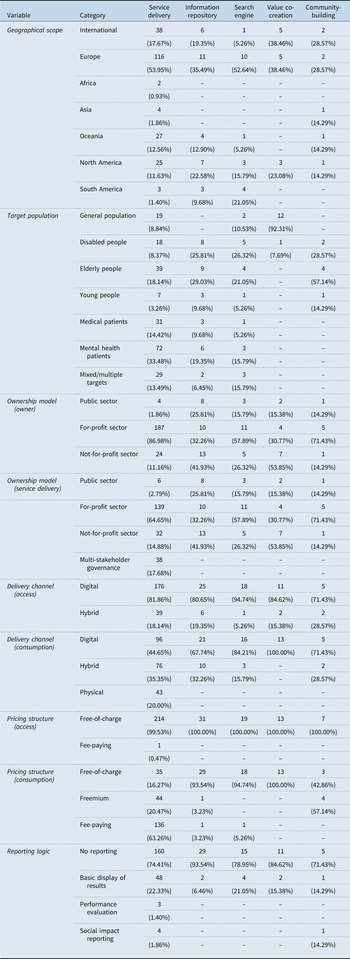
Building upon both empirical distributions and theoretical constructs, the study developed a functional typology comprising five platform types – service delivery, information repository, search engine, value co-creation, and community-building – and highlighted their associations with other key dimensions of the dataset (e.g., ownership models, target populations, pricing structures). This classification framework enables systematic differentiation of platform logics and governance configurations. Service delivery platforms constitute the majority of the dataset (n = 215; 75.44%) and display a highly consistent configuration across key variables. They are overwhelmingly owned by for-profit actors (n = 187; 86.98%) and most frequently rely on fee-paying models at the point of service consumption (n = 136; 63.26%), indicating a strong alignment between service provision and market-based pricing. These platforms are primarily oriented toward mental health users (n = 72; 33.48%) and elderly populations (n = 39; 18.14%), and are predominantly accessed through digital-only channels (n = 176; 81.86%). Reporting is limited, with 74.41% of platforms (n = 160) providing no form of disclosure. Information repositories comprise 10.88% of the dataset (n = 31) and exhibit a different configuration, more frequently associated with free service consumption (n = 29; 93.54%) and a more balanced distribution of ownership across not-for-profit (n = 13; 41.93%), for-profit (n = 10; 32.26%), and public-sector actors (n = 8; 25.81%). These platforms are primarily oriented toward elderly (n = 9; 29.03%) and disabled users (n = 8; 25.81%) and are mostly delivered through digital channels (n = 21; 67.74%), reflecting a recurring combination of informational functions and non-market-oriented access models. Disclosure practices remain minimal in this category. Search engines account for 6.67% of cases (n = 19) and combine predominantly for-profit ownership (n = 11; 57.89%) with almost universal free service consumption (n = 18; 94.74%). They primarily serve vulnerable populations, including disabled (n = 5; 26.32%) and elderly users (n = 4; 21.05%), and are delivered almost exclusively through digital-only channels (n = 18; 94.74%). This pattern reflects a recurring combination of market-based governance and non-commercial access models. Reporting is also underdeveloped in this group. Value co-creation platforms represent 4.56% of cases (n = 13) and are characterised by a consistent alignment between participatory functions, orientation toward the general population (n = 12; 92.31%), and entirely free access. These platforms are predominantly characterised by not-for-profit governance (n = 7; 53.85%) and their services are consumed entirely through digital channels. Disclosure remains marginal, with most platforms not providing structured information. Community-building platforms are the least represented group (n = 7; 2.45%) and primarily target elderly users (n = 4; 57.14%). They are most often governed by for-profit actors (n = 5; 71.43%) and tend to adopt freemium models (n = 4; 57.14%), combining free access with paid features. These platforms are mainly accessed through digital channels (n = 5; 71.43%), sometimes in combination with hybrid formats. Reporting practices are largely absent, although one platform provides social impact disclosure (14.29%).
Table 2 presents a detailed cross-tabulation of these platform types across the key analytical dimensions.
Cross-classification of digital welfare platforms by functional type and structural characteristics

Table 2. Long description
Table 2 compares five functional types: service delivery, information repository, search engine, value co-creation, and community-building. Counts and within-type percentages cover six dimensions. Service delivery is largest, concentrated in Europe (53.95%), mental health patients (33.48%), and for-profit ownership (86.98%). Information repositories are mainly not-for-profit (41.93%); search engines are European (52.64%) and mainly for-profit (57.89%). Value co-creation targets the general population (92.31%) and is mostly not-for-profit (53.85%); community-building targets elderly people (57.14%) and is predominantly for-profit (71.43%). Digital access predominates across all types and is almost universally free. Consumption differs: service delivery is predominantly fee-paying (63.26%), while information repositories, search engines, and value co-creation are overwhelmingly or entirely free. Reporting is largely absent across all types. Dashes indicate no platforms in a category.
4.3. Decision model
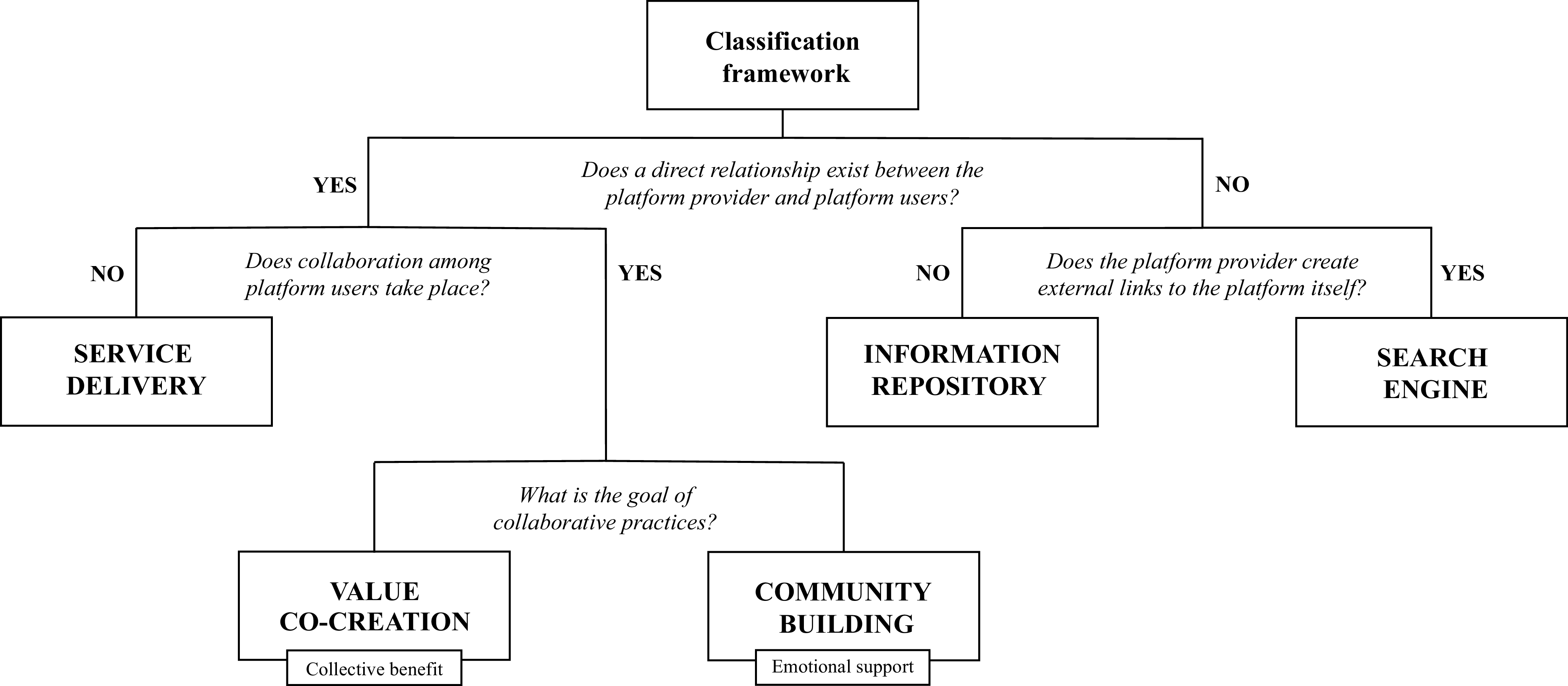
To implement the classification framework, the decision model was developed following a decision-tree structure. The classification begins by identifying whether a direct relationship exists between the platform provider and platform users. In the absence of such interaction, platforms are evaluated for their navigational features: if they do not redirect users externally, they are classified as information repositories; if they serve as portals linking users to external services, they are defined as search engines. For platforms with direct user interaction, the model distinguishes between transactional and collaborative engagements. Transactional platforms are categorised as service delivery. Platforms that enable collaboration are then assessed based on the goal of collaborative practices: those oriented toward collective benefit are classified as value co-creation, while those oriented toward emotional support are identified as community-building platforms. This sequential logic ensures conceptual consistency and analytical transparency across the classification process.
The full decision pathway is visualised in Figure 1.
Decision-tree model for the functional classification of digital welfare platforms.

Figure 1. Long description
The decision tree classifies digital welfare platforms into five functional types. It begins by asking whether a direct relationship exists between the platform provider and platform users. If no direct relationship exists, the next question asks whether the platform provider creates external links to the platform itself. If no external links are created, the platform is classified as an information repository. If external links are created, the platform is classified as a search engine. If a direct relationship exists, the next question asks whether collaboration among platform users takes place. If no collaboration occurs, the platform is classified as service delivery. If collaboration occurs, platforms are further classified according to the goal of collaborative practices: value co-creation when the goal is collective benefit, and community-building when the goal is emotional support.
5. Discussion
5.1. Convergences and divergences across functional categories of welfare platforms
Despite the structural diversity observed across digital welfare platforms, the analysis reveals a set of recurring patterns that are not merely descriptive, but also reflective of underlying systemic logics shaping the evolution of digital welfare infrastructures. A salient feature is the widespread adoption of digital-only access models – particularly among information repositories, search engines, value co-creation, and community-building platforms. This tendency reflects a broader infrastructural orientation toward scalability, automation, and cost-efficiency, consistent with second-wave digital-era governance paradigms (Margetts and Dunleavy, Reference Margetts and Dunleavy2013). Another commonality is the near-universal provision of free access to platform interfaces. However, monetisation typically occurs downstream, at the level of service consumption, through fee-paying or freemium models. These deferred revenue structures create the appearance of inclusivity at the point of entry while embedding selective mechanisms of value extraction at later stages (Cohen, Reference Cohen2017). These convergences coexist with pronounced divergences in ownership models, governance structures, and social orientation, pointing to the presence of distinct and, at times, competing institutional logics within the same empirical landscape. Service delivery platforms, which constitute the majority of cases, predominantly target mental health users, elderly individuals, and medical patients. Notably, many retain physical or hybrid components of service consumption, underscoring the continued relevance of embodied welfare provision even within digital ecosystems. Rather than displacing traditional service infrastructures, these platforms appear to reconfigure existing channels (Longo and Maino, Reference Longo and Maino2021). The governance of service delivery platforms is overwhelmingly private and commercialised, with most platforms owned and operated by for-profit actors and financed through user payments. This structure reflects broader market-driven trends in welfare provision and platform capitalism (Zander et al., Reference Zander, Lu and Chimenti2025). In contrast, platforms oriented toward information dissemination and civic participation – particularly information repositories and value co-creation platforms – are more frequently governed by not-for-profit or public-sector actors. These platforms often target structurally vulnerable groups (e.g., elderly or disabled users) or emphasise participatory engagement and public value, suggesting a more civic or solidaristic orientation. Community-building platforms constitute a minor group and demonstrate differences in terms of ownership and monetisation. Their frequent use of freemium models and limited accountability practices suggests that this format remains experimentally configured, lacking standardised governance or financing mechanisms (Appel et al., Reference Appel, Libai, Muller and Shachar2020). These findings suggest that while digital welfare platforms are technologically convergent in their reliance on digital infrastructures and user-facing interfaces, they diverge significantly in terms of institutional logics, redistributive implications, and governance orientations. Within the observed dataset, the ecosystem is characterised by significant internal heterogeneity, with divergent visions of what digital welfare platforms are for, whom they serve, and how value is produced and distributed (Powell, Reference Powell2019). This fragmentation signals a broader reconfiguration of welfare governance, in which platformization introduces competing institutional logics and redistributes roles and responsibilities across different providers, rather than following a linear model of digital transformation (Lund-Tønnesen, Reference Lund-Tønnesen2026).
5.2. Structural voids and systemic risks in digital welfare
Beyond observable divergences, the analysis reveals six structural voids – domains of absence or insufficient development that raise concerns about the long-term inclusivity, equity, and legitimacy of digital welfare governance. First, platforms oriented toward participatory or collaborative engagement – namely, value co-creation and community-building – are marginal. Their limited presence suggests that participatory, deliberative, or solidaristic forms of digital engagement are systematically deprioritized in favour of transactional service delivery. This reflects a governance paradigm that privileges administrative efficiency and market rationality over democratic co-production (Zander et al., Reference Zander, Lu and Chimenti2025). Second, the underrepresentation of youth-oriented platforms is striking. Adolescents and young adults are among the least served populations, despite their heightened digital engagement and distinct welfare needs. This gap may reflect a policy assumption that general-purpose digital platforms or social media can substitute for targeted services. However, such assumptions risk obscuring youth-specific vulnerabilities, including precarious transitions, mental health risks, and exclusion from institutional welfare channels (Davis et al., Reference Davis, Anderson, Yang, Choukas-Bradley, Bell and Slovak2025; Hofmann et al., Reference Hofmann, Sæbø and Rydén2024). Third, public-sector ownership is exceedingly rare. Public actors, rather than serving as a central coordinator or standard-setter, often play a peripheral role in platform governance (Bennett and Meers, Reference Bennett and Meers2025). This retreat raises the possibility of a dual-track welfare system: commercially sophisticated platforms for resourced users, and fragmented or inadequate provision for vulnerable groups (van Toorn et al., Reference van Toorn, Henman and Soldatić2024). Without robust public stewardship, the platformization of welfare risks reinforcing existing inequalities and undermining the universality of entitlements. Against this backdrop, the limited presence of welfare platforms dedicated to emotional support or peer interaction for young people creates an unmet need. This space is often filled by private, fee-based mental health platforms offering psychological support or well-being services, where access depends on whether users can afford to pay and service design is driven by commercial logics. In contexts where young users may be particularly vulnerable, this configuration raises social and ethical concerns regarding the governance of digital infrastructures for youth support. Fourth, the dominance of digital-only delivery models constrains accessibility for users who require face-to-face, relational, or place-based services. While digital platforms can expand reach, they may remain less accessible to users with limited digital literacy, poor connectivity, or context-specific needs (Novello and Garavaglia, Reference Novello and Garavaglia2026). Hybrid models – combining digital efficiencies with physical accessibility – remain underdeveloped despite evidence of their value in promoting inclusion (Drysdale et al., Reference Drysdale, Bates, Ritter, Smyth, de Leeuw and Katz2024). Fifth, pricing structures are heavily skewed toward fee-paying models, especially in service delivery platforms. Freemium models – which could potentially reconcile sustainability with accessibility – are infrequently adopted and inconsistently implemented. In the absence of affordability safeguards, personalisation and monetisation logics risk amplifying socio-economic disparities (Dubé and Misra, Reference Dubé and Misra2023). In practice, this results in platforms where users can freely browse available services but are required to pay in order to complete bookings or access core functionalities. In many cases, access to services is not clearly defined, and users’ ability to pay acts as a mechanism of selection and prioritisation. For instance, when service availability is limited, platforms may implicitly prioritise users who are able to confirm and pay for services more rapidly, while offering inadequate information on how waiting lists or provider allocations are managed. Finally, accountability and transparency mechanisms are largely absent. The overwhelming lack of reporting – whether on performance, outcomes, or social impact – undermines the capacity for evidence-informed governance and weakens public trust. In cases where reporting is present, it is typically limited to basic metrics or promotional content, rather than systematic evaluations of effectiveness or equity (Leone de Castris, Reference Leone de Castris2025; Reid and Ringel, Reference Reid and Ringel2025). Platforms frequently rely on user profiling to match users with providers, yet the criteria guiding these processes are rarely made explicit. In practice, users are often presented with a list of recommended providers without any indication of why certain options appear first, whether due to proximity, availability, user ratings, or other prioritisation criteria. In some cases, providers who respond more quickly or operate within paid tiers may be displayed more prominently, although this is not clearly communicated to users. This lack of transparency makes it difficult to assess whether services are allocated based on need, availability, or efficiency. Moreover, the absence of social impact measurement, combined with the prevalence of digital-only and fee-based models, limits the ability to identify who is excluded from these platforms and why, weakening the capacity for public actors to assess whether services are delivered equitably. For instance, platforms typically track completed transactions or successful matches, but do not capture users who fail to find suitable services, abandon the process due to cost, or disengage because of digital barriers. As a result, exclusion remains unobserved within platform metrics, making it difficult for public actors to evaluate whether access is effectively equitable. These structural gaps highlight that the architecture of digital welfare is defined not only by its present configurations but also by its omissions. The consistent neglect of participatory functionality, public-sector leadership, hybrid accessibility, affordability, and transparency reveals a systemic bias toward market logics. Absent corrective governance interventions, the digital transformation of welfare may deepen existing exclusions.
5.3. Governance implications and directions for future research
These findings carry significant implications for platform governance and point to a set of policy priorities for the design of more inclusive digital welfare ecosystems. Overall, the analysis suggests an ongoing reconfiguration of welfare governance in the context of platformization. Digital welfare platforms are not neutral delivery tools but rather socio-technical infrastructures that reshape how access to services is designed, mediated, and governed (Bennett and Meers, Reference Bennett and Meers2025; Chimenti et al., Reference Chimenti, Hagberg and Araujo2025). As such, they redefine the institutional boundaries between public, private, and third-sector actors, with implications for how services are structured, responsibilities are allocated, and accountability is ensured. They also shape which populations are reached and which remain underserved, as reflected in the concentration of platforms around specific user groups (e.g., patients) and the relative absence of others (e.g., young people). This introduces a governance challenge: as access to welfare services becomes increasingly mediated by platform architectures, public actors face reduced visibility over how services are prioritised and allocated. In this context, ensuring equity and accountability requires not only regulation but also the capacity to understand and intervene in platform-based mechanisms that are not fully transparent or publicly governed. The current dominance of for-profit governance structures underscores the need for renewed public-sector leadership. Public actors need not displace private innovation but can reassert their role as standard-setters, regulators, and stewards of equity, transparency, and democratic accountability. Moreover, the marginalisation of participatory and civic-oriented platform types calls for deliberate investments in civic digital infrastructures that prioritise user co-design, feedback loops, and relational engagement – especially in sectors where trust and responsiveness are central. This would help rebalance the current dominance of transactional, efficiency-driven models. The study also underscores the importance of embedding equity considerations directly into platform design. Age, disability, socio-economic status, and geographic access are not simply implementation issues but must inform the architecture of welfare platforms. Hybrid infrastructures, affordability safeguards, and transparent reporting standards are key levers for ensuring that platformization does not exacerbate structural exclusion. Future research should extend the empirical mapping of platforms across underrepresented regions and welfare regimes, while also adopting longitudinal approaches to capture change over time. Ethnographic and participatory methodologies can illuminate how users navigate platforms in practice and what forms of exclusion or empowerment result. Interdisciplinary collaboration – linking digital governance, social policy, platform studies, and Science and Technology Studies – will be essential to theorise and inform the ongoing restructuring of welfare in the platform era. These avenues could elucidate whether digital platforms are reinforcing welfare commodification or enabling hybrid governance arrangements that blend innovation with public value. Policy interventions are needed to strengthen transparency in platform operations, ensure clearer criteria for access and service allocation, and support more systematic forms of public monitoring. This also requires incorporating user feedback and promoting more inclusive design to reduce barriers to access.
6. Conclusion
This study presents the first comprehensive global mapping and inductive classification of digital welfare platforms. Drawing on a dataset of 285 validated cases spanning diverse institutional and geographical contexts, it identifies five core functional types – service delivery, information repository, search engine, value co-creation, and community-building. The analysis develops a multidimensional classification framework, operationalised through a decision-tree model, to systematically capture the structural and functional heterogeneity of digital welfare infrastructures.
Two primary contributions emerge. First, the study offers a detailed empirical portrait of the digital welfare platform landscape, highlighting the predominance of for-profit service delivery platforms – many of which operate under fee-paying or freemium models within sectors such as mental health and elderly care. Second, the research proposes an inductive typology that clarifies how digital infrastructures mediate various modes of welfare provision, ranging from navigational support to peer-driven community engagement. The findings underscore the fragmented nature of platformized welfare ecosystems, where technological convergence coexists with deep divergences in governance models, redistributive logics, and institutional orientations. Although digital interfaces may increase surface-level accessibility, the underlying architectures frequently reinforce commercialisation, privatisation, and exclusionary dynamics. Participatory, public, and equity-driven models remain underrepresented, suggesting a digital welfare trajectory more aligned with efficiency than with inclusion or democratic accountability. The study is not without limitations. First, its reliance on open web searches introduces potential selection bias, as platforms with limited digital visibility or operating in less digitised contexts may be underrepresented, contributing to the observed geographical imbalance. While the search strategy followed a structured and transparent protocol, its open web-based nature and the use of qualitative stopping criteria may limit the full replicability of the dataset. Second, the non-probabilistic sampling strategy precludes statistical representativeness, positioning the findings as exploratory rather than statistically generalisable. Third, the interpretive nature of classification, combined with the use of a single primary coder, entails some degree of subjectivity. However, coding followed an iteratively refined protocol, and ambiguous or borderline cases were examined independently and subsequently discussed with a second researcher, supporting the overall consistency of the coding process. Despite these limitations, the findings illuminate core tensions in how welfare is being reshaped through digital infrastructures. Ultimately, the governance of digital welfare platforms constitutes not a neutral technical challenge, but a profoundly political and normative project. The extent to which these infrastructures promote inclusion, equity, and accountability will depend on the institutional visions and policy choices that underpin their development. As digital platforms increasingly mediate access to social rights, their design must be treated as a matter of democratic concern. Without deliberate public intervention and sustained civic oversight, digital welfare risks becoming a mechanism for deepening stratification rather than advancing solidarity.
Supplementary material
The supplementary material for this article can be found at https://doi.org/10.1017/S1744133126100747.
Acknowledgements
The author conducted this research at Bocconi University and is currently affiliated with the Department of Bioengineering at Imperial College London. The author would like to thank Professor Francesco Longo for his valuable feedback and discussions on the methodological framework and classification process.
Financial support
This research received no specific grant from any funding agency in the public, commercial, or not-for-profit sectors.
Competing interests
The author declares no conflict of interest.
Declaration of generative AI use
During the preparation of this work, the author used ChatGPT (OpenAI) to support language editing. The author reviewed and edited the content as needed and takes full responsibility for the content of the published article.



 Open access

