Chromis limbata (Valenciennes, 1833), the Azores Chromis, is a species restricted to the Macaronesian Islands (Azores, Madeira and Canaries) and the western coast of Africa (between Senegal and Congo, Wood, Reference Wood1977; Edwards, Reference Edwards1986; Rocha et al., Reference Rocha, Rocha, Robertson and Bowen2008). The Cape Verde Islands bear an endemic and a tropical amphi-atlantic Chromis species (Edwards, Reference Edwards1986). Chromis chromis (Linnaeus, 1758), the most likely sister species of C. limbata (Wood, Reference Wood1977; Edwards, Reference Edwards1986; Rocha et al., Reference Rocha, Rocha, Robertson and Bowen2008) is found in the Mediterranean and adjacent Atlantic. Chromis limbata inhabits rocky areas from 3 to 50 m, where it forms aggregations in midwater (Brito et al., Reference Brito, Pascual, Falcón, Sancho and González2002). During the summer, nesting males defend territories and take care of the eggs (Figure 1) that are attached to the substratum (Mapstone & Wood, Reference Mapstone and Wood1975). In the case of C. chromis, after a pelagic larval phase of 18–19 days (Raventós & Macpherson, Reference Raventós and Macpherson2001) fish settle to adult grounds. It is likely that C. limbata have similar life history parameters.
A nesting male of Chromis limbata taking care of the eggs that are attached to a shallow boulder at Terceira Island, Azores (Portugal). Photograph by Áthila Bertoncini.

Regarding relationships among Chromis species, Rocha et al. (Reference Rocha, Rocha, Robertson and Bowen2008) support that C. multilineata (Guichenot, 1853) and C. atrilobata Gill, 1862 are sister species. On the other hand Domingues et al. (Reference Domingues, Bucciarelli, Almada and Bernardi2008) support that C. limbata is the Atlantic sister of C. chromis (the Mediterranean species).
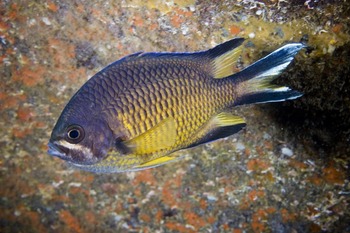
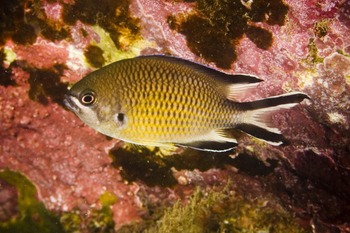
Vagrant individuals of the Azores Chromis were detected on the southern coast of Brazil. In this paper, the first photographic record for this species in the south-western Atlantic is given (Figure 2). The photograph was taken at Campeche Island, located 1.5 km on the east coast of Santa Catarina Island, South Brazil (27°41′44″S 48°27′53″W). The presence of C. limbata in the south-western Atlantic extends the known range of the species by almost 6400 km, being the 6th Chromis species to be registered in Brazil, together with Chromis enchrysura Jordan & Gilbert, 1882, Chromis flavicauda (Günther, 1880), Chromis jubauna Moura, 1995, Chromis multilineata (Guichenot, 1853) and Chromis scotti Emery, 1968. In 2008 two individuals of 8 cm standard length (SL) were repeatedly observed at Campeche Island during March and April. In May a single individual was encountered and in June none was sighted. All encounters occurred in the same boulder area of 12 m2 suggesting a great site fidelity and possibly small home range. Both specimens were observed feeding together with a single Chromis multilineata; so far the only Chromis species with the rare Chromis jubauna Moura, 1995, observed in South Brazil. The area has been monitored monthly by underwater visual censuses since July 2007. In other opportunities, December 2008 and March 2009, three to five individuals were observed at the Xavier Island (27°36′35″S 48°23′08″W) located northward of Campeche Island, 3 km from the east coast of Santa Catarina Island. The specimens from Xavier Island were larger than the ones observed at Campeche Island and were dispersed near the bottom at 8 m depth. One specimen was collected and deposited at the Ichthyological Collection of the Museu de Historia Natural Capão da Imbuia, reference no. 12327.
Chromis limbata feeding on plankton in midwater close to a boulder commonly covered by calcareous algae at Campeche Island, Santa Catarina (South Brazil). Photograph by Áthila Bertoncini.

Wirtz et al. (Reference Wirtz, Fricke and Biscoito2008) report that C. limbata has been previously confused with Chromis chromis (Linnaeus, 1758), e.g. by Maul (Reference Maul, Noronha and Sarmento1949), Nunes (Reference Nunes1974), and by Lloris & Rucabado in Quéro et al. (Reference Quéro, Hureau, Karrer, Post and Saldanha1990: 846–847), who included a (erroneous) record of the species from Madeira by Fowler (Reference Fowler1936). See Domingues et al. (Reference Domingues, Bucciarelli, Almada and Bernardi2005) for a genetic study of eastern Atlantic and Mediterranean Chromis species. The main diagnostic meristic counts and measurements of the collected specimen are given in millimetres: 126 mm total length; 92 mm standard length; dorsal fin with 13 rays and 11 soft rays; anal fin with two rays and 11 soft rays; pelvic fin with one ray and five soft rays; pectoral fin with 17 soft rays; 22 scales in the lateral line.
Although dominant average ocean current circulation reaches the north-eastern Atlantic islands from the west, the marine littoral fauna and flora of the temperate Macaronesia (Azores, Madeira, and Canaries) share affinities with the eastern coasts of the Atlantic and the Mediterranean (Prud'homme Van Reine, Reference Prud'homme Van Reine1988; Weerdt, Reference Weerdt1989; Lloris et al., Reference Lloris, Rucabado and Figueroa1991; Wirtz & Martins, Reference Wirtz and Martins1993).
Migration between the Azores, Madeira, and the Canaries showed an evident prevailing north-west trend (Domingues et al., Reference Domingues, Santos, Brito and Almada2006), as western Africa and the Macaronesian Islands have been the main source of eggs and larvae transported by several eddies and having small islets and shallow seamounts as ‘stepping-stones’ for the dispersal of warm water organisms to the Azores, Santos et al. (Reference Santos, Hawkins, Monteiro, Alves and Isidro1995).
Fluctuations in the effectiveness of the soft biogeographical barriers in the Atlantic Ocean, such as the Benguela Current, Mid-Atlantic and Amazon Barriers, may provide a mechanism for much of the recent faunal exchange and diversification of reef fish in the Atlantic (Floeter et al., Reference Floeter, Rocha, Robertson, Joyeux, Smith-Vaniz, Wirtz, Edwards, Barreiros, Ferreira, Gasparini, Brito, Falcon, Bowen and Bernardi2007). Olavo et al. (Reference Olavo, Costa, Martins and Costa2007) support the hypothesis of a reef fish dispersal corridor in deep waters, along the continental South American edge, connecting the province of Brazil with the north-western Atlantic one.
Floeter et al. (Reference Floeter, Rocha, Robertson, Joyeux, Smith-Vaniz, Wirtz, Edwards, Barreiros, Ferreira, Gasparini, Brito, Falcon, Bowen and Bernardi2007) suggested that the Mid-Atlantic Barrier seems quite permeable in terms of the relationship between Brazil and the Gulf of Guinea (Brazilian species are sisters to East Atlantic ones in 67% of the cases). The record of C. limbata in South Brazil corroborates the hypothesis that the Mid-Atlantic Barrier can also be occasionally breached by North Atlantic species, in spite of examples like Acanthurus monroviae (Acanthuridae) in Brazil (24°15′S 46°10′W) (Luiz-Junior et al., Reference Luiz-Junior, Floeter, Gasparini, Ferreira and Wirtz2004).
Reef fish generally have a bipartite life cycle with a dispersive larval phase (Sale, Reference Sale and Sale1991). Although the transport and survival of the fish as egg and/or larvae could be a plausible explanation, the majority of Pomacentridae have a short larval period, varying from three to eleven days, when compared with the larval phase of the Acanthuridae or Pomacanthidae which can last more than a month (Leis, Reference Leis and Sale1991). On the other hand, although with little probability, the introduction hypothesis by ships or oil rigs should not be excluded when considering Santa Catarina (see Gerhardinger et al., Reference Gerhardinger, Freitas, Bertoncni and Rangel2006).
Obviously the presence of a dozen Azores Chromis does not necessarily imply the establishment of a previously unrecorded viable population on the Brazilian coast. However, this occurrence is a remarkable example of the importance of long distance dispersion in the potential colonization of species from isolated oceanic islands over evolutionary time, and future research should address their establishment, as well as its occurrences along Brazilian coastal islands.