Reading acquisition in alphabetical systems begins with learning the grapheme-phoneme correspondences. First, children read the words slowly and in a serial way, letter by letter, with a strong length effect in which the longer the words are, the more grapheme/phoneme rules must be applied (Cuetos & Suárez-Coalla, Reference Cuetos and Suárez-Coalla2009; Spinelli et al., Reference Spinelli, De Luca, Di Filippo, Manzini, Martelli and Zoccolotti2005; Zoccolotti et al., Reference Zoccolotti, De Luca, Di Pace, Gasperini, Judica and Spinelli2005; Zoccolotti, De Luca, Di Filippo, Judica, & Martelli, Reference Zoccolotti, De Luca, Di Filippo, Judica and Martelli2009). However, as they repeatedly read the same words, they develop orthographic representations of those words in their memory, which in turn led to increased reading fluency (Share, Reference Share1995). Thus, readers of alphabetic systems developed two reading strategies: sublexical or letter by letter, necessary for reading unknown words; and lexical, very useful for recognizing familiar words (Coltheart, Rastle, Perry, Langdon, & Ziegler, Reference Coltheart, Rastle, Perry, Langdon and Ziegler2001). We must add that adults rely on units larger than the grapheme (morphemes) to read morphologically complex words, facilitating reading (Álvarez, Carreiras, & Taft, Reference Álvarez, Carreiras and Taft2001; Domínguez, Cuetos, & Seguí, Reference Domínguez, Cuetos and Segui2000; Schreuder, Grendel, Poulisse, Roelofs, & van de Voort, Reference Schreuder, Grendel, Poulisse, Roelofs, van de Voort, Balota, Flores d’Arcais and Rayner1990).
It is not clear, however, when exactly the morphology effect appears on reading and whether this effect depends on the orthographic depth or reading skills. In this sense, some researchers argue that English-speaking children must develop intermediate representations between the grapheme and the word, in order to deal with the irregularities of the orthographic system (Ziegler & Goswami, Reference Ziegler and Goswami2005). The support in units larger than the phoneme could be justified in opaque orthographic systems, given the inconsistency between graphemes and phonemes. On the contrary, in transparent languages, such as Italian or Spanish, the rules of grapheme-phoneme conversion are a perfectly efficient strategy to read any kind of word; and it is not necessary to use larger than the grapheme units to assign the correct pronunciation of words. This would be consistent with the psycholinguistic grain size theory, which considers that the recognition or word reading in transparent language is mainly based on phonological processes (Ziegler & Goswami, Reference Ziegler and Goswami2005; Ziegler, Perry, Jacobs, & Braun, Reference Ziegler, Perry, Jacobs and Braun2001). Several studies have attempted to thoroughly research the impact of the orthographic system in the reading development (Goswami, Ziegler, Dalton, & Schneider, Reference Goswami, Ziegler, Dalton and Schneider2001, 2003). Goswami et al. (Reference Goswami, Ziegler, Dalton and Schneider2001) compared English and German children (7 to 9 years-old) in reading pseudohomophones and pseudowords that are either phonologically or orthographically similar to words. English children benefited from the orthographic similarity of pseudowords, which was not the case with German children. This was interpreted as English-speaking children using longer units than German-speaking children or, in other words, transparent orthographies encouraging the use of small units and opaque orthographies stimulating the use of larger units. Moreover, in English language, Carlisle and Stone (Reference Carlisle and Stone2005), found that 2nd and 3rd grade children made use of morphology in reading derived words, because they read words with suffixes more accurately and faster than words without suffixes, suggesting that the reading of morphemes could be an intermediate step between reading based on grapheme-phoneme conversion rules and lexical reading. In French, Marec, Breton, Gombert, and Colé (Reference Marec-Breton, Gombert and Colé2005), found morphological effect in pseudoword reading, but not in word reading among children from 1st and 2nd grade, suggesting that children in other languages more transparent than English, rely less in the morphology. However, in a subsequent study, Casalis, Dusautoir, Colet, and Ducrot (Reference Casalis, Dusautoir, Colé and Ducrot2009), found morphological effect in a morphological priming task involving 4th grade children. In this study, the children had to make a lexical decision on derived words that were preceded by others, morphologically or orthographically related. The results showed priming effect when the word was preceded by the morphologically related word. Accordingly, one would think that the use of morphology in reading might depend on the reader level, the orthographic depth and/or the type of stimulus to read.
The effect of the morphology seems to be also present in children with dyslexia since they showed effect of morphological structure in word decoding (Elbro, Reference Elbro1990; Elbro & Arnbak, Reference Elbro and Arnback1996). Elbro (Reference Elbro1990) investigated the decoding strategies used by Danish adolescents with dyslexia. The adolescents were asked to read aloud isolated words, of which 19 were morphologically transparent at semantic level and 19 were not. The adolescents with dyslexia read morphologically transparent words with greater accuracy and speed than opaque words, showing a dependency on the morphological word structure to read.
The use of morphology by children has also been studied to some extent in transparent languages, such as Spanish, Italian and Finnish (Burani, Marcolini, & Stella, Reference Burani, Marcolini and Stella2002; Cuetos & Suárez-Coalla, Reference Cuetos and Suárez-Coalla2009; Muller & Brady, Reference Muller and Brady2001), since the development of morphological representations would allow a smooth and precise reading, especially with unknown words, avoiding the grapheme segmentation. In Spanish, Cuetos and Suárez-Coalla (Reference Cuetos and Suárez-Coalla2009), found that children from 1st grade had less difficulty (both in terms of speed and accuracy) in reading words formed by familiar groups of letters, than in reading control words, showing knowledge and use of units larger than the grapheme. In a similar way, Burani et al. (Reference Burani, Marcolini and Stella2002), found that Italian children between the ages of 8 and 10 read morphologically complex pseudowords better than morphologically simple pseudowords.
What happens with children with dyslexia in transparent languages such as Spanish? We know that children with dyslexia have difficulty in learning the alphabetic code, but also in processing long words as a whole (De Luca, Borrelli, Judica, Spinelli, & Zoccolotti, Reference De Luca, Borrelli, Judica, Spinelli and Zoccolotti2002; Hutzler & Wimmer, Reference Hutzler and Wimmer2004). This difficulty requires them to use sublexical strategies that hamper accuracy and reading speed (Suárez-Coalla & Cuetos, Reference Suárez-Coalla and Cuetos2012). The use of morphological representations could be a useful strategy to overcome these difficulties. Nevertheless, the use of morphological units to read, by children with reading difficulties in transparent languages, has not yet been studied in depth, although it is receiving increased attention due to the importance of its theoretical and practical implications. In fact, Italian children with dyslexia appear to benefit from the morphological structure of words when reading aloud. So, children with dyslexia (6th grade) read complex stimuli (words and pseudowords) more quickly and accurately than simple ones (Burani, Marcolini, De Luca, & Zoccolotti, Reference Burani, Marcolini, De Luca and Zoccolotti2008). They show benefit particularly from the presence of the roots (left constituents), but no of the suffixes -right constituents- (Traficante, Marcolini, Luci, Zoccolotti, & Burani, Reference Traficante, Marcolini, Luci, Zoccolotti and Burani2011). In addition, children with dyslexia appear to benefit, unlike the children without dyslexia, from morphology in reading words (Marcolini, Traficante, Zoccolotti, & Burani, Reference Marcolini, Traficante, Zoccolotti and Burani2011). In Spanish, Rodrigo et al. (Reference Rodrigo, Jiménez, García, Díaz, Ortíz, Guzmán and Hernández2004), focused on the contribution of morpheme recognition to the reading of Spanish-speaking children with dyslexia. A morphological comprehension task was used, where children had to read a word (consisting of root+suffix) and then select the correct picture. This study is an approach to the role of morphology in Spanish-speaking children with dyslexia. However, according to Burani, Dovetto, Spuntarelli and Thornton (Reference Burani, Dovetto, Spuntarelli and Thornton1999), morpheme-based reading does not necessarily mean access to the semantic component of the morphemes involved, while the presence of morphemes can improve the speed and accuracy in reading morphologically complex words, simply by recognizing units larger than the grapheme.
In this line, the present study was designed to try to determine whether Spanish-speaking children with dyslexia use morphology to read morphologically complex stimuli, i.e. if they have and use representations of morphemes to facilitate accuracy and fluency. The development of morphological units would be very useful for children with dyslexia, as they would avoid the excessively analytical and slow reading, of those long and unknown stimuli without representation in the visual-orthographic lexicon.
Method
Participants
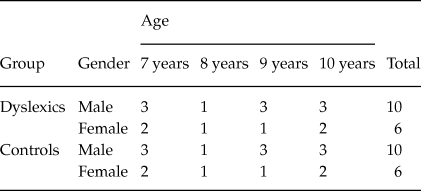
A total of 32 children participated in this study, 16 developmental children with dyslexia from 7 to 10 years old (10 boys and six girls, M age = 8.5 years old, SD = 1.2) and 16 children with an appropriate reading level for their chronological age (10 boys and six girls, M age = 8.5 year old, SD = 1.3), (see Table 1). All of these children attended schools in Asturias.
Distribution of Participants by Group, Age and Gender

All participants shared the same socio-cultural background, and their native language was Spanish. To diagnose dyslexia in the absence of other cognitive difficulties, a battery designed to assess reading processes, PROLEC-R (Cuetos, Rodríguez, Ruano, & Arribas, Reference Cuetos, Rodríguez, Ruano and Arribas2007) was administered, in addition to the Spanish version of the Wechsler Intelligence Scale for Children Revised (WISC-R, Wechsler, Reference Wechsler1993). The mean Intelligence Quotient (IQ) in children with dyslexia was 103 with a range of 90 to 120. Reading scores varied greatly, although all participants were 1.5 to 2.5 standard deviations (SD) below the average for their age in the reading test (see Table 2). No obvious cognitive impairments were identified in any of these participants. Children without reading difficulties had an appropriate reading level for their chronological age and good academic performance throughout the school years, which indicated no cognitive difficulties. In addition, they performed normally in several tests (reading and cognitive included) implemented by teachers, in collaboration with the Counseling Department of the school, at the beginning of the school year.
Reading Level of Dyslexic and Control Group. Scores in Words and Pseudowords Reading from PROLEC-R Test

Materials
Participants were asked to read aloud a total of 80 stimuli (simple and complex words and pseudowords), distributed in four categories of 20 stimuli each. The categories were as follows: 20 words of simple morphology (e.g., pereza); 20 words of complex morphology (e.g., belleza); 20 pseudowords (considered morphologically complex) created by a stem and a morpheme (e.g., plateza) and 20 pseudowords (considered morphologically simple) created from a word, by changing one or two letters (e.g., astoza).
All stimuli had a length of 3 syllables, and words (simple and complex) were also matched in frequency. Morphologically simple words had an average frequency of 35.49 (SD = 21.17) while that of morphologically complex words was 34.58 (SD = 22.23). Furthermore, complex words and pseudowords were matched on suffixes. The stimuli were also matched on grammatical class (all of them were nouns and adjectives) and, to a large extent, on initial phoneme and syllable frequency. However, in this study, this aspect does not seem so relevant, because we have obtained reaction times (RTs) from the spectrogram of each stimulus, which allows to establish the precise starting point for each answer.
Procedure
The stimuli were written in 22-point Arial font and remained on the screen for 4000 ms. They were presented in two blocks of 40 stimuli each and appeared randomly in each block, separated by a pause and preceded by six practice trials in order to familiarize the child with the task. Children were seated 30 cm from the screen and, at the beginning of the test, were asked to read the words quickly and accurately. The following directions appeared on the computer screen: “You must read aloud the words and pseudowords as quickly as possible without making any mistakes”. The task was performed at the children’s school or the speech therapy center in a single session of 20 minutes, and the children’s responses were recorded on .WAV files using the application DMDX (Forster & Forster, Reference Forster and Forster2003). Recordings were subsequently analyzed with the application Check Vocal (Protopapas, Reference Protopapas2007) through which we obtained number of correct answers and RTs from the resulting spectrograms.
Analysis
The dependent variables of this study were reading accuracy (number of correctly read stimuli by category) and reading speed (RT). The experimental design included two within-group factors (lexicality and morphological complexity) and between-group factors (reading-group). From these data (number of correctly read stimuli and RTs), we performed two analysis of variance (ANOVAs) for repeated measures, in order to determine the effect of lexicality and morphological complexity in children with and without dyslexia.
A total of 2560 data were obtained, 2202 of which were correct answers (86%). Children with dyslexia had an accuracy level of 83% compared with 88% of the control group. Children with dyslexia showed a 3.9% outlier rate, while children in the control group only 1.4%. For RTs, 2.5SD over the mean of each participant were considered outliers.
Results
Results of the accuracy reading analysis
In the analysis of accuracy, we found a group effect, F(1, 30) = 17.65, p < .001, indicating that the difference in reading accuracy between the two groups was significant: the control group had significantly more correct answers than children with dyslexia. We also found a lexicality effect, F(1, 30) = 75.28, p < .001, since the participants were more accurate in word reading than in pseudoword reading. There was also a lexicality by morphological complexity interaction, F(1, 30) = 22.83, p < .001, suggesting that the role of morphology tends to be larger in the reading of pseudowords (see Table 3). Post-hoc comparisons using Bonferroni test indicated that the difference between simple and complex words was not significant, but the difference between simple and complex pseudowords was close to significance (p = .07), with a greater number of correct answers in complex (M = 17.4, SD = .36) than in simple pseudowords (M = 16.4, SD = .35). Finally, there was no interaction between group and morphological complexity; both children with and without dyslexia showed no significant differences between simple and complex stimuli, due to the high number of correct answers in reading (ceiling effect).
Mean and Standard Deviation of Reaction Times (RT) and Accuracy Percentage in Reading Words and Pseudowords, Simple and Complex

Note:
RT = Reaction times, Acc = Accuracy
Results of the analysis of reading speed
The analysis of the RTs demonstrated a group effect, F(1, 30) = 20.11, p < .001, with longer reading latencies in the dyslexic group; a lexicality effect, F(1, 30) = 17.17, p < .001, so latencies of words were lower than those of pseudowords; and a morphological complexity effect, F(1, 30) = 39.728, p < .001, as the RTs of simple stimuli were significantly higher than those of complex stimuli.
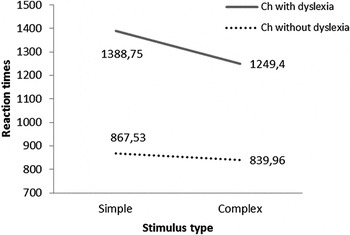
In addition, we also found morphological complexity by group interaction, F(1, 30) = 17.818, p < .001, (see Figure 1). Therefore, the role of morphological complexity tends to be higher in children with dyslexia than in the control group. The Bonferroni test indicated that, in the control group, there was no significant difference between simple (M = 869, SD = 71) and complex stimuli (M = 840, SD = 62); but the difference was significant at p < .05 level in the dyslexic group, since dyslexic children read complex stimuli faster than simple ones: simple stimuli (M = 1389, SD = 88), complex stimuli (M = 1249, SD = 71).
Morphological complexity by group interaction in reaction times (RT).

Finally, the lexicality by morphological complexity interaction was close to significance, F(1, 30) = 3.72, p = .063, because the role of morphological complexity appeared both in words and pseudowords, but the morphological effect is greater in the reading of pseudowords than in the reading of words (see Table 3).
Discussion
The aim of this study was to determine whether Spanish-speaking children with dyslexia use larger units than the grapheme (as a morpheme) when reading, as a strategy to compensate for their phonological recoding difficulties. The results showed that children with dyslexia were slower and less precise than the control group, something expected, taking into consideration the characteristics of the groups,. Moreover, children with dyslexia, as well as children without dyslexia, read words more accurately and faster than pseudowords, something demonstrated repeatedly in the research literature, since reading of unknown words and pseudowords involves analytical reading, which implicates slower reading and more errors (Sprenger-Charolles, Cole, Lacert, & Serniclaes, Reference Sprenger-Charolles, Cole, Lacert and Serniclaes2000; Suárez-Coalla & Cuetos, Reference Suárez-Coalla and Cuetos2012; van der Leij, van Daal, & De Jong, Reference van der Leij, van Daal, De Jong, Verhoeven, Elbro and Reitsma2002).
However, the main contribution of this work is the set of results obtained concerning the role of the morphological structure in reading. We found a greater morphology effect in speed reading. This suggests that Spanish children may use a morphological strategy when reading; a strategy used in others languages, which differ in orthographic depth (Burani, et al., Reference Burani, Marcolini and Stella2002; Carlisle & Stone, Reference Carlisle and Stone2005). Specifically, in a transparent language, Burani et al. (Reference Burani, Marcolini and Stella2002) found that the reading of children with a good reading level, from 3rd to 5th grade, was affected by the morphological structure of the stimuli, i.e. pseudowords, made up of roots an derivational suffixes were read more quickly and more accurately than pseudowords without morphological structure. Therefore, children started showing morphological reading from an early age, which could facilitate the reading of complex words they had never seen before.
But the most interesting in this study, is the difference between groups in terms of morphological complexity. The morphologically complex stimuli were read faster than the simple ones by children with dyslexia, but the difference was not significant in the group of children without dyslexia, which suggests that Spanish-speaking children with dyslexia use morphological processing when reading aloud, a strategy that complements the grapheme-phoneme conversion and lexical reading. The development and use of intermediate units to read is present in Spanish children with dyslexia, something that might seem unnecessary given the transparency of the language. When they are reading, children without dyslexia did not show any difference between simple and complex stimuli. However, children with dyslexia showed a large difference between simple and complex stimuli. This benefit of the presence of morphemes, units smaller than the word and larger than the grapheme, fit with a possible strategy to overcome its deficit in the phonological decoding, and its difficulty to develop orthographic representations of whole words. In readers with dyslexia the use of a morphological strategy appears to be a useful strategy, which helps reading unfamiliar words that are not represented in the lexicon or are too long to process as a whole (Burani et al., Reference Burani, Marcolini, De Luca and Zoccolotti2008; Elbro & Arnback, Reference Elbro and Arnback1996). In contrast, children with an appropriate reading development did not show, as much as children with dyslexia, the effect of morphology, because other reading strategies, lexical and/or sublexical, allowed them a reading fluency.
In summary, the results of this study showed that children with dyslexia would be able to develop representations of units larger than the grapheme, which would allow them to read aloud accurately and fluently. These data do not lead to the conclusion that the use of morphology involves access to the meaning, as other studies have tried to show (Colé, Leuwers, & Sprenger-Charolles, Reference Colé, Leuwers and Sprenger-Charolles2005; Rodrigo et al., Reference Rodrigo, Jiménez, García, Díaz, Ortíz, Guzmán and Hernández2004); only that the presence of morphemes facilitates reading. These results, otherwise, might justify the use of units larger than the grapheme to read in Spanish, in contrast to the Psycholinguistic grain size theory of Ziegler and Goswami (Reference Ziegler and Goswami2005). This theory assumes that readers of shallow orthographies rely mainly on grapheme-phoneme recoding strategies, as these grapheme-phoneme correspondences are highly consistent. Because of the orthographic consistency, in the transparent languages, the development of units larger than the grapheme (such as syllables, rhymes or whole words) would be less necessary or take more time. However, in this study we found that, even in shallow languages, children develop representations of units like morphemes (units of multiple grain size), facilitating speed and accuracy reading. Similar data were found in other transparent languages, such as Italian, which seems to confirm that, in transparent languages, morphemes can develop as a reading unit, despite the orthographic consistency (Barca, Burani, Di Filippo, & Zoccolotti, Reference Barca, Burani, Di Filippo and Zoccolotti2006; Burani et al., Reference Burani, Marcolini, De Luca and Zoccolotti2008). In addition, the support in units longer than the grapheme to read, by children with limited reading ability, could be considered a compensatory strategy to overcome their difficulties in phonological recoding, as considered in other studies (Elbro & Arnback, Reference Elbro and Arnback1996). Although the studies of Elbro (Reference Elbro1990) and Elbro and Arnbak (Reference Elbro and Arnback1996), were carried out with Danish speaking dyslexic adolescents, one language more opaque than Spanish language, the results of our study support the idea that the dyslexic children, of transparent languages, could also use morphology to read more fluently.
Our results suggest that Spanish children (with and without dyslexia) can be read by relying on representations of graphemes that appear together frequently, such as the case of morphemes. In this line, it might be interesting to know at what moment children begin to use units larger than the grapheme to read. The acquisition of reading begins with the development of a process sublexical (grapheme-phoneme), but other mechanisms may be developed in parallel (recodification in syllables, morphemes, words), we would be speaking of a progression without specific stages characterized by simple processes. According to this, children would develop different reading routes that they would use depending on the characteristics of words, as suggested by the multiple routes model of Grainger, Lété, Bertrand, Dufau, & Ziegler (Reference Grainger, Lété, Bertrand, Dufau and Ziegler2012).
These findings may have important implications for working with these children, taking into account that the difficulties in phonological recoding hamper the formation of representations in the orthographic lexicon (Share, Reference Share1995, Reference Share1999). In this sense, encouraging the development of units larger than the grapheme, could improve the reading ability of children with dyslexia.