Introduction
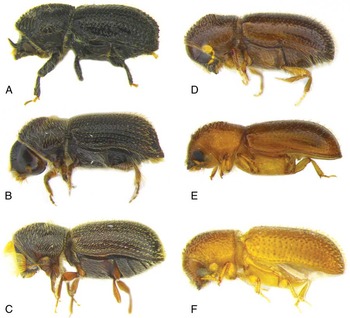
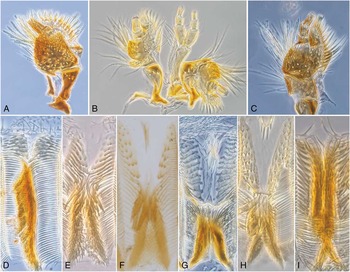
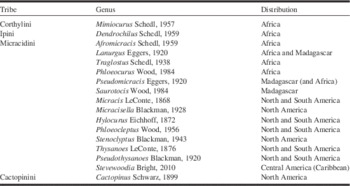
Bark beetles in the tribe Micracidini (Coleoptera: Curculionidae: Scolytinae) are found in the Afrotropical, Nearctic, and Neotropical regions (Table 1). This is one of few tribes in Scolytinae that possibly exhibits a disjunct trans-Atlantic distribution – a geographical split which dates back to the Paleocene or longer (Jordal and Cognato Reference Jordal and Cognato2012). The Afrotropical taxa include the six genera Afromicracis Schedl, Lanurgus Eggers, Phloeocurus Wood, Pseudomicracis Eggers, Saurotocis Wood, and Traglostus Schedl; two of these (Pseudomicracis and Saurotocis) are mainly found in Madagascar. New World genera are more numerous and include Hylocurus Eichhoff, Micracis LeConte, Micracisella Blackman, Phloeocleptus Wood, Pseudothysanoes Blackman, Stenoclyptus Blackman, Stevewoodia Bright, and Thysanoes LeConte. The tribe is morphologically fairly homogeneous, with relatively few traits characterising the group (Fig. 1). However, most females bear a distinct tuft of long setae on a short antennal scape (Fig. 1C, see Wood Reference Wood1982), and, irrespective of sex, have a distinctive apical plate of the proventriculus (Fig. 2, see also Lopez-Buenfil et al. Reference Lopez-Buenfil, Valdez-Carrasco, Equihua-Martinez and Burgos-Solorio2001). Other traits are apparently similar to species in Dryocoetini, Ipini, and Cactopinini (Wood Reference Wood1978, Reference Wood1986), but a detailed phylogenetic analysis is needed to test such relationships.
Lateral view of (A) Cactopinus rhois, (B) Phloeocleptus cristatus, (C) Lanurgus species, (D) Afromicracis species, (E) Dendrochilus arundinarius, and (F) Mimiocurus setifer.

Maxillae (A–C) and proventriculus (D–I) of species in Micracidini and Cactopinus. Internal face of left maxilla in (A) Cactopinus species, (B) Phloeocleptus cristatus, and (C) Lanurgus xylographus. The inner face of one proventriculus blade in (D) Cactopinus species, (E) Cactopinus rhois, (F) Phloeocleptus cristatus, (G) Lanurgus xylographus, (H) Afromicracis species, and (I) Micracisella nanula.

Current classification of Micracidini and putatively close relatives in Cactopinini, Ipini, and Corthylini.

Species of Micracidini differ biologically in several ways from other bark beetles. The large majority of species are bigamous where exactly two females join the male in a shared tunnel under bark (Wood Reference Wood2007). Females are therefore the courting sex having the most extravagant and species diagnostic features (Kirkendall et al. Reference Kirkendall, Biedermann and Jordal2014). Very little is known about the Afrotropical genera, but field observations indicate that they are fairly similar in behaviour to their Neotropical relatives (B.H.J., unpublished data). A large proportion of species on both continents are found breeding in dry and old twigs or branches and constitute an important part of the wood-boring fauna in arid scrublands and dry, deciduous forests. Typical species breed in inner bark, but the tribe as a whole is found in a broad range of woody tissues. Some species of Lanurgus tunnel into the sapwood as do many Hylocurus, or they tunnel through the pith of twigs such as in Micracisella (see Wood Reference Wood1982). Others are found in lianas or small shrubs, particularly so in the Afrotropical Afromicracis and Lanurgus.
Monophyly of Micracidini has rarely been disputed since Wood’s (Reference Wood1986) revision of Scolytinae genera. The tiny species of Afromicracis was one of the later additions to the tribe and this genus contains several species with little sexual dimorphism that is otherwise typical for micracidine species. In that respect the genus shows several similarities with the rare Afrotropical genus Dendrochilus Schedl, currently placed in Ipini (Wood Reference Wood1986). Both genera are fairly uncharacteristic and could be placed several places in the classification based on gross external morphology (Fig. 1). Molecular data has nevertheless placed Afromicracis with confidence in Micracidini, close to Lanurgus, and there is little reason to suggest other relationships for this genus (Jordal and Cognato Reference Jordal and Cognato2012). The question remains, however, where Dendrochilus belongs in this scheme.
Another taxon that is possibly closely related to Micracidini is the enigmatic genus Cactopinus Schwarz. All species in this genus are found in dry scrublands, known from Mexico to the southwestern United States of America. In these dry terrains they have adapted to feed on novel host plants, especially cactus (Cactaceae) and Agave Linnaeus (Asparagaceae), but there are also several species feeding and breeding in Pinus Linnaeus (Pinaceae) and Rhus Linnaeus (Anacardiaceae) (Atkinson Reference Atkinson2010). A separate subfamily was originally erected by Chamberlin (Reference Chamberlin1939) for this genus based on the unique presence of a pair of horns arising from the lower frons (Atkinson Reference Atkinson2010). Some authors believe the genus is most closely related to Micracidini, either near Phloeocleptus and Stenoclyptus (Wood Reference Wood1957), or more distantly related (Blackman Reference Blackman1943; Wood Reference Wood1986), while others suggest a totally separate position of Cactopinus in its own subfamily (Bright Reference Bright2014). Recent molecular phylogenetic analyses have suggested a potentially close relationship to Micracidini, in particular the Neotropical and Nearctic genera of the tribe (Jordal et al. Reference Jordal, Gillespie and Cognato2008; Jordal and Cognato Reference Jordal and Cognato2012).
This study provides the first thorough phylogenetic analysis of Micracidini genera and close relatives, based on DNA sequences from five gene fragments, and morphological characters. We are testing several taxonomic and biogeographical hypotheses related to the current classification. First we test the monophyly of Micracidini and thereby explore likely sister group candidates for the tribe, with particular focus on Cactopinus. Second, we test the hypothesis that all Afrotropical and New World genera are reciprocally monophyletic, which would be contrary to Wood’s (Reference Wood1986) hypothesis on mixed clades of genera from different continents. A third hypothesis involves the monophyly of the Afrotropical genera, with a special focus on Afromicracis and its relationship to Dendrochilus.
Central to our test scheme is the information provided from morphological characters, particularly internal or otherwise hidden anatomical characters. We give particular attention to characters coded from mouth parts, the posterior margin of the head, sutures on the thorax, hind wings, male genitalia, and the inner face of the eight proventricular blades (Figs. 2–3). Character states coded from these body parts have rarely been used in phylogenetic analyses of bark and ambrosia beetles, with a few notable exceptions (Jordal et al. Reference Jordal, Normark, Farrell and Kirkendall2002b; Jordal and Hewitt Reference Jordal and Hewitt2004). Internal anatomical characters have furthermore shown promise in associating species to tribe or higher clades (Jordal et al. Reference Jordal, Beaver, Normark and Farrell2002a; Jordal Reference Jordal2009, Reference Jordal2010, Reference Jordal2012) and are applicable to the phylogenetic analyses of many bark beetle groups. We therefore test the hypothesis that internal morphology is diagnostic for well-supported nodes in molecular phylogenetic trees.
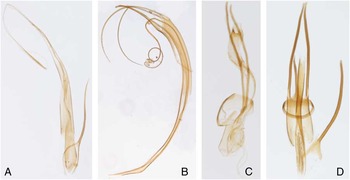
Male genitalia of (A) Cactopinus rhois, (B) Phloeocleptus cristatus, (C) Afromicracis species, (D) and Micracisella nanula. The spiculum gastrale is present in all species but detached in photographs B and C.

Materials and methods
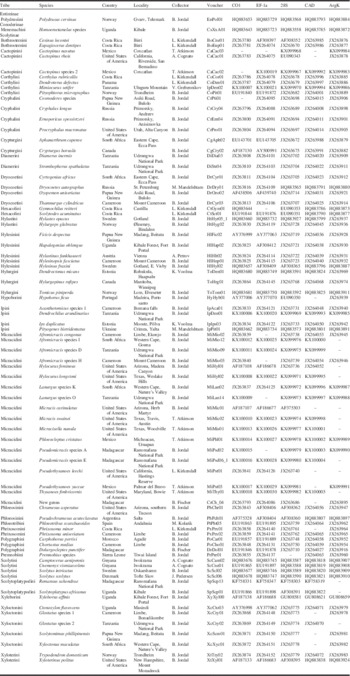
We included 80 species of Scolytinae in the phylogenetic analyses (Table 2). Two weevil species were selected as outgroups for rooting of the trees. Micracidini was represented by 18 species from nine genera. Selection of other scolytine tribes was based on previous studies indicating a potentially close relationship of Micracidini and Cactopinus, but with otherwise uncertain relationships to other tribes (Jordal et al. Reference Jordal, Gillespie and Cognato2008; Jordal and Cognato Reference Jordal and Cognato2012). Three species of Cactopinus were included as well as representatives from 21 of the currently 26 recognised tribes. DNA was extracted from whole specimens or from the abdomen if only singletons were available. Voucher specimens were based on siblings in collected broods, and the extracted remains of the body.
List of samples and their geographical origin, their DNA voucher number, and GenBank accession numbers.

Nucleotide sequences were obtained by polymerase chain reaction and sequencing using the same protocols as published elsewhere (Jordal et al. Reference Jordal, Sequeira and Cognato2011; Jordal and Cognato Reference Jordal and Cognato2012). A molecular data matrix was constructed from 3492 nucleotides, including 690 COI, 857 EF1a, 459 CAD and 801 ArgK nucleotides, and 685 aligned positions of the large ribosomal subunit 28S remaining after G-block pruning (Castresana Reference Castresana2000). The complete 28S matrix included 1047 positions when aligned with the software Muscle using default settings (Edgar Reference Edgar2004); G-block settings allowed small final blocks, gap positions, and less strict flanking positions.
Morphological characters were selected based on low variability across multiple genera, with states scored categorically (Appendix 1). A broadest possible representation of characters was aimed for, including adult characters from the head, pronotum, thoracic sclerites, elytra and hind wings, abdomen, legs, proventriculus, and male genitalia; and larval characters. Fewer taxa were available for scoring larval features and the phylogeny was therefore analysed with these characters excluded or included. Internal anatomical characters were observed from dissected beetles treated in 8% potassium hydroxide, washed in water and embedded in Euparal on slides. Terminology for external adult characters follows standard Coleoptera terms (Leschen and Beutel Reference Leschen and Beutel2014), with additional modifications for internal characters based on Schedl (Reference Schedl1931, mouthparts), Nobuchi (Reference Nobuchi1969, proventriculus), Kukalova-Peck and Lawrence (Reference Kukalova-Peck and Lawrence1993, hind wings), and Jordal (Reference Jordal1998, male genitalia; Reference Jordal2009, hind wings). Terminology for larval features follow Lekander (Reference Lekander1968).
Phylogenetic trees were reconstructed based on Bayesian inference using the software MrBayes 3.2 (Ronquist and Huelsenbeck Reference Ronquist and Huelsenbeck2003). Data were divided into eight partitions by genome and nucleotide position, 28S, and morphology (Jordal and Cognato Reference Jordal and Cognato2012). The best model for each molecular partition was identified using the software MrModeltest (Nylander Reference Nylander2004) in PAUP* (Swofford Reference Swofford2002). Morphological data were analysed using a model with γ distributed rate variation. The data were furthermore analysed by maximum parsimony, which is based on fewest possible assumptions about character evolution (identical rates). Morphological characters were evaluated by its rescaled consistency index over the molecular and morphology-based tree topologies. Incongruence between morphological and molecular data was assessed by the incongruence length difference test (Farris et al. Reference Farris, Källersjö, Kluge and Bult1995) using 100 random addition replicates, with “maxtrees” set to 1000.
Time of divergence was estimated in the software Beast (Drummond and Rambaut Reference Drummond and Rambaut2007) using the same model as for MrBayes. The input file was generated in the Beast module “Beauti” using recommended priors (https://code.google.com/p/beast-mcmc/wiki/ParameterPriors). Twenty million generations were generated, with the first 20% discarded (burn-in) as suggested by stable posteriors and likelihood values evaluated in the software Tracer (Rambaut et al. Reference Rambaut, Suchard, Xie and Drummond2014). Molecular rates were calibrated with a relatively precise fossil age for the oldest Scolytinae and other Curculionidae. Because the oldest known Curculionidae fossil (tribe Anthonomini) is 116 million years old (Santos et al. Reference Santos, Mermudes and Fonseca2011), the split between the older Entiminae and the ingroup was set to that age, with a broad standard deviation placing 95% of the node age between 130 and 100 million years old (minimum age of Scolytinae; see Cognato and Grimaldi Reference Cognato and Grimaldi2009; Kirejtshuk et al. Reference Kirejtshuk, Azar, Beaver, Mandelshtam and Nel2009).
Results
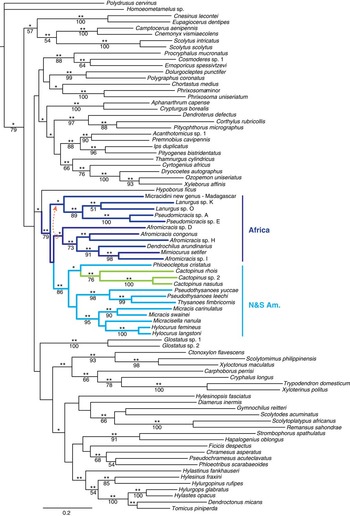
Bayesian analysis of all data resulted in topological stability with a potential scale reduction factor of 1.0 and a standard deviation of split frequencies 0.01 (Fig. 4). The parsimony analysis resulted in two trees of length 23 187 steps. The basal resolution in Scolytinae was generally weakly resolved. Hypoborus Erichson formed the sister group to Micracidini, albeit moderately supported (posterior probability=0.95, bootstrap<50). Micracidini was furthermore paraphyletic with respect to Cactopinus and Dendrochilus (including the synonymous Mimiocurus setifer (Schedl)) and formed a strongly supported clade (posterior probability=1, bootstrap=79).
Tree topology resulting from Bayesian analysis of the combined molecular and morphological data (eight data partitions). Thick branches indicate Micracidini and nested taxa. Neotropical lineages in light blue, Afrotropical in dark blue (including Dendrochilus and Mimiocurus), Cactopinus in green. Posterior probabilities above nodes (*>0.95; **1.0), bootstrap support values below. Arrow indicates the position of the Afromicracis clade in the parsimony analysis (two trees, length=23 187). N&S Am., North and South America.

All New World taxa of Micracidini and Cactopinus were monophyletic and highly supported (posterior probability=1, bootstrap=86). In the Bayesian analysis the Afrotropical taxa formed a two-step grade with a clade consisting of Afromicracis and Dendrochilus as a weakly supported sister group to the New World clade. All Afrotropical taxa were monophyletic (bootstrap<50) in the parsimony analysis. Among the micracidine genera with multiple species included, Afromicracis was paraphyletic with respect to Dendrochilus (posterior probability=1, bootstrap=91), and Pseudothysanoes with respect to Thysanoes (posterior probability=1, bootstrap=99).
The Beast analysis of the molecular data was generally congruent with the Bayesian analysis of the same data, showing highly supported clades of Micracidini (posterior probability=1) and a nested New World clade that includes Cactopinus as sister to Phloecleptus. The minimum age of Micracidini was estimated to 89.8 million years ago (74.9–106.9), the New World clade 74.8 million years ago (61.8–88.0), and the split between Phloeocleptus and Cactopinus 64.0 million years ago (51.9–75.6).
Morphology versus molecules
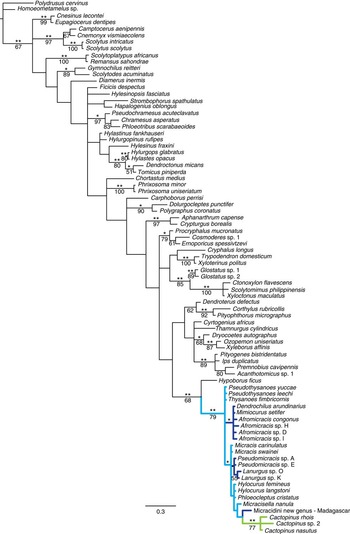
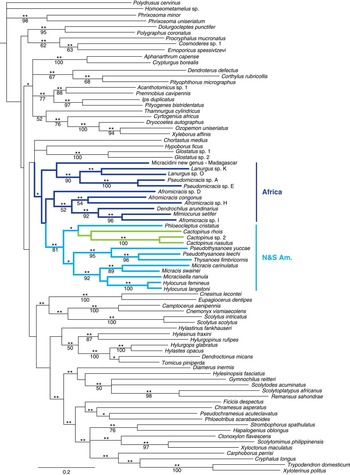
Separate analyses of the morphological and molecular data sets supported a clade of all micracidine genera, which also included Cactopinus and Dendrochilus (Figs. 5–6). Many other clades were nearly identical between the two data sets, including clades consisting of: Scolytini and Bothrosternini; Pseudochramesus Blackman, Chramesus LeConte, and Phloeotribus Latreille; Hylastini and several genera of Hylurgini; Cryphalus Erichson and Xyloterini; Corthylini, Ipini (including Premnobius Eichhoff), Dryocoetini and Xyleborini. Less congruent clades were generally not well supported. The incongruence length difference test for morphological versus the molecular data was not significant (P=0.39).
Most likely tree topology resulting from the Bayesian analysis of morphological data, based on γ distributed rate variation. This topology is identical to one of the 2146 most parsimonious trees (length=557 steps, 11 tree islands). All parsimony trees contained a monophyletic clade consisting of Micracidini, Cactopinus, Mimiocurus, and Dendrochilus. Colour and node support as in Figure 4.

Tree topology resulting from Bayesian analysis of the molecular data (five genes), based on seven data partitions (codon position per genome, and 28S). The parsimony analysis resulted in identical tree topology (length=22 541 steps). Colours and node support as in Figure 4. N&S Am., North and South America.

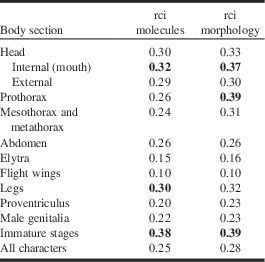
The fit between morphological characters and tree topology was generally high with an average consistency index of 0.36 and a rescaled consistency index of 0.25 as fitted to the molecular topology (Table 3). The highest average rescaled consistency index values were measured for characters on immatures (mainly head capsule features), adult mouthparts, and legs, while a much lower fit to the tree was measured for characters associated with the elytra and flight wings. Many of the nodes increased their support values with the addition of morphological data, particularly in the parsimony analyses (31 increased, two decreased). Among the nodes with synergistic increase in node support was the one connecting all Micracidini (and Cactopinus), the node subtending its sister group Hypoborus, and nine internal nodes in Micracidini (Figs. 4, 6).
The fit of morphological characters on the molecular or morphology-based topologies, as measured by the rescaled consistency index (rci).

Note: Characters are grouped by body sections, showing the three highest values in bold.
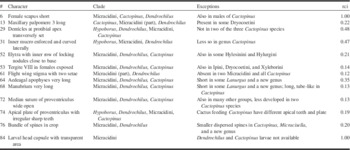
Potential synapomorphies for Micracidini were not present unless Dendrochilus was included in the tribe, a genus that is essentially identical to Afromicracis in all diagnostic features (Table 4). Micracidini and Dendrochilus share a proventricular crop with a bundle of spines just anterior to the apical plate, and, with a few exceptions, containing exactly two setae on the stigmal patch on the flight wings. Many more characters supported a clade containing the above mentioned taxa and Cactopinus, for example, a short female scapus (sometimes also in males), a long maxillary palpomere 3, a row of interlocking nodules on the basal inner flange of the elytra (also in some Hylesinini and Hylurgini), an exposed tergite VIII in females (also in Ipini and Dryocoetini/Xyleborini), very long apophyses and manubrium in the male genitalia, and a longitudinally divided and broadly separated apical plate of the proventriculus where each half contain irregularly placed, sharp teeth (less so in cactus feeding species of Cactopinus). The latter character state also supported a putative sister relationship to Hypoborus, together with the peculiar placement of the most apical denticles on protibiae being displaced posteriorly mesially making a transverse apical row of denticles (or just a single denticle) and with a strong and laterally curved inner apical spine (mucro).
Characters supporting phylogenetic relationships in Micracidini and close relatives, with the rescaled consistency index calculated for each character over the entire data matrix, including outgroups.

Note: See Supplementary material for a complete list of characters.
Discussion
Cactopinus is part of Micracidini
Our data clearly demonstrate that Cactopinus is a member of Micracidini due to its nested and well-supported position in that tribe. This was not entirely unexpected based on previous molecular analyses (Jordal et al. Reference Jordal, Gillespie and Cognato2008; Jordal and Cognato Reference Jordal and Cognato2012), but previous studies were considerably less decisive in terms of node support and revealed ambiguity about the monophyly of the tribe. We have here added two additional species of Cactopinus together with several more genera of Micracidini and combine molecular with morphological data. A close relationship between Cactopinus and the Micracidini is therefore corroborated and clearly reject alternative hypotheses that these two groups are only distantly related (Wood Reference Wood1986; Bright Reference Bright2014).
Cactopinus beetles have a unique appearance, which have led various authors to erect a separate tribe or subfamily for the genus (Blackman Reference Blackman1928, Reference Blackman1943; Chamberlin Reference Chamberlin1939; Wood Reference Wood1986; Wood and Bright Reference Wood and Bright1992; Bright Reference Bright2014). The most striking difference from other bark beetles involves a pair of horns arising from the epistoma of males (Atkinson Reference Atkinson2010). In Micracidini the females are usually the ornamented sex, particularly so in the frons and antennae, reflecting their courting behaviour. Micracidine species are generally bigynous, where the male initiate the gallery system and is joined by two successively courting females (Kirkendall et al. Reference Kirkendall, Biedermann and Jordal2014). The observation that males are the most ornamented in Cactopinus (Atkinson Reference Atkinson2010) may indicate reversed sex roles, with males courting, although no such observation has been made to date. Evolutionary changes in mating system is nevertheless a fairly labile process in scolytines and reversed sexual dimorphism is therefore not regarded as particularly indicative of relationships (Kirkendall et al. Reference Kirkendall, Biedermann and Jordal2014). In fact, several lineages in Micracidini show modifications in these traits, including Micracisella – the only monogynous genus in Micracidini – and in many Afromicracis where the two sexes are unmodified and very similar.
Paired horns are highly derived traits and autapomorphies of this kind provide no evidence for relationships to other genera lacking this trait. The relatively few other distinctive characters in Cactopinus intergrade with various micracidine genera, including a rough keel-shaped posterior part of the pronotum (e.g., less developed in some Cactopinus and present in some Lanurgus), the lack of setae on the stigmal patch of the flight wings (e.g., absent in an undescribed genus from Madagascar, occasionally present as one seta in some micracidines), and smaller dispersed crop spines in the proventriculus (as in Micracisella). We furthermore note that the very special male genitalia of Cactopinus are similar to those in Phloeocleptus – the sister group to Cactopinus in our analyses and occasionally placed close to Cactopinus in the classification (Wood Reference Wood1957). The apical plate of the proventriculus is furthermore modified for cactus feeding, and a species such as Cactopinus rhois Blackman that feed on Rhus has a proventriculus more similar to other micracidines (see Fig. 2E). Overall, there is little reason to argue that Cactopinus deserves a separate status as tribe or subfamily (contrary to Bright Reference Bright2014).
Cactopinus is one of the early offshoots from the North-American branch of Micracidini, which diverged at least some 60 million years ago, in accordance with previous studies based on the same molecular data (Jordal and Cognato Reference Jordal and Cognato2012). Many micracidine species have habitat preferences similar to Cactopinus, which are found predominantly in dry forest types and scrub landscapes (Wood Reference Wood1982; Atkinson Reference Atkinson2010). Even though the climate must have changed repeatedly over evolutionary time, the adaptation to dry forest types seems consistent in a phylogenetic perspective, with only a minority of species found today in moist or wet conditions in temperate or tropical rainforests. It is therefore particularly interesting to find another dry adapted group of beetles as a possible sister group to Micracidini and Cactopinus; Hypoborus and other genera in the tribe Hypoborini (e.g., Liparthrum Wollaston) are all found in similar dry forests of the Mediterranean type. More data are needed to confirm this relationship but we note that this result is consistent with recent phylogenetic analyses of Scolytinae genera (Jordal and Cognato Reference Jordal and Cognato2012).
Dendrochilus
The Afrotropical “mystery” genus Dendrochilus is clearly not a member of Ipini where it is currently placed (Wood Reference Wood1986). All genetic and morphological data supported a nested position of D. arundinarius Schedl within Afromicracis and therefore require transfer to this genus. We have examined the type specimens of seven of the nine known species of Dendrochilus and the morphological variation is indeed very limited across these species. Dendrochilus arundinarius is therefore fully representative for the genus, showing strong affinities with the majority of Afromicracis species characterised by obscure antennal sutures and sparse setae on the antennal scapus. As in many micracidine genera they have only few lateral socketed teeth on the protibiae, with the last apical tooth placed mesial to the lateral edge, and the inner apical spine is somewhat enlarged and laterally curved. This feature enables reliable distinction from the Ipini genus Acanthotomicus Blandford. Furthermore, the manubrium of the male genitalia is long and pointed (as long as the penis), a feature otherwise rarely observed in Scolytinae. It is therefore not surprising that the phylogenetic analyses of morphological characters also supported a nested position of Dendrochilus within Afromicracis as observed for the nucleotide data (see Figs. 4–6).
It is interesting to observe that the phylogenetic placement of M. setifer is close to D. arundinarius, requiring transfer to Afromicracis (see Figs. 4–6). This species was originally described in Mimips – a synonym of Acanthotomicus – and was later placed in the genus Mimiocurus Schedl (see Wood and Bright Reference Wood and Bright1992). It would therefore be advisable to revise other species in the genus Mimiocurus and perhaps Acanthotomicus to potentially discover further synonyms of Afromicracis.
The genus Afromicracis appears to be one of the oldest genera of Scolytinae, estimated to more than 70 million years old (64–93) based on our data. This is a much older age than other micracidine genera – especially the New World genera are much younger. The Nearctic and Mesoamerican fauna has been more intensively studied compared with the Afrotropical fauna and it is therefore quite possible that a thorough morphological and genetic study of Afromicracis will reveal morphological disparity and hence the existence of more than one genus. Until such work has been made (B.H.J., work in progress), we can only conclude that the nine species currently placed in Dendrochilus are micracidines and that M. setifer is related to these species. Very little is known about the natural history of Dendrochilus species, but the few published records on these beetles (Schedl Reference Schedl1957, Reference Schedl1958) revealed no particular ecological differences from Afromicracis.
The origin of Micracidini and its biogeographical history
Contrary to Wood’s (Reference Wood1986) hypothesis, which implies repeated divergence between the African and American continents, our data revealed only a single origin of New World Micracidini. Most analyses indicated a nested position of this clade in Micracidini, implying an Afrotropical origin for the tribe as a whole. The only other scolytine clade with similar biogeographical pattern is the genus Phrixosoma Blandford (see Jordal and Cognato Reference Jordal and Cognato2012). Although only four species of that genus were analysed genetically, it seems likely that the trans-Atlantic split in Phrixosoma reflects reciprocal monophyly and hence uncertainty in the geographical origin of that genus. Three clades in the weevil subfamily Platypodinae (Curculionidae) on the other hand indicate an African origin of Neotropical taxa (Jordal Reference Jordal2015), which is more in line with the pattern here detected for Micracidini. The age of divergence varies considerably between the three platypodine cases so there is apparently no common pattern underlying their evolutionary history. The colonisation of the New World in Micracidini occurred about the same time (late Cretaceous) as in the oldest trans-Atlantic split between the platypodine genera Periommatus Chapuis and Tesserocerus Saunders plus Tesserocranulus Schedl. That only a single ancestral population of micracidines got permanently established in the New World over such a long time span is therefore particularly illustrative for their limited dispersal capacity.
Assessment of the micracidine sister group would further illuminate the origin of the tribe. Based on genetic data (see also Jordal and Cognato Reference Jordal and Cognato2012) and our new morphological analysis, the most likely sister lineage to Micracidini is the tribe Hypoborini – here represented by the genus Hypoborus. Other potential sister groups tested in this study, such as Cactopinus and Dendrochilus, were nested within the tribe and as such were of little guidance in these questions. A complete sampling of all Micracidini genera will likely not influence much on the sister group assessment because they are all very similar to our included taxa. Traglostus is possibly a synonym of Lanurgus (Wood Reference Wood1986) in which several species has recently been synonymised (Beaver Reference Beaver2011); Saurotocis is a derived form of Pseudomicracis (B.H.J., unpublished molecular data); Stenoclyptus may be a synonym of Pseudothysanoes (Wood Reference Wood1986). The East African Phloeocurus is typical Afrotropical micracidine, intermediate between Pseudomicracis and Lanurgus in the shape of the antennae and declivity outline. The least known genus is the monotypic Stevewoodia, but it has all defining characters of Afromicracis and therefore could be an Afrotropical species introduced to the Caribbean area. Although we cannot yet conclude on the Micracidini sister relationship, it makes sense that a clade of dry adapted hypoborine beetles from mainly the Mediterranean and the arid parts of the Afrotropical and Malagasy regions (Jordal et al. Reference Jordal, Kirkendall and Harkestad2004) forms the sister group to the dry adapted micracidine clade. Surely it will demand more molecular data to confirm this relationship, and we are currently optimising 13 additional genes for this purpose.
The application of morphological characters in Scolytinae phylogeny
This study is the first to include a large number of morphological characters in a phylogenetic analysis of a large number of scolytine genera. Although some incongruence was apparent between molecular and morphological data, the agreement between them was generally very high. In fact, the addition of 88 morphological characters to the molecular matrix resulted in substantially higher node support for many congruent nodes and as such document great value of including even a modest number of morphological characters in phylogeny reconstruction (Wiens Reference Wiens2003). When comparing nodes that were incongruent between the two data sets, none obtained high node support, which further emphasise the low conflict between these data sets. That previous classifications (Hopkins Reference Hopkins1915; Wood Reference Wood1978, Reference Wood1986; Bright Reference Bright2014) conflict strongly with our analyses suggest that these classifications were based on either insufficient data, or a total absence of proper character evaluation in a phylogenetic context.
At least some characters for each body part contributed to the phylogenetic resolution and there was no apparent difference in the information potential between internal and external characters. Even the most homoplasious groups of characters – such as those coded from flight wings and elytra – were at least partly diagnostic for smaller clades. One such example is the consistent presence of locking nodules along the internal rim of the elytra (just behind the scutellum) in Micracidini and Cactopinus while at the same time this character varied considerably in Hylurgini and Hylesinini where it is supposed to be invariably present (see Wood Reference Wood1978). Internal or otherwise hidden characters from the mouthparts, proventriculus, or male genitalia, were particularly informative for Micracidini and close relatives and has previously demonstrated great use in resolving other scolytine tribes such as Dryocoetini and Xyleborini (Jordal et al. Reference Jordal, Beaver, Normark and Farrell2002a), Crypturgini (Jordal and Hewitt Reference Jordal and Hewitt2004), and in Polygraphini (Jordal Reference Jordal2009). The dissection of internal structures and membranes also resulted in some surprising discoveries. For instance, the suture separating the postnotum from the metanotum is presumably complete in all genera that Wood (Reference Wood1978, Reference Wood1986) classified as “Scolytinae” as well as in some “Hylesininae”, but we nevertheless found a fused postnotum in several genera of Cryphalini, but not in Cryphalus. The postnotum was also fused to the metanotum in Scolytoplatypodini (Remansus Jordal and Scolytoplatypus Schaufuss) and Hexacolini (Gymnochilus Eichhoff and Scolytodes Ferrari) – again reflecting the molecular data. Without going into further details here, it is clear that a thorough study of scolytine morphology is needed to correct apparent errors in character assessment that have led to mistakes in classification of genera and tribes. This will be a topic for future studies that involves morphological dissections and DNA sequencing of almost 200 scolytine genera.
Acknowledgements
The authors would like to thank T. Atkinson and V. Grebennikov for providing some of the more important samples in this study. This research was funded by the Norwegian research council grant 214232/F20.
Supplementary material
Appendices describing morphological characters and nexus file are available online at http://dx.doi.org/10.4039/tce.2016.31.