



1. Introduction
Massive stars (M $_* \geq 8$ M
 $_\odot$) are very luminous (10
 $^{4}$–10
 $^{6}$ L
 $_\odot$), but span effective temperatures from cool Red Supergiants (
 $T_{\mathrm{eff}} \geq$ 3000 K) to hot OBA stars (
 $T_{\mathrm{eff}} \geq$ 10000 K). They are located in the upper part of the HR diagram, being very rare objects, which depending on the initial mass function, represent less than 5% of the stars in Galaxy. They are used to map star forming regions and consequently, the spiral arms.
Despite their rarity, massive stars play a fundamental role in the evolution of their host galaxies Eldridge & Stanway (Reference Eldridge and Stanway2022). A large amount of the global energy budget of these galaxies comes from the powerful ionizing radiation of massive stars, which also shapes the local interstellar medium, forming large H ii regions. The strong wind, throughout the life of these stars, deposits large amounts of momentum and energy into the local interstellar medium Castor (1993). The intense mass loss, via winds or eruptions, from the main-sequence to their Supernova (SN) explosions, makes massive stars the main sources of carbon, oxygen and heavy elements for the interstellar medium. Therefore, they are responsible for the fundamental material for building planets and even life. The combination of intense radiation and strong winds from multiple massive stars can trigger new star formation events or even the destruction of the maternal molecular clouds.
However, even considering their importance, many questions remain unanswered regarding the evolution of massive stars. How do they form? How do they evolve from the main-sequence to a SN explosion? Do all massive stars explode as SN? What are the mechanisms that trigger mass-loss/winds? What is the origin (and role) of their magnetic fields? What is the link between the different observational and evolutionary phases? Many of these questions are the focus of different articles in these proceedings.
However, the main focus of this work is the characterization of mass-loss products, such as winds, disks, rings, and pseudo-atmospheres, as well as the identification of companions, their influence, and the determination of binary or multiplicity fractions across different classes of massive stars. To better understand these topics, the high angular resolution provided by speckle and optical long-baseline interferometry is an important tool that has been used by our group in collaboration with the following colleagues: Dr. Tiago Batista Souza (Universidad de Valparaíso, Chile), Dr. Armando Domiciano de Souza (Observatoire de la Cotê d’Azur/UniCA, France), Dr. Anthony Meilland (Observatoire de la Cotê d’Azur/UniCA, France), Dr. Catalina Arcos (Universidad de Valparaíso, Chile), Dr. Michel Curé (Universidad de Valparaíso, Chile), and Dr. Michaela Kraus (Astronomical Institute of Czech Academy of Sciences, Czech Republic).
Therefore, this article has the following structure: Section 2 describes speckle and optical long-baseline interferometry and their applications; Section 3 shows the results of companions identification in a sample of Be stars from northern and southern hemispheres, as well as the preliminary characterization of the circumstellar medium of B[e] Supergiants. Section 4 introduces the project OCEANS and Section 5 presents the conclusions and perspectives for the use of interferometry in the study of massive stars.
2. Speckle and Optical Long-baseline Interferometry
As previously cited, the high angular resolution provided by interferometry has been an ideal tool for studying massive stars. There are many papersFootnote 1 related to this application associated with different classes of massive objects: (i) OB stars Frost et al. (Reference Frost, Sana and Le Bouquin2025); (ii) Be stars Guerrero et al. (Reference Guerrero, Souza, Borges Fernandes and Guajardo Jurado2025); (iii) Wolf-Rayet Deshmukh et al. (Reference Deshmukh, Shenar and Mérand2025); (iv) Luminous Blue Variables Weigelt et al. (Reference Weigelt, Hofmann and Schertl2021); (v) B[e] Supergiants Wang et al. (Reference Wang, Weigelt and Kreplin2012); (vi) Red Supergiants Ohnaka et al. (Reference Ohnaka, Hofmann and Weigelt2024); and Yellow Hypergiants Anugu et al. (Reference Anugu, Baron and Monnier2024). For our study, speckle and optical long-baseline interferometry have been used to study Be stars and B[e] supergiants.
2.1. Speckle Interferometry
Speckle interferometry is characterized by analyzing the interference effects due to atmospheric turbulence in short exposure images, where it is possible to achieve observations limited by the diffraction limit of the telescope and not by the seeing Labeyrie (Reference Labeyrie1970). Images with exposure times shorter than the coherence time freeze atmospheric effects. Therefore, stars are not seen as point sources, but as a granular structure, called speckles. In the case of binary or multiple systems, the speckles have an interference pattern that can be identified by the Fourier analysis.
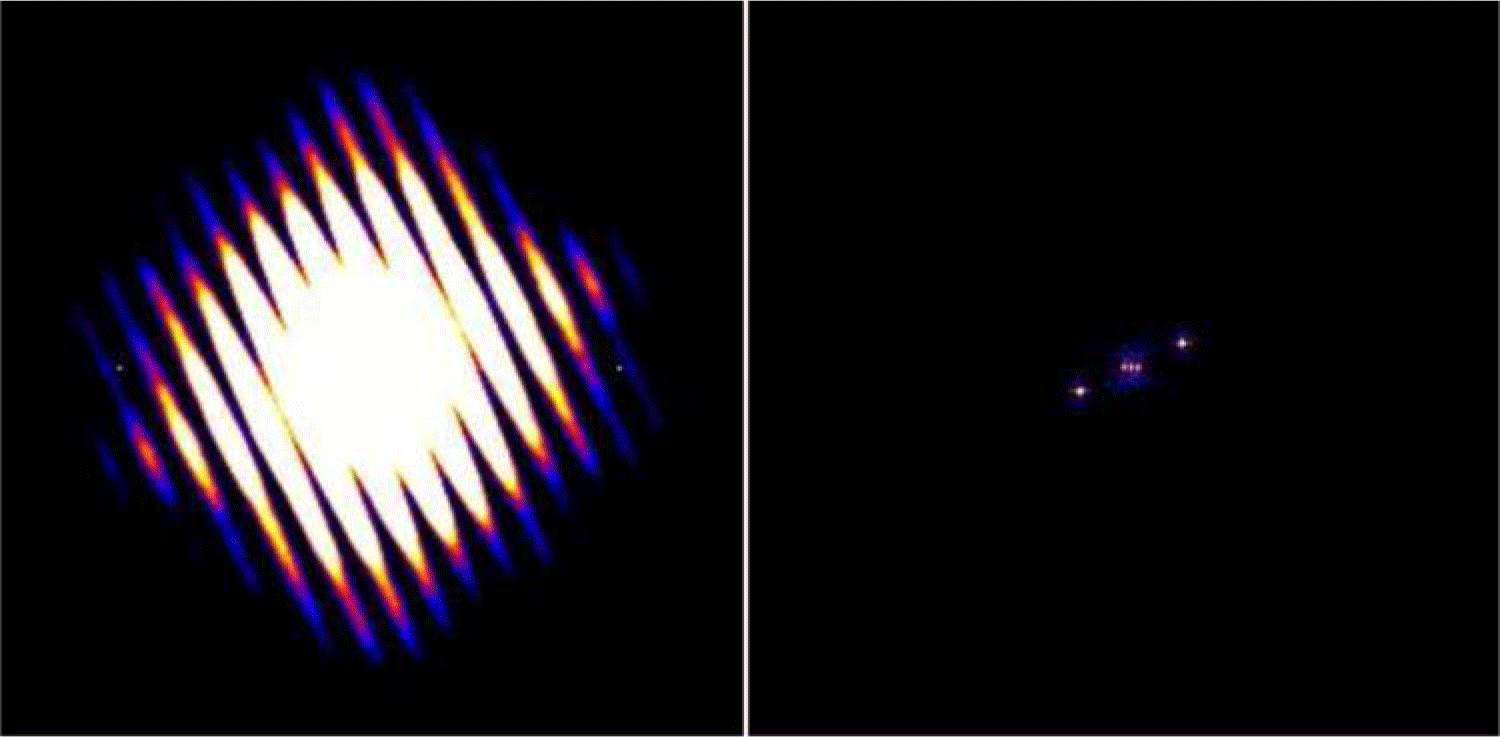
A fits-cube of 1000 images of 20 ms each, for every star and for different filters, e.g, V, R and I, is taken and data reduction follows a standard process Guerrero et al. (Reference Guerrero, Souza, Campos, Borges Fernandes and Campagnolo2018). The mean value of the square modulus of the Fourier transform of all images is derived, the power spectrum (PWS). For a binary or multiple system, the PWS shows bright and dark fringes (Figure 1). The distance between the maxima of the fringes is associated with the separation of two or more stars, while the axis perpendicular to the fringes represents the position angle of the system. The contrast of the fringes is associated with the magnitude difference between the stars in the system.
The PWS (left panel) and the ACF (right panel) of the binary system WDS J09285+0903.

By applying the Fourier transform to the PWS, we obtain the autocorrelation function (ACF) that preserves the PWS information and provides a clearer representation. We have the presence of a central maximum, representing the primary star, and also secondary maxima, associated with the companions (Figure 1). The secondary maxima are composed of symmetrical pairs with respect to the central maximum and exhibit an ambiguity of 180 $^{\circ}$ related to the position angle. This ambiguity can be resolved using a high-resolution image created by adding all the individual images.
The main advantage of speckle interferometry is its simple and cheap technical configuration that needs a fast-transfer CCD, microscope lens and a filter wheel. More than one filter is necessary to optimize both spatial resolution and photometric contrast across different spectral types. Another advantage is the possibility of using small and medium-sized telescopes to achieve the diffraction limit. Based on this, our group has used the 1.6-m telescope at the Pico dos Dias Observatory (OPD) in Brazil and the 2.1-m telescope at the San Pedro Martir Observatory (SPM) in Mexico to perform observations of southern and northern Be stars, respectively, searching for new binary or multiple systems Souza et al. (Reference Souza, Guerrero and Borges Fernandes2020); Guerrero et al. (Reference Guerrero, Souza, Borges Fernandes and Guajardo Jurado2025). Using V, R and I filters, we have achieved diffraction-limited resolutions of 0.074", 0.081", and 0.11", respectively, in Brazil and of 0.053”, 0.067”, and 0.088”, respectively, in Mexico.
2.2. Optical Long-Baseline Interferometry
The optical long-baseline interferometry is characterized by the combination of light from two or more telescopes, creating an interference pattern. This makes it possible to achieve an angular resolution associated with the projected separation of the telescopes on the sky (the baseline) rather than with the mirror diameters. With the longest VLTI baselines, the K-band angular resolution is of order 1 mas Mourard & Nardetto (Reference Mourard and Nardetto2019).
The interferometer effectively measures the fringe contrast, which is called visibility, and also differential and closure phases. Thanks to van Citter-Zernike theorem, we know the visibility is related to the Fourier component of the brightness distribution of the source. Actually, the visibility is proportional to the amplitude of the Fourier component, which corresponds to a spatial frequency in the Fourier space. On the other hand, the phase of the fringes is the phase of the Fourier component with the same spatial frequency, being important to derive the orientation of the observed object on the sky. The closure phase is the sum of the phases from three beams (baselines/telescopes), forming a “closure triangle”, eliminating the atmospheric effects and probing departures from centrosymmetry in the brightness distribution of the source.
Optical long-baseline interferometry has became an important tool to identify close binary systems, to study the shape of rotating stars and also the circumstellar environment of bright stars, describing the presence of disks and rings. Recently, we have observed a sample of Galactic B[e] Supergiants with VLTI/GRAVITY that operates in the K-band, between 2.0 and 2.4  $\mu$m. It combines 4 telescope beams, providing 6 baselines, 4 closure-phase triangles (three of which are independent), 6 differential phases and around 1,600 visibilities.
3. Results
3.1. Binary fraction of Be stars
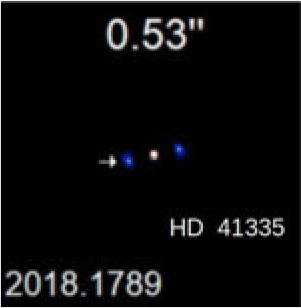
Using the speckle interferometry, we have searched for binarity or multiplicity in two samples of Be stars. From the OPD, we observed a sample of 24 southern Be stars, with 7 possible binary or multiple systems, 3 of them identified for the first time, with separations ranging from 0.10" to 6.69" Souza et al. (Reference Souza, Guerrero and Borges Fernandes2020). Using the SPM, a sample of 46 northern Be stars was observed Guerrero et al. (Reference Guerrero, Souza, Borges Fernandes and Guajardo Jurado2025). Twelve possible binary or multiple systems were identified, 5 of them for the first time. Separations ranging from 0.08" to 0.85" were measured. For two systems, we possibly found an outer third companion, where the closer companions are not seen by us, but identified in the literature. The triplicity in these systems may cause the migration of the closer companion inward due to dynamical interactions, causing its merger with the primary or mass transfer, forming a faint stripped companion Dodd et al. (Reference Dodd, Oudmaijer, Radley, Vioque and Frost2024). This is the case of HD 41335, seen in Figure 2, where an inner companion, the Be star circumstellar disk and also a circumbinary disk were identified using CHARA and VLTI/GRAVITY data Klement et al. (Reference Klement, Rivinius and Gies2024).
The ACF of the possible triple Be system HD 41335 Guerrero et al. (Reference Guerrero, Souza, Borges Fernandes and Guajardo Jurado2025). The arrow indicates the actual position of the outer companion. Its separation and the Julian epoch of the obsevation are also indicated in the figure.

It is important to note that due to the limited time coverage of our observations, we can only identify companion candidates and follow up observations are necessary. However, for known binary systems, each observation provides direct measurements of separation, position angle, and magnitude difference, which are compared to historical data from the literature to refine orbital parameters.
From our analysis, we found multiplicity rates amongst Be stars of  $\sim$26%, considering the sample observed at SPM, and of
 $\sim$30%, for the OPD’ sample, in agreement with the literature Dodd et al. (Reference Dodd, Oudmaijer, Radley, Vioque and Frost2024). However, these are just observed multiplicity rates, as potentially missed objects should be taken into account, like companions that are too close, or too widely separated, or too faint.
3.2. The circumstellar medium of B[e] Supergiants
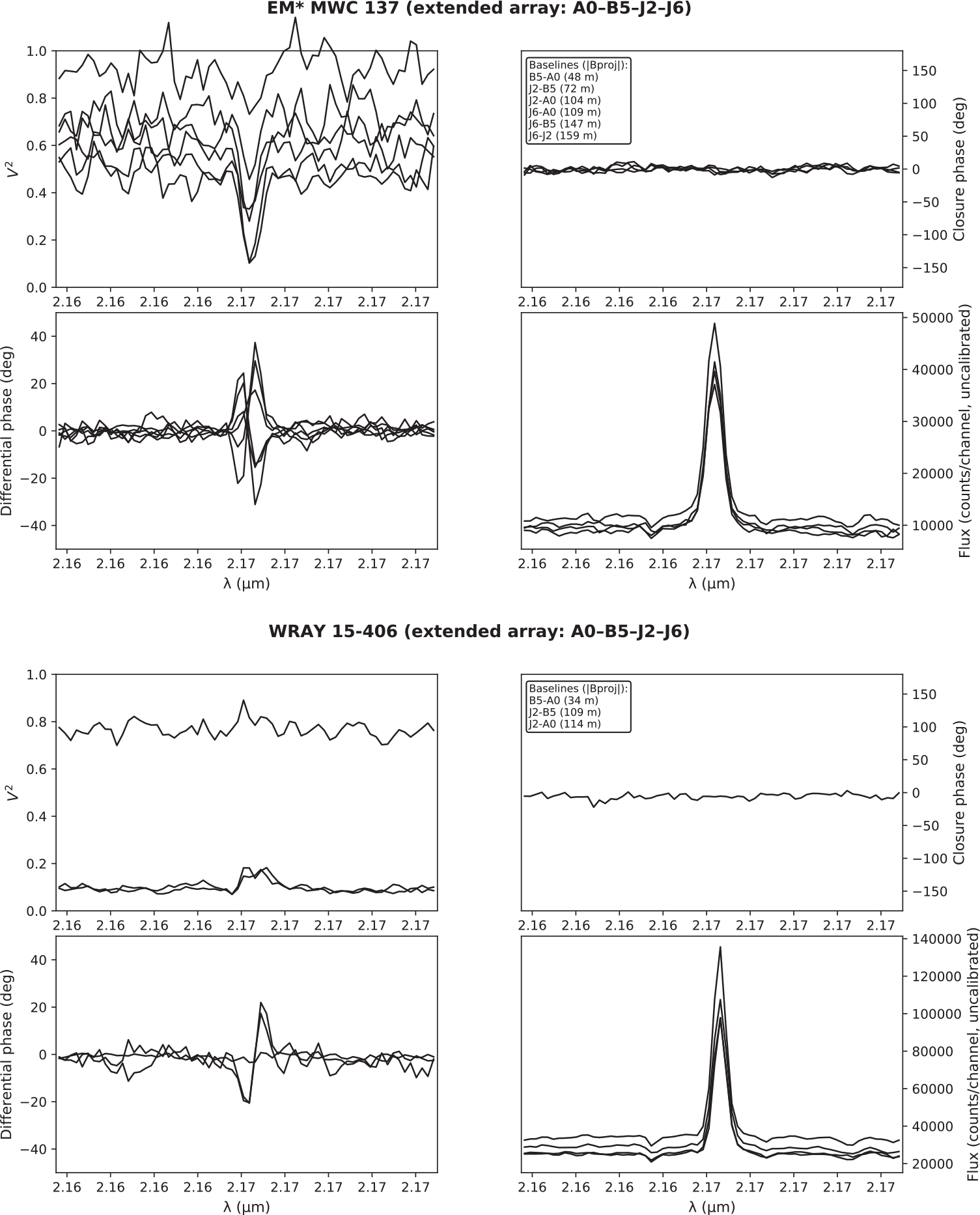
Our group observed a sample of B[e] Supergiants with VLTI/GRAVITY to describe the circumstellar environments (geometry, kinematics, and physical conditions) of these objects. Our preliminary results for two objects are very interesting showing a different behaviour for each one of them. We obtained calibrated visibilities, differential and closure phases, and fluxes. For both stars, the Br <sc>  $\gamma$</sc> line, which traces hot ionized hydrogen (recombination), is in emission. For EM
 $^*$MWC 137, there is a drop in the visibilities across the Br <sc>
 $\gamma$</sc> line (Figure 3), indicating a more extending gaseous region than the continuun. The opposite is seen for WRAY 15-406 (also in Figure 3), where Br <sc>
 $\gamma$</sc> line is formed in a more compact region than the continuum in the K-band. This behaviour is similar to that one expected for young stars, like Herbig Ae/Be Garcia Lopez et al. (Reference Garcia Lopez and Natta2024), but not for evolved supergiants. Concerning the differential phases, both stars show the S-shape behaviour indicating the presence of a rotating gaseous disk Meilland et al. (Reference Meilland, Millour and Kanaan2012). The closure phases of both stars do not show any signal of asymmetry in the K-band emitting region.
VLTI/GRAVITY observations of two B[e] supergiants from our sample: EM* MWC 137 (top panels) and WRAY 15-406 (bottom panels). Each row shows, from left to right, the calibrated squared visibilities ( $V^2$), closure phases, differential phases, and uncalibrated flux. All observations were obtained with the extended-array configuration of the Auxiliary Telescopes (A0B5J2J6), providing six projected baselines for the
 $V^2$ and differential-phase measurements, and four closure-phase triangles (three of which are independent). The corresponding projected baseline lengths (
 $|B_\mathrm{proj}|$) are indicated. For WRAY 15-406, only three
 $V^2$ (and one closure-phase; J2-B5-A0) measurements are available due to quality flags in the data. Fluxes are shown for each of the four telescopes.

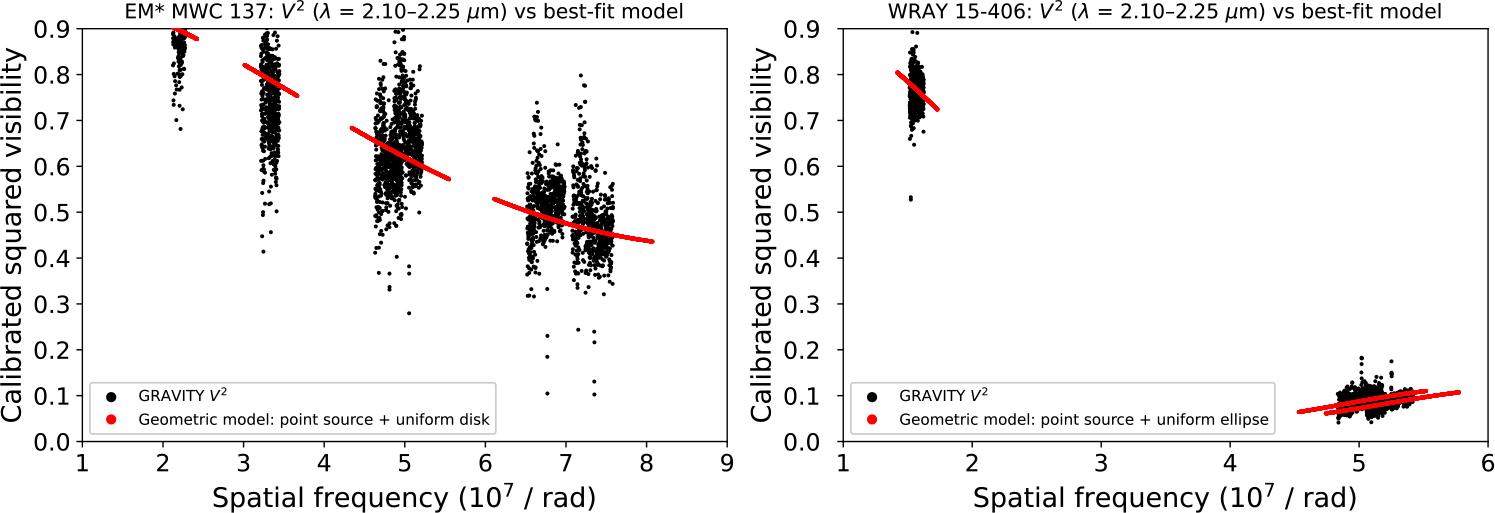
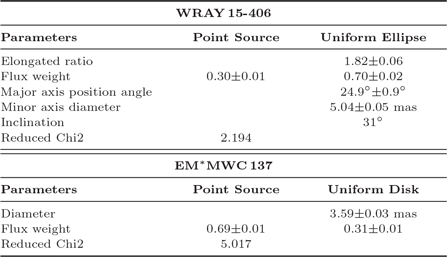
From the modeling, using geometric models provided by LITproFootnote 2 (Lyons Interferometric Tool prototype), developed by the Jean-Marie Mariotti Center (JMMC), we derived the best scenarios to reproduce the visibilities. For WRAY 15-406, the best model is assuming a point source, which represents the central star, and a uniform ellipse for the circumstellar emitting region. For EM $^*$MWC 137, the best model is combining a point source (central star) with a uniform circular disk (circumstellar region). The best geometric models for both stars are shown in Figure 4 and their parameters in Table 1.
The best geometric models for reproducing the visibilities obtained with VLTI/GRAVITY from six projected baselines for EM $^*$MWC 137 (left panel) and from three projected baselines for WRAY 15-406 (right panel), as shown in Figure 3.

Parameters of the best geometric models for reproducing the visibilities of EM $^*$MWC 137 and WRAY 15-406.

Table 1 Long description
A table comparing parameters of geometric models for two stars, WRAY 15-406 and EM*MWC 137. The table has two sections, each with two columns: Parameters and two model types. For WRAY 15-406, the models are Point Source and Uniform Ellipse. For EM*MWC 137, the models are Point Source and Uniform Disk. Each section lists specific parameters such as elongated ratio, flux weight, major axis position angle, minor axis diameter, inclination, and reduced chi squared. The values for each parameter are provided for both model types.
4. The OCEANS Project
Aiming to investigate in great detail the physical properties and evolution of massive stars, especially impacted by binarity or multiplicity, an international network among 16 institutes from Europe and Americas was created, with a multidisciplinary team composed of theoreticians and observers. This is the OCEANS projectFootnote 3 (”Overcoming Challenges in the Evolution and Nature of Massive Stars”), led by Dr. Michaela Kraus (Astronomical Institute of Czech Academy of Sciences, Czech Republic) and involving more than 90 researchers, postdocs and PhD. students. It is funded for 4 years by the Marie Skłodowska-Curie Action (MSCA) Staff Exchange within the Horizon Europe framework. OCEANS is based on collaborating visits, the organization of schools and the development of numerical codes to analyse data obtained from observational campaigns using the different facilities to which the members of the institutes may have access.
5. Conclusions and Perspectives
The high angular resolution provided by interferometry is an important tool for the study of massive stars. Speckle interferometry is a simple technique using small and medium-sized telescopes for the identification of binary or multiple systems and to improve orbital solutions. The increase of the number of observed stars and of their diversity will allow us to derive more precise binary fractions, contributing for a better comprehension and improvement of stellar and population evolutionary models.
On the other hand, optical long-baseline interferometry and its angular resolution in the sub-arcsecond regime is crucial for the identification of close binaries and the precise description of the geometry of gaseous and dusty circumstellar environments. More data and the application of kinematical and physical models are necessary to better understand the nature of these objects and the processes associated with the Be, B[e] and other related phenomena.
Acknowledgments
This project is co-funded by the European Union (Project 101183150 - OCEANS). M.B.F. acknowledges financial support from the National Council for Scientific and Technological Development (CNPq) Brazil (grant No. 307711/2022-6). E.S.G.A. acknowledges support from the National Council for Scientific and Technological Development (CNPq, Brazil) through the Conhecimento Brasil program (BCB-1; grant Nos. 315004/2025-8 and 447563/2024-6).
 V2
 V2
 |Bproj|
 V2
 ∗
 ∗


