Introduction
Proton radiation therapy is emerging as a powerful radiation therapy techniques because of its ability to deliver conformal and uniform dose distributions that provides superior tumour dose coverage and sparing of nearby critical structures in comparison with photon radiation therapy.Reference Noël and Antoni1,Reference Schlegel, Bortfeld and Grosu2 Proton beams deliver dose to a region-of-interest without exit dose beyond the tumour which spares surrounding normal tissue.Reference MacDonald, Trofimov and Safai3,Reference Krejcarek, Grant, Henson, Tarbell and Yock4 In addition, protons as charge particles interact with higher energy transfers along their tracks in the medium than photons or electrons which provides superior radiobiological effects that allows better tumour control.Reference Tommasino and Durante5,Reference Girdhani, Sachs and Hlatky6 Proton therapy will most likely follow a similar trend as photon therapy which began with relatively simple delivery techniques using static, open fields delivered from few gantry angles. Over time the dose delivery systems gradually progressed to more complicated delivery techniques which now include multi-leaf collimator (MLC) for conformal field shaping and arc therapy achieving more conformal target coverage.Reference Teoh, Clark, Wood, Whitaker and Nisbet7 This increasing complexity of the beam delivery systems may be the future of proton therapy as well. Currently, conformal proton therapy (CPT) is delivered with few fields which consist of static fields with each having its own customised aperture and compensator using scattering or proton intensity modulation with scanning systems which does not make use of the full potential of proton therapy.Reference Vargas, Fryer and Mahajan8
Early investigations compared the dose distributions from proton arc therapy (PAT) with electron arc therapy using a Rando phantom chest wall on a rotating platform.Reference Sandison, Papiez, Bloch and Morphis9 This study showed that the dose distributions for PAT are more conformal to the target with much less dose and integral dose to the left lung in comparison with electron arc therapy. Non-small cell lung patients treated with stereotactic body radiation therapy were replanned with proton arcs using proton passive scattering beams, intensity-modulated proton beams and volumetrically modulated photon arc therapy (VMAT).Reference Seco, Gu, Marcelos, Kooy and Willers10 The PAT plans were produced using 8–14 coplanar beams separated by 10° with an in-house treatment planning system. This simulation study showed that PAT plans produced high conformal doses for the tumour in comparison with standard proton plans and significantly lower lung doses in comparison to VMAT. Another study investigated PAT using a novel spot-scanning algorithm for lung and head and neck (H/N) cancer patients.Reference Ding, Li, Zhang, Kabolizadeh, Stevens and Yan11 They found that the PAT plans had better conformality for the tumour, lower skin dose and significantly smaller integral lung dose in comparison with traditional intensity-modulated proton therapy. Although the previous studies indicated the dosimetric advantages of PAT, it is still practically hard to implement clinically because of the limitations of the hardware and software components that are available on commercial proton therapy systems. Particularly, the main challenge is moving the heavy gantry during PAT. The goal of this study is to investigate the feasibility of performing PAT with the MEVION proton system introduced recently as a compact single-room machine where the cyclotron is mounted and integrated with the gantry. This study represents a simulation of PAT and quantitative evaluation of the dose coverage of the tumour and sparing of the surrounding normal tissue utilising the MEVION-S250 double-scattering proton therapy system.
Materials and Methods
MEVION-S250 proton therapy system
The MEVION-S250 system is a compact single room, passively double-scattering system (MEVION Medical Systems, Littleton, MA, USA). Protons are accelerated to a nominal energy of 250 MeV within the synchrocyclotron accelerator.Reference Zhao, Sun and Grantham12–Reference Klein and Bradley14 After the acceleration stage, the protons pass through beam shaping devices including two passive scatterers which widen and flatten the beam. Then, the beam passes through 1 of 14 range modulation wheels creating the desired spread-out Bragg peak (SOBP), 1 of 2 absorber wheels setting the desired range and final fine tuners for fine beam shaping. The system provides proton beams with clinical ranges from 5·0 to 32·0 g/cm2 and maximum circular field sizes up to 25 cm diameter. Once the beam is accelerated and set to the desired range and modulation, the double-scattering system traditionally conforms the distal end of the beam with patient- and field-specific compensators while the beam is shaped to a field-specific brass aperture. The compensators and apertures are mounted on the proton gantry using a retractable applicator near the patient. This applicator is attached to the in-room gantry which can rotate a total of 195°.Reference Chen, Bloch, Hill and Klein15 The patient is set up on a robotic couch which has 6-degrees of motion allowing for 3-translational and 3-rotational shifts to correct patient position using image-guided radiation therapy with an on-board kV-imager.Reference Zhao, Sun and Grantham12
PAT simulation
In this study, PAT was simulated using multiple proton beams (5–15) with an average static single fixed conformal aperture (SPAT) for all beams and dynamic conformal aperture (DPAT) from the different beam-eye-views (BEVs). The beams were designed to deliver dose from different directions that simulate partial arcs spanning 90–180° from the proximal side of the tumour without the use of tissue compensators to compensate from surface curvatures and heterogeneities. The conformal apertures were obtained by considering a hypothetical MLC to shape the aperture in each BEV to cover the planning target volume (PTV) and spare normal tissues. The dose parameters from the arc plans were compared quantitatively with conventional proton plans that used customised aperture and tissue compensator specific from each beam.
PAT simulations with a dynamic conformal aperture (DPAT)
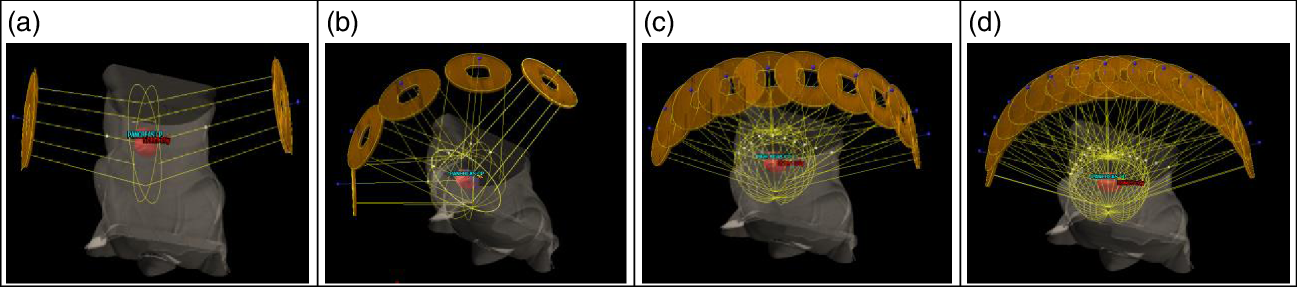
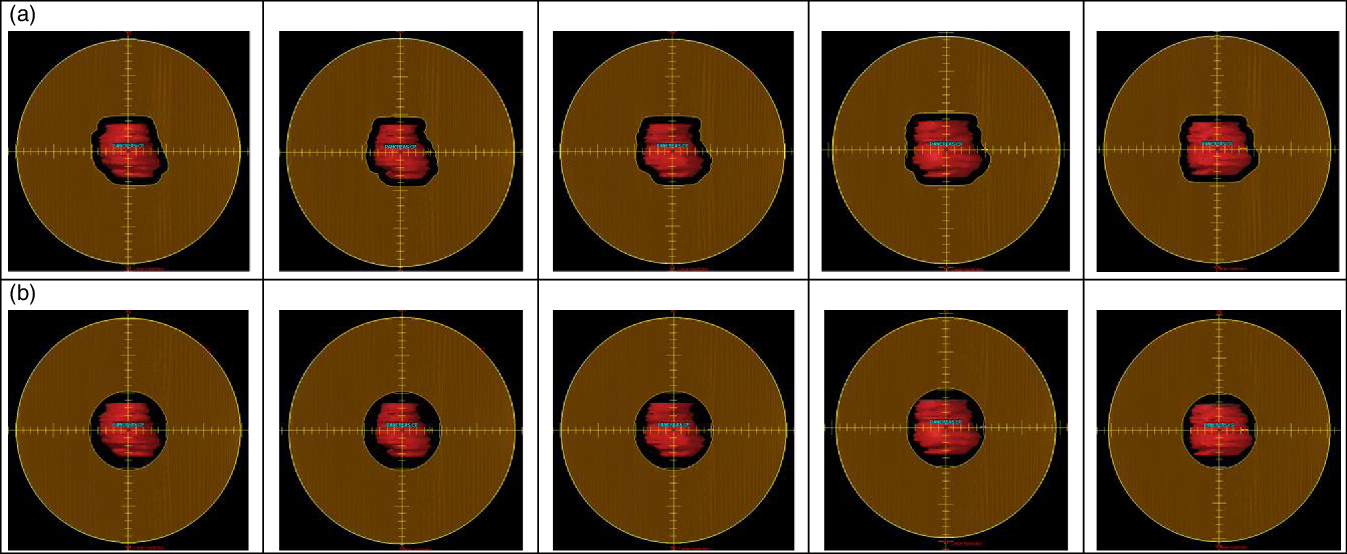
DPAT was simulated with 5, 10 and 15 coplanar fields using the MEVION-S250 proton therapy system as shown in Figures 1a–1d. The Eclipse-treatment-planning system (Varian Medical Systems, Inc., Palo Alto, CA, USA) was used to design conformal apertures for each beam based on the PTV shape in that specific angular view with 1 cm margin to achieve optimal dose coverage laterally as shown in Figure 2a. The required range and modulation (R i) for each field that provides the optimal conformal dose coverage of the PTV was calculated by the treatment planning system which used the PTV maximal length, L max, and depth, d max, along the central-axis of the beam at that certain angular view, i, for the spread-out Bragg Peak, SOBPi, as given by the following equation:
 $$SOB{P_i} = {R_i}({L_{\max }},{d_{\max }})$$
Beam arrangement used for (a) conventional proton plans with two beams with specific aperture and compensator, (b) 5-conformal beams, (c) 10-conformal beams and (d) 15-conformal beams used to simulate proton arc therapy.

(a) BEVs of dynamic conformal apertures with five different views for a pancreatic tumour (DPAT), (b) BEV with five different views using one fixed static circular aperture (SPAT).

The arc plans in this simulation study were designed without a compensator as usually done in conventional proton planning to account for surface curvature of the patient and tissue heterogeneities in the beam path. To account for dose delivery uncertainties without a compensator, a PTV similar to photon therapy was used. Smearing and smoothing techniques were not applicable to this simulation since a range compensator was not used. Furthermore, distal and proximal margins were not applied to the beam as these uncertainties were considered using the PTV which was irradiated from different directions as done with photon therapy.Reference Seco, Gu, Marcelos, Kooy and Willers10 The increasing number of coplanar fields was intended to simulate continuous, full or partial arcs since the MEVION system does not provide continuous arc capability. The different beams in the arc configurations were equally separated (from 10 to 45°, depending on the total arc angle) and spanned the same arc angles for each configuration. In some cases, fields within the arc were omitted to minimise the dose to nearby critical organs. For example, in the case of the pancreatic tumour, any field angles passing directly through the spinal cord were removed.
PAT simulations with a single static aperture (SPAT)
In this study, a practical approach of arc proton planning was employed considering the limitation of dose delivery with gantry rotation and lack of a multi-leaf-collimator in the MEVION system. This technique was performed considering a single average conformal aperture to cover regularly shaped spherical and cylindrical targets in the different treatment sites simulated in this study which include a prostate, pancreas, lung, H/N and brain as shown in the second row in Figure 2b. This field size was optimised considering dose coverage needed to cover 100% of the PTV with the 95% isodose line during the forward planning process. The average conformal opening of the aperture at a certain beam-eye-view, BEV C, from different angular views (BEV i) of the PTV is given by the following equation:
 $$BE{V_C} = {{1}\over{n}}\sum\limits_{i = 1}^n {BE{V_i}} \left( {A_i^{PTV}, M} \right)$$
where n is the number of beams employed in the arc proton plan, AiPTV is the area of PTV in the ith BEV and M is a margin to account for the proton beam penumbra. This simulation provides a practical approach for the MEVION system where one single circular aperture was used for all beams as shown in Figure 2b. This aperture will be attached to the gantry once at the time of patient setup without the need for compensators at the start of the procedure where dose is delivered from different discrete gantry angles without the need for an MLC to conform the beams in the different BEVs. Furthermore, this removes the need to go into the room to change aperture during treatment.
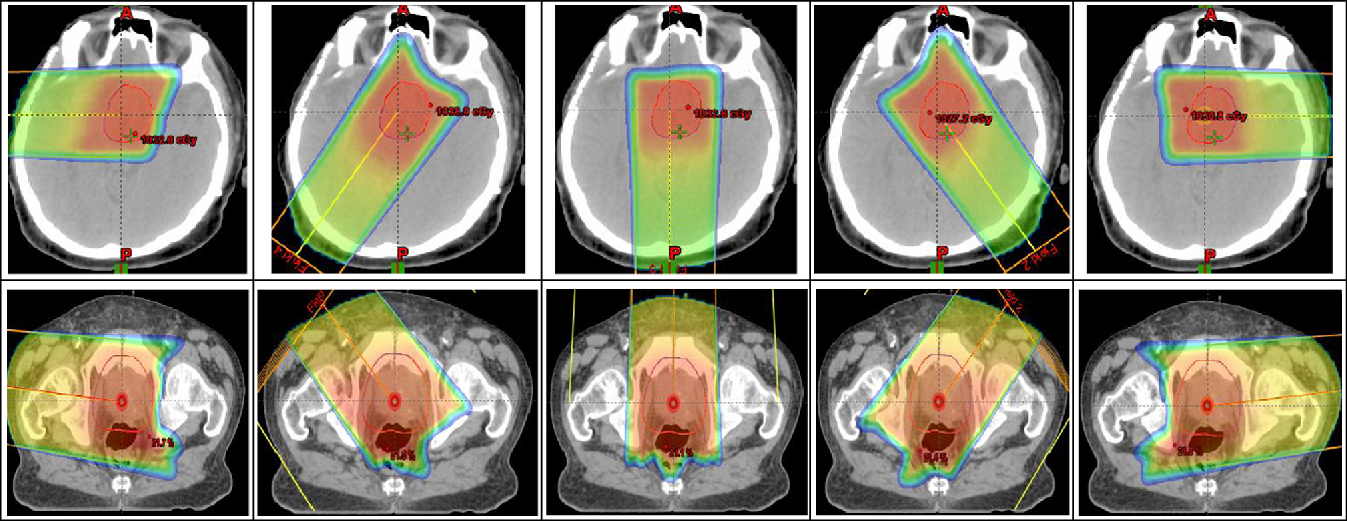
In this simulation, all beams were equally weighted and each beam contributed nearly equal dose towards the cumulative dose delivered as shown in Figure 3. Dose conformality was achieved by a combination of conformal average aperture and range modulation by the proton beam. First, the depth and range modulation of each proton beam are calculated and optimised by the treatment planning system, where the deepest and shallowest edges of the PTV were used to determine the distal and proximal edges of the proton profiles as given by Equation (1). Second, the average conformal aperture with a margin of nearly 1 cm provides lateral conformality for a fraction of the dose delivered by each beam in the proton arc at a specific BEV as given by Equation (2). Third, dose spillage or deficiency forms the average conformal aperture, and depth and range modulation of the beams from irregularities in the shape of the target are compensated by delivering fractional dose by each beam in the proton arc from the different directions to obtain conformal dose coverage of the PTV in 3D.
The dose contribution from each conformal beam for a brain proton plan with a total of five beams in the first row and for a prostate in the second row.

Dose evaluation
The PTV dose coverage from the arc plans was compared with conventional proton plans, which were planned with two fields with a conformal aperture and compensator for each field. The dosimetric parameters of Dmin, Dmax, Dmean, D98, D50 and D33 of the PTV were used to compare the two-field CPT plans to the PAT plans. Additionally, the conformality indices (CIs) and homogeneity index (HI) were used for dose comparison between the different arc and conventional proton plans.Reference Paddick16,Reference Feuvert, Noël, Mazeron and Bey17 The CI is given by the following:
 $$CI = {{{{{(T{V_{PIV}})}^2}}}\over{{TV \times PIV}}$$
where TV is the total volume of the PTV in cm3, PIV is the volume (cm3) covered by the desired prescription isodose and TV PIV is the volume common between the two previous volumes in cm3. The heterogeneity index is given as follows:
 $$HI = {{{{D_{2\% }} - {D_{98\% }}}}\over{{{D_P}x100}}}$$
where D 2% is the minimal dose (in cGy) received by 2% of the PTV, D 98% is the mammal dose (in cGy) received by 98% of the PTV and DP is the prescription dose (in cGy).
Results
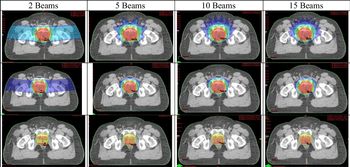
Figure 4 shows the dose distribution with a display cut-off doses at 20, 40 and 95% isodose lines for two-field CPT and 5, 10 and 15 field fixed-PAT for a nearly cylindrical prostate target. It can be seen that by adding more coplanar conformal beams, the low-dose levels are spread out more around the target. Additionally, the 95% dose level shows increasing conformal dose with increasing the number of beams per arc.
Dose distribution for a prostate target with lower dose cut-off at 20% in the first row, 40% in the second row and 95% in the third row planned with 2-beam CPT in the first column, 5-beam PAT in the second column, 10-beam PAT in the third column and 15-beam PAT in the fourth column.

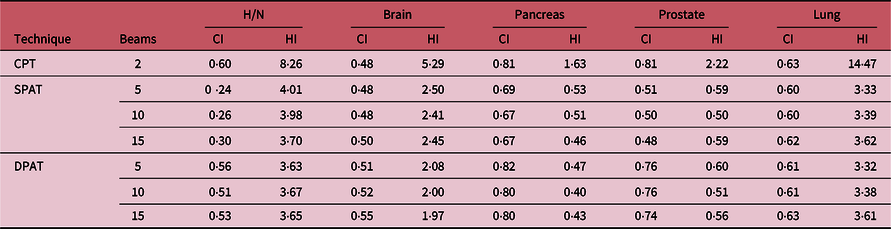
Table 1 shows that the HI is superior for DPAT and SPAT compared with CPT. The HI improves with increasing number of beams in arc plans for the different treatment sites. The CI depends on the treatment site and complexity of the shape of the PTV. For the brain tumour, pancreas and lung tumours, PAT plans conformality was comparable and sometimes superior to CPT. However, the CIs in CPT for H/N and prostate were superior to DPAT and SPAT. The conformality of CPT plans was superior only on the dose coverage of the distal side of the tumour. However, PAT has equal or better conformality at the proximal and lateral sides in comparison with CPT. CIs were generally better in DPAT compared to SPAT for the different treatment sites.
Conformality and homogeneity indices for PTV located in different treatment site including the head and neck (H/N), brain, pancreas, prostate and lung for CPT with 2-beam SPAT and DPAT plans with fixed and conformal apertures, respectively

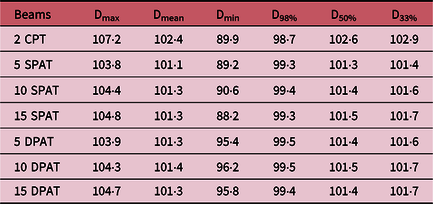
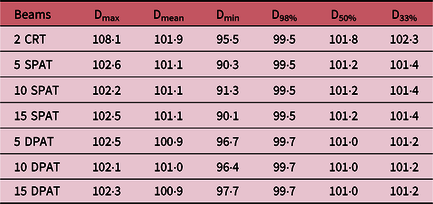
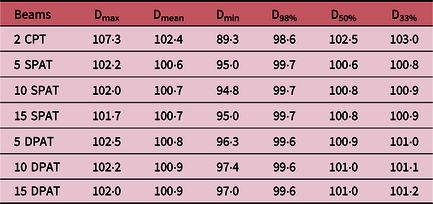
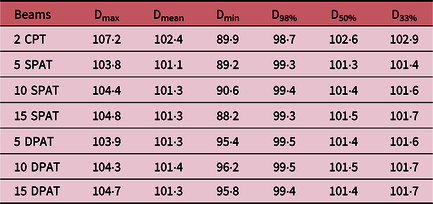
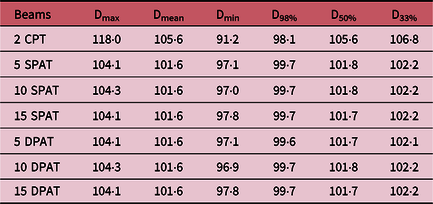
Tables 2–6 listed different dose parameters for the PTV from the various treatment sites that include H/N, brain, pancreas, prostate and lung, respectively. While the mean and minimum doses from PAT and CPT are comparable, the maximum doses from arc plans are significantly lower than the maximum doses in conventional plans. The fixed-PAT and conformal-PAT plans provide comparable dose parameters for regularly shaped targets such as near spherical or cylindrical targets in the different sites. The uniformity of the PAT plans improved generally with increasing number of beams. However, there are different factors that affect dose uniformity that include tumour shape and depth besides the number of beams. The maximum, mean and minimum doses did not change much with the number of the beam in PAT plans. In addition, D98, D50 and D33% were comparable in CPT and PAT plans. These dose parameters in DPAT and SPAT were not sensitive to variations in the number of fields for the arc plans.
Comparison of the dosimetric parameters of Dmax, Dmean, Dmin, D98%, D50% and D33% for a head and neck tumour for 2-beam CPT, SPAT with 5, 10 and 15 beams and DPAT with 5, 10 and 15 beams

Comparison of the dosimetric parameters of Dmax, Dmean, Dmin, D98%, D50% and D33% for a brain tumour for 2-beam CPT, SPAT with 5, 10 and 15 beams and DPAT with 5, 10 and 15 beams

Comparison of the dosimetric parameters of Dmax, Dmean, Dmin, D98%, D50% and D33% for pancreatic cancer for 2-beam CPT, SPAT with 5, 10 and 15 beams and DPAT with 5, 10 and 15 beams

Comparison of the dosimetric parameters of Dmax, Dmean, Dmin, D98%, D50% and D33% for a prostate tumour for 2-beam CPT, SPAT with 5, 10 and 15 beams and DPAT 5, 10 and 15 beams

Comparison of the dosimetric parameters of Dmax, Dmean, Dmin, D98%, D50% and D33% for a lung tumour for 2-beam CPT, SPAT with 5, 10 and 15 beams and DPAT with 5, 10 and 15 beams

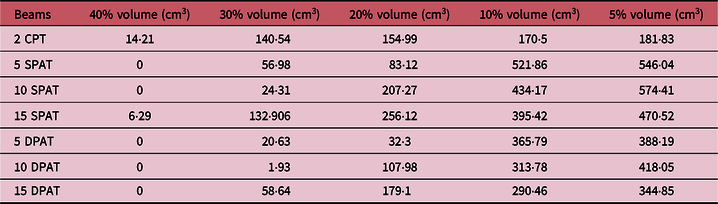
Table 7 shows a comparison of the dose volumes included in low-dose regions within 1 cm skin layer at low (5, 10%) and intermediate dose levels (30, 40%) from 2-beam CPT, SPAT and DPAT simulated with 5, 10 and 15 beams for a prostate case. The volumes included in the superficial layer from conventional proton plans are significantly larger than the PAT plans at intermediate dose levels. However, the SPAT and DPAT plans spread out superficial doses and thus have large skin volumes that are receiving lower dose levels than conventional plans. In this simulation, the DPAT plan has lower volumes in the low-dose regions (5 and 10%) than the SPAT plans. One of the main issues in conventional proton therapy is increase in skin dose at high and intermediate dose levels which can be deposited from a SOBP using one or two beams only. However, PAT spreads out the dose distribution where skin will receive low doses and be spared from intermediate and high dose levels as demonstrated in this simulation.
Volumes (cm3) included in lower dose regions within 1- cm skin layer: 40, 30, 20, 10 and 5% using 2-beam CPT, SPAT and DPAT simulated with 5, 10 and 15 beams for a prostate case

Discussion
The PAT plans provided superior dose coverage and sparing of normal tissues in comparison with conventional plans using two fields for several treatment sites including brain, H/N, lung, pancreas and prostate. The normal tissue entrance and skin doses were lowered significantly (<40%) by delivering dose from multiple directions over wider angular views compared to conventional plans that have large entrance doses from only two fields. Minimum and maximum doses of the PTV and dose conformality and uniformity from arc plans were superior to conventional, while the mean doses were nearly equivalent in both plans. In this simulation, conformal arc plans were performed by dose delivery from multiple beams to imitate beams with continuous gantry rotation and changing MLC shapes conforming to the tumour shape in different angular views. These arc plans did not require patient-specific compensators for each beam needed in conventional plans. Arc proton therapy advantages include (a) generating superior treatment plans in terms of dose coverage of the PTV and sparing of critical structures as demonstrated previously, (b) PAT is more cost and time effective because of faster patient setup and dose delivery with no need for aperture and compensator manufacturing, quality assurance and switching during treatment for each beam as in conventional plans, (c) conformal arc proton therapy with the MEVION double-scattering system provides an alternative to the scanning proton system that requires large quadrupole magnets required to scan the pencil proton beams across the tumour, (d) PAT is less vulnerable to patient setup, dose delivery and patient motion uncertainties and associated requirements of lateral, distal and proximal margins as in CPT. This is due to a small fraction of the total dose that is delivered from many directions which mostly averages over the course of treatment.
The current MEVION double-scattering system, however, does not have the hardware and software tools to perform the conformal arc proton because of the lack of an MLC system integrated with the machine. Furthermore, the gantry cannot deliver dose while rotating around the patient. In this simulation, two approaches were provided to perform conformal arc proton therapy: (a) the use of a single aperture with multiple conformal beams that is obtained from an average opening of the beams from different views of the PTV at different angular views (SPAT) and (b) conformal aperture for each beam from a different angular view in the conformal proton plans (DPAT). In the first approach, the proton conformal plans for regularly shaped targets, such as near spherical or cylindrical shapes, provided superior conformal dose coverage of the tumour with lower skin and critical structure doses compared to conventional proton plans using two fields. This is due to the use of multiple beams that deliver low doses at entrance depths and paths through normal tissue. In contrast, conventional plans with only two beams have relatively larger entrance and path dose, while minimum, maximum and mean doses of the PTV are nearly equal in both the conformal and conventional plans. The patient setup and dose delivery times are comparable with both arc and conventional plans. This is achievable by having to position and image the patient only once for setup, unlike conventional plans which require setup verification after each change in compensator. Furthermore, the use of no field-specific compensator and one aperture size removes the need to enter the room and replace these devices for each field. Although this approach of using proton conformal plans has several dosimetric and delivery advantages for regular-shaped targets, its use is limited for PTV with complicated shapes. This fixed-aperture CPT which uses one aperture shape for all angular views does not require the MLC system and can be performed with the current hardware tools that are available on the double-scattering MEVION proton system where one aperture is used for several beams from multiple directions without the need for compensators to modulate the intensity of the beam to compensate for the patient surface and tissue heterogeneities in the beam path.
The second approach represented in this study investigated PAT simulated with several conformal beams due to the limitation of hardware and software tools currently available on the MEVION proton therapy system. Optimally, the arc plans are planned and delivered with continuous rotation of the gantry over a certain angular range where more irradiation is deposited from many more directions instead of discrete gantry angles as simulated by several conformal beams. However, the MEVION system with available hardware and software tools is capable of delivering CPT with multiple beams from different direction as simulated in this study. In this approach, the apertures need to be changed for each beam without the need to insert a patient-specific compensator. The patient setup and treatment times required to deliver CPT might be slightly longer than conventional plans depending on the number of conformal beams used. It seems that CPT can be performed with nearly 5–7 beams, while maintaining superior dose coverage in comparison with the conventional 2-beam proton therapy. Furthermore, in CPT, patient’s compensator is not needed to modulate the intensity of the beam to consider patient surface variations and tissue homogeneities similar to conventional proton plans. The two approaches represented previously are not limited to the MEVION system and can be performed using other commercially available proton systems.
Proton dose distributions are usually optimised using clinical-target-volumes with lateral, distal and proximal margins to consider patient setup and tumour localisation uncertainties.Reference Noël and Antoni1,Reference Hsi, Schreuder and Moyers18 In this proton arc simulation study, the PTV was used for proton dose optimisation which is needed to account for dose delivery uncertainties without a compensator where smearing and smoothing techniques are not needed. The lateral, distal and proximal margins are not required because of beaming the PTV from different directions as done with photon therapyReference Seco, Gu, Marcelos, Kooy and Willers10 which improves the accuracy of the delivery of conformal proton dose to the target and sparing of nearby critical structures.Reference Seco, Gu, Marcelos, Kooy and Willers10 One concern of using an MLC system for beam shaping in proton therapy is the enhancement of the neutron production.Reference Chen, Bloch, Hill and Klein15,Reference Heo, Yoo and Song19–Reference Howell, Burgett and Isaacs21 In this simulation, the MLC system is used to replace the static aperture to shape the double-scattering proton beam to produce conformal dose for the PTV. It is not used to modulate intensity of the beam as in photon beams. Thus, it is not expected to increase neutron production if it is made from similar materials that are used for the manufacturing of the static apertures used currently on the MEVION system. Furthermore, neutron dose will be reduced in PAT in comparison with conventional techniques of treatment and dose delivery with tissue compensators and static apertures. This is achieved by the elimination of the patient-specific compensator in the proton beam path before the patient with arc CPT as simulated in this study.
PAT has several advantages as presented in this study that may provide an alternative in the future to conventional treatment techniques of conformal beams using scattering proton systems or intensity-modulated proton therapy with scanning systems similar to the progress of photon therapy from IMRT to VMAT. However, there are numerous software and hardware challenges in performing PAT with current scattering or scanning proton systems that include integration of MLC, intensity modulation of the proton beams while the heavy gantry is in motion, patient setup uncertainty, motion management and integration of image-guided proton therapy.
Conclusions
Arc proton plans have superior tumour dose coverage and sparing of normal tissue in comparison with conventional plans using the MEVION double-scattering system. However, the current system with available hardware and software tools cannot perform actual conformal arc plans because of lack of an MLC system and inability to deliver dose during gantry rotation. SPAT can be achieved using a single aperture that delivers dose to regularly shaped targets such as nearly spherical or cylindrical targets as demonstrated by simulations in this study. A second approach is the use of DPAT where the shape of the aperture varies and conforms to the shape of the target in BEV at multiple angular views. The single aperture CPT technique is more time and cost effective compared with conventional techniques that are used currently with the MEVION proton therapy system because of the elimination of the need for patient-specific compensators. Arc proton therapy is not limited to scattering proton system as demonstrated in this study and it can be performed with other proton therapy system.
Acknowledgement
None.