Gesture contributes to three mutually dependent processes: learning (Goldin-Meadow, Reference Goldin-Meadow2000), thinking (Alibali, Kita & Young, Reference Alibali, Kita and Young2000) and communicating (Kendon, Reference Kendon1994). Gesturing in concert with spoken language may reduce cognitive demands on these processes by allowing two different sorts of representational systems, visual and verbal, to share the load (Goldin-Meadow, Reference Goldin-Meadow2000).
Consider first the effect of gesture on listeners. Adults' comprehension and retention of spoken messages are better when those messages are augmented by symbolic gestures that reinforce the meanings being expressed than when they are not. This is especially true under difficult conditions such as listening in the context of noise (see review in Kendon, Reference Kendon1994). Children too are better able to comprehend spoken messages when these are accompanied by symbolic gestures than when they are accompanied by conflicting gestures or no gestures (McNeil, Alibali & Evans, Reference McNeil, Alibali and Evans2000). For example, preschoolers asked to follow directions stated via complex clause structures performed better when gestures reinforced the meaning of locative words in the directions (e.g. the word up with a gesture to indicate ‘up’) than when the gestures conflicted with the meaning of the words (e.g. the word up with a gesture to indicate ‘down’). Importantly, children do not necessarily derive benefit from reinforcing gestures when the spoken message is simple for them (McNeil et al., Reference McNeil, Alibali and Evans2000). Therefore, studies of both adults and children suggest that the utility of gesture as a scaffold for listeners' comprehension may depend upon task demands.
This leads to a second consideration, the effect of gesture on learners. High task demands are inherent to learning situations. Not surprisingly, classroom teachers use more gesture when introducing new concepts to their students than when reviewing old concepts (Alibali & Nathan, Reference Alibali, Nathan, Goldman, Pea, Barron and Derry2007), and children exposed to new concepts via aligned speech and gesture learn better than those exposed to new concepts via speech alone (Valenzeno, Alibali & Klatzky, Reference Valenzeno, Alibali and Klatzky2003). When teachers' gestures do not align temporally or conceptually with their words, students' learning suffers (Roth & Bowen, Reference Roth and Bowen1999).
Gesture as a contextual support for word learning
In the current study, we were particularly interested in the effect of the speaker's gestural input on the listener's performance in an ostensive word-learning context. To ensure that the gestured input provided to the listeners aligned temporally with the word to be learned, we designed a training demonstration in which the examiner gestured while speaking. To provide conceptual alignment between the gesture and the word, we used a symbolic gesture that was iconic, that is, one that readily captured the meaning of the target word.
Two previous investigations suggest the utility of our approach. In one study, Ellis Weismer & Hesketh (Reference Ellis Weismer and Hesketh1993) taught eight normally developing kindergarteners (and eight children with specific language impairment) three novel words for spatial concepts (e.g. the nonce word /wug/ to mean ‘beside’). These words were modeled repeatedly to describe the spatial location of an alien doll under the pretense that the words were part of the alien's language. Importantly, for half of the stimulus items, while the examiner modeled the novel words, she also presented an iconic gesture that conveyed the associated spatial meaning. Subsequent comprehension probes (e.g. ‘put Sam wug the box’) revealed a significant advantage for those word–concept pairings that were taught with gestural support.
In a more recent study, Capone & McGregor (Reference Capone and McGregor2005) employed a similar teaching paradigm. They introduced novel words and their referents within a play setting and, as in Ellis Weismer & Hesketh (Reference Ellis Weismer and Hesketh1993), the link between the word and referent was emphasized by iconic gesture in some conditions. This study varied from Ellis Weismer & Hesketh (Reference Ellis Weismer and Hesketh1993) in three ways: the participants were toddlers rather than kindergarteners, the referents were objects rather than spatial locations, and the teaching and testing involved four sessions extended over the course of eleven days rather than a single session. By the fourth session (nine cumulative exposures to the novel words), the children were better able to produce the novel names and were better able to report the function of objects learned in the gesture conditions than in the no-gesture condition.
These two studies were useful first steps towards demonstrating the influence of symbolic gesture on word learning; they also introduced new questions. First, the control condition in both studies was merely an absence of gesture; that is, they involved no symbolic support beyond the words being spoken. Is there something special about gesture as a support for word learning or would any other symbolic support work as well? Second, because both studies included a focus on children's fast mapping, or their initial appreciation of the word-to-referent link, the introduction of novel words was necessary. This design requirement limited the ecological validity of the studies. Do gestures enrich children's understanding of real words, words whose meanings have already begun to emerge from everyday experiences?
In the current study, we pursued these questions by examining toddlers' comprehension of a real target word, the spatial term under, before and after training wherein action models and verbal labels were supported by either a gesture, a photograph or by no additional symbol. In the following sections we motivate and expound these methodological decisions.
Is gesture special?
To build upon the results of Ellis Weismer & Hesketh (Reference Ellis Weismer and Hesketh1993) and Capone & McGregor (Reference Capone and McGregor2005), we wished to determine whether gesture as a modality for symbol support is particularly useful or whether any other symbol support would work as well. To do so, we chose to compare the effect of gestured symbols and static symbols on word learning. Given that a spatial term was the target word to be learned, it was essential that both symbols could capture visual–spatial meanings.
Gestures readily express visual–spatial meanings (Alibali et al., Reference Alibali, Kita and Young2000; Graham & Argyle, Reference Graham and Argyle1975; Majid, Bowerman, Kita, Haun & Levinson, Reference Majid, Bowerman, Kita, Haun and Levinson2004). They can convey location and movement. Both are relevant to the meaning of spatial terms in that such terms serve to relate a landmark object to a trajector object that either is moving or has been moved into a given location (e.g. ‘she is hiding the ball under the table’; ‘the ball is under the table’). Moreover, children use spatial terms to express both location and movement (Clark, Reference Clark2004; Kelly, Reference Kelly2002). For example, two-year-olds will frequently use the word up to mean ‘pick me up’. Gestured input may serve to reinforce this early appreciation of the semantics of spatial terms.
Gestured symbols are also developmentally appropriate for toddlers. Children exploit the gestural modality for communicative purposes from a very early age. Children who are taught symbolic gestures will use them to communicate before they are able to do so using spoken words (Goodwyn & Acredolo, Reference Goodwyn and Acredolo1993; McGregor & Capone, Reference McGregor and Capone2004). Children who are not directly taught such gestures will create their own and the timing of this attainment roughly parallels the onset of spoken words (Capone & McGregor, Reference Capone and McGregor2005). By 1 ; 6, children comprehend requests for objects that are conveyed via gesture (Tomasello, Striano & Rochat, Reference Tomasello, Striano and Rochat1999).
Photographs, too, can capture visual–spatial relationships. A photograph of a trajector object together with a landmark object provides a static depiction of their locative relationship. Photographs are also relevant from a developmental standpoint. Even infants aged 0 ; 5 can link a photograph with the object it represents (DeLoache, Strauss & Maynard, Reference DeLoache, Strauss and Maynard1979) and children aged 2 ; 6 can purposefully use photographs as symbols to guide their search within a three-dimensional context (DeLoache & Burns, Reference DeLoache and Burns1994). In the context of naming, children aged 1 ; 6 and 2 ; 0 treat pictures (drawings) as symbols for object referents (Preissler & Carey, Reference Preissler and Carey2004).
We hypothesized that, because it can convey both the target location and the necessary movement, gesture would be a more useful support for mapping the meaning of under than would photographs, symbols that readily convey location but not movement. Given children's early sensitivity to motion (Kellman, Reference Kellman and Granrud1993), gesture may also serve to elicit more attention to moments of training than still photographs.
Do gestures enrich nascent word knowledge?
Between the ages of 0 ; 9 and 1 ; 2, children begin to demonstrate sensitivity to a range of spatial contrasts (McDonough, Choi & Mandler, Reference McDonough, Choi and Mandler2003). By 1 ; 6, children display heightened sensitivity to spatial categories relevant in their own language community (Choi, McDonough, Bowerman & Mandler, Reference Choi, McDonough, Bowerman and Mandler1999). For children learning English, comprehension of the words in, on and under emerges early: in before 2 ; 0, on between 2 ; 0 and 2 ; 3, and under between 2 ; 0 and 2 ; 9 (Johnston, Reference Johnston, Stiles-Davies, Kritchevsky and Bellugi1988); however, at such early ages, comprehension remains highly context dependent (Clark, Reference Clark1973; Wilcox & Palermo, Reference Wilcox and Palermo1974; Rohlfing, Reference Rohlfing, Pütz, Niemeier and Dirven2001; Reference Rohlfing2006). Specifically, young children are better able to follow instructions that contain spatial terms when those instructions match their understanding of how objects usually function in context (Lloyd, Sinha & Freeman, Reference Lloyd, Sinha and Freeman1981). A canonical relationship between objects (e.g. ‘put the spoon in the cup’) will elicit better understanding than a non-canonical relationship (e.g. ‘put the spoon on the cup’).
With toddlers aged 1 ; 8 to 2 ; 0 as participants, and under as a training target, we were in a position to examine the contribution of gesture to the enrichment of children's nascent word knowledge. We expected the children to come into the study with some appreciation of spatial categories and, perhaps, some fragile or context-restricted knowledge of under. By comparing the children's ability to follow under instructions before and after gesture training, we could examine the extent to which gesture enriched this fragile knowledge. Furthermore, by careful selection of objects, we could examine the extent to which gesture enabled a more context-independent understanding. Specifically, we included object pairs that allowed under relationships that were canonical (e.g. ‘girl under umbrella’) and non-canonical (e.g. ‘cup under table’) to determine whether gesture was effective in promoting understanding in both contexts.
We employed a gradient scoring method inspired by Capone & McGregor (Reference Capone and McGregor2005) to get at degree of knowledge. Specifically, we were not as concerned with whether children knew the meaning of under before and after training, but rather whether they needed minimal, moderate or maximal scaffolding to demonstrate that knowledge. Therefore, the specific prediction was that children trained with gesture supports would require less scaffolding after training than before and that their declining need for scaffolding would be more dramatic than that of the children trained with a different symbolic support or than children who received no extra symbolic support.
The current study
To summarize, in the current study, we presented training demonstrations in which objects were placed into under relationships and labeled. We compared the utility of gestures and photographs as supports for the mapping of under in this training context. To discern the role of symbolic support in general, we also compared the learning of children who received gesture or photograph supports to children who received no extra symbolic support. We selected the term under as a target and toddlers between 1 ; 8 and 2 ; 0 as participants because under was likely in the realm of the toddlers' conceptual understanding but was, at the same time, not far along in the learning process. In addition, the choice of under extended the focus of previous investigations from novel to real words. We also tested, but did not train, the comprehension of on as a means of demonstrating the children's compliance with the task. We reasoned that, because knowledge of on emerges prior to under, we could use on performance to ensure that each child understood the task and was paying attention to the examiner.
Children's degree of knowledge of under was measured in terms of the level of scaffolding they needed to perform under instructions before, immediately after and two to three days after training that varied in symbolic support. Given its accessibility to young children and its inherent capacity for capturing movement, we hypothesized that gesture would be superior to photographs and to no symbolic support in promoting enrichment of the spatial term under. We also explored the basis for the gesture advantage by determining whether gesture attracted more attention to moments of training than photographs or no symbolic support. Finally, we explored the extent of the gesture advantage by determining whether gesture lessened the children's dependence on physical context (i.e. canonical objects) when processing under instructions.
METHOD
Participants
Originally we recruited 49 participants but excluded 9 due to non-compliance (n=5), attrition (n=2), bilingualism (n=1) or a ceiling-level performance on under at pretest (n=1). The actual participants were 40 monolingual English-speaking children, 19 boys and 21 girls, between the ages of 1 ; 8 and 2 ; 0. Children were randomly assigned to one of three training groups: model+gesture symbol (+Gesture), model+photograph symbol (+Photo), or model alone (Model Only). The results of three one-way ANOVAs demonstrated that the groups were well matched on chronological age (F(2, 37)=0·69, p=0·51, ηp2=0·04), total number of words (F(2, 37)=0·25, p=0·78, ηp2=0·01), and number of spatial terms (F(2, 37)=0·29, p=0·75, ηp2=0·02), the latter two as reported by parents on the MacArthur-Bates Communicative Development Words and Sentences Inventory (Fenson et al., Reference Fenson, Dale, Reznick, Thal, Bates, Hartung, Pethick and Reilly1993) (see Table 1). Overall children averaged 4·23 (SD=4·16) spatial terms in their expressive vocabularies. According to parent report, one child in the +Gesture group, one child in the +Photo group and two children in the Model Only group had produced the spatial term under prior to the study.
Characteristics of participants per group expressed as means (and standard deviations)

Because of random assignment, the training groups were not balanced for numbers of boys and girls. The +Gesture group consisted of 4 boys and 8 girls; the +Photo group of 10 boys and 5 girls; and the Model Only group of 6 boys and 7 girls. For this reason, gender was treated as an independent variable in the main analyses.
Stimuli
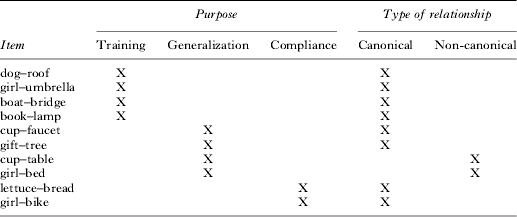
The stimuli consisted of 10 item pairs (see Table 2 and Appendix A), four for training under (dog–roof, girl–umbrella, boat–bridge, book–lamp), four for determining whether trained knowledge of under generalized to untrained items (cup–faucet, gift–tree, cup–table, girl–bed), and two for testing compliance with on instructions (lettuce–bread, girl–bike). All of the training items were functionally canonical in that the trajector object (e.g. book) would commonly go under the landmark object (e.g. lamp) in everyday environments. The under generalization items included two pairs that were canonical (cup–faucet, gift–tree) and two that were non-canonical (cup–table, girl–bed). The latter were included so that we could determine whether training enabled a less context-dependent understanding of under. The on compliance items were both canonical. Importantly, all object sets, whether canonical or non-canonical, allowed responses other than under (or on). For example, a child could hold the girl on top of the umbrella, place the cup beside the faucet, or insert the gift in the branches of the tree.
Item pairs, their purpose in this study, and whether they hold canonical or non-canonical spatial relationships

In session one, all children were pretested on one canonical and one non-canonical under generalization pair and were post-tested on a different canonical and non-canonical generalization pair with assignment of items to pre- or post-test counterbalanced across children. In session two, all children were post-tested on all items (four training item pairs, four generalization item pairs, two compliance item pairs).Footnote 1
Procedure
Each child was seen in a laboratory setting for two sessions scheduled two or three days apart. The procedures conducted during those sessions were approved by the University of Iowa internal review board for ethical treatment of human subjects. The format of the first session was free play, pretest, training and immediate post-test. The session lasted 20–30 minutes. The format of the second session was free play and delayed post-test. The session lasted 10–15 minutes. Parents were asked not to demonstrate or practice under relationships with their children during the days between sessions.
Free play
The purpose of the 5-minute free play was to familiarize the child with the objects and object labels to be used during the experiment proper. The examiner placed all object stimuli on the table and labeled each one once as the child explored and played.
Pretest
The purpose of the pretest was to obtain a baseline measure of on and under comprehension. On was tested purely as a means of determining the child's compliance with the task. Pretesting of under was essential to document each child's knowledge upon entrance to the study and to ensure that no child who participated already exhibited mastery of under (i.e. earned maximum points on both under trials as described below).
During pretesting, three item pairs were presented one at a time in random order. Upon each presentation, the examiner (1) gave an instruction that included on (in a single instance, e.g. ‘Put the lettuce on the bread’) or under (in two instances, e.g. ‘Put the cup under the faucet’). If the child did not comply, the examiner (2) provided a contextual cue that suggested a reason for the trajector to be under (or on) the landmark (e.g. ‘Put the cup under the faucet so we can get a drink’; see Appendix B for a complete list of contextual cues). If the child still did not comply, the examiner (3) demonstrated the expected response and returned the objects to the child saying, ‘Now it's your turn’, to prompt an imitative response. Scaffolds were always presented in this order and scaffolding of a given item was discontinued as soon as the child answered correctly. Performance was measured on a continuous scale: children were awarded 3 points if they immediately followed the verbal instruction, 2 points if a contextual cue was required, 1 point if an imitative model was required, or 0 points if there was no correct response following these levels of scaffolding. Averaging across items, a mean scaffolded score per child was determined for purposes of data analysis.
Training
For all groups, the examiner presented four item pairs, one at a time. Upon presentation, she labeled each object (‘Here's the boat and here's the bridge’), gave the under instruction (‘Put the boat under the bridge’) and then immediately completed the targeted relationship while saying, ‘like this’.
For the +Gesture group, the examiner held her right hand over her left hand then moved the right hand under the left as she gave the under instruction (see Appendix C).
For the +Photo group, the examiner held up a photograph of the item pair already arranged in the under position as she gave the under instruction.
For the Model Only group, the examiner gave the under instruction and completed the targeted relationship without any other symbolic support.
For all groups, after the examiner completed the targeted relationship for each item pair, she placed the pair in front of the child and said, ‘Now it's your turn’ to encourage the child to imitate the placement of the objects in an under relationship.
Post-tests
There were two post-tests, one immediately after training and one delayed for two to three days after training. All children participated in both post-tests. The procedure used in the immediate post-test was identical to that used in the pretest except that the stimuli differed. The stimuli were the four item pairs used during training as well as two untrained and untested item pairs for testing under generalization and one untrained and untested item pair for testing compliance with on instructions. These item pairs and their relevant instructions (under or on) were presented in random order.
At the delayed post-test, the examiner used identical procedures as the pre- and immediate post-tests to assess compliance with eight under instructions (with the four trained item pairs and the four generalization item pairs from session one) and one on instruction, presented in random order.
Statistical analysis
With the exceptions noted below, all analyses involved (3) training group×(2) gender×(3) test ANOVAs with repeated measures on the final variable. All significance tests were two-tailed. As an indication of effect size, ηp2, or the proportion of the effect+error variance that is attributed to the effect, was computed. Tukey's HSD for unequal Ns was used for post-hoc testing of between-subject differences and the Bonferroni test was used for post-hoc testing of within-subject differences.
RESULTS
Performance of on relationships
Prior to testing the hypothesis of interest, we examined responses to on instructions to ensure that the three groups understood and complied with the general protocol. Comparing scaffolded on scores via a (3)×(2)×(3) mixed-model ANOVA, we found no main effect of training group (F(2, 34)=0·52, p=0·60, ηp2=0·03), or gender (F(1, 34)=2·71, p=0·11, ηp2=0·07), or training group x gender interaction (F(2, 34)=0·15, p=0·86, ηp2=0·008). There was a main effect of test (F(2, 68)=3·95, p=0·03, ηp2=0·10), such that immediate post-test (M=2·25, SE=0·15) and delayed post-test (M=2·31, SE=0·16) performances were significantly better than pretest performance (M=1·81, SE=0·18; p<0·05) but not significantly different from each other. These results suggest a ‘warm up’ effect over the course of the first visit. The main effect of test was qualified by a test×group interaction (F(4, 68)=3·76, p=0·008, ηp2=0·18): the warm up was evident for the Model Only and +Photo groups whose average scaffolded scores improved from pre- to post-test on day one by 0·92 and 0·80, respectively, but not for the +Gesture group whose average score was identical at pre- and post-test. There was no test×gender interaction (F(2, 68)=0·29, p=0·75, ηp2=0·008), and no test×training group×gender interaction (F(4, 68)=1·36, p=0·26, ηp2=0·07). The results yield no evidence of drops in compliance over time for any group.
Performance of under relationships
Learning of under was assessed in two ways. First, we compared the groups' abilities to perform under instructions given the items used by the examiner during the training models. Second, we compared the groups' abilities to perform under instructions with untrained, generalization item pairs.
When mean scaffolded scores for manipulation of trained items were submitted to a (3)×(2)×(3) mixed-model ANOVA, the result was a main effect of training group (F(2, 34)=3·89, p=0·03, ηp2=0·19), with the Model Only group (M=2·07, SE=0·15) performing significantly better overall than the +Photo group (M=1·5, SE=0·15; p=0·03) but not significantly better than the +Gesture group (M=1·6, SE=0·16). There was no effect of gender (F(1, 34)=0·001, p=0·97, ηp2<0·001), and no interaction between training group and gender (F(2, 34)=0·26, p=0·77, ηp2=0·02). There was a main effect of test (F(2, 68)=36·23, p<0·001, ηp2=0·52), with performance at immediate (M=1·93, SE=0·15) and delayed post-tests (M=2·22, SE=0·09) higher than at pretest (M=1·03, SE=0·12; ps<0·001) but not significantly different from each other. There were no interactions between test and group (F(4, 68)=1·0, p=0·41, ηp2=0·06), test and gender (F(2, 68)=1·5, p=0·22, ηp2=0·04), or test, group and gender (F(4, 68)=0·92, p=0·45, ηp2=0·05). The main effect of training group together with a lack of test×group interaction suggests that (1) because of random assignment, the Model Only group came into the study with superior knowledge of under Footnote 2 and retained this advantage, and (2) all three groups improved significantly and to a similar degree in their ability to follow under instructions given trained item pairs.
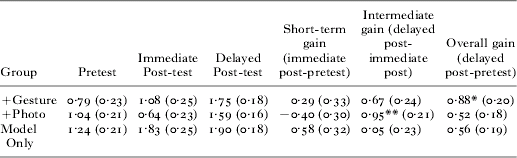
A more stringent test of learning is whether the children demonstrated improvements in their comprehension of under when given the untrained generalization items (see Table 3). When mean scaffolded scores for generalization items were submitted to a (3)×(2)×(3) mixed-model ANOVA, the result was a main effect of training group (F(2, 34)=3·77, p=0·03, ηp2=0·18), with the Model Only group (M=1·65, SE=0·16) performing significantly better overall than the +Photo group (M=1·09, SE=0·15; p=0·01) and marginally better than the +Gesture group (M=1·21, SE=0·16; p=0·08). There was no effect of gender (F(1, 34)=0·14, p=0·71, ηp2=0·004), and no training group×gender interaction (F(2, 34)=0·71, p=0·50, ηp2=0·04). There was a main effect of test (F(2, 68)=13·89, p<0·001, ηp2=0·29), with performance at delayed post-test (M=1·74, SE=0·10) higher than at pretest (M=1·03, SE=0·12; p<0·001) and immediate post-test (M=1·18, SE=0·14; p<0·001). Pretest and immediate post-test did not differ significantly. These main effects were qualified by an interaction of test and training group (F(4, 68)=2·93, p=0·03, ηp2=0·15). This interaction reflected two relevant patterns. First, only the +Photo group demonstrated significant gains from immediate post-test to delayed post-test (p=0·004) but note that this was largely a function of recovering from the dip in performance from pretest to immediate post-test (see Table 2); there was no overall gain for the+Photo group. In fact, the other relevant pattern accounting for the interaction was that, in accord with the primary prediction of the study, only the +Gesture group demonstrated overall gains; their improvement from pretest to delayed post-test was significant (p=0·02; see Table 3). There were no interactions between test and gender (F(2, 68)=2·65, p=0·08, ηp2=0·07), or test, training group and gender (F(4, 68)=0·77, p=0·54, ηp2=0·05).
Patterns of learning presented as mean scaffolded scores and mean gains (with standard errors) for generalization items

** p=0·004; * p=0·02.
Exploration of the gesture effect
To further explore the gesture advantage, we conducted three analyses. Specifically, we sought to better understand the basis, extent and time course of the gesture effect.
To explore the basis of the gesture effect, we compared the attentiveness of the groups. We reviewed videotapes to tally the number of times that each child imitated the examiner's four training models to test the hypothesis that the examiner's gesture was effective because it attracted attention to, and participation in, moments of training. Useable videos were available for 10 children in the Model Only group, 9 children in the +Gesture group, but because of a damaged digital tape, only 5 children in the +Photo group. Based on this partial dataset, all children looked at least briefly at each of the examiner's models and all groups imitated, on average, more than half the time (+Gesture: M=2·33, SD=1·22; +Photo: M=2·60, SD=1·14; Model Only: M=3·30, SD=0·67). A t-test comparing the rate of imitations in the +Gesture group to that of the +Photo and Model Only groups combined revealed no significant attentional advantages for the +Gesture group (t=1·7, df=22, p=0·10, Cohen's d=−0·72). In fact, the non-significant trend was such that the children in the +Gesture group were slightly less engaged by the training.
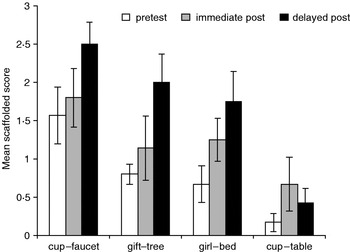
We also explored the extent to which the learning of the +Gesture group varied with object context. To do so, we categorized the scores of the +Gesture group in response to the generalization items at each test (Figure 1). In this descriptive analysis, a canonicality effect was apparent in that the canonical item pair cup–faucet consistently elicited the highest level of performance whereas the non-canonical item pair cup–table elicited the poorest performance. Improvement from pretest to delayed post-test was apparent for all items except cup–table. Degree of improvement on non-canonical girl–bed (and on canonical gift–tree) was as large as or larger than the degree of improvement for cup–faucet. Therefore, gesture supports did improve comprehension in one non-canonical context (girl–bed) but not in another (cup–table).
Mean scaffolded scores of children from the +Gesture group by generalization item pairs and test.

Finally we explored the delay in emergence of the gesture advantage. As a group, there was no significant improvement from pretest to immediate post-test; the advantage for the +Gesture group was revealed in the overall gain from pretest to delayed post-test. Did these mean scores mask individual differences such that some children demonstrated immediate gains in response to gesture-enhanced training but others (the majority) demonstrated gains only at delayed post-test? Alternatively, did children who demonstrate modest gains on the immediate post-test build on those gains for a more impressive performance at delayed post-test? A strong correlation obtained between short-term and overall gain scores for the +Gesture group (r(12)=0·87, p<0·001) supported the latter explanation. The extent to which a child demonstrated short-term benefits from the training demonstrations and the extent to which that child improved overall were related.
DISCUSSION
Gestured input enhances communication on the part of preverbal children (Acredolo & Goodwyn, Reference Acredolo and Goodwyn1988); it strengthens early language development of verbal children (Goodwyn, Acredolo & Brown, Reference Goodwyn, Acredolo and Brown2000), and, more specifically, it facilitates their initial mapping (Capone & McGregor, Reference Capone and McGregor2005; Ellis Weismer & Hesketh, Reference Ellis Weismer and Hesketh1993) and subsequent enrichment of novel words (Capone & McGregor, Reference Capone and McGregor2005). This study reveals an additional benefit of gestured input for verbal children: Gesture served to enrich their knowledge of a real word. Children who received training supplemented with symbolic gesture demonstrated more robust long-term gains in word knowledge, not only as compared to children who received the same training without symbolic support, but also as compared to children whose training was supplemented by symbolic photographs. In the following sections, we interpret the nature of the gesture effect and present some hypotheses about the basis of the gesture advantage.
The nature of the gesture effect
The children in this study had almost certainly been exposed to under prior to the study. On average, they came in with some receptive knowledge of the word; by chance, the +Model Group demonstrated more knowledge than the other two groups upon recruitment. They retained this advantage but they did not learn to a greater degree than children in the other groups during the course of the study. On average, the children in all three groups were good word learners. When given the items that the examiner had used during training, all of which allowed for canonical under relationships, all three groups of children improved from pre- to immediate post-test and maintained that improvement at delayed post-test. This improvement may have reflected, in part, the warm-up characteristic of performance with untrained on; however, this is not likely the complete explanation as children in the +Gesture group did not demonstrate warm-up with on but did, like their peers in the other two groups, demonstrate improvement with under. It seems that the children gained some additional knowledge of under and they did so whether or not they received symbolic support in the form of gesture or photographs.
The gesture advantage was revealed by the children's ability to follow under instructions given the untrained generalization items. With these items, only the children in the +Gesture group, those whose training demonstrations had been supplemented by symbolic gesture, demonstrated long-term gains. The results are reminiscent of Rohlfing (Reference Rohlfing2006) who compared children learning under with or without the benefit of a verbal contrast (e.g. ‘Look the dog is under the table, not on!’). She found no effect of the contrast when the children were tested with the training materials but a contrast advantage emerged when they were tested with untrained materials. We maintain that the differential sensitivity of tests employing trained and untrained items reflects the relationship between the need for scaffolding and the robustness of knowledge. Compared to the untrained generalization items, trained items were better scaffolds because the children had more experience with them and, in particular, more exposure to them in under relationships.Footnote 3 Even modest gains in semantic knowledge could be elicited when scaffolded by trained items; a more robust knowledge was required to perform with the reduced scaffolding provided by untrained items. Only with the semantic enrichment of a contrasting term, in Rohlfing (Reference Rohlfing2006), or a symbolic gesture, in the current study, did more robust learning take place.
Part of this robustness was reflected in the fact that, after training, the +Gesture group became somewhat less dependent on the context provided by canonical objects. Two non-canonical item pairs were tested and gains on one, girl–bed, were impressive. However, there was no gain on the non-canonical item pair cup–table. This difference may reflect the extent to which these item pairs were truly non-canonical. For children in particular, hiding under the bed may be familiar and therefore somewhat canonical, despite being less common than lying on the bed. Moreover, cups normally go on tables and flat surfaces such as tables invite on substitutions (Clark, Reference Clark1973), a common error among the children in the current study. Gesture did not help the children to overcome these particularly powerful affordances for the spatial relationship on.
The time course of the gesture effect
The gesture advantage was revealed two to three days after training. Short-term gains were more subtle and did not reach statistical significance. One mundane explanation for this delay is that, by the end of the first visit, the children were fatigued or bored and, as a result, they did not perform at their best on the immediate post-test. This argument suffers in light of the on and trained under data. If the children had been fatigued or bored with the task in general, their performance with on instructions during the immediate post-test should have suffered, but this was not the case. All three groups followed on instructions as well or better at post-tests than at pretest. Also, improvement with under instructions from pre- to immediate post-test given trained items suggests the children were not bored by under instructions in particular.
Another possibility is that the children in the +Gesture group learned the under instruction outside of the laboratory during the interval between immediate and delayed post-tests. Parents were explicitly instructed not to practice under instructions with their children. It may be that some parents did not follow this instruction but there is no reason to suspect that parents of children in the +Gesture group would be less compliant than parents of children in the other groups. Of course under is a real word and there was no way to control the children's exposure in naturalistic contexts to the word during the interval between tests but, again, the possibility of inadvertent exposure was equal across groups. The lack of significant improvement in the comparison groups weakens the possibility that practice or exposure outside of the lab accounts for the results.
A more interesting possibility is that, over the interval between immediate and delayed post-tests, the information gleaned from the gesture-enhanced training consolidated. Consolidation involves stabilization and enhancement of information in memory over time in the absence of additional exposure to that information (Walker, Reference Walker2005). The positive correlation between gains at immediate post-test and gains at delayed post-test is consistent with the hypothesis that consolidation was at play. Consolidation of newly learned words has been documented in adult learners (Dumay & Gaskell, Reference Dumay and Gaskell2007) and, though not examined directly, patterns that hint at consolidation effects in children's word learning do exist (Rice, Oetting, Marquis, Bode & Pae, Reference Rice, Oetting, Marquis, Bode and Pae1994; Storkel, Reference Storkel2001). Future studies aimed at testing the consolidation hypothesis should ensure that there is no exposure to the newly learned word between gesture-enhanced teaching and delayed test.
The utility of gesture to the mapping process
There could be several reasons for the success of the gesture-supported teaching. One possibility is that gestures are interesting, and thus draw more attention to moments of training. However, we can rule out this possibility because all groups of children paid close attention to the examiner during the training demonstrations; the +Gesture group was not at all superior in this regard. This does not mean that gesture never serves to enhance attention to ostensive naming episodes nor that such enhancement never serves to facilitate learning. For example, in a study of the effect of deictic gestures on the fast mapping behaviors of children aged 2 ; 4 to 2 ; 7, there was a positive relationship between attention and learning such that the more a particular type of gesture drew the child's attention to the target at the time of labeling, the better the child's performance at post-test (Booth, McGregor & Rohlfing, Reference Booth, McGregor and Rohlfing2008). Perhaps gesture as an inducement to attend may be particularly useful for promoting fast mapping but less useful in promoting subsequent learning wherein the goal is not to infer a word to referent link but, rather, to enhance knowledge of the word meaning.
A more likely explanation for the gesture effect in the current study is one suggested by Goldin-Meadow (Reference Goldin-Meadow2000). She posits that gesture serves to minimize cognitive load during moments of language processing. Because the gesture used here was iconic and because it was presented in temporal contiguity with the word, it externalized a meaningful aspect of the referent in the visual world. By making that meaning more obvious, gesture may free cognitive–linguistic resources for processing the word itself and, perhaps, the other lexical and syntactic elements involved. This should be especially true in the current study. Because we recruited toddlers who were very much in the throes of acquiring spatial meanings, task demands associated with under instructions were high, and therefore the scaffolding provided by the gesture should have been particularly useful.
Although the comparison between gesture and photographs as a support for the enrichment of under favored gesture, there remain some gaps in our understanding of the utility of gesture to word learning. If one of the benefits of gesture was, as we have argued, the expression of movement, then other expressions of movement might be equally helpful. Video animations involving movement of inanimate objects into relevant spatial relationships would provide a suitable test.Footnote 4 Also, certain word meanings might be better conveyed via photographs than gestures. Experiments designed to teach words whose meanings are less tied to movement would provide a suitable test. Finally, there might be certain learners whose learning styles are not highly amenable to gestured input. The frequent use of photographs or drawings in clinical language intervention settings is suggestive. Quill (Reference Quill1997) argues that pictures may be especially effective for learners, such as many with autism spectrum disorders, who have stronger visual than auditory perception and who are better able to attend to stable than fleeting referents. The efficacy of gesture and still images as learning aides for these populations should be tested.
SUMMARY AND CONCLUSIONS
Input that included symbolic gesture enriched children's understanding of the spatial term under and did so to a greater extent than input that included symbolic photographs (or no supplemental symbols). Only measures employing untrained materials and delayed testing were sensitive to the gesture advantage.
We conclude that gestured input promoted more robust knowledge of the meaning of under, knowledge that was less tied to contextual familiarity and more prone to consolidation. Gesture may have been particularly effective because it reduced cognitive load during training while emphasizing the target location as well as the movement inherent in the meaning of under. Word learning is a gradual process, one that progresses from emergence to mastery as the learner repeatedly attaches meaning to the word in multiple contexts (Bloom, Reference Bloom2000). This study demonstrates that symbolic gestures, as useful contextual supports for children's comprehension of words in the moment, are ultimately useful supports for word learning.
APPENDIX A
Stimuli for training under 
Appendix B
Contextual cues used to scaffold children's understanding of under instructions at test

Appendix C
An example of training for the +Gesture group