Experimental
Plant material
Fifty-seven sweet potato accessions, from the Gene Bank of IRB-INTA-Argentina, were analysed (data available on http://servicios.inta.gov.ar/bancos). Thirty-one of these accessions correspond to Argentine landraces and twenty-six to introduced germplasm from assorted geographical sources.
DNA amplification
Sixteen primer pairs were tested ( Jarret and Bowen, Reference Jarret and Bowen1994; Buteler et al., Reference Buteler, Jarret and LaBonte1999; Tseng et al., Reference Tseng, Lo and Hwang2002). Seven primers selected, and the sequences, motifs, references and amplification conditions are included in Table 1.
Description of microsatellite loci used to develop the identification matrix

Products were separated on 6% (w/v) denaturing polyacrylamide gels and detected by silver staining. Band sizes were estimated by means of a 25-bp DNA Ladder (Gibco BRL, Grand Island, NY, USA).
Data analysis
A similarity matrix was constructed using Jaccard's coefficient. Cluster analysis was performed by the UPGMA method using NTSyS pc v-2.0.
Total genetic variation was partitioned within and between groups, defined by geographical region or root colour. Genetic diversity was evaluated using Shannon's Index (Bowman et al., Reference Bowman, Hutcheson, Odum and Shenton1971) and analysis of molecular variance (Excoffier et al., Reference Excoffier, Smouse and Quattro1992) was carried out with Arlequín v2000.
Discussion
A total of 73 polymorphic bands were detected and were enough to differentiate 52 out of the 57 accessions unequivocally (92%). Eleven region-specific alleles were detected: five only of Argentine and six only of foreign germplasm. The similarity average found (0.367 ± 0.097) suggested a representative sample with broad genetic base of conserved sweet potato germplasm (Dhillon and Ishiki, Reference Dhillon and Ishiki1999; Jarret and Bowen, Reference Jarret and Bowen1994). The cases of homonymy were clarified and duplicates were also confirmed.
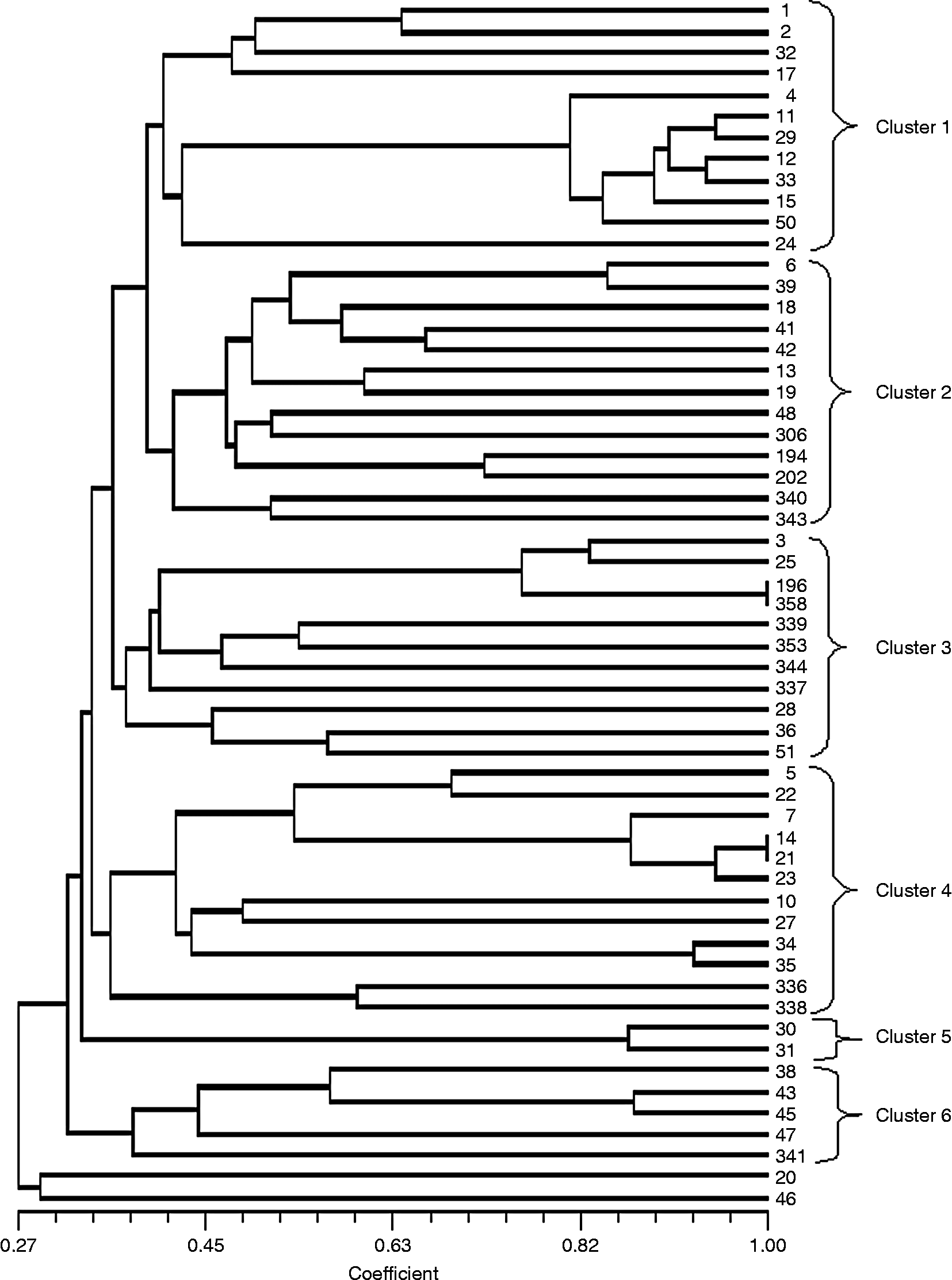
Cluster analysis showed six main groups and two unrelated accessions (Fig. 1).
Dendogram based on the cluster analysis of 57 accessions with seven simple sequence repeat (SSR).

A predominant skin colour of the roots can be observed for each cluster. Materials with the same colour grouped in sub-clusters with high similarity ( ≥ 0.7). The high genetic variation found in this work was similar to that reported by Wang et al. (Reference Wang, He, Prakash and Lu1998), Zhang et al. (Reference Zhang, Ghislain, Huamán, Golmirzaie and Hijmans1998, Reference Zhang, Carbajulca, Ojeda, Rossel, Mill, Herrera and Ghislain2000). He et al. (Reference He, Prakash and Jarret1995) suggested that this might be due to allogamous behaviour, large size of the genome and/or directional selection for different end uses. The self-incompatibility and cross-pollinating nature of this species encourage high genetic flow between genotypes, while vegetative reproduction helps to maintain diversity.
Shannon's diversity values (H s) ranged from 1.23 to 3.85, with an average of 2.69. The average diversity values (H avg) from the Argentine and foreign accessions were 2.16 and 2.44, respectively. Variation within regions accounted for 97.1% of the total variance (Fst: 0.02 896, P = 0.0000, 101,000 permutations), which reflects the non-homogeneous condition of the Argentine germplasm, formed by germplasm introduced from different countries, and adapted to different conditions.
The diversity values (H s) for the purple, orange and white groups were 2.32, 1.53 and 1.59, respectively. Variation within groups accounted for 90.35% of the total variance (Fst: 0.09 652, P = 0.0000, 101,000 permutations). The lower values observed for the cream and orange groups are consistent with the unique origin of these materials. By contrast, the purple skin group is constituted by materials from assorted origins. The breeding of sweet potato in Argentina has been focused on introducing materials with purple skin colour due to local market preferences, so this could bias the higher levels of diversity found in this group.
These analyses suggest a conserved wide genetic base. Molecular characterization of the whole collection is in progress to have a complete view of the diversity of the conserved materials and to plan future introductions avoiding genetic base narrowing.
Acknowledgements
This work was supported by SECYT (Secretary of Science and Technology).