INTRODUCTION
The ‘governance’ concept became a major part of the international conservation discourse soon after the Fourth World Park Congress emphasized the participation of communities, non-governmental organizations (NGOs) and the private sector in the establishment and management of protected areas (PAs) (McNeely Reference McNeely1993; Dearden et al. Reference Dearden, Bennett and Johnston2005). Governance refers to the interactions among structures, processes and traditions that determine how power is exercised, how decisions are made and who is accountable for decision outcomes (Graham et al. Reference Graham, Amos and Plumptre2003). Types of PA governance include: (1) government PAs managed by the centralized government authority, (2) co-managed PAs governed by shared power among various actors, (3) private PAs owned by private parties, sometimes NGOs, and (4) community conserved areas governed by local communities (Borrini-Feyerabend et al. Reference Borrini-Feyerabend, Johnston, Pansky, Lockwood, Worboys and Kothari2006). The IUCN has yet to officially recognize community conserved areas, though some recommend a revision to the IUCN categories in light of their predominance (Kothari Reference Kothari, Lockwood, Worboys and Kothari2006).
Each form of PA governance has its own benefits and disadvantages. Citizens often consider government agencies as legitimate actors to provide public benefits with direct accountability to the public (Borrini-Feyerabend et al. Reference Borrini-Feyerabend, Johnston, Pansky, Lockwood, Worboys and Kothari2006). However, ineptitude, corruption, inefficiency and bureaucratization of government agencies can lead to ‘paper parks’ that are formally recognized, but not actively managed (Brandon et al. Reference Brandon, Redford and Sanderson1998; Borrini-Feyerabend & Tarnowski Reference Borrini-Feyerabend, Tarnowski, Brosius, Tsing and Zerner2005). NGOs tend to be comparatively more effective and efficient than government agencies, can bring in information and innovative ideas, mobilize the public, promote associations and coalitions, and provide financial and technical support (Wells et al. Reference Wells, Brandon and Hannah1992; Alcorn et al. Reference Alcorn, Luque, Weisman and Ottawa2005). However, NGOs may often create a culture of dependency among constituencies; their accountability and legitimacy are questioned due to their reliance on donor funds, and governments tend to be reluctant to handover authority to them (Zaidi Reference Zaidi1999; del Valle Reference del Valle, Terborgh, vanSchaik, Davenport and Rao2002; Ostrom Reference Ostrom2005). Local communities sometimes have developed knowledge, skills and institutions to effectively manage the ecosystems they depend upon as a result of co-evolution (Barber et al. Reference Barber, Miller and Boness2004). As such, some argue for communities’ participation in PA management (Bonham et al. Reference Bonham, Sacayon and Tzi2008). Critics however argue that relatively powerless local communities can not shoulder the burden of enforcing conservation; in addition, they often engage in the exploitation of natural resources (Redford & Sanderson Reference Redford and Sanderson2000; Terborgh Reference Terborgh2000). Community management can also lead to parochialism, exclusion, intolerance or racism (Borrini-Feyerabend & Tarnowski Reference Borrini-Feyerabend, Tarnowski, Brosius, Tsing and Zerner2005). Local communities can gain access rights and share revenues by participating in collaborative management of PAs, but they rarely have the management authority on their own (Menzies Reference Menzies2007).
Lately, there has been a marked shift from a top-down model of ‘government’ to a more horizontal power-sharing model of ‘governance’ to manage natural resources throughout the world (Agrawal et al. Reference Agrawal, Chhatre and Hardin2008). This broader idea of ‘governance’ is recognized as an integral aspect of PAs management in the Convention on Biological Diversity. Taking into account the ongoing political instability in many areas of significant biodiversity, exploring governance models that can secure PAs in areas of turmoil is particularly critical.
The Annapurna Conservation Area (ACA) in Nepal represents one such area, having survived a decade-long Maoist Insurgency (1996–2006) that undermined the integrity of park management across Nepal. The Maoist rebels assumed control over PAs, killed park staff or forcibly evicted them, damaged physical infrastructure and exploited natural resources within PAs. While many government-run PAs struggled to survive the insurgency, ACA appeared to be more or less resilient owing to its empowered grass roots institutions, despite heavy Maoist presence and disruption in the area (Baral & Heinen Reference Baral and Heinen2006).
The Government of Nepal formulated a legal agreement in 1992 that allowed for the King Mahendra Trust for Nature Conservation (now NTNC [National Trust for Nature Conservation]) to manage the present size ACA (7629 km2) for 10 years and collect tourist entry fees to fund conservation and local-level development projects (Bunting et al. Reference Bunting, Sherpa, Wright, West and Brechin1991). As dictated by the rules, the NTNC manages ACA with the help of 56 legally instituted grass roots level Conservation Area Management Committees (CAMCs). About 120 000 people belonging to various ethnic groups and Hindu castes reside inside the area. As one of the most famous trekking destinations in the world, ACA was financially self-sustaining through international tourists’ entry fees in times of peace (Baral et al. Reference Baral, Stern and Bhattarai2008).
Unlike many conservation projects that do not answer in advance ‘what happens afterwards?’ (Sayer & Wells Reference Sayer, Wells, McShane and Wells2004), in 2000 all of the CAMC chairs and secretaries, representatives from local governments, local leaders and the NTNC staff discussed the future of ACA after the termination of the legal agreement inked between the NTNC and the government. The meeting recommended the formation of an overarching council representing all of the CAMCs to enter into a legal agreement with the government to manage ACA (ACAP [Annapurna Conservation Area Project] 2001). The participants also felt that additional capacity-building was in order prior to the handover, so they requested that the government extend the contractual agreement with NTNC until 2012 (ACAP 2001). A similar power transfer has already taken place when, in 2006, the government transferred the management authority of the Kanchenjunga Conservation Area (KCA) from a NGO to a council of local communities. Others, like the Manaslu Conservation Area, which has a similar governance structure to ACA, might follow in the years to come.
CAMCs have been involved in decision making and in the management of natural resources of the area since ACA's inception. This ‘bottom-up approach’ has been credited as one of the critical factors for the project's success (Hough & Sherpa Reference Hough and Sherpa1989). Over time, the CAMC leadership has contributed to improved biodiversity status, increased conservation awareness and improved local socioeconomic development (Bajracharya et al. Reference Bajracharya, Furley and Netwon2005; Baral et al. Reference Baral, Stern and Heinen2007). Concerns remain however about how to sustain the achievements of local leadership and about whether the CAMCs can stand on their own in the long term without government or NGO support (Wells Reference Wells, Wright and Western1994; Stevens Reference Stevens and Stevens1997). In the present governance model, local communities are subsidiaries of the managing NGO; however, they are expected to govern ACA on their own when the NGO withdraws.
To evaluate the viability of future local governance of ACA, we focus upon critical elements of known management effectiveness frameworks: vision, management processes and outcomes (Hockings et al. Reference Hockings, Stolton, Leverington, Dudley and Courrau2006). We explore how CAMC members articulated their organizational mission (vision); the development of trust, legitimacy, leadership and compliance (processes); and perceptions of changes in the status of natural resources over time (outcomes). We assess the overall performance of the CAMCs using a typology that describes the evolution of local groups through three stages (Pretty & Ward Reference Pretty and Ward2001): (1) reactive-dependence: at first, groups form in reaction to a crisis or due to the prompting of an agency and tend to be dependent on external facilitators; (2) realization-independence: in the second stage, groups become increasingly independent and come to realize their emerging capabilities to solve problems; and (3) awareness-interdependence: in the final stage, groups are capable of initiating actions independently and are sufficiently resilient to external threats. We also assess the CAMCs’ commitment to conservation and their leadership effectiveness by gauging members’ perceptions of their critical task and internal perceptions of leadership within each CAMC.
Local support for conservation management entities has also been shown to be critical to conservation success. Without voluntary compliance of local constituencies, enforcement strategies alone may not be sufficient for effective park management (Stern Reference Stern2008a). A key to voluntary compliance is the development of perceptions of legitimacy of governing bodies among local populations (Gearey & Jeffrey Reference Gearey and Jeffrey2006; Viteri & Chávez Reference Viteri and Chávez2007; Pinkerton & John Reference Pinkerton and John2008; Stern Reference Stern2008a). Brechin et al. (Reference Brechin, Wilshusen, Fortwangler and West2002, p. 46) define legitimacy as ‘any behavior or set of circumstances that society defines as just, correct, or appropriate.’
Legitimacy may come about through multiple pathways; critical among them is the development of trust for the governing by the governed (Stern Reference Stern2008a). A lack of trust among stakeholders can derail a governance system (McClanahan et al. Reference McClanahan, Mwaguni and Muthiga2005). For example, Stern (Reference Stern2008b) found that local distrust for park managers was the most consistent predictor of active opposition toward neighbouring national parks amongst local populations, overpowering even the perceived costs and benefits of the protected areas. Institutions may also accrue legitimacy by providing instrumental benefits to their constituencies (Suchman Reference Suchman1995; Stern Reference Stern2008a) and through adequately representing their interests (Stern Reference Stern2008b).
One key indicator of whether local interests are adequately represented is whether the membership of the governing body adequately reflects the diversity of its constituency. We examined organizational representativeness in terms of inclusiveness and participation of minorities such as women and lower caste people. In Nepal, as in many other developing countries, women tend to have a major impact on natural resource management, because they are often more directly connected in their work with natural resources, have knowledge about resource conservation issues and have incentives for conservation (Astolfi Reference Astolfi and McNeely1995). Furthermore, diversity among group members can enhance group performance by bringing in various perspectives (Phillips et al. Reference Phillips, Northcraft and Neale2006) and the participation of minority members in group decision making processes can avoid erroneous assumptions that could lead to poor decision making by majority members (De Dreu & West Reference De Dreu and West2001).
Based upon an assessment of CAMC performance, perceptions of CAMC members and perceptions of legitimacy within the local population, we evaluate the prospects for success of the impending handover of authority to CAMCs in ACA. In doing so, this study provides critical baseline data from which to monitor the effectiveness of the proposed governance model. It also provides insights regarding some of the underlying drivers of the programme's success to date.
METHODS
We collected data from Annapurna Conservation Area Project (ACAP) officers who work for the NTNC, local villagers and CAMC members. We collected all data on-site May–August 2007. While most quantitative data came from structured questionnaires, we made qualitative assessments based on document reviews, interviews and field observations. All interviews were conducted and transcribed in the Nepali language. The transcripts were translated into English for information deemed highly relevant to the research question.
To make assessments regarding the evolutionary stages of CAMCs, the ACAP staff were asked to rate each CAMC they supervise on a 10-point scale regarding its performance during and in the year following the Maoist insurgency. The staff were given three reference points: 10 indicating that the CAMCs carried out almost all of their mandated functions; 5 indicating that the CAMCs carried out about half of their mandated functions; and 1 indicating that the CAMCs completely failed to carry out any of their mandated functions. Two to four staff rated the performance of each CAMC, and their ratings were averaged. We classified the performance of each CAMC as ‘high’ if the score was 8 or above, ‘medium’ if the score was between 6 and 7.9, and ‘low’ if the score was less than 6. The performance rating may not capture all the dynamics of group evolution, but our interviews indicated that the ratings served as a proxy for the stage in which each CAMC could be categorized. All CAMCs effectively lost their ability to rely on external entities for continuous direct assistance during the insurgency. Thus, those ranked ‘low’ on our scale appeared to be reactive-dependent groups, whereas those ranked ‘medium’ and ‘high’ correlate with our definitions of realization-independent and awareness-interdependent, respectively.
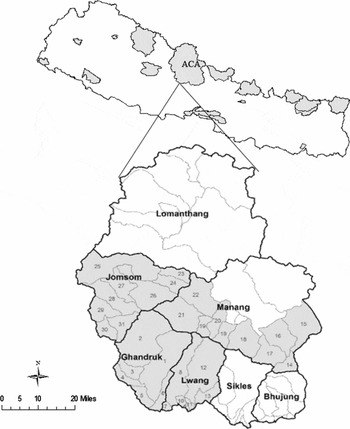
The 1996 Conservation Area Management Regulation required that a CAMC be formed for each village development committee (VDC) located within the conservation area. VDCs, the lowest level administrative and political units, are local-level authorities common to all villages in rural Nepal. There are seven management units (or field bases) for NTNC within ACA; three lie on the northern slope and four on the southern slope of the Annapurna Himalayas (Fig. 1). We selected two management units from the north (Jomsom and Manang) and two units from the south (Ghandruk and Lwang) for the study, based on our experience, review of reports and consultation with the ACAP staff. Lomanthang is separately managed under somewhat different rules, so it was excluded. Both Sikles and Bhujung are similar to Ghandruk and Lwang in ecological settings, ethnic composition and economic status, so we selected Ghandruk because the ACAP first started there, and Lwang to save time and reduce transportation costs. We considered that the four management units selected represent the diversity of ACA. Ghandruk, Lwang, Jomsom and Manang have 5, 7, 9 and 12 CAMCs, respectively. In Manang, we could not survey three CAMCs due to remoteness, time constraints and language barriers; we thus surveyed 30 CAMCs in total.
Map showing a network of Nepali protected areas, seven management units of ACAP, and the intensive study area within the Annapurna Conservation Area. The shaded polygons with numbers are the sample CAMCs. Based on information supplied by the Annapurna Conservation Area Project, Pokhara, Nepal, 2008.

A total of 15 members serve on each CAMC's executive committee. The VDC chairperson is an automatically designated member. One member is elected by user groups (local villagers) in each ward (there are generally nine wards per VDC), and five members are nominated by the ACAP conservation officer (CO). The CO is instructed to include representation of women and lower castes in each CAMC. The members select a chairperson and a secretary among themselves who become the appointed leaders of the CAMCs. At the time of fieldwork, VDC chairpersons were not present on the CAMCs due to the expiration of their tenure within the VDCs. As a result, the sampling frame for the 30 CAMCs consisted of 420 members.
We targeted 210 members (seven in each CAMC) for interviews. We purposively selected the chairs and secretaries (the appointed leaders) because we expected that they would be more knowledgeable about facts and figures of CAMCs than the other members. The other CAMC members were selected by a simple random method within each CAMC to reduce potential biases associated with sampling by convenience. CAMC member interviews focused on their views of the mission of their CAMC, of the leadership of their CAMC and of their confidence in the managerial capacity of the CAMCs to take over sole governance of the protected area. The appointed leaders provided a great deal of factual data, while the other members enriched our understanding with more subjective viewpoints and complementary factual information. Leach (Reference Leach2002) recommends this form of sampling within groups to maximize analyses of groups’ success and function. We conducted 190 scripted one-on-one interviews with the CAMC members (90.5% response rate), of which 23 (12.1%) were chairs, 23 (12.1%) were secretaries and 144 (75.8%) were general members. We interviewed six members on average in each committee, with a minimum of four and a maximum of nine. The interviews averaged 35 minutes in length.
We conducted villager surveys through quota sampling of 207 households within four CAMC management units. The surveys were conducted in one low-performing (reactive-dependent), one medium-performing (realization-independent) and two high-performing (awareness-interdependent) CAMCs. We first segmented the population (households) into three mutually exclusive groups based on economic status: wealthy, middle class and poor. This was done following interviews with the ACAP staff who reported that 20%, 50% and 30% households generally would fall into these categories, respectively. We selected sampling units from each group proportional to the estimated population distribution. We assigned economic status of respondents using the dimensions of their houses as a proxy of economic status in rural areas of Nepal. ACAP staff verified that our classification matched in most cases and, in cases of inconsistency, we followed the staff's classification. To reduce potential biases, we attempted to interview male and female respondents in an alternating fashion. Taking into account time and resource constraints, and a lack of an up-to-date sampling frame, quota sampling was an expedient way to gather the information required for our purpose. Face-to-face surveys were conducted, typically lasting less than 15 minutes each.
The information gathered from villagers’ interviews was also used to cross-validate the information collected from both the ACAP staff and the CAMC members. As a separate measure of CAMC performance, we solicited villagers’ perceptions regarding the status of natural resources (improved, remained the same or diminished) of the area during three time periods: before the inception of ACA, over the last 10 years and over the last five years (since the beginning of the Maoist insurgency in the area). Other data collected from villagers regarded measures of trust and legitimacy.
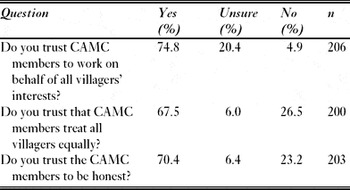
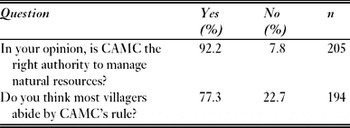
We characterized trust as a tripartite relationship in which entity A trusts entity B to do X (Hardin Reference Hardin2002). In our study, entity A refers to villagers and entity B refers to CAMC members. We asked villagers to respond to three definitions of X: ‘to work on behalf of all villagers’ interests’, ‘to treat all villagers equally’ and ‘to be honest’. We measured legitimacy by soliciting villagers’ perceptions about whether the CAMC is the ‘right authority’ to manage natural resources and about whether most villagers abide by its rules. We asked villagers two other questions. (1) Have you benefited from the CAMC? (2) Would it be better to not have the conservation area here?
RESULTS
Respondents’ characteristics
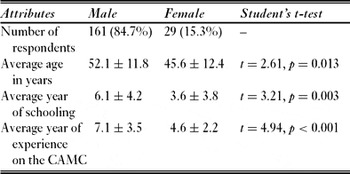
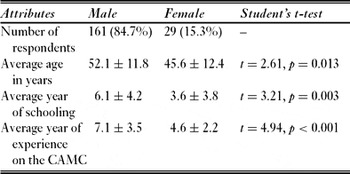
The average age of the 190 CAMC members was 51.1 ± 12.1 years. Only six (3.2%) were ≤ 30 years of age. Their level of education was typically low: 12.6% were illiterate, 40.5% had 1–5 years of schooling, 36.3% had 6–10 years and 10.5% had > 11 years. Among the present members, 45.8% had served on the CAMC before, of which 23.0% served two terms and 77.0% served one term. They averaged 6.7 ± 3.5 years of experience on the committees. Male committee members were older, more educated and had more CAMC experience than female committee members on average (Table 1). Only two CAMC members had migrated to the area from elsewhere.
Attributes of the respondents by gender with Student's t-tests all statistically significant at the 5% error level.
Of the 207 villagers surveyed, 56% were male and 44% were female. The average age was 45.9 ± 16.1 years. In our villager surveys, 20%, 47% and 33% households were categorized as wealthy, middle class and poor, respectively. Only 15% of villagers had migrated to the study area.
CAMCs’ performance
Based on the ACAP staff's assessment and field research, there were nine ‘high performer’ CAMCs, 12 ‘medium performer’ CAMCs and nine ‘low performer’ CAMCs. The high performers often initiated actions independently and accomplished their goals despite the challenge of the Maoist insurgency. They were categorized under the final stage of group evolution, namely ‘awareness-interdependent.’ The medium performers had developed capabilities to work independently, but their performance depended upon ACAP's inputs and the intensity of the insurgency. Thus, they were categorized as being in the second stage of ‘realization-independent.’ The low performers were mostly dependent upon ACAP to run their offices and often failed to accomplish major goals in absence of the ACAP's prompting. They were categorized as ‘reactive-dependent’. There was no correlation between CAMC performance and the duration (age) of CAMCs (r = −0.23, p = 0.23).
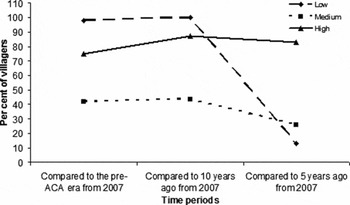
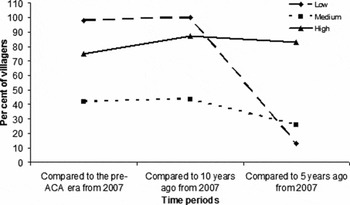
Local villagers also favourably evaluated the performance of CAMCs, as indirectly assessed by their perceptions regarding the status of natural resources of the area. Most villagers perceived that the status of natural resources had improved compared to the pre-ACA era (70.4%) and over the past 10 years (76.7%). About half perceived that natural resources remained in good condition even during the Maoist insurgency (49.0%). A higher proportion of villagers from areas governed by high performing CAMCs suggested that the status of natural resources improved even during the insurgency (Fig. 2).
Per cent of villagers mentioning that the status of natural resources had improved during the three time periods (the pre-ACA era, 10 years ago and 5 years ago from 2007) among high, medium and low performing CAMCs.
Organizational representativeness
In 2007, the youngest CAMC (Narchyang) was 10 years old while the oldest CAMC (Ghandruk) was 17 years old. All of the CAMCs had completed at least two five-year terms, and their average lifespan was 12.4 ± 1.5 years. Over the decade, the presence of women and lower caste members had increased considerably from being nearly non-existent at the project's outset. Two CAMCs had female chairs, and one CAMC had a female secretary. In a few CAMCs, lower caste members and females had defeated higher caste members and males in their elections. In many CAMCs, instead of elections, the CO nominated lower caste and female members. There were four lower caste members in one CAMC, two in six CAMCs, one in 17 CAMCs, and none in six CAMCs. There were four women in one CAMC, three in two CAMCs, two in 17 CAMCs, and one in 10 CAMCs. There was no significant difference in the average number of women and lower caste members among low, medium and high performing CAMCs (F2, 27 < 1.0, p > 0.10).
Effectiveness of CAMC leadership
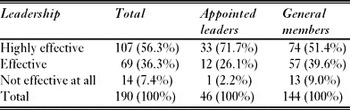
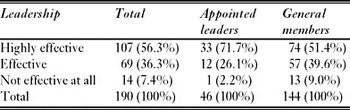
More than half (56.3%) of the surveyed CAMC members described their CAMC's leadership as ‘highly effective’, 36.3% described it as ‘effective’ and 7.4% described it as ‘not effective at all’ (Table 2). Although appointed leaders were more likely to rate themselves as ‘highly effective’ than general members (χ22 = 6.53, p < 0.05, n = 190), more than half of the general members agreed with this sentiment. All but one ACAP staff member regarded the CAMC's leadership as ‘effective’. High, medium and low performer CAMCs did not differ regarding the members’ perceptions of leadership effectiveness (Kruskal-Wallis test: χ22 = 2.37, p = 0.31, n = 190).
Members’ perceptions of the effectiveness of CAMC leadership.
Understanding the mission
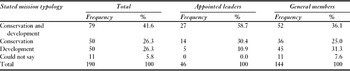
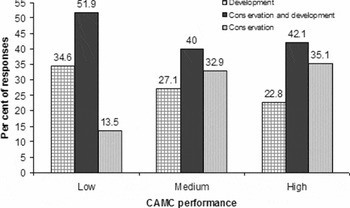
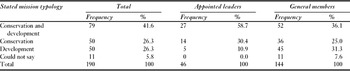
We asked CAMC members to define in their own words the mission of their CAMC. An overwhelming proportion (94%) of respondents expressed the mission in terms of ‘conservation’, ‘development’, or ‘conservation and development’ (Table 3). The appointed leaders were more likely to emphasize ‘conservation’ than the general members (χ22 = 9.56, p < 0.01, n = 179). There was no significant relationship between the duration (age) of the CAMCs and how their members interpreted their organizational mission. There was an association between the performance of CAMCs and how their members interpreted the organizational mission (χ24 = 7.97, p < 0.10, n = 179): members belonging to medium and high performance CAMCs tended to emphasize ‘conservation’ as their mission more than others (Fig. 3).
Members’ understanding of the CAMC's mission.
Interpretation of the main mission of CAMC, made by CAMC members in low, medium, and high-performing CAMCs.

Local support for CAMCs
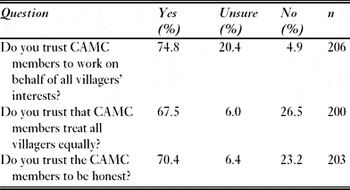
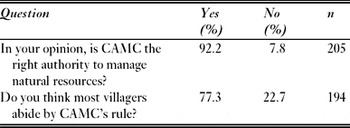
The CAMCs appeared to have garnered local support, as measured by trust and legitimacy. A majority of villagers reported their trust for CAMC members to work on behalf of all villagers’ interests, treat all villagers equally and be honest (Table 4). Almost all villagers perceived the CAMCs to be the right authority to manage natural resources of their area. Most also reported that most villagers abided by the CAMC's rules (Table 5), although only 51.3% of villagers from the areas governed by the lowest performing CAMCs agreed with the statement compared to over 80% in the other CAMCs. Furthermore, 62.6% of villagers had participated in various activities carried out by the CAMCs. About two-thirds (66.2%) of villagers reported that they had benefited from the CAMC. Almost all villagers (96.5%) said that they would be worse off if not for ACA. Most villagers also perceived that the status of natural resources had improved over the past decade. We uncovered no other consistent trends that distinguished different degrees of local support across the spectrum of performance of CAMCs.
Local people's perceptions of the trustworthiness of the CAMC members.
Local people's perceptions regarding the legitimacy of CAMCs.
CAMCs’ managerial capacity
Sixty-nine per cent of CAMC respondents believed that the CAMCs could manage ACA without support from ACAP, 27% disagreed and 4% were unsure. There was no significant difference between appointed leaders (chair and secretary) and general members’ perceptions regarding the CAMC's managerial capacity (χ21 = 1.18, p = 0.34, n = 182). Seventy-two per cent of CAMC respondents who felt that CAMCs could manage ACA independently felt ready do to so within four years. Answers ranged from less than one year to more than six years. All surveyed members of two of the high-performing CAMCs reported that they could manage ACA solely, while no members of one medium-performing CAMC believed they could.
Members of higher performing CAMCs were more confident that they could manage ACA solely (χ22 = 6.06, p < 0.05, n = 190). As expected, members belonging to high or medium performance groups felt they needed less time for preparation to take over management responsibility (Table 6).
Respondents’ perception of preparatory time required (in years) for CAMCs to take over the ACA management responsibility.

Six of the 13 ACAP staff interviewed reported that the CAMCs could manage ACA on their own. Four reported that the CAMCs could take over the management responsibility before 2012, while two reported that they might take 1–2 years longer than this to be fully ready. During the interviews, the staff gave various explanations for their assessments. Their most common explanations for believing the CAMCs were ready to manage ACA on their own included: (1) the experience they had gained since their inception, (2) their sincere commitment to the formation of the overarching council and (3) their legal mandate to represent local people. Two major themes emerged from officials who did not believe the CAMCs would be ready; they felt local communities often fail to navigate complex legal and bureaucratic procedures and that unequal capacities between and within different CAMCs would weaken the proposed council.
Four major recurring arguments emerged in interviews with CAMC members regarding their beliefs for why they would be ready to manage ACA on their own: (1) support from villagers and their active participation in CAMCs’ activities, (2) the continuation of a traditional resource management system that had been practiced in the past, (3) valuable experience gained while working with the ACAP and (4) legal recognition and guidance from well-established rules and regulations. One CAMC member used Kanchenjunga Conservation Area as a reference point: ‘People in Kanchenjunga have fewer resources and less experience in conservation area management than us, but they have already formed a council and started managing the area solely, so why can't we?’ He further added, ‘If we form and run the council ourselves, then we can benefit more than working under the NGO or the government’.
Three primary reasons emerged as explanations by CAMC members for beliefs that CAMCs were not ready to take on sole management responsibility of ACA: (1) continued reliance on ACAP to run an office and members’ lack of confidence, (2) ongoing political instability that tends to discourage members to take on responsibility and (3) the challenge of the continued need for capacity development due to the turnover of CAMC members every five years.
DISCUSSION
This study suggests that: many CAMCs have become robust organizations after more than a decade of hands-on experience in nature conservation; the CAMCs and their associated conservation functions have survived the Maoist insurgency although their degree of performance varied; most CAMC members have reported their confidence in managing the conservation area without external support; most members could articulate the organizational mission and do so in terms of conservation; and the CAMCs have garnered considerable local support. Many members argued for ACA's handover to the proposed council, claiming that they had the capacity to organize, fund and carry out devolved responsibilities at a local level. The ACAP staff further corroborated the CAMCs’ capacities to manage ACA. Other data corroborated all of our measures regarding ACAP staff perceptions of CAMC performance.
Not all CAMCs appeared equally capable of assuming local governance of the protected area. Some work yet needs to be done to build capacities in lower performing CAMCs. Many appear to still be in the reactive-dependent stage of development. Our research suggests that this capacity building may be feasible within the timeframe of the proposed handover, as even some of the younger CAMCs appear to have achieved higher levels of performance. That is, their success did not appear to be necessarily based on the duration of their experience. The high degree of resilience of most CAMCs to the Maoist insurgency further supports the notion that many are performing at particularly advanced levels of group evolution (many at the awareness-interdependent level). The presence of these groups can further solidify those at lower levels through continued capacity building and network strengthening following the creation of a single overarching council.
The timing of the proposed handover of authority will present real challenges, but there are many reasons to believe that local governance can be successful in Annapurna. Baral et al. (Reference Baral, Stern and Heinen2007) found that CAMCs in existence for more than a decade typically made more decisions to take on conservation actions than development actions. All CAMCs have now reached this age. The current study further reflects a high degree of understanding of the conservation mission of the area amongst CAMC members. The empowerment of the CAMCs is crucial to the successful delivery of the benefits of conservation to local people (Bajracharya et al. Reference Bajracharya, Furley and Netwon2005), which can be critical to the development of local support and perceptions of legitimacy (Stern Reference Stern2008a). These perceptions in turn tend to lead toward greater compliance with conservation-related rules and regulations (Stern Reference Stern2008a, Reference Sternb). The symbolic and real empowerment of local people associated with handing over authority to a local council can instill a sense of pride and ownership amongst local residents, often associated with enhanced sustainability of community-based conservation (McShane & Wells Reference McShane and Wells2004).
The proposed governance model for ACA reflects the essential features of co-managed PAs, but the local communities will lead governance instead of the government. In this proposed model, the government hands over the management authority of ACA to the council of CAMCs. The power will be shared mainly between the government and the council. The government owns the conservation area, while the council gains tenurial rights (or proprietorship) over the area. With tenurial rights, the council will have access rights to all resources within the conservation area, withdrawal rights to govern the appropriation of resources, management rights to regulate the withdrawal and improvement of resources and exclusion rights to define the qualifications for resource access. However, they will not have alienation rights to transfer the management authority of the conservation area to any other entity (Schlager & Ostrom Reference Schlager and Ostrom1992). This power remains with the government, which holds title to the land.
Proposed enforcement strategies will likely differ only slightly from current arrangements. Both CAMC members and ACAP staff currently share responsibility for patrolling the area. Most enforcement activities are carried out by the CAMCs themselves. CAMCs give warnings and levy fines in the case of minor offences (such as cutting wood without a permit). Major offences, such as wildlife poaching, are currently handled by ACAP, which forwards cases to a special governmental judiciary system set up to address these offences. While official arrangements are not agreed upon for the future governance system, it is likely that the CAMCs will handle all cases directly and retain the ability to forward more serious offences to the governmental judiciary system.
The government is expected to devolve tenurial rights over the conservation area to the council on a contractual agreement basis. The time period of the contract is still undetermined. It will be the responsibility of the council to secure financial sustainability and steer governance by collaborating with various stakeholders. To this end, the council will require all the authorities that the NTNC currently has, for example the collection of tourist entry fees, user fees and donations, which are critical for financial sustainability. The legal recognition of the council will likely serve to garner influence to protect the interests of the grass roots level CAMCs, which will also be critical for building networks at the national and international levels. Some argue that a major goal of many people-oriented conservation programmes is to vest local communities with significant rights so that they emerge as powerful actors in the governance of conservation programmes (Child & Dalal-Clayton Reference Child, Dalal-Clayton, McShane and Wells2004). The essence of the ACA governance model is that the local communities use external institutional actors for their own integrated conservation and development ends, rather than as a means for an external institution's end (Murphee Reference Murphree, Wright and Western1994).
There are some apparent challenges for the formation of an effective council. The CAMC members’ profiles show a disproportionate number of older and uneducated members. When older members dominate, there may occur a transmission failure from one generation to the next of the operational principles on which community governance is based (Ostrom Reference Ostrom2005). The problem might be exacerbated if youth moves outside the project area (see Fabricius et al. Reference Fabricius, Koch, Magome and Turner2004). As a result, the overarching council might be dependent upon outside technical expertise in the form of consultants for some time. Furthermore, competition between individual CAMCs for power and resources within the newly proposed governance system is possible. Currently, ACAP allocates most resources to CAMCs, and it mediates any conflicts between them. In its absence, some formal mechanisms to resolve conflicts and mediate power differences among CAMCs within the council may be warranted (Morrow & Hull Reference Morrow and Hull1996).
In KCA, local people have expressed concerns about the accountability and transparency of the council (Gurung Reference Gurung and Muller-Boker2006). Given the many similarities between the two areas, these same concerns may surface in ACA. Yet, the reported levels of trust and legitimacy for CAMCs in this study may assuage local people's concerns to some degree.
It is too early to evaluate the performance of KCA; however, by the time ACA's proposed handover begins, there may be an opportunity to learn from KCA's experience. In comparison to KCA, ACA may have a greater chance of success because of its financial sustainability through revenues from tourism and sales of non-timber forest products, long-enduring institutions and stocks of social and human capital (Baral et al. Reference Baral, Stern and Heinen2007, Reference Baral, Stern and Bhattarai2008). In addition, most CAMC members express an understanding of the organization's mission, appear to be motivated to shoulder the management responsibility and consider the CAMC leadership to be effective. These factors can facilitate the council formation.
Current conservation policies tend to give more power to states and NGOs for managing PAs (Brosius & Russell Reference Brosius and Russell2003). These policies often overlook the fact that local institutions might face fewer obstacles in developing trust and legitimacy than those from outside an area (Schwartzman et al. Reference Schwartzman, Moreira and Nepstad2000; Stern Reference Stern2008a, Reference Sternb). The research findings suggest that the involvement of local communities in park management can enhance the legitimacy of PA governance, garner support from local constituencies and strengthen local institutions. Neither governments nor NGOs are immune to failure (Barrett et al. Reference Barrett, Brandon, Gibson and Gjertsen2001). Our results suggest that granting conservation leadership to local communities in the governance of ACA appears a worthwhile experiment with a reasonable likelihood of continued conservation success.
CONCLUSIONS
The ultimate goal of the present management plan is to hand over ACA management to the CAMCs. When the contractual agreement of the NTNC with the government expires in 2012, the local communities of ACA will have had more than two decades of hands-on experience in conservation area management. The Nepali park management agency has insufficient resources to manage the network of PAs under its jurisdiction (Heinen & Mehta Reference Heinen and Mehta2000), so has already introduced a policy of handing over PA management to non-state actors.
Government or NGO failures in PA management clearly illustrate the risks associated with their governance (see Brandon et al. Reference Brandon, Redford and Sanderson1998; Terborgh et al. Reference Terborgh, vanSchaik, Davenport and Rao2002). Would testing the waters with local communities bear any greater risk? In the case of Annapurna, local perceptions, values, interests and capacities seem well-suited to the test. The key variables we examined indicate community-led governance may be a more sustainable option for the long-term management of ACA than the existing governance arrangement. Observing the new community conserved area in Annapurna will contribute to the adaptive management of PAs worldwide in the future.
ACKNOWLEDGEMENTS
The Rufford Small Grants Foundation (UK) and the Sigma Xi (USA) provided funding for this study. Our special thanks go to the ACAP office for granting the research permission, as well as the residents of ACA who participated in the study. We appreciate the help of Som Ale, Shant R. Jnawali, Joel T. Heinen, Lizan Maskey, Nawa Raj Chapagain, Rupesh Shrestha, Bhim Upadhaya, Laxmi Pun, Raj Kumar Gurung, Manish Pandey, Krishna Gurung, Ram Gurung, Shree Krishna Neupane, Suresh Thapa, Beg Bahadur Pun, Janardan Bastola, Namrata Baral, Hari Nepali, Shanti Gurung, Lil Raj Kunwar and Shiva Banskota. We thank the reviewers for their thoughtful comments.
We pay tribute to the conservation leaders who had participated in a ceremony in which the Government of Nepal handed over the management of Kanchenjunga Conservation Area to local communities, and then lost their lives in a fatal helicopter accident.