INTRODUCTION
English-speaking children tend to produce grammatical errors as part of normal development. These errors can include omission of tense and agreement (tense/agreement) markers, such as Mom hug me instead of Mom hugs me. Pronoun errors are also observed, and in English are evidenced as case errors, as in Her hug Elmo instead of She hugs Elmo. Children may also produce errors such as Her hugs Elmo but generative grammar accounts of grammatical development have suggested that these errors should occur rarely or never (Wexler, Schütze & Rice, Reference Wexler, Schütze and Rice1998). Other accounts of language development have suggested that productions like Her hugs Elmo may actually occur more often than previously expected, and that influences of language input may help to explain why these error patterns occur (Ambridge & Pine, Reference Ambridge and Pine2006; Coker, Pine & Gobet, Reference Coker, Pine, Gobet, Altmann, Cleeremans, Schunn and Gray2001; Pelham, Reference Pelham2011; Pine, Joseph & Conti-Ramsden, Reference Pine, Joseph and Conti-Ramsden2004; Pine, Rowland, Lieven & Theakston, Reference Pine, Rowland, Lieven and Theakston2005). This study was designed to examine whether pronoun case and tense/agreement features can be influenced by factors in the input.
Optional use of tense/agreement and pronoun errors
Analysis of longitudinal language samples from young English-speaking children has revealed that most typically developing children often omit tense/agreement morphemes from obligatory contexts for some period of time after they begin combining words into phrases (e.g. Rice, Wexler & Hershberger, Reference Rice, Wexler and Hershberger1998; Rispoli, Hadley & Holt, Reference Rispoli, Hadley and Holt2009). Wexler and his colleagues have described this as the optional infinitive (OI) period (Rice, Wexler & Cleave, Reference Rice, Wexler and Cleave1995; Rice et al., Reference Rice, Wexler and Hershberger1998; Wexler, Reference Wexler, Hornstein and Lightfoot1994). According to these investigators, young children have knowledge of syntax but fail to understand that verbs must be finite in main clauses. As a result, they alternate between using tense/agreement forms appropriately and using a non-finite form in their place. Affected forms include present third person singular -s (e.g. Mommy hugs me / Mommy hug me), copula be forms (e.g. Mommy is nice / Mommy nice), auxiliary be forms (e.g. Mommy is hugging me / Mommy hugging me), and past -ed (e.g. Mommy hugged me / Mommy hug me) (Wexler, Reference Wexler, Hornstein and Lightfoot1994). Typically developing children may remain in the OI stage until four or five years of age before using tense/agreement markers in more than 90% of obligatory contexts (Rice & Wexler, Reference Rice, Wexler and Rice1996a, Reference Rice and Wexler1996b, Reference Rice and Wexler1996c; Rice et al., Reference Rice, Wexler and Hershberger1998).
Wexler and his colleagues later refined their explanation for how the OI phase fits within the generative grammar framework by proposing the Agreement/Tense Omission Model (ATOM; Schütze & Wexler, Reference Schütze and Wexler1996; Wexler et al., Reference Wexler, Schütze and Rice1998). According to the ATOM, when children in the OI period overtly mark agreement features on a verb (e.g. walks ) they should also use a correct nominative case pronoun (e.g. He walks). But if children produce a verb without overt agreement (e.g. walk) in a context that requires it, they may produce either a nominative (e.g. he) or non-nominative (e.g. him) subject pronoun. Note that agreement markers in English also mark tense; therefore, unless both agreement and tense appear in the underlying syntax, the morpheme cannot be expressed. If agreement is represented without tense, nominative case is licensed even though the absence of tense prevents expression of the fused tense/agreement inflection (resulting in He walk). Conversely, if tense is represented without agreement, nominative case is not licensed and the default form for English (accusative or objective case) is used (e.g. Him walk). This distinction between agreement and tense provides an explanation for why some children are observed to produce utterances such as Him talked. Such utterances presumably lack agreement (accounting for the use of him rather than he) but, because -ed marks tense only, its expression is not blocked by the lack of agreement.
Although the ATOM can account for a range of attested child language productions, this model provides no basis for expecting an utterance such as Him walks because the presence of the inflection -s implies the presence of agreement, which should license nominative case. If such errors occur, they should be infrequent and the result of a language production performance error, according to this account. The same expectations arise for other tense/agreement morphemes. Thus, She walking and Her walking can be expected (along with the correct She is walking), but Her is walking is not predicted to occur.
Wexler et al. (Reference Wexler, Schütze and Rice1998) tested the predictions of the ATOM in children with typical development as well as those with specific language impairment. As predicted, they found that the highest frequency of non-nominative subjects occurred with non-finite forms. After eliminating children who showed evidence of only one pronoun case (e.g. a child who said him but never said he or vice versa), they evaluated the resulting group of children (with ‘case contrast’) and again found the highest frequency of non-nominative subjects in non-finite clauses and the least frequent with agreeing verbs. The authors concluded that the predictions of the ATOM model held true even though there were some instances when children produced non-nominative subjects with verbs marked for tense/agreement (e.g. Him hugs). Wexler and colleagues attributed all instances of these unexpected errors to performance errors by the child, small sample size, and potential sampling error.
However, several subsequent studies of spontaneous and elicited speech production by typically developing children and children with specific language impairment have reported use of non-nominative subjects with verbs marked for tense/agreement at rates higher than would be expected based on the ATOM's predictions (Ambridge & Pine, Reference Ambridge and Pine2006; Charest & Leonard, Reference Charest and Leonard2004; Loeb & Leonard, Reference Loeb and Leonard1991; Pine et al., Reference Pine, Joseph and Conti-Ramsden2004; Pine et al., Reference Pine, Rowland, Lieven and Theakston2005; Wisman Weil & Leonard, Reference Wisman Weil and Leonard2012). These studies reveal that the general patterns of agreement and case assignment predicted by the ATOM hold, but errors of the type Him hugs occur too often to be dismissed as noise in the data.
The role of input
Input-based accounts of language acquisition may be helpful in explaining why errors such as Him hugs occur more often than previously assumed by generativist accounts. In an attempt to explain young English-speaking children's me-for-I errors, Kirjavainen, Theakston, and Lieven (Reference Kirjavainen, Theakston and Lieven2009) examined the relationship between children's productions of me in subject position and their caregivers' use of me in secondary clauses (e.g. Let me do it), using longitudinal data from children ages two to four years in the Manchester corpus. Proportional productions of me in preverbal contexts between children and their caregivers were significantly correlated and there was a match between the specific verbs used in these contexts by children and their caregivers. In other words, if a child said Me do it, it was likely that the mother had said phrases such as Let me do it, Help me do it, or Watch me do it more often than other verbs in the input that were not used in me + Verb complement clauses. Thus English-speaking children are thought to extract their me-for-I productions from these me + Verb complement clauses heard in the input (Lieven, Reference Lieven2010).
The frequency of case-distinct (e.g. we–us) versus case-ambiguous (e.g. you–you) pronouns in the input to children by their caregivers may also point to an explanation for why English-acquiring children produce pronoun case errors. According to the input ambiguity hypothesis of Pelham (Reference Pelham2011), a relationship exists between the rate of case ambiguity produced by adult speakers of a language and the case errors produced by children acquiring that language. Pelham compared corpora of English and German because English-acquiring children produce pronoun case errors, whereas German-acquiring children rarely produce pronoun case errors but do produce article case errors. In support of the input ambiguity hypothesis, Pelham reported that English-speaking caregivers produced ambiguous pronouns (it, you, her) 63·3% of the time. In contrast, German adults produced ambiguous pronouns only 7·6% of the time, when speaking with their young children.
Given the high frequency of case-ambiguous pronouns produced by English-speaking caregivers in their speech to young children, it may be possible that children temporarily form abstract rules about the properties of pronouns from highly frequent examples of you and it in both nominative and object case positions. Experimental and longitudinal studies are needed to examine whether there might be a correspondence between the syntactic frames used by English-speaking caregivers with you and it forms and the frames children use when producing non-nominative for nominative pronoun case errors. It may be that specific pre- or post-verbal contexts in which case-ambiguous pronouns are used by English-speaking caregivers as in (1) and (3) contribute to children's overextensions of non-nominative pronouns to subject positions as in (2) and (4).
-
(1) Utterances a child may hear by caregivers:
Mommy loves you.
You love Mommy.
-
(2) Resulting overextensions produced by the child:
Mommy loves him.
Him loves Mommy.
-
(3) Utterances a child may hear by caregivers:
Daddy sees it.
It sees Daddy.
-
(4) Resulting overextensions produced by the child:
Daddy sees her.
Her sees Daddy.
The present study examines the input-based factors that may contribute to why children make pronoun errors, with special reference to the input ambiguity hypothesis. We pursue this issue through a modified structural priming task. Structural priming refers to the influence that the grammatical form of one sentence (e.g. The girl bought the present for her mother) can have on the form of a subsequent sentence (e.g. an utterance produced as The boy gave the money to his sister rather than The boy gave his sister the money). This influence can occur at a rather abstract structural level, as it is seen even when the subsequent utterance shares no lexical content or thematic relations with the prior utterance (Bock & Loebell, Reference Bock and Loebell1990). In the classic structural priming paradigm (Bock, Reference Bock1986), participants hear and repeat sentences (the prime) and then describe target pictures that are semantically unrelated to the prime, but amenable to the same sentence structure. Variations of this method have included speakers listening but not repeating the prime, and describing the target picture after several filler pictures have appeared between the prime and the target picture (see reviews in Leonard, Reference Leonard2011; Pickering & Ferreira, Reference Pickering and Ferreira2008).
Although the early structural priming studies used adults as participants, a growing number of studies have examined priming in children (e.g. Bencini & Valian, Reference Bencini and Valian2008; Foltz, Thiele, Kahsnitz & Stenneken, Reference Foltz, Thiele, Kahsnitz and Stenneken2015; Garraffa, Coco & Branigan, Reference Garraffa, Coco and Branigan2015; Huttenlocher, Vasilyeva & Shimpi, Reference Huttenlocher, Vasilyeva and Shimpi2004; Miller & Deevy, Reference Miller and Deevy2006; Rowland, Chang, Ambridge, Pine & Lieven, Reference Rowland, Chang, Ambridge, Pine and Lieven2012; Savage, Lieven, Theakston & Tomasello, Reference Savage, Lieven, Theakston and Tomasello2003; Shimpi, Gámez, Huttenlocher & Vasilyeva, Reference Shimpi, Gámez, Huttenlocher and Vasilyeva2007; Thothathiri & Snedeker, Reference Thothathiri and Snedeker2008). Most studies of children have primed syntactic structure (e.g. influencing children's use of passive sentences through the experimenter's use of passives). However, Leonard and colleagues have found priming effects on the use of grammatical morphemes such as auxiliary is and past tense -ed by children at a stage of development when these morphemes were only inconsistently used in obligatory contexts (Leonard, Miller, Deevy, Rauf, Gerber & Charest, Reference Leonard, Miller, Deevy, Rauf, Gerber and Charest2002; Leonard, Miller, Grela, Holland, Gerber & Petucci, Reference Leonard, Miller, Grela, Holland, Gerber and Petucci2000).
In adults, target sentences that include some of the same lexical items as the prime sentence show even stronger priming effects than prime–target pairs that share only syntactic structure. However, this ‘lexical boost’ is short-lived; when several filler sentences appear between the prime and the target, the priming effects are the same as for prime–target pairs that have no lexical overlap. Importantly, in young children, the lexical boost is not seen. One possible reason is that the boost is the result of explicit memory of details of the prime sentence, and young children's memory skills may not be sufficient to retain such information (Rowland et al., Reference Rowland, Chang, Ambridge, Pine and Lieven2012).
One prominent view of structural priming is that it represents a type of implicit learning that affects, incrementally, a speaker's command of syntactic structure (Bock & Griffin, Reference Bock and Griffin2000). Learning is assumed when speakers continue to show the influence of a prime even with intervening material and time before the production of the target. In addition, computational models based on structural priming show clear structural learning that is independent of specific lexical content (Chang, Dell & Bock, Reference Chang, Dell and Bock2006). The implicit nature of such learning is illustrated by the finding that adults with anterograde amnesia showed structural priming even with multiple intervening fillers even though these individuals had only limited recognition memory of the prime sentences that had been presented just minutes before (Ferreira, Bock, Wilson & Cohen, Reference Ferreira, Bock, Wilson and Cohen2008).
From the implicit learning perspective, there are more than parallels between changes due to priming and changes that occur in children's syntactic development. As noted by Rowland et al. (2012, p. 60), structural priming may be “a consequence of the implicit statistical learning mechanism that is responsible for learning syntactic representations in the first place”.
To evaluate the input ambiguity hypothesis, we created a modification of the structural priming paradigm, referred to here as ‘paired priming’. In this modification, children hear and repeat not a single prime sentence before responding, but a pair of prime sentences in which the referent that serves as the direct object in the first sentence of the pair serves as the subject of the sentence in the second sentence of the pair. In this way, we could provide grammatical sentence pairs in which the pronoun takes the same form in object and subject position, as in Mom feeds you … and you feed Pluto, as well as sentence pairs whose object and subject forms differ, as in Mom hugs me … and I hug Tinker Bell. Once the second sentence of the pair is repeated by the child, the examiner then provides the first sentence of a second pair, asking the child to provide the next sentence of this pair, as in Mom feeds her and [child describes a picture of the same girl who, in turn, is feeding another character] or Mom hugs him and [child describes a picture of the same boy who, in turn, is hugging another character]. We hypothesized that after hearing sentence pairs involving non-contrasting pronouns such as you–you, the children would be more likely to complete the second pair with a subject pronoun that matches the object form used in the preceding sentence, as in Her feed/feeds Mickey Mouse. The children's responses were also expected to contain a relatively large number of third person singular -s productions even when produced with a non-nominative subject pronoun (as in Her feeds) because this inflection will have appeared in the examiner's production and should also serve as a prime.
METHOD
Participants
Thirty monolingual English-speaking children (15 female, 15 male) with typical language development participated. The children ranged in age from 2;6 to 3;7 (M = 3;0, SD = 4·04 months). All were enrolled in a preschool or daycare and parents reported no concerns about speech and language development. Each child also demonstrated normal language abilities based on a standard score above –1 standard deviation of the mean (M = 113·07, SD = 10·40) on the Peabody Picture Vocabulary Test, 4th Edition (PPVT-4; Dunn & Dunn, Reference Dunn and Dunn2007). All children also passed a pure tone audiometric screening at 25 dB HL for 500, 1000, 2000, and 4000 Hz bilaterally. Six additional children were initially enrolled in the study but did not qualify. These children (1 female, 5 male) were aged 2;6 to 2;9 (M = 2;7, SD = 1·2 months). All six of the children were excluded because they were unwilling or unable to participate in the research activities during the first one or two research sessions.
Procedures
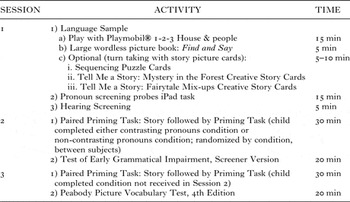
Participants completed assessment and research tasks in three or four 45–60-minute sessions in the authors' child language lab (n = 7), in a quiet room at the child's school (n = 18), in the child's home (n = 2), or at the child's school and home (n = 3). A summary of the schedule of tasks appears in Table 1. All sessions were digitally audio-recorded using a Marantz professional solid-state recorder, model PMD660, with an external microphone (Crown® PZM® -185 Pressure Zone Microphone®). A parent of each participant consented to the research activities in accordance with standards of the authors' Institutional Review Board.
Research activities schedule by session

Research sessions were typically conducted once a week, for three consecutive weeks. One session involved language testing and the second and third sessions involved the two paired priming conditions along with completion of the language testing. A fourth session was used to complete language testing, when needed (n = 4). For all participants, there was at least one week between participation in each of two paired priming conditions.
The children's pre-experiment pronoun and third person singular -s use. Prior to administering the paired priming task, it was critical to determine whether children were, in fact, using pronouns of different forms as well as the third person singular -s inflection. Our hypotheses were grounded on the assumption that both nominative and non-nominative pronouns were present in the children's inventories, and that they had begun to use third person singular -s in at least limited contexts. It was important, therefore, to document this type of use. Although spontaneous speech samples would be the most natural means of obtaining this information, these samples may not necessarily include the obligatory contexts for the forms of interest. For this reason, we chose to use more structured tasks that included obligatory contexts for different pronoun forms and third person singular -s. Spontaneous speech samples were also obtained; however, these served primarily to provide supplementary information about the children's use of the forms of interest.
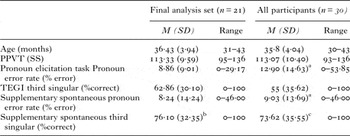
In Table 2, we present the children's pre-experiment use of pronouns and third person singular -s. As described below, from the larger group of thirty children, twenty-one children provided evidence of using all relevant pronouns (he, she, him, her) and a sufficient number of scorable responses in the paired priming task to permit data analysis. Table 2 provides the pre-experiment use for all thirty children, and for the twenty-one children providing the final data analysis set.
Descriptive statistics for the pre-experiment measures

notes: a Four of the 30 children did not have more than 5 scorable responses in each of the two conditions in the paired priming task.
b Three of the 21 children had no obligatory contexts for third person singular -s in their spontaneous speech samples.
c Eight of the 30 children had no obligatory contexts for third person singular -s in their spontaneous speech samples.
Pre-experiment pronoun use. For the structured pronoun task, nominative, objective, and genitive case third person pronouns (he/him/his, she/her/her, they/them/their) were elicited from the children. An interactive iPad application was created using Keynote version 5·2 for Mac (Apple Inc., 2003–2012) and Keynote version 1·6·2 for iPad (Apple Inc., 2010–2012). Participants viewed the presentation via Keynote for iPad on the iPad 2 (Model MC989LL) running iOS 6·0·1 (Apple Inc., 1983–2012).
Participants sat next to the examiner, and a dog puppet acted as a confederate to encourage the child to talk about the stimuli. The stimuli were set up to elicit sentences about who plays with what. Pictures included real photographs of a boy and a girl playing with a variety of toys. The toys were selected to be relatable and familiar to the children who participated in this study. The child heard a series of six questions of the type Who is playing with X?, aimed at eliciting nominative case pronouns. The child first chose one of three pictures (target picture or two foils). Upon touching the correct picture the child heard “nice work” (or similar reinforcement), followed by the request, Okay, now tell Doggie, who is playing with X? The target response expected was He/She/They is/are playing with X. If the child did not respond, or responded with a single word (e.g. Him), the child was shown a prompt screen, heard the prompt question again (Who is playing with X?) and the examiner used the foil pictures to model an appropriate response (e.g. Look, she is playing with a hat, they are playing with the house, and …). The examiner encouraged the child to imitate her description of the foil pictures to encourage use of a complete phrase in response to the target picture. If the child still did not respond, the next item was administered.
The six objective case and six genitive case items were administered in a similar fashion. The prompt question for elicitation of objective pronouns was: Who does the X belong to?, with the target response being: The X belongs to him/her/them. For genitive items, the prompt question was: Whose X is this?, and the target response was: This is his/her/their X. For genitive responses, the child was required to produce the entire noun phrase to ensure use of a possessive determiner (his, her, their) rather than a possessive independent function pronoun (his/hers/theirs). Thus, children who produced one-word responses (e.g. his) following the genitive elicitation question were shown the prompt screen, heard the elicitation question again (e.g. Whose hat is this?) and the examiner used the foil pictures to model an appropriate response (e.g. Look, this is his turtle, this is their bus, and this is …). If the child still did not provide an on-target response, then the next item was administered.
The three different pronoun case types were consistently presented in the same order for all participants: nominative, objective, and genitive. When needed, the child was given breaks between blocks or completed other portions of the assessment battery between each section of the pronoun production screener.
The elicited pronoun production measure was scored on-line by the examiner, scoring was checked and necessary changes were made after listening to the audio-recording. An elicited pronoun error rate was calculated based on data from the elicitation task. The pronoun error rate was the total number of pronoun case errors divided by the total number of attempts (errors plus correct productions).
Pre-experiment third person singular -s use. To gain an impression of the children's use of third person singular -s prior to the administration of the paired priming task, we administered the Test of Early Grammatical Impairment (TEGI; Rice & Wexler, Reference Rice and Wexler2001), a test of finiteness marking abilities in young English-speaking children. Children were first administered the phonological portion of the test to ensure sufficiently accurate productions of word-final /s/ and /z/ phonemes in monomorphemic contexts (a minimum of 80% correct for each phoneme). After passing the phonological portion of the TEGI, participants completed the third person singular -s portion. Scores were reported as percentage correct with possible scores ranging from 0 to 100. Percentage correct scores were employed rather than criterion scores because the TEGI was normed on children above the age of 3;0 and some of our participants were younger than 3;0.
Supplementary spontaneous speech information. To supplement the more structured pronoun and third person singular -s tasks, a 20–30-minute language sample was collected from each child during play with a Playmobil® 1-2-3 house, vehicles, and people. A goal during the language sample was to collect a minimum of ten subject pronoun productions in order to accurately assess spontaneous pronoun use (Rispoli, Reference Rispoli2005). In order to collect as many different third person pronoun productions as possible, children also spent 5–10 minutes talking about the pictures in a large picture board book entitled, Find and Say, illustrated by Gill Guile (Reference Guile1994). Pictures in the book depict people and families in a variety of everyday activities including at the farm, by the river, in town, at the beach, around the house, and celebrating a holiday.
The child utterances from the language samples were transcribed and coded by the first author for morphology and syntax using standard Systematic Analysis of Language Transcripts conventions (SALT; Miller, Long, McKinley, Thormann, Jones & Nockerts, Reference Miller, Long, McKinley, Thormann, Jones and Nockerts2005). All correct pronoun productions and pronoun errors were coded. A spontaneous pronoun error rate was computed from the language samples given the total number of pronoun case errors divided by the total number of attempts (errors plus correct productions). The use or omission of third person singular -s in obligatory contexts was recorded using the conventional SALT codes of /3S and /*3S, respectively. A percentage correct score was computed for spontaneous third person singular -s use given all obligatory contexts.
Paired priming task. A paired priming task was designed and administered utilizing a within-subject design. The goal was to determine whether features of pronoun case in the input can be manipulated to prime young English-speaking children to produce more subject pronoun errors. This study provides the first experimental test of the input ambiguity hypothesis (Pelham, Reference Pelham2011) utilizing a new experimental design, a paired priming task.
The priming task had two conditions – one containing primes with case-contrasting pronouns (I/me, we/us), the other with non-contrasting (case-ambiguous) pronouns (you/you, it/it). The design was within-subjects, blocked by condition type, counterbalanced across participants, and separated by at least one week between condition types.
In each condition, participants first heard a story with a high frequency of non-contrasting pronouns (modified version of Just for You, originally by Mercer Mayer) or a story with a high frequency of contrasting pronouns (modified version of I Went Walking, originally by Sue Williams). The purpose of each story was to provide a more typical context in which the relevant pronouns occurred, so that the transition to the subsequent paired priming task was not abrupt. The use of the pronouns in the stories served as additional input and thus might have had an effect on the absolute level of priming that occurred in the paired priming task. However, our focus was on the relative level of priming in the two conditions, and the stories that preceded the priming task were equated in terms of the amount of exposure to non-contrasting versus contrasting pronouns. Note that the pronouns to be used in the children's responses – she/her and he/him – were not included in the stories.
The story with non-contrasting pronouns contained eleven examples each of the second person singular pronoun in nominative (you) and objective (you) forms and eleven examples each of the third person singular, non-personal pronoun in nominative (it) and objective (it) forms. The story with contrasting pronouns contained eleven examples each of the first person singular pronoun in nominative (I) and objective (me) forms and eleven examples each of the first person plural pronoun in nominative (we) and objective (us) forms. Following the story, participants completed the corresponding paired priming task.
For each item in the paired priming task, participants imitated two pairs of active transitive sentences while watching the examiner perform relevant actions with toy characters. Then participants heard a sentence describing a paired enactment with a third person singular masculine or feminine pronoun in object position and were asked to complete the next sentence of the pair (following the format learned via the paired prime sentences) with a third person masculine or feminine pronoun in subject position. This was followed with another sentence and sentence-to-be-completed pair. Examples of items from the non-contrasting pronoun prime condition appear in (5) and (6); examples from the contrasting pronoun prime condition appear in (7) and (8).
-
(5) Imitation sentences:
Mom covers you … [child imitates] and you cover Tinker Bell … [child imitates].
Dad covers it … [child imitates] and it covers the doggie … [child imitates].
Elicitation sentences:
Mom covers him and … [target: He covers Barney].
Dad covers her and … [target: She covers the kitty].
-
(6) Imitation sentences:
Dad feeds it … [child imitates] and it feeds Donald Duck … [child imitates].
Mom feeds you … [child imitates] and you feed Pluto … [child imitates].
Elicitation sentences:
Dad feeds her and … [target: She feeds Minnie Mouse].
Mom feeds him and … [target: He feeds Mickey Mouse].
-
(7) Imitation sentences:
Mom hugs me … [child imitates] and I hug Tinker Bell … [child imitates].
Dad hugs us … [child imitates] and we hug the doggie … [child imitates].
Elicitation sentences:
Mom hugs him and … [target: He hugs Barney].
Dad hugs her and … [target: She hugs the kitty].
-
(8) Imitation sentences:
Dad kisses us … [child imitates] and we kiss the elephant … [child imitates].
Mom kisses me … [child imitates] and I kiss the giraffe … [child imitates].
Elicitation sentences:
Dad kisses her and … [target: She kisses the bear].
Mom kisses him and … [target: He kisses the doggie].
Ten items were used in each condition, with the same ten transitive verbs used in both conditions. The ten transitive verbs (chase, cover, drive, feed, hug, kiss, pull, push, touch, wash) were selected based on their likelihood to be familiar to young children and their ease of demonstration in a scenario enacted with toys. All ten of the verbs chosen were produced by at least 50% of typically developing children by age 2;6 in the normative sample on the MacArthur-Bates Communicative Development Inventory (Fenson et al., Reference Fenson, Dale, Reznick, Bates, Thal, Pethick and Stiles1994). The groups of four characters per item (e.g. Tinker Bell, doggie, Barney, and kitty) were presented as a group and in the same order in both conditions but were paired with different verbs each time. This allowed any possible influence of the characters (e.g. familiarity or interest by the child) to remain constant across conditions and allowed the activity to seem more novel and interesting to the child since the same characters were engaged in different activities across the two conditions. All items in each condition required use of both he and she, with the order of these two pronouns counterbalanced across children.
Responses during administration of the paired priming task were recorded on-line and later transcribed from the digital audio-recording. All participant transcripts were also independently checked against the recordings for accuracy by trained undergraduate researchers (see paragraph on reliability below). For each participant, frequencies of nominative pronoun, non-nominative pronoun, and other (e.g. noun) subjects were counted. The number of verbs that included or excluded third person singular -s in the elicited sentences was also counted. Finally, four cells were tabulated for each participant with regard to use of nominative or non-nominative case in subject position and inclusion or exclusion of the third person singular -s inflection.
Third person singular -s was examined only for elicited responses containing a third person singular masculine or feminine pronoun. Responses were excluded from the analysis set if they contained other pronominal forms (e.g. it, you, I, me, we, us, they, them) or nominal subjects (e.g. the little girl or the little boy). For each condition, the total number of correct pronoun and third person -s productions possible was twenty (10 items with 2 sentence completion opportunities for pronouns and for third person singular -s in each item). Because children did not always produce a scorable response (i.e. a response with a pronominal subject rather than a nominal subject), proportion of non-nominative pronoun use rather than frequency scores were used in the analysis set.
The first author initially collected on-line responses for the paired priming task and transcribed responses to both conditions for each of the thirty participants. To assess reliability, two trained research assistants listened to each audio-recording and checked each transcript. These individuals were told to pay particular attention to the child's use of pronouns and inclusion or exclusion of third person singular -s forms. They were unaware of the specific research questions of the study. Inter-rater agreement on the paired priming task for pronoun scoring was perfect in the non-contrasting (ambiguous) pronoun condition (kappa = 1·00) and very good in the contrasting pronoun condition (kappa = 0·98). Inter-rater agreement on the paired priming task for third person singular -s scoring was very good in both the non-contrasting pronoun condition (kappa = 0·99), and the contrasting pronoun condition (kappa = 0·99). In cases of disagreement, the first author listened again to the audio-recordings and made changes only if the research assistant's judgment appeared to be correct.
RESULTS
Pronoun case accuracy
All thirty children participated in the paired priming task. However, to promote a more accurate test of the role of input, we applied additional restrictions to the data. First, we ensured that all children included in the analysis set showed use of all four third person singular nominative and objective pronoun forms – he, him, she, and her – on our pronoun production task and/or in their spontaneous speech sample. Requiring all four pronoun forms ensured that data would not be distorted by the absence of certain forms from the children's inventories (see Schütze, Reference Schütze2001). Second, we included only those children who provided at least five scorable responses for each dependent measure (pronouns in subject position, obligatory contexts for third person singular -s) for each condition. Unscorable responses were often productions containing a nominal subject (e.g. the little girl) rather than a pronominal subject. The resulting number of children meeting these criteria was twenty-one. As can be seen from Table 2, the twenty-one children forming the analysis set were very similar to the larger group of children; in fact, all analyses reported for the twenty-one children were also conducted for the larger pool of thirty children with identical results. We focus here on the twenty-one children who met the more stringent criteria.
The two paired priming conditions did not differ in the number of scorable responses provided by the final analysis set of twenty-one children. A response was considered scorable if it included a third person singular pronominal masculine or feminine subject. For scorable pronoun responses in the non-contrasting condition, the mean was 18·38 (SD = 2·06); for scorable pronoun responses in the contrasting condition, the mean was 17·67 (SD = 4·28); (t(20) = 0·83, p = ·42). For obligatory contexts for third person singular -s in the non-contrasting and contrasting conditions, the means were 18·14 (SD = 2·01) and 17·48 (SD = 4·26), respectively (t(20) = 0·78, p = ·44). Preliminary analyses also revealed that the order in which the two conditions were presented did not affect the children's tendency to produce non-nominative pronouns. Non-nominative subject pronoun use was similar in the non-contrasting pronouns condition given the non-contrasting pronouns condition first (M = 0·53, SD = 0·42) or given the contrasting pronouns condition first (M = 0·38, SD = 0·39), t(28) = 1·01, p = ·32). Non-nominative subject pronoun use was also similar in the contrasting pronouns condition regardless of whether the non-contrasting pronouns condition (M = 0·41, SD = 0·43) or the contrasting pronouns condition (M = 0·29, SD = 0·41) was administered first (t(28) = 0·77, p = ·45). Males and females also did not differ in their performance. In the non-contrasting pronouns condition, males (M = 0·39, SD = 0·37) and females (M = 0·52, SD = 0·44) did not differ in their use of non-nominative case subject pronouns (t(28) = 0·90, p = ·38). Similarly, in the contrasting pronouns condition, males (M = 0·29, SD = 0·38) and females (M = 0·42, SD = 0·45) did not differ in their use of non-nominative case subject pronouns (t(28) = 0·85, p = ·40). Given no effects of condition order or sex, these two factors were collapsed in all subsequent analyses.
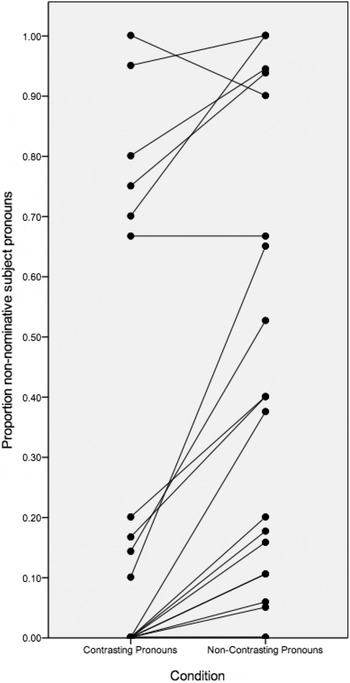
A paired samples t-test was used to compare the use of non-nominative case pronouns in the contrasting pronouns and non-contrasting (ambiguous) pronouns conditions. One-tailed t-tests were used given the hypothesis that the non-contrasting (ambiguous) pronouns condition would be more likely to elicit non-nominative case pronoun productions as compared to the contrasting pronouns condition. Indeed, the non-contrasting pronouns condition was found to elicit production of more non-nominative case pronouns (M = 0·41, SD = 0·37) compared with the contrasting pronouns condition (M = 0·26, SD = 0·37); (t(20) = 4·45, p < ·001). As can be seen from Figure 1, only one child showed a pattern opposite to the dominant pattern, and two others showed comparable scores for the two conditions. In general, the differences between the two conditions were dramatic. These results suggest that priming with pronouns that had case ambiguity (you–you, it–it) was more likely to elicit a subsequent non-nominative case subject pronoun (him in place of he, her in place of she) than priming with case-contrasting pronouns (I–me, we–us).
Proportion use of non-nominative case subject pronouns on the paired priming task by participants with more than 5 scorable responses per condition and evidence of he, she, him, and her in their production inventories (n = 21).

Third person singular -s use with nominative and non-nominative pronouns
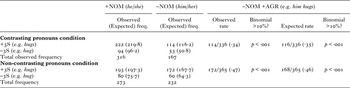
Another question of interest in the study was whether input-induced non-nominative pronoun use would be accompanied by third person singular inflections (e.g. Her covers the kitty). To pursue this question, a binomial probability test was used to determine whether third person singular -s productions with non-nominative subjects were occurring more than 10% of the time. Pine et al. (2005) reasoned that since the ATOM predicts that non-nominative subjects with agreeing verb forms should occur rarely or never, setting the chance level at 10% would represent a reasonable amount of ‘noise’ in the data to test this claim. A binomial probability calculator (available at <http://faculty.vassar.edu/lowry/binomialX.html>) was utilized with n = total number of +NOM and –NOM subjects with +AGR verb forms, k = observed or expected number of –NOM subjects with +AGR verb forms, and p = ·10. One-tailed p values were utilized based on the exact binomial calculation of the likelihood that k or more instances would occur out of n opportunities significantly more than 10% of the time. The frequency of the children's use of nominative and non-nominative subject pronouns with and without third person singular -s appears in Table 3. Binomial testing indicated that the children's use of third person singular -s with non-nominative pronoun subjects (e.g. Him hugs Barney or Her hugs Barney) was much greater than 10% (p < ·001). This was true not only for items in the non-contrasting pronoun condition but for items in the contrasting pronoun condition as well.
Frequency of nominative (+NOM) and non-nominative (–NOM) third person singular subjects with (+3S) and without (–3S) third person singular -s in the paired priming task

The high degree of third person singular -s use could well have been influenced by priming effects. Note that for each non-contrasting pronoun item, the child heard five instances of third person singular -s produced by the experimenter. This can be seen in examples (5) and (6). For each contrasting pronoun item, the child heard four instances of this inflection, as can be seen in examples (7) and (8). One observation consistent with this priming interpretation is the finding that participants were significantly more likely to use third person -s in both the contrasting pronouns condition (M = 0·69, SD = 0·26) and the non-contrasting pronouns condition (M = 0·72, SD = 0·26) than on the TEGI third person singular task (M = 0·55, SD = 0·36), (t(29) = 2·75, p = ·01) and (t(29) = 3·47, p = ·002), respectively.
DISCUSSION
Pelham (Reference Pelham2011) provided naturalistic evidence that demonstrated a strong correlation between English-speaking caregivers' frequent use of non-contrasting pronouns and English-acquiring children's tendency to produce pronoun case errors. This study extended the findings of Pelham and demonstrated that, in a paired priming task, children are more likely to produce non-nominative case pronouns when presented with non-contrasting (case-ambiguous) pronouns (i.e. you–you and it–it) than with contrasting pronouns (i.e. I–me and we–us). Of the children with an adequate number of scorable responses (more than five) in both conditions of the paired priming task, eighteen of twenty-one showed greater production of non-nominative case pronouns when primed with non-contrasting pronouns.
It is important to point out that the prompt immediately before the child's response (e.g. Mom hugs him and …) was of the same form in the two priming conditions. Therefore, the factor that seems most responsible for the difference between the conditions is the type of pronoun used prior to the prompt. These pronouns were uniformly grammatical; they differed only in whether they showed a case contrast (as in I–me) or were instead identical across subject and object contexts (as in you–you).
We interpret the results in the following way. Children's early use of non-nominative pronouns in subject position may have been influenced by the case ambiguity of certain pronouns in the input, as proposed by Pelham (Reference Pelham2011). The children in the present study were at a point in development when pronouns with nominative case were being acquired and were replacing non-nominative forms. However, this substitution process is not instantaneous; it occurs incrementally with additional experience with the input. In the meantime, there is competition between newly acquired (correct) forms, and the forms that had been used in the same context. The data presented support a growing body of literature (see Bock & Griffin, Reference Bock and Griffin2000) suggesting that structural priming is a type of implicit learning that involves the same learning mechanism that occurs in grammatical development. This learning is assumed to involve structure at a more abstract level, with each encounter with an exemplar having a small effect on the strength of the structure's representation. At the age of the children in the present study, any overlap in the words contained in the prime and in the target plays little to no role in the incremental strengthening of the representation (Rowland et al., Reference Rowland, Chang, Ambridge, Pine and Lieven2012). Because we assume that the case ambiguity of other pronouns in the paradigm influenced the children's use of non-nominative pronouns in subject position in their initial development, we likewise assume that the use of non-contrasting pronouns (you–you, it–it) in the prime added incremental strength to the not-yet-fully-expunged non-nominative pronoun competitors for third person feminine and masculine, her and him.
Another finding of the study was a relatively high degree of errors such as Her covers the kitty, in which the third person singular inflection was used with a non-nominative pronoun. These errors were expected, given that previous studies using naturalistic language samples have found higher uses of errors of this type than would be predicted by the ATOM for children with typical development (Pine, Conti-Ramsden, Joseph, Lieven & Serratrice, Reference Pine, Conti-Ramsden, Joseph, Lieven and Serratrice2008) and for those with specific language impairment (Pine et al., Reference Pine, Joseph and Conti-Ramsden2004; Wisman Weil & Leonard, Reference Wisman Weil and Leonard2012). We found an even higher degree of such errors in the present study. Part of this effect may have been attributable to our use of repetition in the task; Shimpi et al. (Reference Shimpi, Gámez, Huttenlocher and Vasilyeva2007) found much greater priming in three-year-olds who repeated primes prior to responding to the target pictures. However, recall that structural priming tasks with children have shown priming of verb inflections when children are at a stage of using these inflections inconsistently in obligatory contexts (Leonard et al., Reference Leonard, Miller, Grela, Holland, Gerber and Petucci2000). In the present study, for all items in both conditions, the prompt immediately preceding the children's response contained a verb inflected for third person singular (e.g. Dad feeds her and …). It seems likely, then, that this prompt served as a prime for the children's response. The fact that the children would combine this verb form with a non-nominative pronoun is in keeping with a basic assumption of the input ambiguity hypothesis. That is, upon hearing forms that do not vary – including those that can combine with third person singular -s (as in It runs) – children might be slow to discard forms such as her and him as alternatives for subject position. In our priming task, we merely capitalized on the residual presence of these forms as competitors for subject position in the children's grammatical system.
This last finding has implications for several related input-based accounts of early grammatical development, especially young children's inconsistency in using inflections that mark tense and agreement. These accounts share the assumption that young children may not fully process input structures, such as We saw her hug Elmo, and may as a result view the non-finite subject–verb clause her hug Elmo as structurally unconstrained and extractable for use as a stand-alone utterance (e.g. Coker et al., Reference Coker, Pine, Gobet, Altmann, Cleeremans, Schunn and Gray2001; Freudenthal, Pine & Gobet, Reference Freudenthal, Pine and Gobet2010; Kirjavainen et al., Reference Kirjavainen, Theakston and Lieven2009; Leonard, Fey, Deevy & Bredin-Oja, Reference Leonard, Fey, Deevy and Bredin-Oja2015; Theakston, Lieven & Tomasello, Reference Theakston, Lieven and Tomasello2003). However, the findings of the present study open up another possibility. Pronoun errors might be mistakenly based on the assumption that non-contrasting pronouns are not restricted to you and it, such that him and her might also serve in subject position, possibly as an optional variation of he and she. In these instances, him and her would not be default forms any more than it in subject position is a default form, and therefore an agreement inflection could co-occur with such pronoun forms (e.g. Her hugs Elmo). This scenario falls completely in line with the input ambiguity hypothesis of Pelham (Reference Pelham2011). Note, furthermore, that such a possibility is not dramatically different from an assumption underling the ATOM. Schütze (Reference Schütze2001) pointed out that if children have not yet learned he and she as lexical items, these forms would not be available to express nominative case even if the verb expressed overt agreement. If forms such as her can occur with third person singular -s when she is not yet available, then it does not appear to be a stretch to assume that her can appear with third person singular -s if the child has not yet worked out that her does not operate like it, another third person singular form.
Alternative interpretations of the data
For this study, we modified the standard structural priming task by presenting paired primes. It might be argued that this procedure enabled children to produce responses that were uncharacteristic of their everyday speech, over and beyond the increased degree of use that would be expected with any priming task. One possibility is that, in the non-contrasting condition, children heard the object pronoun in the examiner's prompt (as in Dad feeds her and …) and simply copied the pronoun to form their own response (as in … her feed/feeds Minnie Mouse). This interpretation is unable to explain why children were much less likely to do such copying in the contrasting condition, even though the same opportunity was available to them (e.g. Dad hugs her and …)
A second alternative is that the children adopted a strategy based on a more abstract knowledge of structure, such as “X verbs Y and … Y verbs Z”. We do not favor this interpretation, for several related reasons. First, it requires considerable metalinguistic skill. The children would have to recognize that this strategy should not be adopted when the response requires a nominative case pronoun that differs in form from the ‘Y’ pronoun in the experimenter's prompt (as occurred in Mom kisses me and …). Therefore, it seems more consistent to assume, as we do, that children have not fully expunged her and him as subject pronouns – a delay that we think is caused in part by hearing you and it as both object and subject pronouns.
Second, although most children showed the expected priming effect, the differences between conditions were rarely large enough to suggest the adoption of a strategy in one condition and not the other. Children who seldom or never used non-nominative pronouns in the contrasting pronoun condition produced more nominative than non-nominative pronouns in the non-contrasting condition. Similarly, children who were consistent in using non-nominative pronouns in the non-contrasting condition produced mostly non-nominative pronouns in the contrasting condition. One child's difference between the two conditions was as large as 55%; however, across all children, the difference was closer to 20% (see Figure 1).
Finally, there were no differences in the children's use of pronouns as a function of the order in which the children participated in the two conditions. This suggests that the children who were initially in the contrasting condition – where they were not using an “X verbs Y and … Y verbs Z” strategy – would have nevertheless adopted this strategy upon hearing perfectly grammatical prime pairs in which the object of one sentence was of the same form as the subject of the next sentence (as in you–you and it–it). Likewise, it would have to be assumed that the children who were initially in the non-contrasting condition readily abandoned the strategy when participating in the contrasting pronoun condition.
In short, the assumptions that must be made for this strategy to be viable seem to be riskier than our position that children who have not yet fully expunged non-nominative pronoun forms from subject position are more likely to use these pronoun forms upon hearing pronouns in the prime whose form does not vary with case. Indeed, the input ambiguity of such unchanging pronouns may have been an important factor in the children's use of him and her in subject position in the first place.
The Agreement/Tense Omission Model revisited
Results of this study are not wholly incompatible with generative accounts of pronoun use during language development, such as the ATOM. However, these results may instead help to fill gaps in the ATOM and explain why children produce errors such as Him runs. The ATOM predicts that these errors should not occur because when a verb is marked for agreement, such as with the third person singular -s inflection, correct pronoun case (nominative, He runs) should occur. Within the ATOM framework, errors such as Him runs are therefore never or rarely supposed to occur except due to an occasional performance error.
This study provides evidence that contradicts this aspect of the ATOM account. The results show that for children in the OI stage, input that includes pronouns with no case contrast and frequent verbs marked for third person singular -s can prime children to be almost equally likely to produce sentences such as Him hugs Elmo as they are to produce He hugs Elmo. It is not clear how such use could be promoted so easily if agreement expressed on the verb automatically translates to the licensing of nominative case on the pronoun in subject position. It seems more likely that, in the period of development captured in this study, him and her were not fully consolidated as forms that mark object case only. This was likely influenced by the fact that some pronoun forms (you, it) are not restricted to object case but can mark nominative case as well. In addition, him and her occasionally appear in the input as subjects of verbs as in Let's watch her chase the boy whereas he and she never appear as direct objects. This combination of input factors could make him and her candidates for misuse. Modification in the input such as through priming could then exaggerate such misuse.
At present, the ATOM seems to have provisions only for the possibility that a child might not have acquired he and she as lexical items. With he and she absent from the lexicon, him and her might continue to be used in subject position even when verbs marked for agreement begin to be used. Once he and she have been acquired, use during the OI period should alternate between he and she with verbs marked for agreement, and him and her with non-finite verbs. Based on the findings of the present study, it might be that this transition is more gradual. Him and her might not be immediately replaced in subject position but instead drop out more gradually at a rate determined in part by the input. The presence of other pronoun forms in the input that do not differ as a function of case (such as you and it) might be one of the factors that influences this rate.
CONCLUSIONS
Our findings point towards a need for a theory of tense/agreement acquisition that accounts for influences of input-driven factors as well as hard-wired universal grammar principles. This investigation – inspired by the ambiguity hypothesis of Pelham (Reference Pelham2011) – has demonstrated that input-based factors can account for error patterns produced by children that are not otherwise explained by dominant accounts of tense/agreement development such as the ATOM. It is likely that children may be especially susceptible to input-driven factors during certain stages of development and more susceptible to hard-wired principles during other stages. The OI stage of development is a time in which some of these influences may compete with one another, leading children to produce grammatical errors.