Over the past decade or two there has been an increase in group-level theorizing in organizational sciences (Morgeson & Hofmann, Reference Morgeson and Hofmann1999). One stream of this work suggests that the sense of ownership and accompanying possessive behaviors express themselves collectively. Observations of a collective cognition of a possessive nature have appeared in investigations into neighborhoods, urban graffiti, street gangs, and territoriality (Altman, Reference Altman1975; Brown & Crossley, Reference Brown and Crossley2008; Ley & Cybriwsky, Reference Ley and Cybriwsky1974; Thrasher, Reference Thrasher1927; Yablonsky, Reference Yablonsky1962), as well as within the organizational sciences (Klimoski & Mohammed, Reference Klimoski and Mohammed1994; Mathieu, Heffner, Goodwin, Salas, & Cannon-Bowers, Reference Mathieu, Heffner, Goodwin, Salas and Cannon-Bowers2000).
Building off of this work the construct collective psychological ownership (CPO) was conceptually defined as ‘the collectively held sense (feeling) that this target of ownership (or a piece of that target) is collectively “ours”’ (Pierce & Jussila, Reference Pierce and Jussila2010: 812). This collectively held mind-set appears to be accompanied by a collectively held notion of an ‘us’ joined by a sense of ‘ours’ that is attached to a target of ownership (e.g., workspace, product created). In addition to their elaboration of the construct, Pierce and Jussila (Reference Pierce and Jussila2010) provided a theory that addressed the conditions under which CPO develops in the context of teamwork, as well as some of its effects. Since then, their theorizing on CPO has been frequently cited across several disciplines (e.g., family businesses, social work), yet there has been a lack of empirical work on CPO due to the absence of an instrument for its measurement.Footnote 1
Missing empirical evidence, the conceptual literature has connected job-focused collective psychological ownership (J-CPO) with several personal- (e.g., commitment, citizenship, protective territorial behaviors) and organization-related (e.g., group potency, group performance effectiveness; Pierce & Jussila, Reference Pierce and Jussila2010) effects. Empirical evidence is needed which illuminates the steps that managers and team leaders can take to encourage the development of this collective sense of ownership and to reap its presumed positive effects. It is toward this end that our study is directed as our research question asks – What are the determinants of and psychological processes associated with the emergence of CPO in teamwork contexts? Without an empirically derived answer to that question managers and team leaders wishing to create the conditions that will spawn the emergence of a CPO are left to rely upon their own implicit theories, as opposed to having scientifically derived evidence to guide their decision making processes. Thus, our intention is to provide insight into the emergence of J-CPO within work team context.
We do this by drawing upon current CPO theorizing (Pierce & Jussila, Reference Pierce and Jussila2010) and a focus on the mutual work experiences that have been proposed to be the antecedents to J-CPO's emergence. With a focus on teamwork experiences, the routes traveled to CPO are positioned as mediators in the teamwork design – J-CPO relationship. Why the focus on teamwork design as the target of collective ownership? Even though there are many potential targets of ownership (e.g., workspace, information) around which a collective sense of ownership could attach, scholars (Katz & Kahn, Reference Katz and Kahn1978; Peng & Pierce, Reference Peng and Pierce2015) have positioned the job (i.e., the work that a team is called upon to perform) as the foundation of organizational life for the majority of employees as it is that organizational experience which is their most proximal experience encountered throughout each and every work day. More specifically, the level of teamwork complexity (TWC) and the degree of team self-management (TS-M) are central in defining the nature and character of work that work teams are called upon to perform (Campion, Papper, & Medsker, Reference Campion, Papper and Medsker1996; Hackman, Reference Hackman and Lorsch1987; Morgeson & Humphrey, Reference Morgeson and Humphrey2006).
Collective Psychological Ownership: Construct and Theory a Brief Overview
CPO, as presented by Pierce and Jussila (Reference Pierce and Jussila2010), is a group-level construct that requires group-level theorizing. The latter refers to systematic attempts to describe and understand how collective structures emerge and how these structures influence the interactions of their members (Morgeson & Hofmann, Reference Morgeson and Hofmann1999). The increase of such theorizing has originated from the simple notion that collective entities exist and can be identified in organizations, and that it would be useful to be able to grasp and conceptualize phenomena that operate at the collective level, as opposed to (just) the individual level. For instance, scholars (e.g., Cooke, Reference Cooke2015; Gibson & Earley, Reference Gibson and Earley2007; Grand, Braun, Kuljamin, Koslowski, & Chao, Reference Grand, Braun, Kuljamin, Koslowski and Chao2016) have acknowledged that groups can develop a ‘mind of its own.’ Weick & Roberts (Reference Weick and Roberts1993: 360), for example, note that ‘a collective mind is distinct from an individual mind, because it inheres in the pattern of interrelated activities among people.’ Similar to marriage, a relational phenomenon, there are organizational phenomena that cannot be meaningful understood at the individual level as the collective is the unit of analysis (Cooke, Reference Cooke2015). Considering the relevance of organizational scholarship, group-level theorizing has become all the more pertinent as there has been an increase in the number of organizations that have initiated and/or expanded their use of work teams (cf. Devine, Clayton, Philips, Dunford, & Mehner, Reference Devine, Clayton, Philips, Dunford and Mehner1999; Lim & Ployhart, Reference Lim and Ployhart2004; Mathieu, Tannenbaum, Kukenberger, Donsbach, & Alliger, Reference Mathieu, Tannenbaum, Kukenberger, Donsbach and Alliger2015).
Providing insight into how this process unfolds, Kozlowski & Klein (Reference Kozlowski, Klein, Klein and Kozlowski2000: 55) note that a ‘phenomenon is emergent when it originates in the cognition, affect, behavior, or other characteristics of individuals, is amplified by their interactions and manifests as a higher level, collective phenomenon.’ ‘Interactive dynamics’ (i.e., verbal and non-verbal language) play a key role as they ‘create an emergent property that is more than the sum of the individual attributes’ (Bandura, Reference Bandura1997: 477–478); whereby agreement among team members emerges, and the construct is transformed from the individual- to the group-level and that collective cognitive/affective state that the target of ownership is ‘ours’ emerges. It is, more-or-less through this process that there is a transition from a state characterized as ‘not us’ to one of an ‘us,’ thereby the target becomes a part of the group's ‘extended sense of itself’ (cf. Belk, Reference Belk1988; Dittmar, Reference Dittmar1992; James, Reference James1890); thereby reflecting the strength of the psychological tie that binds a group of individuals to a particular target of ownership.
CPO's distinctiveness from other team-level constructs, such as team commitment, group identity and group potency, has been previously discussed (Pierce & Jussila, Reference Pierce and Jussila2010, Pierce, Jussila, & Li, Reference Pierce, Jussila and Li2018). Its difference can be seen in terms of it being cast as a collective cognition, one in which possessiveness is its conceptual core, and the question posed by each construct. For example, CPO is the only construct which asks – What do we collectively feel is ours?
The need for social identity (i.e., the need to see oneself and be seen by others as a member of a social system) has been theorized as an important motivation underpinning the emergence of CPO (Pierce & Jussila, Reference Pierce and Jussila2010). When this need is aroused it is likely that the group or team will become jointly aware of its existence as a group, experience a sense of ‘us,’ and develop collective cognition (Rantanen & Jussila, Reference Rantanen and Jussila2011). Those party to CPO (e.g., this is ‘our’ job) simultaneously experience the job is ‘my’ job, just not exclusively so. Thus, the motives underlying personal feelings of ownership (i.e., self-identity, home, and/or effectance motivation; Pierce, Kostova, & Dirks, Reference Pierce, Kostova and Dirks2003) are also involved in the emergence of CPO. These needs are seen as the reason for the existence of CPO, as opposed to its cause.
Central to this investigation, theorizing on the emergence of CPO (Pierce & Jussila, Reference Pierce and Jussila2010) details the key role played by three collective experiences in relation to the target of ownership. It is the collective versus solo travels down one or a combination of three ‘routes’ that spawns the emergence of CPO, namely: collectively experienced shared control over, collectively experienced shared intimate knowing of, and/or collectively experienced shared investment of the group members' selves into the target of ownership. Further, Pierce and Jussila (Reference Pierce and Jussila2010) point out that within virtually any context (e.g., work teams, worker-owned cooperatives, environmental groups) each of these three routes to CPO is likely to be influenced by other forces (e.g., teamwork design).
Emergence of Collective Psychological Ownership in Work Team Context
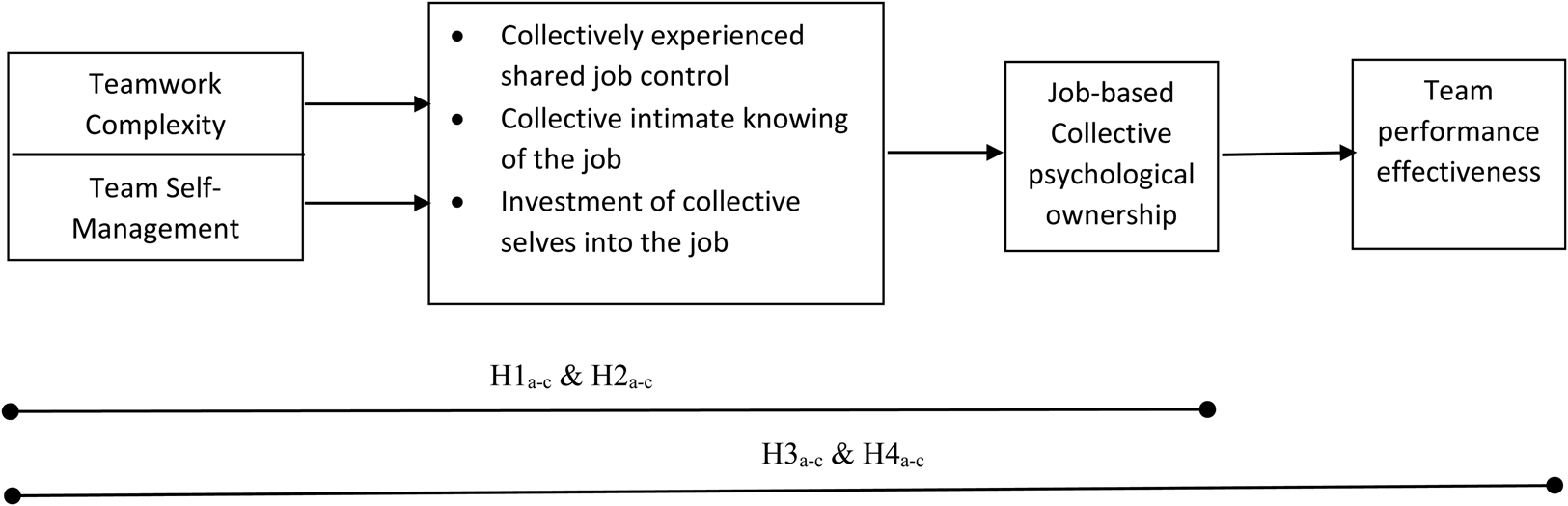
Pierce and Jussila (Reference Pierce and Jussila2010) provide a conceptual model that illuminates the processes through which J-CPO emerges in the teamwork context. It is this model that we are going to empirically examine. Drawing upon the teamwork literature (e.g., Hackman, Reference Hackman and Lorsch1987; Wageman, Hackman, & Lehman, Reference Wageman, Hackman and Lehman2005), Pierce and Jussila (Reference Pierce and Jussila2010) remind us that work teams (e.g., manager-led, self-governing teams) differ from one another along two significant dimensions (i.e., the task to be performed and its' design – level of complexity, and the degree of TS-M). Theorizing on J-CPO, Pierce and Jussila (Reference Pierce and Jussila2010) propose that both dimensions of teamwork design, implemented separately or together, give rise to a collective and possessive mind-set with regard to the assigned work. Teamwork design is also seen as a major cause of a team's sense of itself, and its work-related outcomes (e.g., attitudes, behavior). Figure 1 portrays the relationships to be tested in this investigation. We hypothesize that both work design variables (TWC and TS-M) lead to J-CPO by putting the team on each of the three ‘routes.’ In the following sections, we address the question – ‘How’ TWC and TS-M relate to the emergence of J-CPO? In doing so we highlight the mediating role played by the three route variables in the emergence of J-CPO.
Modeling of the emergence of collective psychological ownership in the team work context and team performance

The effects of teamwork complexity
Work assigned to a team (or an individual) can vary dramatically, inclusive of its complexity (Grant, Fried, & Juillerat, Reference Grant, Fried and Juillerat2011; Hackman & Oldham, Reference Hackman and Oldham1975; Morgeson & Humphrey, Reference Morgeson and Humphrey2006). TWC is focused on the design of the work that is assigned to a team for its completion and it deals with the extent that this work is whole and identifiable (Hackman, Reference Hackman and Lorsch1987; Hackman & Oldham, Reference Hackman and Oldham1975). Work that is low in complexity can be portrayed as the product of, for example, a horizontal and vertical division of labor resulting in low stimulation, challenge, and skill demands, and high in knowledge simplification. In contrast, the inherent nature of work high in complexity is stimulating, challenging, and broad in scope and deep in depth, requiring more advanced levels of knowledge, skills, and abilities. Further, the more complex a team's work is, the more connected (integrated) the team members are in thought and action exercised, and the performance and completion of their joint work (cf. Campion, Papper, & Medsker, Reference Campion, Papper and Medsker1996).
As CPO resides at the intersection of experiences, shared in both time and space among members of a collective around a particular target of ownership (e.g., tasks performed), its very nature is inextricably tied to context where group members (e.g., a work team) sharing their collective experiences cognitively congeal with one another in their coming to a collective sense of possession (cf. Cooke, Reference Cooke2015). As it comes to TWC, we expect that moving from low to high complexity will lead to an increase in team's collective feelings of ownership for the job. As will be discussed in more detail below, this relationship stems from the proposed effect that work design complexity has on each of the collective experiences that give rise to a team's J-CPO.
First, this relationship is a function of an accompanying increase in the team's collective experienced control over the work performed, arising primarily from an increase in job design autonomy. That is, the transition from simple to complex job design is accompanied by a decrease in system-imposed structure and control and an increase in team-based direction and control as it relates to task execution. This increased discretion and decreased imposition of structure results in, for example, expanded responsibilities for a team's joint diagnosis of production problems and the implementation of in-process adjustments to work procedures. Further, it is such joint exercise of control that leads to collective feelings of shared ownership for the work as it becomes experienced as a part of the group's extended sense of itself (Pierce & Jussila, Reference Pierce and Jussila2010; Seligman, Reference Seligman1975).
Second, increased job complexity should lead to increased opportunities for the team to develop a more collective intimate knowing of the work that they perform. Intimate knowing is, in part, influenced by an increase in the amount of discretion that the team exercises in the performance of their job, as they will be called upon to make more decisions and have problems to solve. With the responsibility for performing more of the job from beginning to end (e.g., a work team at Harley–Davidson assembling virtually an entire motorcycle, as opposed to just the installation of the electrical harness) being assigned to the team, as opposed to being performed by members of other teams, team members should come to a broader and deeper understanding of the entire production process. As the team works together to deal with the complexities, it is through interactive dynamics (i.e., explicit communications; ‘group processes involving the acquisition, storage, transmission, manipulation, and use of information’; Gibson, Reference Gibson2001: 122; cf. Bandura, Reference Bandura1997; Chan, Reference Chan1998; Gibson & Earley, Reference Gibson and Earley2007) around the set of tasks assigned to the team that the team members come to see and collectively experience the tasks as a target of shared ownership.
Third, task identity and skill variety are two job design dimensions that are in particular seen as leading to an increased investment of the team's collectives selves into the job. Performance of an increasing portion of the final product (service) requires the team to invest, for example, more of their time, energy, ideas, knowledge, skills, and abilities into the final product. Thus, the team needs to invest more of their collective discretion into task execution, as their responsibility for decision making and problem solving is expanded. Requirements for the use of an increase in the array of skills that need to be invested in work is a key feature of increased job complexity. As team members are called upon to use a greater range and variety of skills they will invariably be investing more of their collective selves (i.e., investment of each member of the collective's self (e.g., their time, energy, knowledge) into task execution. Under such conditions, when team members ‘coordinate cognitively with one another, integrating ideas and creating new knowledge’ (Cooke, Reference Cooke2015: 416) it is likely that they will also develop a team cognition or a shared mental model concerning their collective investment (cf. Grand et al., Reference Grand, Braun, Kuljamin, Koslowski and Chao2016; Kozlowski & Chao, Reference Kozlowski and Chao2012; Kozlowski & Klein, Reference Kozlowski, Klein, Klein and Kozlowski2000). Consequently, J-CPO for the team's work should follow.
Thus, it has been reasoned that TWC positively influences the emergence of J-CPO by working through its creation of the conditions that influence the emergence of team-based collectively experienced control, collective intimate knowing, and the investment of the team's collective selves into their work-related activities. The transformation of these experiences through interactive group processes contributes to the socially constructed sense of ownership. Thus, we hypothesize:
Hypotheses 1a–c
Work team's collectively experienced shared job control (1a), collective intimate knowing of the job (1b), and investment of their collective selves into the job (1c), mediates the positive relationship between teamwork complexity and collective psychological ownership for that work.
The effects of team self-management
Teams also vary in the depth and scope of involvement in the management of work (i.e., planning – setting direction; organizing – addressing people-to-people and people-to-work interaction patterns; directing – communicating, motivating, leading; and controlling – monitoring and reinforcing process and progress). Hackman (Reference Hackman and Lorsch1987) highlights (and simplifies) these differences by delineating four types of work teams (i.e., manager-led, self-managing, self-designing, self-governing). Transition from manager-led to self-governing teams is accompanied by an increase in the team's opportunity for the exercise of direction and control in the management of their work. Thus, ‘manager-led teams’ experience the highest levels of system-imposed structure and relatively low levels of team-based direction and control as each of the management functions and the decision making involved is carried out by the team manager (leader) and imposed upon the work team. By contrast, ‘self-governing teams’ are subjected to a relatively low level of system-imposed structure, thereby providing the team with the opportunity to exercise relatively high levels of team-based direction and control. Such teams are likely to not only perform a number of management functions as a collective, but also several organizational functions (e.g., human resource management).
Just as with levels of TWC, we believe that degree of TS-M is an important contextual factor as it comes to the emergence of J-CPO. Similarly, this relationship stems from the proposed effect that TS-M has on each of the three routes to a collective sense of possession. In other words, increase in TS-M creates the conditions for the manifestation of the group processes that are necessary for the emergence of collective structures such as J-CPO, as team members are required to collectively deal with sense-making, problem solving, planning, organizing, directing, and ultimately controlling.
The relationship of TS-M and J-CPO works through collectively experienced shared control. More specifically, teams operating under a lower level of system-imposed structure have more opportunities to exercise team-based (collective) direction and control. As the team members come together to perform a variety of team functions (e.g., accounting, human resources, purchasing, strategy formulation, structuring), they come to share an experience of autonomy and control. As discussed earlier, it is through interactional dynamics that the team members come to collectively experience that they as a team are in charge of their work and, thereby, come to collectively feel as though that work is the team's collective possession.
A similar role is played by collective intimate knowing, which is also closely associated with the control route. That is, to be able to increasingly self-manage as a collective, the entire team is called upon to more thoroughly understand the work to be performed, the environment within which they and their job are embedded, the needs of their internal or outside customers, the challenges that are to be confronted, the options and opportunities that are available, etc. As team members collectively familiarize themselves with the changing landscape and intersubjectively negotiate the relevance and meaning of (new) information, a collective knowledge structure concerning teamwork emerges and, thereby, the team members come to mutually feel that the work they are dealing with is collectively ‘theirs.’
There is no a reason to expect that the relationship would be any different as far as interdependent investment of the team members' selves is concerned. In other words, accompanying this expansion of discretion and responsibilities (i.e., TS-M), each team member and the team as a whole will be required to invest more of their collective selves (e.g., their time, energy, knowledge, skills, and abilities) into the management of their work. In the ongoing team process the team members come to understand their interdependences and see that the resulting output is the contribution of team effort as opposed to independent efforts of the team members. It is under these conditions that the team members also come to experience their work as an object that is of shared property of the entire team.
In sum, and also drawing upon theorizing and empirical research conducted on psychological ownership at the individual (Brown, Pierce, & Crossley, Reference Brown, Pierce and Crossley2014; Pierce, Kostova, & Dirks, Reference Pierce, Kostova and Dirks2003) and collective levels (cf. Heino, Tuominen, Tuominen, & Jussila, Reference Heino, Tuominen, Tuominen and Jussila2018; Pierce & Jussila, Reference Pierce and Jussila2010), it is expected that each of the three route variables (e.g., experienced control over the job) will have a positive relationship with J-CPO for the work performed by the team. In addition, we envision that each of these three experiences will mediate the relationship between TS-M and J-CPO. Thus, we hypothesize:
Hypotheses 2a–c
Work team's collective experienced shared job control (2a), collective intimate knowing of the job (2b), and the collective investment of their selves into the job (2c) mediates the positive relationship between the level of team self-management and collective psychological ownership for that job.
Team Performance Effectiveness
It has been argued and empirically demonstrated that TWC and TS-M are two strategies that promote team performance effectiveness (Cooney, Reference Cooney2004; Hackman, Reference Hackman and Lorsch1987; Kirkman & Rosen, Reference Kirkman and Rosen1999; Quinteiro, Passos, & Curral, Reference Quinteiro, Passos and Curral2016; Tata & Prasad, Reference Tata and Prasad2004). In light of emergent ownership feelings stemming from these two teamwork characteristics, we speculate that the teamwork design – team performance relationship may work through J-CPO. If confirmed, we will illuminate ‘how’ teamwork design relates to team performance, while also highlighting the organizational importance of J-CPO.
According to teamwork literature (e.g., Cannon-Bowers, Salas, & Converse, Reference Cannon-Bowers, Salas, Converse and Castellan1993; Lim & Klein, Reference Lim and Klein2006; Mathieu et al., Reference Mathieu, Heffner, Goodwin, Salas and Cannon-Bowers2000), shared models (such as CPO) are key to good team functioning. For example, the more team members share an understanding of the tasks to be performed and of the roles of team members in those tasks, the better the team is likely to perform. The same could be said of collective affections (Goodwin, Jasper, & Poletta, Reference Goodwin, Jasper and Poletta2000). A group that is aware of an ‘us’ and is united in its feelings is likely to perform better than a group that is less aware and less united (Forsyth, Reference Forsyth2010). Somewhat similarly, Weick and Roberts (Reference Weick and Roberts1993) suggest that the presence of a shared mental model among a work team enables integrated and coordinated action, somewhat akin to a single person familiar with a task and acting reflexively as though they were on their own. Thinking of this nature could lead one to hypothesize a positive relationship between J-CPO and team performance.
Considering the forces at play promoting a relationship between J-CPO and team performance effectiveness, it can be reasoned that the self-regulatory motivational forces (i.e., self-protection, consistency/verification, and enhancement; cf. Dipboye, Reference Dipboye1977; Korman, Reference Korman1971, Reference Korman1976, Reference Korman, Erez, Kleinbeck and Thierry2001; Swann, Johnson, & Bosson, Reference Swann, Johnson and Bosson2009) that drive behavior at the individual level are likely to play a collective motivational role in shaping team behavior as well. Thus, motivated to protect its sense of itself, to engage in behaviors that verify its worthiness and competence, and to ultimately enhance its identity and sense of ‘itself,’ the team will engage in performance-related behaviors aimed at protecting and enhancing the target of ownership (i.e., that to which its identity has become attached). Deterioration of the target of collective ownership is likely to cause a diminution of the team's sense of itself, much like the loss or destruction of a target of ownership results in shrinkage of the individual's sense of self (cf. Cram & Paton, Reference Cram and Paton1993; James, Reference James1890). To the extent that the job has become an extended part of the team's sense of itself, it will be concerned with and invested in the enhancement of its sense of us, which can be achieved through the effectiveness of job performance. This leads us to propose that J-CPO also has a positive relationship with team performance effectiveness
As previously noted, the extant literature has supported the positive effects of TWC and TS-M with team performance. In addition, we have reasoned that team-work design (i.e., TWC and TS-M) contributes to the emergence of J-CPO, which in turn positively relates to team performance by putting team members on the routes leading to this collective sense of ownership. This leads us to hypothesize that:
Hypotheses 3a–c
Work teams' collective experienced shared control of the job (3a), collective intimate knowing of the job (3b), and the team's investment of its collective selves into the job (3c) along with CPO sequentially mediate the positive relationship between teamwork complexity and team performance effectiveness.
Hypotheses 4a–c
Work team's collective experience shared control of the job (4a), collective intimate knowing of the job (4b), and the team's investment of its collective selves into the job (4c) along with CPO sequentially mediate the positive relationship between team self-management and team performance effectiveness.
Method
Sample and data collection
Participants were from a diverse set of project teams drawn from several organizations located in a major city in northern China. Working through a local association for human resource management professionals, Human Resource (HR) managers from 26 different companies agreed to participate in the study.
We asked the managers to identify project teams in their respective organizations that met three criteria: (1) the team could be either an ongoing team, or one that had just recently completed a major project; (2) team size ranging from two to a maximum of 10 members; and (3) team projects would necessitate members having frequent and substantive project-based interactions with one another. These criteria were selected because CPO theory (Pierce & Jussila, Reference Pierce and Jussila2010) positions frequent and substantive interactions, around shared work experiences as a necessary condition for the emergence of J-CPO. It has been noted that as team size increases, cohesion decreases (Carron & Spink, Reference Carron and Spink1995) as it becomes increasingly difficult for members to come to know one another, for trust to emerge, and for opportunities for shared and intimate interactions to occur.
Questionnaires were mailed to the HR managers for their distribution to the participating team leaders. Each team leader was asked to distribute a questionnaire to each of their team members, requesting their completion independent of their other team members. In addition, there was a separate questionnaire that the team leaders were asked to complete, assessing team performance effectiveness along with several team properties (e.g., tenure). Each team leader was appointed by upper-level management, to oversee the functioning of a single work team. The team member questionnaire contained items for the measurement of J-CPO, TWC, TS-M, and the route variables (e.g., collective intimate knowing). In addition, several items were asked of each team member, in an attempt to verify their membership in what Wageman, Hackman, and Lehman (Reference Wageman, Hackman and Lehman2005) refer to as ‘real teams,’ a condition deemed necessary for the emergence of J-CPO. Both the team member and team leader questionnaires also solicited demographic information. Completed questionnaires were returned, in a sealed and anonymous envelop, to the host organization's HR managers and forwarded to the research team.
All questionnaires were printed in English and accompanied by a Chinese version, as virtually all of the study participants were fluent in English. When a Chinese version of a research instrument was not available it was subjected to a Chinese translation and back translation to English (Brislin, Reference Brislin1980), by members of our research team who were fluent in both languages.
We received responses from a total of 61 teams, each team's leader, and 266 team members. All participants were members of a team that ranged in size between three and ten. The tasks performed by these teams covered a wide range of activities (e.g., sales management, logistics, training, inventory control).
Influenced by the work of Wageman, Hackman, and Lehman (Reference Wageman, Hackman and Lehman2005) and employing data collected from each team member, we looked to see if we were dealing with real teams. They characterized a real team by: (a) team membership clarity (i.e., everyone knows exactly who is a team member), (b) team membership stability (i.e., team membership has been stable for the past two or more months), and (c) team member interdependence (i.e., team members depend heavily on one another to get the team's work completed). Once again, drawing upon the original theorizing on CPO, these attributes are also deemed important for the creation of conditions under which the collective sense of ownership is likely to develop. In the absence of established norms to guide our decisions, we employed an a priori criteria of 3.25 (a team average above the mid-point marker on the five-point scale anchored 1 = Very Inaccurate to 5 = Very Accurate) to judge the extent to which each team can be judged as meeting these criteria. Thus, a total of seven teams with a total of 39 respondents were removed from further data analyses, and our final sample consisted of a total of 54 teams and 227 individuals.
Demographically, the final sample was: 50.2% were male; 91.6% with a minimum of a bachelor's degree; 84% had organization tenure of more than 1 year; 92.1% with a team tenure over 1 month, and well over half of the participants were between the ages of 31 and 45. Among the 54 team leaders: 57.4% were male; all were older than 26; 94.6% had a college degree and above; 96.3% worked for the organization for more than 1 year and worked on the team for more than 1 month.
Variables and their measurement
Following the recommendation of Kozlowski and Klein (Reference Kozlowski, Klein, Klein and Kozlowski2000) for variables involving shared unit properties, measurement of J-CPO started at the individual level and was then aggregated to form a team-level variable. For the measurement of J-CPO we employed the four-item instrument, developed and construct validated by Pierce, Jussila, and Li (Reference Pierce, Jussila and Li2018) across three diverse samples, 891 individuals, and 386 teams. The four J-CPO items (e.g., We [my team members and I] collectively agree that this is OUR job) were responded to on a seven-point Likert-type scale anchored 1 = Strongly Disagree to 7 = Strongly Agree. J-CPO had a coefficient α of .91.
Each of the following variables, involving shared unit properties and measured at the individual level, was aggregated to the team level (cf. Kozlowski & Klein, Reference Kozlowski, Klein, Klein and Kozlowski2000). TWC (α .80) was measured with the autonomy, skill variety, and task identity items taken from Idaszak and Drasgow (Reference Idaszak and Drasgow1987). Each item was written such that the focus was placed on the work assigned to the team, such as: ‘The work of our team requires us to use a number of complex or high-level skills’ (skill variety). Each item was scored on a 7-point scale anchored Very Inaccurate (1) to Very Accurate (7). An additive model across the items measuring the three work design dimensions was employed to provide an assessment of TWC (cf. Dunham, Reference Dunham1976; Piccolo & Colquitt, Reference Piccolo and Colquitt2006; Shalley, Gilson, & Blum, Reference Shalley, Gilson and Blum2009). T-SM (α .90) was measured with Rousseau and Aube's (Reference Rousseau and Aube2010) eight-item instrument (e.g., ‘We plan the accomplishment of our work activities’) which assessed four self-management behaviors: planning, adjusting (organizing), reinforcing (directing), and monitoring (controlling). Each item was responded to on a 5-point scale anchored 1 = Not at all true of us, and 5 = Totally true of us.
We employed and recast from the individual to the group level Tetrick and LaRocco's (Reference Tetrick and LaRocco1987) instrument for the measurement of experienced control (α .86) which was assessed with six items (e.g., To what extent do you and your work team members collectively have influence over the things that affect all of you on the job?). These items were responded to on a 7-point scale anchored 1 = Very Little, 4 = A Moderate Amount, and 7 = Very Much. Measurement of the other two route variables derived from the instrument developed and validated by Brown, Pierce, and Crossley (Reference Brown, Pierce and Crossley2014). Their items were recast from the individual (e.g., I have invested…) to the collective level (e.g., We [my team members and I] have jointly invested…). Collective investment of ourselves (α .98) was assessed with five items (e.g., We [my team members and I] jointly have invested many of our ideas into this job). Intimate knowing (α .90) was assessed with four items (We [my team members and I] collectively have a depth of knowledge as it relates to the work that we do). Both of these variables were assessed on a 7-point Likert-type scale, anchored 1 = Strongly Disagree to 7 = Strongly Agree.
Team performance effectiveness (α .78) was assessed with Campion, Papper, and Medsker's (Reference Campion, Papper and Medsker1996) nine items (e.g., quality of work done, productivity, completing work within budget) which were assessed by the team leader, and responded to on a 7-point scale anchored 1 = Very Poor and 7 = Outstanding. Finally, we included team size and team tenure as control variables. Team size reflects the number of team members, and team tenure reflects the number of months that the team has been in existence.
Analysis
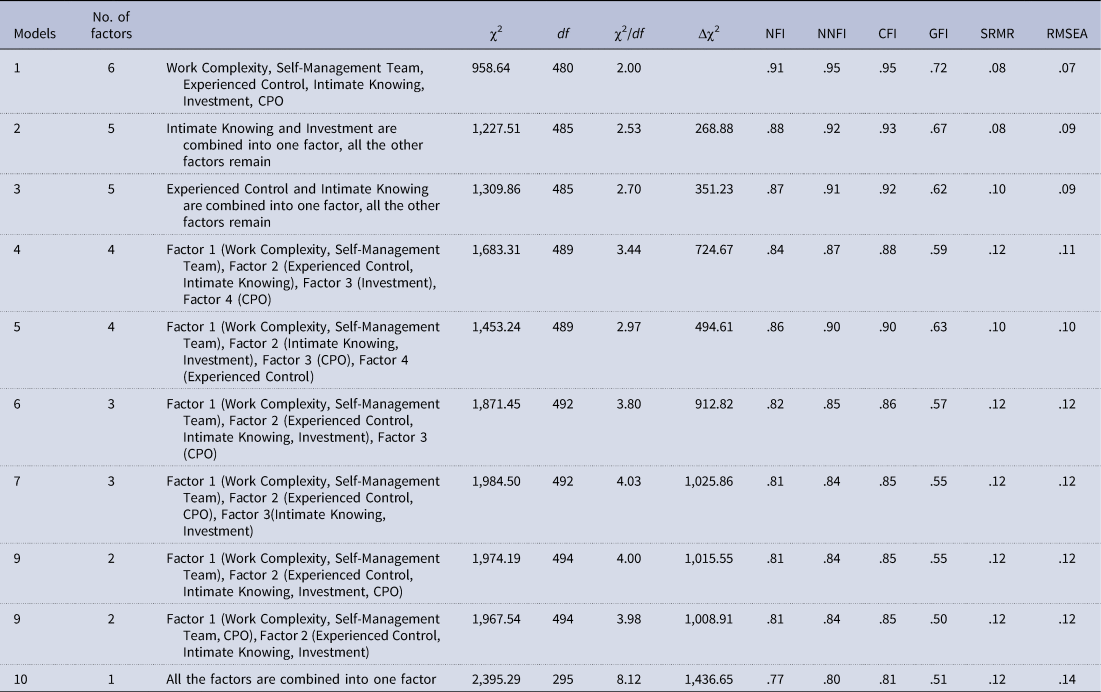
We conducted confirmatory factor analysis at the individual level to assess the scales in terms of their reliability and validity. Table 1 shows the results of these analyses performed on several models with a different number of factors. The baseline measurement model (Model 1) with six factors corresponded to our primary study variables (TWC, TS-M behavior, experienced control, intimate knowing, collective investment of ourselves, and J-CPO) had an acceptable fit with the data: (χ2(480) = 958.64, NFI = .61, NNFI = .95, CFI = .95, SRMR = .08, RMSEA = .07). In the baseline model, all the item loadings ranged from .42 to .94 and the items loaded significantly onto their respective factors. In addition, we compared the above baseline model with several alternative models that had one to five factors to establish discriminate validity of the research variables. The baseline model was found to outperform the alternative models according to model fit indices. Results suggest that the research variables were reliable and valid at the individual level.
Confirmatory factor analysis

Note. All Δχ2 tests are significant at the .001 level.
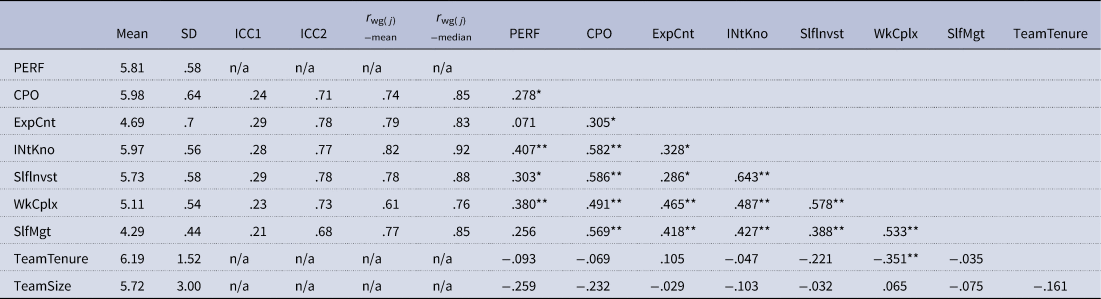
Before aggregating data to the team level we needed to demonstrate sufficient within-group homogeneity among the responses from team members. We calculated intraclass correlations (ICC), and r wg(j) to examine interrater reliability (IRR) and interrater agreement (IRA; cf. Bliese, Reference Bliese, Klein and Kozlowski2000; James, Demaree, & Wolf, Reference James, Demaree and Wolf1984, Reference James, Demaree and Wolf1993; LeBreton & Senter, Reference LeBreton and Senter2008). ICC1 and ICC2 are two accepted estimates of ICC. ICC1 is an index of the IRR and ICC2 assesses the stability of the aggregated means of the measures (Bliese, Reference Bliese, Klein and Kozlowski2000). Following the work of James (Reference James1982) and Glick (Reference Glick1985) we employed a median value of .12 for ICC1 (James, Reference James1982) and a cutoff value of .60 for ICC2 (Glick, Reference Glick1985). In addition, r wg(j) is a well-accepted estimate of IRA of scales that are measured using multiple items or indicators (James, Demaree, & Wolf, Reference James, Demaree and Wolf1993; LeBreton & Senter, Reference LeBreton and Senter2008). An r wg(j) ranging from .50 to .70 suggests moderate agreement and r wg(j) above .70 is believed to reflect very strong agreement among raters. Results from these analyses are reported in Table 2. Employing the criteria mentioned above these observations (ICC1, ICC2, and r wg(j)) suggest that there was strong agreement at the individual level, supporting data aggregation to the team level.
Descriptive statistics, aggregation indices, and correlations
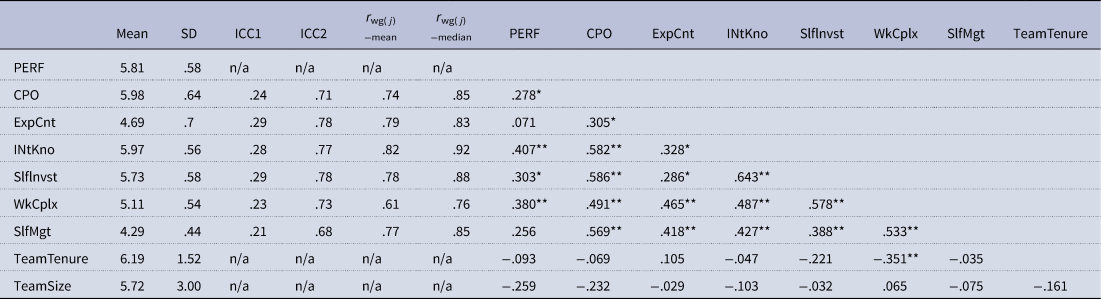
r wg(j): estimate of IRA of multiple item scales; N = 54.
CPO = collective psychological ownership; ExpCnt = experienced control; IntKno = intimate knowing; SlfInvst = self-investment; Slf Mgt = team self-management; WkCplx = team work complexity; Perf = team performance effectiveness; ICC1 = index of interrater reliability; ICC2 = stability of the aggregated means of the measures.
*p < .05, **p < .01.
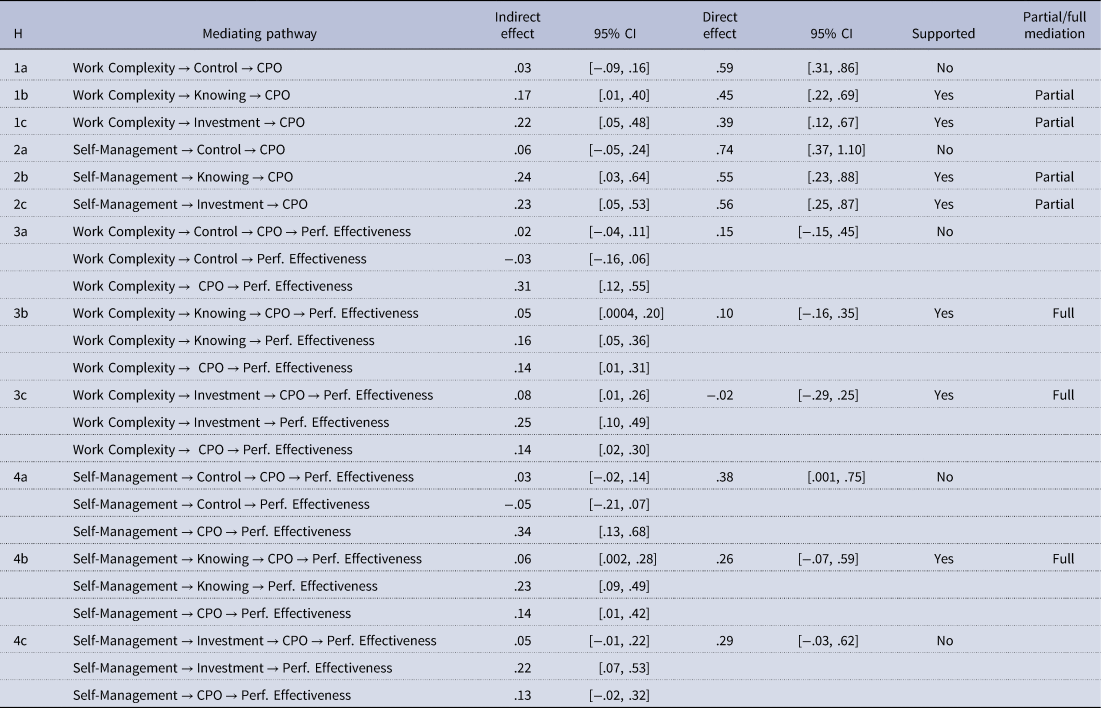
We tested all of our hypotheses by using the indirect effect approach suggested by Hayes (Reference Hayes2013) employing models 4 and 6 (cf. Preacher & Hayes, Reference Preacher and Hayes2004, Reference Preacher and Hayes2008; Zhao, Lynch, & Chen, Reference Zhao, Lynch and Chen2010). Zhao, Lynch, and Chen (Reference Zhao, Lynch and Chen2010) recommended the use of a decision tree, a step-by-step approach to reveal whether a mediation effect is full mediation or partial mediation. In addition, we also followed Preacher and Hayes (Reference Preacher and Hayes2004, Reference Preacher and Hayes2008) who advocated a bootstrap test that relies on confidence intervals (typically 95%) to examine the significance of the indirect effect. In all analyses, we set 10,000 as the size of the bootstrap sample and 95% as the confidence level. We acknowledge that our employment of cross-sectional data precludes testing for mediation, yet observations supporting of our hypothesized relationship should mirror what would be observed under causal conditions.
Theory notes that a team does not need to travel down all three routes for CPO to manifest itself as joint travels down any one of the routes (e.g., collectively experienced control) can lead to the possessive feelings associated with the target. Thus, we examined the mediating role played by each of the three mediating variables independently of one another to see which of the ‘route’ variables played a significant role in J-CPO's emergence and team performance effectiveness. Such information will be extremely helpful in crafting managerial recommendations as to specific steps that can be taken to create conditions conducive for the emergence of the J-CPO and team performance effectiveness. Similarly, we examined the antecedent role of TWC and TS-M separately of one another as they are distinct teamwork design dimensions that can be implemented independently.
Results
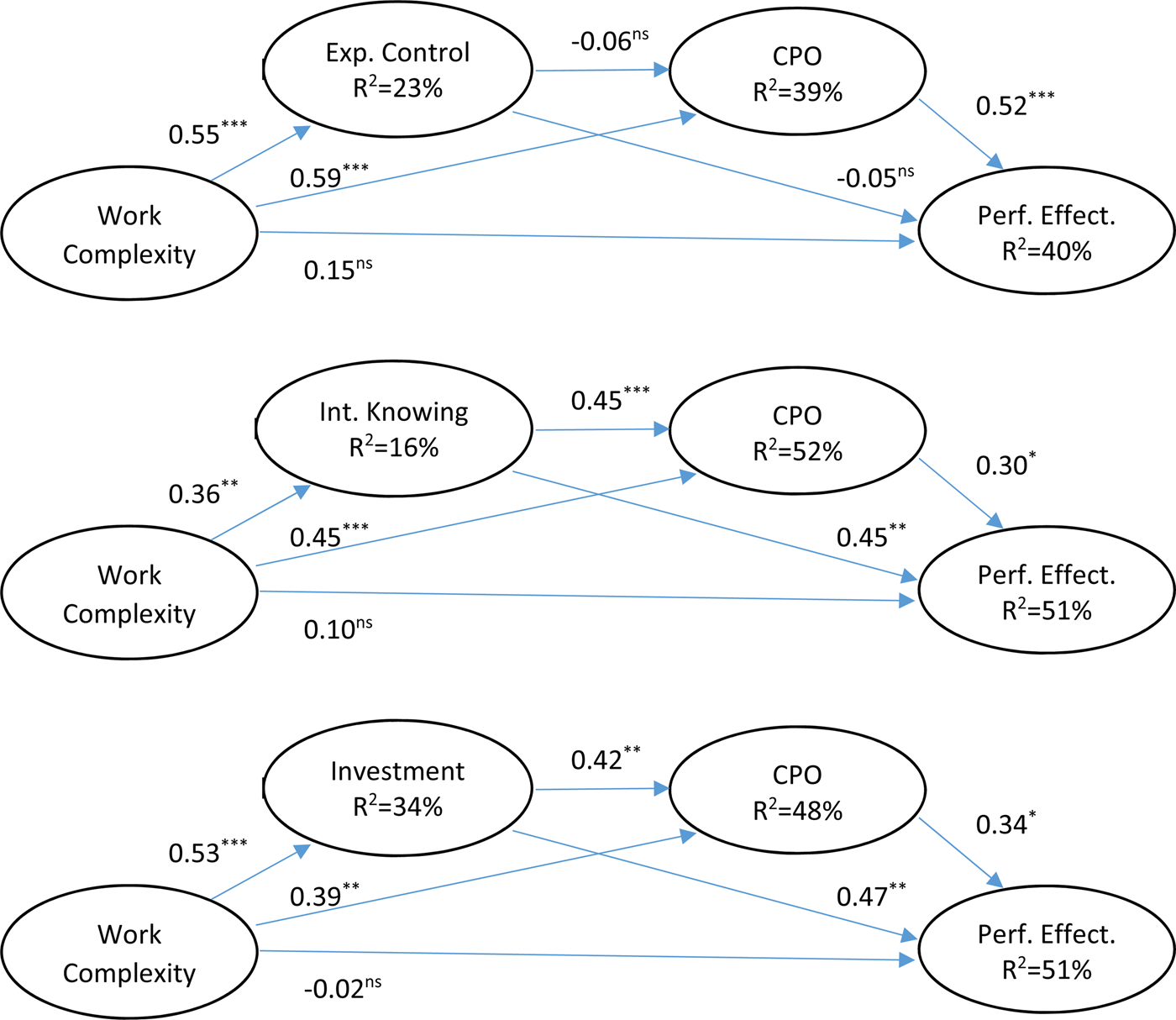
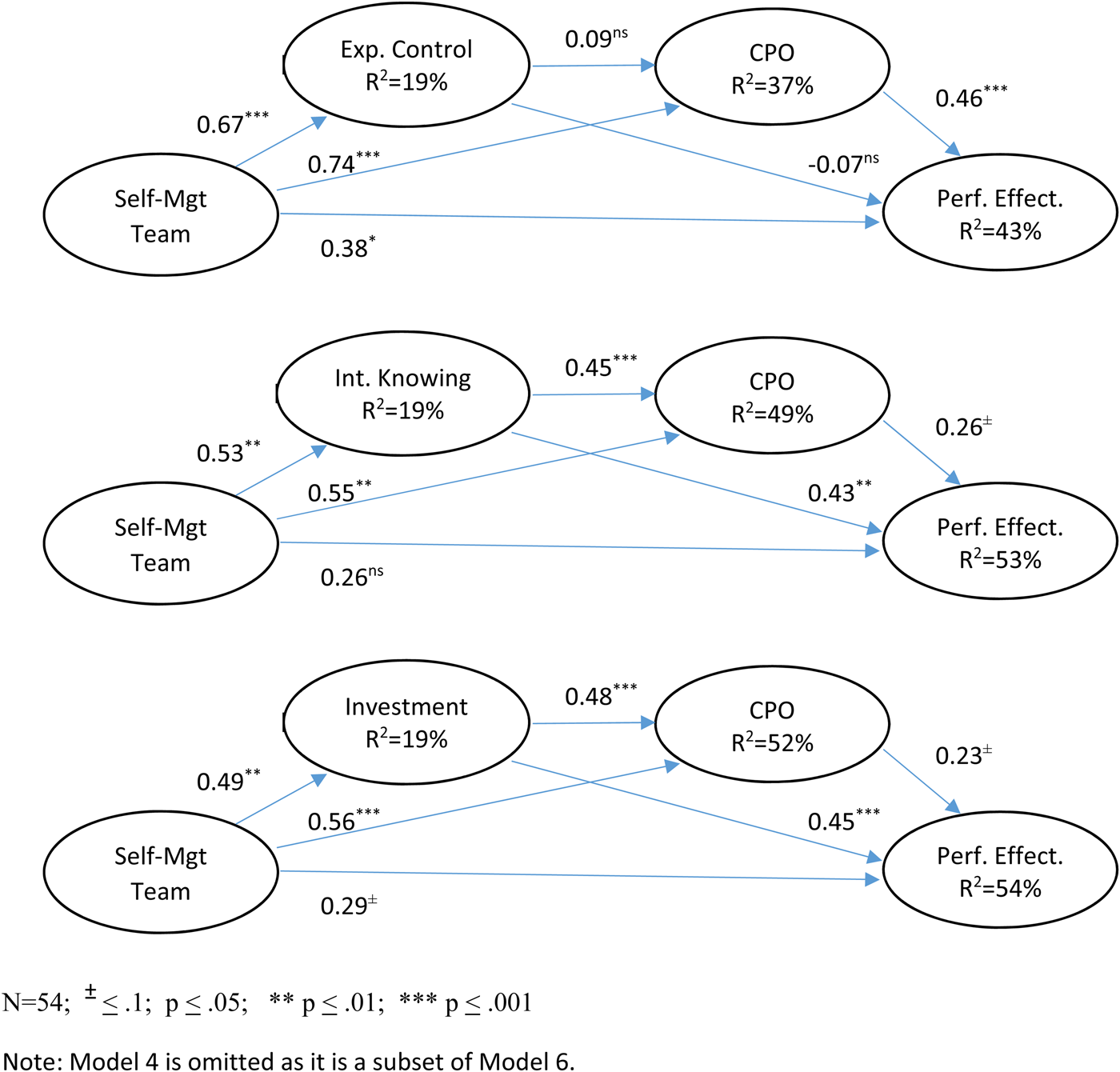
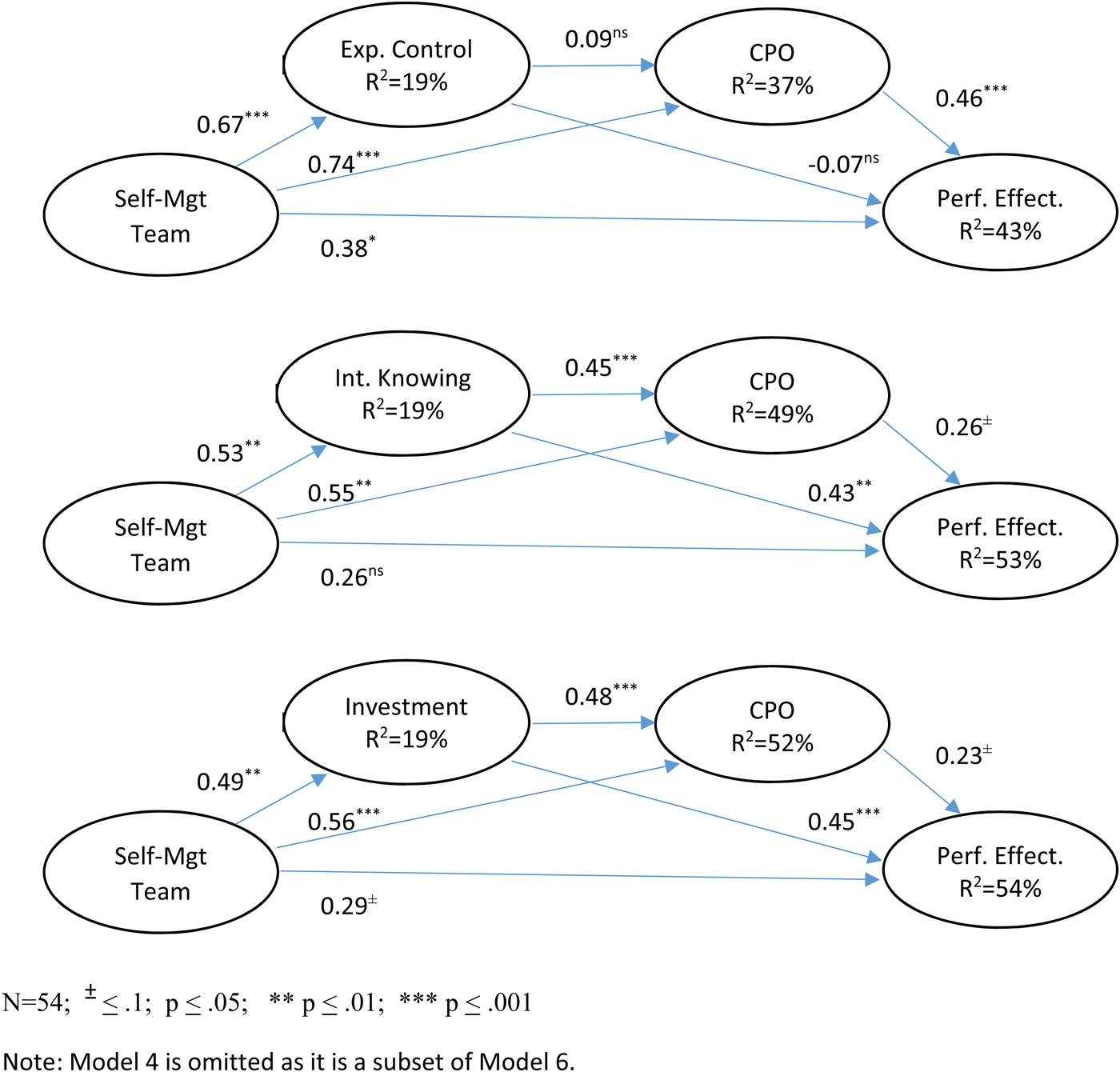
The descriptive statistics (means, standard deviations, and correlations) for the study variables are presented in Table 2. Results of our mediation effects (testing H1a–H4c) are shown in Table 3. In addition, Figure 2 demonstrates all the path coefficients.
Indirect and direct effects
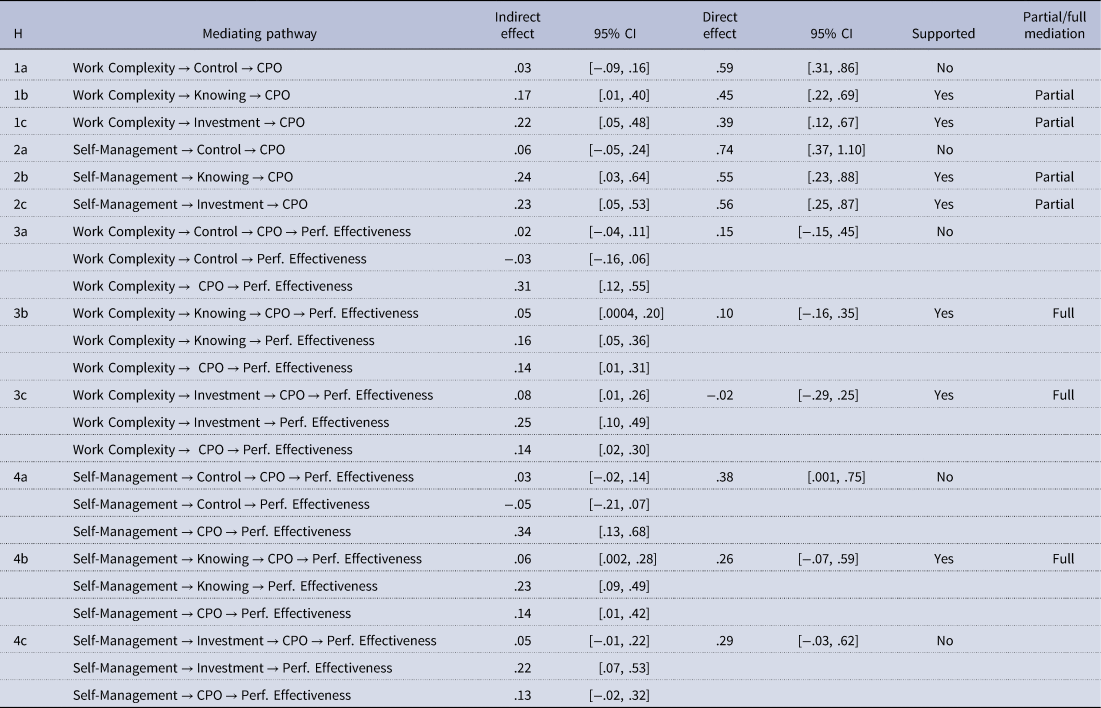
Note. H1a–H2c are from Model 4; H3a–H4c are from Model 6.
Path coefficients (model 6). N = 54; ±≤.1; p ≤ .05; **p ≤ .01; ***p ≤ .001. Note: Model 4 is omitted as it is a subset of Model 6
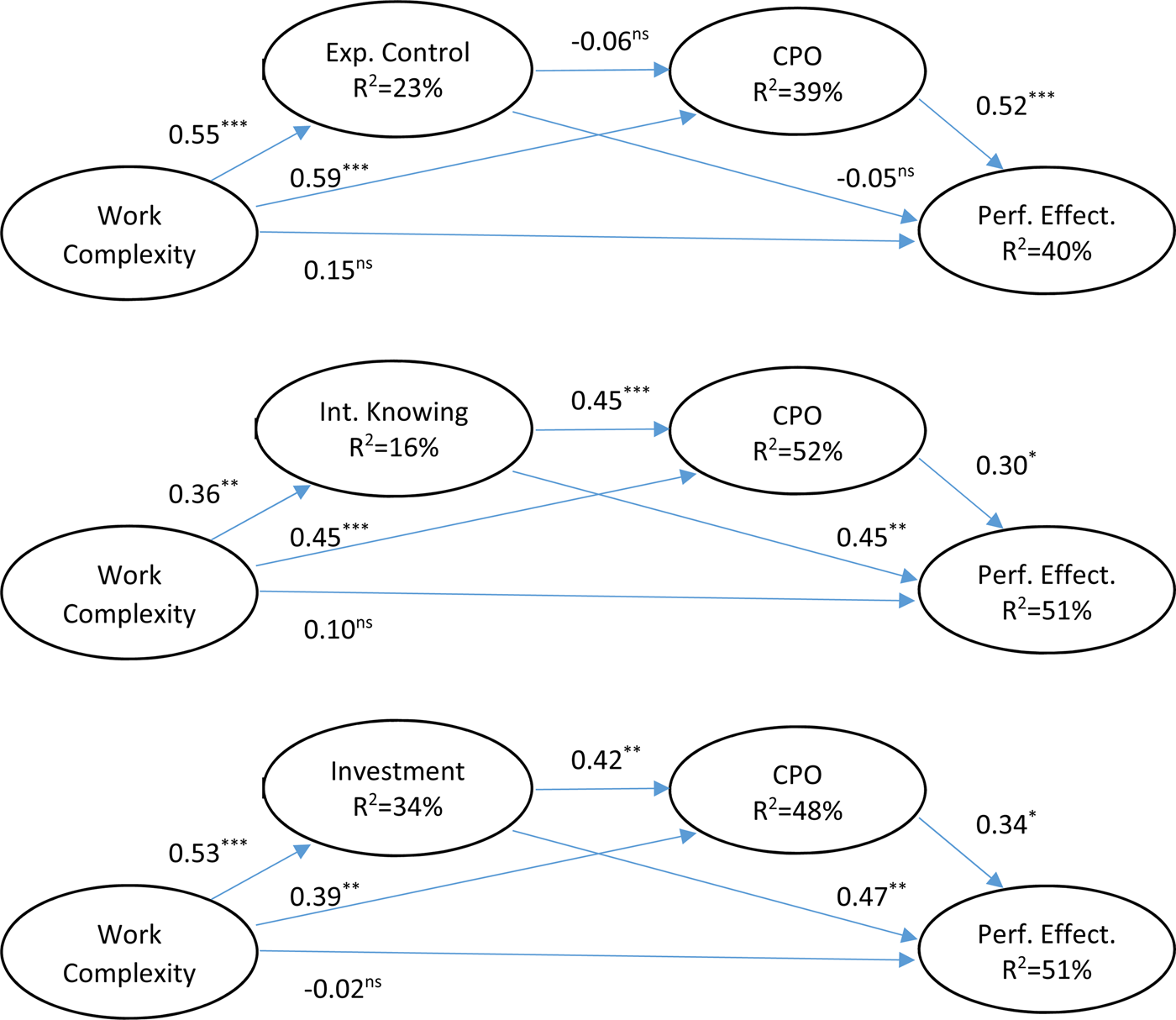
Figure 2b.
Emergence of CPO
As shown in Table 3, the indirect effect of TWC on J-CPO via collectively recognized shared control (experienced control) of the job was not significant. Thus, we failed to find support for H1a, whereby experienced control was hypothesized to mediate the TWC–J-CPO relationship. Collectively recognized shared intimate knowing (intimate knowing) of and the collectively recognized shared investment of the group members' selves (investment of team members' selves) into the job, significantly mediated the relationship between TWC and J-CPO. Thus, Hypotheses 1b and 1c were supported. In addition, the direct effects in both cases were significant, suggesting partial mediation.
Similarly, the TS-M–J-CPO relationship was not mediated by experienced control. As a result, H2a was not supported. The indirect effects of TS-M through intimate knowing and investment of the team members' selves into the job were significant; respectively suggesting that intimate knowing and investment of the team members' selves into the job significantly mediated the relationship between TS-M J-CPO. Thus, Hypotheses 2b and 2c were supported. Similarly, the direct effects of TS-M on J-CPO were also significant, suggesting support for partial mediation.
In summary, we observed evidence suggesting that the two work design variables (i.e., TWC and TS-M) are related to J-CPO by having both a direct, and an indirect relationship working through the team's intimate knowing of, and the team's collective shared investment of their selves into the job. It appears as though the team's experience control over the job, while related to TWC and TS-M, it is not a path linking either of team-work variable with J-CPO. In response to our primary research question, TWC and TS-M appear to be two determinants of job-focused CPO, and both variables appear to put the work team on two paths that lead to J-CPO, namely the collectively recognized shared intimate knowing of the job, and collectively recognized shared investment of the group members' selves into the job.
Performance effects
TWC and TS-M have been recognized as two strategies that promote team performance effectiveness. The secondary purpose of this investigation was to address ‘how’ do these relationships manifest themselves. In response to that research question, we hypothesized the job-focused CPO mediates the relationship between teamwork design and team performance effectiveness. More specifically, we hypothesized that through serial mediation teamwork design puts the team on the paths to the emergence of J-CPO which positively relates to team performance effectiveness.
To test Hypotheses 3a–c, we modeled TWC as the independent variable, sequentially the three route variables and J-CPO respectively as mediators, and team performance effectiveness as the dependent variable (e.g., TWC → collectively shared job control → J-CPO → performance). Serial mediation of team's collective experienced control of the job and J-CPO failed to reveal evidence in support of an indirect relationship between work complexity and team performance effectiveness, thus the absence of support for H3a. In contrast, and in support of H3b and H3c, we observed full mediation of the collective intimate knowing of the job and J-CPO's sequential mediation in the relationship between TWC and TS-M, thereby supporting H3b. Similarly, and in support of H3c, we observed significant full mediation of the team's investment of its collective selves into the job and J-CPO in the relationship between TWC and team performance effectiveness.
To test H4a–c, we modeled TS-M's relationship with team performance effectiveness by working sequentially through each of the three route variables paired with J-CPO. Failing to support H4a, we did not observe sequential mediation of collective experienced control and CPO in the relationship between TS-M and team performance effectiveness. The research evidence revealed full mediation of the sequential mediated relationship involving intimate knowing and J-CPO in the relationship between TS-M and team performance effectiveness, thereby supporting H4b. Finally, there was no evidence to support the sequential mediation of the team's investment of its collective selves into the job along with J-CPO in the relationship between TS-M and team performance effectiveness. As a consequence, H4c was not supported.
Discussion
With regard to the primary objective of this work we asked – What are the determinants of and psychological processes associated with the emergence of CPO in teamwork contexts? To that question we looked to see if the three route variables mediated the teamwork design–J-CPO relationship. Our findings revealed that both intimate knowing of, and investment of the team members' collective selves into the job partially mediated the relationship between both TWC and TS-M, and J-CPO. In both instances experienced control failed to mediate the teamwork design–J-CPO relationship. In sum and response to our research question, these findings suggest that teamwork design, the foundation of organizational life for the majority of work team members (Katz & Kahn, Reference Katz and Kahn1978), may contribute to the emergence of J-CPO through two of the three route variables.
Scholars have observed that TWC and TS-M are two strategies that promote team performance effectiveness. Extending this notion and toward the second purpose of this investigation, we proposed that the teamwork design–team performance effectiveness relationship would be sequentially mediated by each of the routes to J-CPO and J-CPO. For TWC, we observed full mediation for the relationships involving intimate knowing and investment of the team members' collective selves into their job. In terms of TS-M we only found support for full mediation involving intimate knowing.
With the above findings, we take Pierce and Jussila's (Reference Pierce and Jussila2010) theoretical work on J-CPO an important step further by presenting the first known empirical and substantive investigation into its emergence in work team context. In addition, these results reveal that J-CPO may be an important collective psychological state in the teamwork design–team performance relationship.
Our study presented two surprising observations. First, there was an absence of a significant mediation effect for experienced collective control. This observation may have been culturally induced. There are cross-cultural studies which reveal that control is less important and responded to differently by East Asians than it is by European Americans (cf. Ji, Peng, & Nisbett, Reference Ji, Peng and Nisbett2000). This finding may be attributable to high power difference, common place in the Chinese context, and its role where subordinates defer on matters related to control to their team leaders. It is also feasible that the failure of control to manifest itself as a meaningful path, is due to the fact that control needs to be delegated to the team by management, whereas, investment of the self and possibly to a lesser extent intimate knowing are left more to the actions of the team members. Second, we failed to find evidence supporting the significant mediation involving the investment of the team members' selves in the relationship between TS-M and team performance effectiveness. Once again, we wonder if we are dealing with a cultural phenomenon. In the Chinese culture, paternalistic management is frequently accompanied by directive management practices. If this is at play in our sample, there may be a great deal of deference to management in carrying out the management functions (e.g., planning, organizing, controlling) as they pertain to teamwork.
Research limitations and future directions
There are limitations to our study and therefore its contribution to scholarship and management practice. First, our data derive from a relatively small number of teams, thereby limiting statistical power. Second, we employed a correlational and cross-sectional design. As a consequence we are unable to confirm causality, even though the findings may mirror relationships that would be observed under causal conditions. Third, with the exception of supervisor assessment of team performance effectiveness, the data is self-report raising questions about common method bias. For common method effects to materialize, however, systematic effort would have to be collectivized in either an upward or downward direction (i.e., each team member would have to independently respond to the scale items with virtually the same response, such as ‘strongly disagree (agree)’). This is unlikely to have occurred as team participants independently completed their respective questionnaires. Additionally, and following the recommendations of Podsakoff, MacKenzie, Lee, and Podsakoff (Reference Podsakoff, MacKenzie, Lee and Podsakoff2003), a couple of additional steps (e.g., each variable was introduced with its own instructions; five different response scales [e.g., true of us/not true, accurate/inaccurate, poor/outstanding]) were employed to minimize threats due to common method bias. As a consequence, the likelihood of the common method effects should have been appreciably reduced. Fourth, concerns about external validity typically accompany scales in the early stages of their implementation. While measures of individual level psychological ownership level have been successfully employed in multiple cultural contexts, J-CPO has only been employed in Finland and another Chinese sample without any apparent cultural effects. Clearly more work is needed to alleviate concerns pertaining to cultural influences. Finally, we note that the relationship between J-CPO and team performance effectiveness may be reciprocal in nature, whereby sound performance may play a role in a group coming together in the collective belief that this is ‘our’ work, while under conditions of poor performance a team driven by a self-serving bias may distance themselves from any sense of ownership, thereby avoiding a diminution in its sense of itself. Future research should attempt to overcome the limitations mentioned above (e.g., correlational design; sample size), while examining the effects, if any, of culture, team contexts (e.g., environmentalism, sports) and types (face-to-face vs. virtual) upon the generalizability of these findings. In addition, there is a need to identify other organizationally relevant forces that can put work teams on one or more of the routes to J-CPO, such as: organization structure and governance (e.g., organicness, employee ownership), technology (e.g., long-linked/intensive), environment (e.g., uncertainty), team characteristics (e.g., maturity, interdependence, homogeneity/heterogeneity). We also see the need for further exploration of the theory of CPO, inclusive of an examination of its boundary conditions (e.g., individualism/collectivism; underpinning motives, e.g., social identity, effectance, home); as well as its behavioral effects, both positive (e.g., team-based promotion of change and stewardship) and negative (e.g., team-based: information hoarding and to resistance to change) in nature. It is unlikely that work teams develop CPO for each and every target with which they come into contact. To this end, we encourage efforts to identify target attributes that trigger the emergence of CPO. Finally, we believe that employment of CPO in other team/group-based cause and effect models (e.g., transformational leadership → team work motivation, in- and extra role behavior) will provide insight into ‘how’ other effects are produced.
Managerial recommendations
Theory and emerging empirical evidence enable the crafting of a couple managerial recommendations. Empirical evidence from a validation study (Pierce, Jussila, & Li, Reference Pierce, Jussila and Li2018) and now the findings reported here suggest that J-CPO is organizationally important. J-CPO has been positively related to several personal (e.g., experienced responsibility, job satisfaction, affective organizational commitment), group (e.g., group potency) and organizational (e.g., citizenship behavior) outcomes, along with a negative relationship with intra-team social loafing and now the observation of a positive relationship with team performance effectiveness. Wishing to increase a collective mind-set, steps should be taken to increase TWC and TS-M as both appear to put work teams on a path that leads to J-CPO. These two observations lead us to believe that the implementation of other employee involvement and empowerment (organic) practice will be instrumental in achieving the same ends.
The findings from this study suggest that TWC and TS-M may play an important role in the emergence of J-CPO and their production of positive performance effects. Without regard for the target of ownership, CPO does not automatically occur as a result of a group's joint travels down one or more of the routes to CPO, as a group (collective)-mind needs to develop. As a collective-mind, CPO derives from collective actions and experiences involving a target of ownership, and conversations around those actions and experiences. It is through this process that a collective realization that this target is possessively ours, becoming a part of the group's extended sense of itself. Consequently, management needs to assist with the creation of conditions, as well as provide encouragement and opportunities for team members to frequently engage in work-experience conversations dealing with shared experiences of collective control, mutual understanding, and interdependent investment of their collective selves into the management of their work, as well as all phases of task performance.
In summary, and borrowing from CPO theory this collective cognition appears to emerge when there are joint travels down one or more of the routes to CPO, coupled with interactive dynamics among team members related to their negotiated meaning of their joint travels and related experiences, while joined with a set of latent needs (e.g., social identity and effectance motivation) that are aroused and partially satisfied by those experiences.
Acknowledgements
We thank Dr. Craig Crossley from the University of Central Florida for his review and comment on our manuscript.