Introduction
Refrigeration and cooling account for a significant fraction of global energy usage. The need for reduction of energy consumption and greenhouse gas emissions has motivated research in new solid-state cooling concepts (ferroic cooling).Reference Fähler, Rößler, Kastner, Eckert, Eggeler, Emmerich, Entel, Müller, Quandt and Albe1 These include magneto-, electro-, or elastocaloric effects. Pseudoelastic NiTi-based shape-memory alloys (SMAs) are a very promising class of candidate materials for elastocaloric cooling.Reference Mañosa, Planes and Acet2,Reference Bonnot, Romero, Mañosa, Vives and Planes3 While NiTi SMAs are better known for being able to restore their initial geometry after large deformations,Reference Miyazaki and Otsuka4–Reference Hornbogen and Bunk6 these materials have recently also been identified as a promising solid-state alternative to well-established vapor compression cooling systems.Reference Goetzler, Zogg, Young and Johnson7
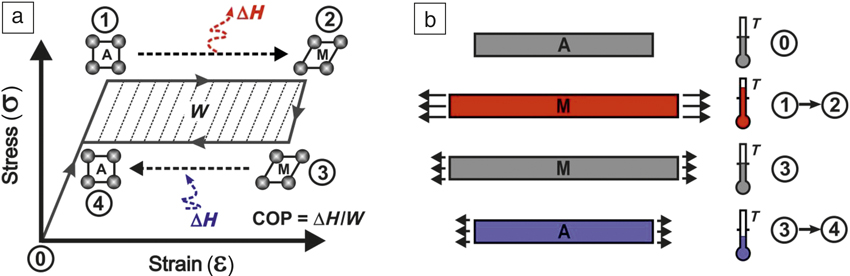
The elastocaloric effect (i.e., pseudoelasticity, a mechanical shape-memory behavior) relies on a reversible martensitic phase transformation,Reference Miyazaki and Otsuka4–Reference Hornbogen and Bunk6 a specific type of solid-state transformation. It represents a shear process in the crystal lattice,Reference Bhattacharya8 and can be triggered by cooling or mechanical loading. Figure 1 shows a schematic elastocaloric cooling cycle starting at the high-temperature austenite state, stage 0 in Figure 1a. During mechanical loading, a stress/strain plateau is reached where the parent phase, austenite, transforms into stress-induced martensite, stage 1 to stage 2. The reverse transformation, stage 3 to stage 4, is characterized by an unloading plateau at lower stresses. Both transformation events are associated with large latent heat ΔH, and thus cause remarkable temperature changes in the SMA.
Heat effects in pseudoelastic shape-memory alloys (SMAs). (a) Stress/strain behavior of the material. The martensitic transformation during loading results in the release of latent heat and thus increases the SMA temperature. During the reverse transformation on unloading, a temperature drop causes absorption of latent heat (ΔH). COP is coefficient of performance; the area W represents the mechanical work input required to drive an ideal cooling cycle. (b) Different material stages of an elastocaloric cooling cycle. Note: A, austenite; M, martensite.

The area, W, in Figure 1a represents the mechanical work input (i.e., force and distance) required to drive an ideal cooling cycle. It is common to characterize the cooling efficiency by the coefficient of performance (COP), which represents the ratio between the cooling energy output ΔH and the required work input, W.Reference Qian, Geng, Wang, Ling, Hwang, Radermacher, Takeuchi and Cui9 Figure 1b shows different material stages of the cooling cycle. The forward phase transformation that occurs during loading between stages 1 and 2 results in the release of latent heat and thus in an increase in the SMA temperature. This heat amount needs to be absorbed by a heat sink, such that a lower temperature is again approached in the material. During unloading, the reverse transformation causes a significant temperature drop between stages 3 and 4. This drop, which corresponds to values between 15°C and 30°C for NiTi,Reference Qian, Geng, Wang, Ling, Hwang, Radermacher, Takeuchi and Cui9–Reference Sehitoglu, Wu and Ertekin11 determines the lowest achievable temperature in a ferroic cooling process.
Present research on elastocaloric cooling follows two main directions. First, basic aspects related to the material behavior, such as heat effects, functional stability, and alloy design, are being investigated.Reference Qian, Geng, Wang, Ling, Hwang, Radermacher, Takeuchi and Cui9–Reference Kim, Jo, Park, Park and Han14 Second, the use of solid-state materials in a cooling process requires new engineering approaches which are being explored.Reference Qian, Geng, Wang, Ling, Hwang, Radermacher, Takeuchi and Cui9,Reference Luo, Feng and Verma15–Reference Ossmer, Wendler, Gueltig, Lambrecht, Miyazaki and Kohl18 Thus, different process design concepts are being developed and evaluated. In the present article, we give a brief overview of recent progress and challenges in these interesting research fields. We consider the case of tensile loading, which allows for high-aspect ratios of the material and thus fast heat exchange as compared to compressive loading. On the other hand, tensile loading also facilitates the formation and growth of fatigue cracks. Nevertheless, this risk can be tackled by using suitable alloy compositionsReference Chluba, Ge, de Miranda, Strobel, Kienle, Quandt and Wuttig19 and material states with low defects densities.Reference Rahim, Frenzel, Frotscher, Pfetzing-Micklich, Steegmüller, Wohlschlögel, Mughrabi and Eggeler20
Elastocaloric material behavior
Latent heat and hysteresis width
Four material parametersReference Qian, Geng, Wang, Ling, Hwang, Radermacher, Takeuchi and Cui9,Reference Wieczorek, Frenzel, Schmidt, Maaß, Seelecke, Schütze and Eggeler10 are important for elastocaloric cooling performance. The SMA must exhibit large latent heat ΔH; low hysteresis width, which corresponds to a low work input, W; and good functional and structural stability, sufficient for several years of service life (>107 loading/unloading cycles). It also must be able to deliver the elastocaloric effect in an envisaged temperature regime.
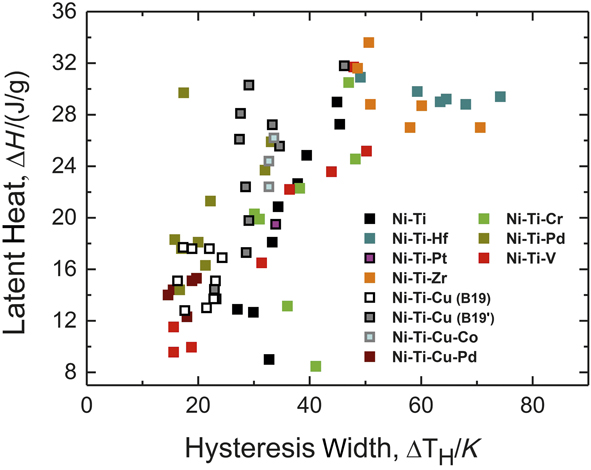
It is well known that the martensitic transformation and thus pseudoelastic behavior is governed by alloy compositionReference Wieczorek, Frenzel, Schmidt, Maaß, Seelecke, Schütze and Eggeler10,Reference Kim, Jo, Park, Park and Han14 and microstructure.Reference Waitz, Kazykhanov and Karnthaler21,Reference Delville, Malard, Pilch, Sittner and Schryvers22 Various research groupsReference Wieczorek, Frenzel, Schmidt, Maaß, Seelecke, Schütze and Eggeler10,Reference Sehitoglu, Wu and Ertekin11,Reference Luo, Feng and Verma15 have made attempts to study the effects of alloy chemistry on cooling performance. Both latent heat and hysteresis width react sensitively to compositional changes.Reference Wieczorek, Frenzel, Schmidt, Maaß, Seelecke, Schütze and Eggeler10,Reference Frenzel, Wieczorek, Opahle, Maaß, Drautz and Eggeler23–Reference Ball and James29 Latent heats between 8.5 and 35 J/g,Reference Frenzel, Wieczorek, Opahle, Maaß, Drautz and Eggeler23 and thermal hysteresis widths ranging from ≈0 K to >70 K,Reference Frenzel, Wieczorek, Opahle, Maaß, Drautz and Eggeler23,Reference Zarnetta, Takahashi, Young, Savan, Furuya, Thienhaus, Maass, Rahim, Frenzel, Brunken, Chu, Srivastava, James, Takeuchi, Eggeler and Ludwig26 are reported in the literature. We note that the thermal hysteresis width, which is often used as a preferred indicator in compositional screenings,Reference Cui, Chu, Famodu, Furuya, Hattrick-Simpers, James, Ludwig, Thienhaus, Wuttig, Zhang and Takeuchi25,Reference Zarnetta, Takahashi, Young, Savan, Furuya, Thienhaus, Maass, Rahim, Frenzel, Brunken, Chu, Srivastava, James, Takeuchi, Eggeler and Ludwig26 is directly proportional to the mechanical hysteresis widthReference Jaeger, Maaß, Frenzel, Schmidt, Seelecke, Kastner and Eggeler27 and thus to the required input work, W (Figure 1a). The results of a recent studyReference Frenzel, Wieczorek, Opahle, Maaß, Drautz and Eggeler23 identify a dilemma that may limit the development of new elastocaloric SMAs. Figure 2 shows that a correlation exists between the latent heat and the hysteresis width. It is difficult to obtain the desired combination of small hysteresis width and large latent heat simultaneously. Nevertheless, Wieczorek et al.Reference Wieczorek, Frenzel, Schmidt, Maaß, Seelecke, Schütze and Eggeler10 recently found a good compromise in a NiTiCuV SMA with an exceptionally high COP value of 20. This value is about 4× higher than for binary NiTi.Reference Qian, Geng, Wang, Ling, Hwang, Radermacher, Takeuchi and Cui9 Schmidt et al.Reference Schmidt, Ullrich, Wieczorek, Frenzel, Schütze, Eggeler and Seelecke30 made a first attempt to study the cooling performance of this material.
Key parameters for ferroic cooling—hysteresis width and latent heat.Reference Frenzel, Wieczorek, Opahle, Maaß, Drautz and Eggeler23 Alloy design requires good compromise (small hysteresis width and large latent heat) between both factors.

Functional stability
The lowest functional degradation of the material is very important for any application. For example, a pseudoelastic SMA would have to tolerate >15 million loading/unloading cycles in a cooling device operating at 0.2 Hz over five years with 50% average utilization. Research on quaternary NiTi-based SMAs revealed a pronounced effect of crystallographic compatibility on the hysteresis width and reversibility (i.e., functional stability in thermally induced phase transformations).Reference Zarnetta, Takahashi, Young, Savan, Furuya, Thienhaus, Maass, Rahim, Frenzel, Brunken, Chu, Srivastava, James, Takeuchi, Eggeler and Ludwig26 The crystallographic compatibility conditions can be derived from the transformation matrixes between austenite and martensite and are thus purely geometric. For crystallographic compatibilityReference Gu, Bumke, Chluba, Quandt and James31 (where the two phases fit without the need for slip or for establishing stressed transition layers), the middle eigenvalue of the transformation matrix λ2 must equal one. This can be achieved by fine-tuning the composition. This λ2 = 1 condition affects the heights of the energy barriers between the transforming phases, which determine the width of the transformation hysteresis.
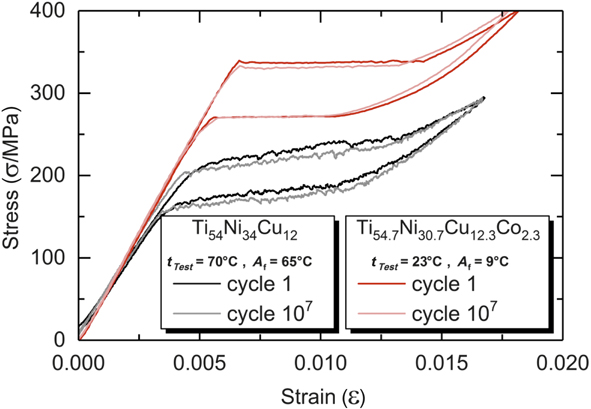
A higher degree of compatibility—so-called supercompatibility—can be obtained by additionally fulfilling other conditions that promote good fit and thus provide an even higher degree of flexibility, as was first demonstrated for Zn45Au30Cu25.Reference Song, Chen, Dabade, Shield and James32 The influence of supercompatibility on functional and structural fatigue in stress-induced austenite-martensite transformations has been demonstrated for TiNiCuCoReference Chluba, Ge, de Miranda, Strobel, Kienle, Quandt and Wuttig19 and ZnAuCu,Reference Ni, Greer, Bhattacharya, James and Chen33 and it was recently reviewed in Reference Reference Gu, Bumke, Chluba, Quandt and James31. The composition Ti54.7Ni30.7Cu12.3Co2.3 showed no measurable fatigue for 10 million pseudoelastic cyclesReference Chluba, Ge, de Miranda, Strobel, Kienle, Quandt and Wuttig19 (Figure 3). This indicates that supercompatibility between austenite and martensite has an important influence on the fatigue behavior. From investigations of different TiNiCu and TiNiCuCo alloys with a λ2-value close to one, the functional degradation behavior was found to also depend on microstructural parameters such as grain sizeReference Chluba, Ge, Dankwort, Bechtold, de Miranda, Kienle, Wuttig and Quandt34 and the nature of precipitates.Reference Chluba, Ge, de Miranda, Strobel, Kienle, Quandt and Wuttig19 It was found that Ti2Cu precipitates, which form in Ti-rich alloys, lead to a near-to-perfect reversibility and repeatability up to >10 million pseudoelastic cycles (Figure 3). The coherency of Ti2Cu precipitates in both phases, austenite and martensite, accounts for this excellent structural and functional property. These Ti2Cu precipitates guide the phase transformation in a well-defined manner and thus act like sentinels, assuring that the austenite-martensite transformation repeatedly follows the same path during each cycle.Reference Chluba, Ge, de Miranda, Strobel, Kienle, Quandt and Wuttig19
Ultralow fatigue of Ti-rich TiNiCu and TiNiCuCo alloys, as demonstrated by next-to-identical first and 107th pseudoelastic transformation cycles.Reference Chluba, Ge, de Miranda, Strobel, Kienle, Quandt and Wuttig19 These materials meet requirements for long-term stability in ferroic cooling applications.

Ferroic cooling applications
Bulk material-based cooling demonstrators
The first successful large-scale elastocaloric cooling devices have been developed and demonstrated.Reference Qian, Geng, Wang, Muehlbauer, Ling, Hwang, Radermacher and Takeuchi35 The concept forming the basis of these developments is mechanical loading and unloading of SMA tube elements in compression and use of the absorbed and released latent heats to cool a hydraulic fluid. In contrast, the work presented in this article focuses on NiTi-based ribbons or wires that are loaded in tension to develop scalable air-cooling devices. Inherently coupled to this design goal is the optimization of the process parameters in terms of cooling power and COP. This requires optimization of the amount of straining, the strain rate, and efficient synchronization between mechanical loading/unloading and heat transfer.
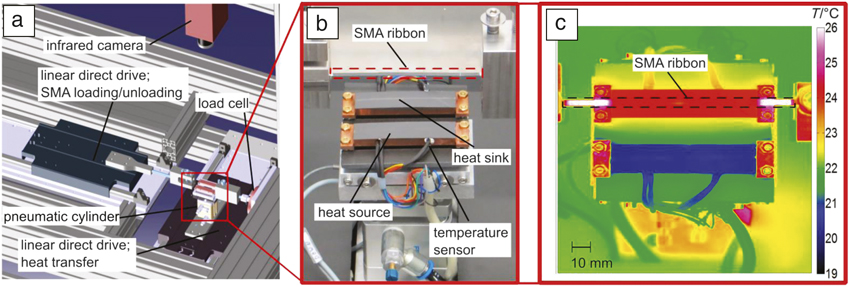
Extending the usual framework of calculating COP values, a graphical method similar to that used for conventional vapor compression cycles has been developed to illustrate relevant work and heat quantities in stress/strain and temperature/entropy diagrams.Reference Schmidt, Schütze, Seelecke and Johnson36 This helps to predict optimized hybrid cycles by appropriately combining adiabatic and isothermal process branches. A comprehensive test rig was developedReference Schmidt, Schütze and Seelecke17,Reference Schmidt, Schütze, Seelecke and Zagrai37–Reference Schmidt, Schütze and Seelecke39 to experimentally validate process efficiency and to study the effects of material training/functional degradation on mechanical, caloric, and thermal properties (Figure 4).Reference Schmidt, Ullrich, Wieczorek, Frenzel, Schütze, Eggeler and Seelecke30 In the device shown in Figure 4a, a pseudoelastic NiTi ribbon is subjected to mechanical cycling. During this process, it moves between two copper blocks, Figure 4b, which act as a heat sink (in contact with the SMA during straining) and a heat source (in contact during unloading of the ribbon), respectively. Figure 4c exemplarily shows a color-coded IR image, which documents temperature changes in the ribbon and the two Cu blocks. A challenge for the design of future elastocaloric cooling devices is the implementation of these concepts into continuously operating units that outperform current vapor compression systems. The first ideas are currently being implemented into a demonstrator with a patent-pending drive element to map experimentally optimized processes.Reference Schmidt, Kirsch, Seelecke and Schütze38 Simultaneously, due to the large number of parameters involved in the design, simulation tools have to be developed to narrow the design space.
Elastocaloric test rig for NiTi ribbon characterization.Reference Schmidt, Schütze and Seelecke17 During cyclic operation, a shape-memory alloy (SMA) ribbon moves between two copper blocks, which act as a heat sink (in contact with the SMA during straining) and a heat source (in contact during unloading of the ribbon). (a) Concept sketch with infrared camera, two linear axes for loading/unloading and heat transfer via copper blocks. (b) Ribbon and copper blocks at higher magnification. (c) Thermography image of the setup during operation. A significant temperature difference between both blocks is established after a few elastocaloric cycles.

Thin-film cooling devices
The implementation of elastocaloric cooling on a miniature scale involves opportunities and challenges. The use of freestanding elastocaloric films allows for efficient heat transfer between film and heat sink/-source, which is of critical importance for high cooling performance. However, parasitic heat fluxes are difficult to control in small systems, and system integration is often challenging. In addition, localized phase-transformation events may affect heat transport.Reference Ossmer, Lambrecht, Gultig, Chluba, Quandt and Kohl13,Reference Ossmer, Chluba, Gueltig, Quandt and Kohl40,Reference Wendler, Ossmer, Chluba, Quandt and Kohl41 One important feature of film-based SMAs is that they allow for almost pure tensile loading even when subjected to out-of-plane deflection.
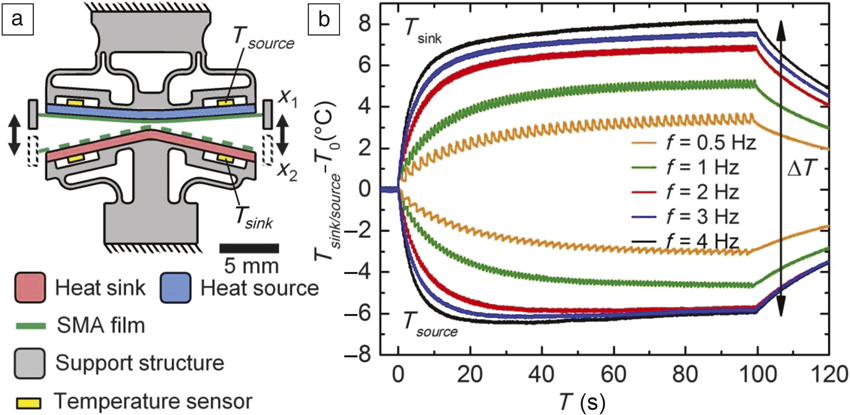
Figure 5a shows an example of a miniature cooling device where this loading principle is applied. Heating and cooling power is separated by bringing the SMA film alternatingly in contact with the heat source during unloading, upper position x 1, and with the heatsink during loading, lower position x 2. Switching heat fluxes and loading the film in one single mechanism makes the setup simple, which is crucial for miniaturization. A typical elastocaloric cycle includes moving the film up and down, which results in stepwise transfer of heat from the heat source to the heat sink. Thus, the temperature T source decreases and T sink increases, as can be seen in Figure 5b for various operation frequencies.
(a) Schematic of a miniature-scale cooling device.Reference Ossmer, Wendler, Gueltig, Lambrecht, Miyazaki and Kohl18 Moving the shape-memory alloy film periodically between the lower (x 2) and upper (x 1) position loads/unloads the film, and, thus, heat is generated/absorbed. Due to alternate switching of surface contacts in both positions, the moving film causes a directed heat flux from heat source to heat sink. (b) Experimentally observed temperature changes of the device for various operation frequencies reaching a maximum temperature span of 14 K.

The device reaches a maximum temperature span ΔT of 14 K at room temperature, a maximum cooling power of 18 Wg–1, and a maximum COP of 6 at zero thermal load neglecting actuation efficiency. Keeping in mind that the film sample has a mass of only 0.015 g, the results in Figure 5b highlight the potential of small-scale elastocaloric cooling devices. Furthermore, it has been shown that work recovery can minimize the required mechanical power input in film-based cooling devices.Reference Ossmer, Wendler, Gueltig, Lambrecht, Miyazaki and Kohl18,Reference Bruederlin, Ossmer, Wendler, Miyazaki and Kohl42 For practical applications, the heat-source element can be interconnected to a thermal load (e.g., an electronic chip or a heat-transfer fluid). Currently, the elastocaloric cooling device is limited by the adiabatic temperature span of the SMA material,Reference Ossmer and Kohl43 in this case, a NiTiCuCo alloy. This limit can be overcome by cascading several SMA films with tailored phase transition temperatures in a stack.
Summary, outlook, and challenges
Elastocaloric cooling principles have high potential for applications because (1) SMAs can provide high cooling efficiency, (2) they represent alternative engineering solutions for conventional cooling processes, and (3) both miniature and large-scale cooling units can be realized. Progress was recently achieved in alloy design where new NiTi-based SMAs with high cooling efficiencies and excellent fatigue lives were developed. These materials have to be studied to determine how they perform in actual cooling devices, and how process conditions can be optimized. For the development of new cooling devices, it may be necessary to extend the temperature range where the elastocaloric effect can be accessed. This will involve the development of cascaded cooling units where SMAs with different operating temperature ranges are combined.
Acknowledgments
The authors acknowledge the support of the Priority Program 1599 Ferroic Cooling funded by the Deutsche Forschungsgemeinschaft DFG (Projects EG101/29–2, SE704/2–2, QU 146/22–2, and K02953/5–2).

Jan Frenzel has been a senior researcher at Ruhr University Bochum, Germany, since 2007. He received his Dr.-Ing. degree in mechanical engineering from Ruhr University Bochum in 2005. He was a postdoctoral researcher at Ruhr University Bochum, Oak Ridge National Laboratory, and Northwestern University. In 2011, he received the Georg Sachs Award for his work on shape-memory alloys. He was a member of the board of directors of the International Organization on Shape Memory and Superelastic Technologies. His current research focuses on materials processing, shape-memory alloys, and superalloys. Frenzel can be reached by email at jan.a.frenzel@rub.de.

Gunther Eggeler has been professor of materials science at Ruhr University Bochum, Germany, since 1995. He studied materials science at Friedrich-Alexander-University Erlangen Nürnberg, Germany, where he obtained his Dipl-Ing degree in 1980 and Dr-Ing degree in 1984. He spent 10 years in Switzerland (1985 to 1987, 1991 to 1994, EPF Lausanne, Habilitation degree in 1993) and in the UK (1988–1990 as senior principal metallurgist in a private company). His current research focuses on elementary microstructural processes, which govern phase transformations and high-temperature plasticity. Eggeler can be reached by email at gunther.eggeler@rub.de.

Eckhard Quandt is a professor in materials science at Kiel University, Germany. He studied physics at the University of Kiel and at the Technical University Berlin. He worked on smart materials from 1991 to 1999 in Karlsruhe, 1999 to 2006 at Caesar in Bonn, and since 2006 at the University of Kiel. From 2014 to 2016, he was dean of the Faculty of Engineering. He is a member of the “Materials Science” review board of the Deutsche Forschungsgemeinschaft and a member of the German National Academy of Science and Engineering. Quandt can be reached by email at eq@tf.uni-kiel.de.

Stefan Seelecke is a full professor of systems engineering and materials science and engineering at Saarland University, Germany, where he directs the Intelligent Materials Systems Lab. He received his PhD degree in engineering science from Technical University Berlin, Germany, in 1995. After his Habilitation degree in 1999, he joined the Department of Mechanical and Aerospace Engineering at North Carolina State University in 2001. His research interests include the development of smart materials-based actuator and sensor systems, in particular (magnetic) shape-memory alloys, piezoelectrics, and electroactive polymers. Seelecke can be reached by email at stefan.seelecke@imsl.uni-saarland.de.

Manfred Kohl is a professor in the Faculty of Mechanical Engineering and head of the Department of Smart Materials and Devices at the Institute of Microstructure Technology at Karlsruhe Institute of Technology (KIT), Germany. He received his PhD degree in physics from the University of Stuttgart, Germany. He worked as an IBM postdoctoral fellow at the T.J. Watson Research Center in Yorktown Heights, and subsequently joined KIT. His current research focuses on multiferroic materials and corresponding microsystems, as well as multimaterial micro- and nanotechnologies. Kohl can be reached by email at manfred.kohl@kit.edu.