Introduction
Since its development in 1938, electroconvulsive therapy (ECT) has remained the most acutely effective treatment for severe depression (UK ECT Review Group, 2003). Depression is the second leading cause of years lived with disability worldwide (Vos et al. Reference Vos2012). Medication and cognitive therapy are effective but about 30% of patients do not respond to standard treatments (Rush et al. Reference Rush, Trivedi, Wisniewski, Nierenberg, Stewart, Warden, Niederehe, Thase, Lavori, Lebowitz, McGrath, Rosenbaum, Sackeim, Kupfer, Luther and Fava2006). Many of these patients might benefit from ECT. Indeed, about 1.4 million people worldwide are treated annually with ECT, with treatment-resistant depression being the most common indication in Western industrialized nations (Leiknes et al. Reference Leiknes, Jarosh-von Schweder and Hoie2012).
Over the years ECT has been, and continues to be, refined with the aim of maintaining clinical effectiveness while minimizing cognitive side-effects. Variations in ECT waveform, frequency of administration, dose and electrode placement may go some way to explain the differences that are seen in patient outcomes (Semkovska & McLoughlin, Reference Semkovska and McLoughlin2010).
Originally, ECT was delivered with a sine-wave stimulus with a long pulsewidth (8.3 ms). This is an inefficient form of electrical stimulation, using higher amounts of energy than required for neurons to discharge (Squire & Zouzounis, Reference Squire and Zouzounis1986). Sine-wave ECT was gradually replaced in most parts of the world by the square-wave brief-pulse (0.5–1.5 ms) stimulus. This led to a reduction in cognitive side-effects but maintained efficacy (Loo et al. Reference Loo, Katalinic, Martin and Schweitzer2012). Some studies have shown that the use of pulsewidths at the shorter end of the brief-pulse spectrum (<1.0 ms) may be more efficient (Swartz & Larson, Reference Swartz and Larson1989; Rasmussen et al. Reference Rasmussen, Zorumski and Jarvis1994). A potential new refinement has been ultra-brief pulse (<0.5 ms) ECT. The ultra-brief pulse stimulus is closer in duration to the neuronal chronaxie (a measure of the length of stimulus required for a neuron to discharge), which is about 0.1–0.2 ms (Geddes, Reference Geddes1987). A recent meta-analysis supported the advantage of ultra-brief ECT in terms of cognitive side-effects; however, this was at a significant cost in antidepressant efficacy (Tor et al. Reference Tor, Bautovich, Wang, Martin, Harvey and Loo2015). Brief-pulse ECT is therefore likely to continue to remain a widely used form of ECT in the near future (Spaans et al. Reference Spaans, Kho, Verwijk, Kok and Stek2013).
Although bitemporal electrode placement remains most commonly used worldwide, right unilateral (d'Elia) placement is preferred in some countries (Leiknes et al. Reference Leiknes, Jarosh-von Schweder and Hoie2012). The first controlled trial of right unilateral v. bitemporal ECT found a significantly faster return of orientation and recall with right unilateral ECT with no significant difference in depression scores (Lancaster et al. Reference Lancaster, Steinert and Frost1958). Over subsequent years numerous studies with varying techniques and procedures produced conflicting results and failed to settle the unilateral v. bitemporal ‘controversy’ (Janicak et al. Reference Janicak, Davis, Gibbons, Ericksen, Chang and Gallagher1985; Pettinati et al. Reference Pettinati, Mathisen, Rosenberg and Lynch1986).
It was not until the publication of a series of studies from the USA, starting in 1987, that it became clear that the effectiveness of right unilateral ECT depends on the strength of the electrical dose above the seizure threshold, being relatively ineffective at the doses nearer threshold (i.e. 1.0–2.5× seizure threshold) used in bitemporal ECT (Sackeim et al. Reference Sackeim, Decina, Kanzler, Kerr and Malitz1987, Reference Sackeim, Prudic, Devanand, Kiersky, Fitzsimons, Moody, McElhiney, Coleman and Settembrino1993; McCall et al. Reference McCall, Reboussin, Weiner and Sackeim2000). This also demonstrated that generalized seizures were necessary but not sufficient for clinical response. The UK ECT Review Group (2003) concluded that high-dose ECT was more effective than low-dose ECT but at that stage there were not enough studies to ascertain whether high-dose unilateral ECT was as effective as moderate-dose bitemporal ECT, or whether it was associated with less cognitive side-effects (UK ECT Review Group, 2003). Only one randomized controlled trial (RCT) at that time had compared high-dose (>6× seizure threshold) right unilateral to bitemporal ECT (Sackeim et al. Reference Sackeim, Prudic, Devanand, Nobler, Lisanby, Peyser, Fitzsimons, Moody and Clark2000). Since then several further trials have been reported, with the hypothesis that high-dose unilateral ECT will match the efficacy of bitemporal ECT while maintaining a cognitive advantage (McCall et al. Reference McCall, Dunn, Rosenquist and Hughes2002; Ranjkesh et al. Reference Ranjkesh, Barekatain and Akuchakian2005; Sackeim et al. Reference Sackeim, Prudic, Nobler, Fitzsimons, Lisanby, Payne, Berman, Brakemeier, Perera and Devanand2008, Reference Sackeim, Dillingham, Prudic, Cooper, McCall, Rosenquist, Isenberg, Garcia, Mulsant and Haskett2009; Kellner et al. Reference Kellner, Knapp, Husain, Rasmussen, Sampson, Cullum, McClintock, Tobias, Martino, Mueller, Bailine, Fink and Petrides2010; Semkovska et al. Reference Semkovska, Landau, Dunne, Kolshus, Kavanagh, Jelovac, Noone, Carton, Lambe, McHugh and McLoughlin2016). An alternative to unilateral or bitemporal electrode placement is bifrontal ECT, where the electrodes are placed over the frontal lobes, sparing both temporal lobes (Letemendia et al. Reference Letemendia, Delva, Rodenburg, Lawson, Inglis, Waldron and Lywood1993). Meta-analytical evidence suggests bifrontal ECT is not more effective than the other placements and requires further characterization (Dunne & McLoughlin, Reference Dunne and McLoughlin2012).
The cognitive side-effects of ECT remain an area of concern to physicians and patients alike. Immediate disorientation following ECT is a recognized effect, typically resolving in the first hour after ECT (Sackeim et al. Reference Sackeim, Portnoy, Neeley, Steif, Decina and Malitz1986). Meta-analytic evidence shows that in the first few days after brief-pulse ECT there is impairment in a wide range of anterograde cognitive tests, but these normalize and often improve after 2–3 weeks (Semkovska & McLoughlin, Reference Semkovska and McLoughlin2010). Bitemporal ECT has been found to have larger deficits in global cognition, delayed verbal memory as well as retrograde autobiographical memory when compared to unilateral ECT. Moreover, higher doses of unilateral ECT have been associated with decreases in verbal learning, delayed verbal memory, visual recognition and semantic memory retrieval (Semkovska et al. Reference Semkovska, Keane, Babalola and McLoughlin2011). With regard to long-term retrospective memory less is known due to both a lack of RCTs with long-term follow-up but also the lack of an agreed measure of remote memory (Freeman, Reference Freeman, Waite and Easton2013; Semkovska & McLoughlin, Reference Semkovska and McLoughlin2013; Jelovac et al. Reference Jelovac, O'Connor, McCarron and McLoughlin2016).
To date, there has been one meta-analysis comparing the cognitive effects of brief-pulse right unilateral v. bitemporal ECT but this did not examine clinical efficacy and was not limited to RCTs (Semkovska et al. Reference Semkovska, Keane, Babalola and McLoughlin2011). The United States Food and Drug Administration (FDA) carried its own systematic review and meta-analysis of various forms of ECT (Food and Drug Administration, 2011). However, the only comparison including high-dose right unilateral v. bitemporal ECT was for depression scores; this only included four studies and the report was not published in a peer-review journal. The UK National Institute for Health and Clinical Excellence (NICE) also published meta-analytic data comparing bitemporal and high-dose unilateral ECT as part of their latest depression guidelines (NICE, 2009). However, this meta-analysis combined studies of bifrontal and bitemporal ECT into a ‘bilateral’ group, as well as combining studies using brief pulse and ultra-brief pulse ECT. One of the studies included also compared ECT in a group of patients that had already failed to respond to moderate-dose right unilateral ECT (Tew et al. Reference Tew, Mulsant, Haskett, Dolata, Hixson and Mann2002). Together, these issues make it difficult to differentiate differences due to pulsewidth from electrode placement. Given the new data from recent trials and the lack of a complete meta-analysis separating out high from low to medium-dose right unilateral ECT, there is a need for a new review of this area. We therefore carried out a systematic review and meta-analysis of RCTs comparing efficacy and cognitive side-effects of brief-pulse high-dose right unilateral and brief-pulse bitemporal ECT for adults treated for depression. Right unilateral ECT has been associated with the need for a higher number of treatments, especially when used at stimulus doses nearer threshold (Fink, Reference Fink2014). The mean number of treatments, along with a comparison of charge in millicoulombs (mC) between the two treatments were also included in the analysis.
Method
The PRISMA statement for systematic reviews and meta-analyses was used to guide reporting (Moher et al. Reference Moher, Liberati, Tetzlaff and Altman2009).
Search strategies
We searched the PubMed, PsycINFO, Web of Science, Cochrane Library and EMBASE databases from inception up to 1 March 2016 with the terms ‘electroconvulsive’ or ‘electroshock’ and ‘trial’ with no language limits. Reference lists of relevant articles were manually searched for any further studies. The International Clinical Trials Registry Platform was also searched using the same terms for any unpublished trials that may be underway. The studies were entered into bibliographic software (EndNote 7, Thomson Reuters, UK) for further analysis.
We only included (i) prospective RCTs comparing (ii) low to moderate dose (1.0–2.5× seizure threshold) bitemporal ECT to high-dose (5–8× seizure threshold) right unilateral ECT for (iii) unipolar or bipolar subjects diagnosed with a major depressive episode according to DSM-III, DSM-IV, or ICD-10 or primary depression according to Research Diagnostic Criteria (Feighner et al. Reference Feighner, Robins, Guze, Woodruff, Winokur and Munoz1972) (iv) aged ⩾18 years using (v) brief-pulse ECT and (vi) a standardized measure of depression for its primary outcome. We did not include ultra-brief pulse ECT as meta-analytic evidence suggests this differs from brief-pulse ECT both in terms of clinical efficacy and cognitive side-effect profile (Tor et al. Reference Tor, Bautovich, Wang, Martin, Harvey and Loo2015). With the exception of reorientation time, cognitive outcomes were included for trials that adopted a pre-post design with an objective measure of cognitive performance. We did not publish a review protocol.
Data extraction
Following exclusion of duplicate records and studies that were clearly not eligible on abstract review, two reviewers (E.K., A.J.) independently screened the remaining full-text records. If inclusion criteria were met, data were independently extracted, cross-checked and any discrepancies resolved by consensus. Where possible, we used scores that had been adjusted for covariates that might influence outcomes, such as baseline depression severity. Outcomes where at least three studies reported data were included. In cases where data were not extractable authors were contacted or data were estimated from graphs. Risk of bias was assessed using The Cochrane Collaboration's Risk of Bias Tool (Higgins et al. Reference Higgins, Altman, Gotzsche, Juni, Moher, Oxman, Savovic, Schulz, Weeks and Sterne2011).
Statistical analysis
All statistical analyses were performed using RevMan 5.3 (The Nordic Cochrane Centre, Copenhagen). For the variable reorientation time, which only had an outcome at end of treatment, effect sizes were based on raw mean differences. For continuous data, with both baseline and end of treatment data, mean change scores were used. For the variable autobiographical memory scores represent post-treatment percentage (%) consistency of recall for autobiographical memories reported before starting ECT. Effect sizes were based on standardized mean differences (SMD) as different versions of rating scales were employed across studies. RevMan calculates SMDs based on Hedges's g, which provides a superior estimate of SMD in small sample sizes (Borenstein, Reference Borenstein2009). For remission, response and relapse, risk ratios were created. Remission was defined as at least a 60% reduction on the 24- or 21-item Hamilton Depression Rating Scale (HAMD-24/HAMD-21) scores with a final score <10 (HAMD-24) or <12 (HAMD-21). Response was defined as at least a 60% reduction on the HAMD and a final score <17 maintained for at least 1 week after the end of ECT. Relapse was defined as ⩾10 points increase on the HAMD-24 compared to the end of treatment score plus a HAMD-24 score of ⩾16. In addition, this increase should be maintained over two interviews at least 1 week apart. Hospital admission for worsening of depressive symptoms also constituted a relapse.
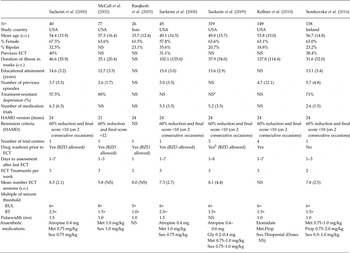
As studies varied in terms of exact dose above threshold, frequency of ECT administration, maximal output of ECT machines and other treatment parameters (see Table 1), we used a random-effects model with inverse variance throughout (DerSimonian & Laird, Reference DerSimonian and Laird1986). Heterogeneity was measured using the I 2 statistic (Higgins & Green, Reference Higgins and Green2008). Where there was significant heterogeneity a post-hoc sensitivity analysis was performed to identify the impact of individual studies on the whole group. This involved removing studies that differed from other studies on parameters that could be predicted a priori to affect outcome, such as dose above seizure threshold. Alternatively, studies that visually were outliers were removed on a one-study removed basis, and the effect on heterogeneity and pooled effect size were observed on an informal basis. We did not perform formal statistical analysis on these sensitivity analysis subgroups in line with recommended practice (Higgins & Green, Reference Higgins and Green2008). We did not carry out a funnel plot analysis of publication bias as there were not enough studies to make this meaningful (Lau et al. Reference Lau, Ioannidis, Terrin, Schmid and Olkin2006).
Summary of studies included in the meta-analysis

BT, Bitemporal ECT; BZD, benzodiazepines; ECT, electroconvulsive therapy; Gly, glycopyrrolate; HAMD, Hamilton Depression Rating Scale; Met, methohexital; ms, milliseconds; NS, not stated; Prop, propofol; RUL, right unilateral ECT; Sux, suxamethonium.
Data are presented as counts, means (standard deviations) or percentages (%). Treatment resistance was measured with versions of the Antidepressant Treatment History Form (ATHF).
a Total number of adequate medication trials (ATHF): 1.3.
b After initial drug washout patients in this trial were randomized to concomitant pharmacotherapy with venlafaxine, nortriptyline or placebo.
Results
The most recent search was completed on 1 March 2016. Our search resulted in 13 567 potentially relevant records after duplicate records were removed (Supplementary Fig. S1). Following abstract screening of these records, 147 full-text records were reviewed for inclusion. One hundred and forty records were excluded after further review (reasons summarized in Supplementary Fig. S1). This left seven RCTs meeting the inclusion criteria (Sackeim et al. Reference Sackeim, Prudic, Devanand, Nobler, Lisanby, Peyser, Fitzsimons, Moody and Clark2000, Reference Sackeim, Prudic, Nobler, Fitzsimons, Lisanby, Payne, Berman, Brakemeier, Perera and Devanand2008, Reference Sackeim, Dillingham, Prudic, Cooper, McCall, Rosenquist, Isenberg, Garcia, Mulsant and Haskett2009; McCall et al. Reference McCall, Dunn, Rosenquist and Hughes2002; Ranjkesh et al. Reference Ranjkesh, Barekatain and Akuchakian2005; Kellner et al. Reference Kellner, Knapp, Husain, Rasmussen, Sampson, Cullum, McClintock, Tobias, Martino, Mueller, Bailine, Fink and Petrides2010; Semkovska et al. Reference Semkovska, Landau, Dunne, Kolshus, Kavanagh, Jelovac, Noone, Carton, Lambe, McHugh and McLoughlin2016) (Table 1). In five studies, where some data were not extractable, the original authors were contacted and four of these responded, providing requested data (Sackeim et al. Reference Sackeim, Prudic, Devanand, Nobler, Lisanby, Peyser, Fitzsimons, Moody and Clark2000, Reference Sackeim, Prudic, Nobler, Fitzsimons, Lisanby, Payne, Berman, Brakemeier, Perera and Devanand2008, Reference Sackeim, Dillingham, Prudic, Cooper, McCall, Rosenquist, Isenberg, Garcia, Mulsant and Haskett2009; Kellner et al. Reference Kellner, Knapp, Husain, Rasmussen, Sampson, Cullum, McClintock, Tobias, Martino, Mueller, Bailine, Fink and Petrides2010).
Efficacy: change in depression rating scores
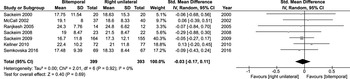
All seven trials used a version of the HAMD before and after either high-dose right unilateral (n = 393) or bitemporal (n = 399) ECT. Overall, there was no significant difference between the two treatments in pre-post HAMD change score [Hedges's g = −0.03, 95% confidence interval (CI) −0.17 to 0.11, p = 0.69, I 2 = 0%] (Fig. 1).
Forest plot of standardized mean differences in HAMD-24 from baseline to end of treatment.

Efficacy: remission, response and relapse
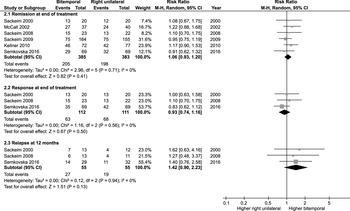
Six trials included data on remission status following high-dose right unilateral (n = 383) or bitemporal (n = 385) ECT. Three trials reported response rates (Sackeim et al. Reference Sackeim, Prudic, Devanand, Nobler, Lisanby, Peyser, Fitzsimons, Moody and Clark2000, Reference Sackeim, Prudic, Nobler, Fitzsimons, Lisanby, Payne, Berman, Brakemeier, Perera and Devanand2008; Semkovska et al. Reference Semkovska, Landau, Dunne, Kolshus, Kavanagh, Jelovac, Noone, Carton, Lambe, McHugh and McLoughlin2016). Overall remission rates were 51.7% (95% CI 46.7–56.7) in the high-dose right unilateral group and 53.2% (95% CI 48.3–58.2) in the bitemporal group. There was no statistically significant difference in the relative risk (RR) of achieving remission (RR 1.06, 95% CI 0.93–1.20, p = 0.41, I 2 = 0%) or response (RR 0.93, 95% CI 0.74–1.16) between the two treatments.
With regard to relapse, two trials reported relapse rates at 12 months (Sackeim et al. Reference Sackeim, Prudic, Devanand, Nobler, Lisanby, Peyser, Fitzsimons, Moody and Clark2000, Reference Sackeim, Prudic, Nobler, Fitzsimons, Lisanby, Payne, Berman, Brakemeier, Perera and Devanand2008) and one further trial also monitored for relapse for 1 year following treatment (data not published) (Semkovska et al. Reference Semkovska, Landau, Dunne, Kolshus, Kavanagh, Jelovac, Noone, Carton, Lambe, McHugh and McLoughlin2016). Overall relapse rates within the first year following ECT were 34.6% (95% CI 22.6–48.7) in the high-dose right unilateral group and 49.1% (95% CI 35.6–62.8) in the bitemporal group. There was no statistically significant difference in the relative risk of sustaining remission for 1 year between the two treatments (RR 1.42, 95% CI 0.90–2.23, p = 0.13, I 2 = 0%). Only two trials had extractable 6-month relapse rates and were therefore not analysed.
Cognitive side-effects: overview
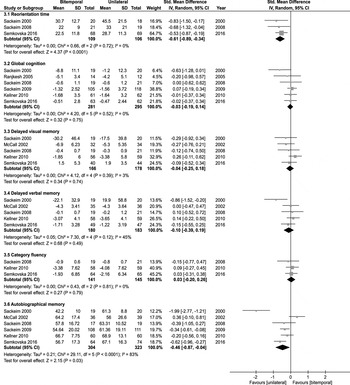
There was considerable variation in the cognitive assessments performed between the included studies, including number, cognitive domains and time points of tests, which restricted what could be meta-analysed (Fig. 3). For example, six studies included a measure of global cognition (Sackeim et al. Reference Sackeim, Prudic, Devanand, Nobler, Lisanby, Peyser, Fitzsimons, Moody and Clark2000, Reference Sackeim, Prudic, Nobler, Fitzsimons, Lisanby, Payne, Berman, Brakemeier, Perera and Devanand2008, Reference Sackeim, Dillingham, Prudic, Cooper, McCall, Rosenquist, Isenberg, Garcia, Mulsant and Haskett2009; Ranjkesh et al. Reference Ranjkesh, Barekatain and Akuchakian2005; Kellner et al. Reference Kellner, Knapp, Husain, Rasmussen, Sampson, Cullum, McClintock, Tobias, Martino, Mueller, Bailine, Fink and Petrides2010; Semkovska et al. Reference Semkovska, Landau, Dunne, Kolshus, Kavanagh, Jelovac, Noone, Carton, Lambe, McHugh and McLoughlin2016), whereas only one contained the n-back test (Sackeim et al. Reference Sackeim, Dillingham, Prudic, Cooper, McCall, Rosenquist, Isenberg, Garcia, Mulsant and Haskett2009). Outcomes assessed by fewer than three studies were excluded.
Cognitive side-effects: reorientation time
Three trials measured time taken to recover orientation following ECT sessions (Fig. 3, part 3.1). Reorientation in all trials was defined as correctly answering four out of five questions (name, location, age, date of birth and day of the week) after each ECT treatment (Sobin et al. Reference Sobin, Sackeim, Prudic, Devanand, Moody and McElhiney1995). Overall, patients receiving high-dose right unilateral ECT (n = 106) recovered reorientation approximately 8 min quicker than those receiving bitemporal ECT (n = 109), (mean difference = −8.28, 95% CI −12.86 to −3.70, p = 0.0004). There was no significant heterogeneity (I 2 = 0%).
Cognitive side-effects: global cognition
Six trials measured global cognition (Fig. 3, part 3.2). Three trials (Ranjkesh et al. Reference Ranjkesh, Barekatain and Akuchakian2005; Kellner et al. Reference Kellner, Knapp, Husain, Rasmussen, Sampson, Cullum, McClintock, Tobias, Martino, Mueller, Bailine, Fink and Petrides2010; Semkovska et al. Reference Semkovska, Landau, Dunne, Kolshus, Kavanagh, Jelovac, Noone, Carton, Lambe, McHugh and McLoughlin2016) used the original version of the Mini-Mental State Examination (MMSE; Folstein et al. Reference Folstein, Folstein and McHugh1975). The other three trials (Sackeim et al. Reference Sackeim, Prudic, Devanand, Nobler, Lisanby, Peyser, Fitzsimons, Moody and Clark2000, Reference Sackeim, Prudic, Nobler, Fitzsimons, Lisanby, Payne, Berman, Brakemeier, Perera and Devanand2008, Reference Sackeim, Dillingham, Prudic, Cooper, McCall, Rosenquist, Isenberg, Garcia, Mulsant and Haskett2009) used a modified version of the MMSE (Mayeux et al. Reference Mayeux, Stern, Rosen and Leventhal1981). There was no statistically significant difference between those receiving high-dose right unilateral (n = 295) and bitemporal (n = 281) ECT (Hedges's g = −0.03, 95% CI −0.19 to 0.14, p = 0.75). There was no significant heterogeneity (I 2 = 0%).
Cognitive side-effects: delayed visual memory
Five trials provided data for performance on complex figure tests measuring delayed retrieval of visual memory (Fig. 3, part 3.3). These tests involve copying a complex geometric figure and then reproducing it from memory either immediately or after a 20–30 min delay (delayed recall) (Lezak, Reference Lezak2012). Different versions of complex figures, including the Rey–Osterrieth Complex Figure test, the Taylor Complex Figure and the Medical College of Georgia Complex Figures, were used to avoid practice effects (Spreen & Strauss, Reference Spreen and Strauss1998; Lezak, Reference Lezak2012). There was no significant difference between those receiving high-dose right unilateral (n = 178) and bitemporal (n = 166) ECT (Hedges's g = −0.04, 95% CI −0.25 to 0.18, p = 0.74). There was no significant heterogeneity (I 2 = 3%).
Cognitive side-effects: delayed verbal memory
Five trials reported extractable data on tests of delayed verbal memory (Fig. 3, part 3.4). These were tests of semantically unrelated lists of words that had to be learned and then recalled after an interval (Lezak, Reference Lezak2012). Two trials (Sackeim et al. Reference Sackeim, Prudic, Devanand, Nobler, Lisanby, Peyser, Fitzsimons, Moody and Clark2000; Sackeim et al. Reference Sackeim, Prudic, Nobler, Fitzsimons, Lisanby, Payne, Berman, Brakemeier, Perera and Devanand2008) used the Buschke Selective Reminding Test (Buschke, Reference Buschke1973; Hannay & Levin, Reference Hannay and Levin1985). Two trials (McCall et al. Reference McCall, Dunn, Rosenquist and Hughes2002; Kellner et al. Reference Kellner, Knapp, Husain, Rasmussen, Sampson, Cullum, McClintock, Tobias, Martino, Mueller, Bailine, Fink and Petrides2010) used the Rey Auditory-Verbal Learning test (Rey, Reference Rey1964; Mungas, Reference Mungas1983; Ryan et al. Reference Ryan, Geisser, Randall and Georgemiller1986). One trial (Semkovska et al. Reference Semkovska, Landau, Dunne, Kolshus, Kavanagh, Jelovac, Noone, Carton, Lambe, McHugh and McLoughlin2016), used the Free and Cued Selective Reminding Test (Van der Linden & GREMEM, Reference Van der Linden2004). There was no significant difference between those receiving high-dose right unilateral (n = 183) and bitemporal (n = 180) ECT (Hedges's g = −0.10, 95% CI −0.39 to 0.19, p = 0.49). Heterogeneity for this outcome was moderate (I 2 = 45%, p = 0.12). Removing the Sackeim et al. (Reference Sackeim, Prudic, Devanand, Nobler, Lisanby, Peyser, Fitzsimons, Moody and Clark2000) trial from the analysis reduced heterogeneity to 0%. This study used 2.5× seizure threshold for bitemporal ECT, which may explain the advantage for right unilateral ECT seen in this trial. However, when the two trials (Sackeim et al. Reference Sackeim, Prudic, Devanand, Nobler, Lisanby, Peyser, Fitzsimons, Moody and Clark2000, Reference Sackeim, Prudic, Nobler, Fitzsimons, Lisanby, Payne, Berman, Brakemeier, Perera and Devanand2008) that used 2.5× seizure threshold were analysed in a separate subgroup analysis there was no significant difference in performance on delayed verbal memory.
Cognitive side-effects: category fluency
Three studies (Fig. 3, part 3.5) provided data on category (semantic) fluency, where participants are asked to produce as many words as possible from a chosen category (e.g. animals) typically in 1 min. It is one measure of executive functioning (Lezak, Reference Lezak2012). There was no significant difference between those receiving high-dose right unilateral (n = 145) and bitemporal (n = 141) ECT (Hedges's g = 0.03, 95% CI −0.20 to 0.26). There was no significant heterogeneity (I 2 = 0%).
Forest plots of remission (part 2.1) response (part 2.2) at end of treatment and relapse at 12 months (part 2.3).

Forest plots of cognitive outcomes.

Cognitive side-effects: autobiographical memory
Six trials reported data on measures of autobiographical memory (Fig. 3, part 3.6). Retrograde amnesia for autobiographical memories refers to difficulties after completing a course of ECT in recalling memories of personal facts (semantic autobiographical memory) or events (episodic autobiographical memory) that occurred before starting ECT (Semkovska & McLoughlin, Reference Semkovska and McLoughlin2013). Three trials (Sackeim et al. Reference Sackeim, Prudic, Devanand, Nobler, Lisanby, Peyser, Fitzsimons, Moody and Clark2000, Reference Sackeim, Prudic, Nobler, Fitzsimons, Lisanby, Payne, Berman, Brakemeier, Perera and Devanand2008; McCall et al. Reference McCall, Dunn, Rosenquist and Hughes2002) used the long form of the Columbia University Autobiographical Memory Interview (CUAMI) (McElhiney et al. Reference McElhiney, Moody, Steif, Prudic, Devanand, Nobler and Sackeim1995). Three trials (Sackeim et al. Reference Sackeim, Dillingham, Prudic, Cooper, McCall, Rosenquist, Isenberg, Garcia, Mulsant and Haskett2009; Kellner et al. Reference Kellner, Knapp, Husain, Rasmussen, Sampson, Cullum, McClintock, Tobias, Martino, Mueller, Bailine, Fink and Petrides2010; Semkovska et al. Reference Semkovska, Landau, Dunne, Kolshus, Kavanagh, Jelovac, Noone, Carton, Lambe, McHugh and McLoughlin2016) used the short version of the CUAMI (CUAMI-SF; McElhiney et al. Reference McElhiney, Moody and Sackeim2001). The CUAMI/CUAMI-SF scores are percentages representing the amount of questions answered correctly at baseline that are subsequently answered correctly at end of treatment. As such, the comparison made for autobiographical memory is not a direct measure of change as was the case for the other outcomes, but rather a measure of consistency in recall, irrespective of how good/poor baseline performance was. Overall, patients receiving high-dose right unilateral ECT (n = 323) performed better that those receiving bitemporal ECT (n = 304) (Hedges's g = −0.46, 95% CI −0.87 to −0.04, p = 0.03). Given the level of heterogeneity (I 2 = 83%, p < 0.0001) a sensitivity analysis was performed. Removing Sackeim et al. (Reference Sackeim, Prudic, Devanand, Nobler, Lisanby, Peyser, Fitzsimons, Moody and Clark2000) reduced heterogeneity to I 2 = 65%. The next most influential study in terms of heterogeneity was McCall et al. (Reference McCall, Dunn, Rosenquist and Hughes2002). Removing this study further reduced heterogeneity to I 2 = 0%. Of note, the McCall et al. study was the only study using 8x (rather than 6x) seizure threshold in the right unilateral group and was also the only trial that found a trend for a disadvantage in this group. Conversely, Sackeim et al. used 2.5× (rather than the more standard 1.5×) seizure threshold in the bitemporal group in their 2000 trial. This could potentially have disadvantaged the bitemporal group in terms of CUAMI/CUAMI-SF performance. However, a 2.5× seizure threshold was also used in the Sackeim et al. (Reference Sackeim, Prudic, Nobler, Fitzsimons, Lisanby, Payne, Berman, Brakemeier, Perera and Devanand2008) trial without such an effect being observed. A further sensitivity analysis including only the three trials (Sackeim et al. Reference Sackeim, Dillingham, Prudic, Cooper, McCall, Rosenquist, Isenberg, Garcia, Mulsant and Haskett2009; Kellner et al. Reference Kellner, Knapp, Husain, Rasmussen, Sampson, Cullum, McClintock, Tobias, Martino, Mueller, Bailine, Fink and Petrides2010; Semkovska et al. Reference Semkovska, Landau, Dunne, Kolshus, Kavanagh, Jelovac, Noone, Carton, Lambe, McHugh and McLoughlin2016) that compared bitemporal ECT at 1.5× seizure threshold with right unilateral ECT at 6× seizure threshold found that right unilateral ECT at this dose maintained an advantage over bitemporal ECT on consistency of autobiographical memory recall after ECT.
ECT parameters
Five trials provided information on mean number of treatment sessions by electrode placement (Sackeim et al. Reference Sackeim, Prudic, Devanand, Nobler, Lisanby, Peyser, Fitzsimons, Moody and Clark2000, Reference Sackeim, Prudic, Nobler, Fitzsimons, Lisanby, Payne, Berman, Brakemeier, Perera and Devanand2008, Reference Sackeim, Dillingham, Prudic, Cooper, McCall, Rosenquist, Isenberg, Garcia, Mulsant and Haskett2009; McCall et al. Reference McCall, Dunn, Rosenquist and Hughes2002; Semkovska et al. Reference Semkovska, Landau, Dunne, Kolshus, Kavanagh, Jelovac, Noone, Carton, Lambe, McHugh and McLoughlin2016) (Supplementary Fig. S2). Overall, there was no significant difference in mean number of treatments (mean difference −0.29, 95% CI −1.21 to 0.63, p = 0.54). There was significant heterogeneity, I 2 = 64%. Removing Sackeim et al. (Reference Sackeim, Prudic, Nobler, Fitzsimons, Lisanby, Payne, Berman, Brakemeier, Perera and Devanand2008) reduced this to I 2 = 0%.
With regard to mean charge (mC) over the course of ECT there was a significant difference between electrode placements in the six trials that provided this information (Sackeim et al. Reference Sackeim, Prudic, Devanand, Nobler, Lisanby, Peyser, Fitzsimons, Moody and Clark2000, Reference Sackeim, Prudic, Nobler, Fitzsimons, Lisanby, Payne, Berman, Brakemeier, Perera and Devanand2008, Reference Sackeim, Dillingham, Prudic, Cooper, McCall, Rosenquist, Isenberg, Garcia, Mulsant and Haskett2009; McCall et al. Reference McCall, Dunn, Rosenquist and Hughes2002; Ranjkesh et al. Reference Ranjkesh, Barekatain and Akuchakian2005; Semkovska et al. Reference Semkovska, Landau, Dunne, Kolshus, Kavanagh, Jelovac, Noone, Carton, Lambe, McHugh and McLoughlin2016), (Supplementary Fig. S3). As expected, the mean charge (mC) in high-dose right unilateral ECT was higher than in bitemporal ECT (mean difference 142.6 mC, 95% CI 121.1–164.1, p < 0.001, I 2 = 86%). As one study (Ranjkesh et al. Reference Ranjkesh, Barekatain and Akuchakian2005) used 5× seizure threshold and was also a visual outlier this was removed in a sensitivity analysis. However, heterogeneity remained high at I 2 = 78% even after removing this.
Pulsewidths used in the included trials ranged from 1.0 to 1.5 ms (see Table 1). There were insufficient numbers of trials to carry out a meta-regression based on pulsewidth.
Risk of bias
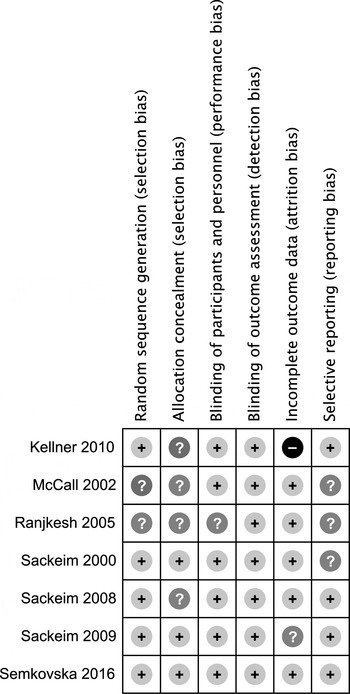
A risk of bias summary is included in Fig. 4. Apart from allocation concealment, the majority of the information was from trials with low risk of bias. The only area where there was any study with a high risk of bias was with regard to incomplete outcome data (Kellner et al. Reference Kellner, Knapp, Husain, Rasmussen, Sampson, Cullum, McClintock, Tobias, Martino, Mueller, Bailine, Fink and Petrides2010). Sixty-three out of 230 participants (27.4%) dropped out of this trial prior to completion. The high dropout rate may have been due to those not achieving remission being classed as dropouts if they did not complete ten treatments. Many participants did not complete all outcomes, and the amount of missing neuropsychological data which required multiple imputation ranged from 35 to 55%. Of note, the adjudged high risk of bias in this trial is in reference mainly to cognitive outcomes, as mood outcomes had better rates of completion. Removing the Kellner et al. (Reference Kellner, Knapp, Husain, Rasmussen, Sampson, Cullum, McClintock, Tobias, Martino, Mueller, Bailine, Fink and Petrides2010) study in a sensitivity analysis did not alter the overall net effects for the neurocognitive outcomes reported in their study (global cognition, delayed visual and verbal memory, category fluency and autobiographical memory – for detailed results including statistical results see Supplementary Fig. S4.1–4.4.
Risk of bias summary. Studies were rated as ‘low risk’ (light grey circle with ‘+’ symbol), ‘high risk’ (black circle with white ‘−’ symbol) or ‘unclear risk’ (dark grey circle with ’?’ symbol) of bias as per the Cochrane Collaboration's tool for assessing risk of bias.

Discussion
Clinical efficacy
In the last 15 years there have been seven RCTs of high-dose right unilateral v. low-moderate dose bitemporal ECT. Although there was some variation in the outcomes used in these studies, we were able to meta-analyse the major clinical and cognitive outcomes. In terms of clinical efficacy we found no significant difference between high-dose right unilateral ECT and bitemporal ECT either on standardized depression rating scales or on categorical remission classification at end of treatment as well as at 12 months after completing ECT. This is in contrast to previous reviews that did not separate high-dose from low to medium-dose right unilateral ECT (UK ECT Review Group, 2003). It is in line with the US FDA review, but we were able to include over twice the number of patients in our meta-analysis (Food and Drug Administration, 2011). We did not find a significant difference in the mean number of sessions used between the two forms of ECT. Some have argued that the most severely ill patients may benefit more, or at least respond quicker, from bitemporal ECT (Kellner et al. Reference Kellner, Knapp, Husain, Rasmussen, Sampson, Cullum, McClintock, Tobias, Martino, Mueller, Bailine, Fink and Petrides2010). As the most severely ill patients are typically not recruited to RCTs, our meta-analysis indicates that for patients eligible to participate in a RCT both forms of treatment were equally efficacious.
Cognitive effects
With regard to cognitive outcomes, we found an advantage for high-dose right unilateral ECT on measures of retrograde amnesia for autobiographical memory following ECT and reorientation time in the week following ECT. Measuring retrograde memory impairment may be less reliable than anterograde memory (Ingram et al. Reference Ingram, Saling and Schweitzer2008). Although the CUAMI/CUAMI-SF have their limitations, they are sensitive to differences in autobiographical memory performance attributable to differences in electrode placement (Semkovska & McLoughlin, Reference Semkovska and McLoughlin2013; Sackeim, Reference Sackeim2014). The only study that favoured bitemporal ECT (although not statistically significant) in terms of autobiographical memory used right unilateral ECT at 8× seizure threshold (McCall et al. Reference McCall, Dunn, Rosenquist and Hughes2002). This indicates that there is no cognitive advantage in going beyond 6× seizure threshold for right unilateral ECT. Reorientation times were better for high-dose right unilateral ECT although this finding was limited to three trials. Prolonged reorientation time at the time of ECT has been reported to be a predictor of subsequent retrograde amnesia after a course of ECT (Sobin et al. Reference Sobin, Sackeim, Prudic, Devanand, Moody and McElhiney1995; Martin et al. Reference Martin, Galvez and Loo2015).
The precise mechanism why recovery of orientation and autobiographical memory are relatively more sensitive to the effects of bitemporal ECT are not fully known (McClintock et al. Reference McClintock, Choi, Deng, Appelbaum, Krystal and Lisanby2014). This may be related to the electric current passing directly through medial temporal lobe structures, including the hippocampus. Non-dominant unilateral electrode placement may result in a reduced immediate depolarization of neurons within these structures, even though there is a rapid subsequent generalization of seizure activity (Lee et al. Reference Lee, Deng, Kim, Laine, Lisanby and Peterchev2012).
For the other cognitive outcomes we did not find an advantage of one form of ECT over the other in the week following ECT. It therefore appears that some, but not all, of the cognitive advantage of right unilateral ECT is lost when given at a sufficient dose to achieve equal clinical efficacy with bitemporal ECT.
Limitations
We identified only seven RCTs that met inclusion criteria, many with small numbers of patients. This prevented the analysis of publication bias or meta-regression of subgroups (Thompson & Higgins, Reference Thompson and Higgins2002). On the other hand, pooling the studies gave us increased power to detect meaningful differences that were not necessarily apparent in the individual trials themselves. Although all trials used a version of the HAMD to measure efficacy, cognitive outcome measures often varied widely from trial to trial which limited the data we could meta-analyse. With the exception of relapse rates at 1 year, we were limited to short-term outcomes (first week after ECT). Only some trials (Sackeim et al. Reference Sackeim, Prudic, Devanand, Nobler, Lisanby, Peyser, Fitzsimons, Moody and Clark2000, Reference Sackeim, Prudic, Nobler, Fitzsimons, Lisanby, Payne, Berman, Brakemeier, Perera and Devanand2008; McCall et al. Reference McCall, Dunn, Rosenquist and Hughes2002; Semkovska et al. Reference Semkovska, Landau, Dunne, Kolshus, Kavanagh, Jelovac, Noone, Carton, Lambe, McHugh and McLoughlin2016) studied the longer-term cognitive outcomes of the two forms of ECT and we found no cognitive outcome data beyond 6 months. However, as the trials differed with regard to the time of follow-up we could not pool these results. Whether the short-term differences in reorientation and retrograde autobiographical memory seen after ECT have a long-term impact therefore remains unclear. Although relapse following ECT is a concern (Jelovac et al. Reference Jelovac, Kolshus and McLoughlin2013), only three trials monitored patients for a year after ECT (Sackeim et al. Reference Sackeim, Prudic, Devanand, Nobler, Lisanby, Peyser, Fitzsimons, Moody and Clark2000, Reference Sackeim, Prudic, Nobler, Fitzsimons, Lisanby, Payne, Berman, Brakemeier, Perera and Devanand2008; Semkovska et al. Reference Semkovska, Landau, Dunne, Kolshus, Kavanagh, Jelovac, Noone, Carton, Lambe, McHugh and McLoughlin2016). Care should be taken with extrapolating our results to non-depression groups such as schizophrenia or mania. Based on our meta-analysis, cognitive outcomes that are differentiated by electrode placement in brief-pulse ECT include reorientation time and autobiographical memory. However, many trials had included cognitive outcomes that we were unable to meta-analyse due to heterogeneity or lack of trials using the given instrument. As recruiting patients to ECT trials is difficult (O'Connor et al. Reference O'Connor, Gardner, Eppingstall and Tofler2010), the use of common cognitive measures that may facilitate future meta-analysis would be helpful.
Conclusions
Based on our systematic review and meta-analysis of seven RCTs, high-dose brief-pulse right unilateral ECT appears to be as effective as brief-pulse bitemporal ECT for the treatment of depression, and appears to have some cognitive advantages. Although brief-pulse bitemporal ECT remains the most common form of ECT worldwide, our findings indicate that high-dose right unilateral ECT may represent a superior alternative for many patients. Although ultra-brief pulse ECT may have a further cognitive advantage, current evidence suggests this is at a slight disadvantage in terms of clinical response (Tor et al. Reference Tor, Bautovich, Wang, Martin, Harvey and Loo2015). Evidence-based alternatives in electrode placement and pulsewidth are now available for the clinician prescribing ECT. It may be that there is currently no ‘gold standard’ form of ECT that suits every patient's need, but we suggest that high-dose brief pulse right unilateral ECT represents an acceptable middle ground for many as a first line form of ECT.
Supplementary material
The supplementary material for this article can be found at https://doi.org/10.1017/S0033291716002737.
Acknowledgements
This work was supported by an award from the Health Research Board (TRA/2007/5), who had no role in study design, data collection or analysis, writing of the manuscript or decision to publish the work. The authors thank Drs Charles Kellner, Rebecca Knapp and Harold Sackeim for providing additional data from their studies.
Declaration of Interest
None.