CHD is the most common group of congenital abnormalities. In certain cases, prenatal diagnosis may be life-saving, because it allows referral to a tertiary centre, where appropriate neonatal invasive therapy can be implemented to reduce perinatal morbidity and mortality.Reference Jaeggi, Sholler, Jones and Cooper 1 – Reference Quartermain, Glatz and Goldberg 3 In our country, in centres where neither a Foetal Medicine Specialist nor a Foetal Cardiologist is available, it is usually an obstetric sonographer who suspects the presence of a CHD, and generally in the third trimester of pregnancy. In a limited-resource scenario, it is, therefore, important to develop a tool to aid non-specialist physicians in Foetal Medicine or Foetal Cardiology to determine which patient may need neonatal cardiac invasive therapy and referral for evaluation and delivery in a tertiary-care centre. The aim of this study was to develop a prediction model based on prenatal ultrasonographic findings to estimate the probability of the need for neonatal cardiac invasive therapy, including cardiac surgery or catheter-based therapy.
Materials and methods
A retrospective cohort study was performed at two tertiary healthcare centres in Argentina, Hospital Italiano de Buenos Aires and Fundación Hospitalaria, between September 1998 and September 2013. For the development of the prediction model, two paediatric and foetal cardiologists, not blinded to the results of the tests, reviewed the clinical records and clips of all patients with prenatal diagnosis of CHD. In the case of discordance between clinical records and clip reviews, information contained in the clinical records was used in order to avoid bias in scoring performed by the unblinded observers. Patients lost to follow-up in the 1st month of life or with incomplete data were excluded. The study was approved by the Institutional Review Board.
The foetal heart views studied as potential predictors were the four-chamber view, the three-vessel view, and the three-vessel and tracheal view. Reference Yagel, Cohen and Achiron 4 , Reference Carvalho, Allan and Chaoui 5 The outflow tracts were not included in the model for its simplification. We acknowledge the importance of assessing the outflow tracts views, but potentially life-threatening CHD requiring neonatal intervention that can be detected prenatally by visualisation of these views, such as severe obstruction of a semi-lunar valve or transposition of the great arteries, can also be detected by visualisation of the three-vessel and the three-vessel and tracheal views. Postnatal echocardiography was performed by five paediatric cardiologists, who had between 5 and 30 years of experience in tertiary healthcare centres, and prenatal echocardiography was performed by three paediatric and foetal cardiologists and a Maternal & Foetal Medicine Specialist trained in foetal cardiology, who had between 5 and 30 years of experience in tertiary healthcare centres. Ultrasonographic assessment with colour flow Doppler was performed with an Esaote AU3 (Esaote Medical Systems, Genoa, Italy), a Medison-SonoAce X8 (Samsung Medison Medical Systems, Seoul, South Korea), and a Phillips HD11 (Philips Medical Systems, Amsterdam, Netherlands), with a 5 MHz convex probe and 3–5 and 8 MHz sectorial probes. Only variables that were available in at least 80% of the cases were included.
The cardiac findings analysed in the four-chamber view are as follows:
-
∙ Ventricle asymmetry – at least 30% difference in width between ventricles, assessed at the level of the tips of the atrioventricular valves at their maximum opening, at the end of diastole, and from endocardium-to-endocardium borders.
-
∙ Significant atrioventricular valve regurgitation – moderate or severe.
-
∙ Recognition of only one atrioventricular valve – single or common valve.
-
∙ Functionally single ventricle – right, left, common, or indefinite.
-
∙ Pericardial effusion – more than 4 mm of pericardial fluid measured in diastole.
-
∙ Foetal tachyarrhythmia – >180 beats per minute.
-
∙ Congenital heart block – <100 beats per minute, with dissociation of atrial and ventricular activity.
In the three-vessel and the three-vessel and tracheal views, the findings analysed were are as follows:
-
∙ Lack of visualisation of a great artery.
-
∙ Asymmetry of the great vessels – 30% discordance, assessed in systole, from endothelium-to-endothelium borders.
-
∙ Reversal blood flow at the transverse aortic arch or at the ductus arteriosus.
-
∙ Turbulent blood flow at one or both great vessels detected by colour and/or pulsed Doppler.
-
∙ Valve regurgitation at one or both semi-lunar valves – mild, moderate, or severe.
We define neonatal cardiac invasive therapy as heart surgery or catheter-based therapy performed during the 1st month of life for clinical stabilisation or for life-saving purposes.
The relationship between each predictor and the outcome variable – neonatal cardiac invasive therapy – was assessed using univariate logistic regression. The relationship between continuous variables – maternal age and gestational age at diagnosis – and the outcome variable was assessed through variable softened graphics with the log odds of the outcome to see the adequacy of the line. Any covariate with univariate significance of p<0.10 was eligible for inclusion in the model.
Variables were added one by one, and with a backward elimination model a parsimonious final model was built. Comparison was made with the likelihood ratio comparison test. Calibration was tested by the Hosmer and Lemeshow test. Discrimination was analysed via leaderboards with different cut-offs and receiver operating characteristic curves using standard methods.Reference Hanley and McNeil 6 The final model was validated internally using the re-sampling method (bootstrap) proposed by Efron.Reference Wasson, Sox, Neff and Goldman 7 Optimism adjustment of the final model was estimated as the difference between the area under the curve (AUCboot) model that emerged from the re-sampling and the area under the curve of the original model. The analysis was performed using STATA 11.2 (StataCorp LP, Texas, United States of America).
Results
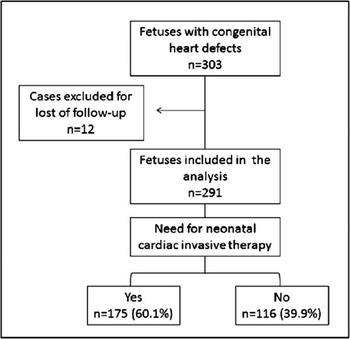
During the study period, 303 patients with prenatal diagnosis of CHD were managed in the two centres. Among all, 12 patients were excluded from the study: 11 due to loss of follow-up and one case with diagnosis of trisomy 18, leaving 291 cases for the analysis (Fig 1).
Flow diagram. Study population and outcome.

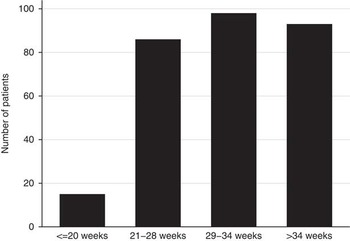
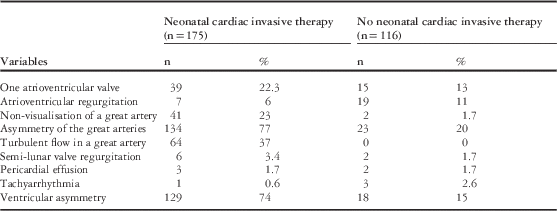
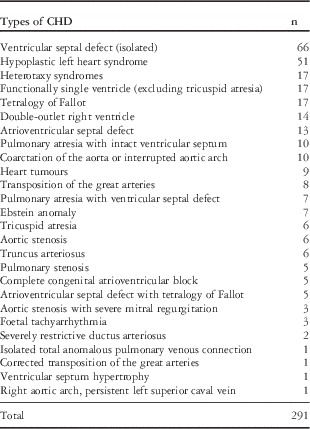
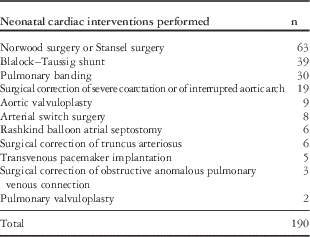
The mean maternal age was 31±6 years, and the mean gestational age was 29.9±5 weeks at initial assessment (Fig 2). The ultrasonographic signs are presented in Table 1, and the final diagnoses are presented in Table 2. A total of 175/291 (60.1%) patients required neonatal cardiac invasive therapy (Fig 1); 175 (60.1%) patients required a total of 190 neonatal cardiac interventions, which are listed in Table 3.
Gestational age at initial foetal echocardiographic assessment.

Ultrasonographic signs

Functionally singe ventricle, reversal flow in a great artery, and congenital heart block presented a discrimination value of 100% (in this sample all cases required neonatal cardiac invasive therapy) and were, therefore, excluded from the model.
Types of CHD

Neonatal cardiac interventions performed

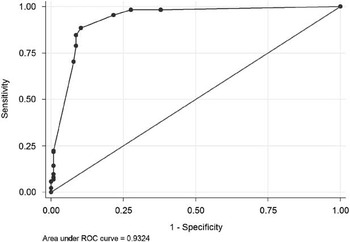
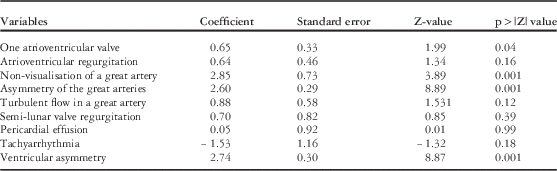
The variables “single ventricle”, “reverse flow at a great vessel”, and “congenital heart block” presented a discrimination value of 100% – all cases required neonatal cardiac invasive therapy – and were, therefore, excluded from the model. Univariate and multiple logistic regression analysis identified that “non-visualisation of a great vessel”, “asymmetry of the great vessels”, “ventricular asymmetry”, and “visualisation of one atrioventricular valve” were significant independent predictors for the need of neonatal cardiac invasive therapy (Table 4). The model showed good calibration (Hosmer and Lemeshow test p=0.67) and good discrimination (area under the receiver operating characteristic curve 0.9324, 95% CI 0.90–0.96; Fig 3).
Area under the receiver operating characteristic curve of the prediction model.

The final predictive model equation was as follows:
 $$\eqalignno{ {\rm logit(pi)}&={\minus}{\rm 3}.{\rm 213358}{\plus}{\rm 5}.0{\rm 87164}{\times}{\rm nga}{\plus}{\rm 2}.{\rm 335187}\cr &\;{\times}{\rm agv}{\plus}{\rm 1}.{\rm 491497}{\times}{\rm oavv}{\plus}{\rm 2}.{\rm 534378}{\times}{\rm va}$$
where logit(pi) represents the natural logarithm of the probability of neonatal cardiac invasive therapy; nga, non-visualisation of a great artery; agv, asymmetry of the great vessels; oavv, visualisation of one atrioventricular valve; va, ventricular asymmetry. After 200 cycles of bootstrapping, the optimism average was 0.02 (95% CI −0.03 to 0.06), suggesting a minimum of adjustment.
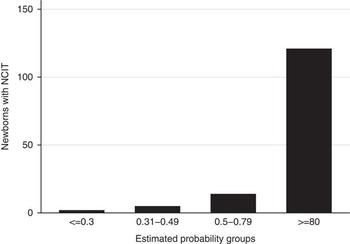
The model successfully stratified the population into clinically relevant categories (Fig 4): 87/291 (29.8%) patients were classified as low risk (predicted probability <0.30), and 148/291 (50.9%) as the highest risk group (predicted probability ⩾0.80). Most children (98.2%) with predicted probability ⩾0.30 required catheterisation or surgery within the 1st month of life. On the other hand, the need for neonatal cardiac invasive therapy occurred in 3/87 (3.4%) children with a predicted probability of <0.30. For a cut-off probability of 0.30, sensitivity was 98.2%, specificity 72.4%, and diagnostic accuracy was 87.9%.
Neonatal cardiac invasive therapy risk categories based on prenatal ultrasonographic findings.

Results of the univariate analysis

Functionally singe ventricle, reversal flow in a great artery, and congenital heart block presented a discrimination value of 100% – in this sample all cases required neonatal cardiac invasive therapy – and were, therefore, excluded from the model.
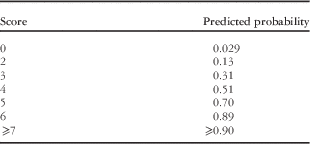
Predicted probability and scoring

Predicted risks can be calculated from the following standard formula:
 $${\rm Risk}\,{\rm score}={\rm 5}{\times}{\rm nga}{\plus}{\rm 2}.{\rm 5}{\times}{\rm agv}{\plus}{\rm 1}.{\rm 5}{\times}{\rm oavv}{\plus}{\rm 2}.{\rm 5}{\times}{\rm va}$$
where nga is the non-visualisation of a great artery; agv the asymmetry of the great vessels; oavv the visualisation of one atrioventricular valve; and va the ventricle asymmetry.
A risk score ⩾3 represents the cut-off predicted probability of 0.30, requiring neonatal cardiac invasive therapy within the neonatal period (Table 5).
Discussion
We developed a prediction model based on ultrasonographic foetal heart findings to estimate the probability of the need for neonatal cardiac invasive therapy, including cardiac surgery or catheter-based therapy, in foetuses with suspected CHD. Asymmetry of the great arteries, lack of visualisation of a great artery, visualisation of one atrioventricular valve, and asymmetry of the ventricles predicted the outcome significantly. Functionally single ventricle, reversal flow in the great arteries, and congenital heart block showed perfect discrimination value and were, therefore, not included. With a cut-off predicted probability of ⩽0.30 (risk score ⩾3), the profile presented 98.2% sensitivity and 72.4% specificity. Priority was given to sensitivity over specificity upon clinical criteria, given the life-threatening condition that may imply a false-negative result.
Previous studies have reported foetal echocardiographic markers as predictors of severity in certain types of CHD. Reversed blood flow across the ductus arteriosus, the aortic arch, or the atrial septum has been described as a sign of severity.Reference Berning, Silverman, Villegas, Sahn, Martin and Rice 8 , Reference Mäkikallio, McElhinney and Levine 9 Regarding pulmonary outflow tract obstruction, several studies have reported the role of foetal echocardiographic findings in identifying patients who require neonatal cardiac intervention, such as those with reversal or bi-directional flow in the ductus arteriosus, low pulmonary valve diameter Z-score (<−3), low pulmonary valve-to-aortic valve annular diameter ratio (<0.6), and an increased peak systolic pulmonary flow velocity.Reference Quartermain, Glatz and Goldberg 3 , Reference Todros, Paladini and Chiappa 10 – Reference Escribano, Herraiz, Granados, Arbues, Mendoza and Galindo 12 In the case of coarctation of the aorta, greater difficulties and limitations have been described. Aortic arch dimensions and isthmic flow abnormalities, among other parameters, have been reported as predictors of severity and of the need for neonatal cardiac surgery.Reference Gómez-Montes, Herraiz, Mendoza, Escribano and Galindo 13 – Reference Matsui, Mellander, Roughton, Jicinska and Gardiner 15 Several studies report signs aimed at predicting the need for urgent balloon atrial septostomy in neonates with CHD that require adequate inter-atrial flow, such as hypoplastic left heart syndrome or transposition of the great arteries.Reference Vlahos, Lock, McElhinney and van der Velde 16 – Reference Maeno, Kamenir, Sinclair, van der Velde, Smallhorn and Hornberger 19 Most of the above-mentioned studies are focussed on finding predictors of severity or of the need for neonatal intervention for specific types of CHD. The model presented here is applicable to most types of CHD, which may be important when there is no definite diagnosis, when the specialist resources in Foetal Medicine and Foetal Cardiology are scarce or are not available, and when there are important barriers in the referral of all the patients with a suspected CHD.
The construction of a single model for all CHD will be a useful tool in clinical practice, with the primary aim of identifying life-threatening CHD by the obstetric sonographer or by the paediatric cardiologist not specialised in Foetal Cardiology, to achieve a timely referral and intervention before collapse or death occurs. Predicting the need for neonatal cardiac therapeutic intervention is a key point for planning delivery strategies and perinatal care. Many of the parameters and measurements described in the previously mentioned studies are time-consuming and need specialised training and experience in foetal echocardiography. The model presented here was constructed based on ultrasonographic features of the foetal heart that can be detected in three echographic views easily obtained by a transverse scan of the foetal heart – that is, the four-chamber, the three-vessel, and the three-vessel and tracheal views – adding the application of colour Doppler or pulsed Doppler to determine the direction of blood flow in the great arteries. In our centre, in accordance with the International Society for Ultrasound in Obstetrics and Gynecology guidelines,Reference Carvalho, Allan and Chaoui 5 the use of colour Doppler investigation is encouraged. Nevertheless, as in other countries, there are currently no national guidelines regarding foetal cardiac screening, and colour and pulsed Doppler flow investigation is not performed during routine screening of the foetal heart. Obstetric ultrasound is widely available, but training and expertise of obstetric sonographers is the main limiting resource, and its improvement is being targeted in order to increase the detection rate of CHD and to reach the diagnosis earlier in pregnancy. Considering the predictive strength of reversed flow in the great arteries, especially in postnatal ductus flow-dependent CHD, we have decided to include colour or pulsed Doppler investigation in the model, in spite of the limitation to its generalisation, especially due to restrictions in the availability of expertise to perform and interpret the Doppler findings. We hope its inclusion in the model will promote the inclusion of colour Doppler investigation during routine foetal cardiac screening.
This study has several limitations. The first is the retrospective design and the fact that it was carried out in two large referral centres. Typically, in a derivation cohort, there is a bias spectrum towards a high risk sample, and the predictive model should be tested in a sample with a much broader spectrum of disease.
Second, the sample was small and there are few or no cases of certain types of CHD. The heterogeneity of this group of anomalies, with several different physiological patterns, suggests the need for large series for validation and studies of applicability. As with most prediction models, although the derivation cohort showed accurate performance, external multi-centre prospective validation is needed and should have a large sample size in order to evaluate accuracy of the model. Third, different aspects may influence the decision to undertake neonatal cardiac invasive therapy, such as the health condition of the baby, the gestational age at delivery, and the newborn’s pulmonary circulation. Finally, in certain anomalies such as isolated ventricular septal defects or some types of balanced atrioventricular canal assessing the size of the defect and predicting the degree of postnatal pulmonary blood flow, and thus the need for neonatal pulmonary banding, may prove extremely difficult. Asymmetry of the ventricles and/or of the great arteries may contribute to the prediction in some of these cases. We also acknowledge that reversal of flow in a great artery may not show perfect prediction performance in a new sample, as in some cases it may be a transitory phenomenon. In addition, the model presented here is designed to be used by obstetric sonographers or paediatric cardiologists not specialised in Foetal Cardiology, but in our study foetal cardiologists acquired most of the images. We assume that this would not be a significant limitation, as the views studied here are part of the five axial views for optimal foetal heart screening.Reference Yagel, Cohen and Achiron 4 , Reference Carvalho, Allan and Chaoui 5 A validation cohort study, with scoring by blinded obstetric sonographers, is currently being performed in a multi-centre prospective study. Although foetal ultrasounds were reviewed by foetal cardiologists not blinded to patient outcome, information obtained before the outcome occurred was used to construct the model and, as previously stated, no differences were seen between reports and clips.
The majority of infants with prenatal diagnosis of CHD will not need neonatal intervention; however, there is a group of babies for whom in utero transfer may be life-saving and for whom perinatal management becomes critical. Predicting the need for neonatal cardiac surgery or therapeutic catheterisation is essential when deciding on the place of birth. In-uterus transportation has been demonstrated to improve clinical prognosis and reduce costs for both patient and family, as well as for the medical system, but it is not always possible to refer all patients.Reference Guerchicoff, Marantz and Infante 20 Accurate and discriminating tools are necessary for the responsible allocation of scarce medical resources. We hope that this predictive model will contribute to improve these issues. Future research in this area is needed.
In conclusion, a prediction model based on echocardiographic findings in foetuses with CHD, even without a definite diagnosis, allows an accurate estimation of the probability for requiring neonatal cardiac invasive therapy and can have a significant impact on patient care.
Acknowledgements
Bradley Krupsaw, proofreader, University of Maryland, USA.
Financial Support
This research received no specific grant from any funding agency, commercial, or not-for-profit sectors.
Conflicts of Interest
None.