Warfarin is a widely used anticoagulant with a narrow therapeutic index and wide variability in dose response, even within a specific patient population. Genetic variations in cytochrome P450 2C9 (CYP2C9) and vitamin K1 2,3-epoxide reductase subunit 1 (VKORC1) affect warfarin dose requirements and use of a pharmacogenetic dosing algorithm can improve the accuracy of dose prediction over fixed dose or clinical algorithms (1–Reference Takeuchi, Kashida and Okazaki4). However, clinical use of WPGT is still limited due to its unclear clinical validity (improvements in clinical outcomes) and several clinical trials are ongoing to elucidate this (5–9).
In addition to clinical validity, patient acceptance is also essential for successful implementation of pharmacogenetic testing (PGT) in the clinic. A study of patients’ and physicians’ perspectives on PGT in Germany revealed that majority of patients are acceptive and optimistic about PGT but are concerned about adverse PGT results, privacy, and possible detection of other diseases (Reference Rogausch, Prause, Schallenberg, Brockmöller and Himmel10). Indeed, privacy, confidentiality, and cost were the main concerns that emerged from other studies as well (Reference Haddy, Ward, Angley and McKinnon11–Reference O'Daniel, Lucas and Deverka13). A more recent large survey of the U.S. public also revealed strong enthusiasm for PGT, with interest being influenced by a combination of personal factors, awareness of genetics, and health and medication history. Notably, a risk of loss of confidentiality severely impacted interest in PGT (Reference Haga, O'Daniel, Tindall, Lipkus and Agans14). A particular concern in PGT is the possibility of generating ancillary information unrelated to the purpose of the PGT, which optimistically did not negatively affect public interest in PGT in the same survey (Reference Haga, OʼDaniel, Tindall, Lipkus and Agans15). Currently, the CYP2C9 and VKORC1 variants related to warfarin dose requirements are not associated with any disease risk.
It appears that patient demand is much stronger for PGT compared with genetic testing for late onset chronic diseases such as breast cancer (here termed as “disease genetic testing,” DGT), possibly because patients perceive PGT similarly to a routine biochemical test. Studies have been done to evaluate patients’ attitudes toward DGT, including in our Asian population. Because PGT is intended to predict drug responses rather than disease risk, it is less laden with medical, social, or personal significance. PGT is therefore less risky than DGT due to lower potential of its results being misused or having unintended far-reaching consequences. Nevertheless, there are still ethical, social, and legal issues associated with PGT that need to be addressed. This includes the risk of the PGT results adversely affecting one's self-image, stigmatization, or disadvantage at acquiring insurance or employment, the doctor's obligation to reveal incidental findings, and the doctor's legal liability should the doctor decide to prescribe a drug that has been “disqualified” by the PGT (Reference Robertson16).
In this study we measured attitudes as willingness to undergo WPGT, expectation of benefit from WPGT and concerns or barriers to taking WPGT. “Expectations” and “concerns” were two independent latent variables which we each measured using multiple items, and were meant to measure how much respondents think WPGT can benefit them (after basic information on it has been provided) and their level of concern regarding ethical, social, or legal issues pertaining to WPGT, respectively.
The objective of this study was to determine the attitudes toward WPGT among Singaporean Chinese. In addition, we also hypothesized the following relationships: (i) attitudes would be associated with socio-demographic and clinical variables, (ii) higher expectation would be associated with higher willingness to undergo WPGT, and (iii) higher concerns would be associated with lower willingness to undergo WPGT.
Two populations, the general public and warfarin patients, were surveyed in this study to explore their attitudes on WPGT to offer valuable insight into that of new warfarin patients, who are difficult to recruit. Due to resource constraint, the study was restricted to the Chinese, the predominant race in Singapore and several countries in the region.
METHODS
Study Subjects
Study I: Warfarin Patients
Patients were recruited from the anticoagulation clinics in the National University Hospital (NUH) between August to December 2011 using convenience sampling. Random sampling was not feasible due to logistical impracticalities (difficulties in screening and contacting potential subjects, and the need to collect personal particulars to do this) and a limited patient population size (i.e., practically all Chinese warfarin patients in NUH would have to be sampled, allowing for nonresponse). The inclusion criteria were age ≥21 years old, Chinese ethnicity, ability to give informed consent, and currently on warfarin therapy. Patients with signs of cognitive function problems, as perceived by the interviewer, were excluded. Patients completed the survey using a self-administered pen and paper questionnaire. The study was approved by the hospital's ethics review committee, and written informed consent was obtained from all patients.
Study II: General Public
Participants were recruited by means of referral from students of the National University of Singapore (NUS) in December 2011, in a modified snow-balling manner. Eligibility criteria were age ≥40 years old, Chinese ethnicity, and have never been on warfarin therapy. To avoid potential bias, we put a limit on one participant per household and up to three participants referred by each student. The questionnaire was administered by means of a Web survey generated using SSI Web 7.0.22 (Sawtooth Software Inc., Orem, UT). This part of the study was approved by the NUS Institutional Review Board. All patients and public participants including those in pilot tests were reimbursed S$10 for completing the survey.
Survey Design
A structured questionnaire was constructed based on input from an initial pilot study involving face-to-face interviews with forty-nine warfarin patients, and then pretested in ten warfarin patients and twelve members of the public on paper or the Web before the main surveys in each population, respectively. The questionnaire was also available in Mandarin.
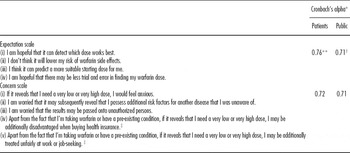
In this study, we measured attitudes as willingness to undergo WPGT (captured on a 5-point scale), expectation of benefit from WPGT, and concerns or barriers to taking WPGT. A supplementary question was included to capture reasons for being “very unwilling” to undergo WPGT. “Expectations” and “concerns” were two independent latent variables which were each measured using multiple items and were meant to measure how much respondents think WPGT can benefit them and their level of concern regarding ethical, social, or legal issues pertaining to WPGT, respectively. The items were adapted from previous studies (Reference Rogausch, Prause, Schallenberg, Brockmöller and Himmel10;Reference Chin, Tan and Lim17) or self-constructed, and were refined through pilot testing on ten warfarin patients. Participants were asked to express their agreement to the statements on a 5-point Likert scale. The items to the expectations scale were slightly modified for the public, after observations from the warfarin patients and pilot testing in the public (Table 1).
Expectation and Concern Scales and Their Internal Consistencies with Regard to WPGT

Agreement to all items was answered on a 5-point Likert scale.
*Cronbach's alpha is a measure of internal consistency.
**Calculated with item (ii) removed as it worsened the overall Cronbach's alpha when included. Cronbach's alpha was 0.60 before removal.
†Item (ii) was reversed (i.e. “I think it will lower my risk of warfarin side effects.”) and item (iii) was removed for the public.
‡A “NA” option was added to these two items as some warfarin patients do not buy insurance or work.
To ensure meaningful responses, basic information on warfarin and WPGT (including possible benefits and risks) were provided at appropriate points in the survey. True/false questions were also included to ascertain the level of understanding of the information provided and a knowledge score calculated from the sum of correct answers to these questions. After the pilot test in the public, the questions testing warfarin knowledge were dropped to shorten the survey as most patients scored well on all items.
Apart from the attitude questions, background information on warfarin intake, demographics, socio-economic status and previous history of stroke, heart attack, diabetes, and cancer were also collected from patients. Housing type was used as a proxy for socio-economic status. For the general public, questions on adverse drug reaction (ADR) history, knowledge of friends’ or relatives’ ADR history, and perception of value of a new test that could potentially decrease the number of International Normalized Ratio (INR) tests needed (should they need warfarin) were asked instead of questions on warfarin intake.
Statistical Analyses
Univariate associations between willingness to undergo WPGT and respondent characteristics were explored using the Fisher's exact test or one-way analysis of variance (ANOVA), where appropriate. Expectations and Concerns scores were computed by simple average of the item scores on each scale. Higher scores indicated higher expectations or higher concerns, respectively. Cronbach's alpha was computed as an assessment of the internal consistencies of the two scales. Item analysis (Cronbach's alpha of the scale with each item deleted in turn) was also performed to identify and eliminate any problematic items. Univariate associations between expectations and concerns with respondent characteristics were analyzed using the student's t-test, one-way ANOVA or Pearson's correlation, as appropriate. A p-value of < .05 was considered statistically significant. All analyses were performed in Stata/SE 10.0 for Windows (StataCorp LP, College Station, TX).
RESULTS
Respondents
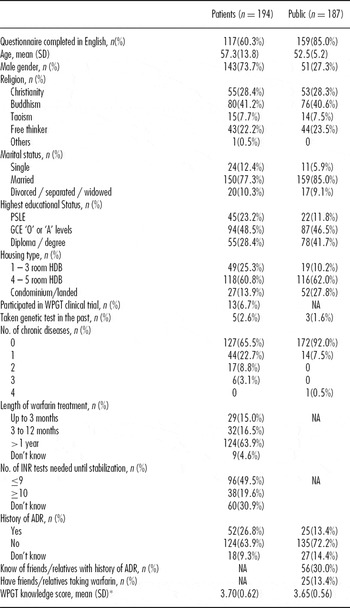
Of 580 warfarin patients approached, 413 were eligible, but only 222 consented to take part, giving a response rate of 53.8 percent. Nineteen subsequently withdrew after finding the questionnaire too difficult or tedious, and duplicate responses from three individuals were found. The second of each duplicate response was deleted. After removing another 6 cases with missing data, 194 remained for analysis. Forty-one patients (21.1 percent) needed substantial assistance in completing the questionnaire. For the general public, 224 logged into the Web survey but 17 were ineligible, 20 did not complete the survey and 187 completed the survey. Characteristics of both populations are summarized in Table 2.
Respondent Characteristics

*WPGT knowledge score ranges from 0 to 4.
PSLE, Primary School Leaving Examination (the qualification of Primary education in Singapore); GCE ‘O’ or ‘A’ levels, General Certificate of Education ‘Ordinary’ or ‘Advanced’ levels (academic qualifications in the Commonwealth countries including Singapore); HDB, Housing Development Board; NA, not applicable.
Willingness to Undergo WPGT
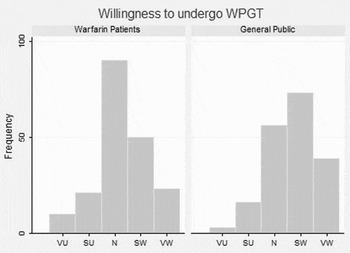
Approximately 38 percent of patients and 60 percent of the public indicated that they were “somewhat willing” or “very willing” to undergo WPGT (Figure 1). More patients were neutral (46.4 percent) compared with the public (30.0 percent). Of the ten patients and three public respondents who indicated “very unwilling,” the main reason was cost. Four also indicated being uncomfortable with a genetic test and three did not think it would benefit them. Overall, relatively few respondents (10.2 percent of public and 16.0 percent of patients) were unwilling to undergo WPGT.
Willingness to undergo WPGT in warfarin patients and general public. VU, very unwilling; SU, somewhat unwilling; N, neutral; SW, somewhat willing; VW, very willing.

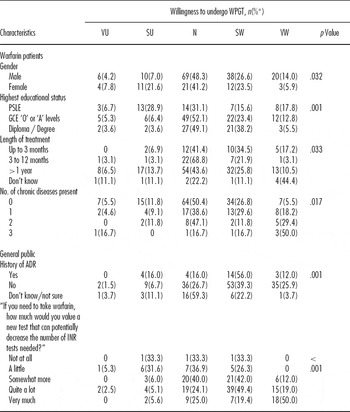
Willingness to undergo WPGT was significantly associated with gender, educational status, length of warfarin treatment, and number of chronic diseases in warfarin patients (Table 3). Willingness was higher in males, the better educated, and those with more chronic diseases, while the trend with length of treatment appears U-shaped. In the public, willingness was associated with ADR history and number of chronic diseases. Those with no ADR history were more willing to undergo WPGT, while those who were not sure tended to be neutral.
Effects of Significant Socio-demographic and Clinical Variables on Willingness to undergo WPGT

VU, Very unwilling; SU, somewhat unwilling; N, neutral; SW, somewhat willing; VW, very willing; SD, standard deviation; PSLE, Primary School Leaving Examination (the qualification of Primary education in Singapore); GCE ‘O’ or ‘A’ levels, General Certificate of Education ‘Ordinary’ or ‘Advanced’ levels (academic qualifications in the Commonwealth countries including Singapore); WPGT, warfarin pharmacogenetic testing; INR, international normalized ratio; ADR, *% are within row.
Expectations and Concerns about WPGT
The expectation and concern scales in both populations had acceptable internal consistencies (Cronbach's alpha >0.7; Table 1). The four items on the expectation scale were administered to warfarin patients but item analysis revealed item (ii) to be problematic. The direction of item (ii) was consequently reversed, and item (iii) dropped (due to similarity with item (i)) in the public survey. Both populations have relatively high expectations (mean scores 3.77 and 3.97, respectively) and moderately high concerns (mean scores 3.30 and 3.33, respectively) about WPGT (Supplementary Figure 1, which can be viewed online at http://dx.doi.org/10.1017/S026646231300069X).
Expectation of benefits from WPGT was not significantly associated with any socio-demographic or clinical variables in patients but was associated with housing type (mean[SD] score for 1–3 room HDB, 4–5 room HDB, and condominium/landed: 4.07[0.55], 3.88[0.56] and 3.97[0.44], respectively, p = .007) and the value placed in a new test that may potentially decrease the number of INR tests needed (mean[SD] score for “not at all,” “a little,” “somewhat more,” “quite a lot,” and “very much”: 2.78[0.77], 3.96[0.41], 3.75[0.55], 4.08[0.51], and 4.14[0.47], respectively, p < 0.001) in the public. Concern score was also not significantly associated with background variables in patients but was associated with housing type (mean[SD] score for 1–3 room HDB, 4–5 room HDB and condominium/landed: 3.58[0.84], 3.39[0.62], and 3.11[0.70], respectively, p = .010) and educational status (mean[SD] score for PSLE, GCE “O” or “A” levels and diploma/degree: 3.59[0.51], 3.38[0.66], and 3.20[0.73], respectively, p = .039) in the public. Higher socioeconomic status and educational status were associated with decreased level of concern about WPGT.
Relationship between Expectations and Concerns with Willingness to undergo WPGT
As hypothesized, higher expectation of WPGT was associated with higher willingness to undergo it (p < .001 in both populations). Higher concern was significantly associated with lower willingness to undergo WPGT in the public (p = .004), but not patients although a similar trend was present (p = .072).
DISCUSSION
Patients’ acceptance is an important consideration in the clinical implementation of PGT and their views on pharmacogenomics and PGT has duly been studied qualitatively and quantitatively (Reference Rogausch, Prause, Schallenberg, Brockmöller and Himmel10–Reference Haga, O'Daniel, Tindall, Lipkus and Agans14). Because attitudes may be influenced by cultural factors, results from these non-Asian studies may not be applicable to our population. To the best of our knowledge, this is the first study on attitudes on WPGT. We found that Singaporean Chinese were generally willing to undergo WPGT or were neutral about it. Unfortunately, no further information on the reason for “neutral” was captured. They also had relatively high expectations and concerns about WPGT. These results are consistent with previous studies in other populations (Reference Rogausch, Prause, Schallenberg, Brockmöller and Himmel10;Reference O'Daniel, Lucas and Deverka13;Reference Haga, O'Daniel, Tindall, Lipkus and Agans14) although no direct comparison can be made due to different question structure and analysis methods.
Patients who were males, better educated and had more chronic diseases were more willing to undergo WPGT. The relationship between chronic disease burden and willingness may be explained by a higher desire to reduce further health-related problems or inconveniences, while the relationships with gender and educational status may be related to the ability to understand the information provided and appreciate the potential benefits of WPGT. In our further analysis, those who needed substantial assistance with completing the questionnaire were generally less willing to undergo WPGT. Females and the less educated tended to need substantial assistance, so it appears that the ability to comprehend the questionnaire is a likely explanation for the observation. The reason for the observed pattern with length of treatment and willingness to undergo WPGT is also not immediately obvious. One speculation is that new patients are still overwhelmed by the inconvenience of frequent INR tests and fear of ADR, while long-term patients begin to desire relief from these burdens. If so, the anticipated duration of warfarin therapy may be the underlying factor.
In the public sample, those without ADR history tended to be more willing to undergo WPGT than those with ADR history, and those who were not sure tended to be neutral. This is in contrast to a U.S. public survey, which found that those with an ADR history were more willing to undergo PGT (Reference Haga, O'Daniel, Tindall, Lipkus and Agans14). Patients who have experienced an ADR have negative emotions and less trust toward their healthcare providers (Reference Butt, Cox, Lewis and Ferner18;Reference Lorimer, Cox and Langford19), so it is possible that some of those who experienced an ADR are now skeptical of medical interventions.
There are several limitations in this study. First, sampling was nonrandom so generalizability of the results may be limited. Second, there may be some nonresponse bias. Males were overrepresented in the patient sample while females were overrepresented in the public sample. The samples were also more highly educated than the general population (percent with diploma/degree = 28.4 percent, 41.7 percent and 22.1 percent, in patients, public sample and general population ≥40 years old) (20), respectively). Given that gender and educational status were predictors of willingness in patients, and educational status affects concern score in the public, the actual willingness to undergo WPGT may be lower, and concern level may be higher. Nevertheless, the public sample is quite comparable in terms of educational status with the general population of age 30 to 60 years old (percent with diploma/degree = 41.2 percent) (20), a group who might become future warfarin patients. With an increasingly educated population, the results may actually have future applicability. Third, we did not use any formal tools to assess cognitive function of warfarin patients during recruitment. However, it might not be practical to administer a screening tool on every potential respondent due to the time needed and the need to conduct it in an appropriate environment at an appropriate time. Fourth, approximately 20 percent of the patients had problems understanding the information presented in the questionnaire and this might have affected their responses. However, this may reflect actual clinical settings where some patients would have difficulty understanding the same information, even if explained by a doctor. In addition, this survey also contained a discrete choice experiment (DCE) designed to elicit preferences and willingness-to-pay for WPGT (results are published separately) and a large part of the difficulty seems to be due to the DCE. Lastly, we only studied the Chinese and thus could not extrapolate our results to other ethnic groups.
Health technology assessment is an increasingly important multidisciplinary field of policy analysis exploring the medical, social, ethical, and economic implications of the use of health technologies to aid in the formulation of informed and evidence-based policy decisions. In this case of WPGT, our study explored some social and ethical aspects and is a valuable contribution in informing certain policy and management decisions during its eventual implementation. Our results indicate the level of concern regarding WPGT warrants that when it does become routine clinical care in Singapore, patients should be informed of the benefits and risks of WPGT, and assured confidentiality of the results. These decisions would then impact the workflow in ordering and administration of the test, as well as the information flow in the existing physical and IT infrastructure in our healthcare system.
CONCLUSIONS
In conclusion, patient acceptance is not a major barrier to clinical implementation of WPGT. However, patient education is necessary and the ethical, social, and legal issues should be addressed in the process.
SUPPLEMENTARY MATERIAL
Supplementary Figure 1: http://dx.doi.org/10.1017/S026646231300069X
CONTACT INFORMATION
Sze Ling Chan, BSc, PhD, Saw Swee Hock School of Public Health, National University of Singapore, Singapore
Joshua Jun Wen Low, Department of Pharmacy, National University of Singapore, Singapore
Kee Seng Chia, MBBS, MSc(OM), MD, Professor and Dean, Saw Swee Hock School of Public Health, National University of Singapore, Singapore; Director, NUS-GIS Centre for Molecular Epidemiology, National University of Singapore, Singapore; Foreign Adjunct Professor, Department of Medical Epidemiology and Biostatistics, Karolinska Institutet, Stockholm, Sweden; Genome Institute of Singapore, Singapore; Yong Loo Lin School of Medicine, National University of Singapore, Singapore
Hwee-Lin Wee, BSc, PhD (phawhl@nus.edu.sg), Assistant Professor, Department of Pharmacy, National University of Singapore, Singapore; Department of Rheumatology and Immunology, Singapore General Hospital, Singapore
CONFLICTS OF INTEREST
Sze Ling Chan has received support in kind from Sawtooth Software, Inc. (free use of software for duration of study). Joshua Jun Wen Low reports a grant to his institution from National University of Singapore. Hwee Lin Wee reports having received a grant from National University of Singapore and consultancy fees from AbbVie Pte Ltd. Kee Seng Chia reports having no potential conflicts of Interest.