INTRODUCTION
Such degenerative diseases as heart disease, stroke, cancer, chronic respiratory illness, and diabetes are currently the leading causes of mortality in the world, representing approximately 63% of all deaths (WHO, 2013). It is widely acknowledged that patients who experience degenerative and chronic illness should have the opportunity to fully participate in decisions relating to their health and care (Greenhalgh, Reference Greenhalgh2009). Consequently, many governments and healthcare providers are moving away from traditional paternalistic models of healthcare, where the healthcare professional is viewed as an “expert,” toward an approach characterized by joint decision making and shared care (Department of Health, 2010; U.S. House, 2010). This “shift” will require patients to be provided with sufficient information to allow them to become knowledgeable and active contributors capable of making informed decisions about their own treatment (Greenhalgh, Reference Greenhalgh2009). However, while there is an increasing volume of material to assist in patient education, there is limited research on the most effective modes of delivery (Greenhalgh, Reference Greenhalgh2009; Wilson et al., Reference Wilson, Makoul and Bojarski2012). Although printed materials have traditionally been employed, this medium is constrained in that it is poor at conveying complex information such as explaining all the steps in a multistep procedure or demonstrating movements (Wilson et al., Reference Wilson, Makoul and Bojarski2012). The use of printed materials also assumes a level of literacy and a degree of motivation that may be lacking in some patients. Recently, such multimedia technology as DVDs, audio recordings, and the internet have been utilized to deliver healthcare information to patients, and their ease and economy of use have made them an increasingly popular choice (Jerant et al., Reference Jerant, Sohler and Fiscella2011). Multimedia interventions could deliver information and support to patients experiencing a range of degenerative conditions and may have the potential to reach a broader audience over a longer duration than traditional print materials (Jeste et al., Reference Jeste, Dunn and Folsom2008). However, there is concern that multimedia interventions are being developed without a concomitant advance in learning theory to support their design, and without fully considering how the social and organizational context may affect implementation (Angus et al., Reference Angus, Cairns and Purves2013; Riley et al., Reference Riley, Rivera and Atienza2011). For these reasons, it is important that interventions not be simply technology-led, but they should be developed and implemented with due regard for how, for whom, and in what circumstances such multimedia approaches will be effective.
METHODS
We are concerned not simply with whether or not multimedia interventions work but also how they may work within a range of contexts. Consequently, we have undertaken a realist review of the literature (Pawson et al., Reference Pawson, Greenhalgh and Harvey2005). A realist review entails a number of assumptions. First, interventions embody the theories of those who devise them about what is likely to produce a desired outcome. Second, interventions are introduced into a particular context. Context is not simply “the spatial or geographical or institutional location into which programs are embedded,” but “the prior set of social rules, norms, values, and interrelationships gathered in these places which sets limits on the efficacy of program mechanisms” (Pawson & Tilley, Reference Pawson and Tilley1997, p. 70). Third, an intervention works by providing new resources that enable people to change their behavior. These changes (i.e., outcomes) are brought about by mechanisms, by which we mean the resources or sanctions, inducements, or discouragements designed to change people's behavior in relation to a particular goal (Pawson & Manzano-Santaella, Reference Pawson and Manzano-Santaella2012). A realist review seeks to identify the underlying theories and circumstances by critically examining the interaction among context, mechanism, and outcome (characterized as CMO configurations) in a sample of identified studies (Wong et al., Reference Wong, Greenhalgh and Pawson2010). Consequently, we examined the literature not only to gauge the outcomes of interventions but also to identify their underpinning theories (whether explicit or implicit) and use of resources, the mechanisms at work, and the impact of context. We sought to conceptualize these factors in ways consistent with our realist assumptions, so that we could make recommendations to those producing and implementing multimedia psychoeducational interventions about which resources to employ, and in what contexts they would be likely to trigger mechanisms that would produce the desired outcomes (Wong et al., Reference Wong, Greenhalgh and Westhorp2013).
Review Questions
-
1. What mechanisms are triggered by multimedia psychoeducational interventions to support self-care for patients with degenerative conditions?
-
2. Which contextual factors help or hinder implementation of the interventions?
Search Strategy
Inclusion and Exclusion Criteria
Studies were included if they provided information on a multimedia psychoeducational intervention intended to support adult patients (over 18 years) with degenerative conditions. The provision of multimedia education to patients and their carers has been a relatively recent development, so only papers published between 2000 and April of 2014 were included in our review. Due to resource constraints, only abstracts written in English were considered. Studies were excluded if they focused on supporting people who were undergoing a time-limited process (e.g., surgery, investigation, temporary treatment, or side effect), as well as studies in which the multimedia intervention was delivered as a real-time intervention by another person using media as an alternative to face-to-face interaction (e.g., telemedicine interactions), as this approach allows a type of interaction not available through recorded media.
Resources Searched
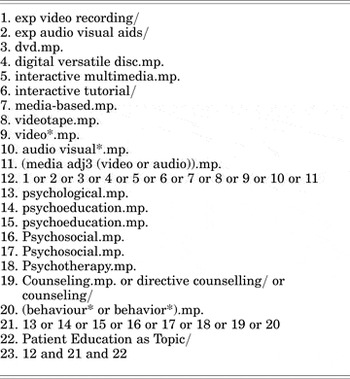
The search strategy for Medline is presented in Table 1. This was modified for use in Science Direct, PSYCHinfo, EBSCO, and Embase. We did not include search terms limited to degenerative conditions because we found including these terms led to us missing potentially relevant studies. In addition, “keyword” searches were completed on Google and Google Scholar. Further potentially relevant studies were identified from both the “hand searching” of key journals and the reference lists of all retrieved articles.
Medline search strategy

Identifying Primary Studies
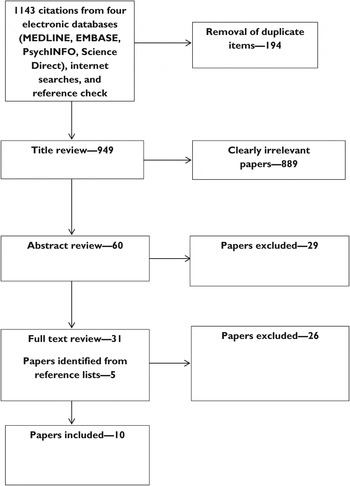
The search process identified 1143 citations (Figure 1). Removal of duplicates left a total of 949 papers. One member of the review team (DS) read the retrieved titles and removed papers that were clearly not related to the subject or to the population of interest; ambiguous titles were included for abstract screening. Some 60 relevant papers were selected for review of abstracts. The abstract review, applying inclusion and exclusion criteria, was completed by two reviewers (DS and PO), leaving a total of 31 articles to be included in a full-text review. Hand searching the reference lists of these papers identified an additional five papers that met our inclusion criteria. Thus, 36 papers were selected for full-text review using a standardized data extraction form. This form included sections related to the realist assessment, requiring the reviewer to seek information on the theoretical background of the intervention, how it was thought to work, and the characteristics of the context thought to influence outcomes. A total of 10 papers met these inclusion criteria and were subjected to further quality assessment by both reviewers.
Flowchart illustrating the search process.

Quality Appraisal
A strength of realist synthesis is that it allows a broad spectrum of studies to be included in a review, but the quality of studies is used to moderate findings. The methodological quality of each included study was assessed using the appropriate appraisal tool of the Critical Appraisal Skills Programme (Public Health Resource Unit, 1993).
Identifying Candidate Theories
Candidate theories were identified through a close reading of texts by two reviewers (DS and PO). Explicit theories were noted and, where absent, implicit theories deduced from the elements of the interventions. Data synthesis involved the two reviewers independently assessing each paper, identifying common components of interventions, and reflecting on the utility of candidate theories before coming together to discuss findings and achieve a consensus regarding the utility of each.
RESULTS
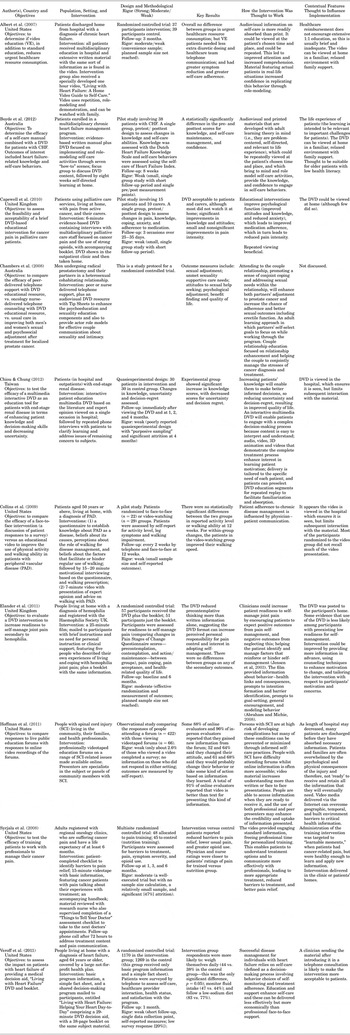
The 10 studies selected for review are summarized in Table 2 in terms of their objectives, population, intervention, design, and results, together with qualitative data on how the interventions are thought to work and how context has influenced implementation.
Summary of included studies

Intended Recipients of the Interventions
Three papers were focused on people with heart failure (Albert et al., Reference Albert, Buchsbaum and Li2007; Boyde et al., Reference Boyde, Song and Peters2013; Veroff et al., Reference Veroff, Sullivan and Shoptaw2012), two on those with cancer pain (Capewell et al., Reference Capewell, Gregory and Closs2010; Syrjala et al., Reference Syrjala, Abrams and Polissar2008), and one each on people with sexual dysfunction following radical prostatectomy (Chambers et al., Reference Chambers, Schover and Halford2008), end-stage renal disease (Chiou & Chung, Reference Chiou and Chung2012), peripheral vascular disease (Collins et al., Reference Collins, Krueger and Kroll2009), hemophilia-related joint pain (Elander et al., Reference Elander, Robinson and Morris2011), and spinal cord injury (Hoffman et al., Reference Hoffman, Salzman and Garbaccio2011).
Objectives of the Studies
The interventions evaluated in the studies were intended to reduce urgent healthcare resource consumption (Albert et al., Reference Albert, Buchsbaum and Li2007); to enhance patient knowledge and decision-making skills (Boyde et al., Reference Boyde, Song and Peters2013; Capewell et al., Reference Capewell, Gregory and Closs2010; Chiou & Chung, Reference Chiou and Chung2012; Hoffman et al., Reference Hoffman, Salzman and Garbaccio2011); to improve sexual and psychosocial adjustment after treatment for localized prostate cancer (Chambers et al., Reference Chambers, Schover and Halford2008); to increase readiness for self-care (Elander et al., Reference Elander, Robinson and Morris2011); and to improve self-management of patients' conditions (Collins et al., Reference Collins, Krueger and Kroll2009; Syrjala et al., Reference Syrjala, Abrams and Polissar2008; Veroff et al., Reference Veroff, Sullivan and Shoptaw2012). One study sought to evaluate the acceptability and feasibility of an intervention (Capewell et al., Reference Capewell, Gregory and Closs2010). Thus, the majority of studies were intended, at least in part, to lead to new self-care behaviors among participants. All completed studies showed some small effects in favor of the intervention, with some achieving statistical significance.
Multimedia Content
Multimedia content was often reported as being developed on the basis of research evidence and expert opinion (Boyde et al., Reference Boyde, Song and Peters2013; Capewell et al., Reference Capewell, Gregory and Closs2010; Chiou & Chung, Reference Chiou and Chung2012; Collins et al., Reference Collins, Krueger and Kroll2009; Hoffman et al., Reference Hoffman, Salzman and Garbaccio2011). A number of videos showed patients (or actors as patients) role-modeling desirable behaviors, while others focused on experts giving opinions. Only one of the interventions consisted entirely of audiovisual material, and this was the only intervention delivered online (Hoffman et al., Reference Hoffman, Salzman and Garbaccio2011). The remainder consisted of audiovisual content supplemented by written material (Capewell et al., Reference Capewell, Gregory and Closs2010; Elander et al., Reference Elander, Robinson and Morris2011; Veroff et al., Reference Veroff, Sullivan and Shoptaw2012), some also with professional-led face-to-face education or support (Albert et al., Reference Albert, Buchsbaum and Li2007; Boyde et al., Reference Boyde, Song and Peters2013; Collins et al., Reference Collins, Krueger and Kroll2009; Syrjala et al., Reference Syrjala, Abrams and Polissar2008) or telephone contact (Chambers et al., Reference Chambers, Schover and Halford2008; Chiou & Chung, Reference Chiou and Chung2012).
Study Designs
Included studies followed various designs. Five were randomized controlled trials (Albert et al., Reference Albert, Buchsbaum and Li2007; Collins et al., Reference Collins, Krueger and Kroll2009; Elander et al., Reference Elander, Robinson and Morris2011; Syrjala et al., Reference Syrjala, Abrams and Polissar2008; Veroff et al., Reference Veroff, Sullivan and Shoptaw2012), as was one study protocol (Chambers et al., Reference Chambers, Schover and Halford2008). Two were single-group pretest/posttest designs (Boyde et al., Reference Boyde, Song and Peters2013; Capewell et al., Reference Capewell, Gregory and Closs2010), one a quasi-experiment (Chiou & Chung, Reference Chiou and Chung2012), and another an observational study (Hoffman et al., Reference Hoffman, Salzman and Garbaccio2011). We judged three of these studies to be of moderate methodological quality (Albert et al., Reference Albert, Buchsbaum and Li2007; Elander et al., Reference Elander, Robinson and Morris2011; Syrjala et al., Reference Syrjala, Abrams and Polissar2008) and the remainder as methodologically weak.
Candidate Theories
Only three of the included studies made reference to specific theories that informed the development and implementation of their interventions. Boyde and colleagues (Reference Boyde, Song and Peters2013) referred to Knowles's (Reference Knowles1998) theory of adult learning, stating that,
Education for patients is more likely to be successful when it is based on a learning theory which recognizes the uniqueness of the adult learner. Knowles's principles of andragogy focus on the characteristics of adult learners identifying their problem-centered, self-directed approach and the importance of their previous life experiences. (p. 45)
This approach was also espoused by Chambers et al. (Reference Chambers, Schover and Halford2008) but without reference to a specific theory.
Elander and colleagues (Reference Elander, Robinson and Morris2011) developed their intervention based on Jensen et al.'s (Reference Jensen, Nielson and Kerns2003) motivational model of pain self-management. Their DVD targeted such influences on readiness to self-manage as “beliefs about costs and benefits, learning histories, experiences, contingencies, modeling, verbal persuasion, and perceived barriers to self-management” (Elander et al., Reference Elander, Robinson and Morris2011, p. 2333). Jensen and coworkers (Reference Jensen, Nielson and Kerns2003) proposed that readiness to undertake self-care is a product of a patient's beliefs regarding the importance of engagement and their self-efficacy in relation to engaging in the necessary behaviors. Veroff and coworkers (Reference Veroff, Sullivan and Shoptaw2012) referred to Riegel and Dickson (Reference Riegel and Dickson2008), who characterized self-care as a decision-making process involving behavioral choices that maintain physiological stability and the response to symptoms. Confidence about self-care is thought to mediate the effect of self-care on various outcomes.
Other papers, whether explicitly or implicitly, put forward more commonsense theories about how an intervention was thought to work. Some argued that audiovisual information was more easily understood by patients and their carers than printed materials (Albert et al., Reference Albert, Buchsbaum and Li2007; Hoffman et al., Reference Hoffman, Salzman and Garbaccio2011; Syrjala et al., Reference Syrjala, Abrams and Polissar2008). DVDs or videos were thought to be superior to face-to-face education in that they could be viewed at a time and place convenient to the viewer (Albert et al., Reference Albert, Buchsbaum and Li2007; Boyde et al., Reference Boyde, Song and Peters2013; Hoffman et al., Reference Hoffman, Salzman and Garbaccio2011), and they could be watched repeatedly (Albert et al., Reference Albert, Buchsbaum and Li2007; Boyde et al., Reference Boyde, Song and Peters2013; Capewell et al., Reference Capewell, Gregory and Closs2010; Chiou & Chung, Reference Chiou and Chung2012), thus aiding retention of the information and allowing patients to access the information at “teachable moments” (Hoffman et al., Reference Hoffman, Salzman and Garbaccio2011). A number of the audiovisual presentations featured patients in real-life situations, often role-modeling desirable self-care behaviors. This was thought to increase viewers' confidence to carry out these behaviors themselves (Albert et al., Reference Albert, Buchsbaum and Li2007; Boyde et al., Reference Boyde, Song and Peters2013; Elander et al., Reference Elander, Robinson and Morris2011; Hoffman et al., Reference Hoffman, Salzman and Garbaccio2011). Authors argued that, once viewers had gained information and confidence from the multimedia content, their anxiety about their condition and treatment would be reduced, and they would be more likely to adhere to recommended self-care behaviors (Capewell et al., Reference Capewell, Gregory and Closs2010; Chiou & Chung, Reference Chiou and Chung2012; Elander et al., Reference Elander, Robinson and Morris2011; Veroff et al., Reference Veroff, Sullivan and Shoptaw2012). Two papers argued that multimedia materials would encourage better communication between patients and physicians (Collins et al., Reference Collins, Krueger and Kroll2009), especially two-way communication (Syrjala et al., Reference Syrjala, Abrams and Polissar2008), thus leading to enhanced self-care behaviors.
Contextual Features Thought to Influence the Effectiveness of Interventions
Some authors located the need for a multimedia intervention in the characteristics of the wider healthcare context. Albert and colleagues (Reference Albert, Buchsbaum and Li2007) noted that in the United States healthcare reimbursement does not encourage extensive one-on-one education, so that it is usually brief and inadequate. Hoffman and coworkers (Reference Hoffman, Salzman and Garbaccio2011) argued that, as length of hospital stay decreases, many patients are discharged before they have absorbed the necessary information, and that patients and families are often overwhelmed by the psychological and physical consequences of the condition (in this case, a spinal injury) and therefore not ready to receive and retain all the information that they will eventually need. This contextual limitation is confirmed by authors who believe that when a multimedia intervention is available for viewing only in hospital, while this may ensure that the material is actually seen, the lack of ongoing access to the material means that patients are less likely to retain the information (Chiou & Chung, Reference Chiou and Chung2012; Collins et al., Reference Collins, Krueger and Kroll2009). On the other hand, it has been proposed that ease of access to multimedia materials allows patients to view the material at home in a relaxed atmosphere and with the support of relatives (Albert et al., Reference Albert, Buchsbaum and Li2007; Boyde et al., Reference Boyde, Song and Peters2013; Hoffman et al., Reference Hoffman, Salzman and Garbaccio2011). However, two papers that described interventions mailed to patients hypothesized that the lack of personalized contact and individualized material may have led to less use of the material and reduced impact (Elander et al., Reference Elander, Robinson and Morris2011; Veroff et al., Reference Veroff, Sullivan and Shoptaw2012). This judgment is implicitly borne out by the fact that all but three of the interventions (Elander et al., Reference Elander, Robinson and Morris2011; Hoffman et al., Reference Hoffman, Salzman and Garbaccio2011; Veroff et al., Reference Veroff, Sullivan and Shoptaw2012) included some contact (either face-to-face or by telephone) with a professional. Finally, some authors identified patient characteristics as influencing the effectiveness of their interventions. Boyde and colleagues (Reference Boyde, Song and Peters2013) argued that audiovisual materials are particularly well suited to older patients who typically have lower health literacy, while Elander et al. (Reference Elander, Robinson and Morris2011) proposed that there is some evidence that where patients have preexisting low readiness for self-care they are less likely to watch a DVD.
Synthesis of Candidate Theories
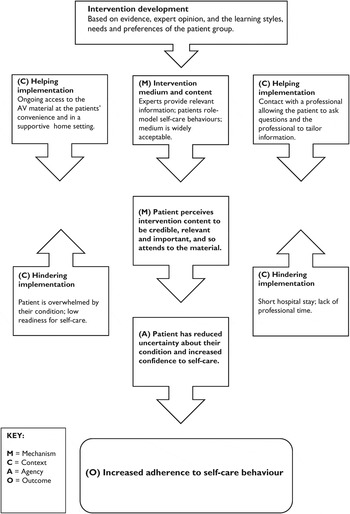
In the following section, we draw together the mechanisms (M) and contexts (C) that tend to produce the outcome (O) of increased adherence to self-care, as far as we could deduce them from the literature. It is evident that the mechanisms themselves have their effect by influencing the perceptions and motivations of individual stakeholders—a stage in the causal chain not fully recognized in the C + M = O configuration. Therefore, we have added the component of agency (A), by which we mean the cognitive, affective, and connotative micromechanisms involved in individual decision making (Bandura, Reference Bandura1997). Putting these ideas together, we can see that a multimedia intervention developed on the basis of the evidence and on what is known about the learning styles, needs, and preferences of the patient group, and which contains relevant expert opinion together with a portrayal of patients modeling self-care behaviors, is likely to be perceived by the patient as acceptable, credible, relevant, and important (M). Patients are therefore more likely to pay attention to the material, which has the potential of reducing their uncertainty and anxiety about their condition, and to increase their confidence about self-care (A), thus resulting in greater adherence to self-care behaviors (O). These processes are more likely to occur in a context where there is ongoing access to the material in a supportive home setting and where there is contact with a professional, allowing the patient to ask questions and the professional to tailor the information provided. They are less likely to occur in a context where the patient is overwhelmed by their condition and has little readiness for self-care, or when hospital stays are short and there is a lack of available professional time (C) (Figure 2).
Theoretical model of how multimedia psychoeducational interventions to support patient self-care in degenerative conditions may work.

DISCUSSION
All the completed studies showed some effects in favor of the interventions, suggesting that the use of multimedia material is potentially valuable in these patient groups. However, the effects were small, and many did not reach statistical significance, indicating a need for further work to refine these approaches. Only three included papers were judged to be methodologically strong, emphasizing the need for the further development and evaluation of such tools.
The concern that multimedia interventions are being developed without a concomitant advance in learning theory to support their design and without fully considering how the social and organizational context may affect implementation (Riley et al. Reference Riley, Rivera and Atienza2011; Angus et al. Reference Angus, Cairns and Purves2013) is partially borne out by our review. The majority of studies evinced only commonsense theories to support their use, and few provided explicit discussion of the impact of organizational or social factors.
The broader organizational context that provided part of the rationale for the interventions was reduced healthcare resources to support patient education, manifested in a sparsity of professional time and reduced length of hospital stay. Nevertheless, most interventions included some direct contact with a professional. This serves to illustrate a tension in the underlying rationale for interventions of this type, that they are often introduced as a substitute for professional time spent educating the patient (because a lack of resources in a given context means that such time is unavailable), yet may work better if they are supplemented by interaction with a professional so that information can be tailored and questions answered.
Shortened length of hospital stay feeds into this context in another way in that patients are likely to be acutely ill for the majority of their stay in the hospital and thus potentially overwhelmed by their conditions, and unreceptive to educational input from professionals even if this is available. Healthcare providers will need to consider carefully how such multimedia interventions are delivered within the available resources in order to strike an optimal balance between cost and effectiveness.
The mechanisms at the heart of the interventions underline the importance of a patient-centered approach to the development and presentation of multimedia content—including involving patients and their relatives in the creation of interventions—and the significance of agency in achieving changes in behavior. Unless the multimedia material engages the patient's attention and proves credible, relevant, and important, it cannot exert any effect. And if the material does not reduce uncertainty about a patient's condition and increase their confidence to attempt self-care, it will not change the patient's behavior. Role-modeling of the desired behaviors by patients (or actors) appears to be particularly important in this respect.
CONCLUSIONS AND RECOMMENDATIONS
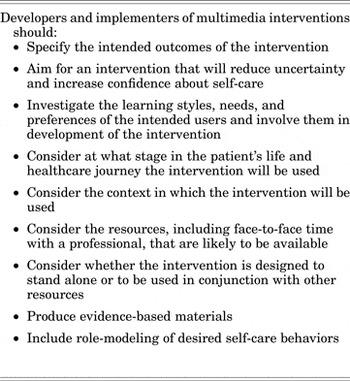
Multimedia interventions may provide high-quality standardized information in an accessible and interesting format, with the potential of producing a change in self-care behavior among patients with degenerative conditions. This change in behavior is mediated by the patient perceiving the information as credible, relevant, and important, and developing the confidence to carry out self-care practices. However, the evidence for efficacy is generally weak and the effects relatively small. Further research is needed to investigate the most effective mode of delivery for this information at different levels of resource. Meanwhile, we recommend that those producing multimedia interventions for patients with degenerative conditions take the mechanisms and contextual issues we have identified into account when developing and implementing their materials (Table 3).
Recommendations for the development and implementation of multimedia interventions for patients with degenerative conditions

ACKNOWLEDGMENTS
This review was supported by funding from the All-Ireland Institute for Hospice and Palliative Care.