Implications
Feeding excess protein and fat in the form of dried distillers grains with solubles to beef cows from calving until mid-lactation did not affect post-weaning gain of steer progeny or insulin sensitivity; however, marbling at slaughter was decreased in steers whose dams were fed dried distillers grains with solubles.
Introduction
Dried distillers grains with solubles are rich in both protein and polyunsaturated fats and can be an economic alternative to corn in ruminant diets. We have demonstrated that utilizing DDGS as a primary energy source is an effective strategy to meet the energy needs of beef cows when grass and/or baled hay alone do not adequately meet the increased nutritional demands of beef cows during the last trimester of pregnancy (Gunn et al., Reference Gunn, Schoonmaker, Lemenager and Bridges2014) or during lactation (Shee et al., Reference Shee, Lemenager and Schoonmaker2016). Limiting high concentrations of dietary dried distillers grains with solubles (DDGS) to lactation diets avoids problems with dystocia that have been noted for cows fed elevated DDGS during late gestation (Gunn et al., Reference Gunn, Schoonmaker, Lemenager and Bridges2014) and still enhances pre-weaning progeny growth (Shee et al., Reference Shee, Lemenager and Schoonmaker2016).
Enhanced pre-weaning growth of progeny from cows fed DDGS during early lactation was attributed to increased long-chain fatty acids (LCFA), polyunsaturated fatty acids (PUFA) and/or urea nitrogen in the dam’s milk (Gunn et al., Reference Gunn, Schoonmaker, Lemenager and Bridges2014; Shee et al., Reference Shee, Lemenager and Schoonmaker2016). Supplementation of lactating ewes with fish oil has been reported to increase milk PUFA content and increase lamb progeny growth (Ferreira et al., Reference Ferreira, Pires, Susin, Gentil, Gilaverte, Parente, Biehl and Ribeiro2014). Elevating levels of specific FA (C4 : 0, C8 : 0, C10 : 0, C12 : 0, C14 : 0, C18 : 3) in milk replacers for Holstein calves resulted in more efficient growth and higher rates of gain and fewer reports of scours (Hill et al., Reference Hill, Aldrich, Schlotterbeck and Bateman2007). Research in dairy calves fed milk replacer (Amos, Reference Amos1986) and suckling beef calves (Lardy and Maddock, Reference Lardy and Maddock2007) indicate that supplemental protein can improve calf performance. Thus, increased milk urea nitrogen in milk of cows fed DDGS may have also contributed to increased gains in progeny compared with progeny from cows fed corn silage and hay (Shee et al., Reference Shee, Lemenager and Schoonmaker2016), as a portion of nitrogen requirements for nursing calves can be met by urea as early as 6 weeks of age (Brown et al., Reference Brown, Lassiter, Everett and Rust1956). With respect to body composition, increasing the percentage of milk replacer protein fed to dairy calves has been demonstrated to increase body protein and decrease adiposity compared with lower levels of protein (Donnelly and Hutton, Reference Donnelly and Hutton1976; Diaz et al., Reference Diaz, Van Amburgh, Smith, JKelsey and Hutten2001).
Long-term growth and carcass composition of the progeny are sensitive to the prevailing concentrations of IGFs, glucose, insulin and glucocortiocoids, which in turn are impacted by the nutritional environment. Previous studies investigating the effect of maternal DDGS on insulin sensitivity of progeny later in life are contradictory (Radunz et al., Reference Radunz, Fluharty, Zerby and Loerch2012; Wilson et al., Reference Wilson, Long, Faulkner and Shike2016; Gunn et al., Reference Gunn, Bridges, Lemenager and Schoonmaker2017). However, long-chain n-3 PUFA have been reported to improve insulin sensitivity in cattle, which subsequently decreased protein breakdown and amino acid oxidation (Gingras et al., Reference Gingras, White, Chouinard, Julien, Davis, Dombrowski, Conture, Dubreuil, Myre, Bergeron, Marette and Thrivierge2007). In addition, feeding excess dietary protein to dams during gestation has been shown to increase circulating progeny IGF-1 (Micke et al., Reference Micke, Sullivan, Gatford, Owens and Perry2010).
Although it has been reported that feeding DDGS during lactation to beef cows increases pre-weaning progeny performance (Shee et al., Reference Shee, Lemenager and Schoonmaker2016), the long-term developmental and metabolic consequences of this increased intake of urea N, LCFA and PUFA from milk in progeny is unclear. Our hypothesis was that feeding DDGS to dams from calving until mid-lactation would have a long-term positive impact on metabolism and improve the post-weaning performance and carcass composition of the offspring. Our objective was to characterize feedlot performance, glucose tolerance and carcass characteristics of the progeny whose dams were fed DDGS from calving until mid-lactation.
Material and methods
The study was conducted at the Purdue Animal Sciences Research and Education Center in West Lafayette, IN. Research followed guidelines in the Guide for the Care and Use of Agricultural Animals in Agricultural Research and Teaching (Federation of Animal Science Societies, 2010) and were approved by the Purdue Animal Care and Use Committee.
Animals and diets
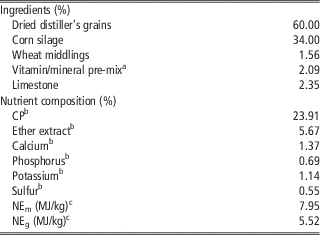
Angus×Simmental cows (n=54) were used in a complete randomized design to determine effects of maternal nutrition from calving until mid-lactation on progeny post-weaning growth and carcass composition of male progeny. The study was conducted at the Purdue Animal Sciences Research and Education Center in West Lafayette, Indiana. A detailed description of diets and dietary formulation for the dams can be found in a companion paper (Shee et al., Reference Shee, Lemenager and Schoonmaker2016). In brief, cows were fed diets supplemented with either DDGS (DDGS; n=27) or soybean meal (CON; n=27) from calving to 129 days postpartum. Cow–calf pairs were allocated to treatment groups within 24 h of birth by cow and calf BW, breed percentage and age to one of two treatments. Cow diets were formulated using the National Research Council (NRC) (2000) for a beef cow in early lactation. Cows fed the CON diet were fed 137%, 100% and 121% of their protein, NEm, and NEg requirements, respectively. Cows fed the DDGS diet were fed 195%, 100% and 138% of their protein, NEm and NEg requirements, respectively. All diets were formulated using individual ingredient chemical composition analysis obtained by wet chemistry methods before the start of the trial (Association of Official Analytical Chemists (AOAC), 1990; Sure-Tech Laboratories, Indianapolis, IN, USA). Maternal diets were designed to be isocaloric (3.97 MJ/kg NEg) but differed in CP (11.7% and 19.4% of diet dry matter (DM) for CON and DDGS) and fat (2.06% and 8.76% of diet DM for CON and DDGS) content. Thus protein and fat concentration in the maternal diet were confounded. After conclusion of the treatments, cow–calf pairs were comingled and treated as one group until weaning at 219 days postpartum. From weaning until 255 days postpartum, calves continued to be managed as one group and were adapted to feedlot diets until feedlot entry when 48 calves were placed in individual pens (2.7×1.5 m) in a curtain-sided, slatted-floor finishing barn.
At feedlot entry, steers were vaccinated against bovine rhinotracheitis, bovine viral diarrhea, parainfluenza-3, bovine respiratory syncitial virus (Bovi-Shield Gold FP5®; Zoetis, Florham Park, NJ, USA), Haemophilus somnus, Pasteurella and Clostridia (Vision-7 Somnus; Merck Animal Health, Summit, NJ, USA), treated with an anthelmintic (Valbazen®; Zoetis) for internal and external parasites, and implanted with Revalor-XS® (4 mg estradiol and 20 mg trenbolone acetate; provided courtesy of Merck Animal Health). A finishing diet composed of 60% DDGS, 34% corn silage and 6% vitamin/mineral supplement (DM basis, Table 1) was fed to all steers for the duration of the study. The diet was formulated to meet the requirements for protein, energy, vitamins, and minerals of a finishing steer with and average mid-point weight of 470 kg gaining 1.9 kg/d (NRC, 2000). Feed was offered for ad libitum consumption once daily at 0800 h and steers had free access to water. Ad libitum intake was determined based on the South Dakota State University four-point bunk scoring system (Pritchard, Reference Pritchard1993) with cattle fed to leave minimal refusal at morning bunk check. Individual feed intake was recorded daily. Feed refusals were weighed and discarded. Individual feed ingredients were collected bi-weekly and dried in a forced air oven at 60°C for 72 h for analysis of DM. Subsequently, bi-weekly feed samples were subsampled, composited and analyzed for chemical composition by wet chemistry methods (AOAC, 1990).
Diet and nutrient composition of steer finishing diet (dry matter (DM) basis)

a Vitamin/mineral pre-mix contained (DM basis): 27.22% Ca, 0.44% Mg, 2.68% K, 0.25% S, 7.31 ppm Co, 658.76 ppm Cu, 33.36 ppm I, 751.09 ppm Fe, 0.13% Mn, 17.08 ppm Se, 0.19% Zn, 130 IU/g vitamin A, 18 IU/g vitamin D, 584 IU/kg vitamin E, 0.98% Rumensin (176.4 g/kg; Elanco Animal Health, Greenfield, IN, USA), 0.52% Tylan (88.2 g/kg; Elanco Animal Health).
b Analyzed composition.
c Calculated composition.
Post-weaning growth, feedlot performance and carcass data
Initial and final BW of calves was determined by averaging individual pre-prandial weights obtained on 2 consecutive days. Individual pre-prandial BW was taken monthly to monitor feedlot performance. All steers were shipped 400 km and slaughtered at a commercial abattoir (Tyson, Joslin, IL, USA) when a target BW of 645±5.3 kg was achieved. Hot carcass weight was recorded immediately following evisceration. Following a 24-h chill, 12th rib fat thickness, longissimus (LM) area, kidney pelvic heart fat (KPH), yield grades, marbling scores and United States Department of Agriculture quality grades were determined by trained personnel. Dressing percent was calculated by taking hot carcass weight divided by the average final live (unshrunk) BW taken on 2 consecutive days before shipment.
Intravenous glucose tolerance test
An intravenous glucose tolerance test (IVGTT) was performed at 134 and 139 days after feedlot entry. Steers were chosen for the IVGTT based on BW, such that the average BW of the steers chosen was equal to the treatment average BW. Treatments were equally represented on both days, however, blood could not be collected from two CON steers (DDGS=9, CON=7). Steers were removed from feed 12 h before the IVGTT but had ad libitum access to water. The morning of the IVGTT, steers were weighed to determine the bolus dose (0.25 g of glucose/kg of BW) which was delivered in a 50% dextrose solution (Agripharm Products, Westlake, TX, USA). Jugular catheters (Hospira, Inc., Lake Forest, IL, USA) were inserted, secured, and a 3.5% sterile solution of sodium citrate was injected into the catheter line to prevent clotting. Steers were immediately placed in stalls and allowed ~2 h to adapt. Blood samples were collected in tubes containing 15 mg Sodium Fluoride and 12 mg Potassium Oxalate (BD Vacutainer; Becton-Dickinson, Franklin Lakes, NJ, USA) at 10 and 5 min before glucose infusion, and 2, 5, 10, 15, 20, 25, 30, 45, 60, 75, 90 and 120 min after glucose infusion. At each timepoint, a 5-ml sample was removed and discarded to clear the catheter line of sodium citrate before blood samples were taken. After collection, blood samples were inverted then placed on ice until they were centrifuged at 3000×g for 20 min at 4°C. Plasma was separated into two aliquots and placed into storage at −20°C within 30 min until analysis.
Plasma samples from the IVGTT were analyzed for insulin using a commercially available radioimmunoassay kit (Coat-A-Count Insulin; Siemens Medical Solutions USA Inc., Malvern, PA, USA). Plasma samples were measured for insulin in a gamma counter (Cobra II Auto-Gamma; Packard Instrument Co., Downers Grove, IL, USA). Glucose concentrations were determined by way of Glucose Liquicolor (Enzymatic) Procedure No. 1070 (Stanbio Laboratory, Boerne, TX, USA). The glucose procedure was modified and used a standard curve of 0, 31.25, 62.5, 125, 250 and 500 mg/dl that was created using a 500 mg/dl glucose standard. Glucose samples were read in ninety-six well polystyrene plates at 495 nm in an Opsys MR microplate reader (Dynex Technologies Inc., Chantilly, VA, USA). The intra-assay CVs were 5.07% and 1.45%, and the inter-assay CVs were 3.5% and 27.3% for glucose and insulin, respectively, for pooled serum samples.
Statistical analysis
Steer performance and IVGTT data were analyzed using the MIXED procedure of SAS for repeated measures (Version 8.0; SAS Institute Inc., Cary, NC, USA). The covariance structures autoregressive order one, heterogeneous autoregressive order one, unstructured and compound symmetric were compared and the covariance structure with the smallest Bayesian information criterion was chosen for analysis of results. For repeated measures, the model included the fixed effects of treatment and day or time, as well as the appropriate treatment×day or time interaction and the simple effects within day were generated using the SLICE function of SAS. Days on feed and carcass characteristics were analyzed using the MIXED procedure of SAS as a completely randomized design. Percent choice and select were analyzed using the GLIMMIX procedure of SAS. The model included the fixed effect of treatment. Animal served as the experimental unit. For all variables analyzed, P⩽0.05 was identified as significant, whereas 0.05>P⩽0.10 was identified as a tendency approaching significance.
Results and discussion
Post-weaning growth and feedlot performance
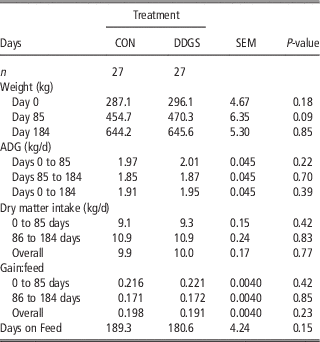
Shee et al. (Reference Shee, Lemenager and Schoonmaker2016) demonstrated that steers whose dams were fed DDGS in this study were heavier than steers whose dams were fed CON at the termination of dietary treatments (129 days of age) and at weaning (219 days of age). The same steers in the present study did not differ in weight upon entry into the feedlot (P=0.18) and tended to be heavier on d 85 of feedlot finishing (P=0.09; Table 2). However, there were no differences in final weight, average daily gain, dry matter intake or gain:feed (P⩾0.22) or days on feed (P=0.15), despite a mean difference of 9 days in favor of DDGS steers. It is unclear why feedlot entry weights in the present study did not differ, but it appears that a weight difference was maintained through day 85 of the feedlot finishing period. Radunz et al. (Reference Radunz, Fluharty, Susin, Felix, Zerby and Loerch2011b) observed that limit-feeding ewes DDGS or corn from mid-gestation until parturition had no effect on pre-weaning progeny performance, but progeny from ewes fed DDGS were heavier at slaughter than those from dams fed haylage (Radunz et al., Reference Radunz, Fluharty, Relling, Felix, Shoup, Zerby and Loerch2011a). In addition, when DDGS+corn stover was fed to 2-year-old cows from late gestation through early lactation, female progeny were heavier at puberty at 1 year of age compared with female progeny from cows fed corn silage and grass haylage (Gunn et al., Reference Gunn, Schoonmaker, Lemenager and Bridges2015). In contrast, when DDGS was fed to cows only during late gestation (Radunz et al., Reference Radunz, Fluharty, Zerby and Loerch2012; Wilson et al., Reference Wilson, Long, Faulkner and Shike2016) there were no differences in weight or performance of calves in the feedlot or at slaughter compared with calves whose dams were fed hay or limit-fed corn. When DDGS+corn stover was fed from late gestation through early lactation it was observed that calves were heavier at weaning compared with calves whose dams were fed corn silage and grass haylage, but there were no differences in weight of male progeny in the feedlot or at slaughter (Gunn et al., Reference Gunn, Bridges, Lemenager and Schoonmaker2017).
Effect of maternal diet from calving until mid-lactation on feedlot performance of steer progeny

ADG=average daily gain; CON=soybean meal supplemented as a protein source in dam’s diets; DDGS=dried distiller’s grains with solubles used as a protein and energy source in dam’s diets.
Shee et al. (Reference Shee, Lemenager and Schoonmaker2016) attributed greater weights in pre-weaned calves from dams fed DDGS to the elevated concentrations of PUFA and/or milk urea nitrogen observed. Supplementation of lactating ewes with fish oil was reported to increase milk PUFA content and to increase lamb progeny growth (Ferreira et al., Reference Ferreira, Pires, Susin, Gentil, Gilaverte, Parente, Biehl and Ribeiro2014). Elevating levels of specific fatty acids (C4 : 0, C8 : 0, C10 : 0, C12 : 0, C14 : 0, C18 : 3) in milk replacers for Holstein calves resulted in more efficient growth and higher rates of gain and fewer reports of scours (Hill et al., Reference Hill, Aldrich, Schlotterbeck and Bateman2007). Research in dairy calves fed milk replacer (Amos, Reference Amos1986) and suckling beef calves (Lardy and Maddock, Reference Lardy and Maddock2007) indicate that supplemental protein can improve calf performance. With respect to body composition, increasing the percentage of milk replacer protein fed to dairy calves has been demonstrated to increase body protein and decrease adiposity compared with lower levels of protein (Donnelly and Hutton, Reference Donnelly and Hutton1976; Diaz et al., Reference Diaz, Van Amburgh, Smith, JKelsey and Hutten2001).
Glucose tolerance test
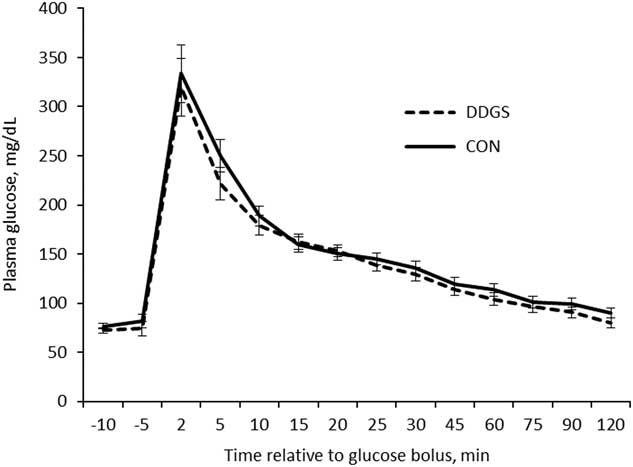
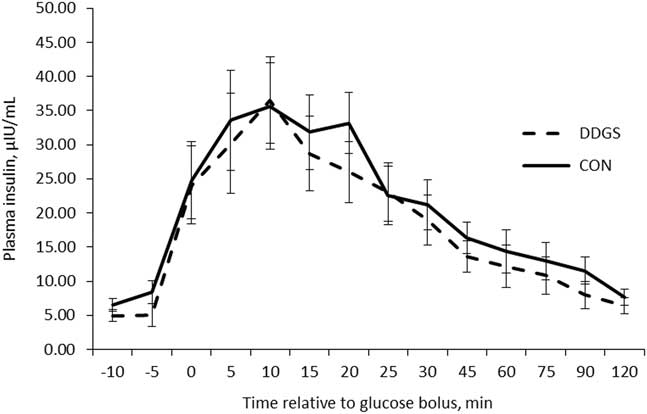
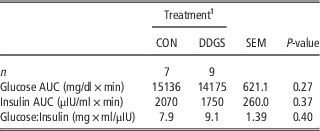
Steers in the current study whose dams were fed DDGS were exposed to greater concentrations of milk PUFAs (Shee et al., Reference Shee, Lemenager and Schoonmaker2016). Polyunsaturated fatty acids can improve insulin sensitivity through changes in membrane composition, the formation of secondary messengers, and through alterations in gene transcription (Gingras et al., Reference Gingras, White, Chouinard, Julien, Davis, Dombrowski, Conture, Dubreuil, Myre, Bergeron, Marette and Thrivierge2007). However, maternal diet in the current study had no effect on glucose clearance (P⩾0.17; Figure 1) or insulin secretion (P⩾0.16; Figure 2) as measured by the IVGTT. Glucose (P=0.27) and insulin (P=0.37) area under the curve did not differ between treatments (Table 3), nor did the glucose to insulin ratio (P=0.40). These data agree with that of Radunz et al. (Reference Radunz, Fluharty, Zerby and Loerch2012) and Gunn et al. (Reference Gunn, Bridges, Lemenager and Schoonmaker2017). Radunz et al. (Reference Radunz, Fluharty, Zerby and Loerch2012) observed no differences in glucose clearance or insulin sensitivity to an IVGTT when steers’ dams were fed DDGS during late gestation compared with steers whose dams were fed hay or limit-fed corn. Gunn et al. (Reference Gunn, Schoonmaker, Lemenager and Bridges2014) also noted no differences in glucose clearance or insulin sensitivity in steer progeny of cows fed DDGS+corn stover during late gestation through early lactation compared with steers whose dams were fed corn silage+grass haylage. In contrast, Wilson et al. (Reference Wilson, Long, Faulkner and Shike2016) observed that progeny from cows fed a diet of DDGS, corn bran and cornstalks from late gestation until parturition had decreased post-feeding glucose and insulin concentrations and insulin to glucose ratio at slaughter compared with progeny from cows fed hay, suggesting improved insulin sensitivity because of DDGS.
Plasma glucose concentration before and after infusion of glucose bolus 134 days after feedlot entry from steers whose dams were fed soybean meal (CON, n=7) or dried distiller’s grains with solubles (DDGS, n=9) from calving until mid-lactation. Circulating glucose concentration P-values were ⩾0.17 for individual time points and treatment×time P=0.99. Greatest SEM=15.94.

Circulating insulin concentration before and after infusion of glucose bolus 134 days after feedlot entry from steers whose dams were fed soybean meal (CON, n=7) or dried distiller’s grains with solubles (DDGS, n=9) from calving until mid-lactation. Circulating insulin concentration P-values were ⩾0.16 for individual time points and treatment×time P=0.99. Greatest SEM=7.129.

Effect of maternal diet from calving until mid-lactation on offspring glucose area under the curve (AUC), insulin area under the curve and glucose to insulin ratio

CON=soybean meal supplemented as a protein source in dam’s diets; DDGS=dried distiller’s grains with solubles used as a protein and energy source in dam’s diets.
1 AUC were calculated as described by Cardoso et al. (Reference Cardoso, Sears, LeBlanc and Drackley2011) using the positive incremental trapezoidal rule.
Carcass characteristics
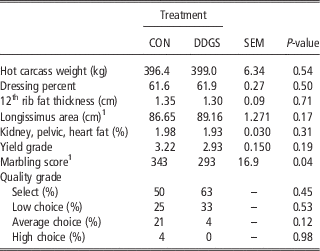
Carcass characteristics are presented in Table 4. Hot carcass weight (P=0.54), dressing percent (P=0.50) and LM area (P=0.17) were not altered by maternal treatment. Kidney, pelvic, and heart fat % (P=0.31), 12th rib fat thickness (P=0.71) and yield grade (P=0.19) did not differ between treatments; but, marbling score (P=0.04) was decreased by maternal feeding of DDGS. The decrease in marbling did not influence the percentage of steers that graded choice and better (P=0.39). Wilson et al. (Reference Wilson, Long, Faulkner and Shike2016) demonstrated that steer progeny from cows fed a diet of DDGS, corn bran and cornstalks from late gestation until parturition had increased 12th rib fat thickness and KPH compared with steer progeny from cows fed hay. Previous studies have observed no differences in marbling or quality grades in progeny whose cows were fed DDGS during late gestation compared with hay or limit-fed corn (Radunz et al., Reference Radunz, Fluharty, Zerby and Loerch2012; Wilson et al., Reference Wilson, Long, Faulkner and Shike2016) or when fed DDGS+stover from late gestation through early lactation compared with a diet of corn silage and grass haylage (Gunn et al., Reference Gunn, Bridges, Lemenager and Schoonmaker2017). The finishing diet in the present study contained 60% DDGS, whereas previous studies (Radunz et al., Reference Radunz, Fluharty, Zerby and Loerch2012; Gunn et al., Reference Gunn, Bridges, Lemenager and Schoonmaker2017) removed DDGS from the finishing diet or fed lower concentrations (45%) in the finishing diet (Wilson et al., Reference Wilson, Long, Faulkner and Shike2016). Dried distiller’s grains with solubles has been shown to decrease marbling deposition when fed above 29% DDGS (Depenbusch et al., Reference Depenbusch, Coleman, Higgins and Drouillard2009; Schoonmaker et al., Reference Schoonmaker, Trenkle and Beitz2010) and exposure to DDGS before finishing with a DDGS-based diet may compound any negative effects DDGS in the finishing period has on marbling. Dried distiller’s grains with solubles is much lower in starch (Schoonmaker et al., Reference Schoonmaker, Trenkle and Beitz2010), which when fermented to propionate is the primary precursor for glucose and intramuscular fat deposition.
Effect of maternal diet from calving until mid-lactation on steer carcass characteristics and yield grade

CON=soybean meal supplemented as a protein source in dam’s diets; DDGS=dried distiller’s grains with solubles used as a protein and energy source in dam’s diets.
1 USDA marbling scores: 200 to 299=slight; 300 to 399=small; 400 to 499=modest; 500 to 599=moderate.
It is also plausible that the greater levels of PUFA and CLA or urea nitrogen in the milk of DDGS-fed cows compared with control cows (Shee et al., Reference Shee, Lemenager and Schoonmaker2016) altered body composition of DDGS-fed progeny in such a way that hindered adipose development. Paradis et al. (Reference Paradis, Berthiaume, Lafrenière, Gervais and Chouinard2008) observed an increase in the CLA content of subcutaneous adipose tissue of suckling beef calves when milk contained higher levels of CLA due to maternal supplementation of raw v. extruded soybeans. This increase in tissue composition of CLA or n-3 fatty acids could potentially impact marbling as Smith et al. (Reference Smith, Gill, Lunt and Brooks2009) reported that n-3 fatty acids and CLA inhibit bovine adipocyte growth. Gunn et al. (Reference Gunn, Schoonmaker, Lemenager and Bridges2014) also supplemented maternal diets with DDGS and reported an increase in milk CLA and PUFA concentration compared with milk from cows fed corn silage and haylage; however, Gunn et al. (Reference Gunn, Bridges, Lemenager and Schoonmaker2017) did not report altered total PUFA content in progeny muscle at slaughter, and in contrast to the present study, observed no differences in marbling at slaughter. In addition, feeding diets that exceed protein requirements have the potential to increase carcass leanness, alter the partitioning of fat, and increase carcass weights in cattle, as has been documented in the swine industry (Chen et al., Reference Chen, Lewis, Miller and Yen1999).
Gunn et al. (Reference Gunn, Bridges, Lemenager and Schoonmaker2017) reported that dressing percentage tended to be greater in steers whose dams were fed DDGS+corn stover during late gestation and early lactation compared with steers whose dams were fed corn silage and haylage. The increase in dressing percentage reported by Gunn et al. (Reference Gunn, Bridges, Lemenager and Schoonmaker2017) was due to an 11 kg increase in HCW of the DDGS steers, and indicates that maternal DDGS may have programmed progeny to partition energy from non-carcass to carcass components. Schoonmaker et al. (Reference Schoonmaker, Claeys and Lemenager2013) reported a similar effect of DDGS on carcass weight and dressing percentage when DDGS was fed to early weaned steers from 134 to 223 days of age. In contrast, Radunz et al. (Reference Radunz, Fluharty, Zerby and Loerch2012) observed an 11 kg decrease in HCW and a decrease in dressing percentage in progeny when dams were fed DDGS compared with hay or limit-fed corn during late gestation. Dressing percentage was also decreased in progeny of ewes fed DDGS from mid-gestation until parturition compared with progeny from ewes fed either haylage or limit-fed corn and haylage (Radunz et al., Reference Radunz, Fluharty, Relling, Felix, Shoup, Zerby and Loerch2011a). Wilson (2016) observed no effect of maternal diet on progeny HCW when cows were fed hay or a diet of DDGS, corn bran and cornstalks from late gestation until parturition.
In conclusion, feeding DDGS to dams from calving until mid-lactation did not alter feedlot performance. Average daily gain, intake, gain:feed and the number of days for progeny to reach a targeted slaughter weight did not differ. Marbling was decreased in steers whose dams were fed DDGS, but other carcass characteristics were not impacted. Potential negative effects of early DDGS exposure on intramuscular fat development may materialize when diets that contain high amounts of DDGS are fed during the finishing phase.
Acknowledgments
Appreciation is extended to the employees of the Purdue Beef Research and Teaching Center for help in conducting this research.