

Introduction
Researchers in the United States have long been interested in the effects of negative election campaigning on vote choice, information recall and citizen attitudes towards democracy. As a result, they have generated a fairly robust set of findings on these issues in the American context. Richard Lau and his colleagues’ meta-analysis (2007) of 111 published studies on this topic, for instance, found that contrary to popular belief negative campaigning was not an effective strategy for winning votes. It did, however, sometimes increase campaign knowledge and interest among citizens during elections. Since that meta-analysis, researchers have focused on determining whether there are exceptions to these general findings (see Fridkin and Kenney, Reference Fridkin and Kenney2011; Krupnikov, Reference Krupnikov2014; Krupnikov and Bauer, Reference Krupnikov and Bauer2014; Krupnikov and Piston, Reference Krupnikov and Piston2015; Marks et al., Reference Marks, Manning and Ajzen2012; Wu and Dahmen, Reference Wu and Dahmen2010).
Although the American literature is fairly large and well-developed, the scholarship on negative campaigning in multiparty settings is much less so. There have been some experimental and non-experimental studies that have focused on these issues in some European countries, such as the Netherlands (Walter, Reference Walter2012; Walter and Vliegenthart, Reference Walter and Vliegenthart2010), Switzerland (Nai, Reference Nai2013), Germany (Walter et al., Reference Walter, van der Brug and van Praag2013) and Denmark (Hansen and Pedersen, Reference Hansen and Pedersen2008), but these studies are the exception rather than the rule. Similarly, few studies have looked at negative campaigning in Westminster parliamentary democracies, many of which are multiparty systems (see Daignault et al., Reference Daignault, Soroka and Giasson2013; Haddock and Zanna, Reference Haddock and Zanna1997; Jerit, Reference Jerit2004).
This lacuna in the literature is surprising because politicians and strategists in these countries regularly use and believe that negative campaign messages and strategies are crucial for winning elections (Flanagan, Reference Flanagan2014). According to influential newspaper columnist Jeffrey Simpson (Reference Simpson2011), “Attack ads work. And as long as they work, parties will use them.” Similarly, in British Columbia, the New Democratic Party (NDP) suffered a major defeat in the 2013 provincial election, prompting then-NDP campaign director Brian Topp to argue that the party needed to run “a more aggressive, bloody-minded campaign” in the next election (Culbert, Reference Culbert2013). The rise of the federal Conservative Party of Canada (CPC) under the leadership of Stephen Harper has also been partly attributed to its increased use of attack ads. According to Tom Flanagan (Reference Flanagan2007: 285), who was CPC national campaign manager in 2004 and senior communications advisor from 2005 to 2006, “the Conservatives were ambivalent about playing hardball in 2004. Because we feared that negative ads might feed into the ‘scary’ image that the Liberals had pinned on Harper, we made whimsical ads such as ‘Carousel’ and ‘Cookie Jar.’ In 2006, however, Conservative advertising went for the jugular with an unflattering picture of [Prime Minister] Paul Martin, and it paid off.” Since then, the CPC's strategy has continued to rely heavily on running “hard-hitting, fact-based negative ads; and [to] do whatever is legally possible to jam our opponents’ communications and disrupt their operations” (Flanagan, Reference Flanagan2007: 285; Flanagan, Reference Flanagan2014).
In short, negative campaigning has become a major feature in at least some multiparty political systems and yet relatively little research has been published on its effects. This lack of research is problematic because the findings and assumptions found in the American literature, based on a two-candidate or two-party race, may not easily translate to countries like Canada where voters are often presented with three or more candidates at election time. In two-party races, the outcomes are relatively easy to predict. Negative ads will either decrease or increase support for the attacker or the target. But what happens in a multiparty system if one or more parties run a negative campaign while others maintain a more positive message? How do voters respond to differing campaign tones within a multiparty context? Adding additional parties or candidates increases the complexity of the potential effects, making it difficult to translate the findings of the American literature to multiparty systems. Given that many countries use multiparty systems and given the increased use of negative campaigning in some of these contexts, such as in Canada, more research is needed into the dynamics of negative campaigning and vote choice in settings where voters are confronted with more complex combinations of parties running negative-positive election campaigns.
In this paper, we contribute to the literature by analyzing original data collected from an online voting experiment to answer two sets of questions related to negative campaigning in a multiparty context. First, to what extent does the attention and vote share a candidate receives vary according to the tone (positive/negative) of his or her election campaign? Second, does a candidate's vote share and the attention he or she receives change depending on the tone of the other candidates’ campaigns?
Going Negative: Conceptual and Theoretical Considerations
Generally speaking, studies of negative election campaigns have tended to focus less on the nature of the attack (such as issue-based attacks versus character-based ones) and more on the overall tone of the campaigns being waged by the candidates and/or parties (Lau et al., Reference Lau, Sigelman and Rovner2007). In John Geer's influential book, for instance, he defines negativity as “any criticism leveled by one candidate against another during a campaign” (Reference Geer2006: 23). Following his work, the literature has tended to define a negative campaign in two ways. One body of scholarship has tended to favour a directional definition, conceptualizing “negativity” in broad terms as any election campaign in which a candidate or a party criticizes an opponent rather than emphasizing its own positive aspects (Curini and Martelli, Reference Curini and Martelli2010: 636; Hansen and Pedersen, Reference Hansen and Pedersen2008: 409; Nai, Reference Nai2013: 44). These criticisms usually focus on a candidate's personal traits and characteristics, or a candidate's or political party's policies, ideas, and voting record (Lau and Rovner, Reference Lau and Rovner2009: 286). In this sense, negative campaigning is directional in that the candidates or parties use negativity in hopes of attracting support for themselves and diminishing support for their opponents (Walter and van der Brug, Reference Walter and van der Brug2013).
Other researchers have conceptualized negative campaigns more narrowly in an evaluative manner. For these scholars, negativity is defined as including only “those critiques that are unfair, illegitimate, dishonest and deal with trivial issues” (Walter and van der Brug, Reference Walter and van der Brug2013: 3). To be classified as negative, campaign messages must violate certain democratic norms, such as fair play, civility and mutual respect (Dermody and Hanmer-Lloyd, Reference Dermody and Hanmer-Lloyd2011: 739; Fridkin and Kenney, Reference Fridkin and Kenney2011: 308; Pattie et al., Reference Pattie, Denver, Johns and Mitchell2010: 334). These messages can range from more “innocuous efforts” that are purely cognitive in nature to more direct, purposive, and cognitive-emotional ad hominem attacks (Dermody and Scullion, Reference Dermody and Scullion2003: 82; Fridkin and Kenney, Reference Fridkin and Kenney2008: 699; Jackson and Mondak Reference Jackson and Mondak2009: 56).
Positive campaigns, on the other hand, have received less conceptual scrutiny in the literature and, as a result, have tended to be defined as being opposite to the evaluative and directional negative definitions outlined above. Positive campaigns, for instance, are usually defined as situations or strategies in which a candidate or party focuses mainly on promoting its own policies, agendas, voting records, characteristics, and experiences (Carraro et al., Reference Carraro, Castelli and Gawronski2013; Sullivan and Sapir, Reference Sullivan and Sapir2012: 294). This definition would be a directional conception of a positive campaign. Positive campaigns have also been defined as situations or strategies in which a candidate or party has offered “a legitimate critique of an opponent's policy stands, qualifications, or other substantive information” (Stevens et al., Reference Stevens, Sullivan, Allen and Alger2008: 528). This definition would be an evaluative conception of a positive campaign.
In terms of the extent to which negative campaigns affect vote choice, the evidence is mixed. Although some studies have found that negative messages can be effective depending on their content, tone and the timing in which they are deployed (Fridkin and Kenney, Reference Fridkin and Kenney2011; Krupnikov, Reference Krupnikov2014; Marks et al., Reference Marks, Manning and Ajzen2012; Wu and Dahmen, Reference Wu and Dahmen2010), on the whole, researchers have yet to demonstrate definitively that “going negative” in the American context is an effective strategy for winning votes (Lau and Rovner, Reference Lau and Rovner2009; Lau et al., Reference Lau, Sigelman and Rovner2007: 1183). Indeed, in some cases, negative campaigns can actually harm their users (for example, the backlash effect) far more than their intended targets (Lau et al., Reference Lau, Sigelman and Rovner2007: 1182–83).
These findings are somewhat surprising because they are seemingly at odds with a large body of research on the prevalence of a “negativity bias” among human beings. According to this research, humans, on the whole, tend to emphasize in a variety of ways negative entities and phenomena over positive ones (Krupnikov, Reference Krupnikov2012: 391; Rozin and Royzman, Reference Rozin and Royzman2001; Soroka, Reference Soroka2014). Some experiments, for instance, have found that “an angry face ‘pops out’ of a crowd of happy faces, but a single happy face does not stand out in an angry crowd. The brains of humans and other animals contain a mechanism that is designed to give priority to bad news” (Kahneman, Reference Kahneman2011: 301). Another finding crucial to our study is that negativity induces the human brain to classify phenomena as immediately threatening, even if there is no real threat or if the threat is merely symbolic. Negativity repels the human brain and pushes individuals to engage in loss aversion to avoid potential dangers and threats (Kahneman, Reference Kahneman2011: 300–01).
As a result, we should expect to find that negative campaign messages not only reduce support for their intended targets but are also more memorable to voters. The literature, on the other hand, suggests that negative messages do not reduce support for their intended targets (see Lau et al., Reference Lau, Sigelman and Rovner2007), partly because the effects of the negativity bias may be tempered by the nature of the actor delivering the message and his or her intentions for doing so. Although citizens may pay more attention and be more apt to recall negative campaign messages, the effects of these messages are likely to be tempered by the fact that they are being delivered by an opponent whose main goal is to defeat the other candidates and win office (as opposed to running for the greater good). As such, negative tones may produce a backlash towards the deliverer rather than reducing citizen support for the intended target (Lau et al., Reference Lau, Sigelman and Rovner2007: 1182–83).
These assumptions and findings are very much consistent with research on negativity bias, negativity dominance and loss aversion. Voters who punish the deliverers of negativity in a political campaign may be doing so because they recognize that the producers of the negativity are likely more dangerous than the target(s) of the attack. Absent other information, individuals will be suspicious of the motives of the attacker, especially in a political campaign where the main goal of the participants is to win power and influence policy. Put another way, voters with no other information except for the negative messages will respond negatively to the producer of the attacks because of the nature of the contest (that is, to win power) and our inherent predispositions toward negativity and loss aversion. Of course, political campaigns involve all sorts of other informational (such as partisanship) and contextual dynamics (such as the economy) that interact with the negative messages and so much of the existing research on this topic has produced a rich yet mixed set of results. If we strip away these contextual factors and consider only the effects of negative tones on vote choice, then it is reasonable from a theoretical standpoint to expect voters to punish the producers of negativity and to reward targets who remain positive.
An additional consideration is how parties and candidates respond to the tone of their opponent's campaign. Existing studies have found “that people explicitly dislike and condemn the use of negative campaigning during political races, also when the negative messages represent a reaction to a previous attack. Indeed, as expected, participants evaluated more positively (that is, more competent and warmer) the candidate who ignored the attacks as compared with the candidate who counter-punched” (Carraro et al., Reference Carraro, Castelli, Breazu, Campomizzi, Cerruto, Massimiliano and Toto2012: 795). Craig and colleagues’ findings (Reference Craig, Rippere and Grayson2014) are more nuanced in that they discovered different types of responses (that is, counterattacks, denials, counterimaging, justifications and charges of mudslinging) could mitigate the effects of negative advertising to different degrees. In almost all cases, however, the existing literature has focused on two-party and two-candidate races rather than multiparty or multi-candidate ones.
In sum, although the literature on negative campaigning in two-party and two-candidate races is large, well-developed and diverse (Lau et al., Reference Lau, Sigelman and Rovner2007), the scholarship on multiparty systems is not (Daignaultet al., Reference Daignault, Soroka and Giasson2013; Haddock and Zanna, Reference Haddock and Zanna1997; Hansen and Pedersen, Reference Hansen and Pedersen2008; Nai, Reference Nai2013; Rose, Reference Rose2004; Soroka and McAdams, Reference Soroka and McAdams2015; Walter, Reference Walter2012; Walter and Vliegenthart, Reference Walter and Vliegenthart2010; Walter et al., Reference Walter, van der Brug and van Praag2013). Accordingly, very little is known about the effects of negative campaigning in multiparty systems such as those found in Canada, Europe and New Zealand. What happens if two out of three parties go positive or two out of three parties go negative in these countries? We build upon existing work by considering how voters react to the way candidates respond to negative campaigning in multiparty systems. In particular, our study allows us to assess the impact of mixed candidate messages and responses (that is, one candidate ignoring an opponent's negative campaign while another responds with a counterattack) relative to the impact of campaign tone when all candidates employ similar tone.
Answering these types of questions is important for teasing out the effects of different choice sets and levels of informational complexity on voting behaviour. In two-candidate races, the choice set available to voters is much smaller compared to the choice set in multi-candidate races. In two-candidate races, different campaign tones (that is, positive and negative) will either increase or decrease support for the candidate and increase or decrease support for the opponent. They may also increase or decrease voter turnout. As well, voters in these situations face relatively limited levels of informational complexity, making their decision about whom to vote for relatively simple (Lau et al. Reference Lau, Sigelman and Rovner2007). In multiparty races, however, the choice set and informational demands are much more complex. It is unclear, given the greater number of options and informational complexity in these contests, how voters will react to additional candidates adopting different campaign tones. Multiparty settings, therefore, are valuable sites for assessing how voters deal with more choices and more information from multiple candidates.
Rather than drafting a new set of expectations based on the above speculations, we instead draw upon the American literature and apply its findings to a multiparty setting. We do so because the empirical literature on negative campaigning in two-party settings is much more robust and well-developed than the theoretical literature on multiparty elections. Given these considerations, our expectations are as follows.
Recall that while there is some evidence that negative campaigning potentially increases campaign knowledge and interest (Lau et al., Reference Lau, Sigelman and Rovner2007), the majority of research findings show that it also tends to produce no advantage and, in some cases, may even result in significant backlash towards the attacker, in terms of vote choice. Similarly, existing research in the Canadian context suggests that while negative information might heighten interest (Daignault et al., Reference Daignault, Soroka and Giasson2013; Soroka and McAdams, Reference Soroka and McAdams2015), it may also move voters away from the candidate engaged in the negative campaign (Haddock and Zanna, Reference Haddock and Zanna1997). Given our experimental design, where it is the candidate who delivers the negative message, we expect voter backlash to decrease the vote share for the attacking candidate. Combined with earlier evidence of negative messages increasing interest and attention, we put forth our first two hypotheses:
H1:
The amount of attention a candidate receives will be greater when she or he engages in a negative campaign relative to the attention received when offering a more positive message.
H2:
The vote share a candidate receives will be lower when she or he engages in a negative campaign relative to the vote share received when offering a more positive message.
How might the relationship between campaign tone and the attention and vote share a candidate receives change when moving from a two-party to a multiparty context? For example, in a three-way race, there are a variety of possible combinations in terms of the number of parties adopting positive or negative messages.Footnote 1 One combination might involve all three parties “going negative.” Another might be if all of the parties decide to “go positive.” We might also expect a situation where one party goes negative and the other two go positive and another instance where one party goes positive and the others go negative. In the first two scenarios (that is, all parties go negative or all go positive), all else being equal, we should see no difference in vote support among the parties because the effects of the messages should cancel each other out. In the third and fourth scenarios, however, we should see some important differences in each party's vote support. Specifically, we expect that the party that goes negative against two positive campaigns will lose more in terms of vote support compared to the scenario where two or more parties adopt negative campaign messages (see Carraro et al., Reference Carraro, Castelli, Breazu, Campomizzi, Cerruto, Massimiliano and Toto2012). We believe that the contrast in campaign tone across parties will become more apparent to voters in a multiparty context, especially when one of the parties stands out as the only one to engage in a negative (or positive) campaign. As such, in a multiparty setting, we expect the relationship between campaign tone effect and the number of parties to be linear with the effects most evident when only a single candidate engages in negative (or positive) campaigning and weakest when all three candidates engage in similar campaign styles. This forms the basis of our third and fourth hypotheses:
H3:
The amount of attention a candidate receives when engaged in a negative campaign will decrease as the number of candidates engaged in similar campaign styles increases.
H4:
The loss of vote share a candidate receives when engaged in a negative campaign will decrease as the number of candidates engaged in similar campaign styles increases.
Before turning to our research design and analysis, we should note that our focus in this paper is on the impact of campaign tone more generally as opposed to examining the effects of particular attack ads or changes in tone over the course of a campaign. In other words, we are interested in the effects of consistent campaign tones (that is, positive or negative) on voting behaviour. Certainly there are instances where candidates may adopt a positive campaign (such as door-to-door canvassing, commentary to the media and political speeches) while at the same time running one-off or more sustained negative ads on radio, television and the internet. Candidates may also choose to start a campaign with a generally positive tone and then eventually go negative. In this paper, however, we have chosen to focus solely on consistently positive versus negative campaigns to isolate the baseline effects of campaign tone in multiparty systems. We hope our results encourage further study that considers the effects of different types of election advertising mediums as well as messages in addition to broader campaign strategies (for example, varying the tone over the course of an election) and how these factors might affect voting behaviour in multiparty settings.
Methodology
In order to test our hypotheses, we employed a web-based experiment using Canadian respondents.Footnote 2 The respondents were recruited via an online sample drawn from Survey Sampling International's (SSI) proprietary panels.Footnote 3 Participants were given incentives to complete the study as part of SSI's reward program, offering points for completed surveys that could be exchanged for prizes through its online marketplace as well as entry into a quarterly draw for $1250 (CAD). Sampling was performed within strata for gender, age, region and household income to ensure the sample was reflective of the Canadian population in accordance with these characteristics.Footnote 4
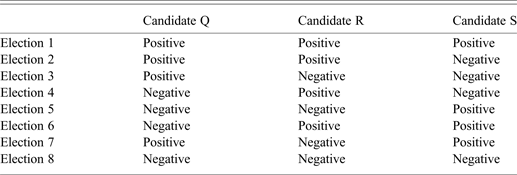
After consenting to participate in our study, respondents completed a brief survey that allowed us to capture a host of individual level characteristics, including socio-demographic information, political interest, ideology, and so forth. Following the pre-survey, participants were randomly assigned to one of eight experimental conditions, allowing every combination of positive/negative campaign tone across candidates (note that each respondent participated in only one treatment; see Table 1 for an overview of the eight treatments and below for further explanation). All eight treatments began with a pre-campaign instruction screen that introduced participants to three fictional candidates competing in an upcoming election. The parties were fictional as well, identified as Party Q, Party R and Party S. While we recognize the potential threat to external validity by employing fictional candidates and parties, we chose to do so in order to be sure we captured the impact of campaign tone, void of pre-existing partisan influences or other factors besides campaign tone that may have influenced the attention a candidate received or the vote. We also accounted for potential candidate bias by presenting candidates that were all male, approximately 50 years of age, with similar profiles in regards to marital status, children, education and experience. All candidates had Anglo-Saxon names and surnames. Furthermore, we ran within-candidate analyses to account for potential ordering effects and to assess the robustness of our results (see below). Once the participants had reviewed the instructions, they advanced to the campaign screen. This screen consisted of a static information board that provided five information links with identical titles for each candidate (see Appendix 1 for screenshot). Participants could choose to access candidate information by clicking on the links. Unbeknownst to the participants, we recorded the information links that they accessed.
Election treatments
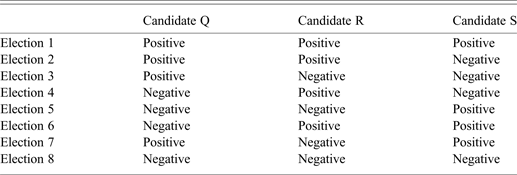
Note: Cells indicate the tone of the campaign for each candidate.
The first manipulation was to vary the tone (negative or positive) of the campaign for each candidate. To do so, we altered three pieces of information: a newspaper story covering the candidate during the campaign, a direct quotation from the candidate drawn from a TV debate and a statement from a fictitious advocacy group named “Campaign Watch Canada” (see Appendix 2). The manipulation reflected the tone of the information. For positive campaigns, the newspaper story and the quotation contained content where the candidate spoke only about his own qualifications. Under the negative treatments, the stories and the debate quotation presented the candidate as attacking his opponents, commenting on their lack of qualifications for political office. The statement from Campaign Watch Canada simply summarized the tone of the campaign (negative or positive) that the candidate had adopted. Of the 942 participants who accessed information on the candidates, 892 (approximately 95%) viewed at least one of the links cueing campaign tone. Given the focus of our research questions, we include only the 892 participants who were exposed to the stimulus in the analyses that follow. This allows us to compare the number of information links accessed and the probability of voting for each of the candidates according to the tone (positive or negative) of their campaign. Given that all other factors except for the tone of the message are held constant and the tone is assigned randomly, we can assess the impact of campaign tone by comparing differences in the information search and vote choice according to treatment.Footnote 5
The second manipulation reflects the number of candidates engaged in similar campaign styles. In order to fully test hypotheses 3 and 4, we designed a treatment for every combination of candidates engaging in negative or positive campaigns. Our treatments include all candidates running positive or negative campaigns (Elections 1 and 8 respectively), a single candidate running a negative campaign (Candidate S in Election 2, Candidate Q in Election 6, and Candidate R in Election 7), and two candidates engaging in a negative campaign (Candidates R and S in Election 3, Candidates Q and S in Election 4, and Candidates Q and R in Election 5). Given this design, we can test how the number of candidates employing similar campaign styles affects the vote decision process and choice (see below). Table 1 summarizes the campaign tone of each candidate in each treatment.
Results
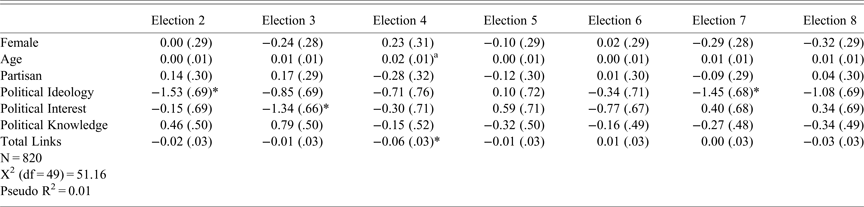
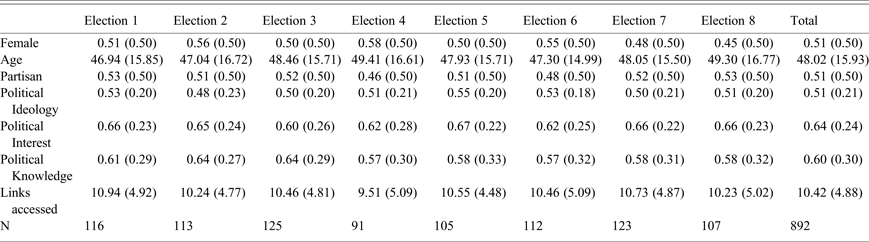
As noted, we have information on 892 participants who accessed at least one of the cueing links.Footnote 6 Appendix 3 provides a summary of the distribution of respondent characteristics for each treatment. To test whether random assignment to our treatments produced similar samples, we use a multinomial logistic regression model to predict participants’ assignment to treatment group as a function of socio-demographic characteristics, partisanship, ideology, political knowledge (a scale based on the participants response to five factual political knowledge questions) and political interest. Our likelihood ratio statistic (χ2 statistic) indicates that assignment to treatment is independent of respondents’ characteristics, suggesting balance on observables between conditions (p = 0.39, see Appendix 4).
Following from earlier work (see Daignault et al., Reference Daignault, Soroka and Giasson2013; Lau et al., Reference Lau, Sigelman and Rovner2007; Soroka and McAdams, Reference Soroka and McAdams2015), our first hypothesis contends that the amount of attention a candidate receives will be greater when she or he engages in a negative campaign relative to the attention received when offering a more positive message. To test this hypothesis, we set the proportion of information links accessed (number of links accessed for a given candidate divided by the total number of links accessed for all candidates) following the first link conveying campaign tone as our dependent variable. Modelling the proportion of links accessed after exposure to the stimulus, as opposed to the overall proportion of links viewed, serves to further validate our causal mechanism; our assumption that the treatment affected behaviour can only be true if the change in behaviour occurs following exposure to the stimulus.Footnote 7 We run separate OLS regression models for each candidate to control for overall differences in the amount of information accessed for each candidate according to the candidate's placement on the campaign screen. In our study, most individuals (99%) began by accessing information related to the first candidate presented, Candidate Q, leading to a slightly higher average number of links accessed for that candidate (Candidate Q = 3.7, Candidate R = 3.4, and Candidate S = 3.3).Footnote 8 By conducting within candidate analyses, we account for this potential bias. This design also allows us to test the robustness of our results by conducting the same set of tests repeatedly for each of the three candidates. Furthermore, by opting to model the proportion of information links accessed following exposure to the treatment, as opposed to the raw count of links viewed, we are able to account for individual level differences in the overall depth of their information search in addition to the timing of exposure to the stimulus.
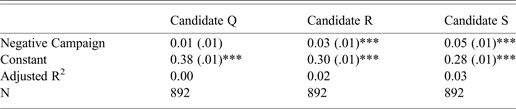
To test the impact of negative versus positive campaigns, we add a dichotomous measure that takes the value of 1 if the respondent viewed at least one of the information links that conveyed the negative tone of the campaign (newspaper story, debate quotation, or statement from Campaign Watch Canada, see above) for the candidate and 0 otherwise. The results from this first set of analyses are presented in Table 2.
Proportion of information links accessed after first tone-cueing link according to campaign tone
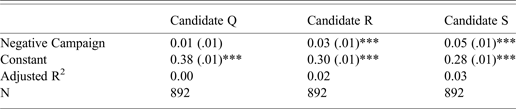
Note: Cells report OLS regression coefficients with standard errors in parentheses.
*** p < .001 ** p < .01 * p < .05 a p < .10
The results offer evidence that the tone of the campaign did influence the attention candidates received in our experiment; all three candidates experienced increased attention from voters when they criticized their opponents relative to the attention they received when they spoke of their own strengths, although the result does not meet conventional levels of statistical significance in the case of Candidate Q (Table 2). For candidate R, going negative resulted in a three-percentage point increase in the proportion of considerations he received while the proportion of information links accessed for Candidate S increased by five points when he opted to criticize his opponents. We suspect the non-significant result for Candidate Q reflects the fact that the vast majority of respondents (99%) began their information search by viewing one of the Candidate Q information links.
The results from this first assessment support our hypothesis, suggesting that voters are more likely to access information about a candidate who goes on the attack relative to the attention the same candidate receives when offering a positive message. These findings also confirm earlier work that found that negative campaigns heightened interest (Daignault et al., Reference Daignault, Soroka and Giasson2013; Lau et al., Reference Lau, Sigelman and Rovner2007; Soroka and McAdams, Reference Soroka and McAdams2015), offering external validation of these results. It would seem that our participants were drawn to negative messages, increasing the attention they paid to a candidate attacking his opponents.
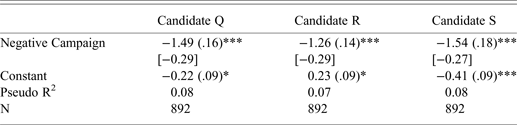
To further examine the implications of campaign tone, we turn to hypothesis 2, which states that the vote share a candidate receives will be lower when she or he engages in a negative campaign relative to the vote share received when offering a more positive message. Once again we run separate models for each candidate, this time employing a logistic regression specification with a vote for the candidate equal to 1. As with our first set of models, our sole explanatory variable is a dichotomous measure of whether the participant viewed at least one of the information links that conveyed the negative tone of the campaign. The results from these models are presented in Table 3.
Vote probability according to campaign tone
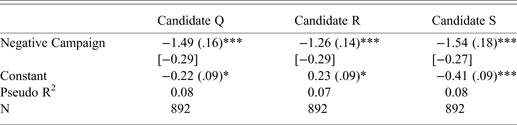
Note: Cells report logistic regression coefficients with standard errors in parentheses. Marginal effects/discrete change reported in square brackets.
*** p < .001 ** p < .01 * p < .05 a p < .10
Clearly voters in our study were turned off by negative campaigns. In all three of our models we find support for our second hypothesis with the vote probability decreasing by a statistically significant (p < 0.001) 29 points for Candidate Q and Candidate R, and a drop of 27 percentage points for Candidate S when engaged in a negative campaign compared to the vote share these candidates received when offering a positive message (Table 3). Combined with the results above, we take this as evidence that the tone of the campaign affects the vote decision process and vote choice, all else being equal. While voters may be more likely to pay attention to a candidate attacking his or her opponents, it appears that this added interest has negative consequences for the vote. These results mirror the conclusion drawn by Lau and his colleagues’ assessment (Reference Lau, Sigelman and Rovner2007) of published studies in the United States.
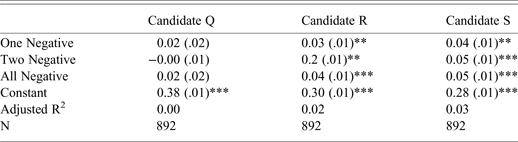
While our first set of findings support the results of earlier work (along with offering external validation of our experiment-based results), the primary objective of this study is to assess the impact of campaign tone in a multiparty context. To do so, we rerun both sets of models, this time taking into account the number of parties engaged in negative campaigns. We add three dichotomous variables to each model: one where the candidate is the only one engaged in a negative campaign, a second that controls for conditions where two candidates are engaged in negative campaigns, and a third for the condition where all three parties are engaged in a negative campaign. As above, each of these dichotomous variables takes the value of 1 only if the respondent has viewed at least one of the information links conveying the negative campaign tone for the candidate under examination. In all cases, the elections where the candidate employs a positive message is set as the reference. Once again, by running these models separately for each candidate, we are able to offer additional evidence of the robustness of our results in addition to controlling for cross-candidate differences in the number of information links considered. Our assumption is that the impact of the campaign tone will vary according to the tone of the other candidates. Quite simply, we are testing to see whether candidates in multiparty systems are better off “fighting fire with fire” by countering negative messages with a similar strategy or if candidates are rewarded for maintaining a positive message even when being attacked by their opponents. According to our third hypothesis, the amount of attention a candidate receives when engaged in a negative campaign will decrease as the number of candidates engaged in a similar campaign tone increases. These results are presented in Table 4.
Proportion of information links accessed after first tone-cueing link according to campaign tone and campaign style of other candidates
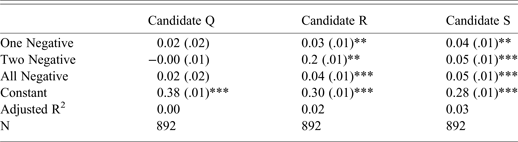
Note: Cells report OLS regression coefficients with standard errors in parentheses.
*** p < .001 ** p < .01 * p < .05 a p < .10
Based on these results, we find little evidence that the number of candidates engaged in a similar campaign style influences the proportion of links considered (Table 4). Contrary to our expectations, the results for all three conditions, for each candidate, are very similar to those reported in Table 2. These findings suggest that when it comes to the attention a candidate receives, the number of other candidates engaged in a negative campaign has little impact; it is the tone of the candidate's campaign that matters, with voters in our study exhibiting greater interest in candidates when they opt for a negative message. Accordingly, our results suggest that a multiparty system is no different than of a two-party system when it comes to the level of interest expressed under negative conditions.
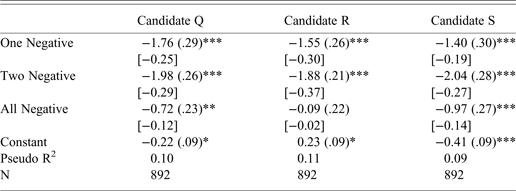
Our final hypothesis states that the loss of vote share a candidate experiences when engaged in a negative campaign will decrease as the number of candidates engaged in a similar campaign tone increases. Here we rerun the models we used to test hypothesis two with the addition of controls for the number of candidates engaged in negative campaigns. Once again, each of these dichotomous variables takes the value of 1 only if the respondent has viewed at least one of the information links conveying the negative tone of the campaign for the candidate under consideration. Table 5 reports these findings.
Vote probability according to campaign tone and campaign style of other candidates
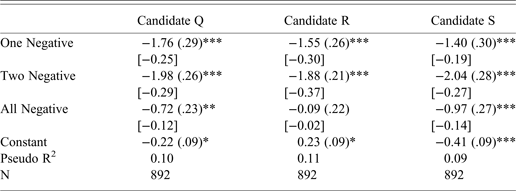
Note: Cells report logistic regression coefficients with standard errors in parentheses. Marginal effects/discrete change reported in square brackets.
*** p < .001 ** p < .01 * p < .05 a p < .10
The vote models offer intriguing results: candidates in our study suffered at the ballot box for going negative, but the cost varied according to the number of other candidates engaged in similar behaviour. In all three models we find a statistically significant drop in the probability of voting for the lone candidate who goes on the attack. The magnitude of this drop is substantial, ranging from a 19-percentage point decrease in vote probability for Candidate S to a full 30-percentage point decrease in the case of Candidate R (Table 5). Setting aside the results for the two negative candidates treatments for a moment, we see that while candidates do lose vote support when they all go on the attack, the magnitude of this drop in support is somewhat less than what we find in the condition when only one candidate is negative. In fact, for Candidate R, the coefficient for the drop in vote probability when all candidates are negative is no longer statistically significant.
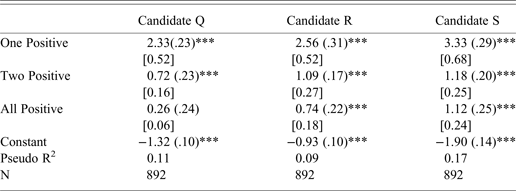
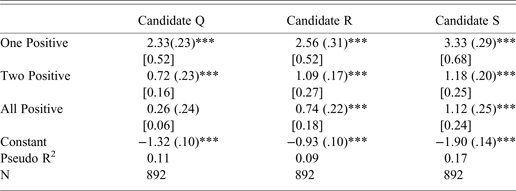
Returning to the results for the two negative candidates’ treatments, we find the largest drop in vote probability in all three models: a decrease of 29 percentage points for Candidate Q, 37 points for Candidate R and 27 points for Candidate S. In all three models, the change is statistically significant (p < 0.001). Contrary to our expectation that we would observe a negative, linear relationship, with the drop in vote probability decreasing as more candidates went on the attack, we instead find that it is the two negative candidates’ treatments where the largest loss of vote support is observed. The explanation for this result reflects the fact that when two candidates adopted negative campaign tones, voters moved their support to the lone candidate with a positive message. To demonstrate the size of this effect, we reproduce the models presented in Table 5, only this time with dichotomous variables for treatments with one, two and all candidates engaging in positive campaigns. Here each of the dichotomous variables takes the value of 1 if the respondent has viewed at least one of the information links conveying the positive tone of the campaign for each candidate respectively. These findings are presented in Table 6.
Vote probability according to campaign tone and campaign style of other candidates
Note: Cells report logistic regression coefficients with standard errors in parentheses. Marginal effects/discrete change reported in square brackets.
*** p < .001 ** p < .01 * p < .05 a p < .10
According to these results, it is clearly advantageous to be the only candidate running a positive campaign. In all three models, staying positive while the other candidate(s) engage in mudslinging significantly boosts vote share (Table 6). The increased probability of voting for the lone candidate with the positive message ranges from 52 percentage points in the case of Candidate Q and Candidate R (p < 0.001) to 68 points for Candidate S (p < 0.001). In all three models we also observe the linear relationship we had anticipated. These findings suggest that candidates in multiparty systems who can stay above the fray when their opponents are on the attack stand to gain considerable support.
Based on these results, it appears that the best strategy is for candidates to maintain a positive message, especially when the other candidates opt for a negative one. However, if one must go negative, it is advantageous to have the other candidates do likewise. While voters in our study paid more attention to candidates on the attack (regardless of how many other candidates took a negative tone), this increased attention was met with lower support at the ballot box.
Conclusion
This research set out to test the impact of campaign tone in a multiparty setting. Our results show that campaign style can influence the attention voters allot to candidates and the vote share these candidates receive. In the case of the former, campaign tone influenced the amount of candidate information individuals sought; engaging in a negative campaign increased the attention a candidate received. The increased attention was unaffected by the number of candidates engaged in similar campaigns. However, while candidates received more attention when they opted for a negative tone, this effect did not translate into increased vote share, especially when the other parties in a multiparty context countered with positive messages. For example, in the treatment where Candidate S was the sole individual to engage in mudslinging, his vote probability decreased by 19 percentage points (Table 5). On the other hand, when Candidate S stood out as the only one staying above the fray, vote probability increased by a full 68 points (Table 6). We find similar results for all of our candidates, offering additional evidence of the robustness of our conclusions. Similar to their American counterparts, our results suggest voters in multiparty settings are turned off by negativity when it comes to vote choice. Importantly, the impact campaign tone has on the vote share is conditioned by the number of parties engaged in similar campaign behaviour.
While we are encouraged by our results and the contribution this work makes to our understanding of the impact of campaign tone in a multiparty setting, we are also aware of our study's limitations. First, there is the inevitable question of external validity. We created an artificial election environment that drew upon an online sample as test subjects. Furthermore, we presented campaigns that were either positive or negative, omitting “mixed” styles that may be more likely in actual campaigns. In addition, our mock elections were devoid of many of the cues that voters may employ in actual elections, most notably the use of party labels that provide a wealth of information ranging from incumbency, leadership, ideology, and so forth. However, while we note these limitations, we maintain that our study makes an important contribution. The design we employed allowed us to isolate the impact of campaign tone on the vote decision calculus and choice directly. Furthermore, our design allows us to assess the way in which the number of parties employing similar campaigns mediates the impact of campaign tone in a multiparty setting, net of external influences. As one of the first studies to offer empirical evidence of these relationships, our work contributes to a largely underdeveloped field of study. At a minimum, our work exposes the importance of taking into account the variation in campaign tone employed by parties within a multiparty system, providing a baseline measure of the impact campaign tone may have in a multiparty context.
Future research might examine whether our findings hold in elections where the tone of the campaign is mixed or the attacks are varied, focusing on personal characteristics of the candidate compared to the policy position of the party. Researchers might also examine the interplay of the overall campaign tone adopted by candidates in multiparty settings and the tone of the election advertisements they broadcast on traditional and non-traditional media platforms. If candidates remain neutral or positive in their day-to-day campaigning (such as door-to-door canvassing, political speeches and commentary to the media), for instance, but employ negative advertisements against their opponents on radio, television and social media, are they able to draw support away from their opponents? Alternatively, what happens when candidates change the overall tone of their message mid-campaign? Finally, researchers might introduce real party labels to investigate whether partisanship mediates some of the effects observed here. We expect, however, that our overall conclusion will hold: fighting fire with fire in multiparty systems does not lead to electoral success.
Appendix 1: Campaign Screenshot

Appendix 2: Example of positive and negative newspaper stories, quotations from campaign, and statements from Campaign Watch Canada
Positive:

Negative:

Appendix 3: Sample summary characteristics
Appendix 4: Test of random treatment assignment