In the last two decades, many cases of actual or attempted federal preemption
of state regulation have followed an intriguing new interactive pattern.
While this pattern is not comprehensive enough to define a new theory of
federalism (see Zimmerman 2004), it now occurs
regularly enough to merit close attention and an attempted understanding of
its dynamics (see Walters 2004). It is also an
example of the kind of complicated federalism, with vertical checks,
balances and thresholds, that has emerged in a 21st century
America closely divided upon whether and how to use government policy to
address various social and economic problems.
Often the federal government leads this process, as a conservative coalition
at the federal level oversees the deregulation or “de-enforcement” of
various forms of existing regulation. Or, in contrast to the federal
government's activist regulatory role in the 1960s and 1970s, the federal
government decides not to develop new regulations, such as a “patient's bill
of rights,” or programs to support emerging technologies, such as stem cell
research. If this federal action is entirely within the bounds of federal
preemption of state regulation, which has often been the case for the
deregulation of firm entry or pricing policies in many industries, often
known as “economic” or ex ante regulation, then it usually stands
(barring a rare, successful court challenge). If the states retain at least
some ability to regulate a particular sector, or if the federal action is
not backed by legislation, however, some state legislature, agency, or
especially state attorney general (SAG) is likely to step up to regulate
that sector more strictly than the federal action. These state activities
may influence businesses beyond the boundaries of that state, or may have a
disproportionate impact on the national economy if the state is large, like
California's regulation of automobile emissions or its promotion of stem
cell research, or home to large chunks of an industry, as with the financial
firms in New York (or credit card companies in Delaware, etc.). Affected
businesses and firms then try to stop this state regulatory activism with
lobbying and court challenges at the state level. However, failing that, and
facing the possibility of balkanized regulations, businesses then lobby
federal agencies and/or Congress to preempt the state regulatory actions. As
Nivola (2001, 58) colorfully characterizes this
phase, for businesses: “Better to have one 500-pound gorilla in charge of
regulating the industry, its lobbyists reckoned, than to deal with 50
monkeys on steroids.”
These business efforts at the federal level may or may not succeed in gaining
preemption. Even if they do succeed, the increased salience around the issue
created by the jurisdictional debate usually requires a political compromise
for a new federal standard that is less deregulatory than the original
federal action, but less pro-regulation than the activist state's. In other
words, the result ends up somewhere between the two extremes, but the states
have had an important influence on national policy.
Modeling the Interaction
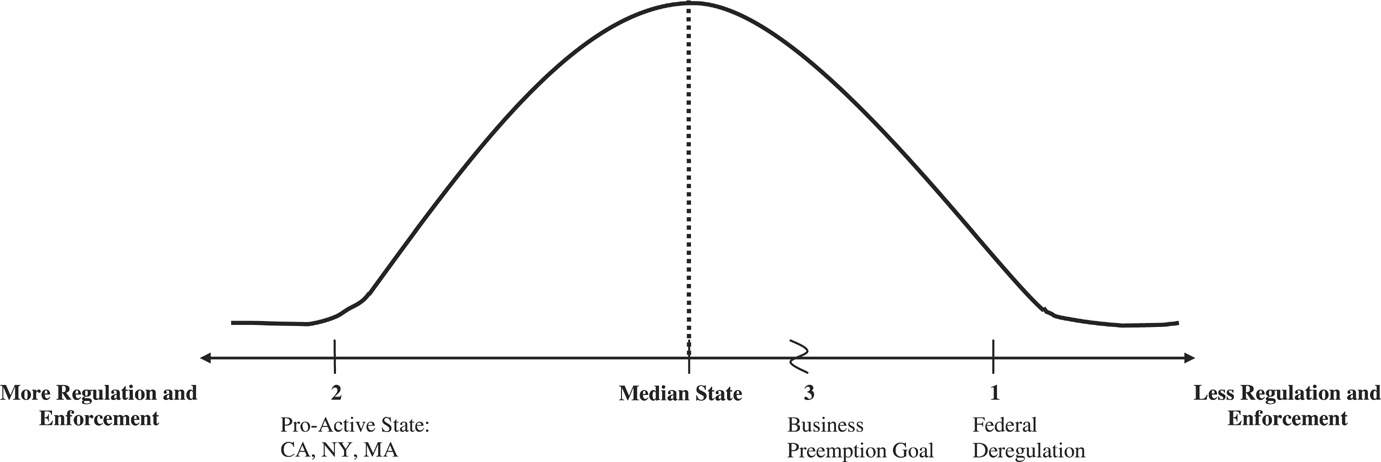
A simple spatial model can demonstrate this process, with policy
preferences for less regulation and enforcement on the right side, and
for more regulation and enforcement on the left (see Figure 1). I am assuming that the “preferences” of the 50
states are normally distributed over this range, with a median state's
preferences somewhat to the left of the federal coalition, though this
is not necessary for this type of interaction to occur (that is, the
federal action could be at the median point of all the 50 states, or
elsewhere).
Point 1 represents the federal deregulatory or de-enforcement action. It
could be a single decision, like Congress voting against limits on
carbon dioxide emissions from automobiles or President Bush's decision
to severely limit federally funded stem cell research. Or, it could be a
longer-term process, such as the Securities and Exchange Commission
(SEC) gradually relaxing its oversight of and enforcement over corporate
accounting practices over a few years. Reacting to this specific
decision or to the trend of de-enforcement, state actors develop their
own regulatory initiative, which might be at Point 2. It is worth noting
that sometimes Point 2 happens first chronologically, as states
experiment with new regulations, though this usually means that the
federal government has decided to skip Point 1 or to make it implicit.
For example, in 2001, seven states adopted “do not call” laws against
telemarketers that proved so popular Federal Trade Commission Chair
Timothy Muris later developed a national rule limiting telemarketing, an
action he admitted would have been unlikely without the states acting
first.
Other examples include the California legislature approving carbon
dioxide emissions limits in 2001 and New York State Attorney General
Eliot Spitzer using state law to go after corporate financial fraud and
accounting shenanigans. If the affected automobile manufacturers or
financial firms are unable to defeat the initiative at the state level,
by a combination of lobbying, legislative reversals, bureaucratic
decisions, or judicial challenges, they then appeal to federal actors to
preempt these state actions, which is Point 3. Given the ensuing
publicity about the issues, however, they often have difficulty arguing
for a position as extreme as the original federal-level status quo
(Point 1) and will probably have to live with a less deregulatory
outcome, if they are able to get a consensus at all for a preemptive
federal standard (and, though lobbying groups tried, they were not
successful in achieving federal preemption in these particular
examples). One of the earlier examples was the establishment of the
federal Environmental Protection Agency in 1970, after California had
developed very strict air pollution regulation; automobile manufacturers
found California's actions more problematic than federal regulation
(Moe 1989; Carlson
2003). If lobbyists and politicians achieve no federal
consensus, the various, and perhaps conflicting, levels of regulation
stand.
Thus, the actions of a single state, or sometimes of multiple states,
“pull” the resulting federal regulatory equilibrium to a more
pro-regulatory position (see Walters 2004 on
three states banding together to react in this manner to threatened
federal preemption over insurance regulation). This suggests that,
despite some recent consensus toward less regulation by slim majorities
among federal level institutions, individual states use their power to
provide a threshold level on how far deregulation and de-enforcement can
go. While the left/right position described here has been the most
common pattern in recent years, there is no inherent reason that this
interaction could not pull regulation in the other direction, if some
states preferred more deregulation than a more activist federal
government might prefer. The key for this to work is that the federal
government cannot or will not always preempt the states' authority to
regulate in some of these areas, or such preemption is shaped partly by
state preferences. In this current context of state activism, whether or
not to preempt is often a theoretical dilemma for federal conservatives,
who might favor both more deregulation and retention of state
authority.
Given that state regulation has not “faded away” or been preempted away
in recent years, and may well have expanded its role in the system
through these balancing interactions, it is worth paying some attention
to the specific patterns of preemptions.
The Continued Existence and Relevance of State Regulation
Different scholars and observers hold two opposing normative perspectives
on state regulation. The negative view suggests that regulation largely
is captured by the most powerful interests in the state who easily
dominate under-staffed part-time legislatures and agencies, that states
collectively “race to the bottom” in a lowest common denominator attempt
to attract business investment with loose regulatory policies, and that
state regulation is an unnecessary additional barrier for American firms
competing in a global economy monitored enough by the World Trade
Organization (WTO), EU, and other international regulations. Supporters
of this position believe that the federal government should preempt
state regulation as much as possible. Theoretical arguments supporting a
single federal regulatory regime, and thus preemption, are that firms
need consistent and stable regulation to compete in national (and
international) markets, that federal regulation can incorporate
jurisdictional externalities, that federal regulators can access greater
analytic resources than individual states, and that national politics
may be less susceptible to extreme interest group capture than state
regulation.
In contrast, advocates of the favorable perspective believe that the
states have improved their policymaking institutions and ability over
time, that devolution has added to that strength, and that citizens now
see states as the most trusted and capable partners in the American
system. This implies not preempting the states, in most circumstances,
unless a very strong case can be made. Theoretically, this positive
perspective is bolstered by the idea that state regulation can better
match policies to the preferences of their citizens and businesses, that
states can act as experimental laboratories, and that they have
competitive incentives to regulate in efficient ways.
In either case, there is no denying the continued importance of state
regulation. The states regulate up to 20% of the American economy (Teske 2004). Though regulatory expenditures
represent only a small percentage of state and federal government
budgets, regulation forces private actors to spend considerable monies.
About one-third of state agencies mainly address regulatory issues. Into
the 21st century, states retain their role as the only
regulators of business activities like corporate chartering, insurance,
workers compensation, and occupational licensing. Preemption of these
activities would require a major change in assignment of regulatory
responsibility (though partial preemption of state insurance regulation
may be coming, as a result of the convergence of the financial
industries, accelerated by the Gramm-Leach-Bliley Financial
Modernization Act of 1999 (113 Stat. 1338)). States share some
regulation with the federal government, usually along the constitutional
intrastate/interstate division, as in telecommunications and
electricity, and with a few areas of transportation. Some preemption has
occurred in these industries, but important elements of regulation
remain at the state level. States implement specific federal regulations
in areas like occupational safety and environmental policy, where they
sometimes have authority to go beyond federal standards, to try
different implementation approaches to meet these standards, or to
address problems not handled by federal legislation. States have some
overlapping jurisdictions with the federal government in discretionary
enforcement areas like consumer and financial regulation. These last two
arenas provide the most examples of the interactive federal/state
preemptive pattern.
In my own research, and in reviews of the broader literature, I have
found that industry capture and regulatory “races-to-the-bottom” are
legitimate concerns about state regulation, but that most areas of state
regulation are actually characterized by contested interest group
environments within which state institutional actors often make
independent policy choices (Teske 2004; Gerber and Teske 2000). The most influential
state institutional actors are legislators and bureaucrats. Governors
have also been trying to centralize their control over state regulatory
agencies.
While state regulation continues to be important, the patterns of
preemption vary by regulatory type and sector.
Ex Ante Structural Regulation Versus Ex Post
Enforcement
Recent regulation of price and entry in some markets, or ex ante
structural regulation, has generally been characterized by partial or
complete federal preemption of the states, often through explicit
legislation with a deregulatory goal. At the same time, federal
“de-enforcement” of ex post regulation, often involving reduced
enforcement efforts by agencies headed by presidential appointees,
rather than Congressional legislation, has been resisted by the states,
often successfully, as in the pattern noted above.
In the sphere of ex ante regulation, the federal government
preempted state efforts to regulate transportation industry prices and
entry, specifically and statutorily in airline deregulation in 1978,
state railroad deregulation in 1980, state intercity busing deregulation
in 1982, and state trucking deregulation in 1994. While preempting the
states, the federal government largely stopped its own economic
regulation of these industries, even eliminating the Civil Aeronautics
Board in 1978 and the Interstate Commerce Commission in 1996. The
federal government also preempted much of the states' ability to
regulate prices and entry in financial industries; for example, after
the savings and loan associations' (S&L) crisis of the late 1980s,
they prevented the states from chartering S&Ls. Congress also
preempted state restrictions on interstate branch banking in 1994 and
later preempted state oversight of mutual funds. As Congress relaxed the
separations between different kinds of financial firms in the 1999 act,
they set up a greater possible role for federal regulation over the
insurance industry, the oldest and perhaps most important industry only
regulated by the states. While federal officials have not preempted
state telecommunications and electricity regulation as much, with the
Telecommunications Act of 1996 (110 Stat. 56) Congress
preempted some state regulation, and that act and the Energy Act of
1992 opened the door for further state deregulation. Congress
and federal agencies have not pushed deregulatory preemption further in
these two critical industries in part because local incumbent firms
still face only limited competition.
Thus, when Congress decides that federal deregulation is appropriate, it
can either “incent” the states to deregulate as well, or, backed by
sufficient legal precedent, preempt them outright. Indeed, the federal
goals have at least been consistent, because as these federal
deregulatory and preemptive actions decreased the power of states over
many areas of economic regulation, they also decreased the federal role
as much, or even more.
While there are significant political and theoretical differences between
the kinds of economic, ex ante regulations that have been
deregulated substantially and the kinds of information and risk
regulation associated with ex post forms of enforcement,
Presidents Reagan and George W. Bush, and the 1994 Republican Congress'
“Contract with America,” lumped them together with “big government” and
tried to reduce enforcement by cutting budgets and centralizing their
authority over agency rulemakings. In response, many organized labor,
environmental, and consumer groups resisted these attempts, and they
often used the states as a form of venue shopping to achieve their
goals. In many ways, this reversed the traditional “state's rights”
politics that conservatives had embraced in the past to resist
progressive federal initiatives. These regulatory activists have found
considerable success in shaping policies in several states, including,
but not limited to, California, New York, and Massachusetts.
Observers first noticed this balancing effect of regulatory federalism
during the Reagan administration. In the 1990s, President William
Clinton moderated the federal reduction in regulatory enforcement, but
the political power and explicit anti-regulatory agenda of the 1994
Republican-controlled Congress continued to make regulatory activists
wary of federal activities, so they pressed on with state efforts. For
example, in health care, pro-regulatory groups pressured several states
to adopt patient's bills of rights and prescription drug laws during the
1990s, when Congress would not enact such bills. After 2000, skepticism
from pro-regulatory activists accelerated, maintaining their focus at
the state level, especially as several powerful Bush regulatory
appointees publicly argued for reductions in regulatory enforcement.
Regulatory activists have utilized three state-level institutions to
advance their policies—legislatures, state attorneys general (SAGs),
and, in about half of the states, citizen initiatives. For example, in
the late 1980s, 20 state legislatures considered various forms of
nutrition labeling, action that was preempted by the passage of the
Nutrition Labeling and Education Act of 1990 (104 Stat.
2353), as food manufacturers feared facing 50 different standards, and
succeeded in implementing Point 3. Similarly, in the early 1990s
environmental groups pressed 21 state legislatures to pass laws
requiring plastic six-pack connectors to be biodegradable—business
groups then pushed Congress to press the EPA to develop uniform national
biodegradable rules in 1993, again succeeding in Point 3 preemption that
was more regulatory than initial federal actions.
While legislative action is important, the expanded activities of SAGs
now play the most critical role, as exemplified best by New York's
Spitzer. Observers note: “His assault this year on the seamier habits of
leading brokerage houses has vaulted him to another plane, a national
figure with a higher profile than many governors and senators. Fortune
magazine put him on its cover in September, branding him ‘The Enforcer’”
(Perez-Pena and McGeehan 2002). Traub
(2002, 39) wrote: “Spitzer and other
attorneys general are filling a void that was intended, by the
anti-Washington right, to be filled by the marketplace—by, say,
self-regulating Wall Street businesses—not by other legal actors like
state A.G.'s.” Spitzer's aggressive regulation of financial, brokerage,
and insurance firms prompted later SEC and New York Stock Exchange
investigations and led these firms to (unsuccessfully) seek federal
preemption of Spitzer's actions.
Spitzer is not the only aggressive SAG in recent years: six SAGs
challenged in court the Bush administration's proposal to relax
environmental standards for upgrades of industrial facilities, 29 SAGs
sued Bristol-Myers over the blocking of a generic drug alternative to
BuSpar, eight SAGs sued the U.S. Department of Energy over relaxation of
appliance energy efficiency rules, and nine SAGs insisted on a tougher
U.S. Department of Justice antitrust settlement with Microsoft in 2003.
SAGs piggy-back on the popular product liability movement, taking on
cases against big national corporations perceived to have deep pockets.
Nearly two-thirds of SAGs are Democrats, many seeking to build name
recognition to run for governor, and they are collectively building upon
the foundation of their stunning 1998 victory against tobacco firms
(Provost 2003). Business groups have
recognized their disadvantage in dealing with SAGs; they recruited and
funded candidates successfully so that 10 of 15 SAGs elected in November
2002 were Republicans.
In the half of the states that have the citizen initiative, regulatory
activists have sometimes employed it. California's Proposition 65 on
food labeling in 1986 started the national debate on that topic, leading
to the 1990 federal labeling act. California's 2004 initiative on stem
cell research is leading to what some have called a mini National
Institute of Health, funded by taxpayers in our largest state, though
the research will have national (and global) implications.
Future Implications
Despite deregulation and globalization, to paraphrase Twain: “the death
of state regulation has often been greatly exaggerated” (Teske 2003). While the federal government has
preempted much state authority over structural economic regulation in
the last 25 years, state social regulatory activists keep re-enforcing
other areas. Federal de-enforcement of social regulation prompts varying
forms of state re-enforcement, which in turn often leads back to
business' lobbying for preemptive “liter” regulations. States have added
“balance” to the system, where some expected further “checks” on
regulatory growth. States may also be setting a threshold on how far
deregulation and reduced regulatory enforcement will go, even with a
conservative coalition firmly in control of federal government
institutions.
A number of regulatory topics may soon fall into this federal/state
preemptive pattern, including predatory lending practices, Internet
privacy and identity theft, genetically altered food, workplace
ergonomics and repetitive stress illnesses, and insurance agent
licensure requirements. Not for the first time in American history,
federalism is proving to be a complicated structure, with sometimes
surprising equilibrating effects. Strange political bedfellows are also
being created, as progressives who see no prospect of elected federal
institutions supporting their policies in the near future now favor
strong state's rights, while a conservative coalition on the U.S.
Supreme Court questions whether a number of federal regulations actually
apply to the states.