1. Introduction
Beginning with Coase's (Reference Coase1937) seminal paper, a large literature has arisen to examine the boundary between the market and the firm.Footnote 1 The key question addressed by this literature concerns whether, or under what conditions, it is more efficient to organize a transaction through the market or within the confines of a firm. A point that has not often been made, however, is that there are different ways in which market (arm’s-length) transactions can be organized. One possibility is a spot transaction in which the parties meet and negotiate an instantaneous exchange under certainty; another is a contractual arrangement that is negotiated before all information pertinent to the transaction is known. The advantage of a contract is that it allows commitments to be made that are enforceable by a third party (the court), thereby avoiding holdup problems.Footnote 2 This form of governance is therefore sometimes referred to as ‘court ordering’. The disadvantage of this approach is that the terms of the contract must be negotiated under uncertainty, thus leading to the possibility of costly litigation once the information is revealed.Footnote 3
In examining this trade-off, I will emphasize the sense in which a contract is intermediate between a pure market transaction, where enforcement is not an issue, and a transaction within a firm, where the owner (residual claimant) can dictate the terms of the transaction. In this light, one way to think of the contract is as a hybrid structure in which a court stands ready to enforce the terms of the transaction, much the way the owner of a firm could. Unlike the firm owner, however, the court has no financial stake in the transaction and only acts when called on. The law therefore provides temporary access to coercion when a dispute arises in the face of unforeseen circumstances, and in this sense courts can be thought of as acting like a ‘temporary firm’.
This perspective reflects the boundary between pure market exchange on one hand, and exchange by means of legally enforceable (contractual) exchange on the other, which is the general subject of Coase's classic paper on social cost (Coase, Reference Coase1960), especially as fleshed out by Calabresi and Melamed's (Reference Calabresi and Melamed1972) important distinction between property rules and liability rules. Calabresi and Melamed specifically define property rules to be the basis for consensual exchange in a market setting, and liability rules to be the basis for non-consensual exchange on terms set by the court. They go on to argue that the choice between the two rules depends on transaction costs; that is, when transaction costs are low, property rules are preferred, whereas when transaction costs are high, liability rules are preferred. In other words, when bargaining between the parties to a transaction is possible, the market is the preferred means of organizing the exchange, with the role of the court being limited to protecting the underlying property rights. However, when there are impediments to bargaining, such as uncertainty, the court can play a more important role in forcing efficient exchanges that otherwise would have been foregone. In this sense, the choice between property rules and liability rules mirrors the Coase Theorem, which similarly asserts that court-ordered assignments of rights, including contractual rights, only matter for efficiency when transaction costs are high.
By recognizing the boundary between markets and firms on one hand, and between markets and contracts (law) on the other, the current paper therefore blends the insights from Coase's two classic papers in an effort to provide a more complete picture of the organization of exchange. The logically complete framework therefore implies existence of a third boundary: that between firms and contracts. The distinction here, as will be made clear below, is between fully coercive exchange within the boundaries of a firm, and consensual exchange outside of the firm that is enforceable on-demand by the court, which, as noted, potentially introduces a non-consensual element into the transaction.
In this sense, the current paper is related to the large and growing literature on hybrid organizational forms that are intermediate between pure markets and pure firms (Hodgson, Reference Hodgson2002; Menard, Reference Menard2004; Williamson, Reference Williamson1996). As the preceding discussion has suggested, I will argue that legally enforceable contracts lie between markets and firms in the sense that they blend consensual and non-consensual elements. To be sure, the idea of relational contracting has long been recognized as intermediate between markets and firms (Goldberg, Reference Goldberg1980). The main contribution of the current paper is to draw an explicit link between the literature on the boundary between firms and markets on one hand, and the law-and-economics literature on contract enforcement on the other, using the building blocks of property rules and liability rules.
More specifically, the paper illustrates the interplay between consensual and coercive exchange, and particularly the role that courts play in facilitating the exchange process. The insights of Coase (Reference Coase1937) are well-known in this literature – in highlighting the importance of court ordering as a means of exchange within the broader context of hybrid firms, this paper integrates the ideas of Coase (Reference Coase1960). Although ostensibly addressing different topics, Coase's two papers have in common the role of transaction costs in determining the boundary between consensual exchange and coercion, where the latter can either take the form of a durable command relationship within a firm, or a temporary one, as embodied by a contract backed by a judicially enforceable remedy. In explicating this link between Coase's two classic papers, the current paper will not address all of the unresolved issues pertaining to hybrid organizational forms. Rather, its goal is to provide one additional ‘view of the cathedral’, to use Calabresi and Melamed's (Reference Calabresi and Melamed1972) colorful metaphor.
In examining the choice among markets, firms, and courts, the formal analysis will focus on two key factors that potentially impede exchange. The first concerns the incentives for parties to make efficient transaction-specific investments prior to trade, which has been the subject of much of Williamson's work on the advantage of firms and contracts over market exchange. I will explicitly treat this issue here, usually referred to as ‘asset specificity’, as a holdup problem. The second factor concerns incentives for efficient performance of the transaction after all information is realized – that is, deciding when the transaction should be completed and when it should be breached, which has been the focus of much of the law-and-economics literature on efficient remedies for contract breach.Footnote 4
The next section motivates the analysis by describing an illustrative case from contract law. Section 3 then develops the main argument, the formal details of which are included in the Appendix. Finally, Section 4 concludes.
2. An illustrative case
Consider the well-known case of Goebel v. Linn,Footnote 5 which involved a dispute between an ice company and a brewery that arose when the ice company refused to deliver ice at the contractually set price of $2 a ton because an unusually warm winter had caused the ice ‘crop’ to fail. The brewery, which had a large stock of beer on hand that would have spoiled without ice, therefore agreed to increase the price to $3.50 per ton and took delivery, but later sued to have the original price reinstated by the court.Footnote 6 The court, however, enforced the higher price based on the ‘unexpected and extraordinary circumstances’ that had arisen,Footnote 7 which likely would have driven the ice company into bankruptcy had the lower price prevailed.
From a historical perspective, this case depicts a general problem faced by breweries prior to the invention of artificial refrigeration, which required them to store their beer in caves, either natural or specially constructed for the aging of beer. Because the temperature of the caves was not always low enough during the summer months, however, ice was also needed. In those days, natural ice cut from rivers and ponds during the winter and stored in insulated icehouses provided the only supply. This explains why breweries initially arose in northern cities like Milwaukee, where ice was readily available during the winter. Still, the market for ice was not dependable because mild winters could cause supply shortages and high prices. Consequently, many large breweries built their own ice houses to store ice so that it was available year round, thus removing at least some of the uncertainty over the cost of beer production (Baron, Reference Baron1962: 231–234). Smaller breweries like the one in Goebel v. Linn, however, relied on contracts with independent ice companies.
This situation represents a classic problem of organizational choice in which a manufacturer needs to ensure the supply of an input that is essential to its production process. The asset-specificity problem arises because the manufacturer needs to initiate the production process (i.e., the brewing of beer) before the cost of the essential input (ice) can be known with certainty. The question, then, is how to organize the transaction between the manufacturer and the input supplier so as to maximize the gains from trade.
Based on the above framework, there are three options. One is by a spot transaction between the manufacturer and supplier after the cost of the input is realized. The problem with this pure market arrangement is that the input supplier may be in a position to hold up the manufacturer, given that the latter has already made non-salvageable investments that lock it into the transaction. To avoid the holdup problem, the manufacturer, before making any investments, could enter into a contractual arrangement with the supplier that specifies the price of the input. This hybrid arrangement reflects the facts of the Goebel v. Linn case. Although the ice company was still able to hold up the brewery for a higher price, the court recognized that the brewery had the option of suing for breach of contract when the ice company initially refused to deliver at the contract price. For some reason, the brewery chose not to pursue this remedy,Footnote 8 but if it had, the standard remedy for breach, expectation damages, would have required the ice company to fully compensate brewery for its lost profits. As a final option, the manufacturer could have solved its ice supply problem by simply buying out or merging with the ice company (i.e., vertically integrating). Following this strategy would have ensured the timely delivery of ice at an acceptable cost, but the drawback is the governance cost of managing the ice company, which the model below will treat as an agency cost.
The preceding case study shows the various options that can be used to organize exchange. All are imperfect in their own way, so the optimal choice is the one that maximizes the expected value of the transaction. The model in the next section formalizes the relevant trade-offs.
3. Analysis of alternative organizational forms
The model in this section asks how the various organizational forms affect incentives for non-salvageable, transaction-specific investments, and for performance, in relation to the hypothetical first-best outcome. The discussion is mostly informal, with the technical details relegated to an appendix. A numerical example will be used to illustrate the key results. For concreteness, I will couch the discussion in terms of the brewery/ice case.
Set-up of the model and the social optimum
Let V(x) be the brewery's gross profit from the sale of beer, where x is its initial investment (i.e., how much beer it brews), and V′ > 0 and V(x)″ < 0. Storage and sale of the beer, however, requires the delivery of ice at a cost C, which is not known with certainty at the time the brewery chooses x. The sequence of decisions is therefore crucial: first, the brewery must choose x, then the cost of supplying ice is realized, and finally, the decision of whether or not to supply the ice is made. If the ice is delivered, the transaction goes ahead as planned, yielding a joint return of V(x) − C − x, but if it is not, the initial investment, x, is lost.
As usual, the social optimum is derived in reverse sequence of time. Thus, once C has been realized, it is optimal for delivery of the ice to occur if C ≤ V(x) for any value of the sunk investment x. In contrast, if it turns out that C > V(x), then the ice should not be supplied, even though this means the loss of the brewery's initial investment in beer. Now move back to the time when the brewery has to make its choice of x. From a social perspective, it should choose x to maximize the expected value of the beer, subject to uncertainty regarding the delivery of ice. Specifically, because there are some states of the world where the realized cost of ice will make delivery inefficient, the brewer should invest less than if delivery were certain. In other words, the brewer should hedge against the possibility of non-delivery so as to mitigate the amount of the loss in that state.
The actual performance and investment decisions will be made by the relevant decision-makers based on the organizational form governing the ‘transaction’ between the brewer and ice supplier. The next three sections derive the resulting equilibria: first, under a market (spot) transaction, then under a contractual arrangement, and finally under vertical integration.
Market transaction
When the brewery and ice company interact in a market setting, they engage in a spot transaction for the sale of ice after the cost of ice production is realized. I assume that they complete a transaction whenever it is jointly profitable given the realized cost, C, and the brewer's prior investment, x; that is, whenever V(x) ≥ C. In other words, I assume Coasian bargaining takes place at this point (Coase, Reference Coase1960).Footnote 9 I further assume that the price of the ice is determined by generalized Nash bargaining. The resulting price is therefore
 \begin{equation}
P = {\alpha}V(x) + (1 - {\alpha})C,\end{equation}
where α represents the strength of the ice company's bargaining power.Footnote 10 The key thing to note here is that the price is increasing in x as long as α > 0. Thus, the more that the brewery has invested in reliance on the promised delivery of ice, the higher will be the price that the latter can extract at the time of the transaction. This represents the source of the holdup problem that plagues spot transactions in the presence of prior transaction-specific investments. In particular, because the brewery rationally anticipates the outcome of its subsequent bargaining with the ice company, it will underinvest in beer compared to the efficient level in order to lessen its vulnerability to the holdup problem. This is the primary disadvantage of market exchange in this context.
Court-enforced contract
As an alternative to engaging in spot transactions, the brewery and ice company may choose to enter into a legally enforceable contract that commits the ice company to deliver ice at a pre-determined price over some prescribed time period. The advantage of this arrangement from the brewery's point of view is that it avoids the need for the parties to negotiate a price for each transaction after C has been realized. As a result, it eliminates the holdup problem. In addition, it creates an obligation on the part of the ice company to perform, which the brewery can enforce by legal means. In other words, in those states where the ice company chooses not to perform, the brewery can seek damages in court. (I ignore here the risk of bankruptcy on the part of the input supplier in high-cost states.) Let R be the pre-determined contract price, payable on performance,Footnote 11 and let D be the damages in the event of breach as set by the court.
The timing of events in this case is as follows. First, the brewery and the ice company sign the contract and specify the contract price, R;Footnote 12 then the brewery chooses x; and finally, the ice company realizes the cost of performance, C, and decides whether or not to perform. In the event that it chooses not to perform, the parties go to court, which orders the ice company to pay damages of D to the brewery.
Considering first the ice company's performance decision, once C is realized, it will deliver the ice if R − C ≥ − D, or if
 \begin{equation}
C \le R + D,\end{equation}
and breach if the reverse is true. Recall that the condition for efficient performance, given x, is C ≤ V(x). Thus, the measure of damages for breach that induces the ice company to perform efficiently is D = V(x) − R, which is the ‘expectation damage’ measure (Shavell, Reference Shavell2004: 343–344). Under this measure, the ice company is required to pay the brewery its surplus from the transaction, conditional on its actual level of investment. Expectation damages induce efficient performance because they force the ice company to internalize the full cost of breach to the brewery, given its prior investment of x. (Note that such a measure assumes the court is able, after the fact, to observe and condition the amount of damages on the brewery's actual loss of income as a result of the breach; namely, V(x)).
Given the above damage measure, the brewery anticipates that the breach decision will be made efficiently by the ice company for any amount of x that it invests. In other words, the transaction will occur efficiently, as was the case under the spot transaction. The problem, however, is that the brewery now has an incentive to overinvest in beer production. The reason is that the expectation damage measure fully insures it against non-delivery of ice and hence creates a moral hazard problem (Shavell, Reference Shavell1980).Footnote 13 The result here is therefore the opposite of the outcome under market organization, which resulted in underinvestment by the brewery.
Vertical integration
The third alternative to the market or contract is for brewery and ice company to vertically integrate; that is, to organize their transaction within a single firm. For concreteness, I assume that the brewery takes control of the ice company, though the reverse is also possible (see, for example, Grossman and Hart, Reference Grossman and Hart1986). Thus, I will treat decisions concerning the production and delivery of ice as being made by ‘employees’ of the firm in return for a wage, while the ‘owner’ (the residual claimant) decides how much to invest in brewing the beer. I will model the relationship between the residual claimant and the workers as a principal-agent problem.
The distinguishing feature of this type of organizational form is that it outlives the individual transaction. As a consequence, the employees must be paid in both the delivery and non-delivery states, though I will allow the wages to differ in those states. Specifically, suppose that in the states where the (single) worker is asked to produce and ‘deliver’ ice, he is paid a wage of w, but when he is not asked to produce due to high costs, he is paid a wage of w 0, where w 0 is defined to be the minimum wage that prevents the worker from quitting (hence, w ≥ w 0). In this specification, the cost of delivery, C, is interpreted to be the worker's realized, and privately known, cost of performance.
The owner of the integrated firm chooses the maximum cost under which it will produce. Let Ĉ be this threshold cost level. Thus, the firm will produce when C ≤ Ĉ and not produce when C > Ĉ. However, because the owner cannot observe the realization of C, he must create an incentive contract for the employee to produce only in those states where C ≤ Ĉ. In other words, the owner must specify a contract consisting of the wages, w and w 0, and the threshold cost, Ĉ, to maximize profits, subject to the following constraints:
 \begin{equation}
w - C \ge w_0 ,\quad C \le \hat C,\vspace*{-18pt}\end{equation}
 \begin{equation}
w - C < w_0 ,\quad C > \hat C.\end{equation}
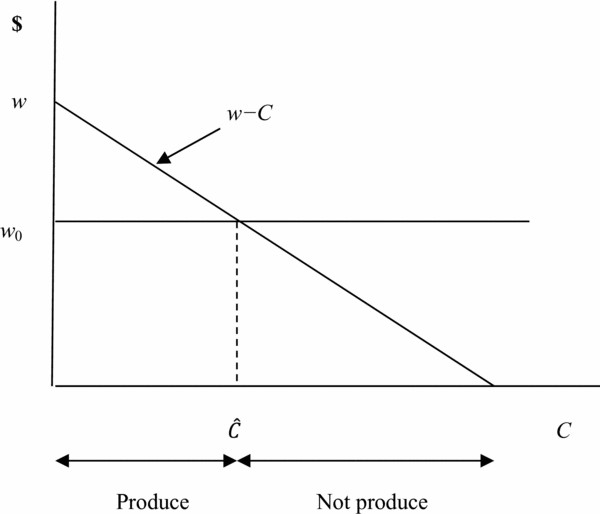
Constraint (3) says that the worker, after privately observing the cost of production, prefers to produce in the ‘low-cost’ state, while (4) says that the worker prefers not to produce in the high-cost state but instead to receive the reservation wage. Figure 1 depicts the ranges for C graphically. Note that, given w 0, which is determined by the next-best option of workers, the choice of w uniquely determines Ĉ (and vice versa). Thus, only one of these variables needs to be independently chosen.
Ranges for production and non-production under vertical integration.

The problem for the owner/brewer is therefore to choose x and w to maximize profit, subject to constraints (3) and (4). It turns out that, in the optimal solution, the firm will underproduce given x – that is, it will take delivery of ice too infrequently from a social point of view. Intuitively, because the brewer/owner cannot observe the worker's cost of delivery, he must pay the worker a high enough wage to produce in the desired range (i.e., when C ≤ Ĉ). Thus, by reducing the range of production slightly, he can lower the wage he has to pay in production states. (In Figure 1, a reduction in Ĉ coincides with a lower w.) At the optimum, the marginal reduction in the wage bill just equals the lost profit from production. Given the underproduction, however, the firm invests efficiently in x because the owner fully internalizes the cost and benefit of the investment.
Comparison of the various forms
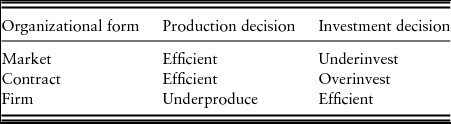
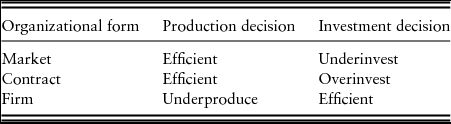
The conclusions from the preceding sections are summarized in Table 1. Note that all of the organizational forms involve some inefficiency: the spot market and contract both result in efficient production (delivery of ice) once the cost of performing is realized, but the brewery invests inefficiently under both. In particular, it underinvests under market exchange in a strategic effort to mitigate the holdup problem, and it overinvests under the long-term contract due to the moral hazard problem created by the expectation damage measure. In contrast, when the brewery and ice company merge, the integrated firm invests efficiently given the anticipated level of production, but it underproduces as a result of the agency costs associated with the workers’ private knowledge of the cost of ice production.
Outcomes under the various organizational forms
Since none of the organizational forms achieves the first-best outcome, the choice among them depends on which involves the least distortion. In the context of the current model, this will depend on three factors: (1) the importance of the brewery's up-front investment; (2) the severity of the holdup problem that may arise after beer production is complete and delivery costs are realized (which depends on the relative ex post bargaining strengths of the parties), and (3) the degree of ex ante uncertainty over the ice company's costs of supplying the essential input (which determines how likely breach is.) To illustrate the nature of the choice, I first consider some special cases and then develop a numerical example.
Suppose first that investment by the brewery in anticipation of performance is not important (i.e., V is fixed). In other words, the asset specificity problem is not severe in the sense that the brewery could easily salvage the initial investment if delivery of the ice turns out to be infeasible or undesirable. In that case, the risk of a holdup by the ice company is small or non-existent, and so both the market and contract yield the efficient (first-best) outcome because they both result in efficient production once costs are realized. In other words, when asset specificity is not a severe problem, arm's length transactions yield the maximum gains from trade. In contrast, the firm results in underproduction because of the agency costs. Thus, when up-front investments are not important, we would expect spot market transactions and contracts to dominate vertical integration.
Alternatively, suppose that the up-front investments are important but production costs are known, which makes performance perfectly predictable. In this case, only the holdup problem remains, so the spot market will result in too little up-front investment. In this case, the transaction is best governed within the confines of a firm or by a contract. In the context of the simple example, both organizational forms will be efficient because of the hypothesized absence of cost uncertainty, which, recall, was the source of both the agency costs under vertical integration and moral hazard under contracting. In reality, of course, the choice will depend on other factors that affect the relative costs of the two forms, which will likely depend on both the scale and expected duration of the relationship. In the brewery context, for example, one might expect small breweries to enter into contracts with ice companies, as was the case in Goebel, and large breweries to build and operate their own ice houses.
In the most general case where production costs are uncertain and up-front investments are important, none of the forms yields the efficient outcome. Thus, all we can say is that, as the likelihood of breach increases, the level of investment under the market more closely tracks the efficient level of investment as compared to the contract. This is true because the level of investment under the contract is not sensitive to the probability of breach, owing to the moral hazard problem arising from the breach remedy, and thus diverges further from the efficient level as that probability increases. In contrast, the level of investment under the market, though inefficiently low, at least declines with the probability of breach. Consequently, as the probability of breach increases, the market and firm will tend to dominate the contract, with the choice between the former two options depending on the relative costs of the holdup and agency problems. Again, one would expect that for more enduring relationships, the firm would be the preferred choice.
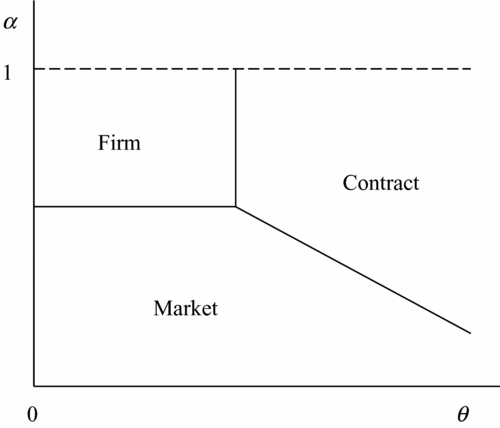
To gain further insights, we consider a simple example. Let the brewer's gross profit be V(x) = θx 1/3, and assume that C is uniformly distributed on [0,4]. A comparison of the various organizational forms involves computing the net value of production under each form while varying the production parameter θ, and the bargaining power parameter α. Figure 2 provides a stylized representation of the optimal organizational form for different combinations of θ and α.Footnote 14 In the figure, the vertical axis, represented by α, reflects the severity of the holdup problem, with higher α corresponding to greater bargaining power on the part of the ice company, while the horizontal axis, represented by θ, reflects the importance of the brewery's up-front investment, with higher θ corresponding to an increased probability of performance, given the (fixed) distribution of costs.
Regions where different organizational forms dominate.
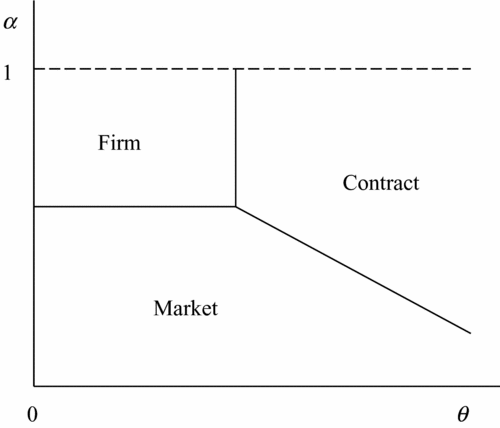
Note first that the market dominates for all θ when α is low (near zero). This is true because the brewery expects to receive a large share of the gains from any ex post bargaining under a spot transaction and thus internalizes most of the gains from trade. In other words, the holdup problem is not severe. (In the extreme case where α = 0, the holdup problem is absent and the outcome is first-best under market exchange.) As α rises, however, the holdup problem worsens, and eventually the firm or contract dominates the market, with the choice depending on the value of θ. Specifically, when θ is high, meaning that the likelihood (and value) of production is high, the contract dominates the firm. In this case, the risk of breach is low, and so the moral hazard problem associated with contract breach is small compared to the agency costs under a firm. In other words, the value of the contract in allowing the parties to pre-commit to a price, coupled with the high probability of performance, makes it the preferred form. In contrast, when θ is low, and consequently the likelihood of breach is high, the opposite is true, and the firm dominates the contract.
4. Conclusion
The optimal organizational form between two potential trading partners is the one that achieves the largest expected gains from trade. Alternatively stated, it is the form that minimizes the cost associated with inefficient incentives for transaction-specific investments and performance. The contribution of this paper has been to examine markets, firms, and the law as alternative institutional arrangements for organizing transactions in the presence of these imperfections. This exercise represents the logical extension of Coase's seminal contributions to industrial organization on one hand, reflected by his examination of the market-firm boundary; and to law and economics on the other, reflected by his examination of the market-law boundary. The result is a unified approach to comparative organizational form that reveals the relative advantages and disadvantages, within a fairly simple economic setting, of market exchange, court ordering (contracts), and internal governance (agency).
The paper also contributes to the literature on hybrid organizational forms by using the insights from the law-and-economics literature on contract enforcement to illuminate the sense in which contract are intermediate between pure markets and firms. Using the distinction between property rules and liability rules, the paper argued that contracts combine consensual and non-consensual elements to deal with the twin problems of unforeseen contingencies (cost uncertainty) and asset specificity (holdups) by allowing trading partners to make commitments that courts stand ready to enforce. In this sense, courts play the role of temporary firms to support otherwise consensual transactions.
Acknowledgements
In writing this paper I have benefited from conversations with Richie Adelstein, and also from the helpful comments of Dick Langlois and students in the undergraduate honors seminar in the economics department at the University of Connecticut. Finally, I acknowledge the very helpful comments of two reviewers and the editor, Geoffrey Hodgson, which have greatly improved this paper.
Appendix
This appendix provides the formal details of the model described in the text. The notation is as follows:
V(x) = brewer's gross value of performance;
x = brewer's non-salvageable investment in dollars, V′ > 0, V″ < 0;
C = random cost of delivering the essential input (ice);
F(C) = distribution function of C, where F′ ≡ f > 0.
The sequence of events is as follows: first the brewer chooses x, then the ice company realizes the value of C, and finally, the parties decide whether or not to transact.
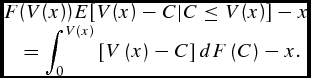
The social optimum is found by backwards induction. Thus, once C is realized, it is efficient to transact if and only if V(x) ≥ C for any prior choice of x. Given this production choice, the expected value of the brewery's investment is given by
 \begin{equation}
\begin{array}{l}
F(V(x))E[V(x) - C|C \le V(x)] - x \\
\quad = \displaystyle\int \nolimits_0^{V(x)} \left[ {V\left( x \right) - C} \right]dF\left( C \right) - x. \\
\end{array}\end{equation}
The optimal choice of x therefore solves the following first-order condition:
 \begin{equation}
F(V(x))V'(x) - 1 = 0,\end{equation}
which says that the brewery should invest up to the point where the expected marginal benefit equals the marginal cost. Let x* denote the resulting first-best level of investment.Footnote 15
The actual performance and investment decisions will depend on the specific organizational form.
Market (spot) transaction. Assuming Coasian bargaining once C is realized, production will occur efficiently given x; that is, whenever V(x) ≥ C. According to the generalized Nash bargaining solution,Footnote 16 the resulting price is given by
 \begin{equation}
P = \alpha V(x) + (1 - \alpha )C,\end{equation}
where α represents the strength of the ice company's bargaining power. Given that the brewery rationally anticipates this outcome, it will choose the initial investment to maximize
 \begin{equation}
F\left( {V(x)} \right)E\left[ {V\left( x \right) - P|C \le V(x)} \right] - x.\end{equation}
Using (A3) to substitute for P in this expression yields
 \begin{equation}
\begin{array}{l}
F\left( {V\left( x \right)} \right)E\left[ {V\left( x \right) - \alpha V\left( x \right) - \left( {1 - \alpha } \right)C|C \le V(x)} \right] - x \\
\quad = \displaystyle\int \nolimits_0^{V(x)} \left[ {\left( {1 - \alpha } \right)(V\left( x \right) - C)} \right]dF\left( C \right) - x\,. \\
\end{array}\end{equation}
The resulting first-order condition is
 \begin{equation}
F\left( {V\left( x \right)} \right)\left( {1 - \alpha } \right)V'(x) - 1 = 0.\end{equation}
Denote the solution to (A6) by xM. Comparing (A6) to (A2) shows that xM < x* for α > 0. Further, xM is decreasing in α, indicating that the brewery invests less as the holdup problem becomes more severe.
Contract. As an alternative to a spot transaction, the brewery and ice company can sign a contract that commits the ice company to deliver ice at a pre-determined price over some prescribed time period. Let R be the price, payable on performance, and let D be the court-awarded damages in the event of breach (non-delivery). The timing of events in this case is as follows. First, the brewery and the ice company sign the contract and specify R; then the brewery chooses x; and finally, the ice company realizes C and decides whether or not to perform. If it does not perform, the court orders it to pay damages of D to the brewery.
Considering first the ice company's performance decision, once C is realized, it will deliver the ice if and only if R−C≥ −D, or if and only if
 \begin{equation}
C \le R + D.\end{equation}
Since the condition for efficient performance, given x, is C ≤ V(x), the measure of damages for breach that induces the ice company to perform efficiently is D = V(x) − R. Given this damage measure, which corresponds to expectation damages, the brewery anticipates that the breach decision will be made efficiently by the ice company for any amount of x that it invests. Thus, it computes its expected return from the contract to be
 \begin{equation}
F(V(x))[V(x) - R] + [1 - F(V(x))]D - x.\end{equation}
After substituting D = V(x) − R, this expression becomes
 \begin{equation}
V(x) - R - x.\end{equation}
Thus, the brewery will behave as if performance were certain. Consequently, its profit-maximizing level of investment, denoted by xC, will solve the first-order condition
 \begin{equation}
V'(x) - 1 = 0,\end{equation}
which, given (A2), involves overinvestment.
Vertical integration. The third alternative is for brewery and ice company to vertically integrate; that is, to organize their transaction within a single firm. In the current specification, I assume that the ice company becomes the ‘employee’ (agent) of the brewery, but the brewery (principal) cannot observe the realized cost of production. The brewery must therefore structure the wage contract to induce the agent to produce only in the desired (low cost) states. In particular, the contract will specify a threshold Ĉ such that the agent produces when C ≤ Ĉ, for which he receives a wage of w, and does not produce when C > Ĉ, for which he receives a wage of w 0, which is the lowest wage that just prevents him from quitting (the reservation wage). To ensure incentive compatibility, the contract must satisfy the following constraints:
 \begin{equation}
w - C \ge w_0 ,\quad C \le \hat C,\end{equation}
 \begin{equation}
w - C < w_0 ,\quad C > \hat C.\end{equation}
Constraint (A11) says that the worker, after privately observing the cost of production, prefers to produce in the low-cost state, while (A12) says that the worker prefers not to produce in the high-cost state. Writing equation (A11) as an equality yields the threshold cost as a function of w:
 \begin{equation}
\hat C\left( w \right) = w - w_0 .\end{equation}
The expected profit for the owner, given (A13), is
 \begin{equation}
\mathop \int \nolimits_0^{\hat C(w)} \left[ {V\left( x \right) - w} \right]dF\left( C \right) - \mathop \int \nolimits_{\hat C(w)}^\infty w_0 dF\left( C \right) - x,\end{equation}
where the first term represents expected profits in the production state, and the second represents costs in the non-production state. The principal chooses w and x to maximize this expression subject to (A13).
Consider first the choice of w. The first-order condition is
 \begin{equation}
- F\left( {\hat C} \right) + \left( {V\left( x \right) - w + w_0 } \right)f\left( {\hat C} \right)\left( {\frac{{\partial \hat C}}{{\partial w}}} \right) = 0.\end{equation}
Since  $\frac{{\partial \hat C}}{{\partial w}} = 1$ from (A13), this expression can be re-arranged to yield
 \begin{equation}
f\left( {\hat C} \right)\left[ {V\left( x \right) - \hat C} \right] = F(\hat C),\end{equation}
from which it follows that V(x) > Ĉ. Thus, the firm underproduces, given x. This is true because, given the principal's inability to observe the realized cost of production, he must pay the worker a high enough wage to induce him to produce over the range where C ≤ Ĉ (see Figure 2). Thus, by reducing the range of production slightly, he can pay a lower wage in the production states. At the optimum, he just balances the cost of lost production against the lower expected wage bill. The resulting inefficiency represents an agency cost associated with vertical integration. In what follows, let ŵ(x) denote the solution to (A16).
The principal's optimal investment, x, solves the following first-order condition:
 \begin{equation}
\mathop \int \nolimits_0^{\hat C} V'\left( x \right)dF\left( C \right) - 1 - F\left( {\hat C} \right)\left( {\frac{{\partial \hat w}}{{\partial x}}} \right) + \left[ {V\left( x \right) - \hat w\left( x \right) + w_0 } \right]f\left( {\hat C} \right)\left( {\frac{{\partial \hat w}}{{\partial x}}} \right) = 0.\end{equation}
Since the final two terms drop out by (A13) and (A16), we have
 \begin{equation}
F\left( {\hat C} \right)V'\left( x \right) - 1 = 0.\end{equation}
Thus, the owner invests optimally, given the cost threshold Ĉ. Table 1 summarizes the results regarding the efficiency of the various organizational forms.