INTRODUCTION
Ensuring a consistent, standard approach to the delivery of “best” care for people with life-limiting illnesses is a priority for palliative care services worldwide (Ferris et al., Reference Ferris, Balfour and Bowen2002; Ferris et al., Reference Ferris, Gómez-Batiste and Fürst2007; Hardy et al., Reference Hardy, Haberecht and Maresco-Pennisi2007). To achieve this, palliative care service provision must be founded on a quality management approach (Palliative Care Australia, 2003) that strives to provide patients and their families with seamless care, involving timely, coordinated, and appropriate needs-based support (Palliative Care Australia, 2005). The needs of palliative care patients and their families are typically complex, however, and interdisciplinary management is required to ensure that care is responsive and well coordinated (Ferris et al., Reference Ferris, Balfour and Bowen2002).
Specialist palliative care services provide care to those patients with life-threatening illness whose needs exceed the capacity and resources of primary healthcare providers. In Australia, patients can move freely between community, acute hospital, and hospice services dependent on needs, but most will have intermittent involvement with a specialist palliative care service (Palliative Care Australia, 2003). Given the diversity of care settings available, a systematic approach to care planning and delivery is needed so as to ensure that patients receive the best palliative care support available and in the place of their choosing.
Implementing a prescribed suite of clinical tools can enhance assessment and guide care delivery across disciplines and settings and may improve patient and family outcomes (Ferris et al., Reference Ferris, Balfour and Bowen2002; Weissman & Meier, Reference Weissman and Meier2011; Antunes et al., Reference Antunes, Harding and Higginson2013). Clinical tools encompass brief screening instruments, needs assessments, and patient-reported outcome measures, which can be used by health professionals to inform clinical decision making. When used consistently, clinical tools may assist in promoting best patient care through: identifying areas of unmet need; facilitating communication around patients' goals and preferences for treatment; ensuring regular monitoring of patient outcomes; and providing an equitable, systematic approach to ensure all patients have equal opportunity to accessing support (Antunes et al., Reference Antunes, Harding and Higginson2013). Strategic use of clinical tools may also assist with judicious use of human resources.
Despite this, the use and implementation of a routine set of clinical tools in the specialist palliative care sector has not been achieved (Antunes et al., Reference Antunes, Harding and Higginson2013). Many tools are available for use, but they are often used sporadically at the individual service level. Uncertainty exists surrounding the most appropriate and useful tools for health professionals to utilize in specialist palliative care services.
Given this background, our study sought to recommend a suite of key clinical tools that may assist with the assessment and care planning of specialist palliative care provision for patients and family caregivers admitted to specialist palliative care settings (home, hospital, and hospice). Our study was undertaken in the state of Victoria, Australia, with the following objectives: (1) to develop a broad understanding of current practices of palliative care providers associated with assessment and care planning strategies and to identify tools currently in use; (2) to identify clinical tools from the palliative care literature; (3) to critically appraise these clinical tools; and (4) to endorse a suite of clinical tools considered appropriate and practical for specialist palliative care practice.
METHODS
This study employed a mixed-methods sequential design over four phases. Ethical approval was provided for by the institutional human research and ethics committee. A study advisory committee was assembled based on relevant expertise including clinical, research, and government policy disciplines. The advisory committee provided study oversight, ensured clinical relevance to specialist palliative care settings throughout Victoria, and facilitated dissemination of study findings.
Phase 1: Palliative Care Sector Survey
A survey of the palliative care sector in Victoria was undertaken with the objective of identifying clinical tools that are currently employed, their purpose (clinical assessment or data collection), and providers' perceptions of their usefulness in aiding practice. A pilot of the survey was first undertaken by members of the project advisory committee to assess face validity, and minor alterations were made.
The survey was administered online to specialist palliative care providers funded by the Victorian Department of Health across community, inpatient, and consult services. The manager of each Victorian specialist palliative care service (n = 60) was asked to nominate a representative with broad awareness of palliative care service delivery to complete the survey. Descriptive and summary statistics were undertaken to provide an overview of results across services.
Phase 2: Systematic Literature Review
Search Strategy
A systematic literature review was undertaken with the objective of identifying clinical tools specific to adult palliative care, and relevant to the following domains: symptoms, pain, psychological/emotional, quality of life, spirituality, family, prognosis, performance/functional status, multidomain assessment/needs assessment, and care of the imminently dying patient. These were selected based on the World Health Organization's definition of palliative care (WHO, 2006), as well as national standards of palliative care practice (National Consensus Project for Quality Palliative Care, 2009).
Electronic databases (Medline, CINAHL, PsychInfo, EMBASE, PubMed, Cochrane Database of Systematic Reviews, DARE) were systematically searched to identify clinical tools utilized in the palliative care setting. Core concepts searched included: (1) clinical assessment/needs assessment tools, and (2) adult palliative care populations. All search terms were chosen individually for each database to ensure that the terminology corresponded to the database's system of indexing. Searches were restricted to literature on adult populations, published in English between January of 1998 to December of 2012.
Given the limitations previously recognized with systematic “bottom–up” searches (O'Leary et al., Reference O'Leary, Tiernan and Walsh2007; Richardson et al., Reference Richardson, Medina and Brown2007), supplementary data gathering strategies were also conducted to identify clinical tools not detected by systematic searches. Grey literature was searched using resources such as CareSearch (CareSearch, 2013), SIGLE (System for Information on Grey Literature in Europe) (Open Grey, 2011), and key palliative care organizations including the statewide (Palliative Care Victoria, 2015) and national (Palliative Care Australia, 2012) peak bodies. Prior reviews of clinical tools as well as “needs assessments” relevant to domains of palliative care (Hølen et al., Reference Hølen, Hjermstad and Loge2006; Kirkova et al., Reference Kirkova, Davis and Walsh2006; Lau et al., Reference Lau, Cloutier-Fisher and Kuziemsky2007; Richardson, Medina et al., Reference Richardson, Medina and Brown2007; Thekkumpurath et al., Reference Thekkumpurath, Venkateswaran and Kumar2008; Vodermaier et al., Reference Vodermaier, Linden and Siu2009; Albers et al., Reference Albers, Echteld and de Vet2010; Hudson et al., Reference Hudson, Trauer and Graham2010; Selman et al., Reference Selman, Siegert and Harding2011) were consulted. Finally, professional and academic contacts of the advisory committee were contacted to identify additional published tools in use throughout the palliative care sector.
Selection of the Literature
The above search strategy resulted in 2738 studies that were screened by two reviewers by their titles. From these studies, 424 were selected for abstract review based on their relevance to adult palliative care. Finally, 98 articles were reviewed in full, and 86 met the following inclusion criteria:
■ The publication described a specific clinical tool relevant to at least one or more of the domains of palliative care (not including research tools).
■ The publication measured/reported the impact of the tool on patient or caregiver outcomes, including physical, psychological, and social.
■ The publication referred to a tool that involved an adult palliative care population.
■ The tool referred to in the publication focused on the clinical assessment and/or care planning of patients already admitted to a palliative service.
Data Extraction and Synthesis
Data extraction was carried out to gather important information about each clinical tool identified, including: study setting, name of tool, description of tool, primary purpose of tool (screening/assessment), intended users, number of items, translations, breadth of use, administration methods, validity and reliability tested (yes/no), and domains covered. All clinical tools identified were then sorted according to the domain of palliative care in preparation for the appraisal process. In instances where the same tool covered several domains of interest, it was categorized as a multidimensional tool.
Phase 3: Appraisal of Clinical Tools
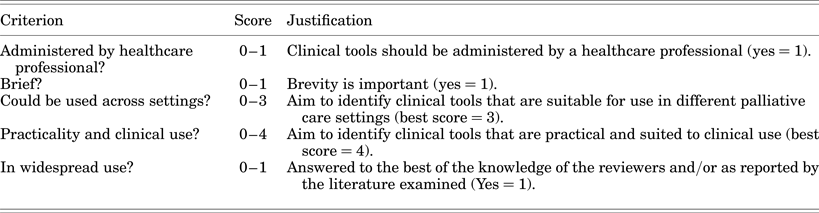
An appraisal process was conducted to evaluate the clinical tools identified in phase 2. In line with the pragmatic aims of this review, tools were assessed according to their clinical and practical utility for specialist palliative care services defined according to the variables listed in Table 1, which were developed by the project team. Each tool was independently appraised by two reviewers according to predetermined criteria, which were established in partnership with the project advisory group, to assess their utility (scored on a 1–10 scale). In the case of discrepancies, the tool was discussed and agreement reached.
Clinical tools appraisal criteria

For particular domains of palliative care that had already been subject to a recent and comprehensive systematic review, we assessed only the clinical tools recommended by previous authors in line with our criteria (Table 1). These domains included: family/caregiver needs assessment (Hudson et al., Reference Hudson, Trauer and Graham2010), psychological/emotional needs (Thekkumpurath et al., Reference Thekkumpurath, Venkateswaran and Kumar2008; Vodermaier et al., Reference Vodermaier, Linden and Siu2009), quality of life (Albers et al., Reference Albers, Echteld and de Vet2010), and prognostic tools (Lau et al., Reference Lau, Cloutier-Fisher and Kuziemsky2007).
Phase 4: Expert Palliative Care Focus Group
A multidisciplinary expert focus group (n = 7) was assembled to review the clinical utility of the tools that were appraised in phase 3, with a view to providing recommendations regarding particular tools with relevance to practice in the Victorian palliative care setting. Purposive sampling was undertaken to identify members of the Palliative Care Clinical Network (a statewide initiative to foster improvement in palliative care) and to ensure a variety of disciplines and sites (home, hospital, hospice) of care provision were represented.
The focus group was facilitated by one investigator (JP) and structured according to the domains of palliative care. Perceptions of tools within each domain were sought. Copies of the included tools and their appraisal scores were made available to focus group participants, who considered these alongside the tools' appropriateness and practicality for palliative care practice.
The preferred clinical tool in each domain was recorded, along with observations about the tools and recommendations of how the preferred tools were to be used to ensure both the functions of screening and assessment or ongoing monitoring.
RESULTS
In addition to the results outlined below, a summary of our results is illustrated in Figure 1.
Summary of results.
Palliative Care Provider's Perceptions of Clinical Tools (Phase 1)
Phase 1 participants included 38 healthcare professionals from 60 invited palliative care providers (response rate 63.3%). The participants worked across settings, including community (68%), inpatient (18%), and consultancy (13%) services, from metropolitan (32%), regional (45%), and rural (55%) areas. Participants identified several clinical tools that were currently being utilized through the palliative care sector in Victoria. The most widely used tools included: the Karnofsky Performance Status (KPS) scale (Karnofsky et al., Reference Karnofsky, Abelman and Craver1948) (79%), the RUG–Activities of Daily Living scale (Williams et al., Reference Williams, Fries and Foley1994) (66%), the Australian Palliative Care Outcomes Collaboration (PCOC) tools (Eagar et al., Reference Eagar, Watters and Currow2010) (47%), the Edmonton Symptom Assessment System (ESAS) (Nekolaichuk et al., Reference Nekolaichuk, Watanabe and Beaumont2008) (47%), the Liverpool Care Pathway for the Dying Patient (24%), and the Eastern Cooperative Oncology Group (ECOG) scale (Oken et al., Reference Oken, Creech and Tormey1982) (24%).
Participants recognized and indicated their support for the use of clinical tools in specialized palliative care settings. Common benefits cited included: “enables prioritizing care,” “improves quality of care,” and “enables benchmarking.” Completion of clinical tools was generally reported to be undertaken by senior staff within the organization. The main barrier to the use of clinical tools reported by participants was the perceived resources needed to enter patient data into information systems following completion. Nonetheless, benefits were reported to outweigh the effort involved for all common clinical tools identified in the survey.
Systematic Literature Review and Critical Appraisal (Phases 2 And 3)
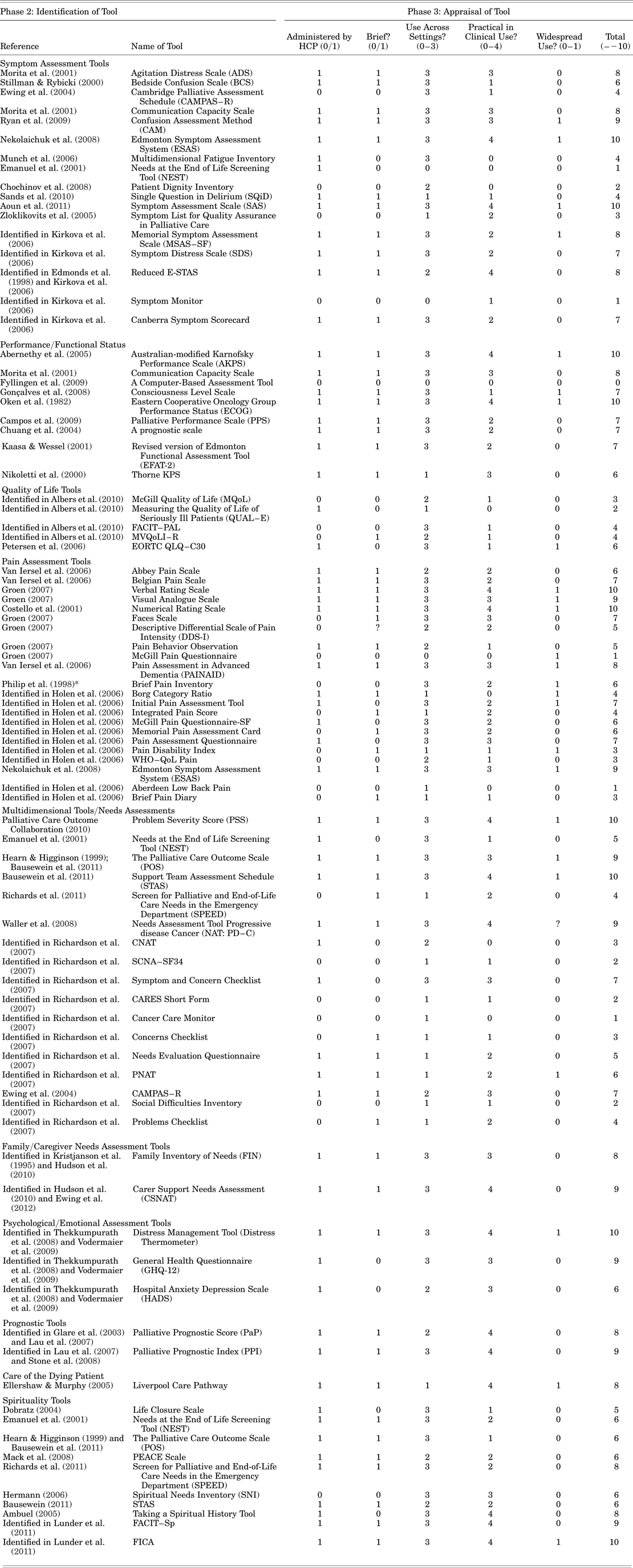
The search strategy undertaken resulted in the identification of 90 clinical tools that were appraised for their applicability for use in specialist palliative care (Table 2). These tools represented several domains of palliative care, including assessment of: symptoms (17 tools); performance/functional status (11 tools); pain (22 tools); needs/multidimensional assessments (18 tools); spirituality (10 tools); and care of the imminently dying patient (2 tools). Additionally, appraisal was also undertaken on recommended tools by recent systematic reviews of the following domains: family/caregiver needs assessment (two tools) (Hudson et al., Reference Hudson, Trauer and Graham2010); psychological/emotional needs (three tools) (Thekkumpurath et al., Reference Thekkumpurath, Venkateswaran and Kumar2008; Vodermaier et al., Reference Vodermaier, Linden and Siu2009), quality of life (five tools) (Albers et al., Reference Albers, Echteld and de Vet2010); and prognostic tools (two tools) (Lau et al., Reference Lau, Cloutier-Fisher and Kuziemsky2007).
Clinical tools identified and appraised by reviewers
Overall, there were a number of tools available with relevance to the specialist palliative care setting. The quality of tools across domains, however, was variable, as evidenced in the wide variation of appraisal scores (1–10). Some tools identified within a particular domain were very specific to a particular patient subgroup or problem, such as the dementia pain scoring system. While some of these particular tools were identified as robust and scored highly on the parameters, their specificity meant that generalization to a broader patient group and set of problems was limited.
Clinical Tools Recommended for Widespread Use in Specialist Palliative Care Services (Phase 4)
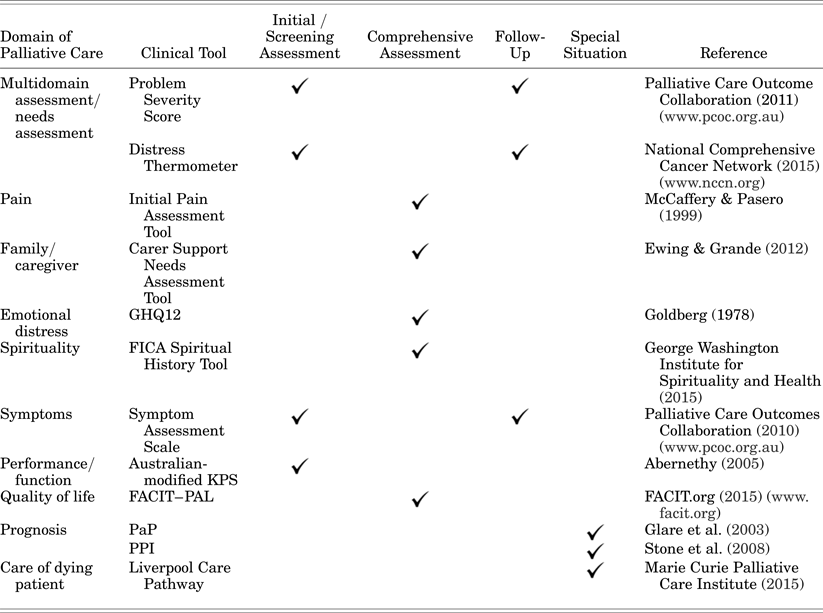
The focus group participants reviewed the tools identified within each of the domains, noted the results of the appraisal of each tool, and discussed the applicability of each to clinical care in light of these factors. In each domain, a preferred tool was identified through consensus. The practicality of application was a key factor in each case (Table 3). For this reason, the highest-scoring tool during the appraisal process was not always chosen by the focus group participants as the preferred tool. Of note, the focus group agreed upon an approach that involved screening broadly for problems at key points, and then application of specific tools to regularly monitor those problems identified in order to foster effective care planning.
Overview of the clinical tools recommended for widespread use
DISCUSSION
Multiple tools are available to assist healthcare professionals to assess and record patient care; however, discerning which ones are most pertinent for routine systematic use across services and sites of care can be challenging. Our study provided recommendations for a suite of clinical tools to assist specialist palliative care services in Victoria to assess and plan care for patients and their family caregivers.
While we have recommended tools across several domains of palliative care provision and advocate for routine assessment to include these aspects of care, we recognize the challenges associated with implementation. For services that do not currently use tools in practice, we suggest to focus attention on one domain in the first instance, and to systematically implement a single tool to gradually orientate staff to the assessment system. For services that utilize a few tools sporadically, our recommendations may be used to review current practice and tighten assessment accordingly, moving toward a consistent approach to care. Finally, services with an established practice of clinical assessment measurement may wish to implement the whole suite of tools into clinical care, and monitor outcomes and resourcing issues of this change to practice.
The process of developing the list of recommended tools in this study was comprehensive, yet we took a pragmatic approach to ensure that recommended tools were relevant to “real-world” practice. There were, however, several limitations. Importantly, while we noted if there had been psychometric data published for each tool, we did not explicitly examine validity and reliability data. Although we have evaluated the clinical utility of relevant tools, others have pointed to a lack of testing of such tools in practical care, and we know little about the responsiveness, feasibility, appropriateness, and acceptability of many needs assessments.
CONCLUSIONS
We have recommended a suite of practical clinical tools that cover the most important domains of palliative care. We suggest that subsequent work be undertaken to explore the pragmatic implications of systematically implementing these clinical tools into standard specialist palliative care practice. This will need to involve consideration of cost, policy, and resource issues. In addition, training for staff would also be required. Finally, evaluation of the implementation would need to be undertaken.
ACKNOWLEDGMENTS
We would like to thank the focus participants for their time and expertise:
■ Dr. Juli Moran Director of Palliative Care Services, Austin Health. (physician, metropolitan-based practice)
■ Ms. Kathleen Hendry, Project Officer, Palliative Care and Haematology, Western Health. (nurse, metropolitan-based practice)
■ Ms. Carmel Smith, Executive Manager, Goulburn Valley Hospice Care Service Inc. (nurse, rural-based practice)
■ Ms. Theresa McCarthy, Caritas Christi Hospice, St. Vincent's Health. (pastoral care worker, metropolitan-based practice)
We would also like to acknowledge the expert opinion provided by Professor Brian Kelly, Associate Professor Rosalie Hudson, and Associate Professor Bruce Rumbold.
FUNDING
This study was funded by the Department of Health, Victoria, to support the initiatives of the Victorian Palliative Care Clinical Network.