After the Western uproar against the trade of white females in Third World countries in the early nineteenth century, the problem of trafficking in persons [TIP] only gained renewed attention after the end of the Cold War. This was thanks to overwhelming reports on the growing practice of the sale of humans from the impoverished former Eastern Bloc countries to Western Europe, as well as the publication of the report of the United Nations [UN] Working Group on Contemporary Forms of Slavery.Footnote 1 In Southeast Asia, TIP became a regional concern given the booming tourism industries and the increasing “feminization” and “illegalization” of labour migration in 1970s–1980s.Footnote 2 In the early 1980s, concerns over the role of organized criminal groups in TIP in Southeast Asia were added to the fold.Footnote 3 The prevalence of TIP in Southeast Asia gained more attention when the head of the United Nations Office on Drugs and Crimes [UNODC] estimated that the number of Southeast Asians falling victims to TIP in 1990–2000 had exceeded the number of slaves in the entire history of the transatlantic slave trade.Footnote 4 With growing international scrutiny on the prevalence of TIP around the world, some sources have dubbed Southeast Asia a TIP hotspot,Footnote 5 with all Southeast Asian states being identified as source, transit, and/or destination countries for intra- and extra-regional TIP.Footnote 6
Unfortunately, because of its clandestine nature and other factors (e.g. the lack of a comprehensive definition and understanding of TIP), law enforcers around the world find it hard to identify victims and apprehend perpetrators, or even to generate a reliable estimate of the number of TIP victims. This is particularly so in Southeast Asia, as the exact prevalence of, and revenue generated from, TIP in the region are unknown. Furthermore, efforts to gauge the prevalence of TIP in the region focus more on women and children victims, and hardly any data exist on male victims (although this may change with the recent exposé of the trafficking and enslavement of men and boys in Thailand’s fishing industry). In addition, the absence of a sound methodology still makes it difficult for the region to generate reliable estimates and data. Thus the picture of the TIP problem in the region is incomplete and cannot effectively inform the formulation of comprehensive national and regional strategies to eradicate TIP.
The Association of Southeast Asian Nations [ASEAN] has taken the lead in the regional effort to eradicate TIP since 1997, with the adoption of the ASEAN Vision 2020. In this document, ASEAN Member States [AMS] acknowledge that TIP is a problem that “can be met only on a regional scale” and that requires “agreed rules of behaviour and cooperative measures” from Member States.Footnote 7 While the United Nations Convention on Transnational Organized Crime [UNCTOC] and the Protocol to Prevent, Suppress, and Punish Trafficking in Persons, especially Women and Children [TIP Protocol] classify TIP strictly as a transnational organized crime,Footnote 8 the ASEAN framework treats TIP as a transnational crime and migration issue, without requiring the role of an organized criminal group in its commission.Footnote 9
As with most of ASEAN’s political-security commitments, ASEAN’s anti-TIP measures were based on non-binding regional instruments such as the ASEAN Declaration to Combat Transnational Crime and its Plan of Action, and the ASEAN Declaration against Trafficking in Persons.Footnote 10 ASEAN also established the ASEAN Ministerial Meeting on Transnational Crime [AMMTC] to co-ordinate regional actions against transnational crime, and the Senior Official Meeting on Transnational Crime [SOMTC]—the AMMTC’s operational arm—to implement measures against transnational crime, including TIP.Footnote 11 AMS membership in the UNCTOC and TIP Protocol may contribute directly to the growing regional efforts to eradicate TIP.Footnote 12 Nevertheless, despite AMS’ concern over TIP in the region, their reluctance to adopt a regional legal instrument against TIP until 2015 has resulted in less legalization of the issue.
Considering AMS’ general reluctance to conclude consequential legal instruments under the ASEAN political-security pillar, the adoption of the ASEAN Convention against Trafficking in Persons especially in Women and Children [ACTIP)] in November 2015 is a major step towards combating TIP, and to stronger legalization of anti-TIP measures in Southeast Asia.Footnote 13 Remarkably, ACTIP has recently entered into force with record speed.Footnote 14 However, these developments also present a number of important questions. Will ACTIP create genuine hard legal obligations on AMS to take meaningful actions against TIP? And with its entry into force, how will the Convention be implemented and complied with in a consistent manner?
This paper endeavours to answer the above questions by comparing ACTIP to other relevant international and regional anti-TIP conventions, to assess the strength of the former’s provisions. The paper argues that ACTIP’s adoption and entry into force represent a growing trend in ASEAN treaty practice, especially on issues of international and regional concern, in which ASEAN uses combinations of hard and soft obligations in certain treaties to encourage states’ ratification, and thus the treaties’ timely entry into force. Notwithstanding this progress, more needs to be done to increase the effectiveness of ACTIP, including the prescription of a stronger compliance mechanism. The first part of the paper will describe the prevalence of TIP in the region and the need for concerted actions against TIP, to explain the need for reliable data and estimates. The second part of the paper will discuss the ASEAN framework and measures against TIP prior to ACTIP’s adoption. It then provides a preliminary overview and analysis of ACTIP’s provisions, measuring it against relevant international and regional treaties such as the UNCTOC, the TIP Protocol, and the Council of Europe Convention on Action against Trafficking in Human Beings [CoE Convention].Footnote 15 The conclusion will discuss ACTIP’s entry into force vis-à-vis ASEAN treaty practice and possible challenges regarding implementation of and compliance with ACTIP.
I. The Prevalence of TRAFFICKING in Southeast Asia
A. Trafficking in Women and Children
The 2013–2014 US Department of State’s TIP Reports estimate that there are twenty to twenty-seven million TIP victims, including children, around the world.Footnote 16 The US’s 2010 TIP Report estimates that women and girls constitute fifty-six percent of TIP victims.Footnote 17 In one of its recent findings, the UNODC finds that women (forty-nine percent) and children (thirty-three percent) constitute the majority of TIP victims.Footnote 18 The International Labour Organization [ILO] estimates that traffickers generated up to US$32 billion annually through TIP, making it the third most lucrative transnational organized crime.Footnote 19
As the general practice shown above illustrates, many organizations almost always provide a general prevalence estimate on the number of persons falling victims to TIP in their reports, to describe the seriousness of the threat of TIP both globally and regionally.Footnote 20 However, there is simply no agreed estimate on the number of trafficked men, women, and children in Southeast Asia.Footnote 21 For instance, the International Organization for Migration [IOM] estimates that about 200,000–225,000 women and children are trafficked from Southeast Asia every year,Footnote 22 while the UNODC estimates that more than thirty million women and children may have been trafficked from and within the region.Footnote 23 These estimates on the number of TIP victims in the region are not updated; the above-mentioned estimates are only the most cited estimates of TIP victims in the region since 2000.Footnote 24
Estimates on revenue generated from TIP in the region are generally derived from revenue generated from the sexual exploitation and forced labour of women and children.Footnote 25 Considering the clandestine nature of TIP, and the failure to account for victims of male sex trafficking, the real number may be even higher. It contributes significantly to the US$100 billion revenue generated from transnational organized crime in Southeast Asia.Footnote 26 It is still not clear why estimates on TIP prevalence in Southeast Asia focus on women and children. One plausible explanation is the proliferation of a huge body of research on TIP in Southeast Asia establishing that the great majority of TIP victims are women and children.Footnote 27 The tourist boom in Southeast Asia resulted in sex tourism in Thailand, the Philippines, and Cambodia, hence the increase of women’s and children’s participation in labour migration within and from Southeast Asia (the feminization of labour migration).Footnote 28 Similarly, available data on TIP in the region produced by national authorities and international organizations also focus on women and children.Footnote 29
Turning to specific forms of exploitation, many studies show that TIP in Southeast Asia is mainly for the purposes of prostitution and other forms of sexual exploitation, forced labour, “trade in brides”, and domestic workers.Footnote 30 Trafficking in children is usually for the purposes of panhandling, domestic workers, and the child brides industry.Footnote 31 Since 2011, there have also been growing incidents of trafficking in new-born babies in Malaysia and Thailand for adoption.Footnote 32 The 2014 Global Slavery Index report confirms that “baby-trafficking” is still prevalent in Southeast Asia.Footnote 33 Apart from cross-border TIP, TIP within the national territory of AMS is highly prevalent, especially in ASEAN coastal states such as Indonesia, Myanmar, the Philippines, Thailand, Malaysia, and Vietnam.Footnote 34
B. Trafficking in Men
The lack of estimates, data, and research on trafficking in men does not mean that the number of TIP male victims is insignificant. If women and children are generally profiled as TIP victims, then men are mostly profiled as irregular migrants in Southeast Asia.Footnote 35 However, recent investigation reports by several international media revealed a shocking discovery that will change this perspective: the trafficking and enslavement of men and boys in Thailand’s fishing industry, and the trafficking of Rohingyas and Bangladeshis into forced labour in Malaysia and Thailand.Footnote 36
Some media reports uncovered the appalling practice of Thai fishing companies enslaving labourers from the Philippines, Myanmar, and Cambodia. These men are generally recruited by illegal manning agencies and the Malaysia-Thailand border criminal ring. They are made to catch fish in the waters of Indonesia, Thailand, the South China Sea, and the South Atlantic, for export to the US and Europe. Traffickers either kidnapped or tricked their victims into agreeing to indentured servitude and then sold them into slavery, and many of the victims are now stranded and trapped in the remote Indonesian island of Benjina.Footnote 37 So far, there is no authoritative estimate on the number of men and boys trafficked into the Thai seafood industry. However, one report stated that at least 4,000 foreign forced labourers have been abandoned in Benjina as of March 2015.Footnote 38
The reports indicate that the main push and pull factors to this crime are the lucrative revenue generated by Thailand’s ever-expanding fishing industry—the biggest seafood industry in the world, and one that generates more than US$7 billion annually—and the decreasing interest of able men from Thailand, Cambodia, and Myanmar to take up jobs at sea because of the low safety standards.Footnote 39 The reports are the first to describe the regional dimension of trafficking in men in Southeast Asia. Unfortunately, there has yet to be a comprehensive study on the extent of trafficking in men at the regional level, or on the interrelation of irregular migration, migrant smuggling, and the demand side of trafficking in men in Southeast Asia’s migration discourse.Footnote 40
The year 2015 also witnessed the massive trafficking of the Rohingyas and Bangladeshis into Thailand and Malaysia. In May 2015, a Rohingya roti seller reported to the Thai authorities about TIP activities on the Malaysia-Thailand border in a desperate bid to save his nephew, who was held by traffickers. The search lead to the discovery of a mass grave containing the remains of twenty-six Rohingya and Bangladeshi TIP victims in Songkhla province (Thailand).Footnote 41 By June 2015, the Malaysian authorities discovered 139 gravesites, 28 detention camps, and at least 150 corpses on their side of the border, while their Thai counterparts found at least six detention camps, five mass graves, and thirty-three corpses.Footnote 42 Despite these findings, the Malaysian authorities never confirmed the total number of deaths. In fact, local accounts revealed that such slave camps have been plaguing the Malaysia-Thailand borders for at least a decade, and that reports to the police have been filed but have received little to no response.Footnote 43
Traffickers have exploited the desperation of many Bangladeshis and Rohingyas, who mostly live under unbearable economic hardship and are subjected to persecution, to lure them into TIP and slavery.Footnote 44 According to the Freeland Foundation and the Daily Star investigations, TIP on the Malay-Thai borders is run by an international criminal syndicate that recruits unknowing individuals in the Cox’s Bazar District (Bangladesh) and Rakhine state (Myanmar) and transports them to the the southern Thailand and northern Malaysian borders.Footnote 45 Traffickers lure victims with promises of better jobs and living conditions in Malaysia for a small transportation fee of US$100–200. However, instead of taking these people directly to Malaysia, the boats docked in Thailand and immediately the victims were kept captive and separated into two categories: those who have friends or relatives who could pay for their ransom and those who do not.Footnote 46 Those who belonged to the latter category are usually sold as cheap labour into the Malaysian agriculture industry and the Thai fishing industry.
The UN High Commissioner for Refugees estimates that about 31,000 Bangladeshis and Rohingyas who left the Bay of Bengal in 2015 fell victim to such a scheme.Footnote 47 The discovery of the mass graves of TIP victims and slave camps led to a regional crisis of abandoned vessels overloaded with thousands of Rohingyas and Bangladeshis in the Bay of Bengal and the Andaman Sea.Footnote 48 In July 2015, The Guardian’s investigation confirmed that the slaves working aboard Thai fishing boats were also victims of the jungle slave camps on the Malaysia-Thailand border, establishing a direct link between TIP and the Thai seafood industry.Footnote 49
These findings prompted strong reactions from the international community, especially from major seafood importers. In April 2015, the European Union [EU] warned Thailand that it would impose a ban on Thai seafood if the use of slave labour persisted.Footnote 50 The prospect of losing about US$1 billion/year in the European market because of this ban spurred the Thai government to strengthen efforts to eradicate TIP criminal rings, as well as to impose higher labour and fishing permit requirements on Thai fishing companies. In 2016, the government claimed that it had made significant progress in reducing TIP in its seafood industry. However, media reports show that slave labour aboard Thai fishing ships is still prevalent.Footnote 51 Recent reports even suggest that the government’s rigorous anti-trafficking measures in the seafood industry, coupled with Thailand’s shrinking fish stock, may have caused the situation to deteriorate. The reports reveal that the government’s rigorous anti-TIP measures have driven many local fishermen to convert their boats to illegally smuggle migrants, as it is easier and generates more income than catching fish.Footnote 52
C. Organized Criminal Groups
The presence of organized criminal groups in Southeast Asia has long been established.Footnote 53 These criminal groups typically take the guise of recruitment agencies that mainly target women and children for the purposes of sexual exploitation and forced labour.Footnote 54 However, criminal groups involved in TIP are not necessarily organized. Marshall reported that TIP within the Greater Mekong Sub-region [GMS] resembles that of a cottage industry with an array of small-scale smuggling operators along the migration path, who occasionally turn to trafficking their customers.Footnote 55 Some authors also noted that TIP in Southeast Asia is “often informal and managed through personal connections”.Footnote 56 Nevertheless, both regional and international criminal syndicates have been more active in intra-Southeast Asia TIP since 1998,Footnote 57 such as the trafficking of Rohingyas and Bangladeshis into Malaysia and Thailand and the Yakuza’s increasing involvement in trafficking in women and children from and within the GMS.Footnote 58 AMS need to be vigilant of organized criminal groups in the region, because of the clandestine nature of TIP and the absence of an intra-ASEAN open-border policy for ASEAN citizens.
II. Intra-ASEAN Framework against Trafficking Prior to the Adoption of the Convention
Before the adoption of ACTIP in 2015, ASEAN adopted various non-binding instruments to deal with TIP in the region. For example, ASEAN developed a framework against transnational crime in the late 1990s, acknowledging that AMS needed agreed rules of behaviour and co-operative measures to deal with the rise of transnational crime.Footnote 59 Then in 1997, ASEAN adopted the Declaration on Transnational Crime, which recognized the need to have clear and effective regional modalities to combat transnational crimes.Footnote 60 This Declaration was monumental, as it established the AMMTC, the highest policy-making body based on ASEAN co-operation to combat transnational crime, including TIP. The AMMTC is also responsible for co-ordinating co-operation among ASEAN bodies, and with international agencies, to fight transnational crime.
In 1999, the AMMTC adopted the Plan of Action to Combat Transnational Crimes. This outlined the general measures that states needed to take to implement the 1997 Declaration, such as the criminalization of TIP within their domestic jurisdiction and the capacity-building of law enforcers.Footnote 61 Most importantly, the Plan of Action established the SOMTC to implement policies adopted by the AMMTC, and developed work programmes implementing the Plan of Action.Footnote 62 Another crucial development in the Plan of Action is the assignment of the Meeting of ASEAN Director-Generals of Immigration and Heads of Consular Affairs Division [DGICM], the ASEAN Chief of National Police [ASEANAPOL], the ASEAN Law Ministers Meeting [ALAWMM], and ASEAN Finance Ministers in the investigations and prosecutions of perpetrators.Footnote 63
As mandated in the 1999 Plan of Action, the AMMTC approved the Work Programme to Implement the ASEAN Plan of Action to Combat Transnational Crime.Footnote 64 The Work Programme requires AMS to strengthen regional efforts to combat TIP by submitting country-specific studies on TIP, a report on national laws and regulations, and information on relevant international treaties that each AMS has ratified or acceded to, and progress reports of states’ efforts to enact relevant domestic legislation.Footnote 65 It also requires the criminalization of TIP and harmonization of domestic legislation as a basis for regional policies to combat TIP.Footnote 66
In line with the 1999 Plan of Action,Footnote 67 the DGICM, working under the AMMTC, is tasked with the responsibility of overseeing the implementation of regional commitments on TIP as indicated in the 2000 Plan of Action for Cooperation in Immigration Matters.Footnote 68 The Immigration Plan of Action serves as one of the Plans of Action to implement the 1997 Declaration on Transnational Crime. It focuses on the institutional structure to co-ordinate co-operation on immigration issues, including TIP, and the dismantling of criminal organizations.Footnote 69 The adoption of the Plan of Action marks the inclusion of TIP in the ASEAN framework on migration, and further highlights the security concern that TIP poses to the region. It represents an uplifting development, as the Plan of Action, albeit in general terms, focuses not only on border measures but also on strengthening collaboration on other measures to prevent and eradicate TIP.Footnote 70
In 2001, the AMMTC stated that transnational crime, including TIP, threatens ASEAN security, and classified it as a non-traditional security issue.Footnote 71 The DGICM followed by acknowledging that the issue of TIP had become more pressing and that ASEAN needed to adopt specific instruments against TIP.Footnote 72 As a response to the regional concerns over transnational crime, the 2003 Declaration of ASEAN Concord II firmly acknowledged TIP as a threat to regional security that needed to be tackled under the auspices of the future ASEAN Political-Security Community.Footnote 73 The 2003 Declaration was followed by the adoption of the ASEAN Declaration against Trafficking in Persons Particularly in Women and Children in 2004.Footnote 74 The 2004 Declaration showed a focus on victim protection, which included commitments in differentiating victims from perpetrators, ensuring humane treatment of victims, and safeguarding the human rights of victims.Footnote 75
However, the 2004 Declaration’s strategy in counter-TIP still relied heavily on immigration measures. For instance, while the Declaration urged the AMS to distinguish victims from perpetrators and to undertake actions to respect and safeguard the victims’ human rights, it still focused on the repatriation of victims and stayed silent on measures to prevent the re-trafficking of repatriated victims.Footnote 76 Furthermore, the Declaration did not indicate any measure to differentiate victims of TIP from irregular migrants. As many TIP victims enter the country of destination or transit illegally because of coercion or deception, the absence of such measures may put victims of TIP at a disadvantage when they encounter law enforcers or immigration officers. Being classified as irregular migrants can cause them to be re-victimized by the authorities who are supposed to grant these victims protection.
In 2004, ASEAN also adopted the Treaty on Mutual Legal Assistance in Criminal Matters [MLAT],Footnote 77 which provided a basis for international co-operation in criminal investigations and prosecutions among AMS.Footnote 78 The MLAT required each Member State to establish a central authority to make and receive requests on mutual legal assistance.Footnote 79 In particular, Article 5(2) enabled the central authorities to expand their co-operation to include the International Criminal Police Organization [INTERPOL] and the ASEANAPOL. The adoption of the MLAT corresponded with the ASEANAPOL’s broadening scope, which required the MLAT to provide comprehensive measures on mutual legal assistance, harmonize AMS’ relevant anti-TIP legislation, and support the adoption of national action plans against TIP.Footnote 80 The MLAT was the first relevant binding instrument that could boost co-operation among AMS to investigate and prosecute traffickers. However, despite the number of transnational crimes reported in Southeast Asia, no known request has been made under the MLAT scheme for TIP-related cases,Footnote 81 partly because the MLAT provisions cannot be applied effectively without legal harmonization in some AMS.Footnote 82
In 2007–2010, ASEAN adopted several instruments relevant to, and affirmed the security and migration dimensions of, TIP within the ASEAN counter-TIP framework. These instruments consisted of (1) the 2007 ASEAN Declaration on the Protection and Promotion of the Rights of Migrant Workers, which reiterated AMS’ commitment to take concrete measures to curb TIP by applying stricter penalties to traffickers;Footnote 83 (2) the 2009 ASEAN Political-Security Community Blueprint, which focused on strengthening AMS’ criminal justice responses in eradicating TIP “bearing in mind the need to protect victims” according to AMS regional and international commitments;Footnote 84 and (3) the 2010 Master Plan on ASEAN Connectivity, which set up an ASEAN committee to implement the Migrant Workers Declaration in developing an instrument to, among other things, curb TIP.Footnote 85
In 2015, the AMMTC adopted the Kuala Lumpur Declaration in Combating Transnational CrimeFootnote 86 to reinvigorate the existing ASEAN framework to fight TIP, in response to the Rohingya refugee crisis in Southeast Asia and the trafficking of Rohingyas and Bangladeshis in some ASEAN countries. These crises put ASEAN under close international scrutinyFootnote 87 and raised serious regional security challenges. The Declaration strengthened the mandate of the AMMTC, by prescribing the AMMTC’s annual meeting and its power to hold emergency meetings to take swift actions against immediate threats.Footnote 88 The Declaration also stipulates cross-sectoral co-ordination with the ASEAN Economic Community and Socio-Cultural Community.Footnote 89 The direct reference to cross-sectoral co-ordination with the ASEAN Socio-Cultural Community is a sign of progress as ASEAN starts to align the political-security dimension of TIP with the need to observe better treatment of TIP victims, especially women, children, and migrant workers.Footnote 90 The Declaration endorsed the work of the ALAWMM to enhance co-operation on extradition, including the continued drafting of an ASEAN convention on extradition.Footnote 91 The Declaration also prescribed the formulation of “a new ASEAN Plan of Action to Combat Transnational Crime” that ostensibly will replace the 1999 Plan of Action and its Work Programme.Footnote 92 The latest ASEAN Political-Security Blueprint 2025 reaffirms all of these strategies and measures.Footnote 93
Despite the ASEAN anti-TIP instruments adopted since the late 1990s, ASEAN’s measures against TIP remain less legalized, because AMS prefer to tackle this issue through non-binding instruments, and are reluctant to adopt consequential legal instruments. Although this approach may have served ASEAN’s interest in the past and enhanced intra-regional co-operation to fight TIP, the lack of legalization also likely means poor implementation and difficulties in measuring the progress of TIP eradication. Furthermore, ASEAN’s pronouncement that TIP constitutes a regional political-security concern rings hollow, because ASEAN and its Member States do not enforce their declared measures against TIP and also fail to tackle, for instance, the trafficking of Rohingyas and Bangladeshis into Malaysia and Thailand.Footnote 94 This disconnect indicates a lack of legal commitment and poor implementation and makes the legalization of regional anti-TIP measures even more imperative, especially with the escalating security threats and international pressures that TIP presents to the region.
ACTIP, as will be discussed in the next section, is one of the many steps towards legalization. ACTIP represents a meaningful departure from past ASEAN practices on TIP eradication, mostly because it provides binding legal obligations for AMS and ASEAN to step up their counter-TIP and victim protection measures. But there is a danger that AMS may fall back on their old habit of pronouncing rhetoric rather than implementing their commitments. It remains to be seen whether the entry into force of ACTIP will translate ASEAN’s regional political-security concern over TIP into more effective implementation in eradicating TIP.
III. The ASEAN Convention against Trafficking in Persons
In accordance with the ASEAN Plan of Action to Combat Transnational Crime, the SOMTC established the Working Group on Trafficking in Persons [WG-TIP], which consists of ASEAN experts on TIP eradication. The WG-TIP aims to assist with implementation policies and plans adopted by the AMMTC.Footnote 95 In 2007, the AMMTC tasked the SOMTC and the WG-TIP with conducting studies on the possibility of developing an ASEAN convention against TIP.Footnote 96 The WG-TIP conducted nine experts’ group meetings, spearheaded by the Philippines, to draft ACTIP and its Plan of Action.Footnote 97 The ASEAN Foreign Ministers Meeting and ASEAN leaders followed the drafting of ACTIP closely and set out a deadline for the adoption of ACTIP in 2015.Footnote 98 Crucial to the fulfilment of this deadline is the Emergency AMMTC Meeting in July 2015 that stipulated the early adoption of ACTIP in September 2015.Footnote 99 This is understandable considering the security threats that the region faced in relation to the involvement of international smuggling and TIP rings in the exploitation of the Rohingyas and Bangladeshis. Finally, in November 2015, all ASEAN leaders signed and adopted ACTIP and its Plan of Action.Footnote 100
ACTIP resquires all AMS to ensure that their domestic legislations are consistent with their obligations under ACTIP. Its provisions are generally an amalgamation of provisions from other international treaties related to transnational crime and TIP, such as the UNCTOC, the TIP Protocol, and the CoE Convention. The following parts of this paper provide a preliminary analysis of ACTIP and assess whether ACTIP has provided the needed legal framework and scope to combat TIP in Southeast Asia.
A. Scope and Purpose
ACTIP’s objectives are to prevent and combat TIP, to ensure the just and effective punishment of traffickers, to protect and assist TIP victims, and to promote regional legal co-operation, which echo those of the TIP Protocol.Footnote 101 Special reference is made to the importance of the principle of nondiscrimination, which suggests that ACTIP provisions should be applied equally without any discrimination based on gender, race, or nationality.Footnote 102 ACTIP applies to all forms of transnational TIP, with or without the involvement of organized criminal groups in the commission of TIP.Footnote 103
The dual status of ACTIP as a security and human rights instrument in ASEAN is suggested by ACTIP’s emphasis on the protection and assistance of TIP victims, the recognition of TIP as a violation of human rights, and AMS’ implied commitments on human rights. Such dual status is possible through the role of the ASEAN Intergovernmental Commission on Human Rights [AICHR] and the Philippines government in promoting the inclusion of a human rights-based approach in ACTIP since 2013.Footnote 104
Interestingly, breaking away from their typical reserved stance on universal human rights standards, ASEAN states did not put a caveat on their commitments to respect and promote universal human rights standards in ACTIP provisions. Normally, a set of limitations based on the principle of “non-interference in the internal affairs” of a Member State and the due regard to the different culture, history, and socioeconomic conditions in each ASEAN Member State (regional particularities) always follows any mention of universal human rights standards in an ASEAN instrument.Footnote 105 Without these caveats in ACTIP, there is no room for AMS to justify any deviation from their international commitments listed in ACTIP based on sovereignty and regional values.
So far, AMS has steadfastly included these blanket caveats of regional particularities in most, if not all, of its binding and human rights instruments. These instruments include the ASEAN Charter, the 2007 ASEAN Convention on Counter Terrorism [ACCT], and the ASEAN Human Rights Declaration. It is not clear, however, why this caveat is absent from ACTIP. The Convention’s drafting processes were low key, and there is little or no information on the draft provisions released to the public prior to the adoption of ACTIP. While further analysis regarding ASEAN caveats on universal human rights standards in ASEAN instruments is important, this paper will not pursue this discussion. Such an analysis requires further study on all ASEAN binding and human rights instruments containing these caveats on the applicability of universal human rights, including their exclusion from ACTIP. Nevertheless, although the absence of the above caveats helps AMS develop the ASEAN human rights framework and implement ACTIP, the exclusion of such caveats may be an exception instead of a norm. One may hope, however, that such an exception can set a precedent that would prevail in cross-cutting issues that are of regional concern, such as security and human rights.
Furthermore, the assertion in ACTIP that the protection and assistance of victims constitutes one of the shared responsibilities of all AMS in the fight against TIP completed the evolution of the ASEAN approach in the fight against TIP. ASEAN’s earlier instruments gave almost a singular focus on the criminalization of TIP, particularly on the identification and punishment of the perpetrators.Footnote 106 The obligation to respect and protect TIP victims’ human rights in ACTIP affirms the human rights approach as an indivisible part of ASEAN’s counter-TIP strategy. Additionally, this assertion also indicates that ACTIP has a broader scope of purposes compared to the TIP Protocol, because the latter emphasizes the prevention, suppression, and punishment aspects of TIP, while the former emphasizes all of the aspects covered by the TIP Protocol and the protection of TIP victims.Footnote 107
B. TIP Definition
It was only in 2000 that states came together and agreed on a more comprehensive definition of TIP, with the adoption of the UNCTOC and its TIP Protocol. Article 3(a) of the TIP Protocol provides the following definition of TIP:
“Trafficking in Persons” shall mean the recruitment, transportation, transfer, harbouring or receipt of persons, by means of the threat or use of force or other forms of coercion, of abduction, of fraud, of deception, of the abuse of power or of a position of vulnerability or of the giving or receiving of payments or benefits to achieve the consent of a person having control over another person, for the purpose of exploitation. Exploitation shall include, at a minimum, the exploitation of the prostitution of others or other forms of sexual exploitation, forced labour or services, slavery or practices similar to slavery, servitude or the removal of organs.
The definition is by far the most widely accepted definition by states and non-governmental organizations [NGOs].Footnote 108 Additionally, the definition has also been adopted by a number of regional counter-TIP treaties and instruments.Footnote 109
The definition combines generally accepted components of TIP enunciated in previous anti-TIP treaties, such as “the exploitation of the prostitution of others”, the existence of “consent” of victims, or a person that has “control over another person”, and methods of compulsion, e.g. “by means of … fraud, of deception, of the abuse of power”.Footnote 110 The definition consists of three main elements—the action, means, and purpose—whose fulfilment is necessary to establish the crime of TIP. The action element includes a broad range of actions that covers the process and the result of TIP—from recruitment to the receipt of victims for the purpose of exploitation. As for the means, its presence is only relevant to trafficking in adults, and if this element is fulfilled, the consent of victims is no longer relevant and cannot be used as a defence.Footnote 111 The Protocol’s TIP definition provides an open-ended list of forms of exploitation, instead of a definition of “exploitation”.Footnote 112 Trafficking in children is the only exception to the application of this definition, as it only requires the fulfilment of the action and purpose; the means is considered irrelevant.Footnote 113
Despite the wide acceptance of the definition, there are problems in applying it. First, the definition lacks “standard measures” on a number of crucial concepts, such as “exploitation” and the means of TIP, which may cause, as Gallagher aptly pointed out, “definitional fluidities”.Footnote 114 For instance, to what degree can forms of “deception” or “coercion” satisfy the means element of the definition? Can the sale of children for adoption, which does not entail any practice akin to slavery, be considered as falling under the Protocol’s definition of TIP?Footnote 115 Moreover, can the sale and resale of pornography be included as a form of “prostitution of others”?Footnote 116 A number of reports have shown that the sale of children for adoption and forced marriage is prevalent around the world, and warrants further international consideration for inclusion in the TIP definition.Footnote 117 Furthermore, the definition does not criminalize the act of exploitation, as its main concern is to criminalize the process that leads to exploitation. Finally, the definition does not deal with the victims’ grievances; nor does the UNCTOC and its Protocol provide remedies for those who are subjected to exploitation.
Second, the TIP Protocol applies only to transnational TIP, and excludes TIP that occurs within the borders of a State Party, because of the status of the TIP Protocol as a supplement to the UNCTOC, and despite the applicability of the TIP definition to internal TIP.Footnote 118 Third, the TIP Protocol lacks a definition of “victim” and a process to identify TIP victims. As a result, many victims are often treated as irregular migrants due to the lack of an (accurate) identification process and/or understanding of TIP and irregular migration, notwithstanding the widespread ratification of the UNCTOC and its Protocols.Footnote 119
ACTIP adopts the TIP Protocol’s TIP definition entirely.Footnote 120 ACTIP’s breakthrough is reflected in the adoption of the definition of “victim”, which is similar to the definition of “victim” in the CoE Convention.Footnote 121 As part of its identification process, ACTIP requires each Member State to establish its own national guidelines for the “proper identification of victims”, and encourages AMS to co-operate with NGOs in the identification process.Footnote 122 Similar to the CoE Convention, ACTIP requires States Parties to adopt measures necessary to identify TIP victims and assign competent authorities to co-operate with NGOs in the identification process.Footnote 123 Furthermore, ACTIP includes provisions on the non-criminalization of TIP victims, a prohibition against detaining victims, and the option to allow victims to remain in States Parties’ territory.Footnote 124 ACTIP provisions on victims’ protection in general exceed the standards set out in the UNCTOC and TIP Protocol, but still fall behind the standards of the CoE Convention.Footnote 125 Nevertheless, ACTIP’s provisions on victim protection can assist not only in the identification of TIP victims in Southeast Asia vis-à-vis differentiating them from irregular migrants, but also in enhancing data-collection efforts and data reliability to support the adoption of better counter-TIP policies, both at national and regional levels.
C. Criminalization and Jurisdiction
Chapter II of ACTIP deals with States Parties’ obligations to criminalize TIP and other acts pertinent to TIP. Similar to the TIP Protocol, ACTIP requires States Parties to criminalize TIP committed intentionally, as well as any attempt to commit TIP. ACTIP establishes as criminal offences the aiding or abetting of the commission of TIP, and the organizing or directing of others to commit TIP.Footnote 126 Unlike the UNCTOC and the CoE Convention, ACTIP only extends this obligation to a natural person and does not prescribe any liability for a legal person, e.g. commercial companies and associations.Footnote 127 Considering the recent cases of TIP and forced labour in the Thai seafood industry, the absence of legal persons’ liability puts ACTIP behind the UNCTOC and the CoE Convention in terms of its comprehensiveness to end impunity for traffickers.
Apart from the criminalization of TIP, ACTIP also adopts provisions of the UNCTOC to criminalize participation in an organized criminal group, the laundering of the proceeds of TIP, corruption, and obstruction of justice.Footnote 128 Similar to the UNCTOC, ACTIP requires states to criminalize the acts of attempting and aiding or abetting the commission of the laundering of the proceeds of TIP; corruption; and the conduct of “organising, directing, aiding, abetting, facilitating or counselling the commission of serious crime involving an organized criminal group”.Footnote 129 On corruption, ACTIP does not include the UNCTOC’s recommendations to, first, criminalize bribery involving foreign public officials or international civil servants, and second, adopt measures to prevent, detect, and punish the corruption of public officials.Footnote 130 The absence of such measures belies the AMS’ acknowledgement that “government corruption” is one of the causes of TIP and that corruption eradication is key in the TIP operations along the Thai-Malay borders.Footnote 131
On penalties, ACTIP does not provide any general guidelines on penalties for the conduct that it requires States Parties to criminalize.Footnote 132 ACTIP does prescribe a number of aggravating circumstances, which require States Parties to impose higher penalties on the offenders.Footnote 133 These include circumstances where the offence was committed against a child (or a person who cannot fully take care of or protect him/herself), exposed the victim to a life-threatening illness, involved more than one victim, involved the serious injury or death of the victim (including death as a result of suicide), was committed by a public official in the performance of his/her duties, and demonstrated recidivism.Footnote 134
On jurisdiction, ACTIP’s Article 10 adopts the wording of Article 15 of the UNCTOC in its entirety. The Convention compels States Parties to establish jurisdiction to investigate, prosecute, and punish all offences prescribed above that were committed in their territory, including on board their vessels and aircraft. ACTIP recommends States Parties to establish jurisdiction in circumstances where, for instance, a national of a State Party is either a victim or a perpetrator of any of the punishable offences under ACTIP. All States Parties must establish the offences in ACTIP as extraditable offences under their domestic jurisdiction. They shall also establish jurisdiction based on the presence of an offender in their territory. If a State Party cannot or will not extradite an offender, it is obliged to prosecute the offender in its territory (aut dedere aut ajudicare).
D. Prevention of TIP
Article 11 of ACTIP on general prevention measures adopts Article 9 of the TIP Protocol in its entirety. It requires States Parties to establish comprehensive measures to prevent and combat TIP and to protect TIP victims from re-victimization. States Parties shall endeavour to undertake additional measures to prevent TIP through, among others, research and socioeconomic initiatives to prevent and combat TIP in co-operation with elements of civil society.Footnote 135 ACTIP also obliges States Parties to increase their efforts to address the root causes of TIP from both the demand and supply sides.Footnote 136 However, these provisions are aspirational in nature; they address the concerns vis-à-vis the challenges and root causes of TIP but do not contain any practical obligation to address such concerns. Meanwhile, Article 9 of the TIP Protocol, read together with Article 31 of the UNCTOC, imposes clearer obligations and general measures to prevent TIP, albeit they generally do not require legislative actions. These include obligations to apply more direct prevention measures through education, raising awareness, and international co-operation on prevention.Footnote 137
The CoE Convention may serve as a case-study in providing specific and direct obligations to address the root causes of TIP, i.e. TIP’s push and pull factors. For instance, to address TIP’s push factor, the CoE Convention requires States Parties to take necessary measures to enable legal migration into their territory, and the proper dissemination of relevant information to “counterac[t] traffickers misinformation” to potential victims.Footnote 138 As for addressing the pull factor, the CoE Convention obliges States Parties to adopt all necessary measures to discourage demand for vulnerable labour, including early education for children on TIP, gender issues and the consequences of gender-based discrimination, and the dignity and integrity of human beings.Footnote 139 That said, unfortunately, ACTIP fails to meet the minimum standards set out in the UNCTOC and its TIP Protocol.
On “Areas of Cooperation”, Article 12 lists the areas in which AMS can establish co-operation to prevent TIP.Footnote 140 AMS are encouraged to co-operate in areas that can (1) discourage the demand side of TIP; (2) address the root causes to reduce victims’ vulnerability to TIP; (3) strengthen TIP prevention policies; (4) strengthen regional co-operation in investigating and prosecuting TIP; (5) enable the legal free movement of people; (6) reduce children’s vulnerability to TIP; (7) promote capacity building; and (8) ensure the punishment of perpetrators of TIP.Footnote 141 States Parties may commence co-operation in the said areas with elements of civil society, international organizations, and other states.Footnote 142 Again, these are couched in unspecific terms, making it difficult to discern specific obligations on TIP prevention. Furthermore, the scope of the obligation is limited, as expressed in the qualifying phrase “in conformity with the domestic laws of the respective Parties”, which can be interpreted as referring to whether their respective domestic legislation is in favour of such co-operation.
Article 13 on border control obliges States Parties to establish direct channels of communication and enhance the exchange and sharing of intelligence information, including establishing and developing relevant databases. Considering that ASEAN has established a number of direct channels of communication to combat TIP,Footnote 143 reference to other direct channels of communication may be made based on the consideration that in some states border control authorities constitute a special division in their government structure, separate from law enforcement. States Parties are obliged to implement “effective border control and controls on the issuance of identity papers and travel documents”.Footnote 144 Article 13 has a more limited scope compared to the UNCTOC, the TIP Protocol, and the CoE Convention on border control. For instance, it does not include other specific measures directed at commercial carriers to prevent them from being used in the commission of TIP, as well as measures relating to the revocation of visas of persons who committed TIP.Footnote 145
The lack of preventive measures vis-à-vis commercial carriers may not help to prevent TIP. Strict requirements on the presentation of legal documents at the time of passenger checks prior to departure by commercial carriers, e.g. during the purchase of tickets, may help considerably in providing another layer to prevent TIP, especially in instances where document fraud is involved.Footnote 146 Legal and administrative sanctions on any commercial carrier that has been proven to be complicit in TIP or negligent in preventing TIP may also support the effective application of the document check requirement.Footnote 147 This highlights the importance of the inclusion of liability of legal persons in ACTIP, as it serves as a basis to impose an obligation of due diligence on commercial carriers.
E. Victim Protection and Assistance
Chapter IV of ACTIP deals with the protection, repatriation, and return of victims. Article 14 lists fourteen obligations and recommendations pertinent to the protection of TIP victims, which include the following:Footnote 148
-
1. the guarantee of TIP victims’ physical safety while they are in the territory of a State Party;
-
2. the protection of victims’ privacy and identity, and support measures to reduce victims’ suffering and to assist them in their recovery and rehabilitation;
-
3. the availability of support measures corresponding with the special needs of TIP victims, especially children;
-
4. the possibility of obtaining compensation.
The provision also adopts Article 7 of the TIP Protocol relating to the status of victims, which requires States Parties to consider adopting measures to allow victims to remain in their territory.
As discussed above, ACTIP goes beyond the scope of the TIP Protocol in relation to the identification of TIP victims. Article 14(1) obliges States Parties to establish national guidelines or procedures for the proper identification of TIP victims. Considering that states may apply different methods and standards of identification, the Convention requires States Parties to recognize the identification of victims concluded by a receiving state.Footnote 149 ACTIP urges States Parties not to hold TIP victims in detention during or after legal proceedings against traffickers, and to allocate appropriate funds for the care and support of TIP victims.Footnote 150 Finally, ACTIP recommends States Parties not to criminalize TIP victims for any unlawful act that they may have committed if such an act is directly related to the commission of TIP.Footnote 151
On the obligation to assist victims with recovery and rehabilitation, ACTIP arguably set out a more stringent requirement compared to the TIP Protocol. If the TIP Protocol only requires its States Parties to consider implementing measures to provide for the recovery of victims,Footnote 152 ACTIP obliges its States Parties, “where applicable”, to provide care and support for the recovery of TIP victims.Footnote 153 Despite the selective nature of the provision, one can argue that as long as a State Party, at the very minimum, already has a legal framework for the protection of victims of criminal acts, including reparation, then it is obliged to extend such protection to TIP victims. However, in some respects, ACTIP also suffers from the same maladies that plague the UNCTOC and the TIP Protocol. For instance, on the right of victims to compensation, ACTIP adopts Article 6(6) of the TIP Protocol and Article 14(2) of the UNCTOC in their entirety. These Articles only require States Parties to provide victims with the possibility of obtaining compensation, and to use the confiscated proceeds of crime to give compensation to victims of TIP. This means that States Parties are not obliged to ensure compensation for TIP victims, and even when they manage to seize and confiscate the proceeds of crime from a perpetrator or a criminal organized group, they are not obliged to use such proceeds to fund compensation for TIP victims.
Article 15 on the repatriation and return of TIP victims derives mostly from Article 8 of the TIP Protocol. It requires a State Party of which a TIP victim is a national or permanent resident to facilitate and accept the return of that person without undue delay.Footnote 154 In returning a TIP victim, the sending state must consider the safety of that person and the status of any legal proceedings related to the person’s status as a TIP victim.Footnote 155 A state of origin must also conduct all necessary verification on the status of the person in its jurisdiction, provide the necessary documents to facilitate the re-entrance of that person into its territory, and adopt necessary measures to establish repatriation programmes.Footnote 156 It seems that the repatriation and return of TIP victims is a sensitive issue among States Parties, as indicated in Article 15(2), that requires the return of TIP victims to their countries of origin/residence. In the TIP Protocol, such return “shall preferably be voluntary”, not mandatory. Furthermore, the requirement prescribed in Article 15(5) on repatriation programmes bears some similarities with Article 16(5) of the CoE Convention. However, unlike the CoE Convention, and despite its proclamation to prevent re-victimization,Footnote 157 ACTIP stops short of stipulating any obligation or measure to avoid re-victimization and reintegrating victims into society at home.
F. Law Enforcement
Article 16 of ACTIP consists of general obligations relating to (1) ensuring that States Parties’ competent authorities are equipped with the necessary skills to fight TIP and to protect victims; (2) taking effective measures to detect, deter, and punish corruption, money laundering, participation in organized criminal groups, and obstruction of justice; (3) ensuring an efficient legal system against TIP; (4) ensuring co-ordination of all relevant bodies to combat TIP; (5) encouraging TIP victims to co-operate in the prosecution of offenders; (6) providing capacity-building programmes for relevant officials to prevent and combat TIP; (7) taking necessary measures to provide protection to witnesses and victims of TIP from intimidation and harassment; and (8) establishing, within each State Party’s jurisdiction, a long statute of limitations period to commence proceedings for any offence under ACTIP. Article 16 generally focuses on ensuring the preparedness of States Parties’ law enforcers, judiciary, legal system, and national capacity to engage in international co-operation to meet the challenges of TIP and to implement ACTIP. Compared to the UNCTOC and the CoE Convention provisions, there are glaring gaps in the concrete obligations or guidelines on how to enforce the substantive criminal law prescribed in ACTIP.Footnote 158
However, this may not be a bad thing for ASEAN, as Article 16 can facilitate the application of AMS’ international obligations to eradicate TIP under the UNCTOC and the TIP Protocol.Footnote 159 ACTIP’s Article 16 can potentially complement these obligations by, among others, ensuring that AMS’ competent authorities are equipped with the necessary skills, and that states have already put in place an efficient legal framework to fight TIP and to implement their international obligations. Indeed, these obligations in ACTIP are rather general; nevertheless, they still bind States Parties to fulfilling certain threshold and standards in combating TIP.
Finally, Article 17 on confiscation and seizure constitutes a part of ACTIP’s law enforcement chapter and adopts the wordings of Article 12 of the UNCTOC in its entirety, because the UNCTOC has detailed rules and procedures for the identification, tracing, freezing, and seizure of assets, as well as for the confiscation of proceeds of crimes, including TIP.
G. International Legal Co-operation
Chapter VI of ACTIP deals with international legal co-operation, consisting of mutual legal assistance in criminal matters [MLA)], extradition, law enforcement co-operation, international co-operation for the purposes of confiscation, and the disposal of confiscated proceeds of crime or property. Article 18 stipulates that States Parties must, subject to their respective domestic laws, afford one another the widest measure of MLA in criminal investigations or criminal proceedings, and that they shall carry out this obligation in accordance with the MLAT. This provision still reflects ASEAN’s reluctance to use hard obligation vis-à-vis MLA. The use of the qualified phrase “subject to their respective domestic laws” suggests a limitation to the scope of both ACTIP and MLAT.Footnote 160 The UNCTOC, for instance, does not have such a limitation in its MLA provision.Footnote 161 Although this limitation may hinder MLA co-operation among States Parties, the existence of MLA-related laws in all AMS is an encouraging indication for the future implementation of Article 18.Footnote 162
On the issue of extradition, Article 19 may not be as comprehensive as the UNCTOC’s Article 16. However, considering the reluctance of some AMS to engage in extradition treaties, the inclusion of any meaningful substance on extradition in ACTIP can be considered as a feat. Article 19 requires each State Party to designate a central authority for the purpose of extradition, and to make all of ACTIP offences extraditable offences in any extradition treaty, either existing or to be concluded. Furthermore, if a party that makes extradition conditional on the existence of an extradition treaty receives a request from another party that does not have an extradition treaty, it may consider ACTIP as the legal basis for extradition. The requested party may take a person whose extradition is sought and who is present in its territory into custody, or take other measures to ensure the person’s presence at extradition proceedings. Article 19 also requires a State Party in whose territory an alleged offender is found, if it decides not to extradite that person, to prosecute the offender in its jurisdiction. This particular provision echoes and complements the obligation of States Parties to establish jurisdiction over TIP based on the presence of a perpetrator of TIP, regardless of his/her nationality, in its territory, if it does not receive any extradition request or wish to extradite the alleged offender.Footnote 163 Compared to the extradition provision in the ACCT, for instance, ACTIP’s extradition provision constitutes significant progress as it imposes a stricter obligation to extradite or to prosecute.Footnote 164
Article 20 deals with law enforcement co-operation, more specifically with the exchange of information and intelligence to combat the offences covered by ACTIP. The measures in this Article include the following: to adopt effective measures to enhance or establish channels of communication between competent authorities; to exchange information pertaining to all aspects of offences covered in ACTIP; to co-operate with other parties in crucial aspects of an investigation; and to exchange personnel.Footnote 165 Furthermore, to give effect to ACTIP, States Parties should consider entering into bilateral or multilateral agreements on direct co-operation between their law enforcement agencies, or may consider ACTIP as the basis for mutual law enforcement co-operation.Footnote 166 Neither the UNCTOC, the TIP Protocol, nor the CoE Convention prescribes such provision. Considering ASEAN’s practice in the past vis-à-vis the emphasis on exchange of information as one of the main forms of meaningful co-operation, this provision is likely to be adhered to by States Parties with little reservation.Footnote 167
Articles 21–22 set out the procedures for States Parties to engage in co-operation for the purpose of confiscation, and to deal with the disposal of confiscated proceeds of crime or property. Both Articles adopt the provisions of Articles 13 and 14 of the UNCTOC in their entirety, probably because the procedures set out in Articles 13–14 of the UNCTOC are detailed, and these procedures do not constitute sensitive political-security issues among AMS.
H. Dispute Settlement and Compliance Mechanisms
ACTIP prescribes negotiation and consultation as a means of resolving disputes.Footnote 168 Unlike the UNCTOC, however, ACTIP does not expressly prescribe arbitration and/or international adjudication as chosen methods to resolve disputes arising from the application or interpretation of the Convention. Instead, ACTIP prescribes a broader provision that allows States Parties to resolve their disputes through other “peaceful means of the settlement of disputes”. The application of this provision, one might assume, can also include binding third-party mechanisms, such as international arbitration and adjudication, as long as all parties to the dispute agree to submit their dispute to such a mechanism. If the disputing parties so agree, they can use the means of dispute settlement provided in the 2010 Protocol to the ASEAN Charter of Dispute Settlement [DSMP].Footnote 169
On matters pertaining to compliance, Vogel and Kessler contend that the existence of a monitoring mechanism to enforce international obligations prescribed in a treaty is crucial to induce compliance.Footnote 170 This ideally entails the establishment of necessary bureaucracy and feedback mechanisms. In this regard, Article 24 gives the SOMTC the power to monitor and review the implementation of ACTIP, and requires it to report periodically to the AMMTC. Apart from these functions, ACTIP does not prescribe any feedback mechanism, e.g. States Parties’ reporting obligation or any power of the SOMTC or the AMMTC to conduct on-site monitoring and to establish their own monitoring mechanisms. ACTIP provision on compliance is a far cry from the compliance mechanism set out in its contemporaries. The UNCTOC and the CoE Convention, for instance, require the establishment of the Conference of the Parties and the Group of Experts on Action against Trafficking in Human Beings to monitor and evaluate States Parties’ implementation of the Conventions. They provide general procedures for these treaty bodies to conduct their monitoring and to review and authorize them to come up with their own supplemental review mechanisms.Footnote 171 Most importantly, the UNCTOC and the CoE Convention prescribe a form of reporting obligation by States Parties as required by the treaty bodies.Footnote 172
Indeed, the absence of a clear and meaningful compliance mechanism has been a chronic problem in ASEAN treaty practice, particularly in ASEAN political-security instruments. For a binding instrument as important as ACTIP, the existence of consequential monitoring mechanisms to ensure States Parties’ compliance may prove to be crucial, as it contributes directly to measuring the effectiveness of ACTIP and to revealing the depth of TIP problems in Southeast Asia. ACTIP’s relevance and its value may depend on this, and thus it is a matter of great urgency for AMS to formulate a better compliance mechanism for ACTIP.
I. Global v. Regional Instruments: What are the Obligations of ASEAN States?
As analyzed in this section, some legal obligations arising from ACTIP adhere to the standards set out in the UNCTOC and the TIP Protocol. For instance, the Convention’s provisions on the TIP definition and confiscation and seizure adopted the wording of Articles 3(a) and 12 of the TIP Protocol and the UNCTOC in their entirety. Furthermore, some of the obligations arising from ACTIP even go beyond the standards set out in the UNCTOC and the TIP Protocol. For example, ACTIP Article 14 obliges States Parties to establish guidelines on the proper identification of TIP victims, and Article 5 prescribes aggravating circumstances in which States Parties should impose higher penalties on perpetrators (both provisions are absent from the UNCTOC and the TIP Protocol). Unfortunately, ACTIP also has provisions that fall short of the legal obligations set out in the UNCTOC and the TIP Protocol. For instance, the obligation to criminalize the corruption of public officials, the prescription of liability for legal persons relating to the commission of TIP, concrete obligations and guidelines for States Parties to enforce the substantive criminal law of the Convention, and, most importantly, meaningful monitoring and compliance mechanisms, are conspicuously absent from ACTIP. In contrast, the legal obligations arising from the CoE Convention are either similar to or stricter than those prescribed by the UNCTOC and the TIP Protocol.Footnote 173
Considering that all AMS are Parties to the UNCTOC and that nine of them are Parties to the TIP Protocol, what are the obligations of AMS in cases where ACTIP prescribes less stringent obligations than those under the UNCTOC and the TIP Protocol on the same subject matters? This paper would argue that obligations prescribed under both the regional and global instruments against TIP are binding on AMS, and that none can be used as a basis to waive the other. This argument is based on several reasons. First, ACTIP, the UNCTOC, and the TIP Protocol are subject to different monitoring and compliance mechanisms; each mechanism is exclusive from the others and requires States Parties to demonstrate and report compliance to obligations prescribed under each instrument. This means that the fulfilment of compliance requirements under one instrument cannot recuse AMS from fulfilling the compliance requirements arising from another instrument.
Second, although ACTIP, the TIP Protocol, and the UNCTOC deal with the same subject matter, the text of ACTIP does not expressly state or indicate any intention to be interpreted as “special” in relation to other treaties and general principles of international law on the same subject matter. On the contrary, ACTIP’s Preamble listed the UNCTOC and the TIP Protocol, among others, as global instruments that serve as a basis for eradicating TIP.Footnote 174 Such affirmation in ACTIP’s Preamble indicates that the Convention will operate based on its adherence to the two global instruments and general principles of international law in general in eradicating TIP.
Third, even if ACTIP applied as a lex specialis and les posterior to the UNCTOC and the TIP Protocol, the standards and obligations set out in the framework instruments cannot be automatically abandoned. This view is affirmed by the International Tribunal for the Law of the Sea in its award on the Southern Bluefin Tuna case, and again by the International Law Commission in its 2006 Report on Fragmentation of International Law.Footnote 175
Indeed, it would be ideal if ACTIP sets out higher standards and obligations for TIP eradication in all aspects from those set out in the UNCTOC and the TIP Protocol, as in the case with the CoE Convention. Nevertheless, this paper contends, notwithstanding ACTIP’s drawbacks in some of its provisions, that AMS’ obligations to eradicate TIP would not fall short of the obligations and standards set out in the UNCTOC and the TIP Protocol. As explained above, AMS’ memberships in the UNCTOC and the TIP Protocol ensure that AMS should uphold their obligations set out in the two instruments despite ACTIP’s more lenient obligations in the same subject matters. On the upside, ACTIP’s obligations that go beyond those set out in the UNCTOC and the TIP Protocol—and vice versa—can complement the application and scope of TIP eradication covered by all three anti-TIP instruments.
IV. The Future of the Convention
A. The Convention’s Early Entry into Force and ASEAN’s Treaty Practice
ASEAN treaty practice shows AMS’ tendency to hold off their ratification of instruments that prescribe strong commitments and obligations and concern highly political issues. One example is the 1985 ASEAN Agreement on the Conservation of Nature and Natural Resources, which has not entered into force despite its thirty-one years of existence. The Agreement prescribes many hard obligations and extensive application measures such as States Parties’ obligations to develop national conservation strategies, to ensure their national development plans give full consideration to ecological factors, and to take measures to maintain maximum genetic diversity.Footnote 176 Most importantly, the Agreement requires States Parties to maintain regular communication with the Agreement’s secretariat on measures that they have taken under the Agreement, to submit a regular report on the application of the Agreement, and to submit to review by a Meeting of the Contracting Parties.Footnote 177
The Agreement requires the ratification of ASEAN’s six founding members, and yet only Indonesia, the Philippines, and Thailand have ratified it.Footnote 178 In the years following the adoption of the 1985 Agreement, some AMS asked whether it was still relevant in the light of the adoption of a number of international environmental treaties, thus suggesting the abandonment of its ratification.Footnote 179 However, this reasoning goes against ASEAN’s practice in adopting, for instance, the ACCT, ACTIP, and the ASEAN Agreement on Transboundary Haze Pollution, whose subject matters are already covered under a number of international treaties related to terrorism, transnational crime, and the environment. With the absence of any official stance on the 1985 Agreement, one possible explanation for some of AMS’s reluctance to ratify this Agreement is that the Agreement may have imposed too many hard obligations on the parties, and allowed excessive regional scrutiny of a Member State’s domestic processes, which may be considered as going against ASEAN’s revered principle of non-interference in the internal affairs of individual AMS.
Of course, there may be other possible reasons for the non-ratification of the Agreement, for example the subject matter of the Agreement may not be on the Member States’ list of priorities. However, AMS’ faithful adherence in applying the “ASEAN Way” in all of their regional dealings can better explain the rare occurrence of meaningful ASEAN legal instruments and their lack of ratification.Footnote 180 A similar trend, for instance, can also be found in the lack of ratification of the DSMP.Footnote 181 In fact, ASEAN agreements that do come into force are generally aspirational and/or lacking stronger legal obligations and compliance mechanisms.Footnote 182
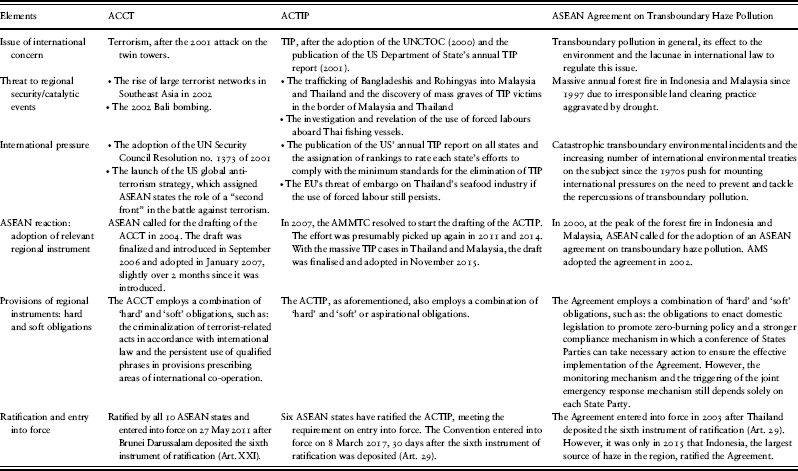
A brief observation of recent ASEAN treaty practice suggests that in recent years there has been an undeclared compromise among AMS vis-à-vis their inclination to ratify a regional legal instrument, especially on issues that pose as threats to the region as a whole. Such threats are usually embodied in catalytic events that threaten ASEAN’s regional security. Another implicit aspect in this compromise is the presence of strong international pressures on AMS to tackle certain issues of international concern, which, if not met with a degree of compliance, can affect the relationship of AMS and their dialogue partners. This compromise translates into the adoption of instruments that consist of both hard and soft legal obligations. However, the instruments usually lack hard obligations pertaining to monitoring and/or review mechanisms, and thus reduce the possibility of external scrutiny on AMS’ domestic jurisdiction. The combination of all the elements above translates into a higher probability for an ASEAN treaty to enter into force in a timely fashion. ASEAN’s binding instruments against transnational crime and on transboundary haze pollution fit this characterization, especially with the speedy entry into force of ACTIP, as their adoption and timely entry into force were spurred by the existence of the elements explained above. Table 1 on the next page will explain the interplay of the elements explained above in influencing ASEAN treaty practice by comparing the experiences of the ACCT, ACTIP, and the Transboundary Haze Pollution Agreement.Footnote 183
ASEAN instruments against Transnational Crime and Transboundary Haze Pollution

The experiences of the ACCT, ACTIP, and the Transboundary Haze Pollution Agreement substantiate the elements provided above in influencing the timely entry into force of ASEAN legal instruments whose subject matters concern the region. The ACTIP experience is even more remarkable, as it entered into force slightly over a year after its adoption.Footnote 184 The comparison in Table 1 below also demonstrates that when it comes to tackling an immediate threat to the region, AMS could indeed come together and act quickly to establish regional co-operation. Another crucial element is the fact that all AMS are Parties to the UNCTOC and most are Parties to the TIP Protocol.Footnote 185 This is important to align the countries’ views and interests to maintain regional security against the threats of TIP, and to depoliticize TIP issues in domestic and regional settings.Footnote 186
It is likely that all ten AMS will ratify ACTIP before the end of 2017, as other AMS are gearing their domestic legislation process in this direction. For instance, despite its ambiguous treaty implementation practice, the Indonesian government is working on a draft law to implement ACTIP and is harmonizing its domestic legislation to comply with ACTIP.Footnote 187
B. Implementation and Compliance
As has been concluded above, ASEAN treaty practice suggests that regional legal instruments that create far-reaching legal obligations on AMS will less likely be ratified. While it is true that the obligations under ACTIP are more acceptable to AMS, and are the reason for the Convention’s early entry into force, its provisions on implementation and compliance mechanisms still leave much to be desired. Article 24 of ACTIP does not elaborate further on how the SOMTC exercises these powers, e.g. whether it has the power to enquire directly with States Parties regarding their application of ACTIP, and whether it can compel States Parties to give it access to conduct on-site monitoring. Nor does ACTIP impose any obligation on States Parties to report to the SOMTC on the domestic implementation of ACTIP. Furthermore, ACTIP is also silent on the role of the AMMTC, apart from receiving reports on implementation from the SOMTC. More specifically, it is not clear whether the AMMTC can play a role in inducing compliance or in acting in cases of non-compliance.
Compared to the monitoring and review mechanisms established in the 1985 Agreement above, ACTIP’s provision related to compliance can be considered fairly weak, as it only prescribes a general obligation of the SOMTC to monitor, review, and report the implementation of ACTIP to the AMMTC. However, if one compares ACTIP with the compliance-related provisions in most ASEAN political-security treaties, such as the ASEAN Charter, it is obvious that ACTIP’s provision on compliance will come out stronger, as most of them have either weaker or even no compliance-related provision. Still, there is little that ASEAN can do to learn and scrutinize the full extent of States Parties’ compliance to ACTIP with the existing compliance mechanism and the current basic principle of consensus in ASEAN’s decision-making process. One alternative is to closely follow States Parties’ reporting obligation and compliance mechanisms under the UNCTOC to learn the extent of the implementation of similar obligations. However, this only partially answers the conundrum; what about other obligations that are not prescribed in the UNCTOC and the TIP Protocol, such as the obligation to ensure that a State Party’s legal system is efficient to deal with TIP cases? Unfortunately, transparency is not ASEAN’s strongest suit, and this question will remain unanswered until all States Parties give their consent to improve ACTIP’s compliance mechanism.Footnote 188
C. Conclusion
ACTIP’s wider scope of application, the inclusion of numerous legal obligations, and its early entry into force suggest AMS’ determination to tackle the challenge of TIP in the region and adherence to their international obligations against TIP. With regard to substantive criminal law and the protection of TIP victims, ACTIP requires States Parties to prescribe a list of aggravating circumstances, which warrant the imposition of higher penalties on the offenders, and to establish national guidelines/procedures for the proper identification of victims. These provisions set out stronger obligations than those in the UNCTOC and the TIP Protocol. It is also true that some provisions are aspirational and focus more on “soft” obligations, such as capacity building and the exchange of information, rather than hard obligations, such as enabling the freer movement of people in the region as a measure to discourage TIP. However, as aforementioned, one can argue that, since all AMS are parties to the UNCTOC and the TIP Protocol, they are nonetheless bound by the obligations provided under these instruments, and that ACTIP’s “soft” obligations can facilitate AMS’ compliance to the UNCTOC and its TIP Protocol. That being said, ACTIP, in general, does indeed impose meaningful obligations upon its States Parties.
Nevertheless, despite the above observations, such progress may be rendered meaningless if States Parties’ compliance to ACTIP cannot be measured. The absence of a compliance monitoring mechanism may prove detrimental in ASEAN’s overall framework against TIP, as there will be no reliable information on the application of the Convention to form the basis for a future regional strategy against TIP. The absence of such a mechanism is inconsistent with AMS’ long-standing regional engagement against TIP and common interests in eradicating TIP, as declared in the Preamble of ACTIP. It is understandable that integrating the UNCTOC or the CoE Convention standards of compliance mechanisms may be difficult for ASEAN, as the Association still strictly observes its long-standing principle of non-interference. In this regard, ASEAN needs to slowly change the mindset of its Member States, vis-à-vis the principle of non-interference, through the legalization of a (limited) procedure to measure the progress of its binding treaties. For instance, notwithstanding its limited use, the adoption of ASEAN’s procedure of “enhanced interaction” in late 1998 to resolve regional issues caused by domestic upheavals or politics may provide a solution. It can be a model for the SOMTC to enquire into and monitor the domestic implementation of ACTIP in a Member State that faces grave TIP threats that can affect the region.Footnote 189
It would be incorrect, however, to say that ACTIP is doomed because of its lack of a compliance mechanism. Such a notion belies the value of ACTIP as the first ASEAN binding instrument that incorporates the protection of human rights in its goals and processes, and as a stronger instrument against transnational crime in the region. Moreover, the absence of any explicit caveat of the principle of non-interference and due regard to regional particularities in ACTIP is crucial to indicate ASEAN’s attempt to break away from its long-standing custom of diplomacy, which is embodied in the ASEAN Way on issues of both international and regional concerns. In this regard, ACTIP represents significant progress towards the greater application of legalization and the role of law in addressing threats of common concern among AMS. The adoption and entry into force of ACTIP embody ASEAN’s first meaningful step towards a stronger regional collaboration to combat TIP. However, to move forward in the fight against TIP and ensure the region’s security, ASEAN needs to implement a meaningful monitoring mechanism to ensure compliance.