INTRODUCTION
Cumberland Bone Cave, Allegany County, Maryland, is important for Pleistocene vertebrate paleontology because it preserved a diverse and relatively well-documented biota. The cave and its fauna were originally described by Gidley (Reference Gidley1913) and more thoroughly by Gidley and Gazin (Reference Gidley and Gazin1933, Reference Gidley and Gazin1938). The site was subsequently studied in varying detail by Nicholas (Reference Nicholas1953, Reference Nicholas, Mohr and Sloane1955) and Van der Meulen (Reference Van der Meulen1978). Although the site still exists, most of it remains under railroad tracks and is inaccessible. Specimens from the cave are curated at the Carnegie Museum of Natural History in Pittsburgh, Pennsylvania, and at the National Museum of Natural History, Smithsonian Institution in Washington, D.C. A collaborative effort to completely re-evaluate the entire fossil biota is currently under way (Eshelman, R., personal communication, 2019) and will make Cumberland Bone Cave the most thoroughly studied biota for the early to middle Pleistocene of the eastern United States.
Biochronological history of eastern North America
The Blancan land mammal age was proposed in the 1940s as a convenient and widely applicable system to organize the faunas of the Pliocene in a broad chronological sequence, and the Irvingtonian and Rancholabrean were established in 1951 to accommodate later Pleistocene biotas (Wood et al., Reference Wood, Chaney, Clark, Colbert, Jepsen, Reeside and Stock1941; Savage, Reference Savage1951; Lundelius et al., Reference Lundelius, Churcher, Downs, Harington, Lindsay, Schultz, Semken, Webb, Zakrzewski and Woodburne1987; Repenning, Reference Repenning and Woodburne1987; Repenning et al., Reference Repenning, Fejfar, Heinrich, Fejfar and Heinrich1990; Bell et al., Reference Bell, Lundelius, Barnosky, Graham, Linsay, Ruez, Semken, Webb, Zakrzewski and Woodburne2004a). The classic Blancan and Irvingtonian faunal sequences of the Great Plains that were developed by Claude Hibbard and his students (e.g., Hibbard, Reference Hibbard1944, Reference Hibbard1949, Reference Hibbard1959; Hibbard and Zakrzewski, Reference Hibbard and Zakrzewski1967) were successfully correlated with various faunas in the western United States, including those from the Snake River Plain in Idaho (Hibbard, Reference Hibbard1969; Zakrzewski, Reference Zakrzewski1969; Repenning et al., Reference Repenning, Weasma and Scott1995; McDonald et al., Reference McDonald, Link and Lee1996), southern Arizona (Johnson et al., Reference Johnson, Opdyke and Lindsay1975; Lindsay et al., Reference Lindsay, Johnson and Opdyke1975; Tomida, Reference Tomida1987), and the extensive sedimentary sequence in the Anza Borrego Desert of southern California (e.g., Downs and White, Reference Downs, White and Tejkal1968; Zakrzewski, Reference Zakrzewski1972; Downs and Miller, Reference Downs and Miller1994; Cassiliano, Reference Cassiliano1999).
To the east, many important Irvingtonian faunas from Florida preserve a rich record of vertebrate remains that provide an important perspective on faunal dynamics in the southeastern United States during the early Pleistocene (Morgan and Hulbert, Reference Morgan and Hulbert1995). Several important Irvingtonian faunas also were discovered in cave deposits in Maryland, West Virginia, and Pennsylvania. Those include Cumberland Bone Cave (MD) (Gidley, Reference Gidley1913; Gidley and Gazin, Reference Gidley and Gazin1933, Reference Gidley and Gazin1938), Port Kennedy Cave (a fissure-fill deposit in PA) (Cope, Reference Cope1871; Wheatley, Reference Wheatley1871; Daeschler et al., Reference Daeschler, Spamer and Parris1993, Reference Daeschler, Lamanna and Carfioli2005), Hanover Quarry No. 1 (PA) (Guilday et al., Reference Guilday, Cotter, Cundall, Evenson, Gatewood, Morgan, Morgan and Mahaney1984), Hamilton Cave (WV) (Repenning and Grady, Reference Repenning and Grady1988; Winkler and Grady, Reference Winkler and Grady1990), and Trout Cave (WV) (Pfaff, Reference Pfaff1990, Reference Pfaff1991). Those sites provide the only perspective we have of Irvingtonian faunas in the northeastern United States, but they have remained a persistent geochronologic challenge (Bell et al., Reference Bell, Lundelius, Barnosky, Graham, Linsay, Ruez, Semken, Webb, Zakrzewski and Woodburne2004a).
The volcanic ashes that were so crucial for establishing chronological relationships in western and central North American faunas are not present in the east, nor is it likely they would be incorporated as primary deposits in caves. Instead, paleontologists relied upon biochronologic correlations, primarily based upon arvicoline rodents, to place the northeastern cave sites in a rough temporal context that can be compared with the faunal sequence from the rest of North America.
These eastern cave sites were placed in a biochronological context by Repenning (Reference Repenning1992). According to Repenning (Reference Repenning1992), the fauna from Cumberland Bone Cave had to be somewhat older than that from Hansen Bluff, Colorado, which was estimated to be 820 ka based upon dated tephra, paleomagnetic stratigraphy, and climatic correlations (Rogers et al., Reference Rogers, Repenning, Forester, Larson, Hall, Smith, Anderson and Brown1985, Reference Rogers, Larson, Smith, Katzman, Smith, Cerling, Wang, Baker, Lohmann and Repenning1992; Repenning, Reference Repenning1992). His justification was based on his conception of Lasiopodomys deceitensis as a direct lineal ancestor of Microtus paroperarius, and his interpretation of the relative abundances in the fauna from Cumberland Bone Cave of the morphotypes of the voles potentially attributable to those two taxa (Repenning, Reference Repenning1992). His interpretation of the relative abundance of those morphotypes in the faunas from Hanover Quarry No. 1, Hamilton Cave, Cumberland Bone Cave, and Hansen Bluff allowed Repenning to hypothesize an age of 830 ka for the biota from Cumberland Bone Cave (Repenning, Reference Repenning1992). His reasoning was that the fauna from Hansen Bluff, with a numerical age of approximately 820 ka, has no morphotypes referable to L. deceitensis but does include morphotypes assignable to M. paroperarius (Repenning, Reference Repenning1992). The faunas from the other sites contain both morphotypes in varying relative abundance, so Hansen Bluff had to be the youngest fauna (the morphotype of L. deceitensis was extinct by the time of deposition of the Hansen Bluff fauna). The fauna from Hanover Quarry was interpreted to have advanced morphotypes of L. deceitensis but no morphotypes of Microtus and was, therefore, the oldest fauna of the group. Morphotypes of Microtus had not yet evolved; it was interpreted to be approximately 835 ka (Repenning, Reference Repenning1992).
Hamilton Cave preserved a sample that was interpreted to be undergoing an evolutionary transformation, with 75% of the specimens being morphotypes referable to L. deceitensis and 25% being morphotypes of a primitive (i.e., early) stage of evolution of M. paroperarius. Hamilton Cave was assigned an age of 840 ka (Repenning, Reference Repenning1992). Similarly, the relative abundance of different morphotypes in the fauna from Cumberland Bone Cave was interpreted to place that fauna temporally between Hanover Quarry No. 1 and Hansen Bluff, and the fauna from Cumberland Bone Cave was assigned an age of approximately 830 ka, because of the higher percentage of advanced morphotypes of Microtus (Repenning, Reference Repenning1992). The terms “primitive” and “advanced” are used here as they were defined by Repenning (Reference Repenning1992).
Other lines of evidence (paleomagnetics and Ondatra evolution) point to an older age of Cumberland Bone Cave and provide the foundation for us to test our hypothesis that Cumberland Bone Cave is early to middle Pleistocene in age. We used a combined uranium-series (U-series) and Electron Spin Resonance (ESR) dating methodology to derive the first numerical age assessment for any of these northeastern cave faunas. The age assessment is derived from sediments and fossils from Cumberland Bone Cave. We use the new data, in combination with previously unpublished paleomagnetic data and the well-documented chronocline of the evolution of Ondatra, to test previously proposed hypotheses for the age of the Cumberland Bone Cave biota. This gives us four independent lines of evidence—(1) Repenning's stage-of-evolution argument, (2) US-ESR, (3) paleomagnetics, and (4) the chronocline of Ondatra—to argue for the age of the deposition of the fossils from Cumberland Bone Cave.
METHODS
Platygonus sp. tooth selection
Five teeth belonging to the Pleistocene peccary, Platygonus sp. were selected for dating, because they were relatively large in size, abundant at the site, and were designated as acceptable for limited-destructive procedures by museum staff and researchers. The teeth (USNM PAL 712593–712597) are housed at the National Museum of Natural History, Smithsonian Institution, in Washington D.C. U-series analyses were completed on all five teeth, but enamel for ESR analyses was removed from only two teeth (USNM PAL 712594 and USNM PAL 712595) to satisfy the museum's request for minimal destruction.
Methodology for combined U-series and ESR dating of remains from Cumberland Bone Cave
In the past few decades, advances in U-series analyses combined with ESR (US-ESR) dating protocols allowed for new approaches for direct dating of fossil tooth remains (e.g., Grün, Reference Grün1989, Reference Grün, Taylor and Aitken1997, Reference Grün2009; Grün et al., Reference Grün, Schwarcz and Chadam1988, Reference Grün, Aubert, Joannes-Boyau and Moncel2008a, Reference Grün, Joannes-Boyau and Stringer2008b, Reference Grün, Eggins, Kinsley, Mosely and Sambridge2014; Joannes-Boyau et al., Reference Joannes-Boyau, Grün and Bodin2010; Joannes-Boyau and Grün, Reference Joannes-Boyau and Grün2011; Joannes-Boyau, Reference Joannes-Boyau2013). Teeth, and in particular enamel, are composed of highly crystalline material (hydroxyapatite) which when exposed to ionizing radiation resulting from the radioactive decay of naturally occurring radiogenic isotopes (predominately U, Th, and K) and cosmogenic rays, generates specific radicals in the crystal lattice that can be measured with an ESR spectrometer. The number of radicals generated over time is proportional to the dose rate from the environmental surroundings of the sample, to which it has been exposed over its depositional history. By combining the U and Th uptake history within the dental tissues and the ESR measurements, the calculation can be refined to obtain a more accurate age estimation for the amount of time since deposition of a fossil.
Sample preparation
Teeth were first sectioned in half to expose all dental tissues in the sample. All teeth were then scanned with a laser-ablation ESI NWR213 instrument coupled to an Agilent 7700 Inductively Coupled Plasma Mass Spectrometer (ICPMS) quadrupole to evaluate the distribution and concentration of 238U. Each sample was then analyzed by a Multicollector ICPMS (MC-ICPMS) to obtain U-Th isotopic data. A small fragment of enamel was removed from two teeth (using a hand-held diamond saw) in order to be measured by ESR. Any attached dentine (and dirt) was removed from the fragment. The outer surface on each side (lingual and buccal) was stripped of the first ~100 μm with a diamond polishing rotary tool. U-series analyses were performed on enamel and dentine from the remaining tooth in the immediate vicinity of the fragment as well as on the fragment directly to assess variations in U-series isotopic ratios and to calculate an optimum U-uptake model.
Dating protocols
ESR dating
ESR dating was performed on a Freiberg MS5000 ESR X-band spectrometer at a 1 G modulation amplitude, 2 mW power, 100 G sweep, and 100KHz modulation frequency. ESR analyses were performed at Southern Cross University with a Freiberg X-ray irradiation chamber (X-rays as radiation source), which contains a Varian VF50 X-ray gun at a voltage of 40KV and 0.5 mA current. The dose rate was calibrated using one single gamma dose and the output value of the X-ray gun.
Each tooth fragment was mounted onto a Teflon® sample holder, in which the fragment was exposed directly to the X-ray source with minimal shielding by a 200 μm aluminum foil shield for soft X-ray. To estimate the ESR equivalent dose (De), each fragment was irradiated eight times, following exponentially increasing irradiation times (i.e., 120, 360, 900, 1800, 3600, 7200, 14,400, and 28,800 s, with an average dose rate of 0.18 Gy/s, which represents an approximate dose step of ~22.6, 67.1, 167, 333.7, 660, 1339.2, 2621.4 and 5135.5 Gy, respectively). During each irradiation step, the output of the X-ray gun was recorded, which allows for the accurate calculation of the dose rate received by the sample at each irradiation step. An additional fragment from the same sample received a single gamma dose and was used to confirm the X-ray irradiation dose response curves (DRCs) and received the same irradiation steps as the associated fragment. DRCs were calculated using the MCDoseE 2.0 (Joannes-Boyau et al., Reference Joannes-Boyau, Duval and Bodin2018) with a single saturated exponential (SSE) as proposed by Duval and Grün (Reference Duval and Grün2016).
It is difficult to assess precise X-ray irradiation doses for DRCs, because of sample symmetry and complex backscattering effects (Grün et al., Reference Grün, Mahat and Joannes-Boyau2012). This can sometimes give wrong dose equivalency results and therefore each tooth needs to be evaluated against gamma irradiation (Grün et al., Reference Grün, Mahat and Joannes-Boyau2012). A second fragment of each sample was measured before and after receiving a known gamma dose of 80 ± 2 Gy, and then irradiated with the same X-ray protocol. A simple subtraction of the measured natural signal was performed on the merged spectra at each irradiation step making the gamma irradiated signal the new natural signal for the DRC. For every irradiation step the fragment was measured over 180o on the X, Y, and Z configurations (see Joannes-Boyau and Grün, Reference Joannes-Boyau and Grün2011). Isotropic and baseline corrections were applied uniformly across the measured spectra. The amount of unstable non-orientated radicals (NOCORs) was estimated to be around 23 ± 3% using angular measurements as outlined by Joannes-Boyau (Reference Joannes-Boyau2013) and used to correct for the DRC. The environmental gamma-ray dose rate was estimated using the U, Th, and K concentration obtained from sediment geochemical analyses of the backdirt of the Gidley excavation of 1913. Sediment samples were provided by the Carnegie Museum of Natural History. The cosmogenic dose rate was estimated to be negligible according to the burial context of the cave (i.e., depth of deposition, latitude, geography).
U-series analysis
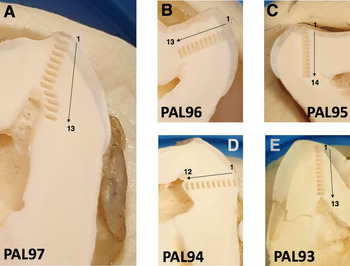
Each tooth was measured for U and Th concentrations by laser ablation, using an ESI NW193 ArF Excimer laser coupled to a MC-ICPMS Neptune Plus. Sections of enamel and dentine were mapped using small rasters to document compositional variability in the teeth and constrain diffusion processes (see Fig. 1). U-series measurements were taken across the dentine and enamel surface for all teeth. Each individual measurement consists of an average value obtained across a raster or ablation track measuring 150 μm x 310 μm in size (this was done twice on each sample); i.e., a succession of short measurements was taken along a raster and then averaged into one value. Measurements were performed at an ablation rate of 20 Hz and a scan speed of 5 μm/s. The rasters were positioned in a series of transects following the growth axis of the dental tissue. The ESR internal dosimetry was calculated by averaging the values of the rasters. Additional measurements were taken across each tooth in areas away from the ESR fragment to assess U variability and diffusion gradients. Baseline and drift were corrected using a NIST 612 glass standard, while two coral standards (the MIS7 Faviid and MIS5 Porites corals from the Southern Cook Islands, South Pacific) (Woodroffe et al., Reference Woodroffe, Short, Stoddart, Spencer and Harmon1991) were used to calculate U234/U238 and U230/U238 ratios and assess the accuracy of measurements. Each coral standard value was obtained by solution MC-ICPMS and used for reference. To account for potential matrix effects, a bovid tooth fragment from South Africa, with known isotope concentrations (U-series at equilibrium) was used to verify measurements. To account for tailing effects, measurements were carried out at half-masses of 229.5 and 230.5 for Th230 and 233.5 and 234.5 for U234. The isotopic data were converted into ages using the Isoplot 3.75 Microsoft® Excel Add-In (Ludwig, Reference Ludwig2012). The combined US-ESR ages were calculated using the Monte Carlo approach described by Shao et al. (Reference Shao, Bahain, Dolo and Falguères2014), with the values updated from those given by Guérin et al. (Reference Guérin, Mercier and Adamiec2011). Water content of enamel, dentine, and sediment was estimated at 3 ± 1, 8 ± 2, and 17 ± 10%, respectively.
(color online) Location of laser-ablation rasters for each tooth analyzed using a LA-MC-ICPMS. For (A) 13 rasters USNM PAL 712597, (B) 13 rasters USNM PAL 712596, (C) 14 rasters USNM PAL 712595, (D) 12 rasters USNM PAL 712594 and (E) 13 rasters USNM PAL 712593 of fossil teeth of Platygonus sp. In the figure, specimen numbers were abbreviated to PAL and the last two numbers of the specimen listed above. All raster sequences were analyzed from enamel to dentine following approximately the growth direction of the tooth and usual diffusion pathway (pulp to enamel-dentin-junction) and reported in Table 1.

Paleomagnetics
In the 1970s, John Guilday of the Carnegie Museum of Pittsburgh collected oriented samples of a speleothem from Cumberland Bone Cave and measured their natural remnant magnetization (NRM) on a Superconducting Technology (SCT) cryogenic magnetometer in the paleomagnetic laboratory of Victor Schmidt at the University of Pittsburgh. The limited data and the original correspondence pertaining to these analyses are archived in the John Guilday Archive (Box 13 on Cumberland Bone Cave) at the Carnegie Museum.
Ondatra teeth
We compared the morphology of the occlusal surface of the m1s (CM 20274, CM 84588, and USNM 12044) (CM = Carnegie Museum of Natural History; USNM = United States National Museum of Natural History) to type specimens of different recognized species of Ondatra from the literature (Brown, Reference Brown1908; Martin, Reference Martin, Stewart and Seymour1996). We then plotted the teeth on the well-known chronocline of Ondatra evolution established by Nelson and Semken (Reference Nelson and Semken1970) in order to interpret an age of the fossils.
RESULTS
Numerical age determination
U-series
We obtained direct, minimum U-series ages of five Platygonus sp. teeth that show consistent diffusion of uranium in the dental tissues (Table 1, Fig. 1). These five U-series results show consistent ratio and concentration across the different dental tissues with a minimum age of ~250 ka for the fossils.
U-series age data for the transects made across the teeth. Note: PAL 94 = USNM PAL 712594, etc. Measurements with U/Th ratio <500 or uranium concentration <1 ppm were excluded from age calculations.

ESR results
The DRC for both samples was calculated using MCDoseE 2.0, giving an equivalent dose for USNM PAL 95 and USNM PAL 94 of 504 ± 18 and 477 ± 22 Gy (1-σ error), respectively. The dose recovered was 86 ± 6 Gy for USNM PAL 95 and 92 ± 8 Gy for USNM PAL 94.
Coupled US-ESR dating
US-ESR age estimates were calculated on two teeth (USNM PAL 712594 and USNM PAL 712595) yielding ages of 722 ± 64 ka and 790 ± 53 ka (1-σ) respectively (Table 2). Both ages are statistically indistinguishable from one another and we advocate for a potential age for the deposition of Cumberland Bone Cave at 756 +87/-98 ka.
Combined U-series–ESR results and parameters for the two fossil teeth from Cumberland Bone Cave.

a Dose equivalent De obtained using McDoseE 2.0 (Joannes-Boyau et al., Reference Joannes-Boyau, Duval and Bodin2018).
b Uranium concentration values were obtained by LA-MC-ICPMS (dentine values are averaged over the entire tooth).
c Values were obtained on the sediment by LA-ICPMS analyses.
d Value was extrapolated from the sediment concentration obtained by LA-ICPMS analyses.
e Parameters and ages were calculated using Shao et al., Reference Shao, Bahain, Dolo and Falguères2014 and updated values from Guerin et al., Reference Guérin, Mercier and Adamiec2011.
Paleomagnetics
Previously unpublished paleomagnetic data from the Guilday archives at the Carnegie Museum are presented in Figure 2. Moments were 10-6 to 10-7 emu/cc. The samples were not demagnetized, but the natural remanent magnetizations (NRMs) of the set displayed a range of directions consistent with varying degrees of a recent, normal overprint on a reversed primary magnetization. If this interpretation is correct, then the speleothem was formed prior to the Brunhes-Matuyama reversal (780 ka) (Bassinot et al., Reference Bassinot, Labeyrie, Vincent, Quidelleur, Shackleton and Lancelot1994).
Cumberland Bone Cave paleomagnetics. Results presented to John Guilday by Victor Schmidt, University of Pittsburgh (Guilday Archives, Box 13, Carnegie Museum of Natural History).

Ondatra chronocline
The lower m1s used in this study have five to six closed alternating triangles, two roots, and an enamel closure pattern that is consistent with O. annectens. The dimensions of the three m1s from Cumberland Bone Cave are provided in Table 3. O. annectens and O. idahoensis overlap in time and morphology, but the dimensions (length/width) of the three m1s from Cumberland Bone Cave (Table 3) place them within the size range of O. annectens. However, if only size was taken into account, Cumberland Bone Cave specimens 2 (CM 94588) and 3 (USNM 12044) on Figure 3 would fall in O. idahoensis. O. idahoensis, however has only five closed alternating triangles on the m1, and the two specimens 2 and 3 have six, which is a characteristic of O. annectens. We therefore elected to call them O. annectens. All three teeth measured smaller (length/width) than Cudahy specimens, indicating an age older than 670 ka, the age of the Lava Creek-B ash associated with the Cudahy fauna. Results are presented in Table 3 and Figure 3.
Ondatra (muskrat) chronocline as proposed by Nelson and Semken (Reference Nelson and Semken1970) updated with Cumberland Bone Cave muskrats. Modified from Jass and Bell (Reference Jass and Bell2011).

Measurements of Ondatra (muskrat) lower first molars recovered from Cumberland Bone Cave, MD. CM = Carnegie Museum of Natural History, Pittsburgh, PA. USNM = United States National Museum of Natural History, Smithsonian Institution, Washington, D.C. R = right; L = Left.

DISCUSSION
We are fortunate that the history of collections at Cumberland Bone Cave spans many decades and encompasses the changing attitudes and practices of vertebrate paleontologists. We were able to obtain a numerical age assessment for the Cumberland Bone Cave biota because the collections at the Carnegie Museum and the Natural History Museum at the Smithsonian Institution included a large sample of bones from large-bodied mammals that could be used for this study, and cave matrix collected during one of the earlier excavations was retained and preserved by museum staff. The temptation to discard such materials is always present in museums that must, of necessity, place a premium on space. Many paleontologists are trained to understand that saved matrix and non-diagnostic materials may be useful for future applications under technologies that have not yet been developed. This is an excellent example of the old adage proving its worth!
Our age model allows us to test the claim made by Charles Repenning (Reference Repenning1992) that the chronological age of Cumberland Bone Cave is approximately 830 ka. Repenning's estimate of the age of the fauna from Cumberland Bone Cave was based entirely upon biochronology, and his conceptual model of how evolution happened and how it would be reflected in the fossil record (see Bell and Jass, Reference Bell and Jass2011). Repenning viewed evolution as being gradational and anagenetic within lineages. A key component of his biochronological age estimates was an assessment of the morphotype(s) and stage of evolution of a sample of fossil specimens. He conceptualized such samples as the fossilized remains of organisms from an interbreeding population. This was especially important for evaluation of faunas that lacked age control, but that could, via stage of evolution, be correlated to sites for which there were one or more direct age controls.
This all seems somewhat convoluted, but it is interesting that Repenning's methodology—including his conceptualization of how speciation took place, the pattern it would yield in the fossil record, and his explicit embrace of paraphyletic taxonomy—yielded an age estimate that is roughly consistent with our independent age model for the fauna from Cumberland Bone Cave. Although the centroid ages of the two samples subjected to ESR analysis are younger than Repenning's estimate by 40,000 to 110,000 years, respectively, the error bar for one sample yields a maximum age of 843 ka, and for the second a maximum age of 786 ka. Therefore, our data, to a large extent, confirm Repenning's hypothesis of the age of the fauna, although we would argue that this assemblage is likely several tens of thousands of years younger.
The remnant reversal in the paleomagnetic sample indicates that fossil deposition was likely before the Brunhes-Matuyama reversal, because that is the most recent time of a reversal in the Earth's magnetic field (Ogg, Reference Ogg, Gradstein, Ogg, Schmitz and Ogg2012). Sometimes evolution itself can give us indicators for the age of a fossil. Ondatra have long been recognized for their biochronological utility, and many would argue that they are one of the best mammalian examples of anagenetic evolution via phyletic gradualism. This is because the measurements of length-versus-width of the m1 documents a linear increase in the size of the tooth from the Pliocene to the modern, across North America (Nelson and Semken, Reference Nelson and Semken1970). When the data for the specimens from Cumberland Bone Cave are plotted on the chronocline of Nelson and Semken (Reference Nelson and Semken1970) and updated with specimens from Cathedral Cave, NV (Jass and Bell, Reference Jass and Bell2011; Fig. 4), the data show that the specimens from Cumberland Bone Cave are smaller than those from the Cudahy fauna of Kansas, which is radioisotopically dated by the Lava Creek B Ash with an upper boundary of 670 ka (Izett et al., Reference Izett, Pierce, Naeser and Jaworowski1992; Izett and Honey, Reference Izett and Honey1995; Bell et al., Reference Bell, Repenning, Barnosky and Barnosky2004b). If the fauna from Cumberland Bone Cave was younger than the fauna from Cudahy then we would expect the m1s of Ondatra to be larger than those from the Cudahy fauna. The paleomagnetic and Ondatra chronocline evidence point to an age for Cumberland Bone Cave that is older than 670 ka.
Stratigraphic column showing the hypothesized age of the northeastern Irvingtonian sites by Repenning (Reference Repenning1992) and Bell et al., (Reference Bell, Lundelius, Barnosky, Graham, Linsay, Ruez, Semken, Webb, Zakrzewski and Woodburne2004a), the independent evidence for the age of the fauna from Cumberland Bone Cave, and our interpretation of the most likely time span of deposition of Cumberland Bone Cave, Maryland.

We finally have the ability to test hypotheses of early to middle Pleistocene faunal dynamics in northeastern North America, because we can place one of those faunal assemblages in a reliable chronological context. The spatial context to understand the paleobiota from Cumberland Bone Cave has long been understood, and the taxonomic assemblage itself is now undergoing a major revision. If faunas with established age control (e.g., Cudahy at 670 ka) are at least roughly contemporaneous with those from northeastern caves, then recognition of a northeastern faunal region may be justified because of the distinct differences in the makeup of the faunal communities between the Great Plains and the northeastern cave sites (Fejfar and Repenning, Reference Fejfar and Repenning1992). Numerical age control for the fauna from Cumberland Bone Cave opens this possibility for the first time, and has the potential to greatly expand our understanding of the early to middle Pleistocene in the eastern United States.
CONCLUSION
Much of our knowledge about mammalian faunal dynamics in the Pleistocene is derived from deposits dating to the latest part of the Pleistocene, and specifically to the interval that falls within the range of radiocarbon chronology from approximately 50,000 to approximately 10,000 yr BP (Bell et al., Reference Bell, Lundelius, Barnosky, Graham, Linsay, Ruez, Semken, Webb, Zakrzewski and Woodburne2004a). Sole reliance on the late Pleistocene record for data pertaining to faunal dynamics, particularly those related to climatic perturbations, is problematic and potentially misleading (Barnosky, Reference Barnosky and Barnosky2004). Age control of fossil assemblages allows the development of a more refined understanding of evolutionary change, faunal dynamics, paleobiogeographic patterns, and the impacts of environmental change on past communities. Compared to the latest intervals of the Pleistocene, early, middle, and early-late Pleistocene faunas of North America have been particularly challenging to place in a reliable chronological context. Faunas from open-air sites that are associated with volcanic ashes derived from eruptions around the Yellowstone hot-spot and elsewhere have been successfully dated across the Great Plains, and provide important anchor-points for temporalizing biostratigraphic correlations. Resultant biochronologies have been tested and refined over the last several decades in the western and central United States, but the important faunas from cave deposits in the northeastern part of the country have remained undated, and biochronological age assessments have not been independently tested until now.
Our combined US-ESR dates, paleomagnetics, and data from the Ondatra chronocline provide independent evidence that the fauna from Cumberland Bone Cave is between 660–830 ka with a most likely age of 756 +87/-98 ka (Fig. 4). These results support prior biochronological age assessments based on arvicoline rodents, and Charles Repenning's estimation of the age of Cumberland Bone Cave is remarkably close to the results we obtained. That he obtained his result from somewhat eccentric lines of argumentation makes the congruence all the more remarkable.
Our success in dating the Cumberland Bone Cave biota cannot be replicated for Pennsylvania's Port Kennedy Cave deposit and Hanover Quarry No. 1, both which are now inaccessible. But if fossil-bearing matrix is still preserved within Hamilton Cave and Trout Cave in West Virginia, our methods could be applied at those sites as well. This will be an important area for further investigation. The subtle differences in the faunas from those sites suggests an approximate, but not exact, contemporaneity with the fauna from Cumberland Bone Cave. The slightly younger, but well-dated faunas from the southern Great Plains in Kansas and north Texas show important faunal similarities with those from Cumberland Bone Cave, but they lack some of the endemic species reportedly found only in the northeastern caves (e.g., Microtus cumberlandensis, Microtus guildayi, Platygonus cumberlandensis, etc.), and contain species that are not reported from the northeastern caves. Therefore, the dating of Cumberland Bone Cave opens the door to a plethora of possible questions that can be addressed surrounding the biota of eastern North America during the early to middle Pleistocene.
ACKNOWLEDGMENTS
We are grateful to Ralph Eshelman for his encouragement of our work, and for the invitation to collaborate on efforts to provide a modern perspective on the fauna from Cumberland Bone Cave. Amanda Milhouse at the Smithsonian Institution, and Amy Henrici at the Carnegie Museum provided specimen access and facilitated loans that allowed this work to be conducted; we gratefully acknowledge their time, consideration, and attention to our needs when we visited the collections under their care. Jack Holt of the University of Arizona provided valuable advice and recommendations for our interpretation of the paleomagnetic data. We thank A. Barnosky, C. Jass, R. Martin, C. Repenning, A. Tesakov, T. Van Kolfschoten, and R. Zakrzewski for discussions about arvicoline rodent taxonomy and paleobiogeography. We would like to thank R. Grün, J.T. Faith, and an anonymous reviewer whose comments made this manuscript better. Funding for this project was provided by the Jackson School of Geosciences, The University of Texas at Austin.