


%20--%3e%3c!DOCTYPE%20svg%20PUBLIC%20'-//W3C//DTD%20SVG%201.0//EN'%20'http://www.w3.org/TR/2001/REC-SVG-20010904/DTD/svg10.dtd'%3e%3csvg%20version='1.0'%20id='Layer_1'%20xmlns='http://www.w3.org/2000/svg'%20xmlns:xlink='http://www.w3.org/1999/xlink'%20x='0px'%20y='0px'%20width='64px'%20height='64px'%20viewBox='5.5%20-3.5%2064%2064'%20enable-background='new%205.5%20-3.5%2064%2064'%20xml:space='preserve'%3e%3cg%3e%3ccircle%20fill='%23FFFFFF'%20fill-opacity='0'%20cx='37.785'%20cy='28.501'%20r='28.836'/%3e%3cpath%20fill='%23595959'%20d='M37.441-3.5c8.951,0,16.572,3.125,22.857,9.372c3.008,3.009,5.295,6.448,6.857,10.314%20c1.561,3.867,2.344,7.971,2.344,12.314c0,4.381-0.773,8.486-2.314,12.313c-1.543,3.828-3.82,7.21-6.828,10.143%20c-3.123,3.085-6.666,5.448-10.629,7.086c-3.961,1.638-8.057,2.457-12.285,2.457s-8.276-0.808-12.143-2.429%20c-3.866-1.618-7.333-3.961-10.4-7.027c-3.067-3.066-5.4-6.524-7-10.372S5.5,32.767,5.5,28.5c0-4.229,0.809-8.295,2.428-12.2%20c1.619-3.905,3.972-7.4,7.057-10.486C21.08-0.394,28.565-3.5,37.441-3.5z%20M37.557,2.272c-7.314,0-13.467,2.553-18.458,7.657%20c-2.515,2.553-4.448,5.419-5.8,8.6c-1.354,3.181-2.029,6.505-2.029,9.972c0,3.429,0.675,6.734,2.029,9.913%20c1.353,3.183,3.285,6.021,5.8,8.516c2.514,2.496,5.351,4.399,8.515,5.715c3.161,1.314,6.476,1.971,9.943,1.971%20c3.428,0,6.75-0.665,9.973-1.999c3.219-1.335,6.121-3.257,8.713-5.771c4.99-4.876,7.484-10.99,7.484-18.344%20c0-3.543-0.648-6.895-1.943-10.057c-1.293-3.162-3.18-5.98-5.654-8.458C50.984,4.844,44.795,2.272,37.557,2.272z%20M37.156,23.187%20l-4.287,2.229c-0.458-0.951-1.019-1.619-1.685-2c-0.667-0.38-1.286-0.571-1.858-0.571c-2.856,0-4.286,1.885-4.286,5.657%20c0,1.714,0.362,3.084,1.085,4.113c0.724,1.029,1.791,1.544,3.201,1.544c1.867,0,3.181-0.915,3.944-2.743l3.942,2%20c-0.838,1.563-2,2.791-3.486,3.686c-1.484,0.896-3.123,1.343-4.914,1.343c-2.857,0-5.163-0.875-6.915-2.629%20c-1.752-1.752-2.628-4.19-2.628-7.313c0-3.048,0.886-5.466,2.657-7.257c1.771-1.79,4.009-2.686,6.715-2.686%20C32.604,18.558,35.441,20.101,37.156,23.187z%20M55.613,23.187l-4.229,2.229c-0.457-0.951-1.02-1.619-1.686-2%20c-0.668-0.38-1.307-0.571-1.914-0.571c-2.857,0-4.287,1.885-4.287,5.657c0,1.714,0.363,3.084,1.086,4.113%20c0.723,1.029,1.789,1.544,3.201,1.544c1.865,0,3.18-0.915,3.941-2.743l4,2c-0.875,1.563-2.057,2.791-3.541,3.686%20c-1.486,0.896-3.105,1.343-4.857,1.343c-2.896,0-5.209-0.875-6.941-2.629c-1.736-1.752-2.602-4.19-2.602-7.313%20c0-3.048,0.885-5.466,2.658-7.257c1.77-1.79,4.008-2.686,6.713-2.686C51.117,18.558,53.938,20.101,55.613,23.187z'/%3e%3c/g%3e%3c/svg%3e)
%20--%3e%3c!DOCTYPE%20svg%20PUBLIC%20'-//W3C//DTD%20SVG%201.0//EN'%20'http://www.w3.org/TR/2001/REC-SVG-20010904/DTD/svg10.dtd'%3e%3csvg%20version='1.0'%20id='Layer_1'%20xmlns='http://www.w3.org/2000/svg'%20xmlns:xlink='http://www.w3.org/1999/xlink'%20x='0px'%20y='0px'%20width='64px'%20height='64px'%20viewBox='5.5%20-3.5%2064%2064'%20enable-background='new%205.5%20-3.5%2064%2064'%20xml:space='preserve'%3e%3cg%3e%3ccircle%20fill='%23FFFFFF'%20fill-opacity='0'%20cx='37.637'%20cy='28.806'%20r='28.276'/%3e%3cg%3e%3cpath%20fill='%23595959'%20d='M37.443-3.5c8.988,0,16.57,3.085,22.742,9.257C66.393,11.967,69.5,19.548,69.5,28.5c0,8.991-3.049,16.476-9.145,22.456%20C53.879,57.319,46.242,60.5,37.443,60.5c-8.649,0-16.153-3.144-22.514-9.43C8.644,44.784,5.5,37.262,5.5,28.5%20c0-8.761,3.144-16.342,9.429-22.742C21.101-0.415,28.604-3.5,37.443-3.5z%20M37.557,2.272c-7.276,0-13.428,2.553-18.457,7.657%20c-5.22,5.334-7.829,11.525-7.829,18.572c0,7.086,2.59,13.22,7.77,18.398c5.181,5.182,11.352,7.771,18.514,7.771%20c7.123,0,13.334-2.607,18.629-7.828c5.029-4.838,7.543-10.952,7.543-18.343c0-7.276-2.553-13.465-7.656-18.571%20C50.967,4.824,44.795,2.272,37.557,2.272z%20M46.129,20.557v13.085h-3.656v15.542h-9.944V33.643h-3.656V20.557%20c0-0.572,0.2-1.057,0.599-1.457c0.401-0.399,0.887-0.6,1.457-0.6h13.144c0.533,0,1.01,0.2,1.428,0.6%20C45.918,19.5,46.129,19.986,46.129,20.557z%20M33.042,12.329c0-3.008,1.485-4.514,4.458-4.514s4.457,1.504,4.457,4.514%20c0,2.971-1.486,4.457-4.457,4.457S33.042,15.3,33.042,12.329z'/%3e%3c/g%3e%3c/g%3e%3c/svg%3e)
Introduction
Sepsis is a major healthcare burden and timely management is critical to improving outcomes. Reference La Via, Sangiorgio and Stefani1 Quality measures such as the Centers for Medicare and Medicaid Services sepsis bundle emphasize early broad-spectrum antibiotics and blood culture collection. Reference Motzkus and Lilly2 While the efficacy of this bundle has come under scrutiny due to limited randomized trials and concerns regarding overtreatment, clinical practice still emphasizes initiating broad-spectrum antibiotics together with an infectious workup. Reference Freund, Cancella de Abreu and Lebal3 At our institution, fungal blood cultures are sometimes ordered alongside standard blood cultures, particularly in patients with risk factors for invasive fungal infections. Reference Schlattmann, Pletz, Kurzai and Bloos4 However, the diagnostic value of routinely including fungal blood cultures in this setting remains uncertain.
Contemporary standard blood cultures, particularly those processed using automated continuous monitoring systems (eg, BD BACTEC™), can detect Candida species with reported sensitivities ranging from 63% to 83% and a median time-to-positivity of 2–3 days. Reference Clancy and Nguyen5 Since multiple sets of standard blood cultures are often obtained, the added diagnostic value of fungal blood cultures may be limited. Fungal blood cultures are typically collected using fungal-specific media (eg, BD Myco/F Lytic medium) or, historically, via isolator-based systems, which have recently been discontinued in the United States. Use of Myco/F Lytic blood culture bottles provide enhanced recovery of fungi by incorporating saponin-based lytic agents that liberate intracellular organisms and by using media optimized for fungal growth with extended incubation. These features improve detection of slow-growing and fastidious fungi, including dimorphic fungi and select yeasts, that may not be recovered in routine aerobic or anaerobic blood culture bottles. Reference Fuller, Davis, Denys and York6 Accordingly, Myco/F Lytic bottles occupy a narrowly defined diagnostic niche yet are frequently overutilized in routine practice, where indiscriminate use is inappropriate given the availability of alternative fungal diagnostics that are often more timely and sensitive. Reference Herrera, Khodadadi, Leal, Kulkarni, Pappas and McCarty7
Fungal blood cultures can also financially impact patients and the healthcare system. While the material cost is low at approximately $13, the specialized labor required for processing leads many commercial laboratories to charge between $99 and $119 per culture. Stanley et al estimated the patient cost at $110. Reference Stanley, Guilfoose and LaSala8 Given the cost and uncertain added value; this study was conducted to evaluate the clinical utility of collecting fungal blood cultures alongside standard blood cultures.
Methods
A retrospective, cross-sectional study was performed at UF Health Shands Hospital, a 1,149-bed academic teaching hospital. Adult patients were included if they had initial fungal and standard blood cultures collected within 24 hours of each other between 1/1/2023 and 12/31/2024. The primary outcome was the detection of fungal growth in a fungal blood culture without growth in the paired standard blood cultures. Secondary outcomes evaluated time-to-positivity, all-cause in-hospital mortality, 30-day mortality, and the cost of detecting an additional fungus through usage of fungal blood cultures. Fungal blood cultures were collected on BD Myco/F Lytic medium and monitored for growth for 28 days via the BD BACTEC™ blood culture system. Standard blood cultures were collected on BD standard aerobic and anaerobic medium and incubated for 5 days. Analyses were performed using JMP®, version 18.0.2 (SAS Institute, Cary, NC). Descriptive statistics were used to summarize categorical data. χ2 and Mann-Whitney U tests were used as appropriate. All P-values were 2-tailed, and P < .05 was considered statistically significant. This study was approved by the Quality Improvement Project Registry at the University of Florida.
Results
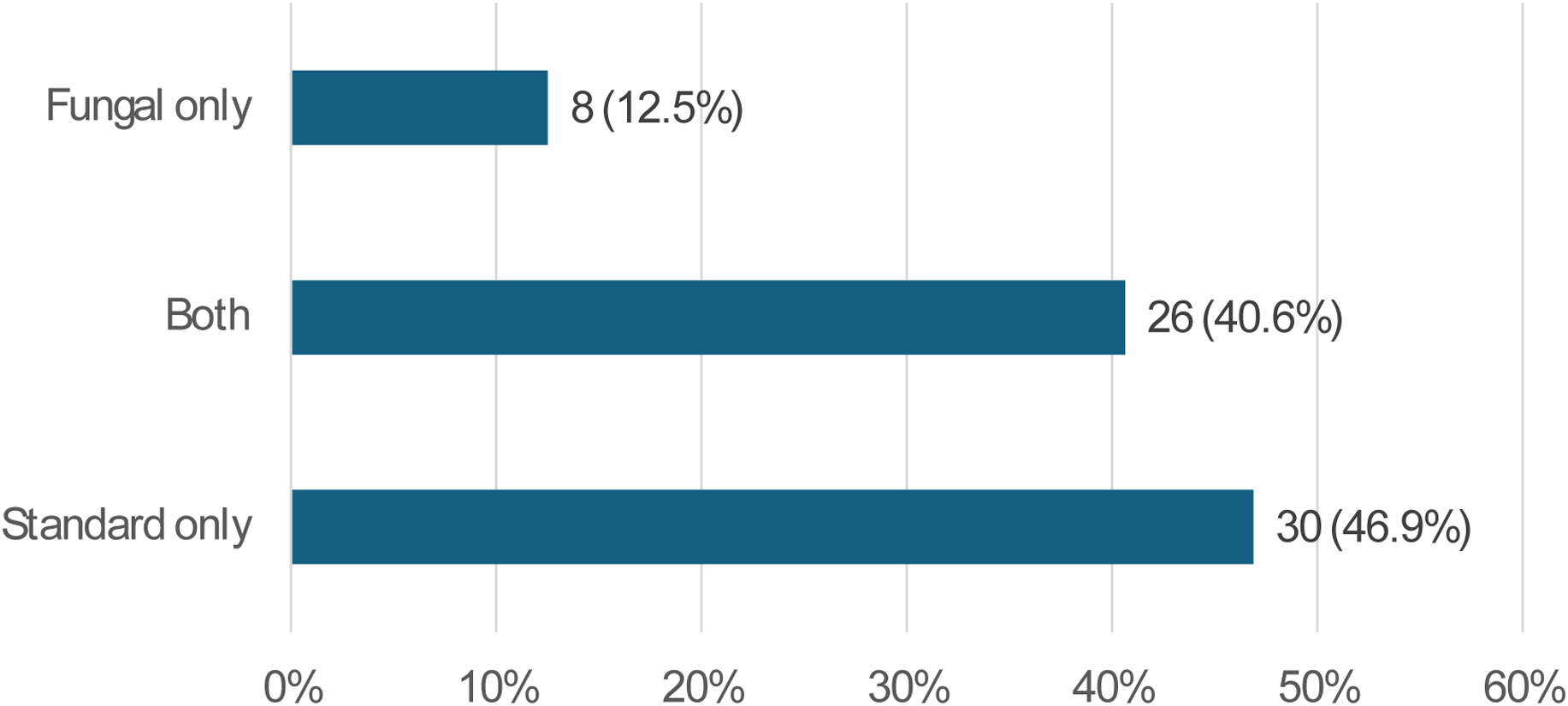
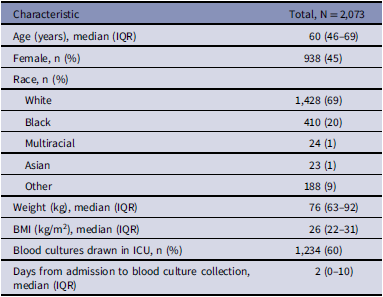
Of 2,449 collections screened, 2,073 paired initial fungal and standard blood cultures met inclusion criteria. Baseline characteristics are displayed in Table 1. Of the 2,073 paired blood cultures, 64 (3.1%) yielded fungal growth in at least one culture type, while the remaining 2,009 (96.9%) revealed no fungal growth in either culture type. Growth in the fungal culture but not standard cultures occurred in 8/2,073 (0.4%) pairs (Figure 1).
Distribution of fungal growth by blood culture type (n = 64).

Baseline characteristics

Table 1. Long description
A table displaying baseline characteristics of a study population. The table has 13 rows and 2 columns. The first column lists characteristics such as age, gender, race, weight, BMI, blood cultures drawn in ICU, and days from admission to blood culture collection. The second column provides the corresponding total values or percentages. Row 1: Age (years), median (IQR), Total: 60 (46-69). Row 2: Female, n (%), Total: 938 (45). Row 3: Race, n (%), Total: White, 1,428 (69); Black, 410 (20); Multiracial, 24 (1); Asian, 23 (1); Other, 188 (9). Row 4: Weight (kg), median (IQR), Total: 76 (63-92). Row 5: BMI (kg/m^2), median (IQR), Total: 26 (22-31). Row 6: Blood cultures drawn in ICU, n (%), Total: 1,234 (60). Row 7: Days from admission to blood culture collection, median (IQR), Total: 2 (0-10).
IQR, interquartile range; BMI, body mass index; ICU, intensive care unit.
In a subgroup analysis of the 64 paired cultures that detected fungal growth in any culture type, 26 (40.6%) were from both culture types and 30 (46.9%) were only from standard blood cultures. Candida species accounted for 60 pairs (93.8%). The other four were Cryptococcus, Histoplasma, Lodderomyces, and Malassezia species. Cryptococcus and Lodderomyces species were recovered from both media types, Histoplasma species grew exclusively in fungal blood culture media, and Malassezia species grew only from standard blood culture media.
Using commercially available estimates, a cost of $99 was used per fungal blood culture bottle. The two-year period that resulted in 8/2,073 (0.4%) positive pairs detected in only fungal blood culture media was used for this calculation. This corresponds to an annual institutional cost of approximately
 ${2{,} 073 \; \textit{paired}\; \textit{blood} \;\textit{culture} \;\textit{bottles} \;\times\; \$ 99 \over 2 \;\textit{years}}=\$ 102{,} 613.50$
to detect the additional 4 cases per year.
Among fungi recovered in both media types, fungal blood cultures had a significantly longer median time to positivity than standard cultures (48 h [interquartile range, IQR, 41–93] vs 33 h [IQR, 28–42]; P < .001). All-cause in-hospital mortality occurred in 361 (17.4%) encounters, and 30-day mortality occurred in 339 (16.4%) encounters.
Discussion
Empirically paired fungal blood cultures rarely identify fungal pathogens not detected by standard blood cultures. Fungemia was uncommon and occurred at 3% of paired cultures, the majority (94%) of which were due to Candida species.
Another major finding was that this study largely recovered fungal growth only in standard blood cultures. One explanation for this is that modern standard aerobic blood culture media are highly optimized and perform exceptionally well for the recovery of Candida species, which represents the vast majority of fungemia cases. Specialized fungal blood culture media are typically only advantageous for the recovery of dimorphic fungi, molds, or fastidious yeasts, which are comparatively rare. Our findings align with Babb et al, who assessed fungal detection in critically ill patients. In their analysis, fungal growth was recovered in 42/1094 (3.8%) of standard blood cultures and 4/523 (0.76%) of fungal blood cultures. Notably, all fungal species recovered from standard cultures in their study were Candida. Reference Babb, Clark, Gaffney, Abdelfattah and Prokesch9
Only one blood culture pair in our study yielded Histoplasma species, with growth observed only in the fungal blood culture. This highlights one possible niche of fungal blood cultures, as described by Herrera et al. Reference Herrera, Khodadadi, Leal, Kulkarni, Pappas and McCarty7 At our institution, Histoplasma infections are rare. Fungal blood cultures may still have added utility in more endemic areas or in immunocompromised patients with specific risk factors. Alternatively, other diagnostic methods, such as urine antigen testing, may offer both faster turnaround and higher sensitivity. Reference Libert, Procop and Ansari10
Limitations to this study included its retrospective nature and single center setting, which may limit generalizability and not capture institutional or regional differences in fungal epidemiology. This study was not designed to evaluate the impact of fungal blood cultures on patient outcomes. Risk factors for invasive fungal infections such as intensive care unit stay, central line use, and immunosuppression were not assessed. However, given the low diagnostic yield and significant cost burden shown in this study, it may be reasonable to restrict fungal blood culture use to those with known risk factors and high risk of non-Candida infections. Future areas of research could include fungal blood culture diagnostic stewardship, and prospective, pragmatic approaches with cost-effectiveness analyses.
Acknowledgments
None.
Financial support
No public funding or grants were used for this study.
Competing interests
All authors have no conflict of interest to declare.
Research transparency and reproducibility
None to declare.

 Open access

