Introduction
Adiponectin is a protein secreted from adipocytes (i.e. an adipocytokine) that is involved in lipid and glucose metabolism.Reference Matsuzawa, Funahashi, Kihara and Shimomura1 Adiponectin binds to its seven-transmembrane spanning receptors, AdipoR1 and AdipoR2, which leads to AMP kinase activation, PPARα activation and enhancement of insulin signal transduction.Reference Kadowaki and Yamauchi2 This results in increased glucose uptake in skeletal muscle, lipid β-oxidation and inhibition of hepatic glucose production. Thus, adiponectin increases insulin sensitivity, improves glucose tolerance and increases HDL-cholesterol concentrations. Low serum levels (i.e. hypoadiponectinaemia) are associated with increasing adiposity [whether expressed as body mass index (BMI), waist circumference, waist–hip ratio, fat mass, percent fat or intra-abdominal fat] and the development of atherosclerosis.Reference Kadowaki and Yamauchi2
In obese children, hypoadiponectinaemia is associated with a more adverse cardiometabolic risk profile.Reference Kynde, Heitmann, Bygbjerg, Andersen and Helge3 Thus, circulating plasma adiponectin may be a useful biomarker to identify overweight children who are at greater cardiovascular risk in the later life. As many countries now have high and increasing rates of childhood obesity,Reference Misra and Khurana4, Reference Biro and Wien5 the role of adiponectin in mediating cardiovascular risk in this age group needs further investigation. However, adiponectin's role as a predictor of the metabolic syndrome in healthy, normal-weight children and adolescents is less clear.
Some investigators have examined adiponectin levels in early childhood. It is not certain whether adiponectin plays a biological role in utero, although adiponectin receptor 1 is expressed in many organs of murine fetuses.Reference Zhou, Sun and Jin6 Newborns have higher adiponectin levels than adults, and levels at birth are positively correlated with birth weight.Reference Kotani, Yokota and Kitamura7, Reference Tsai, Yu and Hsu8 During infancy, serum adiponectin levels fall during the first two years of life in small for gestational age children as they gain weight.Reference Iniguez, Soto and Avila9 It is not clearly known whether antenatal factors or growth during infancy/childhood could affect adiponectin levels in later life.
Similar to other investigators, we found that larger maternal size during pregnancy and larger birth size were directly related to increased waist size in peri-pubertal children.Reference Boyne, Osmond and Fraser10 In addition, children who grew more rapidly throughout childhood later had greater waist circumferences and were more insulin resistant [as measured by homeostasis model assessment of insulin resistance (HOMA-IR)]. Consequently, we hypothesized that large maternal size, large birth size and increased growth rates in BMI during early childhood would be associated with lower adiponectin levels in later childhood. We also thought that hypoadiponectinaemia would be a marker of a more adverse cardiometabolic profile in otherwise healthy children. Thus, in a cohort of Afro-Caribbean children, we describe the maternal, placental, fetal, birth, infant and childhood determinants of serum adiponectin concentrations measured in the peri-pubertal period. Serum adiponectin was also correlated with cardiometabolic risk factors (plasma glucose, lipid profile, blood pressure and insulin resistance) that were measured at the same time.
Methods
Study design and subjects
The Vulnerable Windows Cohort Study is an observational birth cohort that enrolled women who were 7–10 weeks pregnant attending the antenatal clinic at the University Hospital of the West Indies, Jamaica during 1992–1994.Reference Boyne, Osmond and Fraser10–Reference Boyne, Thame and Osmond12 Gestational age was confirmed by a 14-week ultrasound, and women with systemic illnesses (e.g. pre-eclampsia, diabetes and sickle cell anaemia) were excluded. After 82 pregnancy losses, 56 withdrawals for reasons such as work constraints and migration, and five sets of twins, 569 babies were included in the study. For this paper, data analysis was confined to 323 women and their offspring who were seen within 2 years of every scheduled visit between birth and age 12 years. The study protocol was approved by the Faculty of Medical Sciences/University Hospital of the West Indies Ethics Committee and all subjects gave their written informed consent.
Measurements
Maternal weight and height was measured using a standardized protocol.Reference Thame, Osmond and Wilks11 Fetal size was measured sonographically at 14, 17, 20, 25, 30 and 35 weeks using a linear probe (Philips ATL Ultramark IV, Amsterdam, The Netherlands). The average of three measurements was used. Placental volume was also measured at 14, 17 and 20 weeks.Reference Howe, Wheeler and Perring13
All newborns were measured within 24 h of delivery. We measured birth weight with a Health-o-meter® 459 scale (Bridgeview, IL, USA), placental weight with an electronic balance (Digimail 800100; Soehnle GmbH & Co., Murrhardt, Germany), crown heel length with a length board (Holtain Ltd., Crymych, UK) and head circumference with a fibre-glass tape. We measured anthropometry at 6 weeks, every 3 months up to 2 years and then every 6 months. BMI was calculated using the formula BMI = weight (in kg)/height (in m).Reference Kadowaki and Yamauchi2 Blood pressure was measured every 6 months from age 1 year using an oscillometric sphygmomanometer. We measured the stage of the pubic hair and breast development according to the method of Marshall and Tanner.Reference Marshall and Tanner14, Reference Marshall and Tanner15 Testicular volume was measured with a Prader orchidometer (Holtain Ltd, Crymych, UK). At age 11.5 ± 1.3 years, we obtained fasting blood using EMLA® (Astra Zeneca, Karlskoga, Sweden) cream as a local anaesthetic and measured body composition using bioelectrical impedance analysis (50 kHz model 101Q; RJC Systems, Clinton Township, MI, USA) with the subjects wearing light clothing. Fat-free mass and fat mass were determined using the manufacturer's equations.
Assays
Serum adiponectin was measured by ELISA (Linco Research, MI, USA), which had a sensitivity of 0.78 ng/ml. The intra-assay and inter-assay coefficients of variations of the assay were ⩽8%. Plasma glucose was measured by the glucose oxidase system. Total cholesterol, HDL-cholesterol and triglycerides were measured by enzymatic techniques using a VP biochromatic analyser (Abbott, Irving, TX, USA). Plasma insulin was measured with an immunometric assay (Immulite Insulin; Diagnostic Products Corporation, Los Angeles, USA). The assay had an analytical sensitivity of 2 μIU/ml and the intra-assay coefficient of variation was <8.0%. The HOMA-IR score was calculated as the product of insulin and glucose divided by 22.5.Reference Matthews, Hosker and Rudenski16
Statistical analysis
Adiponectin, insulin, HOMA-IR and triglycerides were log transformed towards normality. Growth intervals were defined as follows: birth to 6 months (i.e. early infancy); 6 months to 2 years (i.e. late infancy); and 2–8 years of age (i.e. childhood). We did not define growth using the traditional method of z-scores, which is used in cross-sectional studies. Instead, using linear regression to measure growth better reflects the longitudinal study design. Growth was defined as the amount by which the size at the end of a time interval exceeded that which would have been predicted by linear regression using the measurements available at the beginning of the interval.Reference Boyne, Osmond and Fraser10, Reference Kajantie, Barker, Osmond, Forsen and Eriksson17 Such measures are uncorrelated by construction. Simple differences in z-scores do not have this property, as a large difference may result from either a low value at the beginning of the interval or a high one at the end.
We calculated Pearson's correlation coefficients adjusted for age and sex to measure the associations of adiponectin at age 11.5 years with maternal factors, placental size, fetal size, neonatal size, gestational age and metabolic measurements. Multiple regression analyses including age and sex were used to measure the associations of adiponectin with growth during infancy and childhood. We also constructed separate models adjusting for pubertal stage. We used outcomes and predictors in standardized form, that is, for a standardized score, a value of 0 corresponds to the mean and a value of 1 corresponds to 1 s.d. above the mean and so on. Consequently, the regression coefficients were effectively correlation coefficients. To test for similarity of effects between boys and girls, we used product terms of sex with anthropometric variables. A P-value <0.05 was considered statistically significant. SPSS 15.0 for Windows (Chicago, IL, USA) was used for the statistical analyses.
Results
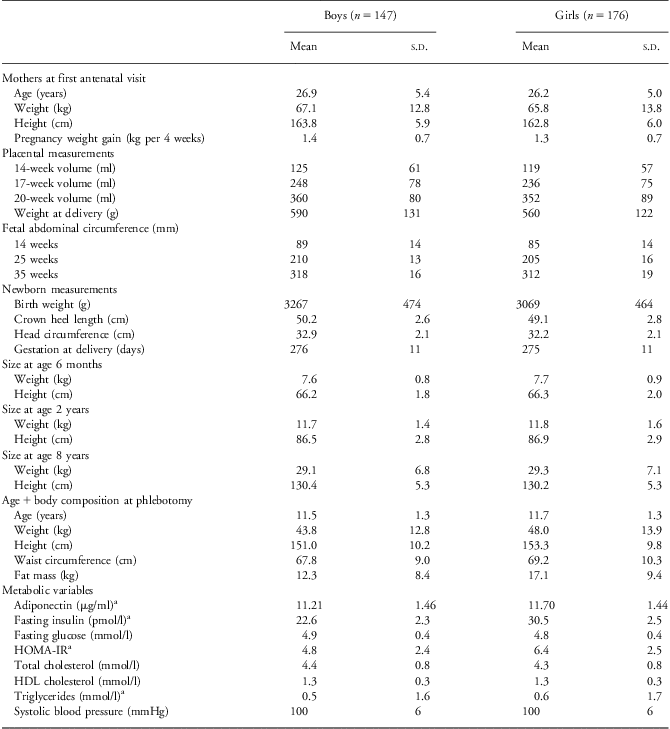
The 323 subjects who were studied were similar to the other members of the cohort in maternal age, height, weight and BMI. They were not different in birth length, head circumference or placental weight, but were 129 g heavier in weight (P = 0.004) and 3.2 days older in gestational age at birth (P = 0.006). Mean values for maternal, placental, fetal, newborn and postnatal measurements and biochemical measurements are shown in Table 1. The boys were similar in size to the girls until the age of 11 years, at which stage more girls had started their pubertal growth spurt and had a higher BMI, fat mass and per cent body fat. At mean age 11 years, 14.3% of girls and 10.1% of boys were obese, whereas 35.7% of girls and 26.1% of boys were overweight. The median age at reaching Tanner stage 3 for pubic hair development was 11.1 years in girls and 12.8 in boys. Markers of cardiometabolic risk (i.e. glucose, lipids, systolic blood pressure) were similar in both sexes. However, fasting insulin and HOMA-IR were significantly higher in the girls (P < 0.05).
Mean maternal, placental, fetal, neonatal, infant and childhood measurements in 323 Afro-Caribbean children

HOMA-IR, homeostasis model assessment of insulin resistance.
aMeans and standard deviations are geometric.
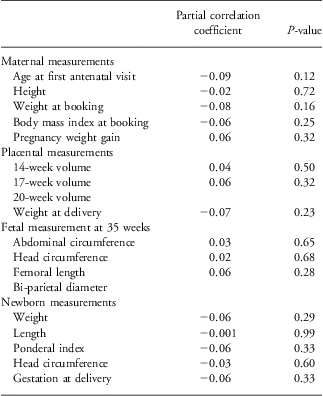
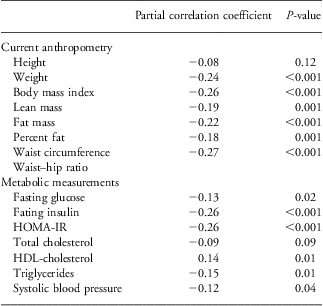
Maternal age, maternal size, placental size, fetal size, gestational age and newborn size were not significantly associated with serum adiponectin levels (Table 2). However, current size of the children (i.e. weight, BMI, lean mass, fat mass, per cent fat, waist circumference and waist–hip ratio), fasting glucose, insulin, HOMA-IR, triglycerides and systolic blood pressure were inversely and significantly related to adiponectin (Table 3). HDL-cholesterol was positively associated with adiponectin. After adjusting for current BMI or waist, the relationships with glucose, insulin and HOMA-IR remained significant, though attenuated, but other associations disappeared (data not shown).
Partial correlation coefficients between maternal, placental, fetal and neonatal measurements of 323 Afro-Caribbean children and their log adiponectin levels at age 11.5 ± 1.3 years
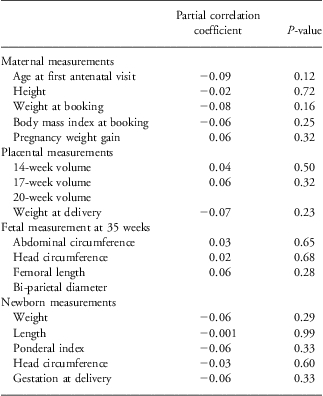
Analyses are adjusted for sex and age. All measurements are in standardized form.
Partial correlation coefficients between current anthropometry and metabolic measurements of 323 Afro-Caribbean children and their log adiponectin levels at age 11.5 ± 1.3 years
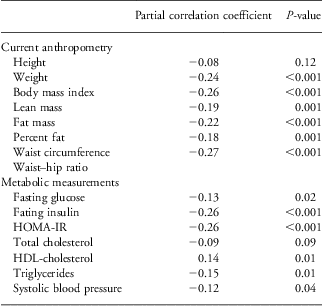
HOMA-IR, homeostasis model assessment of insulin resistance.
Analyses are adjusted for sex and age. All measurements are in standardized form.
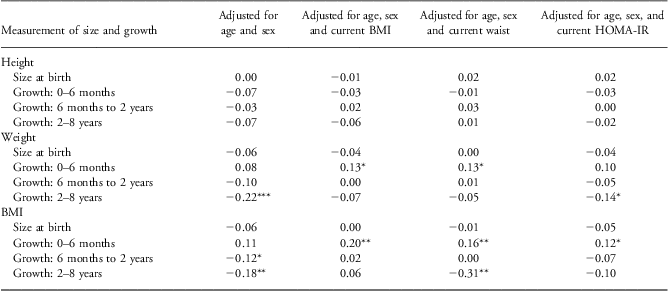
Figure 1 shows the associations of growth throughout childhood with serum adiponectin at age 11.5 years. Although gains in height had an inverse association with adiponectin levels, these were mostly non-significant. During early infancy, there was a trend towards gains in weight and BMI being associated with higher levels of adiponectin. However, the more significant effects were seen later in childhood where there were inverse associations. Greater gain in BMI during late infancy and childhood were associated with lower adiponectin levels (Table 4). In addition, gains in weight during childhood BMI had significant inverse associations. Birth size and gains in height were not significantly associated.
Regression coefficients (95% CI) of serum adiponectin levels with size (height, weight and body mass index) of 323 Afro-Caribbean children from birth to age 11.5 ± 1.3 years. Analyses are adjusted for sex.
Regression coefficients (β) of size at birth and childhood growth of 323 Afro-Caribbean children and log adiponectin levels at age 11.5 ± 1.3 years
BMI, body mass index; HOMA-IR, homeostasis model assessment of insulin resistance.
All measurements are in standardized form.
*P < 0.05; **P < 0.01; ***P < 0.001.
We examined models that included current body size (i.e. BMI and waist circumference) and insulin resistance (Table 4) to determine whether postnatal growth was independently associated. In models that adjusted for current BMI, gains in weight and BMI during early infancy were positively associated with adiponectin levels. Models that adjusted for current waist circumference showed similar associations, although gains in BMI during childhood were now inversely associated with adiponectin. After adjustment for HOMA-IR, gains in weight during childhood were again associated with lower adiponectin levels, but gains in BMI during early infancy were associated with higher adiponectin levels. Adjustment for pubertal stage did not significantly change the pattern of the associations (data not shown).
Discussion
In this cohort of Afro-Caribbean children, maternal size during pregnancy, fetal size and neonatal size were not associated with serum adiponectin concentration in later childhood. However, current body size and growth in weight and BMI during childhood were significantly and inversely related to adiponectin. Most of the relation of growth during childhood was mediated through current body size. Among children of the same current size, growth in BMI during early infancy was directly associated with adiponectin. Finally, lower levels of adiponectin in later childhood were associated with worse cardiometabolic risk (i.e. higher glucose levels, more insulin resistance, more atherogenic lipid profile and higher systolic blood pressure).
Although there is a positive association of birth size with serum adiponectin levels measured at birth,Reference Kotani, Yokota and Kitamura7 we were unable to show an association with adiponectin in later life, that is., at peri-pubertal ages. Adiponectin may play a role in fetal linear growth by stimulating osteoblastic activityReference Oshima, Nampei and Matsuda18 and adipogenesis in animal models.Reference Fu, Luo, Klein and Garvey19 However, adiponectin does not seem to affect postnatal growth and, indeed, its concentration decreases during late fetal life,Reference Corbetta, Bulfamante and Cortelazzi20 immediately after deliveryReference Fuglsang, Sandager and Frystyk21 and during infancy,Reference Iniguez, Soto and Avila9, Reference Fuglsang, Sandager and Frystyk21 especially the high molecular weight sub-fraction.Reference Fuglsang, Sandager and Frystyk21 The decline during infancy was attributed to increased weight (and possibly adiposity) and not to changes in insulin sensitivityReference Kotani, Yokota and Kitamura7, which is compatible with our data.
We found varying associations of growth on adiponectin depending on the period of the life course. It is not clear why weight gain in early infancy could have beneficial effects on adiponectin levels in later life. These data complement other studies that suggest that weight gain during infancy is protective against truncal obesity and insulin resistance in later life (especially in higher birth weight children), but weight gain after age 4 years has an adverse effect.Reference Bouhours-Nouet, Dufresne and de Casson22 Thus, early weight gain in infancy may promote insulin sensitivity by altering body composition. Conversely, faster weight gain throughout childhood predisposes to increased adiposity, presumably with fat tissue deposition in ectopic sites. This would result in hypoadiponectinaemia and a more adverse cardiometabolic profile.
Another possible explanation is that faster growth rates in infancy may reflect catch-up growth in some children, after a period of fetal growth restriction, which can even occur in normal birth weight children. Catch-up growth generally results in more fat mass acquisition.Reference Beltrand, Nicolescu and Kaguelidou23. In such cases, faster growth in infancy results in hyperplasia of adipocytes,Reference Dulloo24 which is more associated with a more metabolically favourable phenotype.Reference Beltrand, Nicolescu and Kaguelidou23 However, catch-up growth in childhood results in adipocyte hypertrophy, which can cause low-grade systemic inflammation and insulin resistance.Reference Dulloo24 This ‘catch-up fat hypothesis’ could explain the divergent effects of faster growth in infancy and childhood on adiponectin levels.
In support of these concepts, pre-pubertal children who were small for gestational age at birth have similar or higher adiponectin levels than matched children who were appropriate for gestational age at birth. However, small for gestational age children who did not have catch-up growth had significantly higher adiponectin levels (15.6 v. 8.5 mg/ml) than children who were appropriate for gestational age.Reference Evagelidou, Giapros and Challa25, Reference Challa, Evagelidou and Cholevas26 In addition, both small for gestational age birth and recent size are associated with lower serum adiponectin levels in 6-year-old Turkish children.Reference Sancakli, Darendeliler and Bas27
Hypoadiponectinaemia in overweight European children signifies a negative metabolic risk profile (higher BMI, HOMA-IR, total serum cholesterol to serum HDL-cholesterol ratio, serum triglycerides and systolic blood pressure) and less cardiorespiratory fitness 6 years later.Reference Kynde, Heitmann, Bygbjerg, Andersen and Helge3 Adiponectin is an indicator of insulin resistance in large for gestational age children at prepubertal ages regardless of body size.Reference Darendeliler, Poyrazoglu and Sancakli28 Our study extends these findings by demonstrating that hypoadiponectinaemia heralds an adverse cardiometabolic risk in otherwise healthy and normal weight children. The effects may be partially mediated by intra-hepatic fat accumulation, which also leads to decreased insulin sensitivity, or an adverse lipoprotein profile.Reference Koska, Stefan and Permana29, Reference Denzer, Thiere and Muche30 Like others,Reference Shatat, Freeman, Vuguin, Dimartino-Nardi and Flynn31–Reference Vasunta, Kesaniemi and Ukkola34 we found an inverse relationship of adiponectin and systolic blood pressure. The mechanisms by which adiponectin can regulate blood pressure appear to be independent of body size,Reference Shatat, Freeman, Vuguin, Dimartino-Nardi and Flynn31 and may be mediated through altered vascular reactivity.
The major strength of our study is the very frequent longitudinal measures of growth in our cohort from fetal life through childhood unlike many studies that are either cross-sectional or only have a few measurements in childhood. Our sample was representative of the entire cohort. However, we only measured total circulating adiponectin and not its high, medium (hexameric) or low molecular weight fractions. High molecular weight adiponectin is more closely associated with insulin sensitivity, but the importance of the different fractions in childhood is not clear. It would have also been interesting if we had recorded adiponectin measurements more than once during childhood. We do not have data on breastfeeding to determine whether breast milk influences the pattern of growth in early infancy and thus on later adiponectin levels. In addition, we do not have any sex steroid data as testosterone can suppress adiponectin expression. However, pubertal stage did not significantly alter our findings, which suggests that a sex steroid effect may not be as important in peri-pubertal children.
In summary, we have shown that antenatal factors are not determinants of adiponectin levels in peri-pubertal children, although we cannot fully exclude a type 2 error. Faster growth of BMI during infancy is associated with higher levels of adiponectin, but faster rates of growth during childhood are associated with hypoadiponectinaemia. These associations were not mediated by current body size or insulin resistance. In addition, hypoadiponectinaemia is a marker of a more adverse cardiometabolic profile in Afro-Caribbean children.
Acknowledgements
This research was supported by was supported by a grant from the Wellcome Trust, 183 Euston Road, London, England, and funding from the University of the West Indies.
The authors thank the participants and staff of the Vulnerable Windows Cohort Study for their consistent role in the cohort over the years.
Conflicts of Interest
None.
Author contributions
MSB contributed to the study design, data collection and interpretation of the data and wrote the first draft of the manuscript. MT contributed to the data collection and writing of the manuscript. TEF contributed to the study design, data collection, interpretation of the data, and writing of the manuscript. CO and RAF contributed to the data analysis and the writing of the manuscript. DST, CTB and SSW contributed to writing of the manuscript.
Some of this data was previously presented as a poster at the 7th World Congress on Developmental Origins of Health and Disease, 18-21 Sept 2011, Portland, Oregon. J Developmental Origins of Health and Disease, 2011; 2 (Suppl 1): S57.