Introduction
The bark and ambrosia beetle fauna (Coleoptera: Curculionidae: Scolytinae and Platypodinae) preserved in Dominican amber is one of the most diverse ancient (17–20 million years ago) assemblages of wood boring beetles (Bright and Poinar Reference Bright and Poinar1994; Grimaldi and Engel Reference Grimaldi and Engel2005). Twenty-seven species representing one of five Platypodinae tribes and eight of 25 Scolytinae tribes have been described (Wood Reference Wood1986, Reference Wood1993; Bright and Poinar Reference Bright and Poinar1994). New genera have been described for six Scolytinae species (Bright and Poinar Reference Bright and Poinar1994). However, many extant genera occur and these taxa are morphological similar to the Recent (i.e., Holocene) Neotropical fauna (Wood Reference Wood1982, Reference Wood2007). Bright and Poinar (Reference Bright and Poinar1994) did not report Hylesinini from Dominican amber but the absence of this taxon is possibly due to sampling biases concerning taphonomy, fossil discovery, or taxonomic attention. Thus, the discovery of the first Hylesinini in Dominican amber is unsurprising because the worldwide distribution of extant Hylesinini species suggests that this tribe originated before the separation of Africa and South America (120–90 million years ago) (Wood Reference Wood1986), other Hylesinus Fabricius species are known from Miocene-Oligocene (40–10 million years ago) Baltic amber and Florissant compressions (Wood and Bright Reference Wood and Bright1992), and an another genus, Phloeoborus Erichson is common among the extant Neotropical fauna (Wood Reference Wood2007). This new species is interesting because it potentially represents a new genus and appears to share a close affinity with extant African Hylesinini genera (Beaver Reference Beaver2010).
Phylogenetic analysis of this new species and the 12 extant Hylesinini genera would test the relationships among these taxa. The phylogenetic relationships of the Hylesinini have not been explicitly addressed. However, a recent molecular phylogeny of 200 scolytines, which included 15 Hylesinini species representing nine genera found this tribe polyphyletic and Strombophorus Hagedorn (Diamerini) monophyletic with Hapalogenius Hagedorn and Rhopalopselion Hagedorn (Jordal and Cognato Reference Jordal and Cognato2012). Limited phylogenetically informative characters likely contributed to the polyphyly of the tribe, thus analyses with additional characters may find the Hylesinini monophyletic (Jordal and Cognato Reference Jordal and Cognato2012). In this study, a phylogeny of all Hylesinini genera and the Dominican amber specimen is reconstructed based on morphological data and is used to justify the recognition of the Dominican amber specimen as a new genus.
Materials and methods
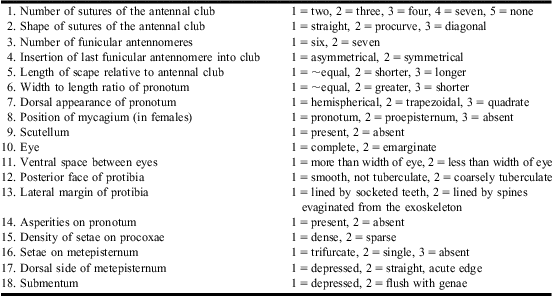
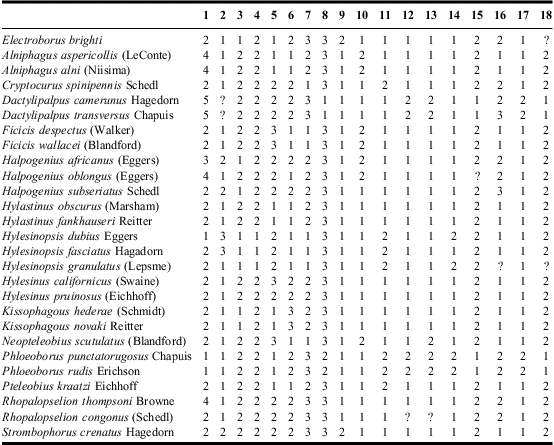
Twenty-five specimens representing all genera of Hylesinini and one Strombophorus specimen (Wood Reference Wood1986; Jordal and Cognato Reference Jordal and Cognato2012), from the A.J. Cook Arthropod Research Collection, East Lansing, Michigan, United States of America (MSUC) and the National Museum of Natural History at the Smithsonian Institute, Washington, District of Columbia, United States of America (USNM) were examined and scored for 18 morphologically variable characters (Tables 1–2). The first nine characters were derived from a Hylesinini generic key because of their potential phylogenetic informativeness at the generic level (Wood Reference Wood1986). The remaining characters were chosen because they exhibited low intrageneric and some intergeneric variation. Using this data matrix (Table 2), most parsimonious trees (mpts) were reconstructed by a heuristic search in PAUP* 4.0 b10 PPC using 100 random additions and default settings (Swofford Reference Swofford2002). Bremer support was calculated with TreeRot v.2 (Sorenson Reference Sorenson1999).
Characters and their states.

Characters and their states scored for Hylesinini and Strombophorus species.
Results
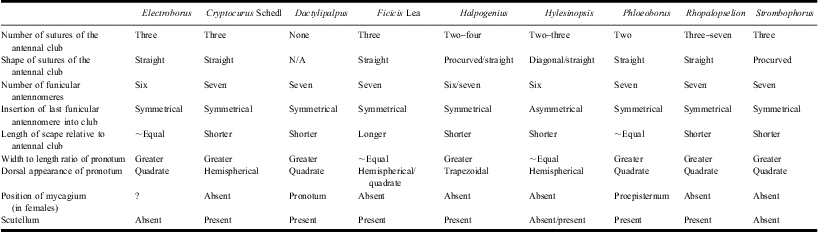
The heuristic search found 3973 mpts for the 25 taxa. The strict consensus tree was mostly unresolved except for the monophyly of six genera and a clade that included Dactylipalpus Chapuis and Phloeoborus (Fig. 1). Bremer support for these clades was modest. Of the mpts, a clade including the Dominican amber species and Strombophorus occurred in 53% of the trees. The sub-cortical lifestyle of bark beetles has resulted in canalisation of body form, thus the similar morphology limited the number of variable characters and resulted in low phylogenetic resolution and Bremer support. Additional molecular characters and taxa beyond those included in the phylogenetic analyses of Jordal and Cognato (Reference Jordal and Cognato2012) will be necessary to further test the monophyly of Hylesinini and resolve generic relationships. Regardless of the tree's low resolution, several conclusions can be made concerning the taxonomic status of the Dominican amber species. This species is not related to Phloeoborus despite occurring in the Neotropics. It shares more characteristics with the African genera Hylesinopsis Eggers and Strombophorus (Table 3). A similar amount of character-state change was observed for the genera. Most genera were associated with unambiguous state changes for two characters, although Hylesinopsis and Phloeoborus exhibited changes among three characters. Generally, these genera are distinguished by a unique collection of homoplastic characters and only a few synapomorphies, for example mycangia in Dactylipalpus and Phloeoborus (Table 3). The Dominican amber species also exhibits a unique pattern of homoplastic characters, which justifies its designation as a new genus.
Unrooted phylogeny of Hylesinini and Strombophorus, one of 3973 mpts found in a heuristic search using 18 morphological characters (RC = 0.45). Numbers below branches equal Bremer support. Nodes with zero Bremer support were unresolved in a strict consensus of the 3973 mpts. Vertical lines represent unambiguous character state changes inferred using accelerated transformations. Numbers above vertical lines are the characters, numbers below are the character state changes and “A” indicates the character state change is apomorphic.
Comparison of generic characters of tropical Hylesinini and Strombophorus.
Taxonomy
Electroborus, new genus
Diagnosis
A combination of characters including a six-antennomere funicle, asperites on the anterolateral areas of the pronotum, and separated procoxae place this genus in Hylesinini. Electroborus most closely resembles the African genus Hylesinopsis, except that in the former the pronotum is quadrate (nearly square) and the last antennomere inserts symmetrically into the club while the latter the pronotum is hemispherical and the last antennomere inserts asymmetrically into the club. It is also similar to Strombophorus in that both genera lack a scutellum and have a quadrate pronotum. However, they differ in the shape of the antennal club sutures and number of funicular antennomeres (Table 3). The absence of a scutellum distinguishes Electroborus from the Neotropical genus Phloeoborus.
Description
Eyes oval, elongate, entire. Antennal funicle with six antennomeres; apical funicular antennomere symmetrically inserted into club; club slightly longer than wide; club base apparently recurved, apical half apparently flattened; possibly two transverse rows of setae (view obscured). Frons with punctures and hair-like setae, epistomal lateral lobes with tufts of longer setae, debris, and bubbles obscure other frontal characters. Pronotum quadrate, wider than long, anterior margin without asperities, sides rounded; discal and lateral surfaces with rows of asperities and hair-like setae, asperities on anterolateral margin larger; mycangia not apparent. Procoxae separated by the width of a procoxa. Protibia widened distally, outer apical angle with several denticles, lateral margin without denticles; protarsomere 3 slender, not bilobed. Scutellum absent. Elytra with bases procurved, basal crenulations present, crenulations present on interstriae 1, 2, 3 near scutellar area; interstriae raised, approximately twice width of striae, with biseriate hair-like setae; striae with serial punctures. Declivity convex; interstriae level with striae, with uniseriate setae on interstriae 1, 2, 3.
Type species
Electroborus brighti, new species.
Etymology
“Electro” (G, elektron) = amber, “borus” (G, bibrosko) = eater, i.e., borer. The name refers to the holotype's appearance of “eating” amber. Living specimens likely ate phloem and/or fungal hyphae as observed with extant Hylesinini species.
Electroborus brighti, new species
Electroborus brighti new genus, new species holotype habitus; (A) dorsolateral; (B) lateral.
Base of the elytra (notice the absence of the scutellum).
Diagnosis
Along with the characters and differences described above for the genus, the larger size, widely separated procoxae, and the absence of granules on the elytral declivity distinguish E. brighti from Paleosinus fossulatus Bright and Poinar, the only similar species known from Dominican amber (Bright and Poinar Reference Bright and Poinar1994).
Description
Holotype (sex unknown), length ∼3.0 mm, ∼2x longer than wide. Frons appear flat with erect black-brown hair-like setae and punctures. Pronotum ∼1.5× wider than long; margins rounded in dorsal and lateral views. Elytra ∼2× longer than wide, base arcuate, apex rounded in dorsal and lateral views; discal striae impressed with punctures approximately the width of the striae; discal interstriae ∼3× wider than the striae, with biseriate black-brown, hair-like setae. Declivity convex; striae not impressed with punctures; interstriae 1, 2, 3 with uniseriate black-brown, hair-like setae, without granules.
Type material
Holotype: American Museum of Natural History no. DR-10723 in Oligo-Miocene amber from La Toca, Dominican Republic. Preservation of this specimen is very good and ∼90% of the body is visible. However, debris and bubbles obscure some of the morphological details on frons, etc. Paratype: Oregon State University Arthropod Collection no. C-7-87A in amber from the Dominican Republic.
Other material examined
Paleosinus fossulatus Bright and Poinar (Reference Bright and Poinar1994), holotype from the Oregon State University Arthropod Collection.
Comments
No morphological variation was observed between the holotype and paratype.
Etymology
This species honours Dr. Donald E. Bright, Jr. and his invaluable treatise of the scolytine and platypodine fauna of Dominican amber.
Discussion
The discovery of E. brighti adds to the taxonomic diversity of Dominican amber. This Miocene scolytine community is taxonomically and ecologically (i.e., species represent the same feeding guilds) similar to the extant fauna with the notable absence of the Xyleborini (Bright and Poinar Reference Bright and Poinar1994). Based on phylogenetic dating, the Xyleborini, which is most diverse in Old World tropical forests, originated ∼20 million years ago and likely subsequently colonised the Neotropics (Jordal and Cognato Reference Jordal and Cognato2012). Other extinct and extant scolytine taxa in Hispaniola (e.g., Cladoctonus Strohmeyer, and Microborus Blandford), suggest a connection between the Caribbean and Old World tropical faunas as observed for many insect groups (Liebherr Reference Liebherr1988) including extant relatives of other extinct Neotropical insect taxa (e.g., Mastotermes Floggatt) (Grimaldi and Engel Reference Grimaldi and Engel2005). Indeed, the close affinity of E. brighti to the African endemic Hylesinini genera adds to the general observation that the Afrotropical and Neotropical faunas were more similar ∼10–40 million years ago. Reasons for the loss of Old World insect taxa from the Caribbean are difficult to discern but are likely due to the dynamic nature of island emergence and submergence (Graham Reference Graham2003). It is possible that Electroborus may exist among the Recent fauna given that an estimated 67% of the Neotropical scolytine fauna remains undiscovered and the Afrotropical fauna is comparatively even more unknown (Wood and Bright Reference Wood and Bright1992; Wood Reference Wood2007).
Acknowledgements
The author thanks David Grimaldi for his guidance in this study of amber inclusions and for access to the American Museum of Natural History collection and George Poinar for the loan of specimens. Natalia Vandenberg kindly provided access to the specimens at the United States Natural History Museum. Donald Bright and Roger Beaver provided helpful correspondences concerning the identity of E. brighti. Sarah M. Smith, Andrew B.T. Smith, and two anonymous reviewers provided helpful comments concerning earlier versions of this publication.