Introduction
To consider the nature of mathematical reasoning, historians of mathematics in non-Western cultures often examine practices in the local tradition to decipher how mathematics was constructed, argued, and transmitted from one generation to the next, abstaining from treating the deductive reasoning in the Greek tradition as the universal standard. The case of reasoning in Chinese mathematical treatises in the sixteenth and seventeenth centuries presents interesting yet much more complicated scenarios. The indigenous practices were well established in the mathematical texts when certain geometric knowledge from Europe, introduced through the translation of first six books of Euclid’s Elements into Chinese as Jihe yuanben 幾何原本 by the Jesuit Matteo Ricci (1552-1610) and his Chinese collaborator Xu Guangqi 徐光啟 (1562-1633) at the turn of the seventeenth century, presented new mathematical knowledge in a brand new form and style. Jihe yuanben exerted tremendous influence on many aspects of the development of mathematics in China since the beginning of its first publication. Arguably chief among them was the emergence of reasoning or explanatory texts as an integral part in many mathematical treatises. To highlight the importance of such a transformation, one should bring attention to the peculiar absence of reasoning in most of the mathematical treatises composed prior to the publication of Jihe yuanben during the Ming Dynasty (1368-1644).
The mathematical treatises in China composed during the fifteenth and sixteenth centuries followed a certain format of presenting the knowledge. Common to all extant works is the collection of ensembles of questions, their answers, and the procedures to obtain the answers.Footnote 1 Little effort was devoted in the text or commentary to establish the validity of procedures, or to illuminate how the procedures came into existence.Footnote 2 In short, providing reasoning or explanation was not a practice in the textual tradition at the time.Footnote 3 The issues of how reasoning in the mathematical treatises might have been related to the authors, intended readers and the purposes, mathematical content, and the intellectual backdrop of the time are interesting in their own right and need further investigation; that discussion, however, falls outside the scope of this current work.
The 1607 publication of Jihe yuanben formally introduced into China the Greek style of presenting geometric knowledge – postulates, axioms, theorems, and proofs. Several geometric works in the seventeenth century followed suit and adopted this format in the treatise. In the early seventeenth century, Jihe yuanben along with other Jesuit-translated mathematical and astronomical treatises that resulted from the calendar reform project helped promote the practice of including reasoning in mathematical treatises.Footnote 4 Our survey of many extant treatises composed in the second half of the seventeenth century shows that these mathematical works in effect include explanations not as commentaries but integrated seamlessly to constitute the main text. This is the case regardless of the subject matter, be it geometry or computational methods, and regardless of the form in which the knowledge is presented – whether in Jihe yuanben’s western style of axioms-theorems-proofs, the traditional Chinese style of questions-answers-procedures, or various combinations of the two styles when they sometimes appear together. Some explanatory texts amounted to proving the properties for which the explanation was made. Some present the reasons why the procedures actually solve the problems. Still others clarify the reasonableness of the rules in procedures. In short, reasoning in a broader sense becomes a staple feature in most of mathematical treatises of China in the seventeenth century.
This paper examines the practices of reasoning in the mathematical treatises of a particular genre, fangcheng, one of the nine branches of mathematics in the Chinese tradition, equivalent to the modern-day systems of linear equations and Gaussian elimination. Comparisons are made of the treatments of fangcheng problems in the treatises composed during the Ming and in the seminal work, Fangcheng lun 方程論 (Discussions on Juxtaposition and Calculation, hereafter the Discussions), composed by the prolific scholar Mei Wending 梅文鼎 (1633-1721) in the Qing Dynasty (1644-1911). Attempts were made to analyze Mei’s computations in the Discussions based on problems of two unknowns and consequently these analyses overlooked an essential feature. As we will show in this article, one of the defining characteristics in Mei’s approach was the designation of the numbers as “positive” or “negative” after each operation. This issue appeared irrelevant in problems of two unknowns. Consequently, the most crucial aspect in Mei’s treatise is absent in these previous studies.Footnote 5 In the Ming works treating fangcheng problems, the prescribed step-by-step procedure in the text made the solution easy to follow; yet the absence of reasoning behind the steps, the many inadequate and incorrect directions of why and when a particular procedure should be undertaken, the non-existent guideline to designate the signs of the numbers after each step, and the pervasive mistakes in the solutions rendered it impossible for an average, uninitiated reader to uncover the correct approach based on the steps in a solution. Consequently, most readers merely learned to follow the steps to achieve the correct answer to the problems discussed in the treatise. Few innovations could be found in these works, only the perpetuated mistakes and occasional new misprints and typographical errors. In Mei’s words, the deterioration of the treatment had reached such a state of decline that “the nine branches of mathematics from antiquity were virtually missing one.”Footnote 6
Setting out to remedy this sorry state, Mei took one set of operations from the procedures unexplained in the old treatises and supplemented it with rules for operations and for designating the “signs” of numbers to form a self-contained system. Explication of the rules and narratives of the steps were provided abundantly, as were the examples and the repeated solutions to the same problem with different initial set-ups. In establishing his system, Mei faced two challenges: first, he had to persuade his contemporaries that his approach, modified from the tradition with his supplemented rules, was legitimate and could solve all fangcheng problems (that could be solved). Mei achieved this goal by explaining his operational rule through the context of examples in trading, along with abundant narratives and explicating texts to demonstrate its wide applicability. Second, Mei had to refute certain practices in the old treatises that were incompatible with his system. His criticisms first identified the practices, then provided the reason for classifying them as mistakes (wu 誤), and finally demonstrated the “correct” alternative in the newly explicated approach of his own. Mei’s treatise presented a logically consistent, self-contained system, which was later adopted by a court-commissioned mathematical compendium and consequently became the orthodox approach to treating fangcheng problems in the eighteenth and early nineteenth centuries in China.
Mei’s explanations, especially those related to his choice of operating rules from the tradition and those of his own innovation, were to legitimize his system. His justification of the rules was based on common sense in trading, establishing the validity and the raison d’être behind them. He then extracted the rules based on the signs of the numbers in the operations, leaving behind the trading context. This process of abstraction tacitly promoted Mei’s rules as reasonable and compatible within the general understanding of commercial trading; moreover, their validity rested on the ultimate test of wide applicability in all problems in the genre. Unsurprisingly, the lack of generality is the most forceful among his reasons for rejecting certain traditional practices. Other reasons for rejection are, as we shall discuss, the absence of uniformity, simplicity, or rigor. To Mei, these epistemological values, which he perceived as constituting the core essence of suanli 算理 (principles of computations), would have been found in the antique approach to fangcheng problems should there have been textual evidence to back up such a claim. In such a manner, Mei presented his innovatively modified approach to the genre as a restoration of the practices from antiquity.

Mathematics in the Ming
Before undertaking the task of analyzing fangcheng problems, we first explore the backdrop against which mathematics was considered among the fields of learning and mathematics’ utility for the general population in fifteenth- and sixteenth-century China to situate our analysis in a proper historic context. We will examine mathematics in two aspects: the cultivation of the literate and the daily life of the general public. The available evidence, although scant, suggests that mathematics was marginal in the training of classical learning; and the general public mostly used arithmetic for commercial use and bookkeeping with the abacus as the calculation tool.
The traditional narrative of mathematics and astronomy during the Ming was that it was in a state of decline. The evidence was abundant: “mathematics and astronomy in China had reached their pinnacle of success during the Song (960-1279) and Yuan (1279-1368) dynasties but had declined precipitously during the Ming,” and there was no innovation at the highest levels of mathematics, to name a couple. Such a view has been challenged by recent studies.Footnote 7 How did mathematics fare in the cultivation of the educated literati and the aspiring degree seekers in the civil service system? As the civil examinations gradually became the dominating channel to enter the government service, their curricula steadily gained greater influence over literati scholarships and fields of learning. The lack of records makes it difficult to know how mathematics was introduced to students in public and private schools during the Ming.Footnote 8 Recent studies have shown that the educated class was not completely ignorant of the subject. Prior to the arrival of the Jesuits in the Ming Court, the calendar reform was such an important concern that memorials were sent to the throne by certain scholars of the day who had the expertise to address them discussing technical issues and potential changes in government organizations. In a different perspective, Benjamin Elman examines and finds that certain policy questions (ce 策) in the civil examinations were dealing with astronomy, law, medicine, ritual, music, and institutions and they appeared regularly in spite of a low frequency.Footnote 9 Elman’s careful analysis of the top answers to these policy questions also sheds light on how mathematics was situated in the training and studies of degree seekers in the civil examinations.
Although the classic studies occupied a preeminent position in the orthodox curriculum in the Ming examination system, the candidates for the provincial and metropolitan examinations were expected to grasp many technical aspects of the calendar, astronomy, and music.Footnote 10 Mathematics, a basis for these technical fields, had to be part of the degree seekers’ preparation for the examinations. That is to say, many if not most of the scholars during the Ming had to possess a certain level of understanding of mathematics. On the flip side, as mathematics has never directly appeared as policy questions, the study of mathematics must have been on a back burner in favor of the other fields more likely to appear. Consequently, we can safely conclude that mathematics as a field of study was marginalized during the Ming for the educated class.
One finding was particularly worth noting in Elman’s study. In the analysis of the answers to policy questions regarding the calendar by an unknown candidate in a collection of model essays, Elman observes a crucial feature in the argument that the candidate’s opinions of a policy and suggestions for a change were framed in orthodox neo-Confucianism rhetoric. This is to be expected. To add credibility, the candidate quoted from the classics, however irrelevant the passage was to the technical issue at hand; and regarding the concerns for the calendar reform, he cited dynastic histories as his sources of information instead of technical manuals. The essay was not deemed so high solely on the technical details, Elman contends. The answers were “not only astronomically informed but high-minded, unimpeachably orthodox…, compounded of conventional sentiments culled from broad reading, and estimable for their rhetorical structure and balance. In other words, they represented astronomical counterparts of what made a good essay on morality or governance” (Elman 2000, 472-473). In short, appealing to the classics or antiquity to boost one’s standing was a common practice in the argument even in the technical fields such as mathematics. As we shall see, Mei Wending did exactly that in his arguments.
Popular mathematics accessible to and utilized by the general population is understandably different from that in the elite tradition, e.g., the influential Jiuzhang suanshu 九章算術 (The Nine Chapters of Mathematical Art, hereafter the Nine Chapters, compiled in no later than the first century C.E.). What mathematics then was considered to be “popular” during the Ming and accessible to the mass? Historians of mathematics in China in the tradition of the “declined” narrative often describe it as “the texts on arithmetical methods and abacus calculations,” and characterized it as “of little originality and representative of the decline of mathematics during the Ming.”Footnote 11 Recent studies on the genre of leishu 類書 (encyclopedia, literally “books topically arranged”) shed more light on the scope of popular mathematics.
During the Song Dynasty, texts in the leishu included “collections of examination literature, biographical dictionaries, primers in how to read classical literature, handbooks on the art of letter writing, pharmacopoeias, geographical surveys, administrative and procedural manuals, and the like.” Many of the topics were compiled for the literary class and the degree seekers of the civil examinations. During the Ming, topics beyond orthodox Confucian learning with a wider public as readers began to appear in the genre. Andrea Bréard argues that towards the end of the sixteenth century, a new encyclopedia genre emerged and continued to develop into the early twentieth century. They were printed on cheap paper for mass consumption, with abundant typographical errors, and were looked down upon by classically trained scholars.Footnote 12
As the topics in these encyclopedias being compiled for daily-life references, these texts are in a better position to inform us about the kind of mathematics that was accessible to and utilized by the general population during the Ming. Among the topics was the section of computational methods (suanfa men 算法門). Its content usually consisted of procedures to solve problems of arithmetical nature, and rhymes direction to use the abacus to make computations to solve the problems. A few daily-life encyclopedias also included the procedures for finding finite series (suan duodui fa 算垛堆法) and a rhymed fate prediction to “calculate” whether a sick person would die according to his age and the time of getting sick.Footnote 13Fangcheng problems or their solutions did not appear in these texts. Needless to say, there was no effort to explain to the readers why the procedures were valid or how they came to be. It is fair to say that the mathematics in the encyclopedia texts formed a different mathematical culture from the elite one. It is worth noting that many Ming mathematical texts treating fangcheng problems also included knowledge from the leishu traditions so as to reach a wider audience and sell better.Footnote 14 They also suffered from the same ill fate of abundant errors, at least in their treatment of fangcheng problems.
The treatment in the Ming treatises and the flaws
Having described the backdrop of mathematics during the Ming, we now turn to the mathematical content of our inquiry. The genre of fangcheng problems has a long history in traditional Chinese mathematics. In the Nine Chapters, the eighth chapter entitled fangcheng is devoted to problems of the namesake and their solutions. The commentaries in the Nine Chapters by Liu Hui 劉徽 (fl. third century) and by Li Chunfeng 李淳風 (602–670 CE) explicitly provide their understanding of reasoning behind the prescribed algorithms in the work.Footnote 15 The calculations in the Nine Chapters were carried out with counting rods, evidenced in the procedures. Fast forward to the Ming dynasty, the treatises composed then still treated fangcheng problems among other genres, with two notable changes. One, the general calculation tool used during the Ming was the abacus, not the counting rods; and two, the treatises no longer included explanation in the main text or in the commentaries.Footnote 16
From the viewpoint of the practice, the abacus does not present itself as a suitable calculation tool for fangcheng problems; the calculations of such problems heavily involve both positive and negative numbers. In the tradition of counting rods, positive and negative numbers are represented with red and black rods respectively on a board. In contrast, a rectangular array of numbers cannot be easily represented with a single abacus. While this deficiency can be easily remedied by utilizing multiple abacuses, the abacus still has no built-in or easily added mechanism to differentiate the positive from the negative. In the texts of the Ming treatises, we see the possibility that a combination of brush calculation (bisuan 筆算) and the abacus could be used to carry out the computation in the solution of a fangcheng problem; such a claim still needs additional investigation to validate. In Mei’s work, the computation diagrams (suantu 算圖) demonstrate how the brush calculation alone could be employed to perform and record the entire computation.Footnote 17
Fangcheng problems, like many others in traditional mathematics, often deal with the prices, weights, lengths, volumes, and quantities of things. As such, the solution always consists of a list of positive numbers.Footnote 18 To solve a problem, “equations” are first set up by listing the appropriate quantities corresponding to the unknowns vertically in columns, and then the top unknown is eliminated from two chosen columns by making the corresponding number zero. This step involves “mutually multiplying” the numbers in each column with the top number from the other and then subtracting or adding the corresponding entries in the two columns to obtain a new column in which the first number becomes zero.Footnote 19 This process of elimination continues until only one unknown and the constant term remain. Then the last unknown can be found by dividing the constant term with the remaining number. Lastly, this answer is back-substituted to the previous equations to get the rest of the answers. The entire process is not unlike Gaussian elimination in the modern-day systems of linear equations; yet certain obvious differences call for a close examination.
To facilitate the explanation, we first clarify certain terms in the analysis. We adopt the terms the “coefficients” of the unknowns and the “constant term” to refer to the numbers in the solutions, as in Gaussian elimination. In solving fangcheng problems, to designate a number as positive or negative is an important issue initially and also crucial after eliminating each unknown. Even though such a designation in seventeenth-century China is drastically different from the modern usage of the terms, as we shall see, we will nevertheless refer to such designations as assigning a number a “sign,” so long as there is no confusion.
We will first examine the solutions in the mathematical treatises composed during Ming China. A typical presentation of a fangcheng problem and its solution in these works start with a statement of the question; then the answer is provided, followed by a computational diagram, and then completed with a narrative of the steps that lead to the final answer. The designation of the signs or the choices of the operations are given without any explanation as if they were self-evident. The flawed, incomplete treatment common in the solutions in the extant Ming treatises makes the mastery of the fangcheng problems and their solutions a virtual impossibility. First of all, the treatises offer two “opposite” operations to eliminate an unknown from two equations but they provide no meaningful guidelines as to which should be used under what circumstance. Secondly, the solution always assigns the signs of the numbers after each operation but fails to articulate the rule of assigning. With the raison d’être unexplained in the texts, readers rely on the procedures and results in each step to extract the reason on their own. As many treatises take problems and their solutions from existing works, the pervasive typographic mistakes were perpetuated in almost all treatises in the fifteenth and sixteenth centuries, which made it extremely difficult if not impossible for the readers to tease out the reason behind the solutions. We demonstrate these flaws and mistakes in a solution to the following problem, which appears in many treatises:Footnote 20
Now sell two oxen and five sheep to buy thirteen pigs, then five liang of silver is left [as the profit]; sell one ox and one pig to buy three sheep, [the trade] fits; sell six sheep and eight pigs to buy five oxen, [the trade] is insufficient for three liang of silver. The question: what is the price of an ox, of a sheep, and of a pig? The answer: The price of an ox is six liang, the price of a sheep two liang and five qian, [and] the price of a pig one liang five qian.
We will follow the solution in Suanfa tongzong 算法統宗 (Unified Lineage of Mathematical Methods, hereafter the Unified Lineage), an important Ming treatise reprinted many times in the seventeenth and eighteenth centuries.Footnote 21 Mei’s treatment of this problem will be discussed later.
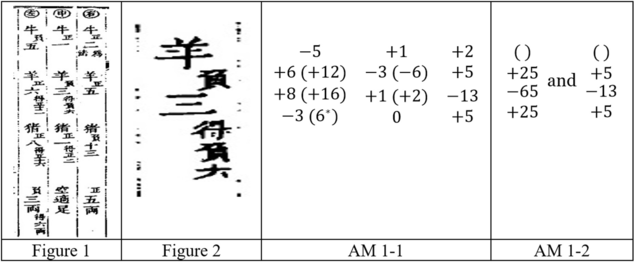
The solution in the Unified Lineage consists of the narratives of the computations as well as a computation diagram (suantu), i.e., fig. 1. Three equations are set up vertically with the order of the unknowns, the oxen, the sheep, the pigs, and then the monetary values, almost identical to the augmented matrix in modern-day linear algebra except for the columns instead of the rows.
Computation diagram in the Unified Lineage of this problem and its partial reconstructions.

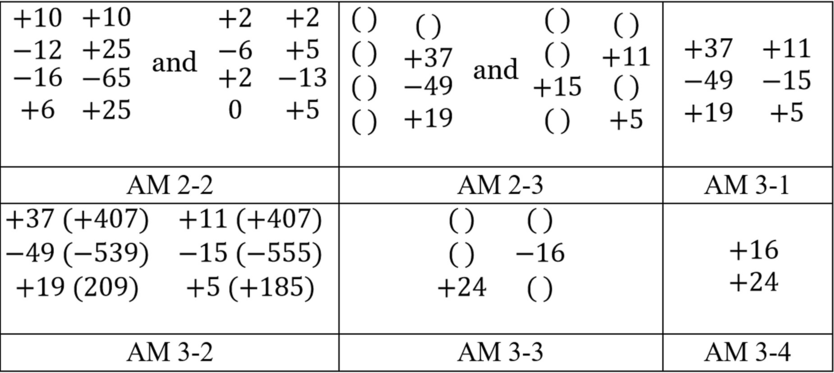
An explanation is in order for the computation diagram, fig. 1. The circled characters on top from right to left indicate the right, middle, and the left columns. The descriptions for the commodities are in the first three rows in fig. 1 along with the results after certain multiplication. Take the second position in the middle column as an example (fig. 1-2), reading top down: the first character indicates the animal (in this case, yang 羊, sheep), followed by the positive or negative designation (fu 負, negative) in a smaller character and slightly to the right, then the initial coefficient for this commodity (san 三, three), and then finally the number after multiplication (de fu liu 得負六, “obtained negative six”) in smaller characters to the right, which is the result after −3 being multiplied by +2, the first number from the right column. The monetary values in the last row also use smaller characters for their signs. Moreover, the value zero in the middle column is described as “empty (kong 空)” and “fits (shizu 適足).”Footnote 22 Two small characters in the (1, 3) position indicate that the number 2 is being used as a multiplier (wei fa 為法) [to multiply the left and middle columns]. The computation diagram incorporates the initial equations and certain computational results. Stripping the numbers from the context, we reconstruct the computation diagram in AM 1-1 with the numbers in parentheses denoting the result after the original number is multiplied with an appropriate number. Certain positions are without parentheses because either they would become zero after the operation, e.g., those in the first row, or there might be two multiplications, e.g., the right column. There is an obvious omission of the character “negative” for the parenthesized number in the last position in the left column, i.e., (6) at the (4, 1) position in AM 1-1.
Here and after, an * indicates a numerical error.

To eliminate an unknown, the right column is multiplied by +1 from the middle column and by −5 from the left column; the results are the right and left columns in AM 1-2, respectively. It is worth noting that in all fangcheng solutions, the negative sign does not figure into multiplication. Next, the following rule of operation is applied to the numbers in parentheses in the middle column in AM 1-1 and the right column in AM 1-2, “tongming xiangjian, yiming xiangjia 同名相減, 異名相加” ([When the two numbers are of] same denomination, subtract one from the other; [when two numbers are of] different denominations, add one to the other, hereafter referred to as “same-subtract-different-add” for simplicity). The denomination (ming 名) here refers to the positive or negative designation of a number. We transpose the columns into rows before completing the above operation and record the process in Computation 1:
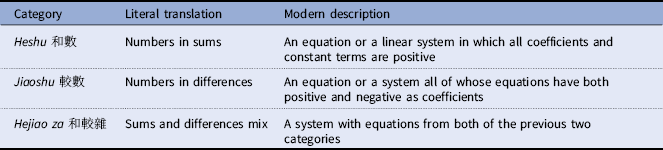
Subsequent steps of the computation in the Unified Lineage.

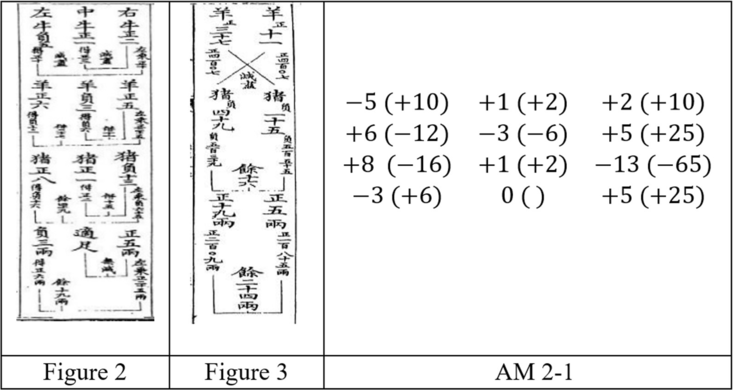
Computation diagrams in Mei’s solution and a partial reconstruction of fig. 2.

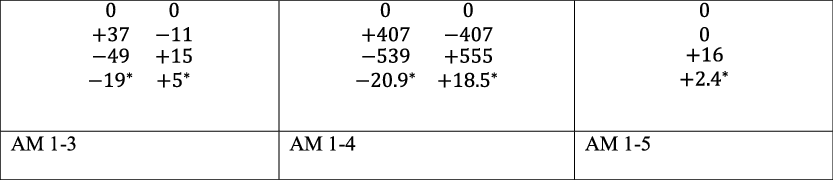
As −6 and +5 are of different denominations and so are +2 and −13, the two pairs are “added” respectively. The “addition” of −6 and +5 results in “−11.” While this addition can be understood by ignoring the signs, i.e., 6 + 5 = 11, the designated negative sign after the operation still needs explaining. Unfortunately, the text states the result without explication. The result in Comp. 1 is the right column in AM 1-3. According to the correct computation, the +5 in the bottom row of Comp. 1 should have been −5. This discrepancy cannot be explained away as a computation in a different system. Each row in Comp. 1 represents a certain trade. A change of the sign for a monetary value switches the excess to the deficiency and vice versa. The actual Gaussian elimination shows that trading 15 pigs with 11 sheep should result in a deficiency of 5 liang of silver, not an excess.
Partial reconstructions of fig. 2 and fig. 3.

When “combining” the left columns in AM 1-1 and in AM 1-2,Footnote 23 the rule of operations applied is “tongming xiangjia, yiming xiangjian 同名相加, 異名相減” ([When the two numbers are of] the same denomination, add one to the other; [when the two numbers are of] different denominations, subtract one from the other, hereafter referred to as “same-add-different-subtract”); see Comp. 2 for this computation, the result of which is recorded as the left column in AM 1-3.Footnote 24 Similarly, that the “difference” of +16 and −65 is −49 was left unexplained. These two computations in the Unified Lineage are described in the text, not in the computation diagram. The treatise gave no reason for why a different rule was employed the second time, nor did it address how the signs of the numbers were designated after the operation. Similar to the mistake in Comp. 1, the −19 of the bottom row in Comp. 2 should have been +19.Footnote 25
Demonstration of the computation involving “numbers in sum.”

A computation diagram for the problem in the Unified Lineage and its partial reconstructions.

The elimination process continues. Mutually multiplying the columns in AM 1-3 with the first number from the other,Footnote 26 we get AM 1-4. We note that both the constant terms are incorrect by a factor of 10; they should have been −185 and +209. To combine them, the rule of “same-add-different-subtract” is applied to get the column in AM 1-5. In the proper context, this represents that 16 pigs are worth 2 liang and 4 qian (or correctly 24 liang) of silver. Therefore, a simple division yields the price of a pig being one liang five qian. Back-substitute this price into the right column in AM 1-3 to get the price for a sheep, two liang five qian; and continue to substitute the prices for a pig and a sheep into the right column in AM 1-1 to get the price of an ox, 6 liang. The full and correct answers of the question thus are obtained in spite of the mistakes in the process.
A partial reconstruction of Mei’s computation diagram of the solution in the Common Script and the subsequent steps of computation.

Here we sum up the anomalies in the solution in the Unified Lineage. First, there are the obvious numerical errors in the computations and incorrect sign. Conveniently, many wrongs make one right: the final prices are all correct. And secondly there is the issue of two sets of completely “opposite” operations: “same-subtract-different-add” and “same-add-different-subtract.” The treatise gives no uniform guidelines as to when each should be used. The addition and subtraction of positive and negative numbers are contrary to the modern convention, i.e., the “addition” of −6 and +5 is −11. This is the general belief that such computations are limited to solving fangcheng problems only.Footnote 27 Furthermore, the negative designation of numbers, though indicating a certain nature and affecting the addition and subtraction, does not figure into multiplication. Still more mysterious is the principle behind assigning the signs to numbers after each operation. If there had been a logical system that purported the consistent rules of designating the signs and clarified the conditions under which each operation is to be employed, it had not been articulated in the Unified Lineage or any other treatises composed during the Ming period. There were certainly piecemeal discussions on these issues based on the number of unknowns or the positions of the columns in the computation diagram. They usually “work” ad hoc for the particular problem without universal applicability. Most importantly, these anomalies are not unique to the Unified Lineage, but common in all the Ming treatises that treat fangcheng problems. As a result, the treatment of the genre has declined to a state that after studying the treatise, one cannot solve a new fangcheng problem if the description or the numbers deviate too much from those in the treatises. It is difficult to imagine what the art of solving fangcheng problems would have become if no efforts had been made to revise the explanations and their presentations of the solutions of the genre.
It is against such a backdrop that Mei Wending writes his systematic treatment of fangcheng genre. From an observer’s viewpoint, there was obviously an urgent need to overhaul how this important genre of the problems should be treated. From an actor’s perspective, what were Mei’s intentions in writing such a work? How did he perceive the context in which this task was to take place? These issues make interesting discussions and Mei’s preface and introduction provide a great deal of insight. We will however postpone that discussion until after we examine Mei’s solution to the same problem.
Persuasion: systematic and coherent treatment
Many comprehensive mathematical works during the Ming included fangcheng problems and the treatment of this genre was fairly standard with little innovation.Footnote 28 Altering the common traditional procedures to solve a genre of problems is always challenging, even when the practices were wretched and the processes full of mistakes. To replace its major components and to illuminate the reason behind the steps, Mei’s first task was to devise a coherent approach and explain clearly to his contemporaries how and why his procedures worked; and the next task was to debunk the flaws and erroneous practices in the tradition. First we will critically examine Mei’s procedures and how they were explicated.
One of the fundamental difficulties in treating fangcheng problems as seen in the earlier example is the designation of the signs to the numbers as they directly affect the course of actions in the procedure. Mei Wending meets this challenge head-on from the very beginning. He upends the tradition of classifying fangcheng problems according the numbers of unknowns and instead coins new terms for the three categories based on the signs of coefficients in the system:
Originally, these terms were used to describe the initial system of linear equations. In the later chapters, the terms describing the first two categories were also used to refer to individual equations within a system. To acknowledge the transformative nature of the linear systems in the solution, Mei also includes among the terms, Hejiao jiaobian 和較交變 (Sums and differences alternation) which describes the fact that as the unknowns are being eliminated, the system itself might move from one category into another.Footnote 29
Next, Mei addresses the issue of designating the sign of the coefficients. Mei sets the rule for assigning signs as follows, when the condition in the problem describes the monetary value as the sum of the values of the commodities, the equation falls under the category of “numbers in sums.” Contrary to the modern practice, Mei designates all coefficients of equations in this category neither positive nor negative. The reason for this designation will be discussed later when we examine Mei’s criticism of certain traditional practices in the Ming treatises. When the condition is about trading commodities, then Mei instructs that one can arbitrarily pick a commodity and assign its coefficient to be positive, and then the coefficients of the other unknowns are determined as follows: the coefficient whose commodity is on the same side of trading as the positive is also positive whether it being traded in or traded out, otherwise it is negative. When the positive and negative have been designated for the coefficients of the commodities, the sign for the monetary value depends on whether the positive commodity is worth more or less than the negative commodity. Mei points out that in a given problem, the signs of the commodities are not fixed initially, but the trading sides are; and furthermore, once the sign of one commodity is determined, so are those of the rest of the commodities.Footnote 30 As soon as the rules of designating the signs of the numbers are established, the category of a given problem can be easily determined. It is clear from Mei’s discussion that the reasoning behind this rule is based on the context of the problem and the common sense of trading. These are the rules of setting up the signs of the coefficients initially.
The general principle of solving a fangcheng problem remains the same: to reduce the number of the unknowns by combining two equations into one successively until the values of the unknowns can be found. Although adopting an operating rule from the tradition and extending the computation diagrams to incorporate all the steps, Mei’s systematic treatment of the fangcheng genre is considered unconventional and innovative. He only employs the rule of “same-subtract-different-add” to eliminate the unknowns. To illustrate how Mei utilizes this rule and elucidates the rule of assigning signs after the operations, we examine Mei’s solution to the same problem discussed earlier. It is worth pointing out that Mei solves this problem three times with different signs for the initial coefficients and different order of the commodities, of which we will analyze the one with the same initial equations as in the Unified Lineage. Mei provides two computation diagrams, Figure 2 and Figure 3, and the narratives of the operations.Footnote 31
Mei’s first computation diagram (Fig. 2) consists of the three initial equations, the equations after being multiplied by appropriate numbers respectively, and the two equations resulted from combining the two pairs. It can also been seen that the columns are paired up by line segments: the right and center, and the right and the left. In AM 2-1, the numbers without parentheses form the initial equations and those in parentheses are obtained by multiplying the number in the original equations with an appropriate number. As in the earlier solution, each column in the pair is multiplied by the first number from the other. Due to the fact that the first number in the center column is 1, the multiplication of the right column by 1 is skipped. That is why there is only one column in parentheses for the right column in AM 2-1.
To employ solely the rule of “same-subtract-different-add,” Mei adds this important instruction, not seen in any of the Ming treatises: if the need arises, the signs of all the numbers in one column can uniformly be changed to the opposite so that the first numbers of the two paired columns are of the same denomination (sign).Footnote 32 This trick is a legitimate operation in Mei’s system, compatible with his rule of assigning signs – the signs of the coefficients are not fixed, but once one of them is determined, the rest are too accordingly. In the solution, all the numbers in the left column in AM 2-1 after being multiplied by +2 change their sign so that the first number −10 becomes +10, the same as the first number +10 in the right column in parentheses. The columns in parentheses of AM 2-1 can be seen in Fig. 2 as the smaller characters below the numbers in the initial equations.
The operation rule, “same-subtract-different-add,” is explicated in the context of an example and shown to be compatible with other (generally) accepted operations. Take as an example the left two columns in AM 2-2. They represent two trades: 10 oxen and 25 pigs trading for 65 pigs with an excess of silver, 25 liang, and 10 oxen trading for 12 pigs and 16 sheep with an excess of silver, 6 liang. This operation compares and “combines” these two trades into one in two steps. First, the comparison: the +10 oxen in both trades, whatever value they possess, are worth the same. Therefore, their subtraction results in zero. Regarding the “different-add” part of the rule, the context of the two trades informs us that the second number +25 in the right trade does not merely have 25 more sheep than in the left trade due to the deficiency of 12 sheep (−12) already there. Therefore the trade has in effect 37 more sheep than the left. This translates into the operation that +25 and −12 should “add up to 37.” But is it positive or negative? Though not in this example, it is stated in the narrative and indicated in certain computation diagrams elsewhere that if the 37 is put in the same trade as +25, then it should be +37; if it is in the same trade as −12, then it should be because the result can be interpreted as one trade has a net 37 sheep in excess or the other has a net 37 sheep in deficiency. As for the “same-subtract” part of the rule, it is generally accepted that the smaller number, excess or deficiency, should be subtracted from the greater and the remainder should remain in the same column (trade).Footnote 33 Applying the rule to the two pairs of columns in AM 2-2 results in the columns in AM 2-3.Footnote 34 Next comes the crucial step of combining two columns.
Let us use the trades in AM 2-3 to demonstrate. Mei adds another rule: if all the remainders are in the same trade, then no change [of the signs] is necessary, as demonstrated by the two left columns in AM 2-3; if both columns contain numbers after the operation, as in the right two columns in AM 2-3, pick and keep the numbers with the signs in one column, change the signs of the numbers in the other, and then combine the two into one. In the two right columns in AM 2-3, the right column is picked; the +15 in the left is then changed to −15 and emerges into the right. The two pairs of columns in AM 2-3 become the two columns in AM 3-1, which is the initial equations in Fig. 3, the second computation diagram, reconstructed in AM 3-2 with only the numbers. The same process continues until the trade in AM 3-4 is reached, from which the price of a pig can be found to be 1.5, 1 liang and 5 qian of silver. The rest of the solution is similar to and yields the same results in the Unified Lineage.
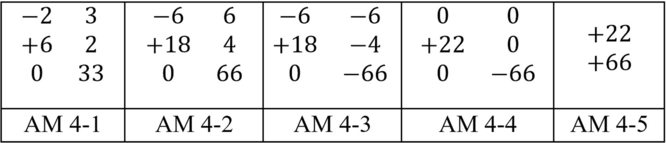
The preceding example demonstrates practically all the rules of computation in Mei’s system, except those involving the “heshu equations,” those with coefficients without signs. As the sign of a number does not figure into multiplication, multiplication by a number without a sign does not alter the designation of the number either. In the case of a system of “Sums and differences mix” whereby both the equations of “numbers in sums” and “numbers in differences” are present, the coefficients in the “numbers in sum” equation can and will all change to positive or negative depending on the sign of the first number in the other equation. The following calculations demonstrate this rule:Footnote 35
To have the same sign for the first numbers in both columns, all the numbers in the right column in AM 4-2 change from no sign to negative. And the procedure can proceed according to the rules already established. The conclusion of this computation also completes the descriptions of all the rules of operations in Mei’s system.
Another feature that sets the Discussions apart from its predecessors and contemporaries is Mei’s systemization of the fangcheng genre. The Ming treatises can be at best described as collections of fangcheng problems, classified according to the numbers of unknowns and the levels of difficulty. The Discussions on the other hand addresses a broad spectrum of issues. From among the traditional operations, Mei hand-picked the “same-subtract-different-add” to be the main rule of operation, supplemented with his own additional instructions. Mei’s efforts in explicating the rule attempts to bestow upon it a legitimized status, in contrast to the others in the Ming treatises. Along with abundant solutions to general problems, Mei shapes his systematic treatment of fangcheng by discussing the more challenging scenarios and efficiency of the procedures.Footnote 36 In treating the three challenging types of problems, Mei demonstrates with concrete examples how the solution can be set up and solved by the same procedures and rules as before, reinforcing the notion of the uniform applicability of his chosen rules.
Regarding the efficiency of the procedures, an issue not directly related to solving problems, Mei discusses the numbers of “calculations (suan 算)” needed to reach the solution to the first unknown for generic problems. Moreover, he also discusses the number of calculations that can be “skipped” (sheng suan 省算) for special cases in which numerous zeros are present among the coefficients. By “one calculation,” Mei means all the steps needed to eliminate the coefficient of one unknown from two equations. In particular, he emphasizes the importance of properly arranging the unknowns and equations (liewei 列位) so that the zeros in the equations can be used to guarantee that certain calculations can be skipped. Comments are also made on the scenarios that allow the steps of multiplication to be skipped, e.g., the first numbers of two columns are identical or one (or both) has the numerical value 1.
The algorithmic approach to solve fangcheng problems presumes a priori a unique solution and is not conducive to the consideration of the numbers of solutions in general. Interestingly however, Mei indeed encounters the cases of infinite solutions. In discussing the efficiency of procedures, Mei inadvertently encounters certain scenarios that do not lead to a definite solution. It is a problem with the conditions that one initial equation is a scalar multiple of another. When the “mutual multiplication” is applied to them, the two equations become identical with the same numbers (qitong 齊同) and therefore the unknowns cannot be “distinguished” from each other, which is counter to the essence of the algorithmic approach to fangcheng problems.Footnote 37 Mei calls problems of this kind “unable to constitute calculations (buneng chengsuan 不能成算).” He further points out that when the number of equations is fewer than that of the unknowns, [at least] two unknowns will not be distinguished from each other at some stage. Well aware of the scope of the fangcheng problems and limitation of his procedures, Mei considers them as legitimate issues important enough to be discussed. It is from these comments and discussions of related issue that Mei’s treatment of the fangcheng genre emerges and takes shape as a self-contained and coherent system.
Refutation: criticism of certain traditional practices
Although criticizing the old, the approach in the Discussions did not aim at completely subverting the tradition. On the contrary, Mei revered antiquity and blamed the sorry state of how fangcheng problems were treated on the authors (or compilers) of earlier mathematical treatises for failing to grasp the true principles behind the steps and forcing their own interpretations upon them. Consequently, the golden rules coming down from antiquity could not be understood.Footnote 38 In promoting his rule of choice, it was imperative and necessary for Mei to distinguish it from the others and spotlight the flaws of the latter. In the examples leading up to chapter four, Mei has successfully demonstrated the prowess and universal applicability of his “same-subtract-different-add” rule. Mei then moves to demonstrating what was wrong with those put forth in other treatises.
The Discussions therefore devoted its fourth chapter to “correcting mistakes (kanwu 刊誤)” [in the old treatises], in hopes of unveiling the true principles. Mei considered six different kinds of “mistakes:” one about assigning numbers to be negative after the operation; two about the operational rules to eliminate one unknown; two others about the misconceptions about calculations; and the last one dealing with a problem with insufficient information to obtain the solution by the fangcheng procedures. In discussing the very last mistake, Mei unintentionally describes a scenario which produces “infinite solutions,” the detail of which will be given below.
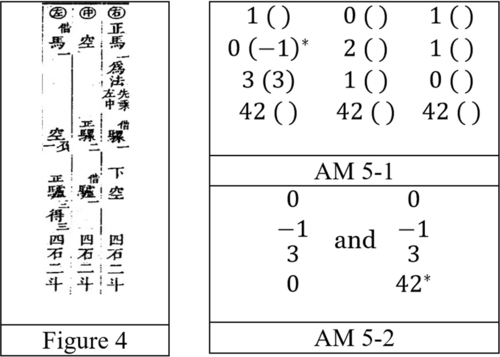
The first mistake is, unsurprisingly, related to designating the sign of numbers, a peculiar way of assigning a number to be negative. The operation is called lifu 立負 (assigning negative). As far as we can tell, this practice was invented to make sense of a mistake so that the solution process can be continued to reach the correct answer. The following example can be seen in the Unified lineage without the term lifu, in the Common Script (Tongwen suanzhi), where the earliest record of lifu can be found among the extant late Ming and early Qing treatises,Footnote 39 and in the Discussions where Mei’s criticism of lifu is laid out. We first describe the mistake in the Unified Lineage, and then the efforts in the Common Script to “correct” the mistake and to end up creating more mistakes, and then finally Mei’s criticism and “correct” approach. AM 5-1 is the partially reconstructed computation diagram in the Unified Lineage, with numbers only.Footnote 40 Only the pertinent steps in the solution are shown here,
To eliminate the first unknown from the left and right column in the initial system in AM 5-1, the left column is multiplied by 1. The result, the numbers in parentheses in the left column in AM 5-1, should have been the same as before; but the computation diagram shows that now −1 is in the second position. The text however describes that −1 was added to the result after applying the rule of “same-subtract-different-add” to the left and right columns, which does not conform to the conventional practice of recording in a computational diagram.Footnote 41 Clearly there is a discrepancy between the computation diagram and the text. The correct result of combining the initial left and right columns in AM 5-1 should have yielded the left column in AM 5-2; the text in the Unified Lineage however indicates that the said result should be the right column in AM 5-2. This mistake is not typographical because its solution continues the process with the right column in AM 5-2. These are the mistakes in this solution in the Unified lineage.
Similar to the Unified lineage, the Common Script uses both rules, “same-subtract-different-add” and “same-add-different-subtract.” In carrying out the operation of subtraction, the former indicates that the smaller number is subtracted from the greater. In its solution to this problem,Footnote 42 the Common Script encounters the difficulty to reconcile the mistake that the subtraction of 0 from 1 results in −1, the result recorded in the Unified Lineage. To make sense of this operation, the narrative of the steps in Common Script basically declares, “due to the middle [coefficient] is zero, there is no need to subtract; therefore, imitating the 1 in the right column, we assign negative (lifu) the one for the horse.”Footnote 43 The solution process continues and reaches the correct answer. The practice of “assigning negative” occurs a few more times in the Common Script, all in very similar conditions, a zero in the original equation and the subtraction of a zero from a positive number becoming negative through applying the lifu operation.
Mei’s criticism of the practice of lifu is two-fold. First, Mei is convinced that such a practice does not come from antiquity.Footnote 44 He cites well-accepted concepts to support his claim that the positive and negative designation should be side-by-side and that one cannot exist without the other. Simply designating a number negative without discussing what else might be positive does not follow the true meaning of the positive and negative.Footnote 45 Secondly, the true mathematical principles are also against this practice, Mei contends. He demonstrates the correct solution to this example with detailed analysis. Mei laments that the calculation involving lifu does not conform to the “same-subtract-different-add” rule in his system. Moreover, the examples utilizing lifu in the Common Script simply treat numbers without signs as positive, much as the modern convention, but fail to explicitly declare them so. Such a practice is directly contrary to Mei’s system in which numbers without signs are neither positive nor negative. Moreover, he has demonstrated his system to be valid and “compatible” with the ancient approach. Ultimately, Mei assesses the lifu operation based on the standard of his own: not coming down from antiquity and non-conforming to the rules in his system.Footnote 46
The next two cases of “correcting mistakes” are excellent examples of the saying, “The best defense is a good offense.” The first case is regarding using both “same-subtract-different-add” and “same-add-different-subtract” rules and the other is about the rule of “odd-subtract-even-add” (jijian oujia 奇減偶加), the meaning of which will be made clear later.
To start, Mei reprimands the employment of the two opposite rules as confusing. In those heavily-criticized Ming treatises, several different directives described the conditions under which each of the rules is to be deployed; Mei dismisses them as too numerous and disorderly to follow.Footnote 47 Mei compares his rule of choice to the operating procedures in the yingnu 盈朒 (excess and deficiency) genre of problems in the tradition of the Nine Chapters. He maintains that the “same-subtract” part of his rule follows the same principle of subtraction for two excesses or two deficiencies and the “different-add” that of adding an excess and a deficiency. To modern readers, this might be Mei’s strongest argument: his choice of rule conforms to and follows accepted principles of the practices employed in another genre of mathematics. Mei asserts that if the “same-subtract-different-add” is similar to and compatible with the computational principles in the tradition, then the opposite “same-add-different-subtract” rule simply cannot make sense. Moreover, to Mei, simplicity triumphs: if one operating rule is sufficient to solve all the problems, then there is no need to have other rules.
Another rule that appeared in the Unified Lineage was “odd-subtract-even-add,” which appeared in a problem of four unknowns. In the solution, the fourth column is chosen to pair up with the first and with the second. It just so happens that in this particular example, to eliminate one unknown from the first and fourth columns, the rule used is the “same-subtract-different-add”; and for the second and fourth, the “same-add-different-subtract.” As a result of this happenstance, a directive of which rule to use is based on the order of the column that is extracted as the general instruction. For problems of four unknowns or more, a rhymed prescription is composed, which includes the lines that the last column should be paired up with others; when the other column is an odd one [in order], the monetary values should be subtracted; and when the other column is an even one, the monetary values should be added.Footnote 48 This is the origin of the term “odd-subtract-even-add.” To expose the absurdity of this directive, Mei shows two different solutions to the same problem from the old treatises. To drive home his point, Mei simply switches the positions of the commodities and the order of the columns; he then follows his approach to achieve the correct answers. To conclude, he affirms that the order of the columns does not matter, any column could be the last, and consequently this rule about even and odd columns cannot be the rule of operation.Footnote 49
Compared to the three earlier ones, the next two mistakes seem minor: differentiating the divisor from the dividend and combining the denominators. The divisor-and-dividend mistake refers to the step in the solution where only the coefficient of one unknown and the constant term remain. To find the value of the unknown, one simply divides the constant term with the coefficient of the unknown. The older treatises have various instructions: use the middle number as the divisor and the low number as the dividend or use the smaller number as the divisor and the larger number as the dividend.Footnote 50 Mei dismisses them all by emphasizing the importance of the context and cautioning against following prescriptions blindly. To expose the mistakes, he provides counterexamples in which the lower number divides the middle number and the greater number divides the smaller number. Such an attack of following prescribed procedures without any understanding is efficient, forceful, and to the point that one should be mindful of the meaning behind the computation and the quantities the original question desires to find, and decide the course of actions accordingly.
In criticizing the practice of combining the denominators, first Mei points out that this technique is misplaced and deployed in a problem that does not necessarily belong to the fangcheng genre. According to Mei, similar problems can be solved using fangcheng or other techniques. Next Mei contends that the procedure of adding the two denominators of the numbers in question, a crucial part of the solution, only works for the specific numbers in that particular problem. That is, the procedure is flawed and cannot be generalized to solve other problems. Mei describes this occurrence as ouhe 偶合 (happenstance). Different numbers then are provided for the problem to expose and discredit the incorrect procedure, but the computations were not included in the Discussions. Instead, he shows the correct fangcheng solution following his own rules and also refers to the earlier section dealing with problems of fractional coefficients.Footnote 51
The last item in the chapter addresses serious flaws that go beyond the mistakes in the procedures. Mei begins with a seemingly unrelated topic, the role of problems in mathematical treatises. According to Mei, the problems in mathematical treatises are actually paradigmatic (guishi 規式) [to disseminate hidden principles]. He continues his philosophical view by describing the roles of general principles and concrete examples. He says, “Although the meaning [of the principles] (yi 意) might be suggested and not explicitly elucidated, the numbers should be concrete and readily verified; if [one] verifies and cannot find the real concrete numbers that can be discussed, then the principle could not be illuminated.”Footnote 52 Mei then introduced the following problem that was included in many treatises to further illustrate his point. Mei considers this problem an embodiment of “numbers that cannot be verified” and “meaning behind the procedure” to be far from clear.” Mei first states the problem:Footnote 53
The well in the question has an unknown depth. Five different kinds of strings of ropes are used to measure it. [If one] uses two pieces of the rope jia; [the sum of their lengths] does not reach the water and a piece of rope yi [is needed] for supplement in order to reach the water. [If one] uses three pieces of rope yi, then one piece of rope bing is [the supplement to reach the water]; [If one] uses four pieces of rope bing, then one piece of rope ding is [the supplement]; [If one] uses five pieces of rope ding, then one piece of rope wu is [the supplement]; [If one] uses six pieces of rope wu, then one piece of rope jia is [the supplement]. [In each scenario, after adding the supplement,] they can all reach the water. What are the depth of the well and the lengths of the ropes?
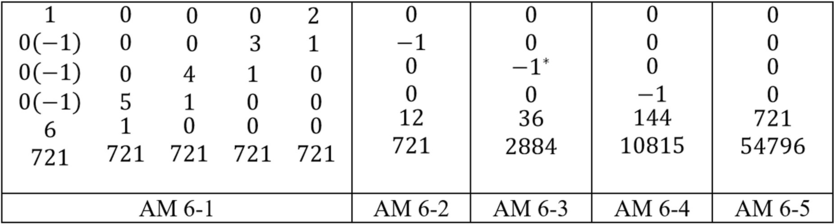
This problem has a long history in China; it can be found in the Nine Chapters.Footnote 54 Mei first goes through the original solution in the Common Script: take the numbers of ropes, two, three, four, five, and six in each condition as the divisors and that of the supplement rope, one, as the dividend. Then multiply the divisors, add the product to the dividend one, and set this number 721 as the depth of the well. AM 6-1 is a partially reconstructed computation diagram with numbers only, based on this mysteriously acquired well depth:
We present Mei’s description of the solution in the Common Script using these equations: mutually multiply and apply the rule of “odd-subtract-even-add” to the left and right columns in AM 6-1 to get AM 6-2. Replace the left column in AM 6-1 with the equation in AM 6-2. Multiply mutually and apply the rule to this new left column and the second column from the right in AM 6-1 to get the new left column in AM 6-3, and then replace the left column with this new one. Note that −1 in AM 6-3 is incorrect and should be 1. Continue the process in this manner to get the results in AM 6-4 and 6-5. Based on the equation in AM 6-5, 54796 is divided by 721 to get that the rope wu is of the length 7 chi and 6 cun, which can then be put back to previous equations successively to get the answers for the other ropes.
Mei counts four kinds of mistakes in the process of the solution. The first two are the rules of “odd-subtract-even-add” and lifu. The third is taking the divisors (721 from the equation in AM 6-5) as the well depth, which was used to set up the question without specifying the unit of the depth. The last is taking the product of the numbers (the constants) from the question, two through six, and adding one to it. Since the former two were discussed already, Mei then focus on the latter two.
Mei’s criticism begins with the issue of the unit in the solution, 7 zhang 2 chi and 1 cun. Nowhere in the problem can any unit be found; yet the answers come with them. Based on the process of the solution, Mei claims that the true intention of this question is supposed to find the lengths of the ropes from the [given] depth of the well, which should be the sum of the lengths in each condition. Using the numbers related to the ropes to find the depth does not, Mei contends, conform to the (i.e., his) fangcheng principles. Obviously Mei can see that 7 zhang 2 chi 1 cun as the well depth and the length of the ropes provided do form a solution for the problem; yet, Mei correctly states that any integer multiple of 721 can also serve as the depth of the well because these numbers can also fit the description of the problem. As a result, there can be infinitely many (wuqiong 無窮) answers for the well depth and 721 cannot be the unique answer (ding lü 定率). As 721 appears in the equation in AM 6-5 as the divisor and as the well depth which is supposed to be the dividend, Mei criticized this practice as confusing the divisor with the dividend.
Furthermore, Mei explores the procedure by which the well depth 721 was obtained. One view is that 721 is the sum of the product of the divisors (2× 3 × 4 × 5 × 6 = 720) and that of the dividends (1 × 1 × 1 × 1 × × = 1). Mei first conceded that in each condition, it is not a huge mistake (dashi 大失) to construe the number of the ropes used as the divisor and the number (one) of supplement rope as the dividend; however, Mei forcefully rejects the procedure. His argument is in the form of questions: if the question is changed slightly so that there are not so many zeros in each equation, how can this procedure of obtaining the well depth work? Assuming the equations continue to have the same numbers of zeros, can the procedure remain true if the depth of well is the difference of the lengths of the ropes? The expected no’s to these questions lead him to claim that this procedure cannot be a general method (tongfa, 通法).
Mei then poses a similar problem in which the depth of the well is given and the supplemental numbers are fractions, and he provides a detailed solution. Right from the start, one can see that this is a counterexample to the procedure of obtaining the well depth from the numbers in the conditions. The commonality of these discussions is that a successful procedure from one particular problem cannot automatically become the general one. The many examples Mei provided are aimed to show that the procedures that Mei adopts in his system of treating fangcheng genre truly withstand the test of time and have wide general application. And to Mei, that is the ultimate standard.
Let us recapitulate the standards Mei uses to criticize these practices. At one time or another, Mei actually appeals to one of the following criteria to condemn the practices found in the tradition: descent from antiquity, conformation to the procedures in Mei’s well-stablished system, and lastly universal applicability. These seemingly unrelated conditions can actually be unified under Mei’s views on mathematics, to which we will turn now.
Intention, context, and impact
In the seventeenth century, fangcheng problems were still a major genre in mathematics as they could be found in many treatises in circulation. In the Discussions alone, many works containing the fangcheng problems and their solutions were explicitly commented on: the Common Script, the Unified Lineage, the Comprehensive Collection, and Suanhai shuoxiang 算海說詳 (Explicating the details in the Sea of Mathematics), to name a few.Footnote 55 To justify the composition of yet another work on this genre and this genre alone, Mei articulated in his own preface and introduction (fafan 發凡) the origins of the genre, the meaning of the title fangcheng, how its treatments became incomplete and incorrect, and why his approach was different from those in the available treatises. Moreover, in the notes on his own works composed around 1707-08, Mei Wending explicitly mentioned that the mistakes in the solutions to fangcheng problems in the Common Script troubled him greatly for almost twenty years before he finally found satisfactory solutions and consequently the Discussions was composed to illuminate the principles.Footnote 56 An important issue for Mei was his rationale to include lun 論 (discussions) as part of the title. These considerations in the introduction set the stage for his style of treating fangcheng problems. Explication of mathematics in the form of “interpretations of the classics” (zhushu 注疏) gives credence to the illusion that Mei’s approach “restores” the refined procedures of antiquity and should be the standard (dingfa 定法) in treating this genre.Footnote 57 Such discussions construct a proper context for Mei’s efforts in reinventing the genre of fangcheng problems.
Mei began by stating the well-known fact that as one of the nine [types of] procedures (jiushu 九數) in Rituals of Zhou [Dynasty] (Zhouli 周禮), fangcheng occupied a prominent place among the various branches of mathematics and enjoyed the attention of scholars in the long Chinese history. Before furthering this argument, Mei addressed the meaning of fangcheng. Fang means bifang 比方, which means juxtaposition [of the quantities], Mei explained, and cheng is chengke 程課, i.e., to determine [the taxes and works].Footnote 58 Putting two characters together, Mei contended fangcheng should mean “determining [quantities] through juxtaposing.” Next Mei turned to the issue of incomplete treatment of fangcheng problems by his contemporaries and the Ming treatises. First Mei reorganized the nine types of procedures into two classes, measurements (liangfa 量法) and calculation (suanshu 算術), and furthermore assigned gougu 句股 (base and altitude, the two shorter sides in a right triangle) in the former and fangcheng in the latter as the ultimate accomplishment in their respective class.Footnote 59 While mathematics was part of the studies for classical scholars in the past,Footnote 60 Mei lamented that it had seen its decline in his day, as it was no longer a viable channel for upward social mobility through the examination system and at the same time looked down upon as the affairs of merchants and minor government functionaries; consequently the scholars and students seeking degrees in the examination system would not “lower” themselves to engage in studying it.Footnote 61 Moreover, the published mathematical works seldom included the full nine genres: even when some did, the amount of material was scanty, Mei continued. He then concluded that these factors contributed greatly to the incomplete (canque 殘缺) treatment of fangcheng of his day.Footnote 62
Changing direction slightly, Mei claimed that Western learning [in mathematics], i.e., geometry, stimulated the studies of measurements in the genre of gougu and therefore the procedures in the traditional works treating gougu problems were then at least correct. In contrast, fangcheng procedures had no work (i.e., Western counterpart) with which to compare and verify, and their treatment was consequently being scrimped.Footnote 63 The extant examples were, Mei contended, being bungled in many hastily published works, which also amended unscrupulous rhymed prescriptions (wangzeng geyuan 妄增歌訣) and set up incorrect procedures that were hard to verify and rectify. The situation got worse to the point, Mei declared, that one of the nine procedures from antiquity had almost become extinct. Mei hoped that his treatise would make the principles clear to its readers so that the procedures could be applied without doubts and the erroneous approaches (miuzhong 謬種) would not corrupt the rules from antiquity.Footnote 64
Next Mei addressed the issue of reclassification of fangcheng problems. He in fact considered the classification in the Ming treatises part of the erroneous approach to the problems—many treatises prescribed one procedure for the problems of two unknowns, another for those of three unknowns, and yet a third for those of four or five unknowns. These ad hoc methods were manifold and confusing. More importantly, in Mei’s view, they did not grasp the true essence in treating problems of the genre and failed to clarify the distinction among the problems. A terrible consequence was that the procedure in one example could not be applied to the others and therefore became completely useless. Mei was convinced that the procedures from antiquity could not and would not function like so. He then gave the names of the four categories in his new classification and claimed that his prescription of the procedures should be the same for all categories of problems. Universal application was the reason, Mei believed, that a procedure such as his became a standard [approach] (dingfa) and that the methods from antiquity should possess the same quality. Even though Mei did not have any antique treatise to validate his claims, he felt that the shared quality of universality made it acceptable that his classification and prescription of procedures restored the ancient procedures.Footnote 65 At the same time, Mei still hoped and continued to find antique works in fangcheng genre to validate his exposition and treatment.
Turning to the inclusion of lun 論 (literally, discussion) as part of the title, Mei again criticized the practice of excluding discussions or explanations in the Ming mathematical works.Footnote 66 He believed that concrete examples without discussions made it impossible to learn how the procedures were established. Without understanding the reason behind the procedures, he continued, many mathematical works taking material from the preceding treatises only perpetuated old mistakes and generated more errors. Intending to illuminate principles of computation (suanli), Mei included more discussions than examples in his treatise. He opened every chapter with a general discussion and then presented concrete examples to substantiate the described rules. After the narratives of the examples, more discussions followed. Consequently, Mei claimed, seventy percent of the content in his work was discussions and thirty percent the examples. It was hence fitting to include lun in the title, he stated. Moreover, the examples served to elaborate the principles, Mei contended, and therefore did not need to be plentiful. As long as the principal meaning (dayi 大義) was “flowing and clear,” there was no need to present many examples that might confuse the readers.Footnote 67
This introduction highlights Mei Wending’s goal of composing this work. Mei wanted to explicitly provide the raison d’être behind the procedures so that they could be correctly applied to other fangcheng problems. To achieve this goal, Mei reclassified the problems, selected a set of procedures from the traditional treatment, supplemented rules of operations, and in the process created his systematic treatment. His reasoning is substantiated by the wider applicability of the procedures and consistency of the rules. Moreover, Mei’s self-contained system operates consistently and is compatible with the wide-accepted procedures for solving problems in other well-known branches of mathematics. Furthermore, such consistency and wide applicability of his procedures allowed Mei to claim a connection between his treatment and the ultimate though vacuous governing notion of mathematics, suanli (principle of computation), which in turns formed a link between Mei’s approach and those from antiquity. Armed with the notion of suanli and the connection to antiquity, the consistency and wide application of his system were Mei’s strongest, most powerful ammunition to persuade his contemporaries and refute the erroneous traditional practices.
Before assessing the impact of Mei’s Discussions, we first provide a broad context of science in seventeenth-century China. The calendar reform that produced many translated European astronomical treatises, tables, and trigonometric works also created competitions between the Chinese and the Western approaches, pitting one fraction against the others.Footnote 68 The reception of the Jesuit calendrical science was compounded by the fact that the foreign religious agents (and their Chinese collaborators) introduced the crucial knowledge to establish a new system of mathematical astronomy and dynastic calendar that had profound political, social, and cultural impact on the court and empire. As astronomy in the Chinese context was embedded in a large and complex body pertaining to other practices, such as judicial astrology, hemerology, and the siting of necropolises for the imperial family,Footnote 69 needless to say, the debates about the competitions were hardly purely scientific. Considering that mathematics is the basis of understanding astronomy and calendrical science, the attitudes towards mathematics from Europe were understandably extended from that towards astronomy.
The Chinese advocates of European mathematics, many of them converts to Catholicism, either considered the traditional Chinese approach as outdated and disposable,Footnote 70 or declared the traditional approach to be limited in its scope so that it should be subsumed under the corresponding Western discipline.Footnote 71 The camp of the Chinese tradition defenders often amalgamated their criticism of the Western approach with their animosity towards the Jesuits, the messengers who introduced them. The defenders of tradition did not care for the religion that was bundled together with the scientific knowledge. Many suspected the Jesuits’ true intentions in China; in an extreme case, some launched a political attack accusing the Jesuits of sedition and plotting to overthrow the Chinese empire.Footnote 72
What then was Mei Wending’s position in such a debate? He demonstrated at least two attitudes, similar yet with subtle differences, at different stages in his career as an astronomer and mathematician. In his early works, Mei can be observed to advocate that the fundamental principles (li 理) behind mathematics should transcend the geographic locations of their origins and remain constant through time.Footnote 73 Even though he resented (bing 病) that the Jesuits rejected mathematics from the Chinese antiquity,Footnote 74 he did not dismiss European geometry and acknowledged its contribution in preserving the knowledge contained in the genre of gougu problems. From this perspective, the Discussions served as a perfect example to repudiate the claim made by the advocates of European mathematics that the traditional Chinese approach were outdated and should be subsumed under the corresponding Western discipline. Over all, the same theme can be found in many of Mei’s work that the Chinese and Western approaches follow the same principles and that scholars should not dismiss one in favor of the other so long as the approach conforms to the principle.Footnote 75 This position directly promoted the integration of approaches from diverse origins.
Mei’s position regarding the Western learning changed slightly in a later astronomical treatise, Lixue yiwen bu歷學疑問補 (the Supplement to [answers to] the doubts concerning the study of astronomy). In this collection of questions and answers regarding many astronomical issues, Mei discussed how Western astronomy actually originated from China, described how it was transmitted abroad from China, and put forth many concrete examples to “substantiate” the claim made by the Kangxi emperor (reigned 1661-1722) that the Western learning [was of] Chinese origin (Xixue zhongyuan 西學中源) in the early eighteenth century.Footnote 76 This claim evolved and took a different form in the court-published Yüzhi shuli jingyun御製數理精蘊 (the Essence of Numbers and Their Principles Imperially Composed, hereafter Numbers and Principles), a mathematical compendium that resulted from one of the many compilation projects promulgated by the Kangxi Emperor. This compendium in its opening section, Shuli benyuan 數理本源 (Origins of Numbers and Their Principles), declared that from the mythical hetu 河圖 (diagram of the [Yellow] river) and luoshu 洛書 (writing of the Luo river) in the Chinese tradition came the studies of numbers.Footnote 77 No longer merely a belief, it was presented as a fact that all things mathematical found their origins in Chinese antiquity. Ludicrous as it was, this “perspective” helped legitimize the study of European astronomy and mathematics in the eighteenth century: the technical knowledge introduced by the Jesuits was no longer foreign; instead, it found its “root” in high antiquity in China and was consequently fitting for scholars trained in the Classics to study or at least get acquainted with. Arguably, this legitimization contributed to the revival of Chinese mathematics in the latter part of the eighteenth century.
Current evidence shows that the Discussions was printed three different times as a stand-alone treatise.Footnote 78 It was also included in three different collections of Mei Wending’s works: the Integration of Mathematics (prefaced in 1680), Lisuan quanshu 曆算全書 (the Complete Writings on Astronomy and Mathematics, hereafter the Complete Writings, first published in 1723), and Meishi congshu jiyao 梅氏叢書輯要 (the Selected Essentials of Mei Family’s Collection first published in 1759, hereafter the Selected Essentials). In the almost 4900-page Numbers and Principles, first printed in 1722 a few months before the Kangxi emperor’s death, Chapter (juan) Ten of Part two is devoted to fangcheng problems. It follows Mei’s categorization of the problems and his approach, employing only the rule of “same-subtract-different-add.” It also assigns the signs to the coefficients in the way that the first numbers in the equations are always positive. One obvious change is the orientation of the layout of the equations. Instead of in columns, the equations and computations in the Numbers and Principles are in rows.Footnote 79 The inclusion of the Mei’s approach to fangcheng problems in a court-published compendium marked the official recognition of his innovative procedures as the state sanctioned orthodoxy of treating the genre.
It was not clear how widely circulated the publications of the Discussions were before the Numbers and Principles became available to the scholars in the eighteenth century. As the three publications were sponsored by different court or provincial officials, the treatise must have reach certain circles of officials and intellects of the day.Footnote 80 Several extant records help to shed the light on the receptions of the Discussions among scholars during this period.Footnote 81 In Chouren zhuan 疇人傳 (the Biographies of the Mathematicians and Astronomers, first printed in 1799, hereafter the Biographies), we find in the entry of Li Dingzheng (fl. in the late seventeenth century), who sponsored one of the stand-alone printings of the Discussions, that certain Christians (bijiao ren 彼教人, literally “[some] members of that religion”) went to argument with Li after reading in his foreword for the Discussions that fangcheng problems were not discussed in the Western methods.Footnote 82 Although it is not clear whether the members meant Jesuit scholars or Chinese converts, the message demonstrates that the Discussions reached a diverse audience. In the short entry for an otherwise unknown scholar in the Bibliographies, Shen Chaoyuan沈超遠 (dates unknown) was described as the one who, after reading the Discussions, had written a work to challenge Mei Wending. In a letter replied to Shen, Mei first thanked Shen for his comments and interpretations regarding the Discussions; he then explained further why the material in the treatise was presented in such an unconventional way (Ruan Reference Ruan2002, 388 and Mei Reference Mei2002a, 350-351). In a letter to another scholar Qin Ernan 秦二南 (dates unknown), Mei discussed the general state of mathematics, astronomy, and calendric science and at the end mentioned that he sent along a copy of the Discussions to Qin. In a different letter to Qin, Mei also discussed the Western treatises in astronomy and calendrical science. He then sent along more books treating the basis of calendric science (Mei Reference Mei2002a, 350 and 354). Moreover, towards the end of his introduction in the Discussions, Mei explicitly mentioned a list of scholar friends, some of them local and provincial officials, who either hand-copied his manuscript, or intended to help Mei publish this work, or offered admiration after reading it. In particular, Mei listed three scholars who questioned and clarified (zhizheng 質正) [certain unclear parts] and the final version of the work was then settled afterwards.Footnote 83 These records show that a milieu of scholars interested in astronomy and mathematics actively engaged in promoting a rather technical field at the end of the seventeenth century. And the Discussion’s influence had to go through this channel to reach a wider audience. The situation however changed in 1720s.
The court-promulgated Numbers and Principles was first published in 1722; and in treating fangcheng problems, as described earlier, it followed the Discussions’ approach. The inclusion must have augmented the Discussions’ clout. We speculate rather confidently that the adoption of Mei’s classification and approach was partly due to Mei’s painstaking explanation of reasons in a complete system. It is also worth mentioning that Mei’s grandson, Mei Juecheng梅瑴成 (1681-1764) was one of the editors and compilers of the compendium. We surmise that this fact might have also contributed in part to the inclusion of Mei Wending’s approach in the Numbers and Principles. The two collections of Mei’s works, the Complete Writings and the Selected Essentials, also helped popularize Mei’s works. They were published initially in 1723 and 1761 respectively. The Complete Writings later found its way into Siku quanshu 四庫全書 (the Complete Texts of the Four Repositories),Footnote 84 a huge collection commissioned by the Qianlong emperor (r. 1736-1795), comprised of all the works that were deemed of importance at the time. The collection of Complete Writings was printed three more times in 1749, 1859, and 1885 while the Selected Essentials were printed in 1761, 1771, 1874, and two other printings with unknown dates, according to Liu Dun (Liu Reference Liu1993, 4:321). Through the many printings of his works, Mei Wending exercised tremendous influence in shaping the landscape of astronomy and mathematics in China and his approach to treating Fangcheng problems became orthodox during the eighteenth and early nineteenth centuries in China.
Conclusion
This case study on the reasoning in Chinese mathematical treatises of the fangcheng genre documents the flaws and lack of reasoning in the works composed in the fifteenth and sixteenth centuries and analyzes the goals of the innovative approach in Mei Wending’s Discussions, a treatise of computational nature treating the traditional topic equivalent to the modern-day systems of linear equations. As fangcheng problems and their treatment were considered by the scholars in the seventeenth century of Chinese origin, un-touched by any foreign experts well-versed in geometry, a part of Mei’s motivations in composing the Discussions was to demonstrate an achievement of mathematics in China in response to the Westerners’ rejection and dismissal of Chinese tradition. In an effort to achieve such a goal, Mei advocated in the Discussions for certain operating rules, some from the tradition and others furnished by himself. Their legitimacy was established and affirmed based on the common sense of trading and previously accepted notions of computation in other genres of mathematics. Mei’s efforts resulted in a self-contained and logically coherent system, which allowed Mei to claim a restoration of ancient approach in his treatment of the fangcheng genre. In contrast to the deductive reasoning contained in the subject of geometry at the time, the standard Mei deployed to assess the “new” and refute the flawed “old” rules emphasized their wide applicability, uniformity, simplicity, rigor, and consistency with the procedures used in solving problems in other well-accepted genres of mathematics. These epistemological values allow us to address the issue of mathematical reasoning in China on its own terms.
In the seventeenth century, did Mei Wending use this same set of epistemological values to assess mathematics in other genres? Did other scholars well-versed in mathematics develop alternative modes of reasoning in treating mathematics? Did all the geometric texts since the early seventeenth century follow the same modes of reasoning as in the Jihe yuanben? As these topics remain open, the issues of reasoning modes in mathematics in China continue to provide a fertile ground for further research. Hopefully more scholars will devote time and energy to answer these vital questions.
Acknowledgements
The author would like to thank the Fulbright Scholar Program, St. Cloud State University, the Chiang Ching-kuo Foundation for International Scholarly Exchange (GS028-A-13), and the laboratoire Sphere at Université Paris Diderot for their financial support while this project was carried out and this paper was being prepared. The laboratoire Sphere also provided logistic support during the academic year 2017-18. An earlier version of this work was presented at the conference sponsored by the laboratoire Sphere, the “Practices of Mathematical Reasoning”, December 4-7, 2017. The comments and critiques provided by the commentator and attendees helped to improve this work tremendously and are greatly appreciated. Moreover, the author wants to thank the referees for their generosity for sharing primary sources to strengthen the arguments presented here.
Jeff Chen holds a Ph.D. in mathematics from Yale University. In the early 2000s, he changed his focus of research to the history of mathematics in late imperial China. His main area of research is in the development of mathematics and philosophy in reasoning, especially in the seventeenth and eighteenth centuries after the Jesuits introduced certain parts of European mathematics into China. Among his current projects is an effort to examine systematically the practices of reasoning in the seventeenth-century mathematical treatises by major Chinese scholars well versed in mathematics. When he is not teaching or working on the research projects, Chen likes to swim, bicycle, travel, and spend time with friends.