Introduction
Electronic dance music (EDM) has emerged as a genre of music, often associated with mass gatherings referred to as electronic dance music festivals; EDM festivals are live music events that feature multiple performers and are often longer than conventional concerts, in some cases days in duration. These outdoor events often occur during the summer months, are frequently attended by large numbers of predominantly young adults, and are associated with high levels of substance abuse.Reference Bogt, Gabhainn and Simons-Morton 1 - Reference Maxwell 4 This demographic may lack situational awareness of the dangers associated with the use of these powerful and sometimes deadly drugs.Reference Yacoubian, Boyle, Harding and Loftus 5 , Reference Lenton, Boys and Norcross 6 3,4-methylenedioxymethamphetamine (MDMA), commonly referred to as “ecstasy” or “molly,” is a frequently used drug at EDM festivals;Reference Bahora, Sterk and Elifson 7 MDMA ingestion results in euphoria and mental stimulation with short-term adverse effects including diaphoresis, tachycardia, fatigue, and muscle spasms. More serious adverse effects include serious or fatal hyperthermia, fluid and electrolytes depletion, as well as central nervous system, cardiac, muscular, renal, and hepatic dysfunction.Reference Weir 8 - Reference White 14 One of the more feared complications of MDMA ingestion is excited delirium syndrome, characterized by delirium and an excited or agitated state, as well as clinical signs of tachypnea, tachycardia, hyperthermia, hypertension, acidosis, or rhabdomyolysis.Reference Patel, Belson, Longwater, Olson and Miller 15 In its most severe form, there can be respiratory arrest, brady-asystole, or pulseless electrical activity arrest.Reference Vilke, DeBard and Chan 16 As a result of the rising popularity in EDM festivals and the resultant illnesses amongst attendees associated with recreational drug use, these events have recently received increased attention in the media.
Electronic dance music festivals are unique mass gatherings that are increasing in popularity and pose special challenges to emergency responders and medical personnel. One factor contributing to the challenge associated with EDM festival events is the ready availability of novel drugs, including ecstasy and synthetic cannabinoids. As a result, medical personnel are confronted with different injury/illness patterns as compared with other forms of mass gatherings. Current models of mass-gathering medical care may be inadequate in their ability to predict the number of medical resources required.Reference De Lorenzo 17 , Reference Milsten, Maguire, Bissell and Seaman 18 Historically, these models incorporate certain variables, including event type and temperature, to predict medical usage rates.Reference Arbon, Bridgewater and Smith 19 The existing literature is replete with case reports and descriptive studies about mass-gathering events.Reference Munn, Lund, Golby and Turris 20 - Reference Locoh-Donou, Guofen, Welcher, Berry, O’Connor and Brady 22 However, there is comparably less information available with respect to the unique nature of EDM festivals.Reference Lund and Turris 23 It has been acknowledged that certain types of music events (including EDM festivals) may lead to an increase in medical usage rates.Reference Ciottone, Biddinger and Darling 24 This report describes the outcomes associated with three separate EDM festivals (Moonrise Festival, SweetLife Festival, and Mad Decent Block Party) that occurred in Maryland USA in 2014. Validated casualty prediction models were used to help articulate guiding principles for the formulation of an informed medical incident action plan. The aim of this study was to utilize retrospective data from three separate EDM festivals to demonstrate the under-estimation of medical needs using currently validated casualty prediction models.
Methods
Study Setting and Population
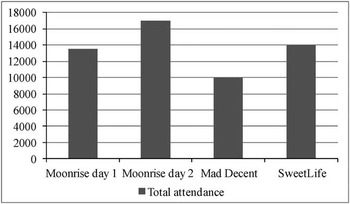
The retrospective data were collected from three discrete EDM festivals held at two outdoor venues in metropolitan Baltimore, Maryland in 2014. The SweetLife Festival (May 2014) and Mad Decent Block Party (August 2014) were held at the Merriweather Post Pavilion, both staffed by the Howard County Department of Fire and Rescue Services (DFRS; Columbia, Maryland USA). The Moonrise Festival (August 2014) was held at the Pimlico Race Course and staffed by the Baltimore City Fire Department (BCFD). The Moonrise Festival was a consecutive two-day weekend event with an attendance of 13,500 on Saturday and 17,000 on Sunday. The Mad Decent Block Party was a one-day event held on a Friday with an attendance of more than 10,000. The SweetLife Festival was a one-day event held on a Saturday with an attendance of more than 14,000. Though the analysis attempted to capture each patient encounter, each event incorporated a different trigger for patient evaluation. For those events staffed jointly with the BCFD, a patient “encounter” was linked to an evaluation. Simply stated, any time a provider performed an assessment or obtained vital signs, an encounter was documented. Events hosted in Howard County Maryland utilized different triggers for a patient encounter. Patients who required an intervention beyond basic first aid interventions were entered into the event log book and documented accordingly.
Data Collection, Outcomes, and Variables of Interest
This was a combined retrospective analysis of patient encounters from three discrete EDM festivals and a qualitative systematic literature review. The protocol for all study procedures was approved by the institutional review board at the University of Maryland, Baltimore. The study aimed to utilize retrospective data from three separate EDM festivals to demonstrate the current under-estimation of medical needs at these unique events using currently validated casualty prediction models. The retrospective data were collected from three discrete EDM festivals held in metropolitan Baltimore, Maryland. The SweetLife Festival was held in May 2014, and the Mad Decent Block Party and Moonrise Festivals were held in August 2014. Information from these festivals was inserted into the predictive Arbon and Hartman models.Reference Arbon, Bridgewater and Smith 19 , Reference Hartman, Williamson and Sojka 25
The analysis incorporated information from four separate data collection streams that documented patient encounters with medical professionals at the three EDM festivals: (1) Maryland Institute of Emergency Medical System Services (MIEMSS; Baltimore, Maryland USA) approved Electronic Patient Tracking System (EPTS); (2) BCFD Electronic Maryland Emergency Medical Services Data System (eMEDS) run reports; (3) Howard County DFRS eMEDS run reports and incident summaries; and (4) an Executive Summary completed by the Howard County DFRS.
The eMEDS is the electronic patient care reporting system used by all Emergency Medical Services (EMS) agencies in the state of Maryland to document all necessary aspects of patient care. The eMEDS is a commercial, off-the-shelf software suite provided by ImageTrend, Inc. (Lakeville, Minnesota USA). This electronic patient care reporting system is used in each of the 27 EMS Operational Programs and is a web-based program available to providers reliably either through an internet connection or through the Field Bridge module. The eMEDS system is hosted on a secure data center in Minneapolis, Minnesota (USA) with a copy of the data, refreshed daily, stored at the MIEMSS, the state EMS agency. These data can then be evaluated for quality improvement or approved research purposes.
The EPTS is one module in a suite of applications provided by HC Standard (Global Emergency Resources; Augusta, Georgia USA). Implemented in 2006, this hand-held, wireless computer allows scanning of a unique identifier, via triage bar code; input of patient information, including vital signs and patient assessment data; and uploads the information wirelessly to the HC Standard software program. Once the patient information reaches the HC Standard software, it is available to providers at the receiving facility to better understand the patient’s injuries or illnesses in a timely fashion.
A Howard County DFRS Executive Summary was prepared to brief elected officials on the experience with illness associated with EDM festivals held at Merriweather Post Pavilion, to share nation-wide best practices, and to make recommendations on further permit requests for EDM festivals.
Data points and outcome metrics from these sources include the total number of patients transported to the hospital by ambulance, patient acuity designated by clinical priority level (Priority 1-4) assigned by EMS provider at triage, patient presentation rate (the number of patients that presented per total attendees), overall mortality, and patient demographics, including sex, age, and reason for presentation.
Results
Attendance and Transport Rates
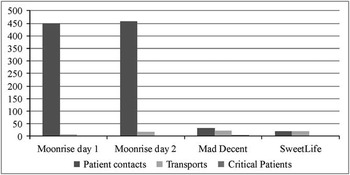
Crowd estimates for the three mass-gathering events were analyzed. Attendance at the 2014 Moonrise Festival approached 30,500 people over the event’s two days. The Mad Decent block party hosted 10,000 concert goers, and 14,000 people attended the SweetLife Festival (Figure 1). As detailed in Figure 2, transport rates varied greatly between the three events. On day one of Moonrise, EMS recorded 450 patient contacts and 10 transports. Two transports were labeled as “critical” by the initial EMS provider. On the second day, providers documented 458 patient contacts and 16 transports. At the Mad Decent Block Party, EMS providers formally evaluated 32 patient contacts and transported 21 individuals. Five of those transports were initially encountered in “critical” condition and two patients expired at the hospital. Excited delirium was listed as the provider’s impression in the “event summary” provided by the responding fire rescue agency. Twenty patient contacts were recorded at the SweetLife Festival. Nine patients were transported, and two of them were labeled as “critical” by EMS responders. The two critical patients required transfer to a regional pediatric intensive care unit for definitive care.
Total Attendance.

Patient Contacts and Transports.

Arbon and Hartman Models
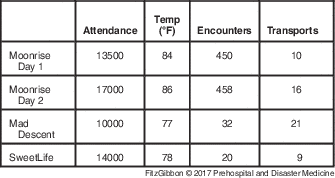
As noted in Table 1, the attendance for the various events ranged from 10,000 to 17,000. The outdoor temperature for all events ranged from 77°F to 86°F. The number of patient encounters at the events ranged from 20 to 450, while the number of patient transports ranged from nine to 21. A total of 960 patients were evaluated over the course of all events, with a total of 56 patients transported to an emergency department.
Event Characteristics

The highest number of encounters occurred during the second day of the Moonrise Festival when 458 patient encounters occurred. The highest number of transports occurred during the Mad Decent Block Party, during which 21 patients were transported to the hospital.
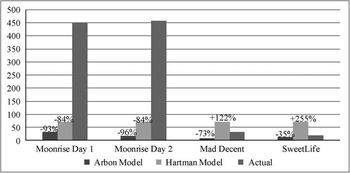
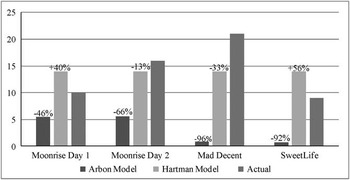
The Arbon method under-predicted the number of patient encounters for each event, as noted in Figure 3. On the second day of the Moonrise Festival, the Arbon model under-predicted the number of encounters by 96%.
Actual and Predicted Number of Patient Encounters.

The Hartman model categorized all events as “Major Events,” predicting 71 encounters and 14 transports. The Hartman model under-predicted the number of encounters by 84% for both days of the Moonrise Festival. For the Mad Decent Block Party and SweetLife Festival, the Hartman method over-predicted the number of encounters.
The Arbon method under-predicted the number of patient transports for each event as well, with the least accurate prediction for the Mad Decent Block Party, under-predicting transports by 96% (Figure 4). The Hartman model over-predicted patient transports for two of the three events.
Actual and Predicted Number of Patient Transports.

Discussion
Electronic dance music festivals have become an increasingly popular event among young adults, and these events pose unique risks involved with medical management of these mass gatherings. Maryland has been host to a number of these events in recent years, and unfortunately, there have been a number of incidents at these events involving overdoses, most commonly due to MDMA, leading to increased transports and in some cases deaths.
Howard County DFRS has provided EMS staffing at Merriweather Post Pavilion for over 20 years. During that time frame, the jurisdiction utilized published recommendations from the available mass-gathering literature and EMS position statement to determine resource allocation for any event. The EMS provider experience also was tapped to inform the eventual even response structure. This system had worked well for each concert season at the Merriweather Post Pavilion. Howard County DFRS found that alcohol availability and the hosting of multi-day events were the only variables that significantly affected patient presentation and transport rates.
In May 2014, the SweetLife Festival was staffed per the matrix recommendations. During the event and in the after-action evaluation, it was clear that both the patient presentation rate and the criticality of patient encounter exceeded both predictions and past experiences. Of concern were two young teenagers, 14 and 16 years old, who were seriously ill and transported to the local hospital. Both pediatric patients required intubation and subsequent transfer for specialized intensive care. In the days following, the Medical Director followed up with Howard County General Hospital staff, shared the DFRS experience, and learned that the emergency department also reported patient volumes and acuities far exceeding past experience. The two patients were followed up and were discharged alive after the intensive care unit stay.
These two pediatric patients were categorized as “near miss” deaths. The Howard County Medical Director and DFRS convened a work group consisting of the Health Department, Howard County General Hospital, Merriweather Post Pavilion, the Police Department, and DFRS, and plans were made to augment resources to accommodate future EDM events.
In August 2014, another EDM festival, Mad Decent Block Party, was held at the same location. The EMS providers encountered a significant number of high-acuity patient contacts and transports and observed an increase in the number of overall patient contacts and transports despite the decreased overall attendance when compared to the SweetLife Festival. Five patient encounters were classified as “critical.” Three patients needed intensive care unit admission, and two patients died at the hospital. All patients were suspected of being intoxicated, and the majority of them presented with signs and symptoms suggestive of excited delirium.
Around the same time in August 2014, the Moonrise Festival was held at a nearby venue and staffed by the BCFD. Over the two-day festival, there were 32 transports, with at least 14 of those transports primarily the result of synthetic substance overdose. It was observed that attendees reported ingestion of MDMA, lysergic acid diethylamide (LSD), and ketamine, among other reportedly unknown substances.
The Howard County DFRS experience, when paired with the BCFD’s response to the Moonrise Festival, showcases similarities and highlights the difficulties in planning medical care for mass gatherings as well as the unique aspects of EDM festivals. In developing the medical action plan, there are very few guidelines for estimating the number of providers and resources that will be needed. Despite the existence of state-wide medical protocols, there is currently no legislative requirement with respect to basic medical staffing requirements at mass-gathering festivals. Like any mass gathering, medical care should be pre-planned, including venue reconnaissance and an estimation of required resources based on the individual characteristics of the event (weather, attendance, duration, type, crowd mood, alcohol and drug use). Various models have been proposed for predicting resources required at mass gatherings, but as evidenced in Figure 1 and 2, both the Arbon and Hartman models poorly predicted the required resources and could not be successfully validated. This may be due to the lack of mass-gathering events with the patient profile of EDM festivals included in their calculations and validations. Given the possibility of critical patient encounters and increased mortality, it is imperative to develop accurate models and adopt a more reliable staffing strategy for events involving MDMA and other similar substance use. In order to minimize the impact on daily EMS operations, events planners, medical directors, and emergency managers should collect and analyze event intelligence. An improved understanding of the patient care demands associated with these events informs the creation of a sustainable incident management plan.
Limitations
The lack of standardization with respect to data collection confounds analysis of EDM events. No uniform standard exists for the purpose of patient documentation. Despite the state of Maryland moving towards a uniform prehospital electronic medical record, only verified EMS operational programs are required to utilize the format. Private first aid services often supplement the medical response to these events and do not participate in documentation via eMEDS. Additionally, the lack of a uniform response paradigm impacts analysis. Basic Life Support providers are assigned to one event, and paramedics may render care at another. Patient outcomes will obviously differ based upon the scope of medical practice available at a particular event. The addition of physician personnel to the Moonrise Festival further obviates analysis given the on-scene ability to treat and release a select group of patients. Existing models do not often factor in the respective capabilities of on-site medical staff into the estimated number of encounters. The definition of a bona-fide patient encounter also remains elusive. For some events, checking in at a first aid station fulfills the definition for a patient encounter. Other definitions of a patient encounter incorporate a specific treatment or an expanded physical assessment. It is hoped that continued analysis of EDM festivals will contribute to more uniform language and data collection. Finally, the retrospective nature of this study prevents making detailed conclusions about injury-related factors.
Conclusion
Electronic dance music festivals pose unique challenges to emergency management personnel and EMS responders. The event structure, when combined with the prevalence of designer drugs and the younger patient demographic, mandates a careful approach to event planning. Information obtained from adequate event intelligence must be coupled with a pragmatic strategy for medical support. Indeed, existing guidelines, models, and staffing matrixes fail to adequately predict the resources required for these events. Standardized methods for event reporting are needed so that emergency response personnel can craft evidence-based guidelines.