INTRODUCTION: THE DEFINITION AND SOURCE OF THE SEVERE STYLE
The term ‘Severe Style’ was first coined in 1837, as Strenger Stil, by Gustav Kramer to describe the first generation of red-figure Greek pottery (Kramer Reference Kramer1837). It was Vagn Poulsen who borrowed Kramer's term, and established its current usage, namely as a description for the style of sculpture considered typical from the time of the Persian Wars until after the mid-fifth century (480–430 bc), and, more profoundly but problematically, as an artistic epoch or discrete period within the Greek tradition (Poulsen Reference Poulsen1937). A concise or simple definition of the Severe Style is nonetheless difficult. Primarily it is defined by a more naturalistic and emotive depiction of the human form compared to earlier static passive Archaic models, with human figures shaped to appear frozen in motion. More precisely, the Severe Style differs from Late Archaic Style in a number of ways, characteristics which were first compiled by Brunhilde Ridgway in 1970, namely: a shift from the ‘Doric’ to ‘Ionic’ clothing styles (e.g. a preference for the more elaborate and crinkly chiton to the rather static peplos); the depiction of motion and emotion; asymmetry, e.g. distribution of weight onto one leg; a development towards naturalism and individualisation of figures and faces, e.g. eyelids acquire volume, chins become heavy (see Ridgway Reference Ridgway1970, 3–11; Thomas Reference Thomas1981, 1–17; Hallett Reference Hallett1986, 75–82; Rolley Reference Rolley1994, 339–40; Stewart Reference Stewart2008, 377–8; Germini Reference Germini2008, 17–19). Additionally, bronze apparently became the primary medium for the manufacture of important sculptures (for cult statues and votives, for example) and a comparatively easy way to produce repetition of successful models, complementing and at times replacing marble and wood (Mattusch Reference Mattusch, Denoyelle, Descamps-Lequime, Mille and Verger2012).
Introductory handbooks of ancient Greek art furnish a standard date for the main period of production of the Severe Style as between 490/480 and 460/450 bc (e.g. Ridgway Reference Ridgway1970, 3; Boardman Reference Boardman1985, 22). Nonetheless, there has long been debate about the first appearance of features of the Severe Style (Thomas Reference Thomas1981, 8–15; Stewart Reference Stewart2008, 378–80). As emphasised by Werner Fuchs (Reference Fuchs1976, 286) in a review of Ridgway's work on the Severe Style (Ridgway Reference Ridgway1970), there is a clear dividing line between those who believe that these features can be detected in works before the Persian Wars, and those who believe that they emerged during or only afterwards. This watershed issue is critical because it has consequences for the way in which we conceive the creation of artistic style. For example, Andrew Stewart has recently argued forcefully from the post-Persian-War position that the Severe Style was created by Athenian artists as a direct ‘response’ to the trauma of the sacking of Athens (Stewart Reference Stewart2008). This idea of a close relationship between the outbreak of the Persian Wars and an accelerated development towards a mature Severe Style is not new however. Since the 1960s, Werner Gauer has been the most vocal proponent of this view (Gauer Reference Gauer1968a; Reference Gauer1968b; Reference Gauer, Pöhlmann and Gauer1994, 182).
The suddenness of the emergence of Severe Style artistic features and the level of break from the Archaic tradition is also a critical point of contention. John Boardman (who prefers the category ‘Early Classical’, with austere or ‘Severe’-looking sculpture forming only a part) described the changes as abrupt and ‘a triumph of realism’ (Boardman Reference Boardman1985, 20–2). Stewart similarly argues: ‘The Severe Style appears suddenly and in revealing circumstances. If any development in ancient Greek art may be described by the cliché “sprung fully-armed from the head of Zeus”, it is this one’ (Stewart Reference Stewart2008, 601). Stewart's extreme characterisation – a sudden appearance of the Severe Style in Athens – is highly contested (for an opposing view, see, e.g., Strocka Reference Strocka2002, 120; Meyer Reference Meyer2015, 20–1; Borbein Reference Borbein2016, 144–5; Meyer Reference Meyer2017, 73–82).
In this context Athens has inevitably played an oversized role in the discussions of the source of the Severe Style (Hallet Reference Hallett1986; Stewart Reference Stewart1990, 136; Walter-Karydi Reference Walter-Karydi2001, 67–9; Işık Reference Işık2001, 150–5), as it often does for the dating of works and material culture between the sixth and fourth centuries. The centre of innovation in Greek politics and art is often assumed to have been in Attica (see Freyer-Schauenburg Reference Freyer-Schauenburg1974, 215; Hiller Reference Hiller1975, 15; a recent example for a largely Atheno-centric perspective is the exhibition catalogue Brinkmann Reference Brinkmann2013). It is striking that Stewart's wide-ranging discussion on the emergence of the Severe Style concentrates on recontextualising the examples from the Athenian acropolis with the help of a wide range of examples from Eleusis, Sounion, Delphi, Olympia, Aegina and Sicily (see the tentative chronology in Stewart Reference Stewart2008, 601 table 1), but he excludes entirely the evidence from southern Ionia (i.e. from the Milesian penisula and Samos). Işık (Reference Işık2001, 160), by contrast, highlights the potential role of Ionian artists who had left Ionia before and during the revolt who worked in Athens. This dominance of Athens, misplaced or not, undoubtedly derives in part from the preservation of Athenian literature and the major monuments on the acropolis, still visible today. It was also predominantly Athenian sculpture that was plundered and taken to Rome under Sulla, initiating a tradition of copying in marble, and hence the better survival of copies, with the resulting continuation of the classical (i.e. Severe-derived) tradition during the Roman and revivalist Neo-Classical epochs in Europe (Harris Reference Harris2015, 397–404).
Given their subsequent impact through time, the transition to Early Classical sculptural traditions thus raises important questions about the nature of artistic generation in ancient Greece (and potentially more widely) and the relative agency of Athens and its unique cultural institutions of the late sixth and early fifth centuries bc. And all of this hinges on some superficially unexciting details about the precise dating and stylistic identity of a small number of both surviving and reported-but-lost sculptural pieces.
From within this heady milieu come three marble sculptures found at Miletos, all of which have been stylistically assigned to the Severe Style. The first is the famous Miletos Torso, today on display in the Louvre, and originally recovered from the theatre at Miletos in 1872.Footnote 1 The other two are smaller pieces from different statues: a male head found in excavations at Miletos undertaken by Theodor Wiegand in the early twentieth century and a seated female statue found at ‘Cape Plaka’ (on the western side of the peninsula) in 1967. These pieces, each of which will be described in more detail below, have been conventionally dated to very soon after the ‘liberation’ of Miletos from the Persians in 479.Footnote 2 Moreover, Volkmar von Graeve took the presence of statuary in the Severe Style at Miletos as evidence for the re-establishment of Milesian stone workshops and their continued (or renewed) ability to produce major objects of art in stone, albeit with an injection of Athenian-inspired artistic templates (von Graeve Reference Graeve1975; Reference Graeve1977). In this view, the statues are seen as an index of a relatively rapid economic and cultural recovery after the disastrous destruction of the city in 494 (Ehrhardt Reference Ehrhardt and Schwertheim2003, 15).
There are, however, growing reasons to doubt the confidence of this post-liberation dating, outlined below, which, along with a number of other lines of evidence, open the space for a rather different view of the context and agency behind the emergence of the Severe Style to that of Stewart's trauma narrative. This article relies on an unashamedly traditional methodological approach, namely a critical archaeological re-evaluation of the dating of ambiguous and often fragmentary ‘art’ remains, but the results are ultimately significant for the length of the transition and how ‘Classical Art’ as we have come to know it was originally generated.
THE IONIAN HISTORICAL CONTEXT: MILETOS BEFORE AND AFTER THE IONIAN REVOLT
Classical art and archaeology remain inextricably dependent on ancient textual sources to structure our chronological ordering of surviving material culture, despite the fact that each evidential category has a somewhat different relationship to time. As a result, textually-derived events with probable archaeological footprints, for example the destruction of the Athenian acropolis in 480/479 by the Persians, have played an arguably disproportionate role in discussions of material culture and art, as the literature devoted to the Perserschutt demonstrates (Hurwit Reference Hurwit1989; Lindenlauf Reference Lindenlauf and Hoepfner1997; Steskal Reference Steskal2004; Stewart Reference Stewart2008, 377–412). This is equally the case for the material from Miletos, where we are also reliant, and sometimes uncomfortably over-dependent when it comes to interpretation of the material remains, on Herodotus’ accounts of the Persian Wars, especially the sack and later liberation of the city. It is thus worth briefly reviewing that orthodox history and its relationship to archaeological strata.
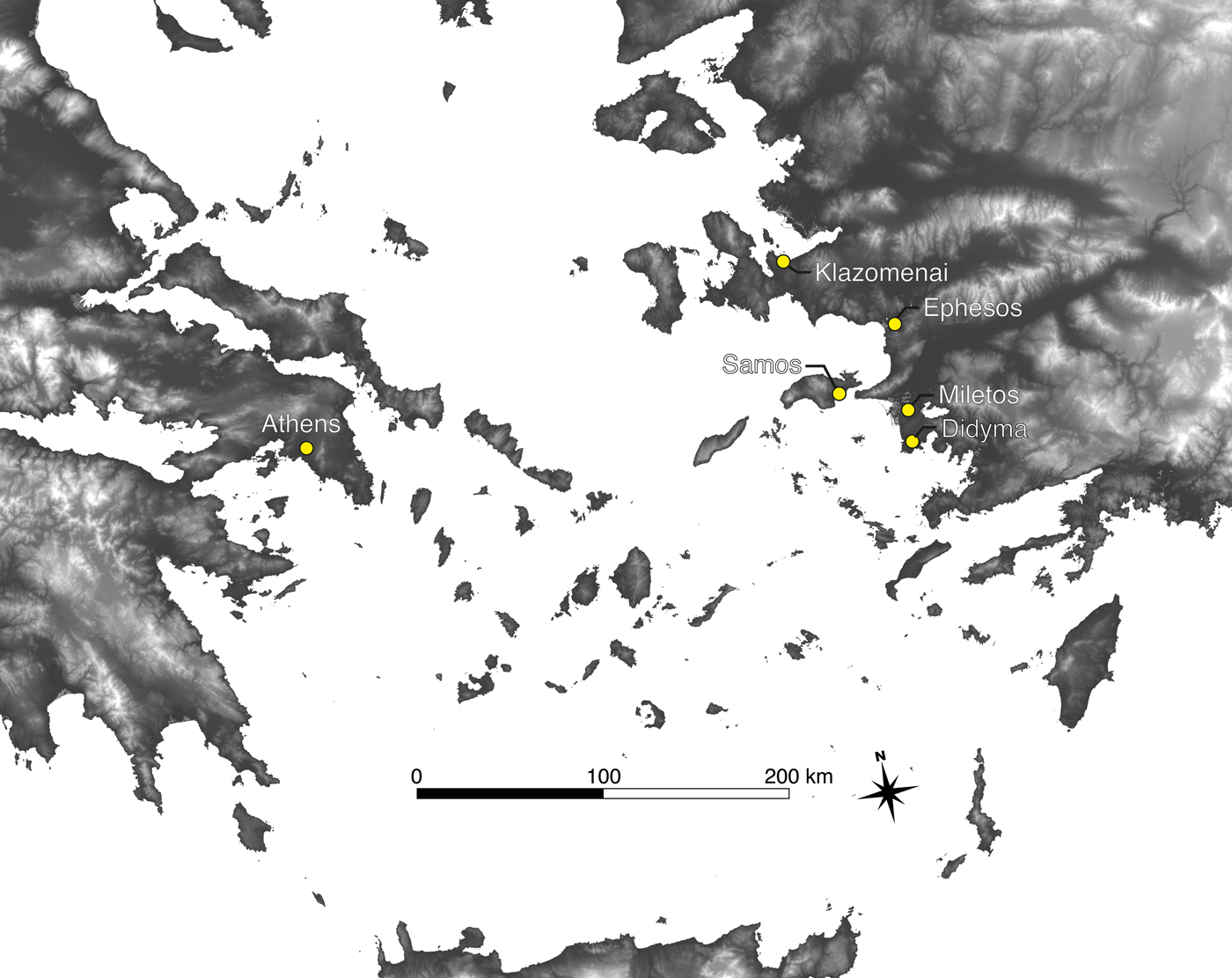
The Battle of Lade, named after the island lying north-west of Miletos (Fig. 1), marked the end of the Ionian Revolt and the defeat of the Ionians by Persian forces in 494. An internal battle for prestige and power among the Milesian elite, initiated by Aristagoras and Histiaios of Miletos in 500/499, the Revolt evolved into a wider struggle against Achaemenid influence (Tozzi Reference Tozzi1978; Georges Reference Georges2000; Bichler Reference Bichler2001, 303–10; Kienast Reference Kienast2002). The Battle of Mykale, in 479, represented a reversal of fortunes for the Persians and was seen by contemporary authors as a ‘liberation’ of Miletos by Athenian-led forces. In part a result of the influence of Herodotus, these two events have formed a fundamental part of the identity of the city in subsequent Greek, Roman and indeed modern conceptions of the city. It is difficult, however, to assess the real physical and cultural effects of each event. According to Herodotus, the defeat at Lade resulted in the total destruction of both the fleet and city, and the enslavement and deportation of its citizens (Herodotus 4.28–6.42). He (6.22.1) reports that Miletos was ‘emptied of Milesians’ (Μίλητος μέν νῦν Μιλησίων ἠρήμωτο). Whether or not this turn of phrase was meant literally,Footnote 3 the real severity and extent of the destruction, its impact on the continuation of daily (and religious) life and the subsequent speed of recovery are today hotly contested (Ehrhardt Reference Ehrhardt and Schwertheim2003; Herda Reference Herda2006; Slawisch Reference Slawisch, Gates, Morin and Zimmermann2009).Footnote 4
Map of Attica and Ionia, including the Milesian peninsula with Samos, Klazomenai (©T. C. Wilkinson).

On the one hand, a degree of exaggeration for rhetorical effect for Herodotus’ intended audience would not be surprising given his biased approach towards Greek and Persian histories and the construction of the other, non-Greek protagonists (cf. the contributions in Rollinger, Truschnegg and Bichler Reference Rollinger, Truschnegg and Bichler2011, Wiesehöfer Reference Wiesehöfer, Dunsch and Ruffing2013 and Skinner Reference Skinner, Harrison and Irwin2018, esp. 212–16). On the other hand, there are in fact a number of identifiable destruction layers that could be plausibly connected to this sack of the city: excavations have revealed burnt strata on the Archaic-period settlement on Kalabaktepe, as well as at other areas of the ancient city (Kleiner and Müller-Wiener Reference Kleiner and Müller-Wiener1972, 50; von Graeve Reference Graeve, Trümpler, Grentzenberg and Baier1986, 37–42; Herda Reference Herda2005, 247; von Graeve Reference Graeve and Radt2006, 244–5; Reference Graeve, Gerlach and Raue2013). Furthermore, and perhaps more tellingly in the long-term, datable archaeological finds for the period between the defeat and the mid-fifth century are extremely limited, not only in terms of raw numbers but also in terms of diversity of forms, shapes and range of materials.Footnote 5 It is nearly impossible to identify significant building activities during the first half of the fifth century. It has been argued that a number of low-key repairs to private houses date to this period (von Graeve Reference Graeve, Trümpler, Grentzenberg and Baier1986, 41), although they have so far been published only in limited detail. Even so, these repairs hardly constitute the sort of works with which we might expect the expensive sculptures in the Severe Style to have been associated. At present, the evidence suggests that sustained civic life did not start to recover until the mid-fifth century at the earliest, and only really took off towards the end of the fifth century.Footnote 6
But Miletos should not only be defined by its defeat by the Persians and subsequent recovery. A major metropolis and sea-power between the seventh and sixth centuries, its citizens founded many colonies around the highly-profitable Black Sea region, relying on the city's hinterland, its connectivity along the Meander for trade and the nearby interstate oracular sanctuary of Didyma for economic and for spiritual prestige (Ehrhardt Reference Ehrhardt1983; Gorman Reference Gorman2001; Herda Reference Herda, Bol, Höckmann and Schollmeyer2008). Politically Miletos was subordinate to the Lydian kingdom from the middle of the seventh century, before falling under the domination of the Persians from the middle of the sixth, whose direct control was first tested by the Ionian Revolt and then destroyed by the rise of the Athenian Empire and its military control of the Aegean (e.g. Osborne Reference Osborne1999; Raaflaub Reference Raaflaub, Ma, Papazarkadas and Parker2009, 94–7).
Subsequent Greek history has been written from an Athenian perspective; this has led us to underestimate the importance of Ionia in general and Miletos in particular in the development of Archaic Greek culture. Before this destruction, the exceptional position and prosperity of Miletos at the end of the sixth century is not only praised by Herodotus (5.28), but is also well documented in the archaeological record (Senff Reference Senff, Jansen and Hoock2002; Greaves Reference Greaves2010). Not least is a well-established tradition of stone sculpture during the seventh and sixth centuries, to which we will now turn.
SCULPTURE IN THE ARCHAIC STYLE FROM THE MILESIAN PENINSULA
Taken as a whole, the evidence for a thriving and varied tradition of (stone) sculpture on the Milesian peninsula during the Archaic period is extensive. If it has sometimes been difficult to appreciate this in the past, it is partly because scholarship on the peninsula has been awkwardly divided into two data fiefdoms. This division resulted from the separation of primary research on the peninsula into two competing German excavation teams working either side of the ancient Akron ridge which separates the peninsula into two: one team based at Didyma and the other at Miletos. Klaus Tuchelt, head of the Didyma team between 1969 and 2001, published extensively on finds of Archaic sculpture from the Sanctuary of Apollo at Didyma and those identified along the Sacred Way which connected the two locales in the past (Tuchelt Reference Tuchelt1970; Reference Tuchelt and Kyrieleis1986a; Reference Tuchelt, Tuchelt, Schneider, Schattner and Baldus1996). Meanwhile, Volkmar von Graeve, head of the Miletos excavation from 1988 to 2011, published exemplars found in and around Miletos (von Graeve Reference Graeve1983). These assemblages should really be examined together; the commonalities of raw materials and stylistic features (e.g. shaping of female garments) strongly suggest that the same artisans or workshops were responsible for producing pieces for installations at both Miletos and Didyma, and probably also for nearby Samos.Footnote 7
Unfortunately, the actual location of the stone workshops that were responsible for this considerable amount of Archaic sculpture remains unknown, but the discovery of unfinished fragments at Miletos (e.g. von Graeve Reference Graeve1983, 15 figs 12–14) makes the existence of a workshop in, or very near to, the city highly likely. The repertoire of Archaic Milesian sculpture is dominated by seated figures. There are at least 40 examples (cf. Tuchelt Reference Tuchelt1970; von Graeve Reference Graeve1983; Höckmann Reference Höckmann1996; Kopanias Reference Kopanias and Klinkott2001; Slawisch and Wilkinson Reference Slawisch and Wilkinson2018, 126), depicting both men and woman, and displaying an astonishing variety of details with regards to the ornamentation of the chairs and the elaboration of their garments. Tuchelt noted that Archaic-period seated figures found in and around Miletos are mostly under life-size, while the ones from Didyma are above life-size. Further the garments of the latter group are more differentiated (Tuchelt Reference Tuchelt1970, 218–19 with fig. 26.3–4). None of the statues seem to have been found in an original context. Only a few of the figure's heads have survived (on later replacements; cf. Bumke Reference Bumke, Einicke, Lehmann, Löhr, Mehnert, Mehnert and Slawisch2009 and Kowalleck Reference Kowalleck, Leypold, Mohr and Russenberger2014); it is unclear whether this is a result of subsequent iconoclastic episodes or the more prosaic deleterious effects of greater exposure to the elements suffered by this part of the works. Other less numerous types of statuary include: standing men (kouroi) and women (korai); reclining human figures (see also Baughan Reference Baughan2011, 24–6); and lion or sphinx figures (Tuchelt Reference Tuchelt1970, 93–8 with figs 63–71; Reference Tuchelt and Kyrieleis1986a, pl. 13; Reference Tuchelt, Tuchelt, Schneider, Schattner and Baldus1996 with pls 79–87; Haider Reference Haider and Ulf1996, 112).
SCULPTURE IN THE SEVERE STYLE FROM THE MILESIAN PENINSULA
In contrast to the rich corpus of Archaic monumental and near-life-sized sculptures linked firmly to the sixth century, only three pieces of sculpture from the peninsula have ever been linked to the Severe Style, namely the Miletos Torso, the head and the seated female figure mentioned above, two of which were apparently found in the city itself. Such a dramatic reduction in the intensity of production is of course a matter of some significance itself. Given the very small number involved and their relationship to the Severe Style, the reliability of their actual date of manufacture is of critical importance, especially in the context of the fate of Miletos following the Ionian Revolt. Each will therefore now be described and discussed individually in more detail. It should be noted from the outset that none of the items have clear, contemporary, stratigraphic context that could provide independent dating evidence, so we are heavily reliant on stylistic comparisons and proxy evidence about the likely state of the city from other materials.
The Miletos Torso (Fig. 2a–b)
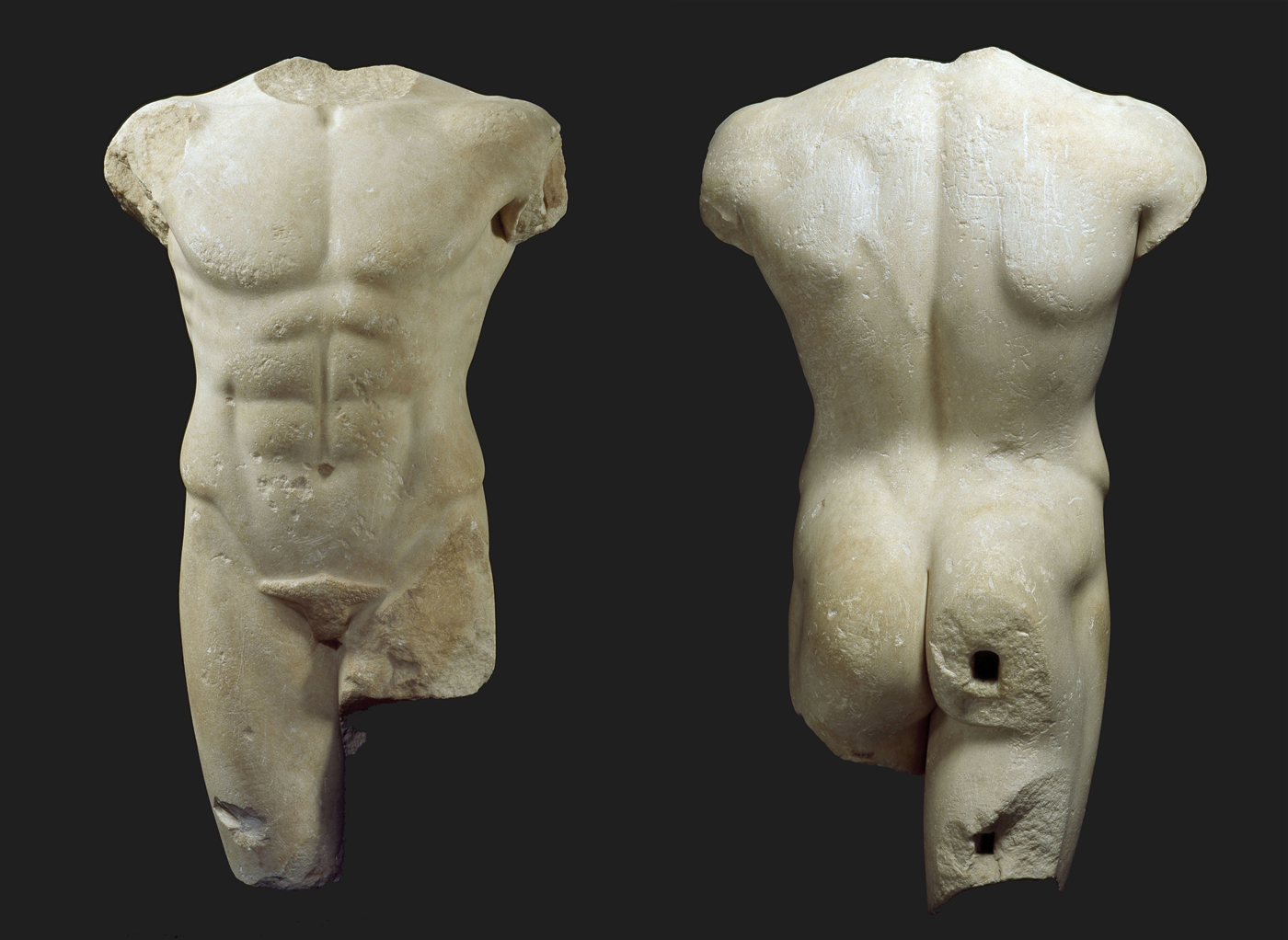
The first piece, the ‘Miletos Torso’,Footnote 8 is very well known in wider art historical literature. From the original standing male figure, the head, neck, arms, the left leg and the right lower leg are lost. Clear traces of repair and alteration to the remaining parts have encouraged the idea that its nineteenth-century find spot, namely the theatre of Miletos, was not its original place of installation (Linfert Reference Linfert1973, 81; Braunstein Reference Braunstein1995). Although the overall relatively stiff posture and positioning of the legs of this piece are still in the tradition of Late Archaic kouroi (cf. Richter Reference Richter1970; Ridgway Reference Ridgway and Boulter1985; Reference Ridgway1993), there are several innovations in the manner of depicting adult men which place the piece apart from typical Archaic representations. These ‘progressive’ features associated with the Severe Style include: the muscular build, especially the accentuated reproduction of the internal division of the abdominal wall; the linea alba (which divides the upper body from the neck onwards); the asymmetry of the body suggesting motion; the ‘ponderation’ (contrapposto) posture created by one left leg posed forward; and the upward-pointing tuft of the pubic hair, a shape which is more common in later statuary (see the detailed descriptions of the torso by Linfert Reference Linfert1973, 83–4; Bode Reference Bode2001, 8–12; Bol Reference Bol2005, 41–3; Reference Bol, Frede and Schollmeyer2011, 131–4). The classification of the torso as an original early work of the Severe Style is almost universally agreed (Linfert Reference Linfert1973, 83, 88–9; Bode Reference Bode2001, 22–3 with bibliography; although cf. Ridgway Reference Ridgway1970, 40, who considers it to be a Roman copy of a now-lost earlier classical original). Though most scholars date its manufacture to the early fifth century bc, on the basis of its Severe Style characteristics, discussions about its precise dating are less unanimous. For many scholars, the textually reported destruction of Miletos in 494 makes production at Miletos itself during the first two decades of the fifth century very unlikely (Linfert Reference Linfert1973, 82–3; Bode Reference Bode2001, 22–3; Bol Reference Bol, Frede and Schollmeyer2011, 134). Indeed some have argued that the torso could have been manufactured outside Miletos (e.g. at nearby Myous: Bol Reference Bol, Frede and Schollmeyer2011, 131–4).
Miletos Torso (©Musée du Louvre, Ma 2792). Front view (D. Lebée & C. Déambrosis); back view (D. Lebée & C. Déambrosis).

The Male Head (Fig. 3a–d)
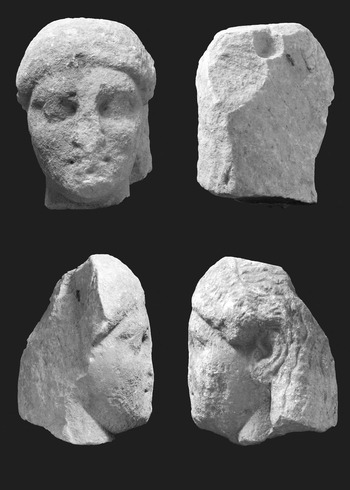
In 1977 Volkmar von Graeve published an above-life-size male head uncovered in the early years of the German excavations at Miletos (sometime between 1899 and 1911). The exact modern find spot was, as far as we know, unrecorded. It has been argued that the head may match the missing head from the Miletos Torso (Bol Reference Bol, Brinkmann, Cobet, Schlotzhauer and Weber2006; Reference Bol, Frede and Schollmeyer2011, 134), but this is difficult to confirm because of the head's inferior preservation:Footnote 9 cracks run underneath the chin and along the right half of the back of the head; the face, hair and ears are all damaged and the nose is completely missing; the marble surface is abraded and shows traces of the effects of fire (von Graeve Reference Graeve1977, 159). From a stylistic perspective the head, like the torso, shows a combination of Archaic and Early Classical features. Late Archaic features include the long compact hairstyle, combed back behind the ears, and the shape of the ears themselves (von Graeve Reference Graeve1977, 161–2 with fig. 6: head from Keramos). By contrast, the facial expression, the heavy eyelids and the fact that the hair is clearly separated from the forehead all link more closely to stylistic features known in the Classical period (e.g. on the figures of the pediment from the Zeus temple in Olympia: Boardman Reference Boardman1985, 33–50 with fig.). Given this apparently ‘transitional’ combination of traits, von Graeve argued that the head should be seen as a very early exposition of the Severe Style and hence dated to the years immediately following the liberation of Miletos in 479, on the assumption that the Severe Style emerged around 480 in Athens (von Graeve Reference Graeve1977, 161–3; Bol Reference Bol, Brinkmann, Cobet, Schlotzhauer and Weber2006, 31–2).
Male Head (©German Archaeological Institute, Istanbul). Back view: D-DAI-IST-R13136 (W. Schiele). Right side: D-DAI-IST-R13138 (W. Schiele). Front view: D-DAI-IST-R13141a (W. Schiele). Left side: D-DAI-IST-R13145 (W. Schiele).

The Seated Female Figure (Fig. 4a–c)
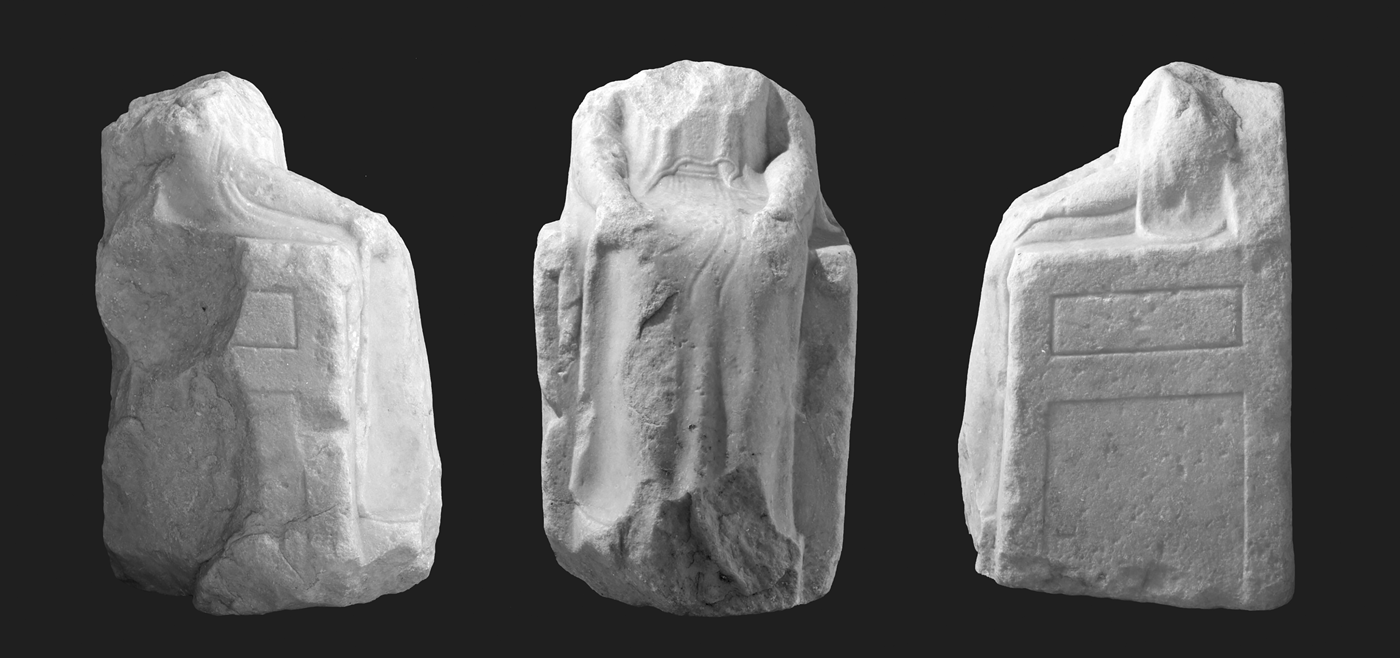
Also published by von Graeve is our third piece, the below-life-size statue of a seated female figure found in 1967, near ‘Cape Plaka’ (modern Balikçi Liman), on the western coast of the peninsula, a few kilometres south-west of the city. The figure is relatively poorly preserved: the head, neck, shoulder and feet are missing, and the hands and chest are abraded. Nonetheless, the clear relationship between this piece and other sixth-century/Archaic seated figures from the Milesian peninsula is evident from the frontal aspect of the figure and the cubic throne with its high vertical backrest (cf. von Graeve Reference Graeve1983, fig. 15). The figure is depicted with typical Ionian dress, composed of a girded chiton and a himation that is diagonally draped across the torso (as a Schrägmantel). However, unlike many Archaic examples, the figure is dissociated from the seat. Similarly, there is a different relationship between the feminine body and the garment, which is depicted in a more naturalistic fashion than typical Archaic models. This is indexed both by the omission of the broad cloth web between the legs and the lively S-shaped fold, swinging out to the side. These features are indeed more often associated with later sculptures in the Severe Style. Since von Graeve assumes 480 as an absolute terminus post quem for the introduction or invention of the Severe Style, he is forced to argue that this figure with both Archaic and Classical features should be seen as another very early example of transition, contemporaneous with the male head and the Miletos Torso and dating to around 479 (von Graeve Reference Graeve1975, 65; Reference Graeve1983, 16).
Seated Figure (©German Archaeological Institute, Istanbul). Left side: D-DAI-IST-R13083 (W. Schiele). Right side: D-DAI-IST-R13084a (W. Schiele). Front view D-DAI-IST-R13086 (W. Schiele).

THE EARLIEST SURVIVING EXAMPLES OF THE SEVERE STYLE OR INNOVATION IN A LATE ARCHAIC MILESIAN TRADITION?
For a simplistic view of the development of ancient sculpture into discrete bounded periods, the ‘transitional’ nature of these pieces presents a problem. All three of the pieces clearly demonstrate features typical of Ridgway's definitional list, cited above, that link them sometimes very closely to other pieces in the Severe Style. But from a stylistic and technical point of view, the relationship between these three pieces and Late Archaic-period statuary from the Milesian peninsula is also very strong, and is in concordance with Archaic examples from the island of Samos, whose workshops had very close ties to those of Milesia before the Ionian Revolt (Tuchelt Reference Tuchelt1970, 178–83). Although there is no direct parallel for the Miletos Torso (Fig. 2), the preserved statues from nearby Didyma (cf. Tuchelt Reference Tuchelt1970, K 20 pl. 22) and Samos (cf. Freyer-Schauenburg Reference Freyer-Schauenburg1974, no. 52 pl. 36 and no. 139 pls 86–7) show that south Ionian workshops were capable of producing sophisticated works (Tuchelt Reference Tuchelt1970; Freyer-Schauenburg Reference Freyer-Schauenburg1974). The preponderance of detail given to the depiction of the adult male body is common to Archaic Milesian sculpture, as is evidence for experimentation in different manners of depiction. The paucity of good find contexts for sculpture of this kind has forced us to rely on a perhaps unjustifiable confidence in a style-led evolutionary dating scheme, heavily reliant on parallels from mainland Greece and Asia Minor, whose dating is equally imprecise (Tuchelt Reference Tuchelt1970, 131–65; Freyer-Schauenburg Reference Freyer-Schauenburg1974, 1–5). The male head (Fig. 3) is more difficult to compare to Archaic examples from the region, given the few heads that have survived. Nonetheless, there are two potential comparanda, one alluded to by von Graeve found in the Karian Keramos (von Graeve Reference Graeve1977, 161–2 with fig. 6), and another a head of a Kouros, dated by Tuchelt to the years 540–530 (Tuchelt Reference Tuchelt1970, K 16 on pl. 11). These demonstrate that a wide range of modes of depictions for the human face were current during the late sixth century. For the seated figure (Fig. 4), however, the stylistic similarities with Archaic sculptures from both Miletos and Didyma are very strong. One other such seated figure, also found near ‘Cape Plaka’ and dated by Tuchelt into the years 550–525 (Tuchelt Reference Tuchelt1970, L 99 on pl. 85), shows that the idea of shifting the hem of the mantle sideways and depicting it in a more vivid way (as seen in the later Severe Style seated figure) was something that artists were already experimenting with before the fifth century. The continuity of features seen in these three pieces in the context of the range of variation already found within Late Archaic sculpture from the region firmly places them within the local Milesian Archaic tradition of manufacture, albeit with marked features that were to become more common in (later) Classical times.
Assigning the term ‘transitional’ is one way to resolve the confusing chronological signals these pieces give us. But in many ways, this is an unsatisfactory solution to a self-imposed terminological problem introduced by our own methods. ‘Late Archaic’, ‘Severe Style’ or ‘Transitional’ are best seen as convenient heuristic classifications designed to model, in artificially static types, a process of cultural production which was likely to have been very fluid and perhaps not always as neatly unidirectional or chronologically bounded as we, as art historians and archaeologists, would like for the stylistic method of dating sculpture to maintain comparative ordinal power. As Werner Fuchs has suggested (Fuchs Reference Fuchs1976, 286), we might imagine a considerable degree of chronological overlap between ‘Archaic’ and ‘Classical’ styles, certainly in terms of works on display from what we would consider different eras, but perhaps also in terms of contemporaneous production of different styles by different (or even the same) workshops.
For the case of Miletos in particular, with its paucity of surviving classical sculpture, the question is: transition to what? And, more pressingly, when exactly did this transition take place? It is worth considering at this point subsequent local traditions. The next datable example of Milesian monumental sculpture comes in the form of a lion statue, found in 1954 in the bay of Mavişehir. Dated by stylistic comparison by Axel Filges to around 400, it shows absolutely no technical connection with its Ionian predecessors (compare with Tuchelt Reference Tuchelt1970, 93–8 nos 66–74) but rather very close similarities with lion statues found in Attica (Filges Reference Filges2007, 42–3 no. 50; cf. Vermeule Reference Vermeule1972, 52 with fig. 11.5). This represents a sharp realignment of sculptural traditions, and a stark cultural reorientation of Ionian workshops towards Attic models by the end of the fifth century BC.
If, as von Graeve argues, the three transitional pieces from Miletos are an index of a rapid ‘revival’ of Archaic Ionian workshops with an injection of innovations from an Athenian-inspired Severe Style after the liberation of the city in 479 (von Graeve Reference Graeve1975; Reference Graeve1977), we must account for, on the one hand, continuity over a major period of disruption and, on the other, disruption over a period of relative continuity: the first, a period of at least 15 years between Lade (494) and Mykale (479), when the workshops are assumed to have been destroyed or have been inactive; the second, of 60 to 80 years between Mykale (479) and the next evidence for monumental sculpture (c. 400). Given the high level of technical knowledge and skill needed to maintain sculptural manufacturing traditions, artistic continuity is perhaps the harder of the two outcomes to explain. It is very difficult to imagine that the three pieces described above could be immediately produced in Miletos itself after a disruption of at least a generation (i.e. a minimum 15 years between Lade and Mykale). At least two more plausible explanations are available: first, if a date of 480 or later is correct, that these pieces were actually all manufactured in Athens (perhaps by artisans who had escaped from the destruction) and brought to Miletos at some point after Mykale, albeit not necessarily immediately; or, second, that their manufacture in Ionia should be dated substantially earlier, i.e. at least before 494.
For the second period defined by artistic discontinuity, the subsequent dearth of sculpture from Miletos until the very end of the fifth century could be put down to a matter of archaeological visibility: if the dominant material of production was bronze, then perhaps we have simply lost all the intermediate transitory steps between the Miletos Torso and the Mavişehir lion statue (acknowledging the fact that we are awkwardly comparing rather different classes of subject). While we cannot rule this possibility out completely, it should be noted that preserved examples of, or references to, the fully developed classical style (i.e. comparable to oeuvres of Polykleitos or Phidias) are few in Ionian contexts as a whole. The only archaeological example seems to be an unfinished head found 1914 at the Heraion on Samos (Freyer-Schauenburg 1999, 689 with fig. 173.1–2). Textual references are more generous, albeit they were all written later. But none refer to Miletos, and, if these dates are to be taken at face value, all the referenced works post-date the middle of the fifth century. Strabo (Geographica 14.637) reports that a statue group made by Myron around 440 consisting of three figures – Zeus, Athena and Herakles – was taken from the Samian Heraion by M. Antonius and later erected at the Capitol in Rome by Augustus.Footnote 10 The same applies to the famous Amazons erected in the Ephesian Artemision around 430 (Ridgway Reference Ridgway1974; Bol Reference Bol1998; for the date: Devambez Reference Devambez1976, 167–8; Fleischer Reference Fleischer2002, 196), which Pliny (Naturalis Historiae 34.53) reports were designed and executed by Polykleitos, Phidias and Kresilas as part of an artistic competition (cf. Hohl Reference Hohl1955). Analogous to the Kanachos-Apollo these sculptures survived in the form of Roman copies, themselves subjects of a long dispute on the Meisterzuschreibung of the individual pieces (cf. most recently Hölscher Reference Hölscher and Linant de Bellefonds2000, 216–17 and Berns Reference Berns, Maischberger and Heilmeyer2002, 129–30 nos 28–30). All in all, the visibility argument seems weak.
Moreover – and this seems to me critical to dating our three Severe Style pieces as much as it helps to explain the subsequent gap – a recent intensive review of all of the published archaeological evidence for any kind of occupation at the city of Miletos during the fifth century shows that there is almost no class of material evidence (e.g. significant quantities of datable ceramic or building activities) that can be safely and unequivocally dated between 494 and around 460/450 (Slawisch Reference Slawischforthcoming). The lack of ceramic markers from Miletos for most of the first half of the fifth century, a more continuous and independent proxy for economic prosperity than the presence or absence of sculpture, makes it much more difficult to imagine the existence of suitable financial resources in the city to support large-scale stone or metal workshops. Although the later date cannot be excluded, the much simpler and therefore more parsimonious explanation is, therefore, that the three ‘transitional’ pieces from Miletos were actually manufactured in the context of Late Archaic Milesian prosperity, namely before 494. Moreover, we do not need to rely on negative evidence from fifth-century Miletos alone to provide support for this scenario, as other information from across Ionia will now show us.
THE VIEW FROM IONIA AND BEYOND: LOST MEDIA, FORGOTTEN COSMOPOLITANISM
Ross Holloway has argued that virtuosity in the methods of producing hollow casting had an immense influence on the development of the Severe Style; the plasticity of clay prototypes and moulds resulted in softer facial expressions and the abandonment of fragmented garments. Holloway sees Athens, Aegina and Argos as playing the most important role in the development of this technique and rejects the possibility of Milesian involvement out of hand (Holloway Reference Holloway1988, 56; see also Mattusch Reference Mattusch1980): ‘Miletos, following its misfortunes in the Ionian revolt, was hardly likely to have been the home of an important and innovative group of sculptors in 480 B.C.’ (Holloway Reference Holloway1988, 60). It is true that there are no preserved bronze statues from Ionia datable to this period, not even small bronze statuettes (Thomas Reference Thomas1981, 162). But Athens, Aegina and Argos are unlikely to have had a monopoly on hollow-cast manufacture in this era: indeed, a famous bronze tripod dedicated to the Sanctuary of Delphi by Gelon of Syracuse, after the battle of Himera in 480, was manufactured by a certain Bion of Miletos (Amandry Reference Amandry, Boardman and Vaphopoulou-Richardson1986, 209–10; for the inscription: Marcadé Reference Marcadé1953, no. 9; Meiggs and Lewis Reference Meiggs and Lewis1989, no. 28). Bion's age in 480 and whether he had worked in Miletos before the Ionian Revolt cannot be determined. Indeed his origins might be irrelevant to where he learnt his trade. Nonetheless it raises the possibility that such skills were well known in Miletos before the destruction of the city.
Didyma: The Lost Kanachos-Apollo Statue
Though the term ‘Severe Style’ is a modern one, ancient commentators also made comparisons between works of different periods and apparently made similar distinctions between Archaic and Classical works. As Volker Michael Strocka (Reference Strocka2002) has argued, this awareness can be detected in Roman discussionsFootnote 11 of a celebrated late sixth-century sculptor, Kanachos of Sikyon (Corinthia), whose oeuvre was considered to be in a transitional style (Strocka Reference Strocka2002, 81–3 with bibliography in note 15). Kanachos’ most famous work is the so-called Kanachos-Apollo, a monumental sculpture in bronze. Known only from written sources, as Tuchelt quipped, its art historical fame is due to the tale of its travels (‘Sie verdankt ihren Ruhm ihrem Schicksal’: Tuchelt Reference Tuchelt1986b, 76). Originally manufactured for the Apollo Sanctuary at Didyma, it was – according to Pausanias, writing in the second century ad – robbed by the Persians and given back to the Milesians by Seleukos I. Nicator.Footnote 12
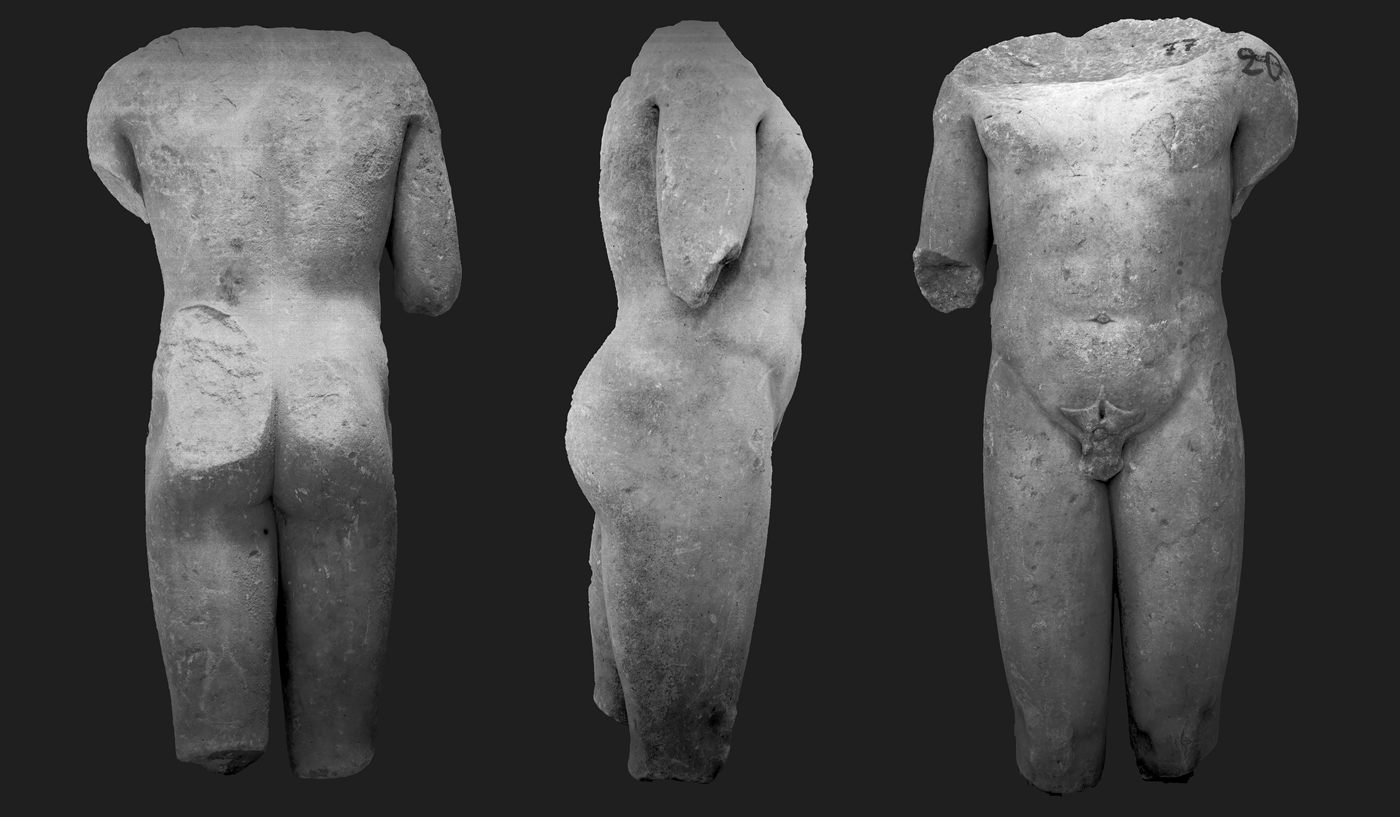
Even though the original is long lost and undisputed copies have not yet been persuasively identified, there are reasons, beyond the ancient discourse on art history, to believe that this statue indeed prefigured many of the stylistic traits of the Severe Style. In particular, as Strocka has shown, numerous motifs on coins, gems, small bronzes and reliefs, many with strong ‘Severe’ features, either evidently depict or reference the Kanachos-Apollo (Strocka Reference Strocka2002, 85–93 with figs 1–9, 11–15). A headless statue (Fig. 5a–b) found in 1900 during excavations at the Forum Romanum near the spring of Iuturna has long been argued as a Roman copy of the Kanachos-Apollo (Strocka Reference Strocka2002, 101–12). Strocka also suggests that the so-called Apollon-Townley head, today in the British Museum (http://collection.britishmuseum.org/id/object/GAA8729), is a copy of the original head of the Kanachos-Apollo, though others have argued against this association (e.g. Germini Reference Germini2008, 58).
Apollo from the spring of Iuturna (©German Archaeological Institute, Rome). Front view: D-DAI-ROM-63.1226 (H. Koppermann). Diagonally from behind: D-DAI-ROM-63.1229 (H. Koppermann).

The date of the alleged plunder of the figure from Didyma provides a convenient terminus ante quem for the production and dedication of this statue into the sanctuary. Herodotus describes the plunder of the Sanctuary of Apollo at Didyma as an immediate consequence of the Battle of Lade and the sack of Miletos, i.e. in 494. Strabo connects the event with the Persian king Xerxes, and with the plunder of Athens and Brauron (i.e. around 480), as a punishment on Miletos for cowardice in naval battle. Evaluation of these competing dates depends to some extent on whether and when Didyma was politically and administratively independent of Miletos (cf. for independence: Tuchelt Reference Tuchelt1988, 430–3; Strocka Reference Strocka2002, 94–6; Furtwängler Reference Furtwängler and Dlugos2014; and for dependence: Ehrhardt Reference Ehrhardt1998, 19–20; Herda Reference Herda2006, 175, 447–57). In the absence of corroborating information for either case, including any archaeological confirmation of destruction at Didyma,Footnote 13 Herodotus’ historical proximity seems the preferable of the two.Footnote 14 If, following both Tuchelt (Reference Tuchelt1986b, 80–1) and Strocka (Reference Strocka2002, 97–8), we assume that the statue was a Milesian votive rather than a cult image, we can even propose a more specific date of installation. According to Strabo, the priests of Didyma supported the Persians during the Ionian Revolt (cf. Strabo, Geographica 7.1.43: Kallisthenes FGrHist 124 F 14Footnote 15). The looting and destruction of the temple in this scenario only makes sense if the sanctuary had been annexed by Miletos during the events of 499, and was returned to the priestly family only after 494. The most plausible time for the installation of the Kanachos-Apollo as votive would therefore be between 499 and 494 (Strocka Reference Strocka2002, 97–8; cf. Weber Reference Weber2015, 16–18 with a full bibliographical list on this subject). If we accept this circumstantial argument that the Kanachos-Apollo was installed at Didyma before 494 (whether or not Kanachos actually worked in his home region or in Miletos), Ionian craftsmen would have been fully aware of the possibilities of new modes of depiction before the city's destruction. An early date for the three pieces from Miletos would, in this context, make much more sense.
Klazomenai: A Leg Fragment
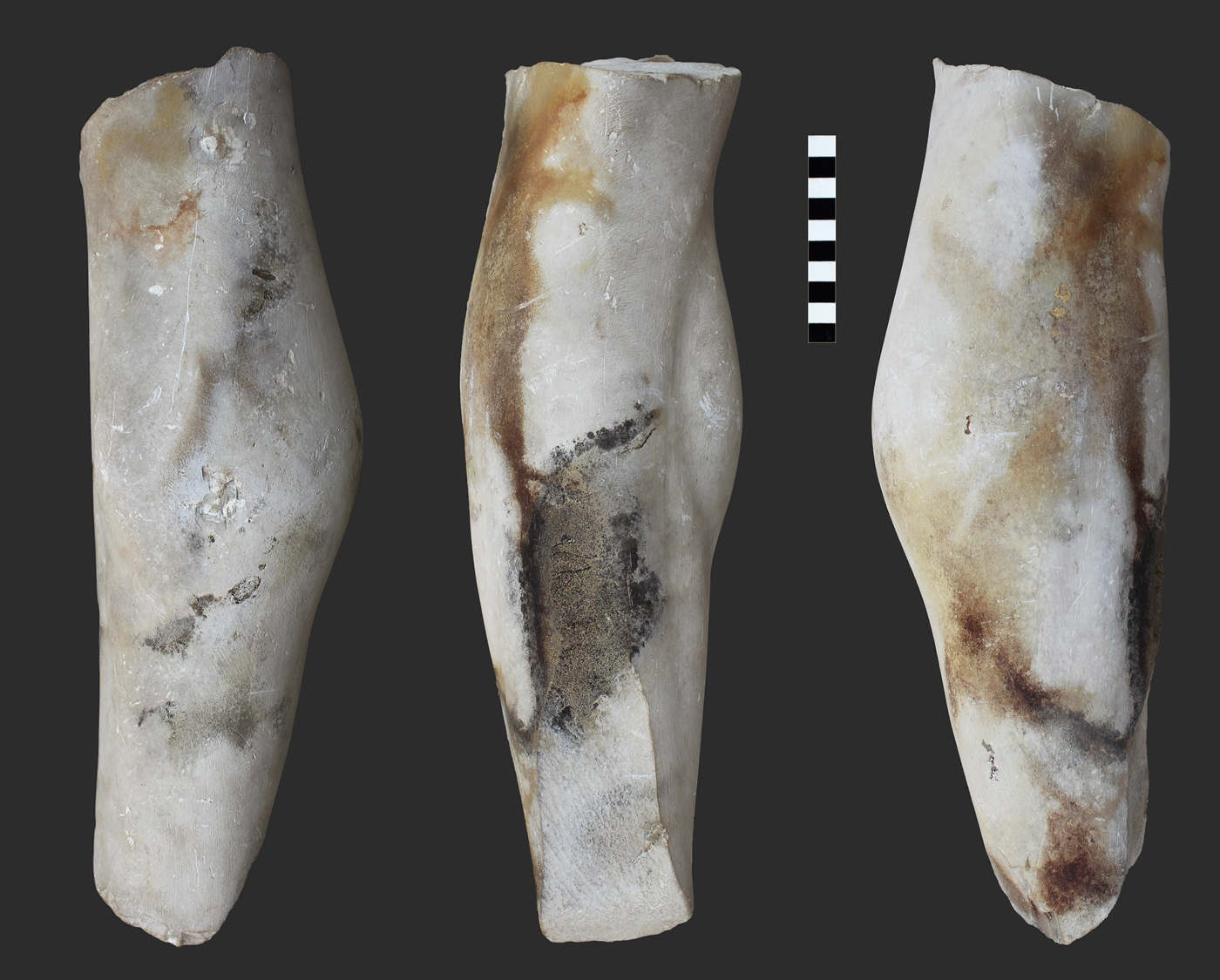
A further corroborating terminus ante quem for early development or at least experimentation with features of the Severe Style comes from a sealed context at the Ionian city of Klazomenai. Here a well had been dug into the southern slope of the acropolis during the Archaic period. The well fell into disuse, apparently when the Klazomenians abandoned the mainland settlement in the early fifth century, and was ultimately sealed off during the second half of the fifth century, at the very latest. In some of the deepest layers of the well, a marble leg (Fig. 6a–c) was found, evidently discarded very soon after the well was abandoned (Ersoy Reference Ersoy2004, 61 with note 2, Bakır et al. Reference Bakır, Ersoy, Fazlıoğlu, Özbay, Özer and Zeren2003, 209–10 with fig. showing the context). The lower leg displays a tensed calf muscle and must have been part of a statue with a clear distinction between supporting and non-supporting leg (i.e. contrapposto), a distinctive innovation of the Severe Style, similar to that seen on the Miletos Torso. Though it is difficult to give a precise absolute date to this terminus ante quem, ceramic evidence suggests that the abandonment of the mainland settlement at Klazomenai seems to have happened during the first years of the fifth century (Ersoy Reference Ersoy2004, 55–60; Güngör Reference Güngör2004, 122; Koparal and İplikçi Reference Koparal and İplikçi2004, 232).
Marble leg from the well in Klazomenai (©Klazomenai excavation, archive).

Samos: Archaic into Classical
Similar transitional examples are also preserved from Samos. Freyer-Schauenburg has convincingly argued that the evidence from Samos shows the depiction of the male body gradually transformed between the late sixth and early fifth centuries, from the rather stiff posture of the Archaic period towards a loosening of the arms and feet (Fig. 7a–c), creating the effect which is later called a ponderation (cf. Freyer-Schauenburg Reference Freyer-Schauenburg1974, no. 138 with pl. 85, no. 139 with pls 86–7 and no. 140 with pl. 88).Footnote 16 Samos did not share the same fate as Miletos in 494, so it would not be surprising if local workshops were able to continue production after this date, and hence incorporate later innovations.Footnote 17 One fragment from a male figure found in Samos has no parallel on the island, but instead most strongly resembles the so-called Leonidas from Sparta with its twisted upper body – a feature not normally to be found within Archaic sculpture (Freyer-Schauenburg Reference Freyer-Schauenburg1974, no. 141 with pl. 88; for Leonidas see Bol Reference Bol and Bol2004, 12–13 with fig. 15a–b). The evidence from Samos, often closely linked to that of Miletos, thus supports the possibility of a pre-480 trend toward Severe Style features.
Kouros (© German Archaeological Institute, Athens). Athen Inst. Neg. Samos 112. 113. 1052–1054. Athen Inst. Neg. 70/1070–1075.

Athens: The Kritios Boy, the Blond Head and the Tyrannicides
In the context of these hints of early development toward the Severe Style detectable in Ionia, in the late sixth or early fifth century, it is worth comparing the Attic evidence for the Severe Style and considering the degree of confidence in the dating of these materials. A few well-known sculptures from Athens usually form the handbook starting point for the discussion of the Severe Style. In the past, it was usually argued that the Kritios Boy and the so-called Blond Head, both of which show more naturalistic rendering of the human form than typical Archaic sculpture, should be dated to before the Persian destruction of the Athenian acropolis in 480.Footnote 18 A review of the contexts of discovery by Jeffrey M. Hurwit (Reference Hurwit1989, 43–7) placed considerable doubt on this previously assumed fixed date. It is this uncertainty regarding the early date of these sculptures that encouraged Stewart to argue so fervently for the post-480 emergence of the Severe Style already cited above. While Stewart's careful re-analysis of the so-called Perserschutt context from the Athenian acropolis rightly highlights the insecure nature of the dating of the relevant layers, I would argue that it does not necessarily follow that we must down-date the Severe Style to after 480 (Stewart Reference Stewart2008, 377–412; on the Perserschutt, see also Lindenlauf Reference Lindenlauf and Hoepfner1997; Steskal Reference Steskal2004).
Uncertainty similarly envelops the dating of the Tyrannicides statue group, another piece usually referred to with regards to the Severe Style. The original bronze version of this famous work was reportedly created by Antenor in 510 (Pausanias, Hellados Periegesis 1.8.5). In a similar fate to that of the Kanachos-Apollo, the statue was robbed by the Persians in 480 but, unlike the statue of Kanachos, apparently never returned. A second work was therefore commissioned and manufactured by Kritios and Nesiotes, subsequently to be erected in 477/476 (Schweizer Reference Schweizer, Kreutz and Schweizer2006, 294–5 with note 50; Meyer Reference Meyer2017, 427–9; but cf. also Stewart Reference Stewart, Seaman and Schultz2017 and Azoulay Reference Azoulay2014, 41–8. The latter includes a less convincing attempt to down date the first group). It is this post-Persian image that was subsequently copied by the Romans, and can be seen reflected by images on Athenian red-figured pots (Brunnsåker Reference Brunnsåker1971; Taylor Reference Taylor1991; Carpenter Reference Carpenter, Oakley, Coulson and Palagia1997; Vout Reference Vout2018, 1–19).Footnote 19 The date of 477/476 naturally fits with Stewart's down-dating of the Kritios Boy and Blond Head to after 480. While this second work is a strong departure from Archaic sculptural traditions, and thereby a type-piece for the Severe Style, we simply have no evidence to suggest whether its predecessor, created 40 years earlier, shared all or any of the same stylistic or compositional elements.Footnote 20 Aside from its construction being bronze rather than wood or marble, it is possible that it was made in a predominantly or even exclusively Archaic stylistic tradition or, given its fame, that it already showed features of the Severe style. The time seems right to abandon the year 480 as a fixed epoch border for ancient sculpture.Footnote 21
IONIA AND ATTICA: MANY SOURCES FOR THE SEVERE STYLE?
All of this is a serious challenge to the narrative that gives primacy to Attica as the motor of the Severe Style. In the context of the now lost statue of Kanachos from Didyma and the leg fragment from Klazomenai, both of which seem most plausibly to date to the earliest years of the fifth century (or at the very least cannot be excluded from such an early date), our three pieces from Miletos seem much more credibly linked to a pre-494 tradition than as offshoots in a short-lived revival of workshops in Miletos in 479 (which would, presumably, be dependent on Athens). Combined with a down-dating of the Kritios Boy and other examples we are presented with a potential alternative to Stewart's post-Persian trauma narrative. In this alternative story, the cultural impetus for the Severe Style came not from Athenian workshops but from Ionian ones or from multiple workshops around the Aegean, in the period immediately before or at the latest during the Ionian Revolt. George M. A. Hanfmann (Reference Hanfmann1953, 23) presaged these ideas sometime ago, albeit on less evidence:
There is reason to think that [Ionian] sculptors were among the pioneers of the new Classical art, when the flowering of Ionia was cut short by the catastrophe of the Ionian rebellion. A powerfully moved torso from Miletus is as bold a venture in representation of motion as anything produced by sculptors trained on the mainland.
Perhaps specifying Ionia as the sole source would be overly essentialist: considering Kanachos’ personal origins from Sikyon, the emergence of the new style seems unlikely to be a ‘purely’ Ionian phenomenon. Nonetheless, given the intellectual context of Milesian natural philosophy during the sixth century, one wonders if an early ‘scientific’ gaze helped prepare the ground for a more intense naturalistic focus on the human body, as Werner Gauer suggested many years ago (Gauer Reference Gauer, Pöhlmann and Gauer1994, 181–2). Equally, as Miletos seems to have been such a well-connected and successful economy during the Late Archaic period (benefitting from its intermediate position between Aegean and the Persian realm, with colonies reaching out to the far sides of the Mediterranean and Black Sea), we should not be surprised if the effect of ‘mechanical and practical forces’ resulting from high production (‘the greater the demand, the faster the pace’; Ridgway Reference Ridgway and Boulter1985, 14) were not also a factor in a precocious artistic industry.
CONCLUSIONS: AN ALTERNATIVE SCENARIO TO THE THUNDERBOLT FROM ZEUS
Although this article is to some extent premised on the distinctiveness of the Severe Style, the evidence presented here should more productively be taken to demonstrate that there is no clear dividing line to be drawn between the latest representatives of the Late Archaic and the earliest of the Early Classical style. From experimentation with minor but detectable stylistic innovations it seems that changes in sculpture tradition slowly accumulated across the sixth to fifth centuries, certainly in Ionia, but perhaps also in other workshops around the Aegean, including Sikyon in Corinthia. A larger number of modifications subsequently resulted in a tangibly different form of expression, which clearly separates them from Late Archaic forerunners (cf. Neer Reference Neer2010 on the changing relationship of the statues with the viewer). But to pinpoint this process or the precise steps taken within the process (which by no means has to be linear) in time and space remains a lost cause, and there is – at least when looking at the pieces from Miletos – no suddenness or abruptness in the development to be observed,Footnote 22 until we turn to later fifth-century sculpture. If the sixth century was indeed a period of intense mobility and economic expansion across the Aegean, with the possibility of mobile craftsmen, a constant flow of ideas and techniques between workshops, combined with the evidence for a great deal of experimentation by Archaic sculptors, then it seems more realistic to see the source of the Severe Style not as single divine ‘thunderbolt’ moment at 480, but part of a slow evolution with origins in the sixth-century economy whose visual impact slowly grew.
In this context, a somewhat different narrative can be gleaned from the three ‘Severe Style’ pieces from Miletos. Far from indexes of a revival of the stone workshops after 479, they should instead be seen as the earliest Ionian stone-based translations of innovations in the depiction of the human form. These stone refractions of the new style, and the leg from Klazomenai, probably date to the late sixth or earliest years of the fifth century (499–494), although artists from Ionia and of course other regions of the Aegean (e. g. Sikyon, but perhaps also Athens) who were experimenting with new manufacturing techniques in metal (perhaps made possible by the economic and intellectual environment of the ‘Ionian Enlightenment’ era) may well have inspired stone workers in the decades before, as is witnessed in the wide variety of forms from Ionia, especially of Milesian stone statues during the Archaic era.
Far from a therapeutic response to the loss and trauma of the Persian Wars, artistic innovation toward the more naturalistic ‘Severe Style’ should actually be seen in the context of economic success and cultural swagger of Ionian cities during the sixth and very early fifth centuries. The role of Athens may instead be seen as, initially, a refuge and, subsequently, from the later fifth century, a vector for the spread of a particular style by association with its economic and cultural hegemony. The city's leaders presumably made use of the skills of those fleeing destruction or economic seizure in Miletos at the end of the Ionian Revolt, and took the advantage of the elimination of a friendly rival to build the new economic and power relationships which ultimately led to the creation of the Athenian Empire. As Attic elites proclaimed their newfound primacy, prosperity and influence, they funded art in the most modern style available: its more cosmopolitan-oriented and localised identities were subsumed by pan-Greekness in the face of Persian otherness. So successful was their embrace of the new style (as well as their literary propagandists) that their successors incorrectly identified Athens as the primary agent and source for this valued symbol.
ACKNOWLEDGEMENTS
Many of the ideas presented here have been tested on audiences in Ankara, Athens, Oxford, Istanbul and Bryn Mawr, who provided helpful feedback and suggestions, and to whom I am very grateful. I would also like to thank the two anonymous reviewers for their helpful comments, Marion Meyer (Vienna) and Astrid Lindenlauf (Bryn Mawr) for discussion on the topic, and Toby Wilkinson (Cambridge) for help with the editing of the English text. Last, but by no means least, I am extremely grateful to Yaşar Ersoy (Izmir) for permission to publish details of the previously unpublished leg fragment from Klazomenai. Photographs are reproduced with kind permission of the respective right holders, noted in the captions. This article is part of a project that has received funding from the European Union Horizon 2020 research and innovation programme under grant agreement No. 700769.