There is scholarly agreement that democracy is not associated with higher rates of economic growth than other regime forms.Footnote 1 However a recent body of research has found that democratization is followed by a period of increased economic growth.Footnote 2 This constitutes an unresolved puzzle, for why should becoming a democracy promote economic growth if being one does not?Footnote 3 What factors distinguish young democracies from established democracies and can plausibly spur growth? This is all the more puzzling since many scholars expect democratic transitions to be associated with economic hardship.Footnote 4
This article documents that across a wide range of specifications and controls, a substantial and immediate influx of aid into young democracies fully accounts for the positive growth effect of democratization. That is to say, democratization is associated with growth, but this is caused by international redistribution rather than the domestic characteristics of political regime change in itself. This explanation resolves the puzzle, because it shows that the regime characteristics of neither young nor established democracies are, in themselves, growth promoting.
On a broader level, the article provides a complementary perspective on the importance of interstate linkages in political regime research. The existing literature on cross-country linkages and regime diffusion has focused on explaining if and when democratic transitions occur.Footnote 5 The results in this article are complementary because they illustrate the importance of interstate linkages in understanding the causes and the consequences of democratization. Countries do not democratize in a vacuum, and whether democratization is the explanandum or (as here) the explanans, democratizations cannot be fully understood from internal factors alone.
On a methodological level, the results that follow illustrate why we should be cautious in treating reduced-form associations between political institutions and economic outcomes as causal, when it is often not specified how the political arrangement in question should affect the economy. Helpman and Dellepiane-Avellaneda also raised this point; they agree that one of the major shortcomings in the empirical institutionalist literature is that it ‘still lacks a proper grasp of the channels through which institutions affect growth’.Footnote 6 This article supplies one such channel for the case of institutional reform as democratization: aid. And since aid is not a characteristic of the political regime, identifying a link between democratization and growth substantively changes the conclusions that follow from reduced-form analyses. This illustrates why reduced-form associations should be treated with caution in empirical institutionalist research.
Lastly, the conclusions are of interest to the development community since they highlight an interesting circularity: much aid is conditioned on institutional reform based on the explicit presumption that the reform in question will help a country realize its growth potential. In the case of democratic reform, the results suggest that it is not the growth-promoting institutional reform in itself that brings growth, but rather the aid that comes with it.
To make these points, the article first re-establishes the positive association between democratization and growth using the difference-in-difference (DID)/fixed-effects specifications from the recent literature and shows that this positive association is driven by the early years of the democratic transition. These results are robust to a set of different specifications and, importantly, to a set of plausible mediating variables that has been considered in the literature. I then document a tight co-movement between aid and growth in the years following democratization. Aid, like growth, is significantly associated with democratization; and the inflow of aid, like the alleged growth effect, stops after about ten years. Finally, I show that across specifications and controls, the influx of aid to young democracies fully accounts for the positive association between democratization and growth.
The remainder of the article is organized as follows. The next section reviews the literature and takes a preliminary look at some of the channels that have been proposed to mediate the effect of democratization on growth. After describing the data and estimation approach, the main empirical results follow for the period 1960–2010. The penultimate section provides historical evidence from the period 1820–1959 along with robustness checks that use alternative measures of democracy and foreign aid. The final section concludes.
Two Bodies of Regime Research and A Puzzle
There is scholarly agreement that democracy is not, in general, associated with higher rates of economic growth. For example, in their summary of the democracy-growth literature, Przeworski and Limongi found the evidence to be inconclusive: an equal number of studies reported in favor of democratic regimes and autocratic regimes, and a few found no significant differences across regime types.Footnote 7 In a similar survey, Sirowy and Inkeles found ‘a very mixed and confusing picture with regard to the effect of democracy on economic growth’.Footnote 8 A decade later, Przeworski et al. concluded that ‘the entire controversy seems to have been much ado about nothing’ and, recently, Dellepiane-Avellaneda found that ‘political regimes were not a key source of variation in observed growth rates’.Footnote 9
In contrast to this early body of work, more recent studies have consistently found that becoming a democracy is positively associated with increased rates of economic growth.Footnote 10 The five studies mentioned in the note use broadly similar specifications, and all confirm the positive association. Of particular interest here are the results from Rodrik and Wacziarg. These authors unpack the temporal dynamics of the democratization-growth nexus and demonstrate that the overall positive growth effect is driven by the early years of the regime transition. Not only is democratization growth promoting (while democracy is not), the overall effect of democratization is driven by the early years of becoming a democracy.
Methodologically, the democratization-growth literature rests on less stark assumptions for causal inference than the democracy-growth studies.Footnote 11 While this is sometimes presented as a methodological argument in favor of the recent literature,Footnote 12 one should bear in mind that, methodology aside, the research question is different: one literature inquires into the economics of regime form, the other into the economics of regime change.
If the conclusions from both literatures stand to reason, we are left with the puzzling result that economic growth accelerates while countries become democracies, and slows down when they are democracies. This naturally begs the question of what factor – that is plausibly associated with an immediate and short-lived growth effect – might distinguish democratizing countries from democracies? To provide a preliminary answer to this question, consider the channels proposed in the democratization-growth literature.
Papaioannou and Siourounis examine whether ‘the significant effect of democratization […] operates through capital accumulation or sound government or trade policies’ and find a strong effect of democratization that is conditional on these channels.Footnote 13 Giavazzi and Tabellini find ‘some acceleration of growth (but not investment) at the time of democratization’, and leave the channel unidentified.Footnote 14 Persson and TabelliniFootnote 15 also consider induced policy changes, focusing on government spending and subsequent economic liberalization. Conditional on economic liberalization, their estimate of the growth effect of democratization increases slightly. This finding suggests, again, that the association between democratization and growth does not run through subsequent economic liberalization.
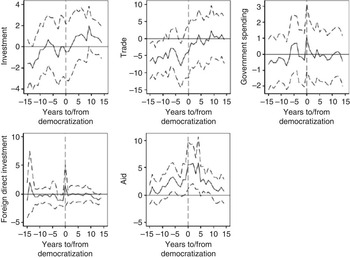
Figure 1 shows the paths of the potential channels of influence (capital accumulation, government spending, trade flows, foreign direct investment and aid) for fifteen years on either side of the onset of democratization.Footnote 16 This graphic illustrates whether, for example, investment or trade increases immediately after democratization, as one would expect if these factors were indeed the channels that link democratization and growth.
Years around democratization
Note: The figure shows the coefficients on dummies for each of the years surrounding democratization. The analyses include country and year fixed effects. The dashed lines indicate the 95 per cent confidence interval. Sources: Marshall and Jaggers 2011, World Bank 2012.

In the top left panel, there is some sign that investment rates pick up around the time of democratization, but the increase is never significantly different from zero (as can be seen from the lower dashed curve). In the top middle panel, trade flows also seem to increase, but the standard errors are far too large for them to be considered statistically significant. In the top right panel, there is some indication that government spending immediately spikes and gradually falls after democratization, but again the estimates are far from significant. Except for a random, but insignificant, spike in the fourteenth year preceeding democratization, foreign direct investment (bottom left panel) shows little variation around the time of democratization. The first four panels in Figure 1, like the recent literature, thus leave unidentified the factors that mediate the association between democratization and growth.
Yet arguably, there is nothing about reasonably free elections in themselves that affects national income. So if the euphoria of political emancipation is not in itself sufficient to raise productivity and national income, we should be able to uncover the channels of influence. The bottom middle panel shows that aid inflows visibly spike immediately upon democratization. The average democratizing country receives an immediate injection of aid of about 6 per cent of gross national income (GNI) in the first five years after democratization, and aid levels remain significantly elevated for about a decade. In contrast to the other candidate variables, the association between aid and democratization is significant during most of the post-democratization period – particularly in the immediate post-transition years, which Rodrik and Wacziarg found to be driving the positive association between democratization and growth. Even if preliminary and univariate, the evidence in Figure 1 suggests that analyses of the democratization-growth nexus should take the influx of aid into account. Before doing so, I briefly describe the operationalization of democratization, the data and the estimation approach used.
Data, Operationalization and Estimation Approach
In keeping with the recent democratization-growth literature, the analyses that follow use the Polity IV measure of democracy (the 21-point scaled variable polity2). While this measure of democracy is standard in the empirical literature, it has been the subject of some debate.Footnote 17 The core findings are therefore reproduced using the so-called ACLP indicator, which was originally constructed by Przeworski et al. and recently updated by Cheibub, Gandhi and Vreeland.Footnote 18
Polity IV offers a tripartite distinction between autocracy (polity score below 1), partial democracy (polity score 1–6) and full democracy (polity score 7–10).Footnote 19 Following this classification, I refer to democratization as the event of becoming a (partial or full) democracy if a country was an autocracy in the previous year. This is the operationalization used in the democratization-growth literature.Footnote 20 To keep the results comparable, it is crucial to use the same. This yields a total of sixty-nine democratizations in the period under consideration (1960–2010).Footnote 21 A full list is available in the online appendix.
With this basic operationalization, I first defined a single democratization dummy that takes the value 1 in the year a country passes the threshold, and stays at 1 for all years in which the country remains a partial or full democracy. This operationalization follows, for example, the work of Persson and Tabellini and Giavazzi and Tabellini.Footnote 22 Secondly, I carved the event of democratization into three consequtive phases, each of which is represented by a dummy variable. Phases 1 and 2 last five years each, while Phase 3 measures subsequent years (if the country does not revert back to autocracy). This approach is similar to that of Rodrik and Wacziarg.Footnote 23
With these variables, I estimate a fixed-effects DID model. The baseline estimating equation is:
 $$ {{g}_{i,t}}\, = \,{{\alpha }_i}\, + \,\phi {{D}_{i,t}}\, + \,\beta {{y}_{i,t{\rm{ - 1}}}}\, + \,\gamma {{X}_{i,t}}\, + \,{{\mu }_t}\, + \,{{{\epsilon}}_{i,t}}, $$
where gi,t is annual growth in per capita GDP in country i in year t. Di,t is the binary democratization indicator, which captures all years after a country's polity score becomes strictly positive. The coefficient of primary interest is φ, which measures the correlation between economic growth and democratization. As described above, to examine the temporal dynamics, the event of democratization was carved into three consecutive phases, each of which is represented by a dummy variable. When estimating this model, the democratization indicator, Di,t in Equation 1 is simply replaced by the three dummies (Phase 1 i,t , Phase 2 i,t and Phase 3 i,t as defined earlier). Lagged per capita income, yi,t −1, is included to allow for economic convergence. Xi,t is a vector of control variables. In all specifications, the control vector includes a dummy for the five years that precede democratization in order to account for the possibility that democratization occurs in response to changed economic performance. It also detects systematic ‘pre-treatment’ differences between democratizing and non-democratizing countries (all conclusions also hold without controlling for pre-democratization years). Regional dummies interacted with time for Africa, Latin America, post-communist countries and oil-producing countries are also included as controls.Footnote 24 All models are run twice: first in reduced form (the potential channels – capital accumulation, government spending, trade and economic liberalization – are not controlled for) and secondly, including these channels as part of Xi,t . The three remaining terms are unobserved effects. Country-specific, time-invariant characteristics, αi , are controlled for using the fixed-effects specification. The time-varying unobserved effects, μt , are controlled for by including a full set of year dummies for 1961–2010. εi,t is the idiosyncratic error term (unobserved effects that vary across countries and over time).
In some specifications, Equation 1 is estimated as an autoregressive distributed lag (ADL) model, including two lags of the dependent variable (gi,t −1 and gi,t −2) in addition to the lagged income per capita. This was done to address the issue of serial correlation, which attenuates standard errors and can be particularly problematic for the DID estimator.Footnote 25 The ADL specifications also include a two-year lag as well as a contemporaneous and lagged difference of all economic controls.Footnote 26 This specification follows Papaioannou and Siourounis.Footnote 27 In all models, standard errors are robustly clustered at the country level in order to minimize arbitrary heteroskedasticity and serial correlation.Footnote 28
The core analyses employ a panel data set of 124 countries in the period 1960–2010, with a total of 4,402 observations. Economic data for the period 1960–2010 are from the World Bank, while the historical growth data (1820–1959) used for robustness checks are from Maddison.Footnote 29 The main specifications code democratizations from the Polity IV data set are as explained above, but robustness checks were conducted using the dichotomous ACLP indicator. Following the voluminous aid-growth literature, the main measure of aid is net official development assistance (ODA) normalized by income (net ODA as per cent of GNI).Footnote 30 Robustness checks were conducted using David Roodman's Net Aid Transfers (NAT) dataset.Footnote 31 The NAT measure differs from the ODA in that it excludes cancellations of foreign debt as an aid transfer and nets out loan interest payments. These analyses use the dollar amount of aid (specifically, the natural log thereof to reduce the weight of outliers) to address the concern that regressing growth on aid normalized by income creates problems of reverse causality.Footnote 32 It is reassuring, therefore, that the results are very similar whether aid is normalized or not. The sample is restricted to country-years for which aid data are available even when aid is not included in the analyses, so that the sample stays constant before and after controlling for aid.
Results: Democratization And Economic Growth
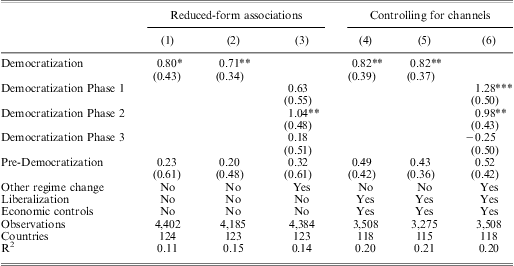
Estimates of Equation 1 are reported in Table 1. Column 1 shows the coefficient from the simple DID workhorse model that is commonly used in the literature. Column 2 estimates the ADL version of Equation 1 as described above, and Column 3 replaces the single democratization indicator by the three phase dummies. Columns 4–6 are identical to the first three columns, but add controls for the set of proposed mediating variables. Rows 11–13 show which controls are included in the individual models.
Democratization and Economic Growth

Note: The dependent variable is GDP per capita growth. All models contain country and year fixed effects, lagged income per capita, indicators for short regime interims and time-interacted regional dummies for Africa, post-communist countries, Latin America and oil-exporting countries. Column 2 includes two lags of the dependent variable. Column 3 controls for autocratization and state failure. Columns 4-6 control for investment, trade, government spending and economic liberalization. Column 5 contains a contemporaneous lag and two lags of the difference of economic controls. Robust standard errors are clustered by country in parentheses. ***p < 0.01, **p < 0.05, *p < 0.1. Sources: Marshall and Jaggers (2011), World Bank (2012), Giavazzi and Tabellini (Reference Giavazzi and Tabellini2005).
The coefficient in Column 1 shows the association between democratization and growth (and is directly comparable to the coefficient in Persson and Tabellini (Reference Persson and Tabellini2006) Table 1, Column 1). I find a significant and sizeable annual growth increase of 0.80 per cent, which is substantial.Footnote 33 For comparison, the Persson and Tabellini study found 0.75 at a similar level of significance. The pre-democratization indicator has an insignificant coefficient of 0.23, which suggests that the regime transition does not occur in response to changed economic performance in the five years preceeding it. As mentioned above, the DID estimator rests on the strong assumption that in the absence of treatment, the average outcomes for treated and controls would have followed parallel paths. In all models, the pre-democratization dummy is consistently insignificant, which shows that before the treatment, treated and controls did in fact follow parallel paths. Prima facie, this corroborates the identifying assumption of parallel trends absent treatment. The coefficient on lagged GDP per capita is significantly negative (not shown), documenting a conditional convergence effect. What matters here is that the estimated growth effect of democratization does not simply capture convergence.
Column 2 is identical to Column 1, except that it introduces richer time dynamics to allow for persistence in economic growth rates. The specification here includes two lags of the dependent variable, which makes the specification similar to Papaioannou and Siourounis, Table 2, Column 5. Allowing for growth inertia does not change the estimated growth effect of democratization, even if the estimate of 0.71 is somewhat smaller than that found in Papaioannou and Siourounis, who report 1.09 with identical levels of significance.
Democratization and Foreign Aid Receipts

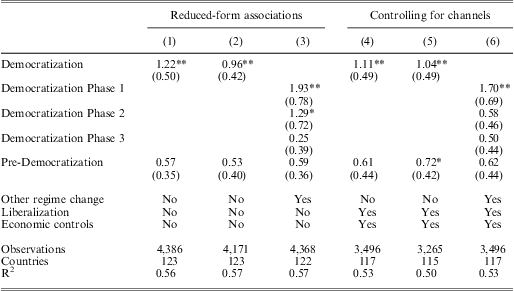
Note: The dependent variable is ODA in percent of GNI. All models contain country and year fixed effects, lagged income per capita, lagged aid, indicators for short regime interims and time-interacted regional dummies for Africa, post-Communist countries, Latin America and oil-exporting countries. Column 2 includes two lags of the dependent variable. Column 3 controls for autocratization and state failure. Columns 4-6 control for investment, trade, government spending and economic liberalization. Column 5 contains a contemporaneous lag and two lags of the difference of economic controls. Robust standard errors are clustered by country in parentheses. *** p < 0.01, ** p < 0.05, * p < 0.1. Sources: Marshall and Jaggers (2011), World Bank (2012), Giavazzi and Tabellini (Reference Giavazzi and Tabellini2005).
The model in Column 3 adopts the approach in Rodrik and Wacziarg to uncover the temporal dynamics of the democratization-growth nexus. Instead of estimating the effect of democratization en bloc, the event of becoming a democracy has been divided into three phases. Column 3 documents a hill-shaped relationship similar to the result in Rodrik and Wacziarg, Table 1, Columns 2–4: the positive association between democratization and growth is transitory and dies off after about ten years.
Columns 4–6 control for factors that could reasonably mediate a short-run association between democratization and growth, and have been proposed in the literature: investment, government consumption, trade and subsequent economic liberalization.Footnote 34 The overall conclusion is easily summarized: conditional on this set of controls, we still see an immediate, sizeable and significant association between democratization and growth. I interpret this as evidence that the growth effect of democracy is not mediated through these channels. The coefficients in Column 6 imply that after ten years, the average democratizing country is richer by 11.9 per cent in real per capita GDP compared to before democratic reform. Interestingly, Column 6 shows that adding these controls attenuates the Phase 2 coefficient. This is intuitive. First, it seems natural to assume that it takes a few years after a major reform for investment rates and trade flows to increase. Secondly, Giavazzi and Tabellini demonstrate that the average time lag between democratization and subsequent economic liberalization is four years. Both observations are consistent with the attenuation found in the second phase of the democratic transition. More surprisingly, Column 6 also shows that the Phase 1 coefficient increases substantially conditional on the set of economic controls. So if it is not political emancipation in and of itself or the set of economic controls traditionally considered in the literature, what is it about democratization that stimulates the economy within the first five or ten years?
I make the claim that international redistribution in the form of foreign aid to new democracies shows up as growth in the short run in two steps. First, I redo Table 1 using foreign aid as the dependent variable to illustrate how foreign aid and growth generally move in tandem during democratizations. Secondly, I repeat Table 1 again, this time controlling for inflows of foreign aid to see if the growth-accelerating effect of democratization is robust to this channel. It is not.
Democratization And International Redistribution
Figure 1 indicated that donor governments’ aid allocation rules are responsive to regime changes. The average democratization was accompanied by an immediate spike in aid inflows of about 6 per cent of GNI; young democracies are donor darlings. This confirms the notion that foreign aid flows respond to donor interests and politics.Footnote 35 Moreover, while foreign aid targeted specifically at democracy-related programs remains relatively modest, it is increasingly common to condition budget support (in the form of grants or loans) on democratic performance.Footnote 36 Table 2 confirms the association between aid and democratization.
Table 2 is structured the same way as Table 1. The first three columns redo the core specifications in the democratization-growth literature, but this time with aid inflows in per cent of GNI as the dependent variable. The last three columns include the same controls as in Table 1.
The table reveals a similarity in the way aid and growth respond to democratic reform: aid, like growth, is substantively and significantly associated with the event of becoming a democracy. And aid, like growth, exhibits a hill-shaped relationship to democratic reform. In both cases, the correlations are particularly strong and particularly significant in the early years of democratization, disappear after around ten years and are robust to the inclusion of economic controls. In short, aid and growth move in tandem in the early years of young democracies.
We proceed to examine if there is an independent association between democratization and growth once aid is controlled for. To do so, the analyses from Table 1 are repeated, this time including the inflow of foreign aid in per cent of GNI as a control variable.
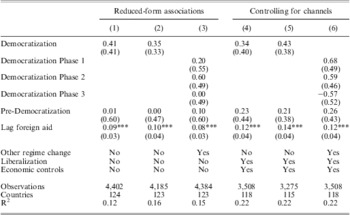
In all six specifications, controlling for aid strongly attenuates the coefficient on democratization, and in all specifications the coefficients turn insignificant. In all specifications, foreign aid (lagged one period) is very significantly associated with growth. The coefficient estimates for aid range from 0.08 to 0.14, which is slightly smaller than existing studies. Most studies report coefficients around 0.15.Footnote 37 When democratic reform is considered en bloc, as in Columns 1–2 and 4–5, the coefficient on democratization is literally cut in half. Recall that in Table 1, the first two columns showed a significant and substantial association between democratization and growth of 0.80 and 0.71 per cent, respectively. In the two first columns in Table 3, which hold the exact same specifications except that aid is included, the corresponding estimates are 0.41 and 0.35, respectively. Columns 3 and 6 show that the estimated association is attenuated most strongly in the early years of the transition. Thus conditional on aid, the estimated coefficient on the first five years of democracy drops from 0.64 to 0.21 and 1.28 to 0.68 in Columns 3 and 6, respectively. This is unsurprising. Given that the aid inflow was strongest in the early years of democratization, we should expect to see the largest reduction of the democratization-growth association in the same years. Overall, Table 3 shows that, conditional on aid, there are few signs of a positive growth effect of democratization. The consistency of this conclusion across specifications and controls is remarkable, particularly given the sensitivity of the democracy-growth association to the choice of controls.Footnote 38
Democratization, Aid and Growth

Note: The dependent variable is GDP per capita growth. All models contain country and year fixed effects, lagged income per capita, indicators for short regime interims and time-interacted regional dummies for Africa, post-Communist countries, Latin America and oil-exporting countries. Column 2 includes two lags of the dependent variable. Column 3 controls for autocratization and state failure. Columns 4-6 control for investment, trade, government spending and economic liberalization. Column 5 contains a contemporaneous lag and two lags of the difference of economic controls. Robust standard errors are clustered by country in parentheses. ***p < 0.01, **p < 0.05, *p < 0.1. Sources: Marshall and Jaggers (2011), World Bank (2012), Giavazzi and Tabellini (Reference Giavazzi and Tabellini2005).
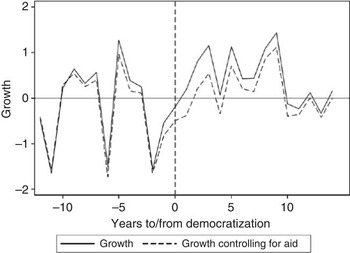
Figure 2 illustrates the article's key result. The solid curve demonstrates that aid increases around the time of democratization and tapers off after about ten years, resulting in the hill-shaped association identified in Table 1. The dotted curve shows that after controlling for aid, the hill disappears.
How aid affects the democratization-growth nexus
Note: The figure shows the coefficients on dummies for each of the years surrounding democratization. The analysis includes country and year fixed effects. The solid curve shows growth around the time of democratization; the dashed curve shows growth after the effect of aid has been removed.
Sources: Marshall and Jaggers 2011, World Bank 2012.

From Aid to Growth
The results in Table 3 explain the short-run association between democratization and increased rates of economic growth; this association is channeled by the immediate and substantial aid influx. The table does not, however, fully complete the causal chain. After all, ‘foreign aid is not produced inside a country's borders, [and] should not show up in GDP in and of itself’.Footnote 39 Yet ‘if a reasonable fraction is spent inside the country, it should eventually appear in the national accounts’.Footnote 40 This is an aggregate demand effect. When spent, the inflow of funds from another country will cause the aggregate demand curve to shift outwards. If prices are less than infinitely elastic, this leads to a transitory output expansion in the short run. The fact that theoretically it must be a short-run effect is consistent with the findings above. The growth that follows democratization is transitory and decreases after about ten years.Footnote 41
An aggregate demand effect is not only theoretically consistent with the findings, it is also consistent with the few empirical studies that trace the impact of aid through the national accounts. Werker et al. use variation in oil prices as a plausible source of exogenous variation in aid donations from OPEC countries to Muslim countries to examine how aid trickles through the economy. They find a substantive and significant effect on household consumption expenditure across different specifications. While the identification strategy alleviates doubt about the internal validity of these results, one might question the external validity (generalizability); their sample is a particular one. However, Chatterjee et al. find identical results (‘aid is associated with a strong positive increase in household consumption’) using a broader sample and more conventional instrumentation strategies.Footnote 42
Therefore my argument is not that the institutional characteristics of democratization somehow improve the effectiveness of aid, an argument related to that of Burnside and Dollar, who found that aid is growth enhancing conditional on good institutions and policies.Footnote 43 I tested this by including an interaction between aid and democratization (or aid and the three democratization phases) in estimations that were otherwise similar to those in Table 3. In none of the models were the interaction terms close to statistical nor substantive significance (results are available on request).
At this point, the endogeneity of aid to growth must be addressed. Aid is not randomly allocated over recipient countries, but can be given to fast-growing countries to incentivize or reward performance.Footnote 44 However, in the voluminous aid-growth literature, political motivations for giving aid are sometimes used as a source of exogenous variation in aid.Footnote 45 Prima facie this logic bodes well for the results here, because the aid spike following democratization is likely to be politically motivated – suggesting that it is not given to reward countries that grow quickly in the first place.
Lastly, consider some alternative interpretations of the results in Table 3. The interpretation presented here is that aid is an intervening variable that mediates the association between democratization and growth. An alternative interpretation could be that countries democratize in expectation of aid inflows, such that aid explains both democratization and growth (the association between these variables would then be spurious). While the results showed that the pre-democratization indicator was rarely associated with aid (suggesting that democratization does not occur in response to aid),Footnote 46 I should emphasize that this interpretation is not necessarily inconsistent with the overall claim made here. Namely, that the temporary growth hike that follows democratization is caused by aid rather than democratization itself. Another alternative interpretation could argue that a positive change in income explains both democratization and aid inflows. Yet in none of the models presented in Tables 1 and 3 was the pre-democratization indicator significantly associated with growth. This suggests that democratizations did not, in general, occur in response to improved economic performance.Footnote 47
Historical Evidence and Robustness Checks
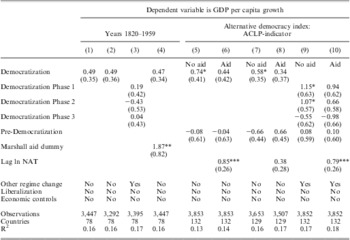
Since aid in large measure is a post-1960 phenomenon, the association between growth and earlier waves of democratizations was not confounded by a simultaneous inflow of aid to young democracies. This observation is used to probe the plausibility of the results. If becoming a democracy in itself ignites a growth acceleration, we should expect pre-1960 democratizations to also be growth enhancing. If, on the other hand, the growth effect of democratization is confounded by the influx of aid, we should not expect democratizations before 1960 to be associated with increased rates of growth.Footnote 48
Table 4 shows the coefficients from analyses of the growth effects of democratizations between 1820–1959. In Column 1, a single indicator variable takes the value 1 in all years after a country's score on polity2 turns strictly positive. Column 2 allows for time-persistent growth rates. Column 3 shows the coefficients from an analysis that distinguishes between three phases. Column 4 is identical to Column 1, except that it includes a dummy for the years 1949–51 for the countries that were Marshall Aid recipients.
Historical Evidence and Sensitivity Checks

Note: All models contain country and year fixed effects. Column 2 contains two lags of the dependent variable. Column 3 controls for autocratization and state failure. Robust standard errors clustered by country in parentheses. ***p < 0.01, **p < 0.05, *p < 0.1. Sources: Cheibu,Gandhi and Vreeland (2009); Marshall and Jaggers (2011); Roodman (2008); and the World Bank (2012).
The results in Columns 1–4 in Table 4 are consistent with the conclusion reached earlier: prior to 1960, democratizations were not confounded by the influx of aid and were not associated with accelerated rates of economic growth. Similar to the coefficients in Table 3, here too the coefficients are positive but insignificant. Interestingly, the size of the coefficients from the earlier democratizations resembles the size of coefficients from later waves of democratization once the effect of aid is controlled for. Thus becoming a democracy has in the last five decades been associated with an average (but insignificant) growth effect of about 0.41 after controlling for aid (cf. Table 3, Column 1). Controlling for Marshall Aid years, the corresponding estimate for democratizations undertaken in the period 1820–1959 is 0.47, which is remarkably consistent.
The remaining six columns replace the Polity IV democracy index with the dichotmous ACLP indicator and replace the World Bank measure of aid with the log of the constant dollar amount of aid lagged one period from David Roodman's NAT dataset.Footnote 49 With this data, the columns show the three core specifications, once without controlling for aid (Columns 5, 7 and 9) and once where aid is controlled for (Columns 6, 8 and 10). Using the ACLP indicator, the democratization-growth association remains substantial and significant. Moreover, across model specifications, the coefficient on democratization is attenuated and loses significance when aid is controlled for, which is consistent with the overall conclusion of this study.
As a final robustness check, controls for political conflict were included. A body of work has shown that democratization may trigger both interstate and civil war.Footnote 50 Since war affects the economy and might also affect donors’ aid allocation, an association between democratization and war or political violence potentially confounds the estimates. To examine this, I used the Major Episodes of Political Violence dataset and re-ran Tables 1 and 3, controlling for political violence, civil war, the aftermath of civil war, interstate war and all of the above.Footnote 51 In all cases, the inclusion of these controls leaves the argument intact: democratization is still positively associated with economic growth, and the association still disappears when aid is controlled for (results are available in the online appendix).
Conclusion
From earlier inquiries into the regime-development nexus, we inherited the somewhat paradoxical result that becoming a democracy is growth promoting but being one is not. Since previous research has found a significant association between democratization and growth even conditional on such plausible channels as economic liberalization, investment rates or trade flows, it was unclear what characteristic of young democracies stimulated growth and distinguished this set of countries from established democracies. The answer proposed here was foreign aid: receiving aid distinguishes democratizing countries from democratic countries and can also plausibly generate a transitory aggregate demand expansion that stimulates growth. This result resolved the paradox, since neither democracy nor democratization is in itself distinguished by higher rates of economic growth.
The results proved robust to a set of different empirical specifications, to alternative democracy indices, to alternative measures of foreign aid, to a broad set of economic controls and to controls for political conflict. The historical implication of the findings – that prior to 1960 and foreign aid as we know it, democratization should not bring growth – could also not be rejected.
The conclusion, that the economic effects of democratization cannot be understood from domestic factors alone, complements the emerging consensus on the importance of external factors and interstate linkages in explaining the onset of democratic regime change. External factors are important to understanding both the causes and consequences of democratization.
Methodologically, this study suggests caution when interpreting reduced-form associations between political institutions and economic outcomes. It is often unclear how a certain political arrangement affects the economy, and mediating variables can rarely be found. This leaves the field vulnerable to treating spurious associations as causal. One solution seems to be to push back and zoom in on the mediating variables where a clear causal narrative can be provided as to why a certain political institution has led to the observed consequences.
The results in this article also have implications for practitioners in the development community. A large empirical literature has established the importance of institutions for comparative economic development,Footnote 52 and the democratization-growth literature clearly reflects this institutionalist turn. The academic interest in institutions has been mirrored in the community of aid organizations, as codified in the so-called Augmented Washington Consensus,Footnote 53 which brought institutional reform and good governance to the forefront of the development agenda. This makes sense: if institutions are instrumental in achieving growth and alleviating poverty, why not tie aid allocations to measures of institutional performance?
The conclusions inform development policy by pointing to an interesting circularity: foreign assistance is allocated to countries that undertake institutional reform or perform well on institutional indices on the presumption that institutional reform will spur economic growth. In the case of democratic institutional reform, however, it is not the political reforms themselves that enhance growth – it is the inflow of foreign assistance.
Thus in the short run, there seems to be a confounding of the effect of what development organizations preach (institutional reform) and the effect of the ‘reward’ (aid) given to countries that comply. While this has only been documented for the case of democratic reform, it could plausibly also relate to other types of institutional reform.