Introduction
Sweetpotato is an economically important crop in the United States. In North Carolina, approximately 36,400 ha of sweetpotato were harvested in 2017 with a farm gate value of $350 million (USDA 2018). The majority of the sweetpotato acreage (more than 90%) in North Carolina is planted with ‘Covington’ (NCDACS 2015), a cultivar released by North Carolina State University in 2008 (Yencho et al. Reference Yencho, Pecota, Schultheis, VanEsbroeck, Holmes, Little, Thornton and Truong2008). The wide adoption of ‘Covington’ is due to its disease resistance and consistency in producing a high percentage of no. 1-grade roots that result in greater economic return (Yencho et al. Reference Yencho, Pecota, Schultheis, VanEsbroeck, Holmes, Little, Thornton and Truong2008). Another sweetpotato cultivar, ‘Murasaki-29’ (Murasaki hereafter), was developed by the Louisiana Agricultural Experiment Station to provide a specialty-type white-flesh, dark purple–skinned cultivar with resistance to southern root-knot nematode (Meloidogyne incognita ) and soil rot (Streptomyces ipomoeae) (La Bonte et al. Reference La Bonte, Villordon, Clark, Wilson and Stoddard2008).
In North Carolina, the weeds that are most economically devastating in sweetpotato include Palmer amaranth (Amaranthus Reference Meyers, Jennings, Schultheis and Monkspalmeri S. Wats.), yellow nutsedge (Cyperus esculentus L.), smooth pigweed (Amaranthus hybridus L.), and common lambsquarters (Chenopodium album L.) (Webster Reference Webster2010). Among these weeds, Palmer amaranth is the most problematic and competitive in sweetpotato. Meyers et al. (Reference Meyers, Jennings, Schultheis and Monks2010a) reported that season-long Palmer amaranth interference can reduce total marketable ‘Beauregard’ and ‘Covington’ sweetpotato yield 36% to 81% at densities of 0.5 to 6.5 Palmer amaranth plants m–1 row.
Sweetpotato growers use herbicides, cultivation, mowing, wicking, and hand weeding as effective tools for weed management (J. Haley and J. Curtis, unpublished data). Like most vegetable crops, a limited number of herbicides are registered for sweetpotato (Kemble Reference Kemble2015). No selective POST-transplant (POSTtr) herbicide is registered for broadleaf weed control in sweetpotato; therefore, growers rely exclusively on PRE herbicides. Flumioxazin PREPLANT followed by (fb) S-metolachlor 10 to 14 DAP is the standard herbicide program used by growers in North Carolina for controlling Palmer amaranth (K.M. Jennings, personal communication). This herbicide program provides greater than 90% season-long control of Palmer amaranth, but S-metolachlor has to be applied to a weed-free field between 0 and 14 DAP to achieve effective control (Coleman et al. Reference Coleman, Chaudhari, Jennings, Schultheis, Meyers and Monks2016; Meyers et al. Reference Meyers, Jennings, Schultheis and Monks2010b). However, S-metolachlor applied too soon after transplanting and followed by heavy rains can cause injury to the storage root (shortening, rounding) (Meyers et al. Reference Meyers, Jennings, Monks, Miller and Shankle2013). Clomazone and napropamide are also registered for PRE application in sweetpotato but provide inconsistent control of Palmer amaranth and other pigweed species (Barkley et al. Reference Barkley, Chaudhari, Jennings, Schultheis, Meyers and Monks2016; Scott et al. Reference Scott, Weston and Jones1995).
Research efforts in sweetpotato are focused on the registration of additional herbicides with differing modes of action that will provide effective weed control. Linuron, a substituted urea herbicide (WSSA Group 7), is registered for PRE and/or POST application to control broadleaf and grass weeds in a number of crops such as potato (Solanum tuberosum L.) and carrot (Daucus carota L.) (Anonymous 2013; Bell et al. Reference Bell, Boutwell, Ogbuchiekwe and Mcgiffen2000). Linuron POST provides up to 96%, 99%, and 90% control of Palmer amaranth, common lambsquarters, and carpetweed (Mollugo verticillata L.), respectively (Brandenberger et al. Reference Brandenberger, Carrier, Havener and Adams2009; Hahn Reference Hahn1992; Miller et al. Reference Miller, Mathews and Smith2013). A sequential application of linuron at 280 g ha–1 in carrot applied at three- and five-leaf growth stage provided at least 85% control of redroot pigweed (Amaranthus retroflexus L.) and common lambsquarters, and caused no crop injury (Bellinder et al. Reference Bellinder, Kirkwyland and Wallace1997). Miller et al. (Reference Miller, Mathews and Smith2013) reported that linuron (840 g ha–1) PREPLANT or POSTtr fb S-metolachlor (803 g ha–1) provided at least 91% control of cutleaf groundcherry (Physalis angulata L.), morningglory (Ipomoea spp.), goosegrass (Eleusine indica L. Gaertn.), and spiny amaranth (Amaranthus spinosus L.), and caused 11% injury or less to sweetpotato.
The tolerance of sweetpotato to herbicides has been reported to be dependent on the rate, application timing, cultivar, and environmental conditions (Barkley et al. Reference Barkley, Chaudhari, Jennings, Schultheis, Meyers and Monks2016; Meyers et al. Reference Meyers, Jennings, Schultheis and Monks2010b; Meyers et al. Reference Meyers, Jennings and Monks2012). Differences in cultivar tolerance to S-metolachlor, metribuzin, and bentazon have been reported in sweetpotato (Harrison et al. Reference Harrison, Jones and Dukes1985; Meyers et al. Reference Meyers, Jennings and Monks2012; Motsenbocker and Monaco Reference Motsenbocker and Monaco1991). Bradeen and Mollov (Reference Bradeen and Mollov2007) reported differences in cultivar tolerance to linuron and metribuzin in primitive potato cultivars. However, limited research has been conducted, and no published information is available to our knowledge on response of sweetpotato cultivars to POSTtr applications of linuron in North Carolina production systems. Linuron POSTtr in sweetpotato would be beneficial to growers, because it gives both PRE and POST control of broadleaf weeds including Palmer amaranth and annual grasses. Thus, the objective of this research was to determine response of Covington and Murasaki sweetpotato cultivars to linuron alone or with S-metolachlor application rate and timing when applied POSTtr.
Materials and Methods
Studies were conducted in grower fields in Faison, NC during 2015 and 2016. Nonrooted sweetpotato cuttings (slips) were cut from field propagation beds by hand and mechanically transplanted to an in-row spacing of 30 cm. Covington was transplanted on May 19, 2015 and May 24, 2016 (35.0525°N, 78.0256°W and 35.1119°N, 78.1721°W, respectively). Murasaki was transplanted on May 19, 2015 and 2016 (35.0525°N, 78.0791°W and 35.0568°N, 78.1948°W, respectively). Soil at both locations in 2015 was an Autryville loamy fine sand (loamy, siliceous, subactive, thermic Arenic Paleudults) with pH 5.4 and 6.1 and organic matter 1.2% and 2.2% where Covington and Murasaki were planted, respectively. In 2016, soil was a Norfolk loamy sand (fine-loamy, kaolinitic, thermic Typic Kandiudults) with pH 5.7 and 0.29% humic matter, and a Goldsboro loamy sand (fine-loamy, siliceous, subactive, thermic Aquic Paleudults) with pH 5.4 and humic matter 1.13% where Covington and Murasaki were planted, respectively. Plot size was two rows, each 1 m wide and 6 m long. The first row of each plot was nontreated and served as a border row; the second row received a treatment. The experimental design was a randomized complete block with four replications. Treatments consisted of a factorial arrangement of two herbicides: linuron alone (Linex 4L; Tessenderlo Kerley, Inc., Phoenix, AZ) or with S-metolachlor (Dual Magnum; Syngenta Crop Protection Inc., Greensboro, NC), two application timings (7 or 14 DAP), and four application rates of linuron. Linuron was applied at four rates (420, 560, 840, and 1,121 g ai ha–1), and S-metolachlor was applied at 803 g ai ha–1. No surfactant was included with linuron. A nontreated check was included for comparison. All plots were maintained weed-free with flumioxazin (Valor SX; Valent U.S.A. Corp., Walnut Creek, CA) at 107 g ai ha–1 PREPLANT, cultivation, and hand removal of weeds as needed. Herbicide applications were made using a CO2-pressurized backpack sprayer with a two-nozzle boom equipped with TeeJet XR 11002VS flat-fan nozzles (Spraying Systems Co., Wheaton, IL) calibrated to deliver 187 L ha–1.
Sweetpotato injury above ground was recorded 1, 2, 4, 7, and/or 8 wks after treatment (WAT) using a scale of 0 (no injury) to 100% (crop death) (Frans et al. Reference Frans, Talbert, Marx and Crowley1986). Sweetpotato storage roots were harvested 105 (Covington) and 142 (Murasaki) DAP in 2015 and 143 (Covington) and 137 (Murasaki) DAP in 2016 using a tractor-mounted disc turn plow and hand-graded into jumbo (greater than 8.9 cm diam), no. 1 (greater than 4.4 cm but less than 8.9 cm diam), and canner (greater than 2.5 cm but less than 4.4 cm diam) grades (USDA 2005). Total marketable yield was calculated as the sum of jumbo, no. 1, and canner grades.
Data were subjected to ANOVA using SAS PROC MIXED considering the factorial treatment arrangement (SAS 9.3, SAS Institute Inc., Cary, NC). All the data from both sweetpotato cultivars were analyzed separately because of the limitation of the experimental design; that is, separate field studies were conducted to test both cultivars. All data were checked for homogeneity of variance before statistical analysis by plotting residuals. Fixed effects included herbicide, application rates, application timing, plus all their interactions. Year and replications within year were included as random effects where data were combined for both years; otherwise, replication was considered as a random effect. Treatment means were separated by Fisher’s protected LSD at a significance level of 0.05. The nontreated check was not included in sweetpotato injury analysis, as crop injury was 0% and had a variance of 0, but was included in the yield analysis.
Results and Discussion
Sweetpotato Injury
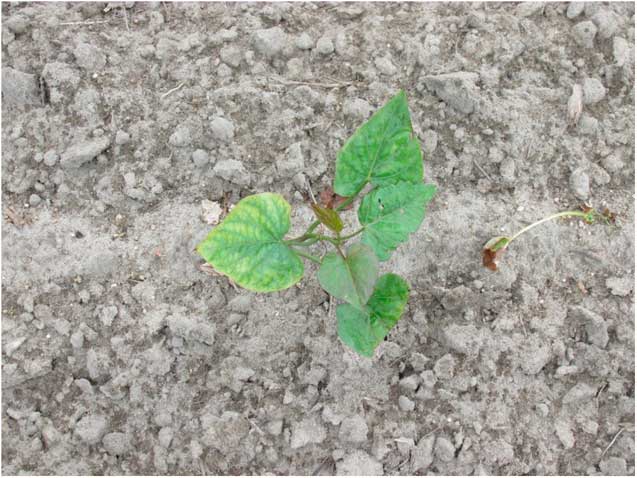
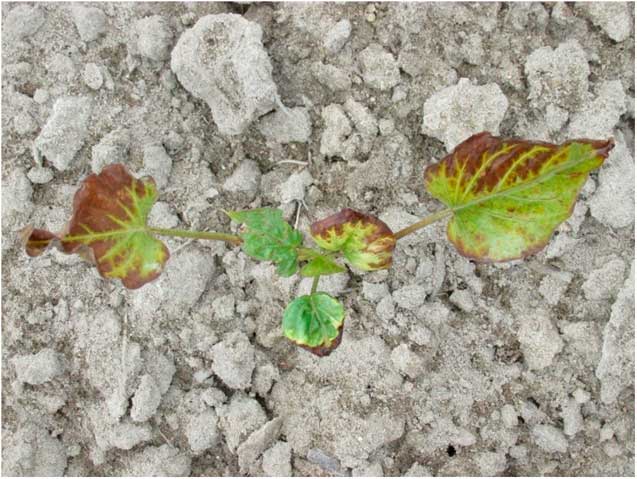
Crop injury first appeared as interveinal chlorosis at the lower rates of linuron (Figure 1) and necrosis on the tips and edges of leaves at the higher rates of linuron (Figure 2). These injury symptoms were observed at 1 and 2 WAT. Plants recovered from chlorosis/necrosis injury within the first 3 wk but were slower in growth as a result of the initial injury. Therefore, the only injury observed at 4, 7, and/or 8 WAT was crop stunting.
At 1 wk after application, leaf interveinal chlorosis in Covington caused by linuron at 560 g ai ha–1 applied 14 d after sweet potato planting at Faison, NC, in 2015.

At 1 wk after application, leaf necrosis and chlorosis in Covington caused by linuron at 1,120 g ai ha–1 applied 14 d after sweet potato planting at Faison, NC, in 2015.

Because of a lack of treatment-by-year interaction for sweetpotato injury for either cultivar, data were combined across years. Further analysis indicated that the two- or three-way interactions among herbicide, application timing, and rate were not significant (P>0.05); therefore, results are presented with respect to significant main effects.
Covington
Sweetpotato plants in the linuron plus S-metolachlor treatments displayed 62% and 54% chlorosis/necrosis at 1 and 2 WAT, compared to 54% and 46%, respectively, in plants treated with linuron alone (Table 1). Similarly, as application timing was delayed from 7 to 14 DAP, chlorosis/necrosis injury increased by 7% and 30% at 1 and 2 WAT, respectively, compared to the earlier application timing. Application rate response was observed for chlorosis/necrosis (1 and 2 WAT) and stunting (4 WAT), and both types of injury were greater for 840 and 1,120 g ha–1 of linuron than for 420 g ha–1. Similar to chlorosis/necrosis, sweetpotato stunting at 4 WAT was greater for linuron plus S-metolachlor (39%) than linuron alone (30%), and when herbicides were applied 14 DAP (46%) rather than 7 DAP (23%). Stunting was transient, and by 7 WAT, no more than 8% stunting was evident regardless of herbicide, application timing, or rate.
Effect of linuron alone or with S-metolachlor on ‘Covington’ and ‘Murasaki’ sweetpotato injury at Faison, NC, in 2015 and 2016.Footnote a

a Data were combined over years.
b Means within columns for dependent variables (herbicide, application timing, or rates) followed by the same letter are not significantly different according to Fisher’s protected LSD (α=0.05). The nontreated check was not included in the statistical analysis.
c Abbreviations: DAP, d after sweetpotato transplanting; WAT, wk after treatment.
Murasaki
Sweetpotato plants receiving linuron alone displayed lower chlorosis/necrosis (1 and 2 WAT) and stunting (4 WAT) (62%, 48%, and 36%, respectively) compared to linuron plus S-metolachlor (75%, 54%, and 43%, respectively) (Table 1). The delay in linuron application from 7 to 14 DAP increased chlorosis/necrosis (1 and 2 WAT) and stunting (4 WAT) by 25%, 38%, and 23%, respectively, compared to the earlier application timing. A linuron rate response was observed for chlorosis/necrosis (1 and 2 WAT) and stunting (4 WAT), and both types of injury were greater for 840 and 1,120 g ha–1 than for 420 and 560 g ha–1. Stunting was transient, and by 8 WAT no stunting was observed with any treatment (data not shown).
Sweetpotato Yield
Yield of Covington and Murasaki sweetpotato is different under normal growing conditions, and genetic variation explains the yield differences between the two cultivars. It has been reported that the marketable yield of Covington sweetpotato averages 41.4×10³ kg ha–1 (Yencho et al. Reference Yencho, Pecota, Schultheis, VanEsbroeck, Holmes, Little, Thornton and Truong2008), and Murasaki averages 15.5×10³ kg ha–1 (La Bonte et al. Reference La Bonte, Villordon, Clark, Wilson and Stoddard2008).
Treatment-by-year interaction was only significant for Covington sweetpotato yield (P<0.05); therefore, data were analyzed by year for Covington yield but not for Murasaki yield. Further analysis indicated that the two- or three-way interactions among herbicide, application timing, and rate were not significant (P>0.05); therefore, results are presented with respect to significant main effects.
Covington
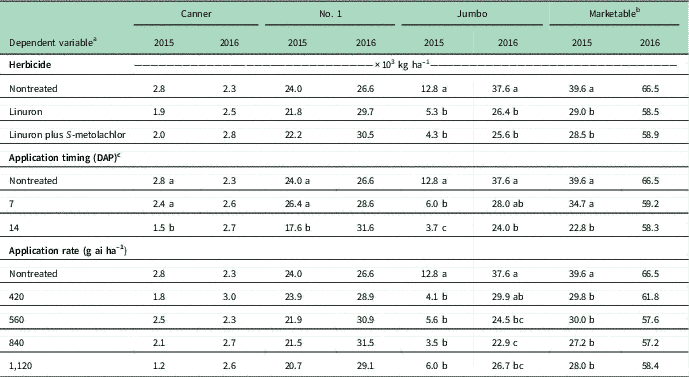
In 2015, canner and no. 1 root yield with linuron alone or applied with S-metolachlor was similar and not different from the nontreated sweetpotato (Table 2). However, jumbo and marketable root yields from linuron alone or with S-metolachlor were similar but were lower than yields with the nontreated check. Delaying linuron application from 7 to 14 DAP reduced the yield of all grades compared to the nontreated check. Linuron rate did not affect canner and no. 1 root yields, but jumbo and marketable storage root yields were similar for rates ranging from 420 to 1,120 g ha–1 and lower than the nontreated check.
Effect of linuron alone or with S-metolachlor on ‘Covington’ sweetpotato yield at Faison, NC, in 2015 and 2016.

a Means within columns for dependent variables (herbicide, application timing, or rates) followed by the same letter are not significantly different according to Fisher’s protected LSD (α=0.05).
b Marketable is the aggregate of jumbo, no. 1, and canner grades of sweetpotato roots.
c Abbreviation: DAP, d after sweetpotato transplanting.
In 2016, no. 1, canner, and marketable root yields were similar from all the treatments regardless of herbicide, application rate, or timing (Table 2). However, jumbo root yields from linuron alone or with S-metolachlor were similar but were lower than yields from the nontreated check. The increase of linuron rates had a negative impact on jumbo root yield, and yield was lower when linuron was applied at 560 to 1,120 g ha–1 compared with the nontreated check.
Murasaki
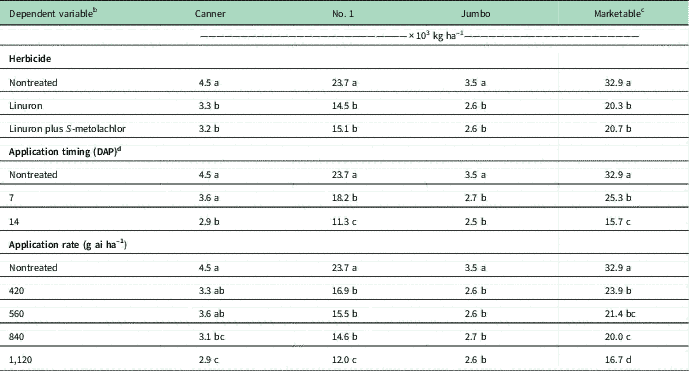
Root yields in the nontreated check were 4.5, 23.7, 3.5, and 32.9×10³ kg ha–1 for canner, no. 1, jumbo, and marketable, respectively (Table 3). All root yields with linuron alone or with S-metolachlor were similar but were lower than yields with the nontreated check. No. 1, jumbo, and marketable storage yields were higher when herbicides were applied 7 DAP (18.2, 2.7, and 25.3×10³ kg ha–1, respectively) than when applied 14 DAP (11.3, 2.5, and 15.7×10³ kg ha–1, respectively). The increase of linuron rates had a negative impact on all root yields, and no. 1, jumbo, and marketable yields from 420 to 1,120 g ha−1 were lower than yield with the nontreated check. The yield reduction can be attributed to the injury observed with these treatments.
Effect of linuron alone or with S-metolachlor application timing and rates on ‘Murasaki’ sweetpotato yield at Faison, NC, in 2015 and 2016.Footnote a

a Data were combined over years.
b Means within columns for dependent variables (herbicide, application timing, or rates) followed by the same letter are not significantly different according to Fisher’s protected LSD (α=0.05).
c Marketable is the aggregate of jumbo, no. 1, and canner grades of sweetpotato roots.
d Abbreviation: DAP, d after sweetpotato transplanting.
The results from this research, however, are not consistent with findings of other researchers. Sweetpotato injury from linuron at 561, 840, and 1,120 g ha–1 applied 14 DAP was reported less than 38% at any time during the season (Rouse et al. Reference Rouse, Estorninos, Singh, Salas, Singh and Burgos2015). Further, sweetpotato treated with linuron had injury symptoms for a longer period of time during the growing season than any other treatments applied, but marketable yield was reported to be similar to that of the nontreated check (Rouse et al. Reference Rouse, Estorninos, Singh, Salas, Singh and Burgos2015). Miller et al. (Reference Miller, Mathews and Smith2013) reported linuron (840 g ha–1) PREPLANT or POSTtr fb S-metolachlor (803 g ha–1) caused no more than 11% injury to an experimental line of sweetpotato from Louisiana State University and produced yields similar to that of the nontreated check. Beam et al. (Reference Beam, Jennings, Monks, Schultheis and Chaudhari2017) reported no injury or yield reduction to Covington from linuron at 560 and 1,120 g ha–1 applied 1 d PREPLANT. The differences in injury and yield between this study and those of other researchers could be attributed to variability in cultivars, application timings, and environmental conditions at each location.
Even though the statistical analysis was not conducted to directly compare the injury and yield responses of both Covington and Murasaki because of the limitation of the experimental design, injury trends were similar between both cultivars in response to rate and timing of linuron alone or with S-metolachlor (Table 1). However, yield response was different between the cultivars (Tables 2, 3). In general, greater injury and yield reduction were observed in Murasaki than in Covington. Differences in sweetpotato cultivars’ tolerance to S-metolachlor, metribuzin, and bentazon, and primitive potato cultivars’ tolerance to linuron and metribuzin have also been reported previously (Bradeen and Mollov Reference Bradeen and Mollov2007; Harrison et al. Reference Harrison, Jones and Dukes1985; Meyers et al. Reference Meyers, Jennings and Monks2012; Motsenbocker and Monaco Reference Motsenbocker and Monaco1991).
Based on this research, there is potential for the use of linuron POSTtr at 420 or 560 g ha–1 at 7 DAP for weed management in Covington sweetpotato. However, an adequate margin of sweetpotato safety does not appear to exist for the POSTtr linuron when applied either as a tank mix with S-metolachlor, 14 DAP, or at rates above 560 g ha–1. Flumioxazin PREPLANT fb S-metolachlor 10 to 14 DAP is the standard herbicide program used by growers in North Carolina (K.M. Jennings, personal communication). The system can provide up to 95% Palmer amaranth control. The weakness of this program is the lack of Palmer amaranth control (often called escapes) that may occur between application of flumioxazin and S-metolachlor. Linuron applied after flumioxazin PREPLANT but before S-metolachlor has the potential to address the weakness of this program by controlling emerged Palmer amaranth as well as providing residual control of this weed. Flumioxazin PREPLANT fb 420 or 560 g ha–1 linuron at 7 DAP fb S-metolachlor at 14 DAP could provide greater season-long control of Palmer amaranth.
These results suggest that linuron has potential to be utilized in sweetpotato. However, the crop injury and yield reduction associated with the POSTtr applications of linuron are of some concern. Based upon these results, sweetpotato tolerance to POSTtr applications of linuron requires further investigation under weed-free as well as weedy conditions on additional soil types and sweetpotato cultivars to ensure crop safety in other situations. Additionally, future research on the potential use of linuron in sweetpotato should focus on PREPLANT applications in combination with other herbicides such as flumioxazin.
Acknowledgments
The authors would like to thank the North Carolina SweetPotato Commission for providing the funding and Burch Farms in Faison, NC for providing field space, sweetpotato transplants, and cultural management of the sweetpotato throughout the studies. In addition, the authors would like to thank Dr. Cavell Brownie for providing assistance with the statistical analysis and to the graduate and undergraduate students in the fruit and vegetable weed science group for putting in countless hours of hard work conducting this research. No conflicts of interest have been declared.