The development of retirement communities
Retirement communities have existed in North America, Australia and New Zealand for over 60 years, where they have become a very popular housing choice. It has been estimated that about four million Americans (five per cent of the older population) live in purpose-built retirement communities and that such developments account for roughly 11 per cent of all new housing (Webster Reference Webster2002). This popularity is not replicated in other countries for various reasons. In much of Canada, for example, human rights legislation precludes developers from applying age-related restrictions on purchasers. In the United Kingdom (UK), although slow to take off, retirement villages are becoming increasingly popular. More stringent planning regulations and a lack of space mean that most UK retirement villages are considerably smaller than in the United States (US). They also differ in their role: in the US they tend to be driven by medical need and have been perceived by some as institutional (Hanson Reference Hanson, Peace and Holland2001), while the focus in the UK has been on ‘community’ and ‘independence’. One feature of retirement villages in the UK that distinguishes them from most other forms of housing-with-care is the diversity of residents and their needs. This is reflected by the government's belief that they are an appropriate option for ‘both fit and frail older people’ (Office of the Deputy Prime Minister 2003a). Other factors encouraging their proliferation include the ageing of the population, the policy endorsement of ‘ageing in place’, the development of new lifestyles in later life, and the wide recognition of the need for greater choice and flexibility in housing options for older people (Heywood, Oldman and Means Reference Heywood, Oldman and Means2002).
Retirement communities first appeared in the UK during the 1950s as clusters of privately-owned residences for retired people in relatively good health who were able to live independently. They have, however, become more diverse and now include ‘extra-care’ housing developments, continuing-care retirement communities (CCRCs), and purpose-built retirement villages.Footnote 1 The first CCRC in the UK, Hartrigg Oaks in York, was opened by the Joseph Rowntree Housing Trust in 1998, and many have since followed. They commonly incorporate a range of facilities and social and recreational activities, and some now make provision for people from a wider age range including those still in employment. Flexible care is typically available, including home help, personal care, health care, home maintenance, eating facilities and transport. In marketing terms, retirement communities sell an image of a positive lifestyle for older people with elements of the concepts of ‘successful ageing’ and ‘active retirement’. They also claim to offer opportunities for companionship and privacy, and a relatively worry-free environment. These concepts are reflected in marketing campaigns that portray new lifestyles in older age. To illustrate, a village in Buckinghamshire has recently been expanded to provide 326 cottages for people aged 55 or more years and is being marketed as a ‘community of like-minded people’ that offers a ‘carefree, active existence in your later years’.
Along with the recent boom in the development of retirement villages has come a trend towards schemes that include various tenures, including rented, privately-owned and shared-ownership properties. This is partly in response to criticisms that retirement villages are only a realistic option for the well off. Phillipson (Reference Phillipson2007: 330) suggested that there are ‘significant inequalities between those older people who are able to make decisions about where and with whom to live, and those who feel marginalised and alienated by changes in the communities in which they had aged in place’. Kuhn (Reference Kuhn1977) was even more direct, calling retirement villages ‘playpens for the old’. Another driver has been the UK government's policy to promote the role of ‘mixed housing’ in community development. For example, an Urban Task Force report urged the creation of mixed-tenure neighbourhoods to reduce the physical and social barriers between income groups (Urban Task Force 2005). These, it suggested, are symbolised by the distinctions between social-rented and owner-occupied housing. The Sustainable Communities Plan (Office of the Deputy Prime Minister (ODPM 2003b) identified several distinguishing features of sustainable communities, including fairness, tolerance, cohesion, respect and engagement with people from different backgrounds, cultures and beliefs. It suggested that housing can contribute to this mix by encouraging sustainability and promoting social inclusion.
The government's Housing Strategy for an Ageing Society (Department for Communities and Local Government (DCLG) 2008) spelt out the role of retirement housing in promoting sustainable communities, including the need to support diversity and social interaction. It advocated mixed tenure in specialist developments as a way of increasing choice and reducing social isolation. An additional attraction of mixed tenure for not-for-profit developers is that the investment from private buyers can be used to support the development costs, which can be up to £20 million. There has been little research into the impact of mixed tenure on the development of a sense of community, however, and that which has been carried out has focused on general housing estates rather than retirement villages. One such study found that, while social contact between residents gradually increases over time most estates were not characterised by inclusive social networks, and that the formation of mixed communities was constrained by the physical separation of tenures (Kearns and Mason Reference Kearns and Mason2007). This was largely because most people only got to know their near neighbours. A review of the British and Dutch literature found little evidence of social interaction between residents from different tenures, largely because lifestyle factors were more important to residents than whether they owned or rented (Kleinhans Reference Kleinhans2004).
Experiences of living in retirement villages
There is a small but growing body of research into the experiences of people living in retirement villages in the UK. One study found various interpretations of the concept of ‘community’ among the residents of one of England's first CCRCs (Croucher, Please and Bevan Reference Croucher, Please and Bevan2003). For most, it meant being good neighbours and having opportunities for social interaction. Although community was important for most residents, achieving a balance between community and privacy was crucial and the lack of pressure to participate in community activities was also valued. Another study of a purpose-built retirement village reported that residents perceived such communities as a positive alternative to both nursing homes and reliance on family support (Biggs et al. Reference Biggs, Bernard, Kingston and Nettleton2000). While many residents moved in to this village with the aim of making new friends and combating loneliness, frailty tended to increase social exclusion (Bernard et al. Reference Bernard, Bartlam, Sim and Biggs2007). A review by Croucher, Hicks and Jackson (Reference Croucher, Hicks and Jackson2006) explored the evidence from recent studies alongside data from a continuing comparative evaluation of seven retirement communities. It concluded that retirement villages have great potential to address a range of policy objectives, including promoting independence, choice and quality of life for older people. A systematic review by Blandy et al. (Reference Blandy, Lister, Atkinson and Flint2003) found high overall levels of resident satisfaction, although a sense of community and neighbourliness were a relatively low priority for residents.
This paper adds to the knowledge base by reporting a study of a mixed tenure retirement village in South West England. The overall aim was to explore the extent to which residents from a wide range of housing and care histories, dependency levels and socio-economic backgrounds can become integrated in a single retirement village community with mixed tenures. Several objectives were also pursued, including the development of a profile of residents across all the housing and care options in terms of their backgrounds and dependency levels; the exploration of how residents understand the ideas of ‘community’ in the context of the retirement village; and the examination of patterns of social interaction between residents across tenures and levels of dependency.
Defining the sense of community
For a concept that is so widely used, ‘community’ is notoriously difficult to define, and it has been suggested that the term means anything to everyone (Crow and Allan Reference Crow and Allan1994). Many good accounts can be found of the debate on the meaning and role of community. Forrest and Kearns (Reference Forrest and Kearns2001) explored some of the key issues, particularly the changing role of locally based identities and social networks. Many sociologists have focused on ‘place’ as the key element in community, as illustrated by what Calhoun (Reference Calhoun1998) called ‘communities of propinquity’. It has been suggested, however, that as a result of globalisation and increased social mobility, the geographical foundation of community is becoming less important. Some writers have portrayed the rapid growth of ‘online communities’ as an example of this shift (Anderson Reference Anderson1991). Gilleard and Higgs (Reference Gilleard and Higgs2000) suggested that, while in the past any individual had a strong attachment to a single community of place, we are now more likely to feel that we belong to multiple communities that are not necessarily connected in any way. For example, people may feel part of one community where they live, of one where they work and of a third connected to a particular leisure interest. For other writers, communities are a symbolic construct. Pahl (Reference Pahl1970) discussed the notion of ‘communities of the mind’, in which he saw community as an illusion that we accept in order to create a feeling of control and autonomy in our day-to-day lives. The concept of social capital has become closely associated with community for many writers. Putnam (Reference Putnam2000) used the term to describe networks of social connection and trust that enable people to act together more effectively to pursue shared objectives.
Despite the difficulties of definition, community is, as Crow and Allan (Reference Crow and Allan1994) maintained, a concept that ‘won't lie down’. Indeed, it has lately resurged and is at the core of the British government's thinking, as evinced by the recent creation of the Department of Communities and Local Government (2006), with its vision of ‘prosperous and cohesive communities, offering a safe, healthy and sustainable environment for all’. Many sociologists, however, have challenged this view of community as a force for cohesion and harmony. Frankenberg (Reference Frankenberg1967) was keen to emphasise the role of dispute and conflict in communities. More recently, in his book Contested Communities, Hoggett (Reference Hoggett1997) highlighted the complex and diverse nature of modern communities, with their disparate and multiple identities, networks and interests.
Environmental gerontologists have suggested that advanced age brings increased attachment to place and increased sensitivity to the social and physical environment (Lawton Reference Lawton1985). This theme is reflected in the British government's Housing Strategy for an Ageing Society (DCLG 2008), which advances the concept of ‘lifetime neighbourhoods’ and emphasises the increasing importance of neighbourhoods as we age, particularly in terms of the need to access local services and amenities. In this context, retirement villages provide distinctive neighbourhoods. They invariably have well defined physical boundaries and offer a wide range of facilities and services, both of which have been found to be conducive to the place attachment (Burholt Reference Burholt2006). They also have clear age limits, usually a minimum of 55 years, which could be said to increase the likelihood that the majority of residents will share similar interests and aspirations.
This view has been supported by a study of Berryfield Retirement Village (Bernard et al. Reference Bernard, Bartlam, Sim and Biggs2007), which found that village friendships focused on shared interests and activities, although wider social networks were important. The researchers concluded that the village offered autonomy, security and sociability, all factors that support a positive environment in which to age. By providing physical proximity, shared amenities and pleasant public spaces, it seems evident that retirement villages offer many opportunities for social interaction and the development of social capital, and would therefore have great potential as communities. The key question for this paper is how mixed tenure impacts on this relative uniformity of interests and identities, particularly in terms of supporting social interaction and the development of a sense of community.
The case study retirement village
The village featured in this study aimed to attract residents of different socio-economic backgrounds by means of its various housing tenures and care options: the target residents ranged from active, independent people to those requiring a high degree of care and support. The village accommodated over 200 older people who occupied privately-owned retirement apartments, a nursing-care home and an extra-care housing facility. The village is a gated development in a residential suburb of a large city that straddles two distinct neighbourhoods. The development is within walking distance of a long-established village with many shops, library, restaurants and other amenities. Both entrances to the landscaped site have security gates and a surveillance system and the site staff include 24-hour security personnel.
Planning permission for the village included two significant restrictions: the retention of a cricket pitch in the centre of the site and locating the extra-care housing in the northeast corner. The care home was the first element of the village to open in July 2003, followed by the private apartments in several phases from August 2003 and the extra-care housing in April 2004. The largest building provided extra-care housing in 51 one- and two-bedroom flats on three floors. One-half of these were available for rent through nomination by the city council's Housing and Adult Services Departments. These residents had been assessed as requiring ‘community care’, which was provided by the on-site care and support team, or other providers if preferred. The remaining flats were allocated to people from the council's housing register who did not have care needs when assessed. The extra-care building included a large glazed atrium that spanned a ‘street’, with café-style tables and chairs and facilities for chess, boules, bowling and snooker.
The village had 98 one-, two- and three-bedroom privately-owned retirement apartments in clusters around the site. These were self-contained, many with individual gardens or balconies, and most on the first floor had either lifts or a stair-lift. The care home had 60 beds, 30 for permanent nursing residents, 15 in a pre-booked short-term respite care unit, and 15 in a specialist wing for people with dementia. The staff of the care home included registered nurses and care assistants. Domiciliary care services could be purchased by residents as and when required from the care and support team run by the organisation that managed the village. This covered a range of support, including personal care, light domestic duties, picking up pensions, shopping and clothes washing. Residents were able to purchase care from external providers if they preferred and could also access a range of assessed services through the community, including physiotherapy, speech therapy and occupational therapy. On-site facilities included a gym with spa pool, a croquet court, a library, carpet bowls, a residents' lounge/dining room, two computer rooms, two hairdressing salons, a pub and two restaurants. An activities co-ordinator arranged events and activities, including art and language classes, a luncheon club, complementary therapy, concerts, multi-faith acts of worship, recall sessions, shopping and other trips, bingo, coffee mornings and various on-site courses organised by the local University of the Third Age.
Methodology
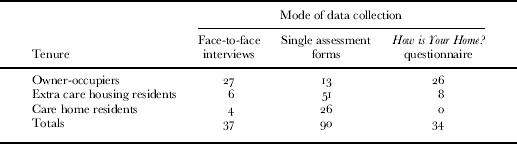
The study was carried out between October 2004 and March 2006 using a case study methodology. Data were collected in three ways from different sets of informants (Table 1). Invitations to be interviewed were delivered to all the village residents apart from 15 people living in the specialist dementia unit in the care home. Of the 37 who agreed to be interviewed, 27 lived in lease-purchase apartments, six in the extra-care housing, and four in the care home. Those who agreed to take part were also asked to complete an adapted version of the How is Your Home? questionnaire, the Housing Options for Older People appraisal assessment tool used by the Elderly Accommodation Counsel (Heywood, Oldman and Means Reference Heywood, Oldman and Means2002). Additional data were collected from 90 single assessment forms, which are used to measure a broad range of health and social care needs. This information was collected from 13 owner-occupation residents, 51 extra-care residents and 26 residents of the care home at the time they moved into the village. It is important to note that data collected from these three sources did not represent the tenure distribution. For example, 57 per cent of the assessment forms had been completed by extra-care housing tenants, and only 14 per cent were from owner-occupiers. This was largely because assessment data are routinely collected for residents needing higher levels of care and most of them lived in the extra-care housing. Conversely, 73 per cent of those interviewed were owner-occupiers and only 16 per cent lived in the extra-care housing. The interviews were transcribed and the content analysed by coding phrases into categories, themes and sub-themes.Footnote 2
Tenure of the research participants by mode of data collection
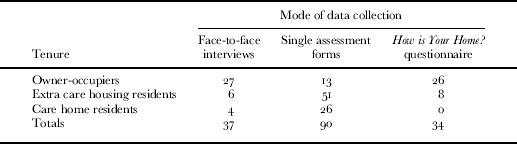
Notes: For further details of the data collection instruments, see text.
Key findings
A profile of the village residents
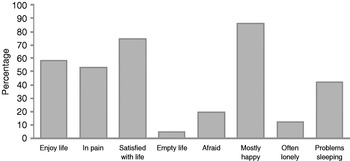
At the start of data collection in 2004, a profile of the village residents showed that 40 were living as couples, with 28 (14 couples) being owner-occupiers and 12 (six couples) living in the extra-care housing. The mean age of the residents was 82 years, and the range from 53 to 96 years. Analysis of 90 assessment forms indicated that 54 per cent of the respondents had personal care needs, the most prevalent being for assistance with using the bath or shower (51%) and with dressing (24%). An overall ‘Abilities’ score was calculated from the 17 assessment items that covered domestic tasks, managing money and medicines, getting around, personal care and continence. The score can range from ‘0’, the lowest level of ability, to ‘100’, the highest (no care needs). The mean score was 75.5 and only four per cent scored below ‘50’. The residents' self-reported levels of wellbeing were generally high: 74 per cent were ‘satisfied with life’ and 86 per cent felt ‘happy most of the time’ (see Figure 1). In addition, 53 per cent of those who had completed an assessment form reported ‘moderate’ or ‘severe’ bodily pain over the previous four weeks and 44 per cent had problems sleeping over the same period. Overall, the residents had diverse health problems and care needs, with many related to varying levels of sensory impairment, feet and skin problems and incontinence. The mobility data indicated high levels of need for support in getting around, both indoors and outdoors.
Percentage of 90 respondents who agreed with quality of life statements.

Perceptions of community among the residents
A central aim of this research was to explore the extent to which residents perceived the village to be successful as a community. The interview data suggest that they had disparate views. One care-home resident described it as ‘a real community of very diverse people to mix with’, while an extra-care housing resident said, ‘You generally get somebody knock on the door and come in and say, “How are things going? Are you alright?” You know, come in and have a chat. It's like a community, all together’. Others questioned the existence of a sense of community. For example, one extra-care housing resident said, ‘It's a failure as far as I'm concerned. I don't really regard myself as being part of a community, simply because I don't know any of the other people here. You don't have to be part of it and I don't think of myself as part of it.’ Those residents who did feel part of a community identified with the area of the village in which they lived rather than with the village as a whole, irrespective of tenure. This point was well made by an owner-occupier: ‘It is quite true that all my friends are either in this road or very similar, well, there is another and again they have flats there. They are nearer to each other. Also, the background is very similar. We all have very much in common.’ Several extra-care residents expressed similar feelings. One remarked, ‘I think this, the very sheltered housing (extra care) this side, has got quite a community spirit going, yes, but I don't think we have a real community spirit with the two sides’.
This view of different areas of the village as distinct and separate was widely reflected in the respondents' expressions. For example, several used the term ‘the village’ to describe the areas containing the owner-occupied apartments rather than the village as a whole. One resident described those living in owner-occupied apartments as ‘that lot up there’ and extra-care residents as ‘us down here’. Other residents demonstrated a pragmatic approach to the development of community. For example, one male owner-occupier said, ‘It's a real enough community within its limitations. The elderly people who hadn't previously known each other are not going to bond into a warm, vibrating, active community just like that.’
Influences on a sense of community
The interview responses suggested that a number of social and physical factors had influenced the extent to which the village had developed as a community. For many residents, social interaction was most important and they described various friendships that had developed. Most reported finding it easy to make friends and one, despite describing himself as being ‘not very sociable’, had made several friends, and commented that ‘it's nice to have half a dozen or so who are quite close’. Some residents suggested that they found it easier to make friends in the village than elsewhere, as this owner-occupier observed:
That has been a wonderful bonus, to have all these people on the spot. You don't go out of your door without someone saying, hello! Now the way we've all lived in towns, you don't see neighbours now. So this is very good.
There was also recognition that, as in any community, not everyone will become friends. Several residents reported that they found it difficult to develop friendships. Others were clear that they weren't looking for friendship and were happy with their own company. For example, one woman living in a retirement apartment enjoyed the occasional company of other residents in the restaurant but had not developed particular friendships. Her view was that, ‘some people just have to have someone to talk to. I don't’. A few residents mentioned regular social interactions with people from other tenures. For example, one woman living in the care home had got to know people in both the extra-care housing and the retirement apartments, as well as making a close friend in the care home. Another owner-occupier described regular contact with some residents in the extra-care housing as follows, ‘I know about four or five names of the people who are in (the extra care building) and join in the activities in the lounge and they are starting to come down to us occasionally as well, which is nice’. Different types of relationship were described by the residents. Cross-tenure interactions were largely of a casual, everyday nature while more established friendships occurred between people living in the same tenure. This partly reflected recognition of differences in their backgrounds, as suggested by the following quotation:
I think that there's obviously an automatic, not barrier, but wall between the council people and the people who bought their's, it's different. I mean, it wasn't cheap to buy here and obviously you're in a different, well, not social position, but financial position to them, and that is always a bit of a barrier to communication.
Social activities among the residents focused to a large extent on shared interests, and many of these were based in particular areas of the village. For example, residents of the retirement apartments ran a croquet club with about 20 core members, which had become a major focus for social interaction. The following quotation from an owner-occupier highlights the role of the croquet club in village life for some residents:
This croquet club's got everybody to know one another. We were all strangers, but we soon knew one another's Christian names, so were soon chatting together and we got into a little group all through the summer. By the time the end of the summer came, we were into sort of having coffee with one another, drinks, and things like that. We gelled together. And that's gone on from that now and it's a good social unit, really. Very nice people. I couldn't wish for a better place to live in really. I'm much better than if I'd been living at home.'
Similarly, the social activities held in the extra-care housing building were attended mainly by people living in that part of the village and were also valued as opportunities for those residents to interact. The village pub and restaurant were both identified as important facilities in this respect, as were the communal lounges in the extra-care housing building. The location of such facilities is also an important factor. Many of the communal village facilities and organised activities were based in the extra-care housing as a way of encouraging interaction between those living in different tenures. However, this had not achieved the desired effect, partly because of the physical layout of the site. In fact, in some ways it had had the opposite effect by causing feelings of resentment among people living in the retirement apartments, who felt excluded from some of the facilities. This situation was compounded by perceived differences in the financial contribution made by residents of the retirement apartments and those living in extra-care housing. One owner-occupier summed it up in the following way:
They do pay something, but it's nowhere near as much as what we pay and people have always got the feeling that we were subsidising them. You know, they've got the same facilities as us with the lighting and the grounds and that, but they were only paying half the price.
Some residents felt that the village had too narrow a range of facilities to promote a full sense of community. In particular there was widespread disappointment at the lack of a shop. Facilities alone may not be sufficient for all residents to feel part of a community, as one owner-occupier recognised: ‘We've got the restaurant where we can meet people but otherwise we are rather isolated in our own community, and particularly me up here, I don't see anybody else’.
The influence of the built environment on social interaction between residents emerged as a strong theme. In particular, the spatial clustering of tenures appeared to discourage social interaction between residents from different areas. This was exacerbated by the cricket pitch that occupied a large area in the centre of the village, creating a sense of division for some residents. It was experienced as a barrier particularly by the residents with impaired mobility, many of whom felt that it restricted their opportunities to take part in some aspects of village life by complicating their access to the facilities and activities in the extra-care housing building. The potential role of the built environment to support social interaction and encourage a sense of community was demonstrated by the residents' comments on the extra-care housing building. This incorporated a long glass atrium along the front, which created the ambience of an indoor ‘street’ with places to sit and facilities for leisure activities. This design was valued by many residents for being ‘light, bright and airy’ and providing a sheltered venue for both casual social encounters and organised meetings.
A central aim of the village was to support diversity in terms of socio-economic background and levels of dependency by providing a mixture of council-nominated extra-care housing, privately-owned apartments and a nursing-care home. The research interviews found widespread awareness of the different backgrounds of the residents. As one owner-occupier put it, ‘I suppose the only parallel you can have is a council estate next to a private estate, isn't it?’ The same resident felt that such variation in social backgrounds was irrelevant to the development of the village as a community. Some residents felt that the village management were trying too hard to achieve social integration across tenures. One owner-occupier commented:
They want us to mix all the time but somehow it doesn't seem to work, because they seem to like to keep themselves to themselves and perhaps we do as well, I don't know. We don't seem to mix. I don't see why we shouldn't but that's just a fact of life.
For a few owner-occupiers the mix of dependency levels within the village was an issue, as expressed in the following quotation:
I don't like being here I'll be honest, because I don't like being surrounded by decrepit old people. With the best will in the world, you talk to some of them and they don't answer – I've given up trying to hold a conversation.
One care-home resident also felt that mixing people with different levels of dependency wasn't always a good idea. She related this partly to the amount of living space available in the care home environment: ‘I mean, with all the empathy in the world, I don't know if that works, especially in a very cramped dining room’. Some owner-occupier residents felt that they had not fully appreciated the mixed nature of the village before moving in and the fact that they would be sharing the site with ‘council tenants’. However, many residents did welcome the mix of dependency levels. For example, one woman who lived in the care home described her concern for the welfare of an extra-care housing resident, and an owner-occupier helped a neighbour look after her patio garden. This kind of support was also taking place in a more organised way in the form of the trolley service for library books, which owner-occupier residents were providing for residents of the care home.
Age was also mentioned by the residents as a factor in the ability of the village to support diversity. As mentioned previously, the ages of the residents ranged from 53 to 96 years, with a mean of 82. Some residents felt that this age profile was older than they had expected, which, combined with the dependency profile, meant that there was a danger of ‘isolating a particular type of person within a particular age group’. Some residents were clear that the lack of younger people prevented the village from being a community. One owner-occupier commented, ‘It still doesn't feel like a community. It can't, can it, when it's all one age?’ Another resident described how, when her grandchildren visited her and played outside, other residents had complained about the noise. However, some saw the age restrictions as a positive feature of the village, including this owner-occupier:
If you're not 100 per cent, you know that the other person isn't 100 per cent, so you can talk about it and tell one another and we don't want to be interspersed with lots of young people who wouldn't understand.
Discussion
This paper has presented the findings of a study of social interaction and perceptions of community among the residents of a mixed-tenure retirement village in England. There was a strong sense of belonging among the residents but most identified with their own section rather than the development as a whole. As the different tenures were clustered within the village, this made tenure an important element of place attachment. The clustering of residents from different socio-economic backgrounds meant that the localised sense of community of place was also largely coterminous with common interests. The most obvious example of this was the croquet club, which provided a focus for social interaction between people living in the privately-owned retirement apartments and had no members from either the care home or the extra-care housing.
Social interaction was the most important factor in a sense of community. For many residents, this centred on a range of organised events and activities as well as the use of communal facilities in the village. This supports the findings of earlier studies that, while established friendships are key factors in the development of social identity and belonging, everyday fleeting interactions are equally important (e.g. Robertson, Smyth and McIntosh Reference Robertson, Smyth and McIntosh2008). Various aspects of the built environment were central to the patterns of social interaction among residents and their perceptions of belonging to a community. In particular, the clustering of tenures appeared to reduce the chances of casual encounters between residents from different backgrounds, which supports the earlier findings of Kearns and Mason (Reference Kearns and Mason2007). In addition, the cricket pitch that occupied a large central area of the village contributed towards a feeling of division between residents from different tenures as well as acting as a major physical obstacle.
A key aim of this study was to determine whether the retirement village achieved its goal of creating a community that supported diversity in terms of both the level of care needed by its residents and their social backgrounds as represented by different tenures. The research interviews found widespread awareness of the differences between residents in different types of accommodation across the village, as reflected in the language they used to describe its different parts and their residents. To put this in the context of theoretical debates of community (e.g. Forrest and Kearns Reference Forrest and Kearns2001; Gilleard and Higgs Reference Gilleard and Higgs2000), the fact that tenures occupied separate physical areas of the village exacerbated the differences in social backgrounds and interests. It also seems clear that some aspects of the village posed social challenges for some residents. In particular, the village layout exacerbated the impact of frailty by restricting access for people with the greatest level of frailty and/or impaired mobility. This echoes a finding of Bernard et al. (Reference Bernard, Bartlam, Sim and Biggs2007), who identified frailty as a major factor in social exclusion. There was some evidence that the care home residents had the lowest levels of integration with the rest of the village. This was largely because they had the highest average levels of physical impairment and therefore found it particularly difficult to access other areas of the village without assistance. Another factor was the fact that the care home had opened almost a year before other parts of the village and some residents had developed patterns of social interaction in the facility. It is also important to note that nursing home residents had complex health-care needs and that their duration of occupancy was likely to be shorter than that of people living in other types of village accommodation. The quantitative findings indicate a wide range of levels of frailty among village residents, as reflected in levels of need for care and support services. The research interviews suggest that this diversity was an issue for some owner-occupiers and could act as a barrier to social interaction.
While the research found limited social interaction between different areas of the village, it is important to consider the extent to which this may reflect the situation in any other village community. For example, a recent report found little evidence of the development of personal friendships across tenures in both traditional and purpose-built communities (Joseph Rowntree Foundation 2006). It should also be remembered that at the time of the research some parts of the village had been open only for a year. It could therefore be argued that it is unrealistic to expect a community to develop in such a short time. In their study of housing estates in Scotland, however, Robertson, Smyth and McIntosh (Reference Robertson, Smyth and McIntosh2008) found that the identity of a neighbourhood can be established at a very early stage, and it may be the case that the clustering of tenure can have a long-term effect on patterns of social interaction and the development of a sense of community. It is, however, important to recognise that the findings reported in this paper provide a snapshot of a retirement village at an early stage of its development. There is a need for longitudinal studies of how a sense of community develops in this context over a long period.
Conclusions
The form of the retirement village examined in this paper counters the criticism of such developments as only for the well off, in that it had a mix of tenures and residents with different levels of dependency. The study confirms previous findings that casual, everyday social interactions are an important element in people's sense of community (Croucher, Please and Bevan Reference Croucher, Please and Bevan2003). It found limited evidence of such interactions across tenures and some examples of lack of tolerance and conflict. The built environment was a key element in the development of social networks among residents. In particular, the clustering of tenures appeared to emphasise differences in the socio-economic backgrounds of residents, and the overall village layout created additional physical barriers. To this extent, residents identified a sense of community in relation to the area of the village in which they lived rather than the overall village. More research is needed in order to compare this clustered model with more recent developments that incorporate ‘pepper-potting’, whereby different tenures sit side-by-side throughout the site. Overall, the residents expressed high levels of satisfaction with the retirement village environment and their quality of life. Attempts to place people from different backgrounds together in the expectation that they will interact socially could be seen, however, as misguided. There was certainly evidence that some residents acknowledged the complexities of trying to generate a diverse community in this way and were not convinced of its merits. This supports the views of Bernard et al. (Reference Bernard, Bartlam, Sim and Biggs2007) that equating the success of retirement villages with achieving a balance between fit and frail residents is simplistic and erroneous.
Although this model of a retirement village has the potential to contribute towards the diversity agenda promoted by the UK government's sustainable communities policies, the obvious question is whether any age-defined community can be truly diverse, or are retirement villages destined to remain ‘playpens for the old’ (Kuhn Reference Kuhn1977). For some residents, the restricted age profile was a positive feature of the village and one of the reasons for choosing to live there, but others emphasised the importance of inter-generational contacts and felt that the limited age range was a barrier to a ‘real’ community. The success of retirement villages as diverse communities depends on grasping the subtleties of diversity among older people and understanding and welcoming difference, whether of social class, health status, ethnicity, age, sexuality or lifestyle.
Acknowledgements
The author would like to thank co-researchers Robin Means and James Nichol. Thanks also go to all of the retirement village residents who took part in the research and Debra Salmon for her comments on earlier versions of this paper.