Grammatical gender is one of the more puzzling of the grammatical categories (Corbett, Reference Corbett1991). It plays an important role in the processing of languages with two (e.g., Italian and Spanish), three (e.g., German, Czech, and Russian) or more grammatical genders (e.g., Nigerian Fula, with around twenty gender categories depending on the dialect; Arnott, Reference Arnott, Manessy and Martinet1967; Corbett, Reference Corbett, Dryer and Haspelmath2011); while grammatical gender is completely absent in others languages (e.g., Hungarian, Finnish).
Grammatical gender is an inherent lexical feature of nouns (Corbett, Reference Corbett1991; Ritter Reference Ritter1993; Picallo, Reference Picallo2008; Bernstein, Reference Bernstein2015). In classical models of monolingual language processing, it is widely assumed that grammatical gender is stored as a property of nouns whose representation differs from that of semantic and phonological information (Caramazza, Reference Caramazza1997; Cubelli, Lotto, Paolieri, Girelli & Job, Reference Cubelli, Lotto, Paolieri, Girelli and Job2005; Levelt, Roelofs & Meyer, Reference Levelt, Roelofs and Meyer1999). Differences among authors emerge, however, in terms of understanding how grammatical gender is retrieved when individuals perform linguistic tasks. Some authors argue that grammatical gender is automatically retrieved whenever participants perform a production task: when a noun is produced as part of a noun phrase and when it is produced in isolation as well (Cubelli et al., Reference Cubelli, Lotto, Paolieri, Girelli and Job2005; Paolieri, Lotto, Leoncini, Cubelli & Job, Reference Paolieri, Lotto, Leoncini, Cubelli and Job2011). Other authors assert that grammatical gender is only retrieved when needed to perform a specific production task where nouns are integrated within a sentential context (Caramazza & Miozzo, Reference Caramazza and Miozzo1997; Levelt et al., Reference Levelt, Roelofs and Meyer1999). Thus, grammatical gender is retrieved when participants produce a noun phrase in which agreement between the noun and the definite article is needed, but gender is not accessed when individuals produce a noun in isolation. Although this issue is unresolved, there are several studies reporting grammatical gender effects during the production of both noun phrases and bare nouns, thus supporting the notion of automatic retrieval of grammatical gender in language production, at least in languages with a complex morphological structure (Cubelli et al., Reference Cubelli, Lotto, Paolieri, Girelli and Job2005; Paolieri et al., Reference Paolieri, Lotto, Leoncini, Cubelli and Job2011).
When we focus on the field of bilingualism, a great number of studies have shown interactions between the grammatical gender of the bilinguals’ two languages when they perform both comprehension and production tasks (Bordag & Pechmann, Reference Bordag and Pechmann2007, Reference Bordag and Pechmann2008; Lemhöfer, Spalek & Schriefers, Reference Lemhöfer, Spalek and Schriefers2008; Morales, Paolieri, Dussias, Kroff, Gerfen & Bajo, Reference Morales, Paolieri, Dussias, Kroff, Gerfen and Bajo2016; Paolieri, Cubelli, Macizo, Bajo, Lotto & Job, Reference Paolieri, Cubelli, Macizo, Bajo, Lotto and Job2010; Salamoura & Williams, Reference Salamoura and Williams2007). This observation supports the notion that in the bilingual mind, the first language (L1) influences the processing of the second one (L2) at the level of grammatical gender even when only the L2 is used. For instance, Paolieri et al. (Reference Paolieri, Cubelli, Macizo, Bajo, Lotto and Job2010) asked Italian–Spanish speakers to name a series of pictures in L2, or translate words from L1 to L2, by producing either the bare noun or the definite article (elMAS or laFEM) correctly marked for grammatical gender. The results showed faster naming latencies for words that were gender-congruent between the bilinguals’ languages (e.g., farfallaFEM, mariposaFEM, –butterfly– in Italian and Spanish, respectively) relative to gender-incongruent words (e.g., forchettaFEM, tenedorMAS, –fork– in Italian and Spanish, respectively), irrespective of the task (bare noun or article + noun). Moreover, Bordag and Pechmann (Reference Bordag and Pechmann2007) with Czech–German bilinguals and a similar L2 naming paradigm, found the same grammatical gender congruency effect in producing both bare nouns and noun phrases (adjective + noun). Salamoura and Williams (Reference Salamoura and Williams2007) extend the evidence of gender congruency effects in bilinguals using languages with a symmetric gender system (i.e., languages that share number and type of gender values) but a different script, such as Greek and German. They found that nouns with the same gender in Greek (L1) and German (L2), were translated faster than nouns with different genders, although the gender congruency effect was observed only when the L2 target production required the adjective + noun.
Therefore, some inconsistent findings appear to emerge using tasks with different demands of syntactic activation, like bare noun or noun phrase (article or adjective + noun) production tasks, at least in languages such as German and Greek (Salamoura & Williams, Reference Salamoura and Williams2007). However, similar effects have been observed for both bare noun and noun phrase production tasks in Italian–Spanish or Czech–German bilinguals (Cubelli et al., Reference Cubelli, Lotto, Paolieri, Girelli and Job2005; Paolieri et al., Reference Paolieri, Lotto, Leoncini, Cubelli and Job2011).
Overall, the presence of gender congruency effects between the two languages of bilingual speakers suggests that both languages are simultaneously active in the bilingual mind and that grammatical gender is available when gender is needed to process agreement between the adjective and the noun in noun phrases, and even when the agreement is not relevant for performing the task, such as during the comprehension and production of nouns presented in isolation. This pattern of results supports the notion that grammatical gender is an intrinsic lexical feature that is available even in production tasks outside of agreement operations. Given that the L1 is activated and spreads activation to the lexical representations of L2, if the nouns of the two languages belong to the same gender class, the target noun elicits a higher level of activation and its selection is facilitated (Cubelli & Paolieri, Reference Cubelli, Paolieri, Arcuri, Boscolo and Peressotti2008).
The grammatical gender effect is quite easily observed in languages with symmetrical gender systems (i.e., gender systems with an equal number of gender categories), but less consistent results have been found in language systems with an asymmetrical structure. For example, Costa, Kovacic, Franck, and Caramazza (Reference Costa, Kovacic, Franck and Caramazza2003) investigated the production of L2 noun phrases with different groups of highly proficient bilinguals and found no effect of gender congruency in Croatian–Italian participants. In order to keep symmetry between the gender values of Croatian and Italian, Costa et al. (Reference Costa, Kovacic, Franck and Caramazza2003) did not include neuter Croatian nouns in their study; however, the underlying asymmetrical structure of the Croatian and Italian gender systems could account for the lack of gender effects: Italian has two gender values (feminine and masculine), while Croatian has three genders (masculine, feminine, and neuter). Recently, Klassen (Reference Klassen2016) has also examined the effect of two asymmetric gender systems with Spanish–German bilinguals. In this study, a gender congruency effect was found, with shorter naming latencies for nouns that were gender-congruent across languages relative to gender-incongruent nouns in both bare noun and determiner phrase production, which is consistent with a significant body of previous research in bilinguals with symmetric gender systems (e.g., Bordag & Pechmann, Reference Bordag and Pechmann2007; Lemhöfer et al., Reference Lemhöfer, Spalek and Schriefers2008; Paolieri et al., Reference Paolieri, Cubelli, Macizo, Bajo, Lotto and Job2010).
In sum, it is possible that the interactions between two grammatical gender systems can be modulated by the demands of syntactic activation during production and by specific properties of languages spoken by the bilinguals. To be more precise, the occurrence of gender congruency effects would indicate that gender is integrated at the lexical level (gender congruency effects in bare noun and noun phrase production) or is integrated at the syntactic level (gender congruency effect in the noun phrase production but not with nouns produced in isolation) (see also Paolieri et al., Reference Paolieri, Cubelli, Macizo, Bajo, Lotto and Job2010, for similar assumptions). Finally, the distance between the two languages of a bilingual could modulate the degree of between-language gender activation. The distance between languages seems to be a plausible modulator of the amount of activation between them. Thus, the proximity of the bilingual's two languages is an important issue that merits further analysis in the study of grammatical gender processing, as has been investigated in the case of lexico-semantic processing (e.g., cognate facilitation effects, see, Guo & Peng, Reference Guo and Peng2006; Hoshino & Kroll, Reference Hoshino and Kroll2008; for languages that utilize different scripts).
Thus, these are the first two objectives of our study: we aimed to evaluate the influence of the syntactic demands of the task using bare noun and noun phrase translation tasks, and to consider the similarity between languages in terms of the symmetry of gender categories and the similarity of language scripts used by Italian–Spanish and Russian–Spanish bilinguals.
A further issue that we aimed to explore is the influence of semantic mediation on the occurrence of grammatical gender effects in bilinguals. Grammatical gender appears to be a meaningful category for distinguishing between male and female groups according to biological sex (Arias Barredo, Reference Arias Barredo1990). For example, children associate the name of human referents with different genders, after which they extend this distinction to other biological entities such as animals (e.g., Vigliocco, Vinson, Paganelli & Dworzynski, Reference Vigliocco, Vinson, Paganelli and Dworzynski2005). Many studies have suggested that male-female differentiation extends to arbitrary words (e.g., Boroditsky, Schmidt & Phillips, Reference Boroditsky, Schmidt, Phillips, Gentnter and Goldin-Meadow S.2003; Koch, Zimmermann & Garcia-Retamero, Reference Koch, Zimmermann and Garcia-Retamero2007; Konishi, Reference Konishi1993; Martinez & Shatz, Reference Martinez and Shatz1996; Sera, Berge & del Castillo Pintado, Reference Sera, Berge and del Castillo Pintado1994; but see Mickan, Schiefke & Stefanowitsch, Reference Mickan, Schiefke and Stefanowitsch2014, for different results). Overall, these studies show that native speakers of a language with grammatical gender attribute feminine characteristics to grammatically feminine nouns and masculine characteristics to grammatically masculine nouns, leading to the conclusion that the grammatical gender property appears to have some effects at the semantic/conceptual level, with more robust effects in Romance languages (see Bassetti & Nicoladis, Reference Bassetti and Nicoladis2016, for a review). In addition, evidence for the influence of grammatical gender on semantic processing has been observed even when the retrieval of gender is not explicitly required by the task. For example, Boutonnet, Athanasopoulos, and Thierry (Reference Boutonnet, Athanasopoulos and Thierry2012) showed that the grammatical gender of Spanish-L1 was retrieved when participants performed a semantic categorization task in English-L2 (where they had to decide if three pictures belonged to the same semantic category or not). ERP results from a study by Friederici and Jacobsen (Reference Friederici and Jacobsen1999) revealed a LAN modulation effect (Left Anterior Negativity; an ERP marker considered to reflect detection of grammatical violations) when the objects to be categorized did not match each other in L1 grammatical gender. Their results indicate that grammatical gender of nouns in the native language influences comprehension even in a second language that lacks such a grammatical property or in a context that does not require access to such information (see also, Cubelli, Paolieri, Lotto & Job, Reference Cubelli, Paolieri, Lotto and Job2011; Ganushchak, Verdonschot & Schiller, Reference Ganushchak, Verdonschot and Schiller2011; Sabourin, Stowe & de Haan, Reference Sabourin, Stowe and De Haan2006).
Moreover, some authors suggest that gender systems are based on semantics and the only differences between them across languages are morphological cues (e.g., number of gender classes, gender markers, gender agreements; see Corbett, Reference Corbett1991). For instance, Mirkovic, MacDonald, and Seidenberg (Reference Mirkovic, MacDonald and Seidenberg2005) found that the association between semantic and morphological information increases the probability of predicting the grammatical gender of words. Therefore, semantic information appears to modulate the processing of grammatical gender. Taken together, these studies suggest a bidirectional influence in which semantics modulate grammatical processing and vice versa.
In the case of bilinguals, this connection between semantic and grammatical representations suggests the possibility that when L1 and L2 nouns share grammatical gender, the corresponding concepts also share more semantic features relative to concepts corresponding to nouns with different gender (Boroditsky et al., Reference Boroditsky, Schmidt, Phillips, Gentnter and Goldin-Meadow S.2003). Previous studies suggest that translation task from L1 to L2 (forward translation, De Groot et al., Reference de Groot, Dannenburg and Van Hell1994), involves two routes of processing: one via the connection between L1 and L2 lexical representations and a second semantic route by which L1 words connect to the semantic system before L2 words are retrieved (Kroll & Stewart, Reference Kroll and Stewart1994). These two routes work in parallel when bilinguals perform forward translation from L1 to L2 (Duyck & Brysbaert, 2004). According to this view, semantic mediation cannot be excluded in forward translation (Duyck & Brysbaert, 2004; Sunderman & Kroll, 2006), and it can be predicted that the degree of lexical and semantic similarity across L1 and L2 words would facilitate the translation process. Hence, in our study, we manipulated semantic strength by considering whether concreteness (Brysbaert, Warriner & Kuperman, Reference Brysbaert, Warriner and Kuperman2014) might modulate the grammatical gender effect in bilinguals.
Concrete and abstract words are represented differently in memory (e.g., Barber, Otten, Kousta & Vigliocco, Reference Barber, Otten, Kousta and Vigliocco2013; Bajo, Cañas, Navarro, Padilla & Puerta-Melguizo, Reference Bajo, Cañas, Navarro, Padilla and Puerta-Melguizo1994). These differences could be linked to the ease with which concrete words are learned in a second language compared with the learning of abstract words in L2 (de Groot, Dannenburg & Van Hell, Reference de Groot, Dannenburg and Van Hell1994; Kaushanskaya & Rechtzigel, Reference Kaushanskaya and Rechtzigel2012; Van Hell & de Groot, Reference Van Hell and de Groot1998). Bilingual memory representations may differ for concrete and abstract words. For example, abstract words may have fewer semantic features than concrete words (e.g., de Groot, Reference de Groot1989; Plaut & Shallice, Reference Plaut and Shallice1993), and hence have fewer semantic elements to share with their translations (Van Hell & de Groot, Reference Van Hell and de Groot1998). Therefore, if we consider that grammatical gender and semantic information interact, it is reasonable to predict that concreteness might modulate the processing of grammatical gender in bilingual speakers.
Two alternatives are possible with regard to the processing of concrete and abstract nouns when we consider the gender congruency effect in bilingual speakers. If this effect were limited to the activation of L1 and L2 grammatical representations only, the same effect would be found regardless of the concreteness of nouns. In contrast, if differences emerge between concrete and abstract nouns in the magnitude of the congruency effect, this would suggest that the congruency effect is partially influenced by the semantic processing of words. Specifically, in the case of bilinguals, concrete nouns have more semantic elements in common between translations (Van Hell & de Groot, Reference Van Hell and de Groot1998) and same gender noun concepts are hypothesised to also share more semantic features in comparison with concepts corresponding to nouns with different gender (Boroditsky et al., Reference Boroditsky, Schmidt, Phillips, Gentnter and Goldin-Meadow S.2003). This suggests the possibility that a stronger gender congruency effect is observed in the case of concrete nouns with respect to abstract nouns. The evaluation of these predictions was the third goal of the present work.
The current study
There are several factors that could modulate the presence of grammatical gender effects in bilinguals. The aim of this study was to explore three of these factors in unbalanced bilinguals translating words from L1 to L2.
Firstly, we examined the need to retrieve grammatical gender directly. To evaluate this issue, we compared the translation of bare nouns vs. the translation of articles + nouns in L2. Secondly, we analysed the possible influence of proximity of the gender systems in the languages spoken by bilingual individuals. To address this point, we compared bilinguals with different gender systems: Russian–Spanish bilinguals (Russian with three-gender classes, Spanish with two-gender classes), and bilinguals with the same gender system, Italian–Spanish bilinguals (both languages with two-gender classes). Thirdly, we investigated the interaction between the semantic and the grammatical systems. To this end, we evaluated if the gender congruency effect differed between the processing of concrete versus abstract nouns. The manipulation of concreteness allows the opportunity to observe a modulation of gender congruency effect with words which, at a conceptual level, differ in the degree of semantic overlap (such as concrete and abstract words) but that do not differ at the grammatical gender level. In addition, the observation of a modulation of the gender effect by concreteness would indicate that bilinguals accessed the semantic system at the time of retrieving the grammatical information in the translation task.
In Experiment 1, we explored whether the grammatical gender congruency effect observed previously in bilingual speakers (Paolieri et al., Reference Paolieri, Cubelli, Macizo, Bajo, Lotto and Job2010) would be obtained for bilinguals whose two languages differ in a number of aspects (script, number of gender categories, presence / absence of determiners), asking whether the grammatical gender of the native language (Russian) affected production in a second language (Spanish). Russian and Spanish are Slavic and Romance languages respectively, with very different gender systems in terms of gender values and gender agreement. Russian has three gender values (masculine, feminine, and neuter) whilst Spanish has only twoFootnote 1 (masculine, feminine) and, unlike Spanish, Russian has no determiners. Unlike masculine and feminine gender categories, neuter is a gender category that is only present in the bilinguals’ L1 (Russian), with no correspondence in the L2 gender system (Spanish). Thus, different outcomes could emerge during forward translation of nouns with neuter gender in L1. On the one hand, neutral nouns could behave as an intermediate level of incongruence between gender-congruent nouns (same masculine or feminine gender in both languages) and gender-incongruent nouns (masculine or feminine in one language but the opposite gender, feminine and masculine, in the other language). On the other hand, neutral nouns could behave as gender-incongruent nouns. This was the reason for including the neutral-incongruent condition in our study. To our knowledge, only Klassen (Reference Klassen2016) has examined this type of incongruence with neutral nouns, in a study that used Spanish–German bilinguals where the L2 of participants did not have a neutral equivalent in their L1, Spanish. In Klassen's (Reference Klassen2016) experiment both shorter naming latencies and lower error rates for neuter-incongruent nouns were found with respect to gender-incongruent nouns, showing a decrement in the amount of interference produced by neuter-incongruent nouns with respect to gender-incongruent nouns. In Russian–Spanish bilinguals, the direction of the asymmetry is reversed, and so L1 nouns with neutral gender do not have a neutral equivalent in L2. This characteristic could ensure that the neutral incongruence condition would simply generate the same pattern of results as the incongruent condition.
In Experiment 2, we investigated the gender congruency effect in two Romance languages with very similar gender systems in terms of gender values and gender agreement (Italian and Spanish) in order to replicate and extend the results of Paolieri et al. (Reference Paolieri, Cubelli, Macizo, Bajo, Lotto and Job2010).
In both experiments, gender congruency and word concreteness were manipulated and bilinguals performed a word translation task from L1 to L2 using bare nouns and noun phrases (article + noun). Similar gender congruency effects in Italian–Spanish bilinguals have been observed with picture-naming tasks and word translation tasks (e.g., Paolieri et al., Reference Paolieri, Cubelli, Macizo, Bajo, Lotto and Job2010). In the current study, the word translation task was chosen because it allows the manipulation of concreteness, including abstract words as stimuli in our experimental materials to evaluate the relationship between semantic and grammatical gender processing. Furthermore, we selected the L1 to L2 direction of translation based on the revised hierarchical model (Kroll & Stewart, Reference Kroll and Stewart1994). L2 to L1 translation can be conducted by lexical connections between the bilingual's two languages, and therefore this translation direction would be less sensitive to concreteness effects. In contrast, semantic and lexical processing are both functional when bilinguals conduct L1 to L2 translation, and so this task would be better suited to capture the semantic effects in our study.
Experiment 1: Russian–Spanish bilinguals
In Experiment 1, we explored whether the grammatical gender of the native language (Russian) affected naming in a second language (Spanish). In this experiment, Russian–Spanish bilinguals (L1-L2, respectively) were required to translate nouns from Russian into Spanish, by producing either the bare noun (Experiment 1a) or the noun phrase (Experiment 1b), for both concrete and abstract nouns. The presence of grammatical gender congruency effects would suggest that the gender systems of the two languages, Russian and Spanish, are integrated at the lexical level (gender congruency effects in bare noun and noun phrase production) or only at the syntactic level (the congruency effect would be limited to the noun phrase condition, with no gender effect in bare noun production). In addition, if the semantic and gender systems interact, the congruency effect would be modulated by the concreteness of the words to be translated.
Method
Participants
Participants were 54 Russian–Spanish advanced bilinguals (L1-L2, respectively). All of the participants were paid for taking part in the study. The experimental data were collected at the University of Granada. The bilinguals were randomly assigned to Experiments 1a and 1b (27 participants in each experiment). In Experiment 1a, participants performed a bare noun translation task from L1 to L2 (e.g., звезда (zvezda)/estrella, –star–), whilst in Experiment 1b they performed an article + noun translation task from L1 to L2 (e.g., звезда (zvezda)/ la estrella, –the star–). Although a within-participants experimental manipulation is a better choice for this kind of study, we preferred a between-participants manipulation in order to avoid the risk of the influence of task order in the within-subject design.
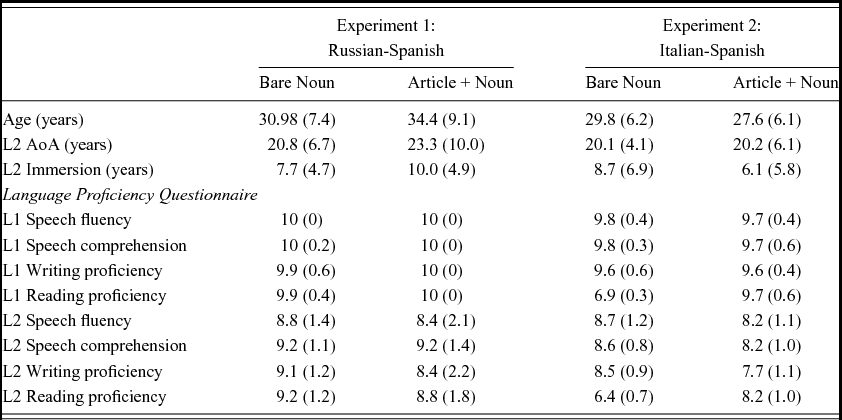
Before performing the experiment, all participants completed a language history questionnaire in which they rated their speech fluency, speech comprehension, writing, and reading skills in both L1 and L2 (see Table 1). The questionnaire was also designed to obtain information about their experience using each language. Participants across the two experiments did not differ in their L1 and L2 proficiency (all p values > .05).
Characteristics of Participants in the Study

Note. Bare noun: L1-L2 noun translation task, Article + Noun: L1-L2 article + noun translation task. The self-report ratings in L1 and L2 ranged from 1 to 10 where 1 was not fluent and 10 was very fluent. Standard deviations are reported in brackets.
Design and materials
A 3 × 2 × 2 mixed design was used. Gender congruency (congruent, incongruent, incongruent-neuter) and word concreteness (abstract vs. concrete) were manipulated within-participants whilst the factor of task (bare noun vs. article + noun) was manipulated between-subjects.
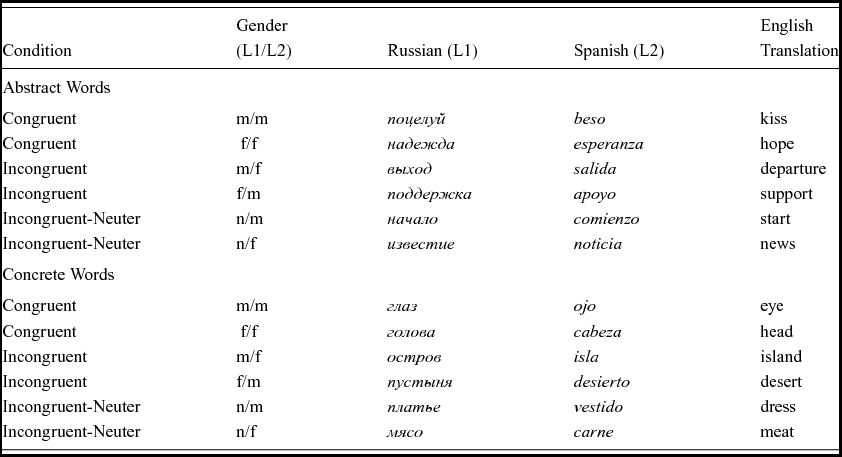
Sixty concrete nouns were selected: 20 nouns had the same gender in Russian and Spanish the gender-congruent condition (e.g., звезда (zvezda) /estrella, –star–, both feminine), 40 nouns had different gender in the two languages: 20 nouns in the gender-incongruent condition (e.g., нос (nos) /naríz, –nose–, masculine in Russian and feminine in Spanish) and 20 nouns in the gender-incongruent-neuter condition (e.g., окно (okno) /ventana, –window–, neuter in Russian and feminine in Spanish). In each set, half of the nouns were masculine and half feminine in both languages. Further, in the gender-incongruent-neuter condition, half of the nouns were masculine and half feminine in Spanish and all had neuter gender in Russian. Similarly, 60 abstract nouns were selected: 20 nouns with the same gender in Russian and Spanish, the gender-congruent condition (e.g., ветер (veter) /viento, –wind–, both masculine), 40 nouns with different gender in the two languages: 20 nouns in the gender-incongruent condition (e.g., прогулка- progulka/paseo, –walk–, feminine in Russian and masculine in Spanish) and 20 nouns in the gender-incongruent-neuter condition (e.g., чувство (čuvstvo) /sentimiento, –feeling–, neuter in Russian and masculine in Spanish). In each set, half of the nouns were masculine and half feminine in both languages. Further, in the gender-incongruent-neuter condition, half of the nouns were masculine and half feminine in Spanish and all had neuter gender in Russian (see Table 2).
Experiment 1. Design and Examples

Note. The gender congruency conditions (congruent, incongruent, incongruent-neuter) and word concreteness conditions (abstract, concrete) were used in the two translation tasks (bare noun translation and article + noun translation). f = feminine; m = masculine; n = neuter.
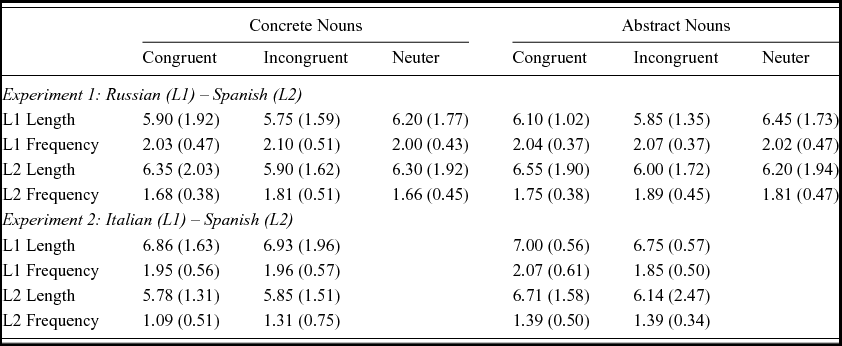
The two sets of concrete and abstract nouns differed in concreteness (concrete nouns, M = 6.12, SD = 1.11; abstract nouns, M = 4.05, SD = 0.96), t(86) = 9.42, p < .001, and imageability (concrete nouns, M = 6.17, SD = 0.56; abstract nouns, M = 4.95, SD = 0.96), t(109) = 8.07, p < .001 (Spanish 7 point scale, LEXESP database; Sebastián, Martí, Carreiras & Cuetos, Reference Sebastián, Martí, Carreiras and Cuetos2000). The gender-congruent, gender-incongruent, and gender-incongruent-neuter sets were matched for a number of lexical variables both for concrete nouns and abstract nouns in the two languages (Spanish, Alameda & Cuetos, Reference Alameda and Cuetos1995; Russian, Lyashevsky & Sharov, Reference Lyashevsky and Sharov2009) (see Table 3). For the concrete noun set, the Russian word length (number of letters) and frequency (log) was similar in the gender-congruent condition, the incongruent gender condition, and the incongruent-neuter condition, Fs < 1. When the Spanish translation of the Russian words was considered, word length (number of letters) and frequency (log) was also equated across the congruent condition, the incongruent condition, and the neuter condition, Fs < 1.
Characteristics of Words Used in the Study

Note. Length in number of letters. Frequency (log). Standard deviations are reported in brackets.
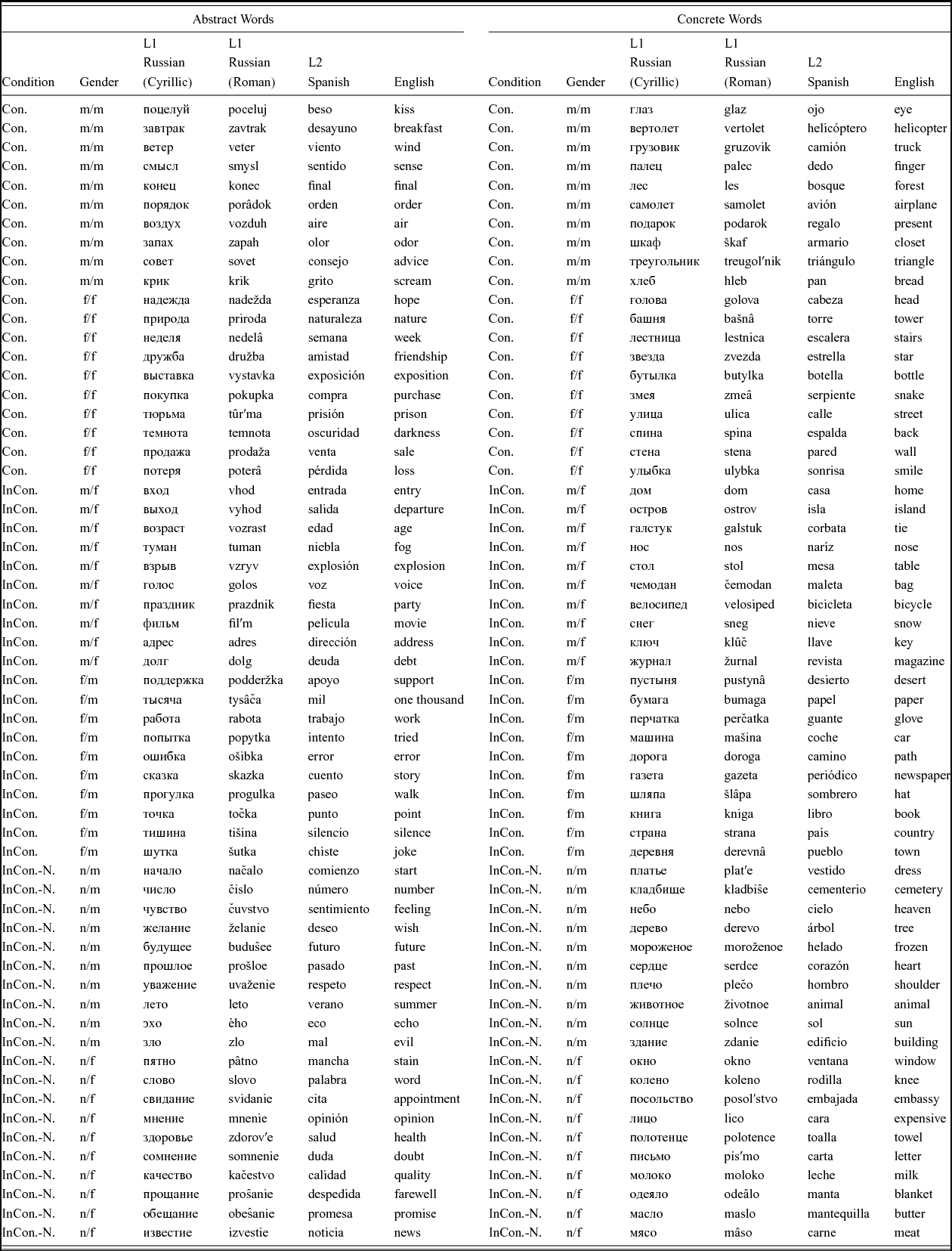
In addition, the number of nouns with transparent endingsFootnote 2 in Spanish was matched as closely as possible across the congruency conditions for concrete nouns (12 nouns, 13 nouns, 14 nouns, for congruent, incongruent, and incongruent-neuter, respectively) and abstract nouns (12 nouns, 12 nouns, 15 nouns, for congruent, incongruent, and incongruent-neuter, respectively). In Russian, all the nouns were selected with transparent endingsFootnote 3 for gender. The material only included non-cognate nouns. The complete set of materials is reported in Appendix A.
Procedure
Participants were presented with Russian (L1) written words and were asked to translate them by providing the corresponding Spanish (L2) nouns, in isolation (Experiment 1a) or preceded by the definite determiner (Experiment 1b) as fast and accurately as possible. At the beginning of the experiment, each participant was familiarized with the set of Russian words and their Spanish translations used in the study. In this phase, the written nouns were presented on the computer screen with the corresponding Spanish noun printed below. Participants were familiarized with the L1-L2 word pairs. This procedure was adopted to ensure that participants knew the Spanish translation of the L1 Russian nouns and to exclude the unknown items from analyses. Moreover, in the production tasks, the inclusion of this phase reduces disfluencies and hesitations during the experimental phase (for a similar procedure, see also Bordag & Pechmann Reference Bordag and Pechmann2007; Costa et al., Reference Costa, Kovacic, Franck and Caramazza2003; Kassel, Reference Klassen2016; Paolieri et al., Reference Paolieri, Cubelli, Macizo, Bajo, Lotto and Job2010; Salamoura & Williams, Reference Salamoura and Williams2007).
Following the familiarization phase, a practice block of 8 trials was administered, after which the experimental blocks were presented. In addition, at the end of the experimental session, participants completed a gender decision task with the L2 nouns that they had to produce in the main experiment. This task was used to ensure that participants knew the grammatical gender of the L2 Spanish nouns and to exclude the unknown items from the experimental analyses.
The stimuli were presented in black Courier New 24 lower-case font on a white background at the centre of the screen, in random order using E-Prime 1.1 (Psychology Software Tools, Pittsburgh, PA). In the translation task, a trial consisted of the following events: a fixation cross presented at the centre of the screen for 500 ms, upon which the Russian word appeared until the participant's response or for a maximum of 3000 ms, and the next trial started 500 ms after word offset. Response latencies were measured from the onset of the stimulus presentation until the beginning of the response. The response of each participant was recorded for later analyses of accuracy.
Results
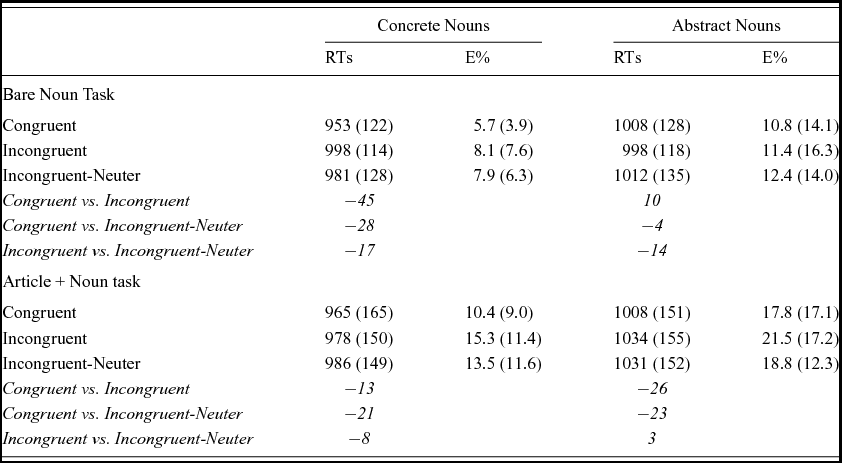
Six types of responses were excluded from the statistical analyses of the translation latencies: (a) translation errors, (b) verbal disfluencies and failures to record the response by the voice key, (c) L1 words whose L2 translations were unknown by the participants in the familiarization task, (d) words whose L2 gender was unknown by the bilingual in the L2 gender decision task performed at the end of the session, (e) responses longer than 2000 ms and shorter than 300 ms, (f) translation latencies more than 2.5 standard deviations above or below the overall mean for a given participant. The percentage of responses eliminated from the latency analyses was 29% in the bare noun task, and 37% in the article + noun task. The mean translation latencies, standard deviations, and error rates found in the experiment are shown in Table 3. Latencies were submitted to analyses of variance (ANOVAs) by both subjects (F 1) and items (F 2).
Gender congruency (congruent, incongruent, incongruent-neuter) and word concreteness (abstract vs. concrete) were analysed as within-participants factors whilst the translation task (bare noun vs. article + noun) was analysed as a between-subjects factor.
Translation latencies
The analyses revealed a significant effect of concreteness, F 1(1, 52) = 54.96, p < .001, η p2 = .51; F 2(1, 38) = 11.66, p = .002 η p2 = .23, indicating that concrete nouns were translated faster (M = 977 ms, SD = 138) than abstract nouns (M = 1015 ms, SD = 139). In addition, the effect of gender congruency was significant in the subject analysis, F 1(2, 104) = 9.14, p < .001, η p2 = .15; F 2 < 1. Importantly, the interaction between concreteness, gender congruency, and task reached significance in the subject analysis, F 1(2, 104) = 5.19, p = .007, η p2 = .09; but was not significant in the item analysis, F 2(2, 76) = 1.36, p = .26, η p2 = .26. The main effects of task and other interactions were not significant (all Fs < 1). In order to understand the three-way interaction, the effects of gender congruency and concreteness were explored for each task separately.
In the bare noun task, the analyses revealed a significant effect of concreteness, F 1(1, 26) = 11.57, p = .002, η p2 = .31; F 2 (1, 19) = 4.50, p = .05, η p2 = .19, and gender congruency by subjects, F 1(2, 52) = 5.45, p = .007, η p2 = .17; F 2 < 1. Importantly, the interaction between concreteness and gender congruency reached significance by subjects, F 1(2, 52) = 5.89, p = .005, η p2 = .18; but not by items, F 2(2, 38) = 1.10, p = .34, η p2 = .06. The gender congruency effect was significant for concrete nouns, F 1(1, 26) = 11.12, p < .001, η p2 = .30; F 2(2, 38) = 2.92, p = .07, η p2 = .13: The comparison between congruent and incongruent nouns, t 1(26) = 4.11, p < .001; t 2(19) = 2.54, p = .02, congruent and incongruent-neuter by subjects, t 1(26) = 2.76, p = .01; t 2(19) = 1.25, p = .22, and between incongruent and incongruent-neuter by subjects, t 1(26) = 2.26, p = .03, t 2(19) = 1.09, p = .28, were significant. For abstract nouns, the gender congruency effect was not significant (both Fs < 1) (see Table 4 for the magnitude of congruency effects).
Mean of Translation Latencies (RTs, in milliseconds), Standard Deviations (in brackets) and Percentage of Errors as a Function of Tasks and Experimental Conditions of Experiment 1 and magnitude of congruency effects

In the article + noun task, the analyses revealed a significant effect of concreteness, F 1(1, 26) = 65.22, p < .001, η p2 = .71; F 2 (1, 19) = 7.54, p = .013, η p2 = .28, and gender congruency by subjects, F 1(2, 52) = 4.27, p = .019, η p2 = .14; but not by items, F 2 < 1. The interaction between Concreteness and Gender Congruency was not significant (both Fs < 1), revealing an effect of gender congruency for both concrete nouns and abstract nouns. The comparisons between congruent (M = 986 ms, SD = 158) and incongruent nouns (M = 1006 ms, SD = 154), t 1(26) = 2.60, p = .015; t 2 < 1, and between congruent (M = 986 ms, SD = 158) and incongruent-neuter nouns (M = 1008 ms, SD = 151) were significant, t 1(26) = 2.56, p = .016; t 2 < 1, but there was no significant difference between incongruent and incongruent-neuter nouns (ts < 1) (see Table 4 for the magnitude of congruency effects).
Accuracy
The accuracy analyses revealed a main effect of concreteness, F 1(1, 53) = 62.19, p < .001, η p2 = .54; F 2(1, 38) = 10.74, p = .01 η p2 = .22, indicating that concrete nouns were translated with less errors (M = 10%, SD = 8) in comparison with abstract nouns (M = 15%, SD = 15). The gender congruency effect was also significant, with fewer errors in the congruent condition (M = 11%, SD = 11) compared with the incongruent condition (M = 14%, SD = 13), and neuter condition (M = 13%, SD = 11), F 1(1, 53) = 10.70, p < .001, η p2 = .17; F 2(1, 38) = 1.25, p = .27. Moreover, the main effect of the task was significant, F 1(2, 52) = 10.95, p < .001, η p2 = .30; F 2(1, 38) = 22.69, p < .001, η p2 = .37, with fewer errors found in the bare noun task (M = 9%, SD = 6) compared with the article + noun task (M = 16%, SD = 9). Other interactions were not significant (all ps > .05).
The ANOVAs conducted in this experiment revealed some inconsistencies in the analyses performed by items. In order to further strengthen the pattern of results found in the experiment, the RT data were analysed by estimating the Bayes factor using the JZS approach (Love et al., Reference Love, Selker, Verhagen, Marsman, Gronau, Jamil and Wagenmakers2015; Rouder, Morey, Speckman & Province, Reference Rouder, Morey, Speckman and Province2012). Bayes factor allows for making statements about the alternative hypothesis, rather than just the null hypothesis, comparing the fit of the data under the null hypothesis relative to the alternative hypothesis. In addition, it specifies a clear estimate of the evidence present in the data and it has been considered to be superior to p-values for statistical evidence (Rouder et al., Reference Rouder, Morey, Speckman and Province2012). When task, gender congruency, and concreteness were submitted to a Bayesian ANOVA, the interaction among the three factors was more likely to occur under the alternative hypothesis (BF 10 alternative/null = 1.039e + 12) than under the null hypothesis (BF 01 null/alternative = 5.489e – 13). When the production of bare nouns was considered, the data were more likely to occur under a model including the concreteness by gender congruency interaction (BF 10 = 4977.106) than under a model that does not include the two-way interaction (BF 01 null/alternative = 2.187e – 4). Moreover, the two-way interaction was preferred over the main effects of concreteness and gender congruency by a BF 10 = 15.195. When the production of concrete nouns was considered, a model including gender congruency was preferred (BF 10 = 230.293) over a model without this factor (BF 01 = 0.004). In contrast, when participants produced abstract nouns, a model without gender congruency was preferred (BF 01 = 4.530) over a model including this variable (BF 10 = 0.216).
When the production of noun phrases was taken into account, the main effects of concreteness and gender congruency were more likely to occur (BF 10 = 6.79) than the interaction between the two factors. Specifically, the data were more likely to occur under a model including the main effect of gender congruency (BF10 = 1.202) than under a model without it (BF01 = 0.829). Thus, Bayesian analyses confirmed the results of those conducted with classical null-hypothesis significance testing reported above.
To sum up, the results found in this experiment showed that the interaction between concreteness, gender congruency, and task was significant and appeared to be driven by the lack of gender congruency effects in the abstract bare noun condition.
In the bare noun task, grammatical gender of nouns in the non-response L1 language (Russian) affected translation in the L2 response language (Spanish). In particular, when bilinguals translated concrete nouns, faster latencies were found in the congruent condition relative to both the incongruent-neuter condition and the incongruent condition. In addition, concrete nouns were translated faster in the incongruent-neuter condition compared with the incongruent condition. For abstract nouns, a different pattern of results was observed; the gender congruency effect was not significant.
In the article + noun task, the gender congruency effect was significant, with a comparable gender effect for both concrete and abstract nouns; congruent nouns were translated faster than incongruent nouns and incongruent-neuter nouns, with no difference between incongruent and incongruent-neuter conditions. Thus, for concrete nouns, a similar pattern of results was observed for both bare noun and noun phrase production when the congruent condition was compared to the incongruent condition and when the congruent condition was compared to the incongruent-neuter condition.
To summarize, in Experiment 1 we observed a gender congruency effect when Russian–Spanish bilinguals translated words from L1 to L2. This effect replicates the findings reported in previous studies (e.g., Paolieri et al., Reference Paolieri, Cubelli, Macizo, Bajo, Lotto and Job2010), suggesting co-activation of gender information between the two languages of bilingual speakers. Importantly, in the current study, the effect of congruency was obtained in languages that are different in many respects (script, number of gender categories, presence / absence of determiners). Therefore, the closeness between the two languages of a bilingual is not necessary for observing a gender congruency effect (see also Klassen, Reference Klassen2016). To the best of our knowledge, this is the first study exploring the possible influence of a semantic variable (concreteness) on the gender congruency effect. The pattern of results indicates an interaction between concreteness, gender congruency and the degree of gender activation required by the translation task (bare noun vs. noun phrase production). For abstract nouns, the gender congruency effect was only significant in the noun phrase task, where a mandatory activation of gender is required. In contrast, for concrete nouns, comparable effects were found for bare noun and noun phrase production. Moreover, the neutral incongruent condition in this experiment appears to produce the same pattern of results as the incongruent condition.
Experiment 2: Italian–Spanish bilinguals
In Experiment 2, we explored whether the grammatical gender of the native language (Italian) affects naming in a second language (Spanish). Italian and Spanish are Romance languages with very similar gender systems in terms of both gender values and gender agreement. In this experiment, Italian–Spanish bilinguals were required to translate nouns from Italian into Spanish by producing either the bare noun (Experiment 2a) or the noun phrase (Experiment 2b). We expected to confirm the effect of gender congruency found in Experiment 1 with Russian–Spanish bilinguals, an effect previously found in languages with a similar gender system (Bordag & Pechmann, Reference Bordag and Pechmann2007; Paolieri et al., Reference Paolieri, Cubelli, Macizo, Bajo, Lotto and Job2010). Previous studies, however, have evaluated the gender congruency effect with concrete nouns only. Therefore, the main goal of Experiment 2 was to evaluate, for the first time, the possible interaction between concreteness, gender congruency, and the syntactic demands of the tasks in symmetrical languages such as Italian and Spanish. We expected to observe the effect of grammatical gender for both bare noun translation and noun phrase translation (Paolieri et al., Reference Paolieri, Cubelli, Macizo, Bajo, Lotto and Job2010), suggesting that the gender systems of the two languages, Italian and Spanish, are integrated at the lexical level. Importantly, if semantic information and grammatical gender are interrelated, the concreteness by gender congruency interaction would be observed, as in Experiment 1.
Method
Participants
Participants were 32 Italian–Spanish advanced bilinguals (L1-L2, respectively) randomly assigned to Experiment 2a (bare noun task) and Experiment 2b, (noun phrase task) with 16 participants in each experiment. Participants in the two experiments were equated in terms of demographic characteristics and proficiency in L1 and L2 (all ps > .05): see Table 1. They were all paid for their participation. The experimental data were collected at the University of Granada.
Design and materials
A 2 × 2 × 2 mixed design was used. Two factors were manipulated within-subjects: gender congruency (congruent vs. incongruent) and word concreteness (abstract vs. concrete). The factor of task (bare noun vs. article + noun) was manipulated between-subjects.
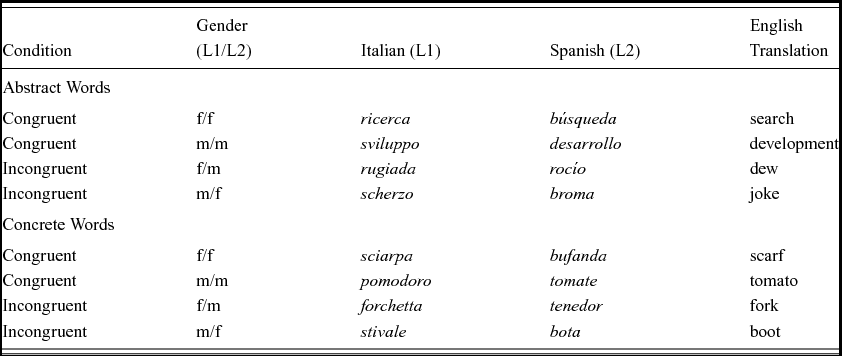
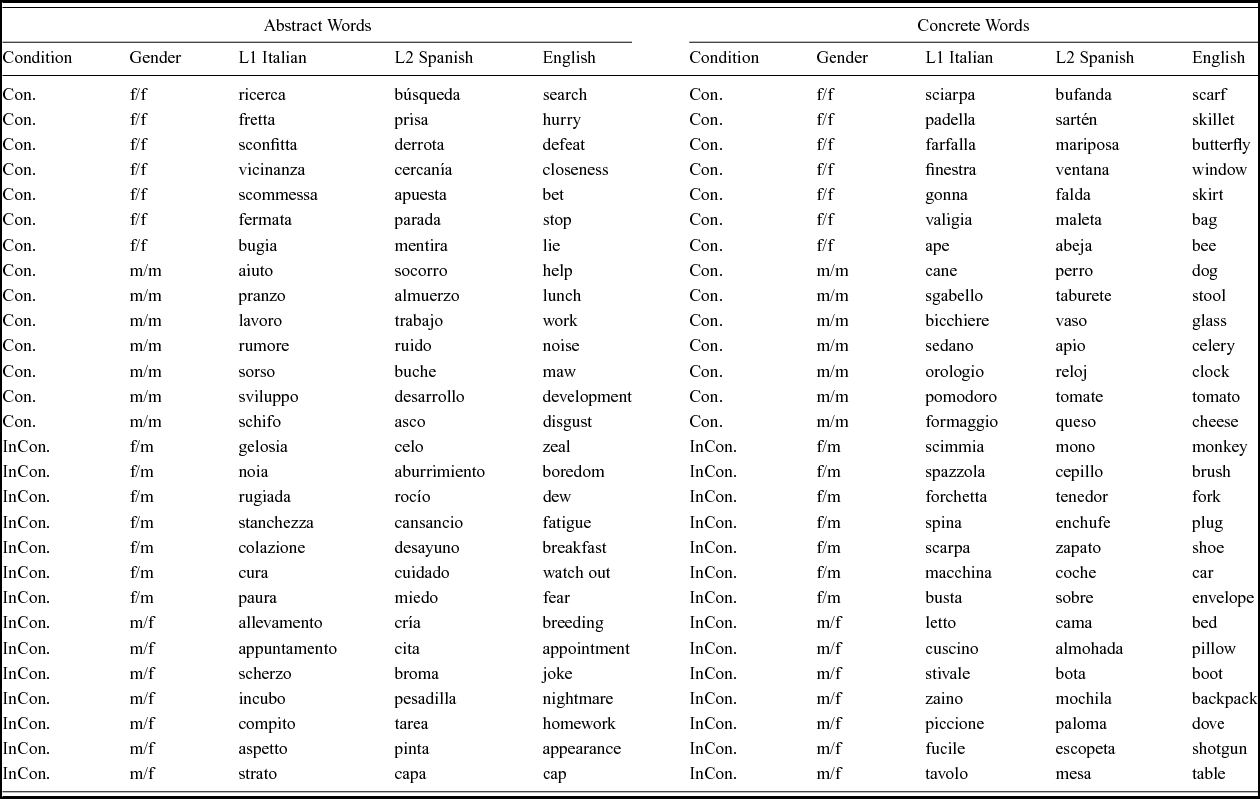
Twenty-eight concrete nouns were selected: 14 nouns had the same gender in Italian and Spanish, the gender-congruent condition (e.g., finestra/ventana, – window–, both feminine), and 14 nouns had a different gender in the two languages, the gender-incongruent condition (e.g., letto/cama, – bed–, masculine in Italian and feminine in Spanish). In each set, half of the nouns were masculine and half feminine. Similarly, 28 abstract nouns were selected, 14 of which had the same gender in Italian and Spanish – the gender-congruent condition (e.g., sviluppo/desarrollo, –development–, both masculine), and 14 with different genders in the two languages – the gender-incongruent condition (e.g., paura/miedo, –fear–, feminine in Italian and masculine in Spanish). In each set, half of the nouns were masculine and half feminine in both languages (see Table 5). The group of concrete and abstract nouns differed in concreteness and imageability values (Sebastián et al., Reference Sebastián, Martí, Carreiras and Cuetos2000). Concreteness values were M = 5.60 (SD = 2.00) for concrete nouns, and M = 4.41 (SD = 1.49) for abstract nouns, t(54) = 2.53, p = .014. Imageability values were M = 5.39 (SD = 1.95) for concrete nouns, and M = 4.02 (SD = 1.07) for abstract nouns, t(54) = 3.25, p = .002. The gender-congruent and gender-incongruent sets were matched for lexical variables in the two languages (Spanish, Alameda & Cuetos, Reference Alameda and Cuetos1995; Italian, Bertinetto, Burani, Laudanna, Marconi, Ratti, Rolando & Thornton, Reference Bertinetto, Burani, Laudanna, Marconi, Ratti, Rolando and Thornton2005). Word length (number of letters) and word frequency were similar in the two gender congruency conditions in L1 and L2 (all Fs < 1) (see Table 2). Finally, the congruent and incongruent conditions were matched as closely as possible in term of nouns with transparent endings for grammatical gender. For concrete nouns, 11 Italian words and 11 Spanish words in each congruency condition were transparent. For abstract words, 13 Italian words in each congruency condition were transparent, 13 Spanish words were transparent in the congruent condition, and 14 Spanish words in the incongruent condition. No cognates were included in the lists. The complete set of materials is reported in Appendix B.
Experiment 2. Design and Examples

Note. The gender congruency conditions (congruent, incongruent) and word concreteness conditions (abstract, concrete) were used in the two translation tasks (bare noun translation and article + noun translation). f = feminine; m = masculine.
Procedure
The procedure used in Experiment 2 was exactly the same as that described in Experiment 1, with the exception that the L1/L2 languages changed from Russian/Spanish (Experiment 1) to Italian/Spanish (Experiment 2).
Results
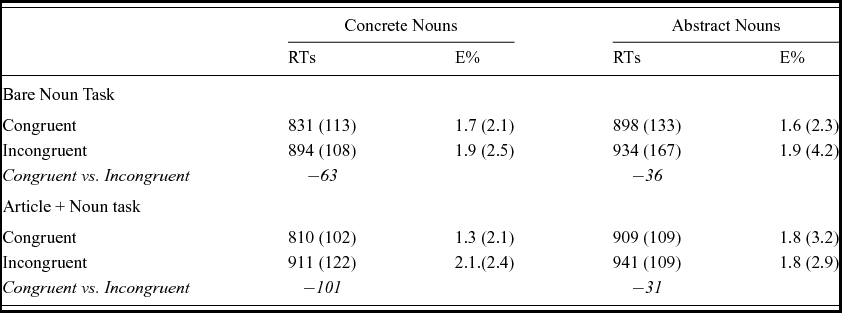
We used the same criteria described in Experiment 1 to discard responses for the translation latency analysis. The percentage of responses eliminated from the latency analyses was 21% in the bare noun task and 12% in the article + noun task. The lower percentage of data discarded in Experiment 2 relative to Experiment 1 (29% and 37%, respectively) could be due to the different length of the experiments (120 trials in Experiment 1 vs. 56 trials in Experiment 2). In addition, the higher degree of orthographic-phonological similarity between the bilinguals’ two languages in Experiment 2 (Italian–Spanish) might reduce the number of outlier responses relative to Experiment 1 (Russian–Spanish bilinguals). The mean translation latencies, standard deviations, and error rates are shown in Table 6.
Mean of Translation Latencies (RTs, in milliseconds), Standard Deviations (in brackets) and Percentage of Errors as a Function of Tasks and Experimental Conditions of Experiment 2 and magnitude of congruency effects

The analyses revealed a significant effect of concreteness, F 1(1, 30) = 30.73, p < .001, η p2 = .51; F 2(1, 26) = 12.05, p = .002, η p2 = .32, indicating that concrete nouns were translated faster (M = 862 ms, SD = 117) than abstract nouns (M = 921 ms, SD = 130). The gender congruency effect was significant, F 1(1, 30) = 44.43, p < .001, η p2 = .60; F 2(1, 26) = 7.18, p = .013, η p2 = .22, revealing that gender-congruent stimuli led to faster translation latencies (M = 862 ms, SD = 120) than gender-incongruent stimuli (M = 920 ms, SD = 127). Importantly, the interaction between concreteness and grammatical gender reached significance in the analysis by subjects, F 1(1, 30) = 7.17, p = .012, η p2 = .19; but not by items, F 2(1, 26) = 1.71, p = .20, η p2 = .06 (concrete congruent, M = 821 ms, SD = 116; concrete incongruent, M = 903 ms, SD = 139; abstract congruent, M = 904 ms, SD = 120; abstract incongruent, M = 938 ms, SD = 107). Planned comparisons revealed a gender congruency effect (34 ms) for abstract nouns, F 1(1, 31) = 4.67, p = .039, η p2 = .13; F 2(1, 27) = .59, p = .45, η p2 = .02, and a gender congruency effect (82 ms) for concrete words, F 1(1, 31) = 98.62, p < .001, η p2 = .76; F 2(1, 26) = 8.14, p = .008, η p2 = .23. The effect of task and other interactions were not significant (all Fs < 1). An error analysis was not conducted due to the low number of translation errors (see Table 4).
As in Experiment 1, Bayesian analyses were conducted in order to further evaluate the RT data found in this experiment. The concreteness by gender congruency interaction was preferred over the main effects of these two variables (BF 10 = 3.508). When the production of abstract words was considered, a model including the effect of gender congruency was preferred (BF 10 = 76988.248) over a model that did not include this variable (BF 01 = 1.316e – 5). Similarly, when the production of concrete nouns was taken into account, a model including gender congruency was preferred (BF 10 = 9.195e + 7) over a model that did not include this variable (BF 01 = 1.082e – 8). Moreover, even when a model with gender congruency effect was preferred in the production of concrete and abstract words, the effect of this variable was BF 10 = 1194.338 times more likely to occur with concrete words relative to abstract words. Therefore, Bayesian analyses confirmed the results of those analyses conducted with a classical frequentist approach previously described.
The results of Experiment 2 with Italian–Spanish bilinguals both strengthened and served as a control for those obtained in Experiment 1 with Russian–Spanish bilinguals. This allowed us to replicate the effect of gender with concrete words and to observe how the effect of gender in abstract words behaves in languages with a symmetric gender correspondence.
In Experiment 2, we found a significant effect of concreteness, with concrete nouns translated faster than abstract nouns. Moreover, the grammatical gender of nouns in the non-response L1 language (Italian) affected naming in the L2 response language (Spanish). The same pattern of results was observed in the bare noun and article + noun task; gender- congruent stimuli led to faster translation latencies than gender-incongruent stimuli. Critically, the magnitude of the gender congruency effect was large when bilinguals translated concrete nouns relative to the translation of abstract nouns in this experiment. In the following section, we present a more in-depth discussion of the results found in this study.
General discussion
In the current study, we evaluated whether bilinguals co-activate their languages at the grammatical level when they produce speech in their second language. To this end, the gender congruency effect was examined. In particular, we considered three important factors that might influence the processing of gender information in bilinguals. These were the proximity of the bilinguals’ two languages, the need to retrieve grammatical gender to produce speech, and the relationship between semantics and gender processing.
The present study revealed that the grammatical gender of L1 affects the production of L2 word translation. Bilinguals translated words faster when there was congruency in the gender of these words across languages than when the words were gender-incongruent. This gender congruency effect appears to be a reliable phenomenon, since it has been observed in bilinguals of languages with a different degree of similarity such as Russian–Spanish and Italian–Spanish, and with different translation tasks, including bare noun and noun phrase translation in L2. The presence of gender congruency effects is consistent with the hypothesis that the selection of one lexical representation involves access to grammatical gender features (e.g., Cubelli et al., Reference Cubelli, Lotto, Paolieri, Girelli and Job2005).
To evaluate the role of the proximity of the languages spoken by the bilinguals, we compared two sets of bilinguals that varied in their L1 (Russian in Experiment 1, Italian in Experiment 2) with both having the same L2 (Spanish). It could be argued that co-activation of gender information and the subsequent gender congruency effect might differ between the two groups of bilinguals. In fact, Italian and Spanish are very closely related languages; both are Romance languages, with the same script and gender systems (two gender classes, masculine and feminine). In contrast, Russian and Spanish differ both in terms of script and gender system (three gender classes in Russian). The results found in our study indicate that, overall, gender congruency effects were observed in the two groups of bilinguals. This observation, in two languages with very different gender systems such as Russian and Spanish, is in line with the results found in languages that share the same gender system, such as Czech–German (Bordag & Pechmann; Reference Bordag and Pechmann2007) and Italian–Spanish (Paolieri et al., Reference Paolieri, Cubelli, Macizo, Bajo, Lotto and Job2010; see also Costa et al., Reference Costa, Kovacic, Franck and Caramazza2003; for an advantage when gender-congruent stimuli are processed in Catalan–Spanish, Spanish–Catalan, and Italian–French bilinguals), as well as with the results found in languages with similar gender systems such as German and Dutch (Lemhöfer et al., Reference Lemhöfer, Spalek and Schriefers2008), or asymmetric gender systems such as Spanish and German (Klassen, Reference Klassen2016). Thus, it appears that bilinguals co-activate their languages at the lexical level regardless of the similarities of their gender systems and scripts. In line with this conclusion, co-activation has been demonstrated at other linguistic levels (e.g., the phonological level) in bilinguals with different scripts (e.g., cognate facilitation in picture naming with Japanese–English bilinguals, Hoshino & Kroll, Reference Hoshino and Kroll2008). Taken together, these findings suggest that between-language co-activation occurs at different levels of processing (grammatical, phonological) regardless of the languages spoken by the bilinguals. However, this conclusion should be treated with caution. A close examination of the results found in Experiments 1 and 2 revealed some differences depending on the languages spoken by the bilinguals. To be more specific, a gender congruency effect was readily observed in Italian–Spanish bilinguals (it was found with both concrete and abstract nouns in the two translation tasks) while it was limited to some circumstances in Russian–Spanish bilinguals. In the latter case the effect was observed with concrete nouns in the two translation tasks (bare noun and noun phrase); but it was found with abstract nouns only when the task required the retrieval of grammatical gender in order to select the article that agreed in gender with the noun (article + noun translation in L2).
As mentioned in the introduction, it is not clear whether grammatical gender is automatically retrieved whenever participants perform production tasks (Cubelli et al., Reference Cubelli, Lotto, Paolieri, Girelli and Job2005; Paolieri et al., Reference Paolieri, Cubelli, Macizo, Bajo, Lotto and Job2010) or whether it is only activated when needed to perform the task (Caramazza & Miozzo, Reference Caramazza and Miozzo1997; Levelt et al., Reference Levelt, Roelofs and Meyer1999). The results found in this study appear to be in favour of the first alternative, albeit with some restrictions. Gender congruency effects can be found when participants produce names in isolation (e.g., Italian–Spanish bilinguals); but, the degree of grammatical gender activation depends on the proximity of the languages (Russian–Spanish bilinguals did not show the effect when translating abstract words in isolation).
An important finding observed in the current study was the modulatory role played by the concreteness of words in producing the gender congruency effect. Russian–Spanish bilinguals showed gender congruency effects when they translated concrete nouns and noun phrases. However, for abstract nouns, a different pattern of results emerged in bare noun and noun phrase production tasks, with an influence of L1 grammatical gender only when the production of a syntactic context was directly required. This differential effect for concrete and abstract words could be due to the reduced similarity that abstract words share with their translations at the semantic level in comparison with concrete words (Van Hell & de Groot, Reference Van Hell and de Groot1998). Thus, it seems that in bare noun production, words with more similarities across languages at the semantic level (concrete words) and the grammatical level (gender-congruent words) are more readily processed relative to less similar words (abstract words and incongruent words). This preliminary conclusion is further supported by the results found in Experiment 2. Italian–Spanish bilinguals showed gender congruency facilitation in the bare noun and noun phrase translation tasks, with a stronger gender congruency effect for concrete nouns compared with abstract nouns.
To explain the present findings, we assume that the grammatical gender effect in forward translation tasks is located at the lexical level (Cubelli et al., Reference Cubelli, Lotto, Paolieri, Girelli and Job2005; Paolieri et al., Reference Paolieri, Cubelli, Macizo, Bajo, Lotto and Job2010). In bilingual speakers, the L1 lexical representation of the target noun, which is activated by the visual presentation of a written word, would spread activation to the L2 lexical representation. Thus, when there is greater similarity between the lexical representations of the two nouns across languages, there will be stronger activation of the L2 noun. This means that when two nouns share the same gender class, the L2 representation is activated more readily, thus producing a decrease in L2 translation latencies (the gender congruency facilitation observed in our study). In addition, the concreteness of the words modulates the response times in gender-congruent and incongruent conditions throughout the semantic system, where concrete words have more semantic features than abstract words (e.g., de Groot, Reference de Groot1989; Plaut & Shallice, Reference Plaut and Shallice1993), and concrete nouns thus share more semantic similarities with their translations (Van Hell & de Groot, Reference Van Hell and de Groot1998). Therefore, similarities in terms of both the semantic level and the gender system favour the processing of words in translation tasks.
To conclude, the present study provides evidence for cross-language activation of grammatical gender in bilinguals. The findings reported here suggest that different written scripts, gender values, and gender systems are not sufficient to restrict cross-language activation of grammatical gender during lexical access in language production. Moreover, semantic variables modulate the gender congruency effect, suggesting a close relationship between semantics and grammatical information in bilingual language production. Future research will be needed to shed more light on this issue.
Stimuli used in Experiment 1

Stimuli used in Experiment 2