INTRODUCTION
The relationship between climate change and disease severity in agricultural crops is receiving increasing attention in response to concerns about future global food security (Chakraborty Reference Chakraborty2005; Garrett et al. Reference Garrett, Dendy, Frank, Rouse and Travers2006; Stern Reference Stern2007). To guide government policy and industry strategic decision-making, there is a need to assess impacts of climate change on disease-induced losses in food crop yields (Gregory et al. Reference Gregory, Johnson, Newton and Ingram2009). In a world where more than one billion people currently do not have enough to eat (Anon 2009), more work is needed to understand the impacts of climate change adaptation strategies available to decrease predicted disease-induced losses in crop yields. Previous UK work to understand these impacts has provided a static analysis of impacts of climate change on disease range, severity and crop production (Evans et al. Reference Evans, Baierl, Semenov, Gladders and Fitt2008; Butterworth et al. Reference Butterworth, Semenov, Barnes, Moran, West and Fitt2010). However, it is reasonable to expect that the agricultural sector will adapt to the predicted threats and adopt strategies to negate some of the projected disease-induced decreases in yield (Nelson et al. Reference Nelson, Rosegrant, Koo, Robertson, Sulser, Zhu, Ringler, Msangi, Palazzo, Batka, Magalhaes, Valmonte-Santos, Ewing and Lee2009).
Adaptation to climate change is defined by the Intergovernmental Panel on Climate Change (IPCC) as ‘adjustment in natural or human systems in response to actual or expected climatic stimuli or their effects, which moderates harm or exploits beneficial opportunities’ (McCarthy Reference McCarthy, Canziani, Leary, Dokken and White2001). Adaptation can be classified as autonomous or planned, and may be done by the private or public sectors (Parry et al. Reference Parry, Canziani, Palutikof, Van Der Linden and Hanson2007). Autonomous adaptation refers to adaptations that are applied by the private sector without a conscious strategy, whereas planned adaptations are usually implemented by the public sector. Adaptation has received increasing attention, since it is now understood that some climate change is inevitable, and the extent to which production and food security can be ensured will depend largely on how successfully agriculture can adapt to the changing conditions (Stern Reference Stern2007). For example, the UK Government has demonstrated the importance it places on understanding adaptation by creating the Climate Change Risk Assessment, a 5-year cycle of research to understand the risks posed by climate change, prioritize adaptation policy geographically and by sector and assess the costs and benefits of adaptation actions (DEFRA 2009). Furthermore, the European Commission recently published a White Paper (EC 2009) that demonstrates the importance it also places on adaptation to climate change.
Typical assessments of climate change impacts do not incorporate adaptation, producing overestimates of losses and implying that farmers will do nothing (or are unable to do anything) to avoid the impacts, which is clearly not the case. Since farmers are continually adapting to changing conditions, whether they are caused by political, market, economic or social changes, a changing climate may simply be another pressure to which they must adapt. Furthermore, the rate and extent of the changes in climate to which UK agriculture must adapt are considerably less than for areas of the world where the climate is currently marginal for food production (Schmidhuber & Tubiello Reference Schmidhuber and Tubiello2007). Nevertheless, climate change may pose problems for UK agriculture associated with an increase in the occurrence of extreme weather events (such as droughts, heat waves and floods, e.g. Semenov Reference Semenov2009) and increased risk of severe disease epidemics (MacLeod et al. Reference MacLeod, Moran, Eory, Rees, Barnes, Topp, Ball, Hoad, Wall, Mcvittie, Pajot, Matthews, Smith and Moxey2010). The aim of the present paper is to consider the latter problem.
Much of the literature on adaptation to climate change has been at a conceptual or generic level (Adger et al. Reference Adger, Agrawala, Mirza, Conde, O'brien, Pulhin, Pulwarty, Smit, Takahashi, Parry, Canziana, Palutikof, van der Linden and Hanson2007; Howden et al. Reference Howden, Soussana, Tubiello, Chhetri, Dunlop and Meinke2007; Iglesias et al. Reference Iglesias, Avis, Benzie, Fisher, Harley, Hodgson, Horrocks, Moneo and Webb2007). This has shaped our understanding of what adaptation is, and the importance of the processes and responsibilities regarding adaptation. Less research exists which quantifies the predicted effects of adaptation actions in reducing climate impacts on agricultural yield. However, this deficiency should be rectified to inform industry and government policy interventions to decrease the predicted risks from climate change. As an example, the present paper considers a particular crop, namely winter oilseed rape (OSR), and a specific disease, phoma stem canker (Leptosphaeria maculans), for which estimates of impacts of climate change are available for the UK (Evans et al. Reference Evans, Baierl, Semenov, Gladders and Fitt2008, Reference Evans, Butterworth, Baierl, Semenov, West, Barnes, Moran and Fitt2010; Butterworth et al. Reference Butterworth, Semenov, Barnes, Moran, West and Fitt2010).
Winter OSR is an important arable crop in the UK, with large areas grown in both England and Scotland (DEFRA 2008a; Scottish Government 2008). The area grown is likely to expand in the future, with increasing interest in biodiesel from OSR to replace fossil fuels (EC 2008). In 2008, the European Commission published a Directive on Energy, which includes a mandatory target of 0·1% of transport fuels to be replaced by biofuels by 2020 (following considerable debate, the Commission stipulated at the end of 2008 that 0·4 of the 0·1 target must come from sources that do not compete with food production). For food and biodiesel OSR crops to have a low-carbon footprint, it is essential to grow them so as to minimize losses from disease, through either breeding for disease resistance or the use of effective fungicides (Mahmuti et al. Reference Mahmuti, West, Watts, Gladders and Fitt2009). The most important OSR disease in the UK is phoma stem canker, caused by L. maculans. In the UK, this disease currently causes annual losses of £70–140M per growing season at a price of £250 per tonne, despite expenditure of £12M on fungicides, and globally there are c. £500M of losses per season (Fitt et al. Reference Fitt, Brun, Barbetti and Rimmer2006, Reference Fitt, Hu, Li, Liu, Lange, Kharbanda, Butterworth and White2008). Worldwide, the most severe epidemics occur in Australia, with its Mediterranean-like climate (Howlett et al. Reference Howlett, Idnurm and Pedras2001). While phoma stem canker currently causes severe epidemics on winter OSR in England, the disease does not yet cause yield loss in Scotland (Evans et al. Reference Evans, Baierl, Semenov, Gladders and Fitt2008). Although the initial phoma leaf spotting phase of the disease (West et al. Reference West, Kharbanda, Barbetti and Fitt2001) occurs in new crops in autumn in both regions, there are subsequently insufficient accumulated °C-days in Scotland for the pathogen to spread along the leaf petioles to the stems and colonize stems to cause severe cankers by harvest the following summer (Evans et al. Reference Evans, Baierl, Semenov, Gladders and Fitt2008). Evans et al. (Reference Evans, Baierl, Semenov, Gladders and Fitt2008) and Butterworth et al. (Reference Butterworth, Semenov, Barnes, Moran, West and Fitt2010) estimated the impact of increasing temperatures on OSR growth, severity of this disease and yield using data collected on 14 sites from England, Wales and Scotland. Four of these sites were located in Scotland, another four were located across northern England and a further four in southern England. The remaining two sites were in Wales; however, these only represented small areas of OSR grown and, as such, were combined with the southern English data, to represent the south. Evans et al. (Reference Evans, Baierl, Semenov, Gladders and Fitt2008) and Butterworth et al. (Reference Butterworth, Semenov, Barnes, Moran, West and Fitt2010) both predicted that climate change will decrease yields in southern England and Wales by up to 50% and that the range of the disease will extend northwards to Scotland. However, the studies did not take into account any adaptive response by farmers.
Consequently, the objective of the present paper is to provide an applied example to illustrate how adaptation to climate change may affect production and economic values, compared to a ‘do-nothing’ strategy. A number of climate scenarios are applied to determine the potential changes in yield of OSR in England and Scotland under climate change, assuming no adaptation. These changes in yield are then adjusted to account for a number of adaptation strategies and the economic consequences of these impacts are calculated.
MATERIALS AND METHODS
Conceptual approach
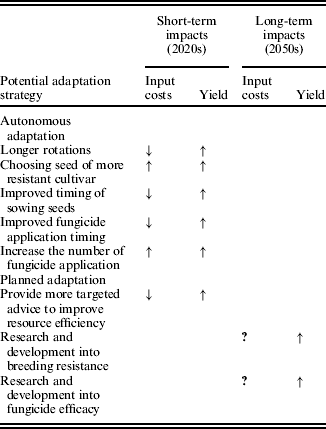
Table 1 presents a conceptual approach to understand the adaptation strategies available for an OSR farmer in the UK, together with their predicted effects on input costs and yields. Strategies that will have impacts by the 2020s are considered as short-term adaptations, and those that will have impacts, predominantly through technological development, by the 2050s as long-term strategies. Many of the short-term adaptation strategies relate to autonomous adjustments in management or behaviour by farmers. However, the long-term strategies, which require investment in research and development, would require external funding, through public or private sector investment.
Quantifiable strategies for adaptation against impacts of climate change on the severity of phoma stem canker epidemics on winter OSR and their predicted short-term and long-term impacts for farmers in the UK
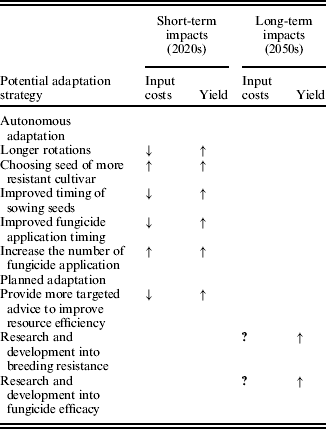
Key: ↓, negative impact; ↑, positive impact; ?, uncertain impact.
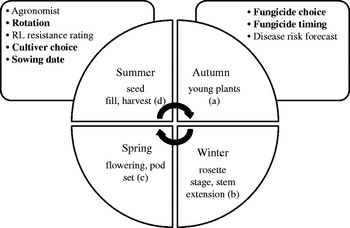
It is assumed that some proactive approach to climate change will occur as a rational response by farmers to decreasing yields. An initial adaptive response to increases in disease severity will be to use a more effective fungicide regime at the appropriate time for spraying, in autumn after the appearance of phoma leaf spots on the new crop (Fig. 1), since the use of fungicides for the control of phoma stem canker is currently often sub-optimal (Gladders et al. Reference Gladders, Evans, Marcroft and Pinochet2006). Some work has attempted to quantify the benefits of improved disease control through optimized fungicide application, by improved fungicide timing or increasing the number of applications, although the response depends on the disease resistance rating of the cultivar (Berry & Spink Reference Berry and Spink2006). Farmers may be able to optimize spray timing through increased use of web-based disease forecasts, such as the forecast developed at Rothamsted (http://www.rothamsted.ac.uk/leafspot/). However, while it may be effective in the short-term, this strategy will not offer a long-term solution to disease problems, especially since European Parliament legislation may prevent the use of several OSR fungicides (EC 1991). Another short-term disease control strategy is for the farmer to choose in summer, after harvest of the previous crop and before the new growing season in autumn, to extend rotations and/or introduce novel crops within the rotation. West et al. (Reference West, Kharbanda, Barbetti and Fitt2001) identify a 4-year break between OSR crops as effective in decreasing yield losses from phoma stem canker. With a 4-year rotation, potential yield losses can be decreased, compared to losses incurred with the shorter rotations currently used. However, there has been a recent trend to increase the frequency of OSR crops in rotations in both England and Scotland, since OSR is more profitable than some of the alternative break crops between wheat (England) or barley (Scotland) crops.
Seasonal development of winter OSR in the UK in relation to the progress of phoma stem canker epidemics and short-term farmer-led adaptation strategies. Crops are sown in late summer (Aug/Sep) and emerge within 10 days when there is sufficient soil moisture. Stem extension occurs in late winter (Feb/Mar) and is followed by flowering in spring (Apr/May) with harvest in summer (Jul). Phoma stem canker epidemics are started by air-borne ascospores of L. maculans produced on diseased crop debris in autumn/winter (Oct–Dec) with phoma leaf spot developing 10–30 days after spore release (depending on temperature) (a). L. maculans grows along leaf petioles to reach the stem (b) where early cankers may be seen in spring (Apr/May) (c); these may become severe by harvest and cause considerable yield loss (d). Farmer-led short-term adaptation strategies (in bold) include choice of rotation (e.g. increasing interval between successive OSR crops), choice of the cultivar (e.g. the selection of cultivars with greater resistance to L. maculans) and choice of the sowing date (e.g. early sowing favours disease) before the start of the growing season. In autumn, farmers can decide on fungicide, fungicide timing and frequency (to maximize control of phoma stem canker). External advice is available from agronomists, the HGCA recommended lists (resistance rating), forecasting schemes (e.g. www.rothamsted.ac.uk/leafspot/) and agrochemical company representatives.

Another adaptation strategy for the farmer may be to plant seeds of a cultivar with greater resistance against the pathogen, using the HGCA Recommended List ratings for disease resistance (http://www.hgca.com) as a guide. Berry & Spink (Reference Berry and Spink2006) also state that improved germplasm and time of sowing to improve germination of the seed and the application of nitrogen to improve establishment of the crop also affect yields. However, the use of increased nitrogen needs to be considered against increasing input costs and increasing environmental demands, particularly when there are growing demands to reduce nitrogen inputs to decrease greenhouse gas emissions and diffuse water pollution, e.g. through nitrate vulnerable zones (Glendining et al. Reference Glendining, Dailey, Williams, Van Evert, Goulding and Whitmore2008; Smith et al. Reference Smith, Martino, Cai, Gwary, Janzen, Kumar, McCarl, Ogle, O'MARA, Rice, Scholes, Sirotenko, Howden, Mcallister, Pan, Romanenkov, Schneider, Towprayoon, Wattenbach and Smith2008; Mahmuti et al. Reference Mahmuti, West, Watts, Gladders and Fitt2009). Berry & Spink (Reference Berry and Spink2006) estimate that a combination of these farmer-led adaptation practices will improve OSR yield from an average of 3 t/ha to a theoretical optimum of 6·5 t/ha. However, this also requires further government investment in applied research to improve productivity of the OSR crop and to effectively transmit knowledge to change farming practices (Gladders et al. Reference Gladders, Evans, Marcroft and Pinochet2006).
Nevertheless, a number of other ‘aversion’ strategies are available to the farmer. Strategies such as investment in crop insurance or reducing input costs to maintain farm income will not avert yield loss in the medium term, as the severity of phoma stem canker will increase over time. Butterworth et al. (Reference Butterworth, Semenov, Barnes, Moran, West and Fitt2010) estimate that yields will decrease by an average of 0·2 t/ha by the 2020s due to the climate change-related increase in disease severity, leading to a loss, at current prices, of £70 per ha (SAC 2009). In addition, the increased severity of disease will produce greater variability in farm income and, since we assume these aversion strategies cannot directly negate the losses in yield, the subsequent reductions in farm income will lead farmers to adopt strategies to negate these effects. Another ‘aversion’ response would be for farmers to remove the OSR crop from the crop rotation cycle. However, it is expected that the impact of climate change will increase the severity of diseases of some other crops, which reduces the options available to the farmer wishing to continue with crop production. Another strategy will be to exit from farming itself. OSR production is associated with a range of farm income types and some smaller farms are either merging or being subsumed by larger enterprises to reduce costs. Given the possible increases in disease severity this trend may increase. However, this is difficult to predict over such a long time-scale. Consequently, if there is some structural change in future OSR production due to these disease factors and farmers leave the industry, it will affect some of the estimates.
There is more conjecture about long-term adaptation strategies, since exogenous impacts may increase in severity and farm production may need to change radically to accommodate future crises (Beddington Reference Beddington2009). Other possible impacts could include changes to land capability, which may allow more marginal land into productive cropping, or subsequent pressures on productive land from housing (Rounsevell et al. Reference Rounsevell, Reginster, Araujo, Carter, Dendoncker, Ewert, House, Kankaanpaa, Leemans, Metzger, Schmit, Smith and Tuck2006). However, most studies have not focused at an appropriate regional or crop-specific resolution to provide adequate estimates of future changes in OSR crop areas up to the 2050s (Veldkamp & Verburg Reference Veldkamp and Verburg2004; Rounsevell et al. Reference Rounsevell, Ewert, Reginster, Leemans and Carter2005; Shepherd et al Reference Shepherd, Anthony, Temple, Burgess, Patton, Renwick, Barnes and Chadwick2007). It is outside the scope of the present paper to estimate these changes and, accordingly, it is assumed that the land area remains fixed, with the caveat that the present estimates should be taken as lower-boundary estimates.
Long-term crop disease-specific adaptations may need to focus on two areas. Firstly, investment from the private sector would mean that new, more effective fungicides appear by the 2020s. Increasing pressures would be placed on agro-chemical companies to control disease to maximize production as a contribution to global food security and to reduce the carbon footprint of agriculture (Walters et al. Reference Walters, Newton and Lyon2007; Mahmuti et al. Reference Mahmuti, West, Watts, Gladders and Fitt2009; Walters & Fountaine Reference Walters and Fountaine2009). Fungicide development should impact positively on future yields. Secondly, public and private investment would be needed to exploit new genomic and genetic technologies to breed new cultivars with more durable resistance against L. maculans, which can operate effectively to decrease severity of phoma stem canker epidemics at the increased temperatures predicted for the UK (Berry & Spink Reference Berry and Spink2006; Evans et al. Reference Evans, Baierl, Semenov, Gladders and Fitt2008; Butterworth et al. Reference Butterworth, Semenov, Barnes, Moran, West and Fitt2010).
Quantifying adaptation strategies
The estimates of Butterworth et al. (Reference Butterworth, Semenov, Barnes, Moran, West and Fitt2010) were used to predict winter OSR yields under different climate change scenarios. This exercise develops the work of Evans et al. (Reference Evans, Baierl, Semenov, Gladders and Fitt2008). Butterworth et al. (Reference Butterworth, Semenov, Barnes, Moran, West and Fitt2010) applied the UKCIP02 climate change projections to provide daily site-specific weather for the climate scenarios (Semenov Reference Semenov2007). It produced a baseline scenario calibrated to weather for the period from 1960 to 1990 and developed low (LO) and high (HI) CO2 emission scenarios for the UK for the 2020s and 2050s, producing simulated weather for five climate scenarios, namely (i) baseline, (ii) 2020LO, (iii) 2020HI, (iv) 2050LO and (v) 2050HI. Then the STICS crop growth model (Brisson et al. Reference Brisson, Ruget, Gate, Lorgeou, Nicoullaud, Tayot, Plenet, Jeuffroy, Bouthier, Ripoche, Mary and Justes2003) was used to produce data for the yield of OSR for each of the 14 sites and the five climate change scenarios.
The parameters were adjusted for typical UK soil and crop systems. This model assumes that diseases are controlled with fungicides. Thus, these predictions were combined with a phoma stem canker yield loss model (Butterworth et al. Reference Butterworth, Semenov, Barnes, Moran, West and Fitt2010) to predict the yield loss from the disease for each of the 14 sites and the five climate change scenarios.
Easterling et al. (Reference Easterling, Aggarwal, Batima, Brander, Erda, Howden, Kirilenko, Morton, Soussana, Schmidhuber, Tubiello, Parry, Canziani, Palutikof, van der Linden and Hanson2007) synthesized results from many crop adaptation strategies globally; while the benefits of adaptation differ between crops and across regions and temperature changes, on an average the adaptations provide a 10% yield benefit compared to yields without adaptation. Spink et al. (Reference Spink, Street, Sylvester-Bradley and Berry2009) estimate that the use of current knowledge could immediately increase UK average winter OSR yield by 0·5 t/ha. This could be achieved by improvements in agronomic efficiency through uptake of best practice by OSR producers. Furthermore, Berry & Spink (Reference Berry and Spink2006) estimate a theoretical yield potential of 6·5 t/ha can be achieved using the existing winter OSR germplasm. This yield potential can be achieved only by investing in genetic and agronomic research to optimize productivity of the current OSR germplasm; these objectives should be achievable in the short term. However, this increase in yield to achieve the potential of current germplasm will involve considerable directed public investment and can be considered a high-adaptation strategy for the 2020s. Spink et al. (Reference Spink, Street, Sylvester-Bradley and Berry2009) also identify other genetic improvements and priorities for research to improve yield to 9·2 t/ha. This is clearly a longer-term aim that requires effort to be directed towards genetic improvement to produce more robust and higher yielding crops. Consequently, this estimate should be achievable by the 2050s. These estimates are used to adjust those of Butterworth et al. (Reference Butterworth, Semenov, Barnes, Moran, West and Fitt2010) to account for both climate change-related decreases in yields and adaptation strategies to decrease losses.
Aggregation of results
The outputs from the OSR model provided predictions of the effects of climate change on OSR yields for 14 sites across the UK for the five different scenarios. The results for each site were then mapped onto the OSR-growing areas of the UK. Data for areas grown and the division of regions were taken from the DEFRA Agricultural and Horticultural Survey (DEFRA 2008a) and the Economic Report on Scottish Agriculture (Scottish Government 2008). It should be noted that there is a discrepancy between the total land area dedicated to OSR production in Scotland in these studies. Butterworth et al. (Reference Butterworth, Semenov, Barnes, Moran, West and Fitt2010) and Evans et al. (Reference Evans, Butterworth, Baierl, Semenov, West, Barnes, Moran and Fitt2010) used a total of 398 720 ha. However, the actual area for the 2006 period was 35 780 ha (Scottish Government 2008). The present authors correct this mistake by using the latter area provided by the Scottish Government.
The results were compiled on the assumption that the areas of OSR grown will remain unchanged over the time period since, as discussed above, there are no robust estimates for land use change up to the 2050s at an appropriate resolution. The results were compiled at the scale of regional authority and then accumulated to be presented by geographic region, and as UK totals. In addition, the economic value of each scenario was calculated. Present values have been calculated at the 3·5% inter-temporal discount rate for 2020s and 3·0% for the 2050s as recommended in the UK Treasury Green Book (Anon 2003). Present value figures show the economic benefit today from a good produced in the future. This therefore enables an estimate to be made of the maximum investment required in adaptation strategies to prevent losses in the future.
The average price per tonne of OSR was estimated by taking a 7-year average from 2002 to 2008 from the SAC Farm Management Handbook. All monetary figures are given at current prices at the time of writing. Since the results have been obtained for only two future periods, the 2020s and 2050s, the present value stream of the effects of adaptation cannot be calculated. Nevertheless, the figures given illustrate the anticipated annual costs and the value of these future costs, current at the time of writing, and they demonstrate the current cost of the impacts of climate change and benefits of adaptation in these periods.
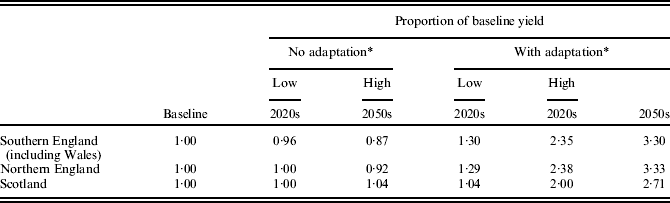
RESULTS
Yield
Table 2 compares the yields expected using the 14 sites of Butterworth et al. (Reference Butterworth, Semenov, Barnes, Moran, West and Fitt2010), aggregated for southern England (and Wales), northern England and Scotland. The yield estimates assume both crop growth and the impact of phoma stem canker. These are presented as an index of change compared against average yields with no-adaptation for low- and high-adaptation strategies for the 2020s along with a further genetic adaptation by the 2050s. A prediction of Butterworth et al. (Reference Butterworth, Semenov, Barnes, Moran, West and Fitt2010) was that Scotland will benefit from climate change, since an increased temperature will improve yield and only slight epidemics of phoma stem canker, which will be most severe in the south during the time period studied. Consequently, the ‘no-adaptation’ scenario shows no discernable effect on yields in the 2020s and a slight increase in the 2050s for Scotland. Ultimately, increased global warming is predicted to increase the range and severity of phoma stem canker and, post-2050s, yields will decrease in Scotland. However, up to this period, farmers in Scotland may not have any incentive to adopt adaptation strategies, since they are experiencing no loss in yields. Consequently, the adaptation scenarios for Scotland are presented to show the comparative benefits of particular strategies, in addition to the predicted benefits with no adaptation (Butterworth et al. Reference Butterworth, Semenov, Barnes, Moran, West and Fitt2010).
For northern England, as with Scotland, the effect of disease on yield is negated by other factors up to the 2020s; however, declines in yields are predicted after this period. This also complicates the response to adaptation to climate change since, outwardly, there is no specific climate-related incentive to adapt to measures in the short term. The main incentive may possibly be related to a ‘catch-up’ effect (Schimmelpfennig & Thirtle Reference Schimmelpfennig and Thirtle1999) in which some of the strategies and technologies adopted for southern English farmers will also be adopted by northern English and Welsh farmers, effectively through knowledge transfer schemes. Hence, while the incentive for adaptation is smaller for northern English farmers, the opportunities have increased for the uptake of these strategies.
However, there is no doubt that southern English farmers will have to adapt, since global warming will directly decrease their yields in the short term. Consequently, these farmers are the most likely to investigate adaptation strategies to negate loss in yield. What is also noticeable from Table 2 is the benefit of adaptation effects compared to present yields. Thus, for the sites in the worst-affected region (the South), yields could increase by around 30% above values current at the time of writing for even the low-adaptation strategy. This is an achievable combination of present knowledge, practice and directed production-specific information. Consequently, as hypothesized, if decreasing yields force farmers to adopt best management practices, they will benefit from this strategy.
Impacts of different adaptation strategies on yield of winter OSR under different climate change scenarios (baseline=1·00)
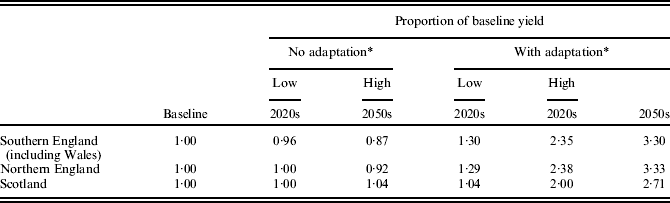
* Average of HI/LO CO2 scenarios.
These improvements in yield may satisfy farmers and policy makers in the short term, so that a high-adaptation strategy may not have enough political impetus up to the 2020s, since it requires much more government funding to achieve these targets than does a low-adaptation strategy. Naturally, this also depends on future policies towards OSR and increasing competition for food crops. The recent EU directive on Energy (EC 2008) does require an increase in the use of biofuels for transport fuels, of which about half of the target must not compete with land for food production. Hence, investment in increasing the output per hectare of biofuel OSR may prove more attractive to policy makers, since this could result in a reduced need for land, leaving more land for food production and other uses, such as recreational tourism or natural ecosystems to encourage biodiversity.
Finally, the quantifiable strategy offered for the 2050s assumes improvements in the genetic potential of the OSR crop. It can be considered as the theoretical optimum, given future research effort and understanding of its application by farmers. All regions will benefit. However, while, under the static scenarios of Butterworth et al. (Reference Butterworth, Semenov, Barnes, Moran, West and Fitt2010), Scotland benefits more from climate change impacts elsewhere, this situation is reversed when adaptation is considered since the benefits for England and Wales are greater than those for Scotland, for all the scenarios. Thus, for English farmers, the incentive for adaptation may be much greater.
National production
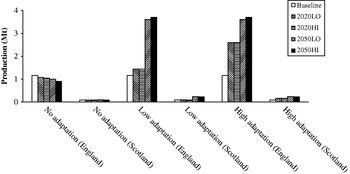
These estimates were then used to calculate potential national production of OSR. For comparative purposes, it has been assumed that the arable land area cropped with OSR remains constant to that of the 2006/07 growing season up to the 2050s. Production estimates are also presented for both high- and low-CO2 IPCC scenarios (Nakicenovic Reference Nakicenovic2000). The estimates of Butterworth et al. (Reference Butterworth, Semenov, Barnes, Moran, West and Fitt2010), corrected for OSR land area in Scotland, are presented in Fig. 2 as the ‘no-adaptation’ strategy and indicate a decrease in English production of c. 23% by the 2050s, whereas for Scotland production increases by 14% above baseline levels. Nevertheless, there are clear benefits from adaptation for both regions. For the 2020s, the adaptation benefits range from a 2% increase in production for Scotland for the low-adaptation/low-CO2 scenario, to an increase of c. 130% in production for the high-adaptation/high-CO2 scenario for England. Production increases substantially by the 2050s, to an optimum of 3·6–3·7 Mt of OSR for England and 0·23–0·24 Mt for Scotland. These values represent clear benefits against the no adaptation scenario for both farmers and UK agricultural production of oilseeds. While these estimates are based on the assumption that the area of OSR does not change, there may be pressures on land for both food production and other uses, such as housing. Nevertheless, the improvements in yield from adaptation could still provide significant increase in production from a reduced area of land.
Impacts of different adaptation strategies on the total production (metric tonnes) of winter OSR in England (northern, southern and Wales combined) and Scotland under different climate change scenarios.

Economic benefits
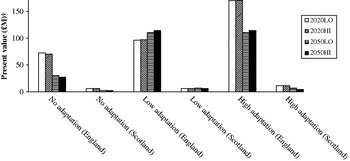
The production estimates were converted into economic values to give an indication of the contribution of OSR to UK GDP growth and the economic benefits of adaptation scenarios. Present prices were adopted for these estimates as an average of 2002–08 and then, to provide an indicator of present value, future values were discounted using the HM Treasury recommended discount factor of 3·5% for 2020, and 3·0% by 2050 (Fig. 3). For England, by the 2020s the difference between adaptation and no-adaptation ranges from increases of £24·1M for low-adaptation strategies to £100·2M for high-adaptation strategies. For Scotland, which already benefits from climate change, there is also an increase in the economic value of OSR through adaptation. The benefit for Scotland will range from £0·14M for a low-adaptation strategy to £5·2M for a high-adaptation strategy. Accordingly, for mainland UK, high adaptation could bring a benefit of more than £105·4M for the UK economy. Thus, these returns from promoting a high-adaptation strategy by the 2020s may substantially outweigh the costs of research and knowledge transfer needed to implement this strategy.
Present values of economic impacts of different adaptation strategies on winter OSR production under different climate change scenarios in England (northern, southern and Wales combined) and Scotland (these data are calculated for an average price over the period 2002 to 2008). †Discounted at 3·5% (2020) and 3% (2050).

The process of discounting means that values in the future are worth less than those in the present day. Consequently, the differences between adaption and no-adaptation strategies decrease in the 2050s scenarios, principally because of this discounting effect. Nevertheless, there are still significant advantages to the adaptation of around £86·5M in England and £4·3M in Scotland. To realize these gains, significant investment is required by both the public and private sectors into breeding for improved disease resistance (Moran et al. Reference Moran, Barnes and Mcvittie2007). Consequently, these future costs will also have to be calculated, and subsequently discounted into present values, to provide an indication of whether the benefits would exceed the costs.
DISCUSSION
The present work demonstrates that there are considerable benefits of adaptation to climate change, especially in areas like southern England and Wales, where the profitability of OSR cropping is expected to decrease under climate change if no adaptive measures are implemented (Evans et al. Reference Evans, Baierl, Semenov, Gladders and Fitt2008; Butterworth et al. Reference Butterworth, Semenov, Barnes, Moran, West and Fitt2010). Furthermore, it shows that it is essential to adopt a quantitative, rather than just a conceptual approach, so that the costs and benefits of short-term and long-term autonomous and planned adaptation strategies can be properly assessed. For winter OSR production in southern England and Wales, appropriate action for managing the disease risk must be considered. These predictions show that, with successful adaptation, yields can be increased above those of the baseline scenario suggested by previous studies under climate change. The benefits of improving disease resistance in OSR in relation to climate change are clear (Mahmuti et al. Reference Mahmuti, West, Watts, Gladders and Fitt2009), although this adaptation strategy is long-term. By contrast, increasing the application of fungicides is a short-term strategy, which may not be possible to maintain indefinitely.
The estimates suggest that the benefits of adaptation are also considerable for northern England and Scotland, although they are smaller than for southern England and Wales since the impacts of climate change on OSR production in these areas are less (Butterworth et al. Reference Butterworth, Semenov, Barnes, Moran, West and Fitt2010; Evans et al. Reference Evans, Butterworth, Baierl, Semenov, West, Barnes, Moran and Fitt2010). Furthermore, the present paper may underestimate the benefits for these northern areas, because it does not account for light leaf spot, currently the main disease in these areas (Fitt et al. Reference Fitt, Doughty, Gladders, Steed and Sutherland1998; Gilles et al. Reference Gilles, Evans, Fitt and Jeger2000), which is expected to decrease in importance with climate change (Evans et al. Reference Evans, Butterworth, Baierl, Semenov, West, Barnes, Moran and Fitt2010). Conversely, the introduction of shorter rotations as an adaptation response may increase the severity of clubroot (Plasmodiophora brassiccae). Accordingly, the present work could be expanded to explore the interactions with other pests and diseases (e.g. Oerke Reference Oerke2006).
One possibility is that OSR production will move to the north of England and Scotland. Butterworth et al. (Reference Butterworth, Semenov, Barnes, Moran, West and Fitt2010) suggest that climate change will increase the yield and profitability of OSR cropping in Scotland, with the greatest increases expected under the high-carbon emission scenario. This may strengthen the argument for a rational response amongst farmers for adopting more substantial adaptation strategies. The extent to which a move in production further northwards will occur will be limited by, amongst other factors, land suitability and changing land-uses, and may possibly result in some marginal land being brought into production. Indeed, some effort needs to be directed towards projecting land use at an appropriately detailed scale to help refine the estimates offered here (e.g. Rounsevell et al. Reference Rounsevell, Annetts, Audsley, Mayr and Reginster2003). At present, the implications of projected changes due to adaptation are uncertain and depend on many factors including farmer behaviour, land-use policy and market conditions (Parry et al. Reference Parry, Canziani, Palutikof, Van Der Linden and Hanson2007).
The challenges posed by a changing climate, while important, must also be balanced against other external pressures faced by farmers. More detailed work on how farmers respond to external stimuli has been done (Toma & Mathijs Reference Toma and Mathijs2007; Pike Reference Pike2008), although little of this work has considered how farmers will respond to climate change-related disease impacts. Decisions would be influenced by factors that include changes in international markets, agricultural and environmental policy, mitigation activity (particularly biofuels) and consumer preferences (van Tassell & Keller Reference Van Tassell and Keller1991; Holloway & Ilbery Reference Holloway and Ilbery1997; Sherrington et al. Reference Sherrington, Bartley and Moran2008). The estimates of future adaptation are further complicated by the market structure in which crop producers operate. Crop breeders, processors and other agents within the supply chain have a considerable influence on how technologies are adopted within the industry. This is particularly true for the high-adaptation strategies, as they require manipulation of germplasm and the improvement of genetic stock. While some work has been done to estimate the economic influence and activity of the supply chain (Frolich & Westbrook Reference Frolich and Westbrook2001; Lindgreen & Hingley Reference Lindgreen and Hingley2003; Sohal & Perry Reference Sohal and Perry2006), no studies have considered how these agents may influence adaptation strategies or how they could evolve to realize these benefits. This therefore requires further investigation.
The present work demonstrates that it is essential to include the influence of strategies for adaptation in any assessment of impacts of climate change on crop production, since farmers are rational and will respond accordingly to the impacts of climate change. Much effort has also been directed towards promoting best practices by Government agencies (DEFRA 2008b). However, recent work by MacLeod et al. (Reference MacLeod, Moran, Eory, Rees, Barnes, Topp, Ball, Hoad, Wall, Mcvittie, Pajot, Matthews, Smith and Moxey2010) and Barnes et al. (Reference Barnes, Moran and Topp2009) has demonstrated the inefficiencies under which most farmers operate and how the uptake of best management practices can be improved. Nevertheless, the adaptation strategies require funding from the public and private sectors on knowledge exchange mechanisms to fully realize these gains. The present paper provides a basis for assessing the potential economic benefits of pursuing adaptation strategies and, hence, their feasibility when weighed against appropriate costs of implementation. The low-adaptation strategy incurs smaller costs but still requires some government and industry investment to provide information and promotion of best management practices. More directed high-adaptation strategies require increased funding for public and private sector research and development. When combined with increased efforts to promote adoption of these strategies, the cost-benefit ratio becomes much greater. However, it is clear that adaptation to climate change in terms of disease control makes a cost-effective, essential contribution to improving food security.
The authors acknowledge the UK Biotechnology and Biological Sciences Research Council (BBSRC; Rothamsted Centre for Bioenergy and Climate Change Institute Strategic Programme Grant), Department for Environment, Food and Rural Affairs (DEFRA, OREGIN), the Scottish Government Rural and Environment Research and Analysis Directorate for funding this research and the British Society for Plant Pathology for supplementary funding to M.H.B. We also thank Jon West (Rothamsted Research) and Peter Gladders (ADAS) for data and the Sustainable Arable LINK programme (PASSWORD, CORDISOR, CLIMDIS) for funding research used for construction of the original OSR and phoma stem canker models.