When a Canadian exchange student returns home from a semester abroad in the capital city of China, she might tell her friends that she had Peking duck every day, but she would never, as a 21st-century liberal arts student, say that she stayed in Peking for a semester. Rather, she would say Beijing, as would most English speakers in the present day. But such discrepancies between English transliterations of Chinese words are far from uncommon. Is it the Nanking Massacre or the Nanjing Massacre? Who is the author of Tao Te Ching: Lao-Tzu or Laozi? What, then, is the Daodejing? This paper will focus on the English representation of Mandarin Chinese phonology, particularly the consonant sounds. The inconsistency of English transliteration of Mandarin is caused by historical exchanges and encounters between the British and the Chinese and a lack of a monolithic standardization of Mandarin. Paradoxically, while these transliterations attempt to unify and standardize themselves and the representation of Mandarin sounds, they simultaneously represent the concept of a diverse Mandarin.
Inconsistency within English transliteration is firstly attributed to the many different systems. These systems, invented by both Chinese and Westerners, include Latinxua Sinwenz, Gwoyeu Romatzyh (Chappell, Reference Chappell1980), and Yale (Wiedenhof, Reference Wiedenhof and Lee2004). The two most prominent systems of transliterations of Mandarin are Wade-Giles and Pinyin. Wade-Giles, established in the 19th century (Kaske, Reference Kaske2008) is named after Herbert Allen Giles, who used this in his Chinese-English dictionary, and Thomas Francis Wade, who created the system of spelling (Wiedenhof, Reference Wiedenhof and Lee2004). Pinyin, on the other hand, is an entirely Chinese invention. It was ‘[designed] during the mid-1950s and promulgated in 1958 by the government of the People's Republic of China’ (Chen, Reference Chen1999: 186–187). It is also the current official transliteration system, having been adopted by the International Standardization Organization in 1982 (Chen, Reference Chen1999). An author's choice to use any particular system depends on his academic, political, social, or historical biases, as well as the time period in which and from which he writes. Before 1980, Wade-Giles was the widely used system. For example, the 1955 R. B. Blakney translation of Laozi's Daodejing (both spellings here are Pinyin) is titled Tao Té Ching. The 1958 Archie J. Bahm translation is titled Tao Teh King. On the other hand, in J. J. Clarke's 2000 book Tao of the West: Western Transformation of Taoist Thought, he uses the Pinyin ‘Dao’ and ‘Daodejing’.
These examples show the interchangeable use and mixture of transliteration methods and that transliterations are often inconsistent within themselves. Although J. J. Clarke uses Pinyin in his book, the title of the book uses the Wade-Giles forms of ‘Tao’ and ‘Taoist’. This usage of both systems can be confusing, especially for readers unfamiliar with different transliteration systems. According to a Wade-Giles to Pinyin conversion table, the standard Wade-Giles of Daodejing would be Tao Te Ching (Tao & Cole, Reference Tao and Cole1991). However, Blakney and Bahm both use a slight variation of this system. Another translation, by Stephen Addiss and Stanley Lombardo, uses this standard title. The Addiss and Lombardo translation was also published in 1993, which is quite recent for Wade-Giles to be still used. In the Bahm edition, he makes footnotes regarding the variations and spellings of certain words. On ‘Tzu’ (zi in Pinyin), Bahm remarks that it can also be spelled ‘Tzŭ, Tsu, Tse, Tsze, Tz, Ts, Tzyy, Dz’ and ‘[pronounced] explosively, like the “tz” in tzar or the “ts” in nuts’ (Bahm, Reference Bahm1958: 71). These variations show just how inconsistent and non-standardized a transliteration system can be. Moreover, Bahm gives the following guide to pronouncing ‘Tao’: ‘Pronounced “dao” or “dow” with an explosive “d”’ (Bahm, Reference Bahm1958: 73). He is correct that the /t/ should be /d/, which only highlights the discrepancy between the spellings of Wade-Giles and the actual Mandarin pronunciation.
Indeed, the biggest problem with Wade-Giles is its failure to accurately represent Mandarin sounds. Addiss and Lombardo's Tao Te Ching includes transliterations of some key quotations of the book. In Chapter 1 they transliterate the first line ‘Tao called Tao is not Tao’ into ‘Tao k'o tao fei ch'ang tao’ (Addiss and Lombardo, Reference Addiss and Lombardo1993: 1). The Pinyin transliteration would be ‘Dao kedao feichang dao’. Here /d/ is represented with /t/. In another section, the sentence ‘Heaven is long, Earth enduring’ is transliterated as ‘T'ien ch'ang ti chiu’ (Addiss & Lombardo, Reference Addiss and Lombardo1993: 7). In Pinyin it is ‘Tianchang dijiu’. Here, the /t/ is also transcribed as /t/, but in Mandarin, /t/ and /d/ are as distinct from each other as they are in English. Furthermore, we see that the /ch/ is in both ‘ch'ang’ and ‘chiu’, whereas in Pinyin they begin with /ch/ and /j/, respectively. My last example from this translation is the transliteration of ‘Crippled becomes whole’ (Addiss & Lombardo, Reference Addiss and Lombardo1993: 22). The Wade-Giles is ‘Ch’ü tse ch’üan’ and the Pinyin is ‘quzequan’. Again /ch/ is used for /q/, which suggests that all these sounds – /ch/, /j/, and /q/ – are the same when they are in fact different from one another. In addition, /ts/ is used to represent /z/ in this phrase, yet the /z/ in Laozi is written as /tz/ in most English editions of the book. Clearly, even within one translation of a generally ‘standard’ system, inconsistency prevails.
Whilst it is perhaps only to be expected to observe such inconsistencies in the past, it is more surprising to find that they continue to be perpetuated in present-day dictionaries. The word ‘Dao’ does not exist in the Oxford English Dictionary (OED), but ‘Tao’ does. In the pronunciation guide, the OED lists both /taʊ/ and /d-/ (OED, tao, n., 1). The most recently cited quote in this entry is from 1980, which would have been around the time when Pinyin was becoming more standard and prominent outside of China (Tao & Cole, Reference Tao and Cole1991). Yet, the OED has not attempted to update this entry with ‘Dao’, which would have certainly been cited many times since 1980. In the online Oxford Dictionaries ( En.oxforddictionaries.com), ‘Dao’ also does not have its own entry, but redirects to ‘Tao’, whereas in the OED there is no such redirection. In its pronunciation guide, the Oxford Dictionaries separates American English from British English. The American English pronunciation is written as /dou/, while the British English one is written as /taʊ/, /ˈtɑːəʊ/, /tou/ (En.oxforddictionaries.com, Tao, n.). Transliteration and pronunciation then, often reflect the regional English traditions as well as the original Mandarin.
The separation between American and British English pronunciation illustrate that the former has somewhat adapted the proper Mandarin pronunciation, whereas the latter still suffers from Anglicization or non-Mandarin influences. Perhaps American English uses the Pinyin more than British English. For instance, in the British English version of the Oxford Dictionaries, ‘qi’, which means ‘air, breath, vital energy’, is directed to Wade-Giles ‘chi’ but stays as the Pinyin ‘qi’ in the American English version. However, in the American Merriam-Webster (2015), ‘qi’ is redirected to ‘chi’, which suggests that even within British or American English there is no set standard; only ‘Dao’ and its variants (‘Daoism’, ‘Daoist’) seem to still be transcribed with a <t> in all these dictionaries. That dictionaries, the corpus of standard spellings, have such disparate spellings of these Chinese words, can explain why Addiss and Lombardo's Tao Te Ching and Clarke's book still uses Wade-Giles, even into the late 20th century.
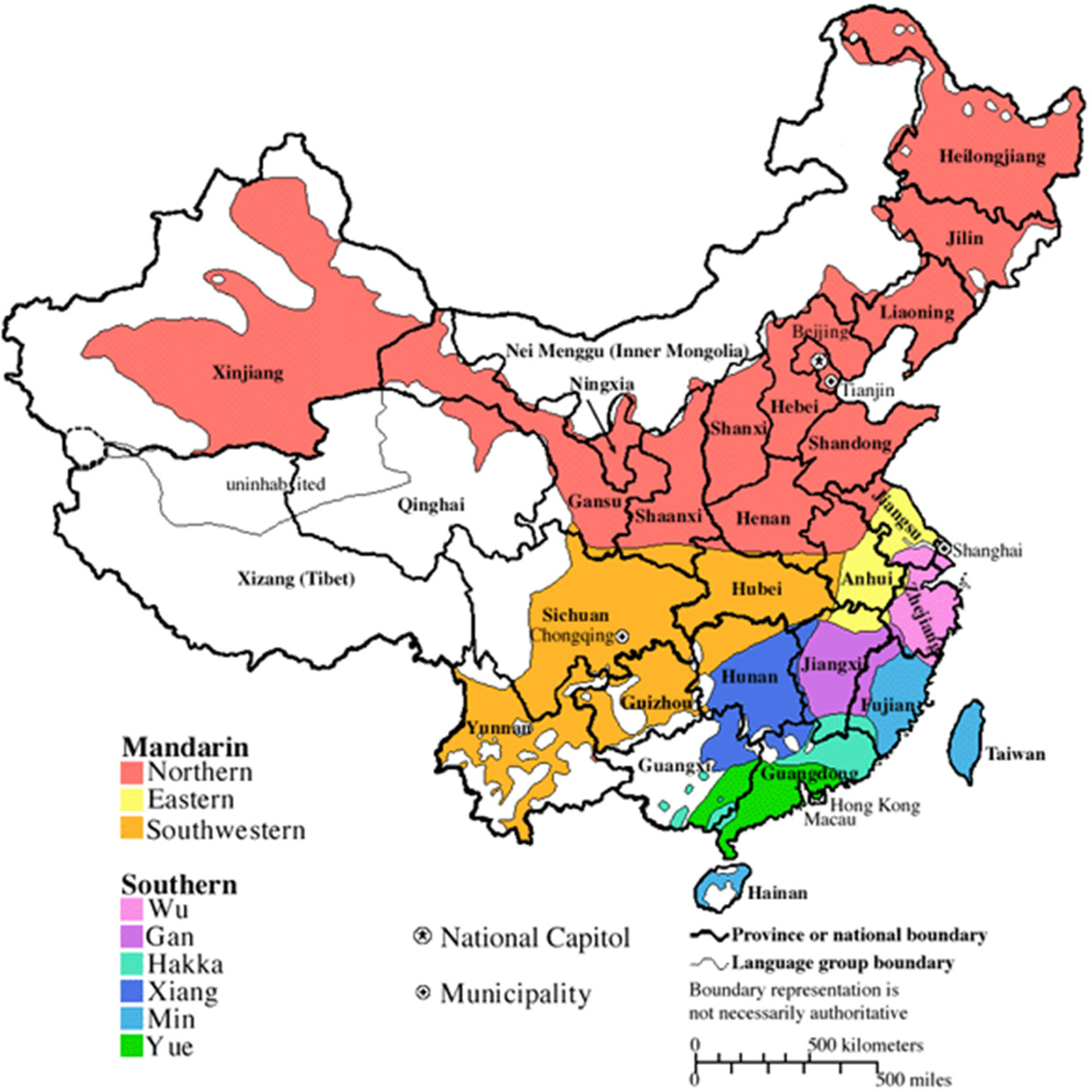
While Wade-Giles and variants are far from sufficient at transliterating, they are of enduring interest in that they illustrate the history of Sino-British relations. The first documented known contact between the two nations was in 1673, when the British tried to open trade with the Chinese (Mundy, Reference Mundy1875). For approximately the next two centuries, this contact remained in the southern provinces of China. Guangzhou (also known as Canton) ‘was the first port, and for a long time the most important one, with which the English carried on trade intercourse [but has] been eclipsed by its younger rivals, Shanghai and Foo-chow … ’ (Mundy, Reference Mundy1875: 89). All of these cities are considered southern cities (see Figure 1), Shanghai being the most northern of the group.
Mandarin and Southern Chinese Split (Dartmouth.edu, 2003a)

In this case, then, the languages that the British heard – the southern languages – would have been different, sometimes very much so, from the northern languages, like the ones spoken in the northeastern provinces. Figure 2 shows the language group that the southern provinces speak. Guangdong speaks Cantonese, which is a prominent variation within the Yue group, and Fuzhou (Foo-chow in Mundy's quote) is part of the Min group.
Dialects of Mandarin and Southern Chinese (Dartmouth.edu, 2003b)

Given these different language groups within mainland China, Wade-Giles, as well as other Western systems of transliteration, are bound to be influenced by these different dialects. In Mandarin the word for television is ‘dianshi’, but in Gan dialects, the word is something similar to ‘tianshi’ (X. Zhou, personal communication). Here, /d/ really is pronounced /t/, which is how Wade-Giles transcribes the sound. Another hard to transcribe sound is /x/ in Mandarin. The Chinese word for star, for instance, is “xing”. According to Gu's Table 9, the Mandarin IPA pronunciation is /ɕiŋ/, but the Cantonese and Fuzhounese pronunciation is /siŋ/, with a clearer /s/ (Gu, Reference Gu and Brown2006). Thus, the Wade-Giles transcription of /x/ as /hs/ is more understandable (Tao & Cole, Reference Tao and Cole1991). If the British were predominantly in contact with the southerners, then they cannot be blamed for transliterating the /d/ sound, like in ‘Daoism’, as a /t/ since this is the correct, or common, pronunciation as far as they knew. In this case, Wade-Giles is not necessarily a ‘bad’ or ‘wrong’ system of transliteration.
When considered individually, the inconsistencies discussed so far are nothing more than just variations between different transliteration systems. When considered together, however, these inconsistencies become interesting in a different way; specifically, they seem to call the concept of Mandarin as a single, consistent and fully standardized language into question. I have alluded to this idea rather vaguely throughout this paper thus far. Like Yue and Gan, and contrary to popular perception, Mandarin is not one language, but a group of languages, consisting of different dialects. Figure 2 shows that Mandarin is separated into three groups: northern, eastern, and southeastern. Mandarin and all the other language groups ‘are roughly parallel to English, Dutch, Swedish, and so on among the Germanic group of the Indo-European language family. If we pursue the analogy further, we may refer to various supposedly more or less mutually intelligible dialects of Mandarin such as Peking, Nanking, Shantung … ’ (Mair, Reference Mair1991: 3). Therefore, English cannot possibly transliterate Mandarin since the latter does not exist as a single language.
What is commonly considered as Mandarin is just one form of it – Putonghua. It literally translates to ‘common language’. It is based on other Mandarin dialects like Beijingese, but includes others as well (Mair, Reference Mair1991). However, it is still different enough from some other Mandarin dialects like Sichuanese. For example, the /h/ in /ch/, /sh/, and /zh/, and other similar sounds is often dropped in Sichuanese but kept in Putonghua and Beijingnese. (Even within Sichuanese there are regional variations, and some actually do keep the /h/). A speaker of Sichuanese would most likely pronounce words like ‘dianshi’ as ‘diansi’ and ‘zhou’ as ‘zou’ (Zhao, personal communication). These disparities show that most transliteration systems attempt at unifying an extremely intricate system of languages and dialects that, for most of history, have not gone under any sort of overhauling standardization.
English underwent a monolithic standardization and unification throughout the early modern period, but the standardization of Mandarin phonology only happened within the last century, and it has not been an easy process. Putonghua's predecessor, Guoyu, proposed by the National Party, initially ‘proved to be untenable, for it was next to impossible to promote such a language without natural speakers’ (Gu, Reference Gu and Brown2006: 345). Later, this idea was developed by the Chinese Communist Party (Mair, Reference Mair1991). In most Chinese provinces, the local dialects are spoken in everyday life; Putonghua is reserved for formal education, media, and the commercial world (Zhou, Reference Zhou2002), and a way for the government to assert political, cultural, and social dominance. Although it officially became the national language of China in 1956 (Zhou, Reference Zhou2002), it is only in the most recent generations after 1980 that are able to speak it with the most proficiency. The older generations, having lacked the standardized education taught in Putonghua, are less able to assimilate to the new language fully; they will often have an accent (Zhao, personal communication). Compared to the older dialects of Wu, which has been around for over 3,000 years, and Yue, which dates back to more than 2,000 years (Zhou, Reference Zhou2002), Putonghua is barely out of the embryonic stage.
Pinyin, as the official romanization system for Putonghua and just as new (Chen, Reference Chen1999), is not necessarily accurate. Although it uses the Latin alphabet, the pronunciation of a lot of the letters, especially consonants, are quite different from English. In my previous example of ‘xing’, Mandarin for star, I have mentioned that Wade-Giles would transliterate the with <hs>. A native English speaker would never know to pronounce <x> as /ɕiŋ/; likewise, an English speaker would never pronounce <c> as /ts/. Here Wade-Giles is actually a helpful pronunciation guide regarding these harder consonants, even if it still incites some head-scratching moments with others. Therefore, Pinyin is only a good transliteration system for those already familiar with it; for others, it is just as confusing as, if not more so than, any other method. Historically, Pinyin, being as new as Putonghua, also excludes the other languages and dialects of Mandarin, when in fact these languages and dialects are older and more culturally significant to their respective speakers. Beyond that, they are more significant, as previously explained, in influencing English understanding of Mandarin phonology.
If Mandarin itself is not unified and has only begun to have a system of standardization, English cannot be expected to successfully represent the different phonologies of this language group. The earlier British contact with China would have had very rare northern Chinese influences. ‘Proper’ Putonghua rarely exists in daily life, if at all. As such, Wade-Giles and Pinyin, as well as other systems, reflect the complexity of Mandarin Chinese and the plethora of phonologies within it. From a purely linguistic point of view, perhaps English transliterations have failed, and are likely always to fail. But socially and historically, they successfully recreate the diversity of the concept of Mandarin in English. As a present day Chinese speaker (of any of its languages) would be accustomed to many different accents, Mandarin or otherwise, of Putonghua, so too should an English speaker grow accustomed to and tolerate the equally diverse systems of transliteration.
 SOPHIE ZHOU is a recent graduate of English from the University of Toronto. Her interest in linguistics was inspired by a History of English course, and she hopes to continue to pursue this passion in her personal and professional lives, focusing on sociolinguistics and historical linguistics. As a future educator, she hopes to share her love of words and language with all her students. Email: sophiezhou3@gmail.com