Introduction
Chagas disease is an infection caused by the parasite Trypanosoma cruzi. According to the estimates of WHO based on 2010 data, about 5.8 million people were infected with T. cruzi only in 21 Latin American countries (WHO, 2015). During the chronic phase, the infection is diagnosed by detecting specific antibodies (Abs) against T. cruzi antigens (Ags) in a patient's serum. Detection is accomplished via conventional screening serological methods based mostly on enzyme-linked immunosorbent assay (ELISA), indirect haemagglutination (IHA) or indirect immunofluorescence (IIF). Chronic Chagas disease (CCD) diagnosis is determined when specific Abs are detected by at least two of these methods. In cases with ambiguous or discordant results, a third assay procedure is used to confirm or discard the condition, since at least two positive results of different techniques are required (WHO, 2002). The current trend is to produce immunodiagnostic assays based on recombinant proteins as sensitizing elements to improve the diagnostic performance, achieve more standardized assays, reduce costs and avoid the use of pathogenic microorganisms (Houghton et al. Reference Houghton, Benson, Reynolds, McNeill, Sleath, Lodes, Skeiky, Leiby, Badaro and Reed1999; da Silveira et al. Reference da Silveira, Umezawa and Luquetti2001; Aguirre et al. Reference Aguirre, Silber, Brito, Ribone, Lagier and Marcipar2006; Camussone et al. Reference Camussone, Gonzalez, Belluzo, Pujato, Ribone, Lagier and Marcipar2009; Praast et al. Reference Praast, Herzogenrath, Bernhardt, Christ and Sickinger2011; Granjon et al. Reference Granjon, Dichtel-Danjoy, Saba, Sabino, Campos de Oliveira and Zrein2016; Santos et al. Reference Santos, Celedon, Zanchin, Souza, de Silva, da Foti, Krieger and Gomes2017). However, as single Ags are often not sensitive enough, mixtures of these Ags are commonly used (WHO, 2010). In order to improve the performance of an immunoassay prepared with multiple Ags, multiepitope proteins expressing several unrelated antigenic determinants have been also proposed (Houghton et al. Reference Houghton, Benson, Reynolds, McNeill, Sleath, Lodes, Skeiky, Leiby, Badaro and Reed1999, Reference Houghton, Benson, Reynolds, McNeill, Sleath, Lodes, Skeiky, Badaro, Krettli and Reed2000; Aguirre et al. Reference Aguirre, Silber, Brito, Ribone, Lagier and Marcipar2006). This strategy would offer several advantages, such as (i) a decrease in the amount of Ags used in the immunoassays, (ii) controlled proportion of antigenic determinants that are displayed to Abs, (iii) increased number of epitopes available on the same surface, (iv) simpler production processes (da Silveira et al. Reference da Silveira, Umezawa and Luquetti2001; Marcipar and Lagier, Reference Marcipar, Lagier and Rodriguez-Morales2012).
Several chimeric Ags have been described to be used for the diagnosis of CCD (da Silveira et al. Reference da Silveira, Umezawa and Luquetti2001; Marcipar and Lagier, Reference Marcipar, Lagier and Rodriguez-Morales2012). These previously reported chimeras were composed mainly of different combinations of FRA, CRA, SAPA, TcD, MAP, B13, TcE, Tc29 T. cruzi Ags. In the present work, a novel chimeric multiepitope construct (CP3) was synthesized. Highly conserved antigenic sequences (MAP and TcD), which have shown to be useful when incorporated in chimeras, were fused with mucin-like glycoprotein (TSSAII/V/VI). This antigenic determinant is displayed on the surface of infective trypomastigote forms of parasite lineages II, V and VI (Di Noia et al. Reference Di Noia, Buscaglia, De Marchi, Almeida and Frasch2002). This Ag has been assessed individually, in mixtures or in an array with other proteins to diagnose CCD, and has been found to be a promising candidate; to date, however, it has not been used in chimeras (De Marchi et al. Reference De Marchi, Di Noia, Frasch, Amato Neto, Almeida and Buscaglia2011; Balouz et al. Reference Balouz, Cámara, Cánepa, Carmona, Volcovich, Gonzalez, Altcheh, Agüero and Buscaglia2015; Granjon et al. Reference Granjon, Dichtel-Danjoy, Saba, Sabino, Campos de Oliveira and Zrein2016).
In a previous work, we reported that, among different recombinant Ags candidates, the multiepitope Ag CP1 carrying FRA and SAPA was the most promising one (Camussone et al. Reference Camussone, Gonzalez, Belluzo, Pujato, Ribone, Lagier and Marcipar2009). In the present study, we aimed to assess the diagnostic performance of the new Ag CP3 to detect T. cruzi chronic infection by developing an indirect ELISA and determining if it could enhance discrimination ability of CP1 protein.
Materials and methods
Production and purification of antigenic recombinant protein
The CP3 gene was synthesized by Integrated DNA Technologies (IDT, Coralville, Iowa, USA). The synthetic gene, with 375 base pairs, encodes three T. cruzi-specific antigenic proteins: MAP, TcD and TSSA. The gene was subcloned into the EcoRI/SacI sites of pET-28a (Novagen, Madison, WI, USA); the resulting plasmid was named pET28a/CP3. The CP1 clone, previously described by our group (Camussone et al. Reference Camussone, Gonzalez, Belluzo, Pujato, Ribone, Lagier and Marcipar2009), was subcloned in pET28a into the EcoRI/SacI sites of pET-28a (Novagen, Madison, WI, USA); the resulting plasmid was named pET28a/CP1.
Expression and purification
BL21 (DE3) competent Escherichia coli cells were transformed with pET28a/CP3 and pET28a/CP1 plasmids by thermal shock at 42 °C for 45 s. The bacteria expressing different proteins were cultured in Luria-Bertani medium supplemented with kanamycin. Cells were grown overnight at 37 °C under agitation until OD500 ~0.5–0.6 and induced at room temperature with 0.1 mm IPTG during 16 h. Cells were harvested by centrifugation at 5000 rpm for 5 min. After that, they were resuspended in distilled water and disrupted by sonication on ice (Vibre-Cell, Sonic & Material Inc) until culture clarification. The suspension was centrifuged at 10 000 rpm for 5 min and four volumes of the supernatant (crude extract) were supplemented with one volume of 5× phosphate buffer-imidazole 20 mm, pH = 7,4. The solution was loaded on a previously equilibrated HisTrap 1 mL column (Ni-NTA Agarose R901-15, Invitrogen). The recombinant protein was eluted with a linear gradient from 20 to 500 mm imidazole. The bicinchoninic acid assay (BCA) was performed for protein quantification and the absorbance was read at 562 nm (Bainor et al. Reference Bainor, Chang, McQuade, Webb and Gestwicki2011). The purity of the recombinant proteins was analysed using 15% sodium dodecylsulfate-polyacrylamide gel electrophoresis (SDS-PAGE) and staining with Coomassie brilliant blue, according to the method described by Laemmli (Reference Laemmli1970).
Protein antigenicity evaluation
Serum panel
Serum samples from chronic T. cruzi-infected patients (n = 67) were obtained from blood donors attending the J. B. Iturraspe Hospital (Santa Fe, Argentina). Two different commercial tests including ELISA (Chagatest ELISA) and IHA (Chagatest IHA) from Wiener Lab (Argentina) were employed to assess the chronic infection status. The serological condition was confirmed as positive when concordant results were obtained, as established by standard technical procedures by the WHO (2002). According to the information provided by subjects, none of them had previously received specific anti-T. cruzi treatment.
Serum samples from T. cruzi-non-infected patients (n = 67) were obtained also from blood donors from the same hospital. Those samples also rendered negative results for syphilis, human immunodeficiency virus and hepatitis A, B and C. According to the last practice guideline of the National Health Institute regarding the management of biospecimen resources, informed consent obtained from blood donors is not mandatory, while the anonymous use of these samples is ensured. Nevertheless, at the moment of the blood collection, the usual institutional form filled by the patients includes a section where non-identifiable use of the remanent serum is authorized for research (National Institutes of Health, 2016).
An additional subset of 17 discordant samples was obtained from patients that were previously examined by IHA (Chagatest HAI, Wiener Lab, Argentina) and ELISA (Chagatest ELISA recombinant 4.0, Wiener Lab, Argentina) and that exhibited discordant results even after both methods were repeated at least twice. In these cases, written consent was obtained after patients had been fully informed about the study. The serological status of these patients was defined by IIF performed in a reference centre (Central Laboratory of the Santa Fe Province). In all serum samples included, the result given by the third reaction was in accordance with clinical and epidemiological information of the patient obtained by a physician at the same centre, especially regarding cardiac and digestive manifestations of the disease.
The original study protocol was approved by the Ethics Review Board of the Santa Fe Province (RP N° 300). The procedures followed the ethical standards given in the 1964 Declaration of Helsinski and its later amendments.
Enzyme-linked immunosorbent assay
Ninety-six-well ELISA microplates were coated with the Ags or the mixture, respectively, at 37 °C for 1 h and then at 4 °C overnight. The optimal amount of Ag per well was preliminary determined by checkerboard titration with reactive and non-reactive sera: 100 ng per well for CP3, 100 ng per well for CP1 and 100:100 ng per well of CP1 and CP3, in carbonate–bicarbonate buffer (pH 9.6). The next day, microplates were washed several times with phosphate-buffered saline (PBS) containing 0.05% (v/v) Tween 20, blocked with 5% skimmed milk/PBS for 30 min at 37 °C, and incubated with a 1:100 dilution of human serum in 1% skimmed milk in PBS for 30 min at 37 °C. Bound Abs were assayed by incubating (37 °C for 30 min) with peroxidase-conjugated goat anti-human immunoglobulin G (Jackson) and diluted 1:26.000 in 1% skimmed milk in PBS. Between each step, the plates were washed four times with PBS containing 0.05% (v/v) Tween 20. The enzyme reaction was developed with 100 µL per well of tetramethyl benzidine (Zymed) in H2O2. The reaction was stopped using 100 µL per well of 0.5 N H2SO4 and plates were read at 450 nm on ELISA reader (Molecular Devices Emax).
Data analysis
All serum samples were evaluated in duplicate, with the result of the test being the mean optical density (OD) value of these simultaneous determinations. ELISA cut-off values were calculated as the mean OD of the true-negative serum samples plus 2 standard deviations of that mean. ELISA results were then expressed as an index of optical density (IOD) of the sample in relation to cut-off; an IOD <1 was considered negative. Grey zone was calculated as ± 10% of the cut-off (0.9–1.10 IOD) (WHO, 2010).
IOD medians for positive samples were compared among the three different Ags conditions by Kruskal–Wallis test and Dunn's multiple comparison post-test analysis. IOD values of samples were distributed using scatter computer graphic software (GraphPad Prism version 5.03). The diagnostic test was evaluated using receiver operating characteristic (ROC) curve analysis by calculating sensitivity, specificity and area under the curve (AUC).
Results
Production and purification of antigenic recombinant protein
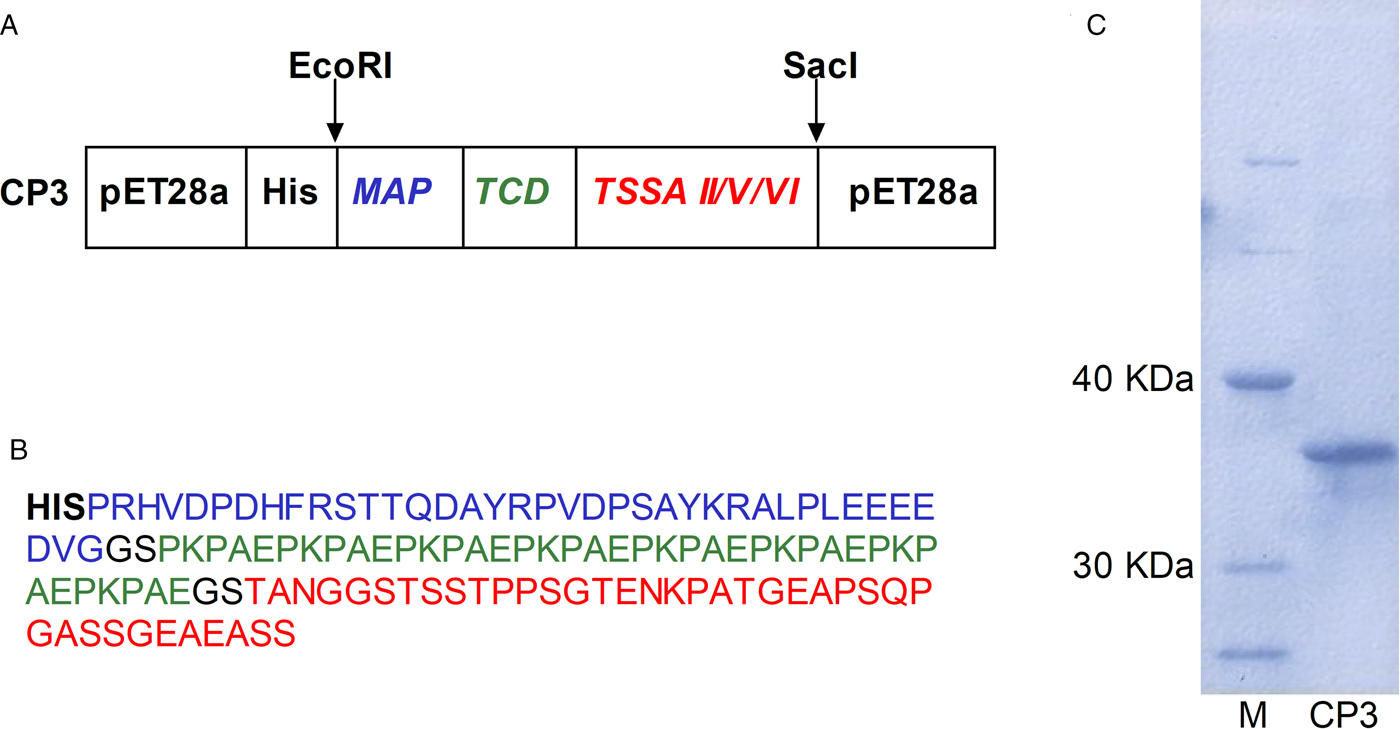
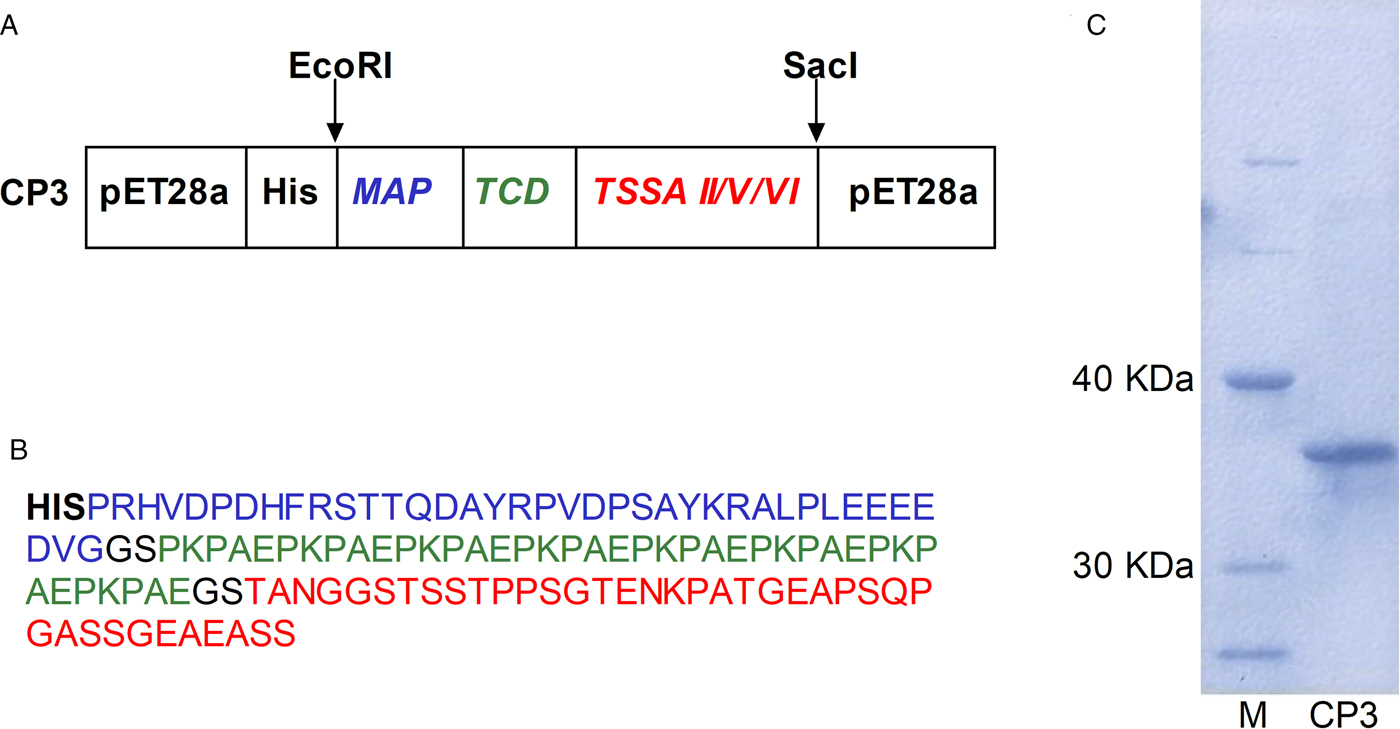
The plasmid construction, the fusion protein sequence and the product of purifications are shown in Fig. 1. The protein amount obtained per litre of induced culture was ~50 mg. The Ag was visualized as a homogeneous band when it was subjected to SDS-PAGE and further stained with Coomassie blue (Fig. 1C).
Protein expression and purification. (A) Schematic representation of the CP3 chimeric protein construction. (B) Amino acid sequences of the CP3 chimeric multiepitope. The different regions are indicated in blue (MAP), green (TcD) and red (TSSAII/V/VI). (C) SDS-PAGE purification of CP3. Lanes: M, molecular mass markers are indicated.
Evaluation of individual antigenicity of CP1 and CP3
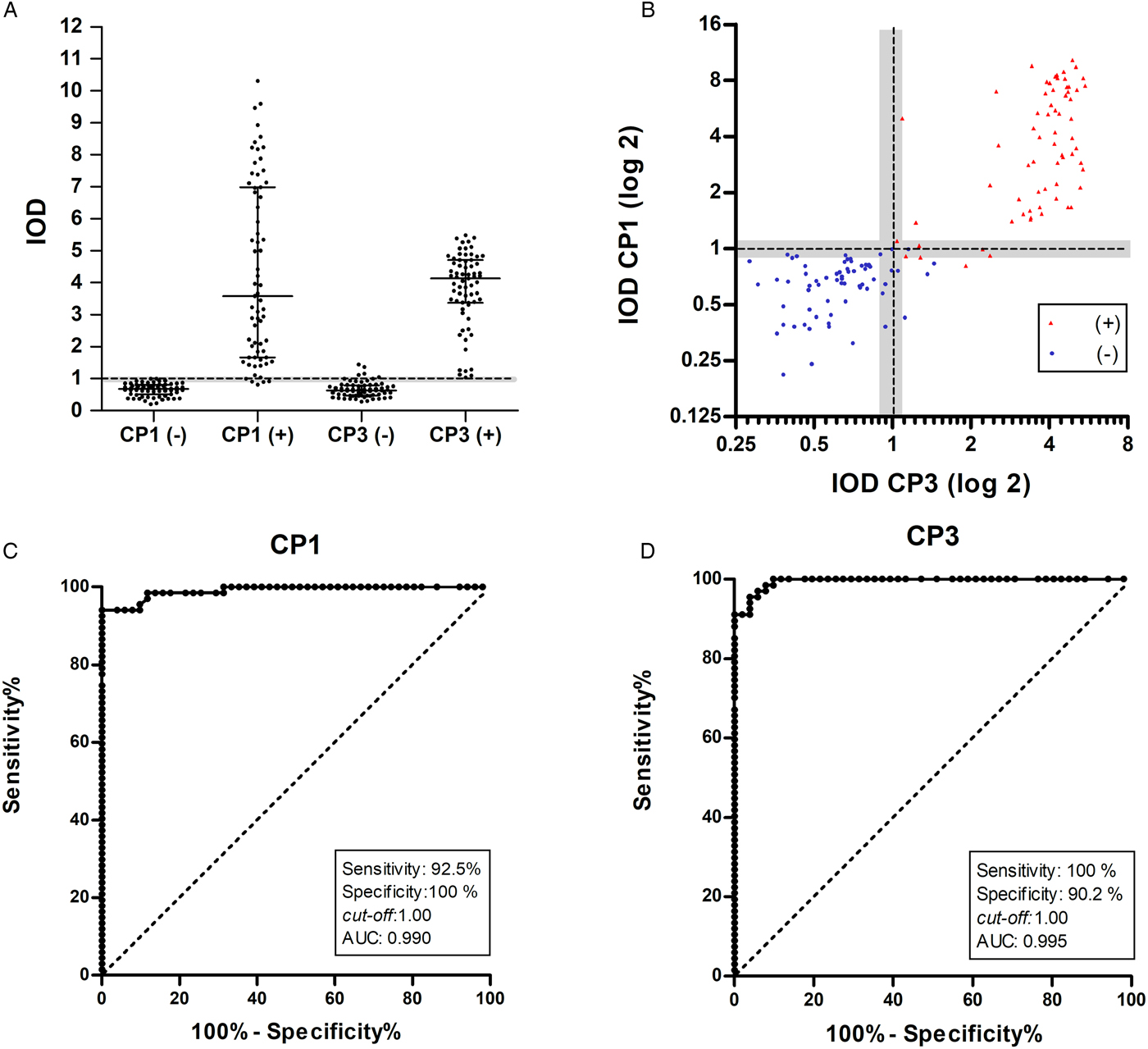
Figure 2A shows the relative IOD distribution obtained for positive and negative sera for CP1 and CP3, respectively. The median values (IQR) of IOD for the positive and negative sera were 4.13 (3.37–4.72) and 0.640 (0.480–0.790) for CP3 and 3.59 (1.67–6.99) and 0.680 (0.520–0.810) for CP1, respectively. Notably, the distribution was different between positive samples, with IQR being narrower for CP3 than for CP1. When the grey zone was analysed, it was determined that 12 and 9 sera yielded results inside the area for CP1 and CP3, respectively. However, when the results obtained for these sera with each protein were analysed, it was determined that only three samples had results in the grey zone for both Ags. These results suggested us the complementarity of the two proteins. To determine whether CP1 and CP3 complement each other when one of the Ags does not reach enough sensitivity, the log2 of IOD obtained for each serum was plotted in an x/y graph (Fig. 2B). Log2 of IOD was used to expand the spatial distribution of IOD corresponding to non-reactive sera. As depicted in Fig. 2B, four specimens that were considered negative or in the grey zone using CP1 resulted positive with CP3.
Assessment of CP1 and CP3 chimeras as single Ags to diagnose CCD. (A) Relative IOD of specific Abs distribution for the studied Ags (CP1 and CP3) on a panel composed of 67 Trypanosoma cruzi-positive and 67 T. cruzi-negative patients. The central tendency line shows the relative median (IQR) values for reactive sera for each assay, and the dashed line indicates the relative cut-off value (IOD/cut-off = 1). The grey zone is presented as a continuous line in this colour. (B) Dot plot of log2 of IOD values of Abs detected by CP3 in x-axis and CP1 in y-axis showing the complementarity of both Ags. The dashed line indicates the relative cut-off value (IOD/cut-off = 1). The grey zone is presented as a continuous line in this colour. (C and D) ROC curves obtained for IOD of Abs detected with CP1 and CP3 proteins on the serum panel.
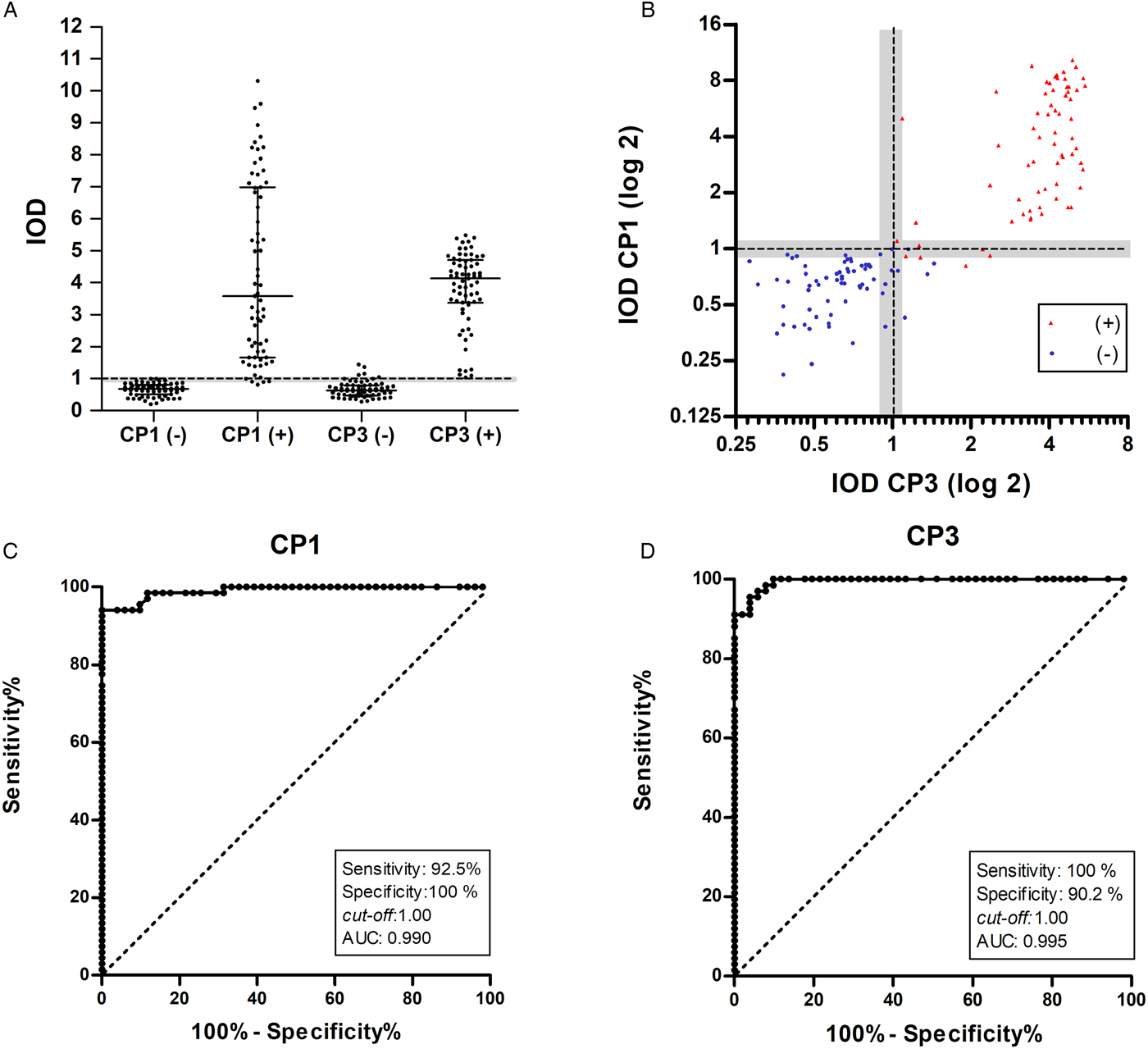
Sensitivity and specificity were calculated from the ROC curves (Fig. 2C and D). Although both proteins presented similar AUC values, CP3 had higher sensitivity than CP1 [100% (95% CI 93.0–100%) vs 92.5 (95% CI 83.4–97.5%)]. By contrast, CP3 had lower specificity than CP1 [90.2% (95% CI 78.6–96.7%) vs 100 (95% CI 93.0–100%)].
Antigenic performance of CP1+CP3 Ags used in the mixture
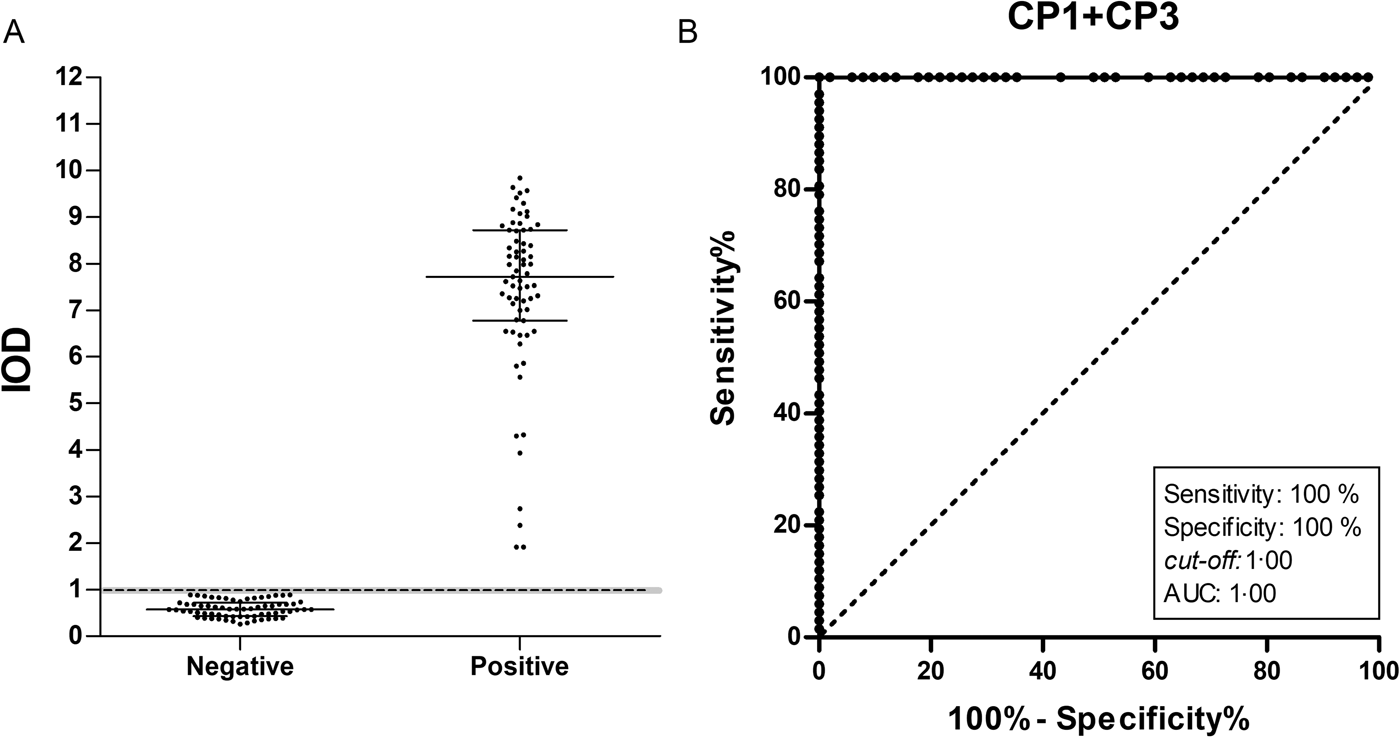
As observed in the relative IOD distribution obtained from a panel of 134 sera (Fig. 3A), when the Ags were combined (both chimeras in the same well), the median value of the positives increased to 7.72 (6.78–8.72). In addition, the median of the negatives decreased [0.570 (0.430–0.720)] with respect to the values obtained using the Ags individually. Therefore, a greater discrimination capacity was achieved with the CP1 + CP3 mixture. It is noteworthy that using the mixture, any sera displayed results inside the grey zone.
Assessment of the mixture CP1 + CP3 to diagnose CCD. (A) Relative IOD distribution of Abs obtained from a panel of 67 Chagas disease-positive and 67 negative serum samples for the CP1 + CP3 mixture. The continuous lines show the relative median values of reactive and non-reactive sera, respectively, in the assay, and the dashed line indicates the relative cut-off value (IOD/cut-off = 1). The grey zone is presented as a continuous line in this colour. (B) ROC curves obtained for the CP1 + CP3 mixture on the serum panel.

The results of the ROC curve analysis (Fig. 3B) showed that the combined use of the Ags caused an increase in the values of sensitivity and specificity with respect to individually assessed proteins (Fig. 2C and D).
Performance of the CP1+CP3 mixture with discordant sera
Discordant sera between ELISA and IHA were used to assess the utility of the CP1 + CP3 assay to classify the status of patients that could not be defined by these methods.
Within the set of 17 discordant sera, nine were classified as positives and eight as negatives by IFI. From the nine positives, six were misclassified by ELISA and three by HAI, while all were well classified by the CP1 + CP3 mixture. From the eight negatives, five were misclassified by ELISA and three by HAI, while three were misclassified with the mixture CP1 + CP3. Taking in mind these results, the ELISA evaluated using the recombinant CP1 + CP3 Ag mixture showed an 82.3% match with the result obtained by the IIF reference assay for the discordant sera, whereas the commercial ELISA and IHA showed 35.2 and 64.7% of match, respectively.
Discussion
In this work, we evaluate a new chimera, composed of MAP, TSSA II/V/VI and TcD Ags, which complements CP1 protein, a multiepitope Ag previously described by our group composed of FRA and SAPA Ags. The whole composition of antigenic determinants of CP1 + CP3 are then SAPA, TcD, FRA and MAP, which were previously used in different chimeras (Carvalho et al. Reference Carvalho, Krieger, Almeida, Oelemann, Shikanai-Yassuda, Ferreira, Pereira, Sáez-Alquézar, Dorlhiac-Llacer and Chamone1993; Houghton et al. Reference Houghton, Benson, Reynolds, McNeill, Sleath, Lodes, Skeiky, Leiby, Badaro and Reed1999, Reference Houghton, Benson, Reynolds, McNeill, Sleath, Lodes, Skeiky, Badaro, Krettli and Reed2000; Umezawa et al. Reference Umezawa, Bastos, Coura, Levin, Gonzalez, Rangel-Aldao, Zingales, Luquetti and da Silveira2003; Praast et al. Reference Praast, Herzogenrath, Bernhardt, Christ and Sickinger2011; Santos et al. Reference Santos, Celedon, Zanchin, Souza, de Silva, da Foti, Krieger and Gomes2017) and TSSA II/V/VI. For the latter, although it was proposed to be used in an multiplex immunoassay array (Granjon et al. Reference Granjon, Dichtel-Danjoy, Saba, Sabino, Campos de Oliveira and Zrein2016), to our knowledge, it has never been incorporated into a chimera. Interestingly, this Ag has been originally described as a candidate to typify the lineage of infecting parasite using the Abs from infected persons (Di Noia et al. Reference Di Noia, Buscaglia, De Marchi, Almeida and Frasch2002). Therefore, Abs against this Ag in infected patients would be detected only in individuals with these lineages. However, these lineages are highly prevalent in South America (Burgos et al. Reference Burgos, Diez, Vigliano, Bisio, Risso, Duffy, Cura, Brusses, Favaloro, Leguizamon, Lucero, Laguens, Levin, Favaloro and Schijman2010). Accordingly, several works have reported appropriate diagnostic performance when used as a single Ag (Bhattacharyya et al. Reference Bhattacharyya, Brooks, Yeo, Carrasco, Lewis, Llewellyn and Miles2010; Cimino et al. Reference Cimino, Rumi, Ragone, Lauthier, Alberti D’ Amato, Quiroga, Gil, Cajal, Acosta, Juárez, Krolewiecki, Orellana, Zacca, Marcipar, Diosque and Nasser2011; De Marchi et al. Reference De Marchi, Di Noia, Frasch, Amato Neto, Almeida and Buscaglia2011). Based on these previous reports, we have supplemented the Ags FRA, SAPA, MAP and TcD with TSSA II/V/VI. The novel chimeric Ag was able to be expressed and purified in soluble form, a characteristic that makes it suitable for use in an ELISA assay. Although CP1 and CP3 had similar performances based on ROC analysis, we found that sera rendering negative results with CP1 protein were properly classified using CP3. The number of sera that renders results in the grey zone was also notably decreased when the results of CP1 and CP3 were integrated.
Based on this finding highlighting the complementarity of these proteins, we inferred that antigenic determinants from CP1 mixed with those present in the CP3 would be useful to correctly define the chronic infection of T. cruzi in humans. To assess this possibility, we used the mixture of CP1 and CP3 in a single well to determine if it improved the discrimination between the OD of reactive and non-reactive sera in relation to the use of the respective single Ag. This CP1 + CP3 mixture successfully classified all reactive and non-reactive sera of the complete panel. It should be noted that samples that could not be correctly classified as positive using CP1 rendered positive values with the use of the mixture. This could indicate that the epitopes from CP1 and CP3 molecules that improve the diagnostic performance in relation to the use of single Ags were correctly displayed on the surface of ELISA well.
In turn, negative sera that were misclassified as positive by CP3 were negative by using the mixture CP1 + CP3 which may be explained by a favourable change in the IOD value distribution to discriminate positive from negative samples. In fact, the median IOD value of positive sera increased with the use of combined Ags as compared with the use of single proteins, indicating complementarity and synergy between these Ags.
Considering the phylogenetic proximity between T. cruzi and Leishmania, the usefulness of these Ags should be evaluated using sera from patients with Leishmania and without Chagas disease to determine possible cross-reactions. In a previous work, we assessed CP1 Ag using Abs from Leishmania spp.-infected individuals and non-cross-reactivity was detected in these sera (Camussone et al. Reference Camussone, Gonzalez, Belluzo, Pujato, Ribone, Lagier and Marcipar2009). Furthermore, TSSA II/V/VI displayed no cross-reactivity with Abs from Leishmania spp.-infected individuals (De Marchi et al. Reference De Marchi, Di Noia, Frasch, Amato Neto, Almeida and Buscaglia2011). We plan to complete CP1 + CP3 assessment using a panel of Leishmania-infected patients. However, considering that in Argentina both infections tend to co-exist in endemic regions and that currently available techniques do not ensure the absence of T. cruzi infection, careful selection of patients is necessary.
Chagas disease is currently diagnosed using two different serological reactions, as established by standard technical procedures and acknowledged by the World Health Organization (WHO, 2002; Ministerio de Salud de la Nación Argentina, 2012). When discordant results are obtained, a third assay must be performed using a high sensitivity test, such as ELISA or IIF (Ministerio de Salud de la Nación Argentina, 2012). These instructions indicated by health authorities are important to obtain reliable results; however, they usually produce an important proportion of discordant results; 3.3% of discordant results were recently reported in a study of 4939 individuals screened in Europe (Moure et al. Reference Moure, Angheben, Molina, Gobbi, Espasa, Anselmi, Salvador, Tais, Sánchez-Montalvá, Pumarola, Albajar-Viñas and Sulleiro2016). Adequate selection of Ags could reduce these discordances, reducing time and costs of the diagnosis. To assess the capacity of our CP1 + CP3 mixture to correctly characterize samples, we used a serum panel from those cases that had produced discrepant IHA and ELISA results when evaluated with the commercial kits. In all serum samples used in this study, the result given by the third reaction (IIF) was in accordance with the clinical and epidemiological data previously obtained from patient characterization. Although in some cases the patient clinical features may not be specific for Chagas disease, this information is complementary and supports the analytical classification of the included samples. This fact is considerably relevant, because there is still no gold standard technique defined by a scientific committee to contrast new trials, and it is quite difficult to obtain samples with such a complete set of data.
Of this seventeen discordant serum panel, only three samples displayed false-positive results using the CP1 + CP3 mixture. This result indicates a better performance of the CP1 + CP3 mixture than the ones displayed by the commercial IHA and ELISA tests, such as ELISA recombinante V.4, which is composed of a mixture of SAPA, Ag1 (FRA), Ag 30 (CRA), Ag 2 (B13), Ag13 (TcD) and Ag36 (MAP). In a previous work (Camussone et al. Reference Camussone, Gonzalez, Belluzo, Pujato, Ribone, Lagier and Marcipar2009), we determined that both CRA and B13, which are not present in our current chimeras but are used in the commercial assay, tend to display high reactivity with sera from uninfected patients. The absence of these Ags in CP1 and CP3 chimeras and the incorporation of TSSA II/V/VI Ag in CP3 to increase the sensitivity would, therefore, be responsible for our favourable results. Accordingly, CP1 + CP3 is a quite promising mixture to accurately diagnose chronic T. cruzi infection. This candidate for CCD diagnosis should be further validated in a larger serum panel including samples from patients infected only with Leishmania.
Acknowledgements
We are grateful to Marcelo Nepote for helping in sample logistics, to Hospital J. B. Iturraspe (Santa Fe, Argentina) for providing characterized serum samples.
Financial support
The authors wish to thank CONICET, UNL and UNR for financial support.
Conflict of interests
None.