Introduction
The concept of “occult forces” is deeply rooted in sub-Saharan African culture and remains very much alive today. Broadly speaking, the term “occult forces” refers to supernatural forces or “magico-religious powers” which may be harnessed either to do good or to inflict harm (Evans-Pritchard Reference Evans-Pritchard1935; Geschiere Reference Geschiere1997; Moore & Sanders Reference Moore and Sanders2001; Falen Reference Falen2007). However, given that the occult sphere manifests in many unique ways across the various local and regional settings in Africa, no single definition exists in the literature which captures these variations in a precise way (Tall & Henry Reference Tall and Henry2008; Leistner Reference Leistner2014; Pels Reference Pels1998; Rush Reference Rush1974). Various studies have shown how the occult sphere impacts the day-to-day lives of the peoples living in countries all over Africa in numerous and profound ways (Landry Reference Landry2015; Leistner Reference Leistner2014), and Benin is no exception to this. For instance, Nik Stoop, Marjike Verpoorten, and Koen Deconinck (forthcoming) have found that magico-religious beliefs reduce the demand for vaccinations in Benin.
However, the empirical literature on occult forces in sub-Saharan Africa remains nascent. Boris Gershman (Reference Gershman2016), who investigated the relationship between witchcraft beliefs and social capital, found a significant and negative relationship. Edward Miguel (Reference Miguel2005), using regional data (not at the household level), found that adverse weather conditions are positively correlated with witch killings in Tanzania. Beyond that, there exists very little empirical research exploring the motives for personal involvement in and spending on magico-religious powers at the household level. An exception to this can be found in Philippe LeMay-Boucher, Joël Noret, and Vincent Somville (2013), who investigate the determinants of investments in magico-religious powers for diagnosis, cure, and protection (non-malevolent use) in Benin based on a data set from 2006. The present analysis, based on a more recent data set, revisits and confirms some of these earlier results. More importantly, it provides an original investigation into the variables correlated with household expenditures on magico-religious powers for malevolent purposes.
Our data, collected in Southern Benin in 2014, is based on a sample of 126 Beninese households. From these, twenty-three household heads (18 percent) reported making an expenditure on malevolent magico-religious powers in and between 1987 and 2014. Of those twenty-three, a subsample of eleven household heads (8.7 percent) reported making such an expenditure in the two years prior to the survey and only five (4 percent) in the six months prior to the survey. Our results suggest jealousy of other people’s economic success may be an important motive for investment in malevolent magico-religious powers. This finding is consistent with anthropological literature suggesting such jealousies may motivate individuals to invest in malevolent magico-religious powers to inflict harm on the economically successful or to appropriate their wealth (see Giblin Reference Giblin2005; Falen Reference Falen2007; Leistner Reference Leistner2014; Landry Reference Landry2015). Funerals are also shown to be positively correlated with such expenditures. This is likely due to tensions surfacing around funeral expenses, inheritance, and the performance of rituals (see Vidal Reference Vidal1986; Noret Reference Noret2010; LeMay-Boucher, Noret, & Somville Reference LeMay-Boucher, Noret and Somville2013). We also find that household heads living with a partner, who are therefore more likely to face greater opportunities for conflict to arise due to being part of a larger social sphere, exhibit a greater likelihood of spending on malevolent magico-religious powers.
While our study focuses on the use of malevolent magic, it is important to highlight that we are not suggesting such investments represent the most salient form of magico-religious practices in Southern Benin or sub-Saharan Africa in general. In fact, our data suggest such practices are much less prominent than magico-religious practices for diagnosis, cure, or prevention, which are widely perceived more favorably in Southern Benin. Our results also demonstrate a positive and significant correlation between household expenditures made on magico-religious powers for diagnosis, cure, and protection and those on malevolent magic. The fact that both are often linked is outlined by Douglas J. Falen (Reference Falen2018).
The following section provides background on magico-religious practices in Benin. We then formulate a number of conjectures as to which household and individual characteristics are likely to influence household expenditures on malevolent magico-religious powers. Following that, we provide an overview of the survey data and descriptive statistics underpinning our analysis. We set out our model specification, provide a discussion of the empirical results, and finally, conclude.
Magico-Religious Powers in Benin
In Southern Benin, man is considered to be intertwined in a web of invisible forces. This assumed interpenetration of the spiritual and material worlds profoundly influences people’s understanding of life’s afflictions. While minor inconveniences and transient misfortunes, such as mild illness, will typically be ascribed to the ordinary course of natural events, more profound, life-changing, or long-lasting misfortunes are often attributed to malevolent occult forces (Omonzejele Reference Omonzejele2008; Leistner Reference Leistner2014). This is especially the case if such events occur together: a run of serious accidents or financial misfortunes involving the loss of significant sums or assets, sudden unemployment, or the unanticipated death of a family member. Similarly, a serious illness befalling a person or animal can be thought to be the result of targeted attacks employing evil spirits, offensive charms, and witchcraft, rather than a simple biological malfunction (Geschiere Reference Geschiere2013; Maslove et al. Reference Maslove, Mnyusiwalla, Mills, McGowan, Attaran and Wilson2009). Adverse weather conditions such as drought or hail which affect crop yields are also likely to raise suspicion of occult activity. Additionally, when a person suspects malevolent occult forces are at play, typically blame does not fall on faraway strangers, but rather on those nearby: a neighbor, co-worker, or co-wife, or more intimately, a parent, sibling, or child (Leistner Reference Leistner2014; O’Neil Reference O’Neil2012).
This mindset is not just a phenomenon among the poorly educated in rural areas. People of all ages, genders, and backgrounds, in both rural and urban settings, may attribute such misfortunes to occult attack. Despite the fact that Benin is becoming increasingly culturally diverse, these beliefs seem to persist across regional and ethnic settings and transcend gender, generational identities, and social and economic status in both urban and rural contexts.
Investing economic and social capital in the management of perceived occult activity is thus a salient aspect of day-to-day life for many Beninese people (LeMay-Boucher, Noret, & Somville Reference LeMay-Boucher, Noret and Somville2013). People frequently turn to specialists who are deemed capable of interpreting and manipulating these invisible forces. They may seek specialist knowledge to determine whether the root cause of their misfortune is actually occult in nature, or because they seek magical protection and healing. LeMay-Boucher, Noret, and Somville (Reference LeMay-Boucher, Noret and Somville2013) show that in Cotonou, expenditures on magico-religious diagnosis, prevention, and treatment is far from anecdotal. In their sample, 48 percent of household heads declared having made such magico-religious expenditures in the twelve months prior to their 2006 survey, with these expenditures representing 5.6 percent of all household expenditures on average. As we show below, we find a similar prevalence from a different sample based on our 2014 survey.
Belief in occult forces does not preclude a parallel belief in science or Western medicine. Visits to the local health post and self-medication are the normal response to minor ailments. In fact, the sale of pharmaceutical drugs through both informal and formal pharmacies is a profitable venture in Southern Benin. The frequency of consultations with experts within the occult sphere is relatively small in comparison to the volume of anti-malaria and paracetamol tablets sold (Baxerres & Le Hesran Reference Baxerres and Le Hesran2011). Pharmaceutical and magico-religious treatments are also frequently used simultaneously to treat the same ailment.
Alternatively, as is the focus of this analysis, individuals may seek to spend on magico-religious forces with malicious intent. Out of the numerous accounts we collected during our survey, one illustrates this particularly well. One of our respondents explained how, following the death of his brother, he sought the services of a local diviner. The diviner confirmed that his brother’s death was the result of a malicious occult attack, and the man proceeded to carry out a counter-attack by requesting the malevolent use of a vodun deity.
The majority of the accounts in our sample follow a similar pattern, where individuals perform counter-attacks against perceived acts of occult aggression, or to a lesser extent, non-occult attacks. Many of these perceived occult attacks were carried out against members of the individuals’ families, most often their children, or sometimes their wives, their mothers, or their siblings. Counter-attacks against perceived personal attacks also appear to be common. In other words, the large majority of the attacks in our sample do not stem from a primarily malicious intent, but from a desire to retaliate against perceived attacks and to prevent future attacks. Most of these perceived attacks are associated with an unknown sorcerer, though in some cases individuals suspect the culprit behind the attack is a specific member of their family.
Only a small proportion of the occult attacks in our sample were not retaliatory in nature. For instance, one individual explained an occult attack carried out against colleagues who were perceived by this individual as selfish and lacking respect for elders. A different motivation sometimes mentioned was self-gain. Another respondent explained that, after applying for a job, he used a vodun to invalidate the offers of contracts to other candidates, and claimed this is why they did not secure the job.
Significantly, 50 percent of the individuals who invested money in the performance of occult attacks claimed the attacks were successful, while none (0 percent) claimed the attacks were unsuccessful. Many individuals claimed that those they performed the counter-attack against died or suffered a serious injury a few weeks later, or simply that their aggressors were scared away.
There are two main categories of magico-religious practices which are employed for both malevolent and benevolent means in Southern Benin. The first of these, Aze, roughly corresponds to the western understanding of witchcraft (see Evans-Pritchard Reference Evans-Pritchard1937), yet it differs in that the ability is not necessarily inherited (Falen Reference Falen2007). The alleged powers of Aze are said to primarily work through the invisible, psychic domain. In other words, an individual does not necessarily need to be in close proximity for Aze to have its intended effect. Such practices are traditionally said to be carried out in secret after nightfall (O’Neil Reference O’Neil2012).
Aze is considered to be a primarily a malevolent force. It is generally used with the intention of causing misfortunes such as illness, infertility, accident, death, loss of money, or insanity. Children are said to be especially vulnerable to Aze attacks (Falen Reference Falen2007). However, despite its primarily destructive role, it is a somewhat ambiguous force. It can allegedly be employed to diagnose and prevent malicious attacks by Bo or vodun deities or other Aze (O’Neil Reference O’Neil2012). Specifically, a type of “white” Aze known as “Aze wèwé” can allegedly be used to counteract the evils of “black” Aze, or “Aze wiwi.” However, the latter is said to be the stronger more dominant force in Southern Benin (Landry Reference Landry2015; O’Neil Reference O’Neil2012). Wielders of Aze are referred to as “Azeto”; however, as highlighted by LeMay-Boucher, Noret, and Somville (Reference LeMay-Boucher, Noret and Somville2013), these persons are rarely identified as such in a precise way in a social group or neighborhood. People generally do not publicly identify Azeto for fear of accusations that they too are Azeto. Anyone able to identify the members of covert groups engaged in such secretive activities is likely to be suspected of complicity.
The magico-religious practices of Bo, locally known as gris-gris, refer to the use of various magical spells, tangible charms, and the manipulation of spirits (Falen Reference Falen2016; LeMay-Boucher, Noret, & Somville Reference LeMay-Boucher, Noret and Somville2013; O’Neil Reference O’Neil2012). Like Aze, Bo can allegedly be wielded to produce both positive and negative effects, depending on the underlying motive for its use. However, unlike Aze, it is not considered to be a predominantly destructive force. One might seek a Bo as a means of protection against Aze and other Bo. Anecdotal examples of the uses of Bo range from one known as “flin,” which is said to aid memory and help individuals to excel in exams (O’Neil Reference O’Neil2012), to one intended to stop rain during an important ceremony or to summon rain to aid crops (Falen Reference Falen2007).
Nonetheless, offensive Bo spells can be used to bring misfortune such as illness or loss of fortune similar to magico-religious practices employing Aze. A crucial difference is that Bo, unlike Aze, is said to work primarily through the physical world, often requiring a person to see, ingest, or touch the Bo for it to work (Falen Reference Falen2016; O’Neil Reference O’Neil2012). Additionally, there is frequently confusion between the magico-religious practices of Bo and the use of traditional vodun deities. Vodun deities are neutral forces which can be requested to perform both good and evil deeds (Falen Reference Falen2016). As LeMay-Boucher, Noret, and Somville (Reference LeMay-Boucher, Noret and Somville2013) point out, Bo practices frequently involve vodun deities, though the use of vodun deities for malevolent and benevolent purposes exists independently of Bo.
There are various “experts” in the field who offer magico-religious services in Southern Benin. Vodun priests, Vodunon, and priestesses, Vodunsi, are one such option. Traditional diviners, in particular priests of the Fâ (a local divination system in Benin), and Bokonon, are also highly sought after (O’Neil Reference O’Neil2012). “Azobleto,” healers who use natural substances, reputedly imbued with special powers, are another. There are many others but, just as it is difficult to differentiate between Aze and Bo and magical manipulations involving vodun deities, the distinction between those wielding these powers and the nature of the services they offer also lacks clarity (Falen Reference Falen2016). Specifically, diviners, healers, and vodun priests are often thought to be involved in good as well as evil Aze and Bo, and O’Neil (2012) argues that while subtle distinctions can be made between such groups, their roles are generally rather fluid.
Generally, locals consider Aze to be a more negative force than Bo, though individuals may think of them differently and employ them in different ways, depending on their past experiences of relying on and investing in them. Individuals’ perceptions can also be significantly influenced by interventions by their local traditional diviners, in particular priests of the Fâ and Bokonon who provide diagnoses, cures, and the means to counter-attack.
Various work from anthropologists (Goody Reference Goody, Moore and Myerhoff1977; Humphrey & Laidlaw Reference Humphrey and Laidlaw1994) has outlined that social involvement in, or spending on, magico-religious rituals does not necessarily imply a personal or intimate belief in such phenomena. Indeed, participation in such rituals may just be a matter of social conformity. When individuals are hesitant about the correct interpretation of a given situation, it may also reflect a choice to account for every eventuality (Noret Reference Noret2007). As Pierre Bourdieu suggested, the logic of ritual action is “to put all chances on your side” (Bourdieu Reference Bourdieu1980:148). Consequently, the evidence presented below demonstrates the prevalence of investment in such ritual practices, not necessarily a belief in any particular aetiology of affliction.
Conjectures
Based on a combination of qualitative and quantitative literature as to which household characteristics are likely to influence household expenditures on malevolent magico-religious powers, this study formulates a number of conjectures. In a section further below (Empirical Estimation Strategy) it empirically investigates these conjectures on the basis of various estimations.
Characteristics of the Head of Household
Various anthropological studies have concluded that belief in occult forces is independent of religious affiliation all across Africa (Kohnert Reference Kohnert1996; Tall & Henry Reference Tall and Henry2008; Mary Reference Mary1999). An exception to this is highlighted in LeMay-Boucher, Noret, and Somville (Reference LeMay-Boucher, Noret and Somville2013), who found that those who identify themselves as “animists” are more likely to make expenditures on magico-religious powers for diagnosis, cure, and protection in Benin. We therefore expect expenditures on malevolent magico-religious powers to be independent of all religious affiliations with the exception of animists. Dirk Kohnert (Reference Kohnert1996) also suggests that belief in occult forces is widespread in Africa irrespective of the level of education. In line with this, LeMay-Boucher, Noret, and Somville (Reference LeMay-Boucher, Noret and Somville2013) found that education has no significant impact on expenditures on magic for diagnosis, cure, and protection. While witch persecutions are generally perpetrated against women, belief in occult forces does not appear to be linked with gender (Abrahams Reference Abrahams1994; Marwick Reference Marwick1965; Kohnert Reference Kohnert1996; Brain Reference Brain1982; LeMay-Boucher, Noret, & Somville Reference LeMay-Boucher, Noret and Somville2013), or ethnicity (Kohnert Reference Kohnert1996; Brain Reference Brain1982). We therefore also expect reports of malevolent magico-religious expenditures to be uncorrelated with education, gender, and ethnicity.
Formulating a conjecture regarding the correlation between income and expenditures on malevolent magico-religious powers is difficult, as there are potentially multiple factors at play. Firstly, those on higher income levels are more likely to face redistributive pressures, and thus may be more likely to make such investments (Platteau Reference Platteau, Bates, Robinson, Akyeampong and Nunn2014). Alternatively, poor individuals may experience feelings of jealousy of other people’s economic success, and thus be more likely to invest in malevolent magic (Leistner Reference Leistner2014). Most notably, LeMay-Boucher, Noret, and Somville (Reference LeMay-Boucher, Noret and Somville2013) point out that magico-religious services in Benin are available at a relatively low cost when compared to household income, and their study finds no significant relationship between income and expenditures on magico-religious powers for diagnosis, cure, and protection. Their interpretation is that low costs minimize financial barriers to consumption and allow individuals to invest irrespective of their own income. This is confirmed by the various interviews we conducted during our fieldwork with around twenty providers of magico-religious powers. Therefore, we expect to find no significant correlation between reports of malevolent magico-religious expenditures and income.
Funerals
In Benin, as in various parts of West-Africa, funerals are important ritualistic events which often take place over days at a time. Friends, family, extended family, and even the whole community may be involved. They are a channel through which individuals can display their wealth by making large financial contributions (see Vidal Reference Vidal1986; Noret Reference Noret2010; Geschiere Reference Geschiere2005; Smith Reference Smith2004). These same authors also highlight funerals as incubators of social tension, as conflicts surrounding funeral expenses, place of burial, inheritance, and rituals typically arise. LeMay-Boucher, Noret, and Somville (Reference LeMay-Boucher, Noret and Somville2013) support this notion empirically, having found funerals to be an important determinant of household expenditures on magico-religious power for diagnosis, cure, and protection in Benin. The authors infer that this is because individuals may seek magical protection in times of conflict. We also expect to find the occurrence of funerals to be positively correlated with expenditures on malevolent magic, as individuals may seek to threaten or cause harm to those with whom they face conflict.
Jealousy and Egalitarian Norms
In many traditional African societies, individual economic success is often readily explained by the use of magic for economic self-advancement at the expense of fellow villagers, rather than being viewed as a result of hard work, risk-taking, and skill development (see Platteau Reference Platteau, Bates, Robinson, Akyeampong and Nunn2014; Leistner Reference Leistner2014). Among villages in South Africa, Cameroon, and Benin, rumors have been known to circulate that successful individuals use magic to transform other individuals into zombies and force them to work on their “invisible plantations” at night in order to increase their own wealth (Fisiy & Geschiere Reference Fisiy and Geschiere1991; Rowlands & Warnier Reference Rowlands and Warnier1988; Geschiere Reference Geschiere1994, Reference Geschiere1995; Rosny Reference Rosny1981; Ardener Reference Ardener1970; Ellis & Ter Haar 2004). Unequal distribution of wealth and success thus has a tendency to evoke strong feelings of suspicion, hatred, and jealousy toward the economically successful (Elster Reference Elster1989; Leistner Reference Leistner2014; Platteau Reference Platteau, Bates, Robinson, Akyeampong and Nunn2014; Giblin Reference Giblin2005; Geschiere Reference Geschiere1995; Falen Reference Falen2007). Various anthropological studies have suggested that one way individuals may deal with such jealousies is by seeking the services of magico-religious providers in an attempt to appropriate wealth from the successful (Leistner Reference Leistner2014; Falen Reference Falen2007; Landry 2015), to cause them physical harm, or even to bring about their death (Giblin Reference Giblin2005). We therefore expect jealousy of other people’s economic success to be positively correlated with reports of malevolent magico-religious expenditures.
Related to that, several anthropological studies have suggested that a collective, shared belief in magical forces creates strong egalitarian norms and redistributive pressures (Leistner Reference Leistner2014). Successful individuals may feel pressured to share their wealth with jealous friends, neighbors, co-workers, or extended family members, due to the threat of occult aggression, other forms of violence, and social alienation. Even when malevolent forces are not suspected, financial success or good fortune may lead to accusation of magical intervention (Platteau Reference Platteau, Bates, Robinson, Akyeampong and Nunn2014; Leistner Reference Leistner2014; Landry Reference Landry2015; Giblin Reference Giblin2005).
According to one South African villager: “You build a beautiful house. They say that you are a witch. They come and burn it down. They say they are burning a witch’s house. You buy a car. They shoot you just because you are working and they are not” (Golooba-Mutebi Reference Golooba-Mutebi2005). Redistributive pressures often discourage effort and risk-taking, as the rewards of such productivity must be shared. In other instances, individuals may attempt to conceal their wealth. During our questionnaire participants were asked if, and why, they ever hide objects which indicate their wealth. 68 percent declared they did, typically stating reasons such as “yes because I have worked hard for my wealth, and people have their eyes on it” or “yes, to avoid witchcraft.” However, when wealth is difficult to conceal, as with large visible assets such as cars, concealment is not feasible.
During our pilot phase, we experimented with various proxies for measuring jealousy. For our empirical analysis, we use one which measures the willingness of individuals to sacrifice a share of their own incomes to avoid feeling economically inferior. We provide further details on this variable below.
LeMay-Boucher, Noret, and Somville (Reference LeMay-Boucher, Noret and Somville2013) explored a related mechanism. Their study found that individuals invest in magico-religious powers for diagnosis, cure, and protection as a substitute for redistribution. We may therefore expect to find a positive correlation between redistributive pressures and reports of expenditures on malevolent magico-religious powers. Successful individuals may use malevolent magic as an act of retaliation against jealous individuals in an attempt to cause them harm, scare them, or steal their wealth. In our context, we proxy such pressures by ownership of expensive and recognizable assets (in our case a car) and not income itself, which more easily concealed.
The Relationship between Protective and Malevolent Magico-Religious Powers
As we observed in the various interviews conducted during our pilot survey, Beninese people often have an intimate belief in the coexistence of benevolent and malevolent aspects of the occult sphere (Falen Reference Falen2018). This is evident in the way Beninese people talk about the positive and negative aspects of Aze and Bo (O’Neil Reference O’Neil2012; Falen Reference Falen2007). One could argue that a head of household who invests in protective magico-religious powers is more likely to invest in malevolent powers (or vice versa). Such an individual has arguably already experienced the benefits of a closely related product/service for protection. He has already interacted with traditional diviners (priests of the Fâ, etc.) and could be more inclined to attribute efficacy to them.Footnote 1 We therefore expect to find a positive correlation between reports of expenditures on magico-religious powers for diagnosis, healing, and prevention, and reports of malevolent magico-religious expenditures.
The Data
The data were collected during the summer of 2014 in the city of Abomey-Calavi, a mainly suburban area of Cotonou (Benin’s largest city), located around 20km from its center. Abomey-Calavi has a population of about 655,000 inhabitants (2013 census). Since an official list of households was not available in public records, households were selected using a pseudo-random selection technique following the Afrobarometer’s survey guidelines. Our sample consists of 126 households and covers the following area: the North of the campus of the University of Abomey-Calavi, to the East of Ouedo and to the South of the main street leading to the city hall of Abomey-Calavi (see the appendix for a map of the area covered). A grid of approximately twenty squares of similar size was applied in this territory, ten of which were then randomly selected. Within each square, every street was allocated a number and then three streets per square were randomly selected. These streets were visited prior to the beginning of the baseline survey. Streets hosting a lot of economic activities such as markets, shops, and public buildings, as opposed to housing, were excluded from the list. We ended up with twenty streets with at least one in each of the ten randomly selected squares. Our enumerator was instructed to enter and survey every tenth house on the left of each chosen street (making our selection process pseudo-random). On average, our enumerator surveyed six households per street. When a selected door was unoccupied, the next house was selected. Where the inhabitants were absent, or when neither the head of household nor the spouse was available, a second visit was scheduled. Our enumerator was local, independent, and qualified. He had previous experience with surveys and field work and undertook a two-day training session given by the authors. Special sessions were dedicated to translation in the local language (Fon) and to test the enumerator’s understanding. The enumerator was also accompanied by an experienced local supervisor during the early stages of the work. The sample size was arrested at 126 due to lack of time and funding constraints.
The survey included questions related to magico-religious expenditures for both beneficial and malevolent uses, as well as other household and individual characteristics. The questionnaire was answered by the heads of the households who typically manage magico-religious expenditures on behalf of the whole household. As personal investment in magico-religious powers, particularly for occult aggression, is a sensitive issue which individuals are often secretive about, questions on the topic were asked toward the end of the survey after participants had developed some trust, in an attempt to minimize under-reporting. None of the household heads we selected refused to take part in our survey or to answer a particular section of our questionnaire. It is also interesting to note that none of the respondents mentioned personally having any magical or divinatory skills and hence themselves refer to the experts we described above to buy these services.
Descriptive Statistics
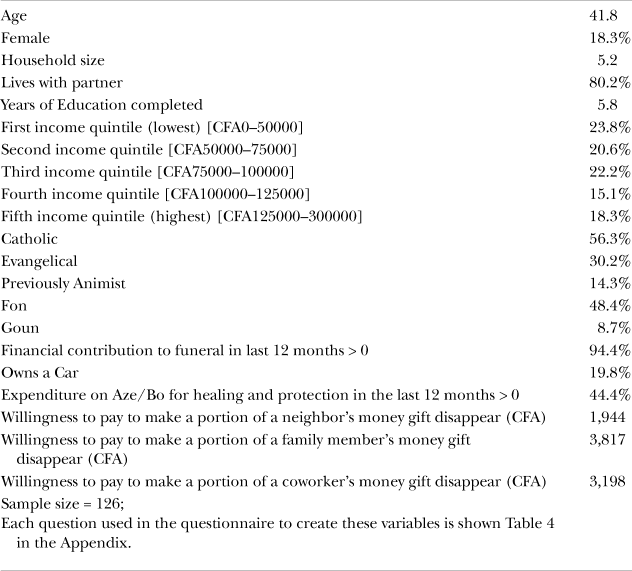
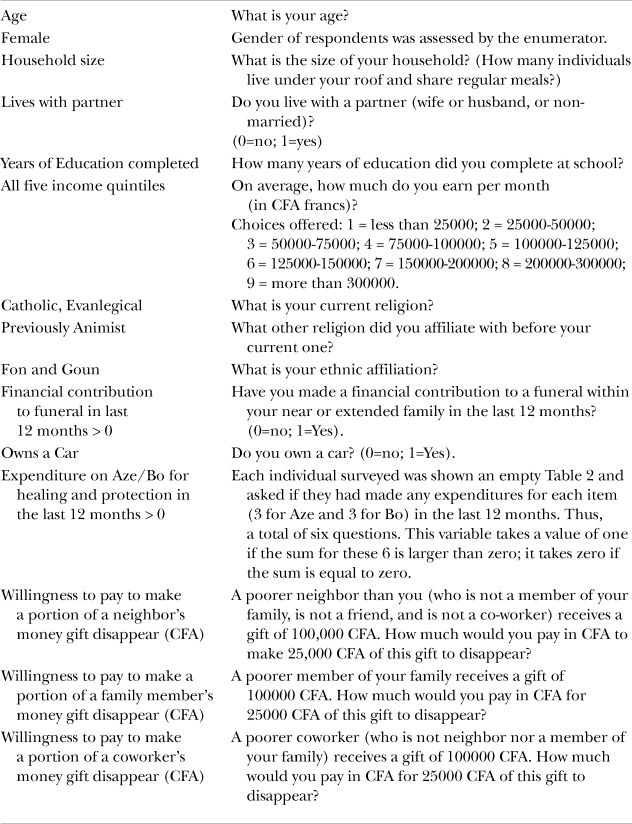
The descriptive statistics for the 126 household heads in the sample for the variables used in our model estimations can be found in table 1. The questions from our questionnaire which were used to create these variables can be found in the appendix (table 4). Across the whole sample, the average age of household heads is around forty-two years, and only 18 percent are female. The average household size is 5.2 people and the majority of household heads (80 percent) live with a partner. We expect those living with a partner as well as those in larger households to be more likely to make expenditures on malevolent magico-religious powers, since these individuals are more likely to face greater opportunities for conflict to arise due to being part of a larger social sphere. Household heads have completed almost six years of education on average. Our income variable is based on the choice of income brackets we used and takes value one for each household head only for one of the five brackets ([CFA0–50000]; [CFA50–75000]; [CFA75–100000]; [CFA100–125000] and [CFA125–300000]) and zero otherwise.
Sample means for head of household characteristics

The largest proportion of household heads (56 percent) identify themselves as being Catholic, and 30 percent identify as Evangelical. Only two household heads identify themselves as being animist, while eighteen household heads describe themselves as being “previously animist,” having converted to other religions. We believe having been an animist previously may act as a good proxy for being an animist, as religious conversion does not necessitate the abandonment of beliefs associated with the previous religion. This is illustrated particularly well by Timothy R. Landry (Reference Landry2015), who describes a conversation with a woman living in Benin who converted from Vodún to Evangelical Christianity. She explains that she converted not because her underlying beliefs changed, but because she believes it to be an easier way to heaven. In our sample, the largest proportion of household heads, 48 percent, are of the Fon ethnicity. The second largest group, 8.7 percent, are Goun. We have smaller shares for other ethnic affiliations which are gathered into the benchmark category for our estimations.
As many as 94 percent of household heads reported having made a financial contribution to a funeral in the twelve months prior to the survey. A total of twenty-six (19.8 percent) household heads own a car. As discussed above, we believe ownership of a visible asset is likely to lead to redistributive pressures and, as highlighted by LeMay-Boucher, Noret, and Somville (Reference LeMay-Boucher, Noret and Somville2013), cars are a symbol of wealth in Benin and remain exclusive possessions. They function as a suitable proxy for redistributive pressures, as they cannot be easily concealed from the public. In our sample, car ownership increases with income. Of those who own a car, 0 percent fall into the lowest two income quintiles, 16 percent fall into the third income bracket, 32 percent fall into the fourth income quintile, and 52 percent fall into the highest income quintile. Ownership of a motorbike, or a color TV, was deemed unsuitable as an indicator of wealth as, out of 126 individuals, respectively 113 and 106 reported owning these. We also considered using a variable which indicates if an individual thinks other people perceive them as rich; however, 94 percent declared they feel this way, offering less variation for a proxy compared to ownership of a car.
Previous literature and our informal discussion during the pilot survey indicated that jealousy is likely to be an important variable driving the use of malevolent forces. While various proxies were elicited during our pilot phase, one appeared to be pertinent and widely understood: surveyed heads were presented with hypothetical scenarios in which (1) a family member, (2) a coworker, and (3) a neighbor receives a hypothetical money gift of CFA100000 (or USD200 at the time of survey, as USD1 was equivalent to around CFA500). Participants were then asked to declare whether, and how much, their willingness to pay (WTP) would be to make CFA25000 of this gift disappear. Of those surveyed, 20.6 percent gave a WTP larger than zero with a mean of CFA1944 to make CFA25000 of a neighbor’s CFA100000 money gift disappear. A positive WTP was given by 16 percent, with a mean of CFA3198 if the individual receiving the gift was a coworker. If the individual receiving the gift was a family member, the corresponding figures were 18.23 percent and a mean of CFA3817. We can infer that some individuals are willing to sacrifice a portion of their own income simply to minimize feeling economically inferior. We believe these variables represent a sufficiently appropriate proxy for whether individuals feel jealous of other people’s financial success.
Expenditures on Diagnosis, Cure, and Protection
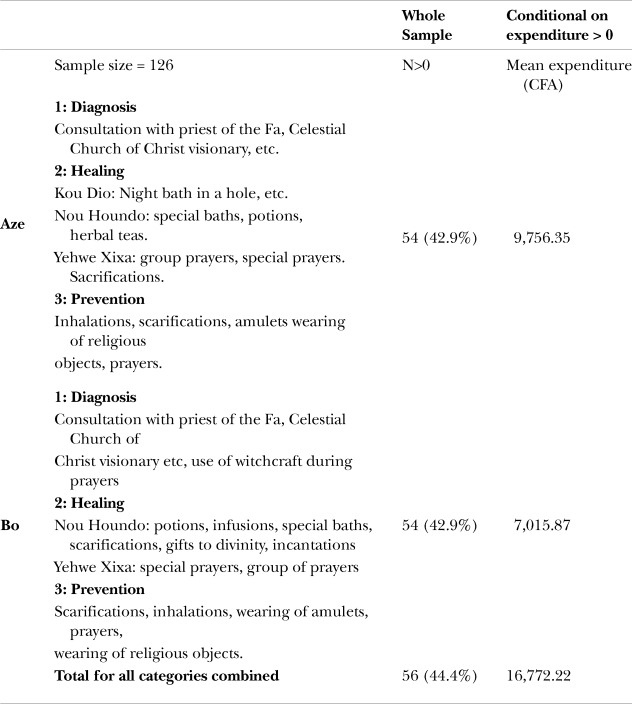
A total of 44 percent of household heads reported expenditures on Aze and/or Bo for either diagnosis, cure, or protection within the previous twelve months. Given that such expenditures are more common than expenditures on malevolent uses, we did not ask about such expenditures preceding the twelve months leading up to our survey. A more detailed breakdown of the expenditures made on Aze and Bo for diagnosis, healing, or prevention of illness and other afflictions believed to be the result of occult aggression can be found in table 2. As highlighted, we do not have such detailed information for malevolent magico-religious powers. However, expenditures on Aze and Bo for diagnosis, cure, and protection offer some interesting insights, especially considering that these are the means by which many individuals cope with the occult attacks we are primarily concerned with. Magico-religious diagnosis typically involves consulting the relevant traditional religious expert, including vodun priests, priests of the Fâ, and visionaries from the Celestial Church of Christ (a local church which claims to have gifts of prophecy), who interpret the nature of the misfortune.
Expenditures on magico-religious powers for diagnosis, healing, and protection within the last 12 months

If an Aze or Bo attack is confirmed, various measures may be suggested as a means of healing. These include the use of potions, herbal teas, infusions, special soaps, scarifications, sacrifications and special prayers. “Kou Dio,” which involves taking a “night bath in a hole,” presents another option. If an individual fears an Aze or Bo attack, that person may instead seek preventive measures. The preventive services offered by local diviners and vodun priests often involve the use of objects imbued with special powers. These include charms, such as special soaps and powders, or amulets and rings which individuals may be required to wear. Magical charms can often be seen hanging over the doorways of Beninese households, and children are often seen wearing amulets to protect them against Aze (Falen Reference Falen2007). Other objects used as charms include candles, holy crosses, and prayer books. Additionally, special prayers may be performed. An equal proportion of people (42.9 percent) reported making expenditures on each of Aze and Bo. Interestingly, that descriptive statistic is comparable to the one that LeMay-Boucher, Noret, and Somville (Reference LeMay-Boucher, Noret and Somville2013) produced based on a sample of 178 households collected in Southern Benin in 2006, eight years preceding the sample on which this paper is based. We find significantly larger average expenditures for Aze and Bo (CFA9756 and CFA7015) than theirs.
Comparing Samples
Using the variables in table 1, we compare the means of the subsample of household heads who reported malevolent magico-religious powers (11 individuals) within previous two years with those who reported zero expenditures (115 individuals) and draw interesting insights. The tests were carried out at a 10 percent significance level, and the test statistics, though not shown here, are available upon request.
Household heads who reported making an expenditure on malevolent magico-religious powers are on average more likely to live with a partner. These individuals are likely to interact with their partner’s family, increasing the scope for potential conflict. There is a significant difference in Fon ethnicity across subsamples. This result is slightly surprising because, as mentioned previously, we did not expect ethnicities to play a role in explaining magico-religious expenditures. However, the econometric analysis that follows confirms our initial conjecture that ethnicity does not significantly explain expenditures on malevolent powers.
Household heads with positive expenditures on malevolent magico-religious powers are more likely to have made a financial contribution to a funeral within the previous twelve months, supporting our conjecture. Their average WTP to make their neighbors’ hypothetical money gifts disappear is significantly larger compared to those with zero expenditures (CFA5565 vs CFA1136), whereas there is no statistically significant difference between groups for co-workers and family members. This supports the notion that our proxy for jealousy is on average more important for those who made malevolent magico-religious expenditures. However, this phenomenon seems to vary between social groups. Household heads who made expenditures on malevolent powers also reported larger average expenditures on Aze and Bo for diagnosis, healing, and protection in the twelve months prior to the survey, thus supporting our initial conjecture.
Finally, we found no statistically significant difference across groups in terms of age, gender, years of education, or current religious affiliation. These statistics are all in line with our conjectures. Differences in income are also insignificant across groups at all levels with the exception of income quintile 4. Despite what the raw data suggest, and in contradiction to our conjectures, we find no significant difference between groups in terms of household size and car ownership. It is worth noting these results are based on a relatively small sample size.
Empirical Estimation Strategy
To investigate our conjectures, we estimate a linear probability model (LPM) using ordinary least squares (OLS). Results shown are for the LPM, but they are similar (in terms of significance) to the ones produced by probit or logit estimation techniques.Footnote 2 Robust standard errors are used to correct for heteroscedasticity, and controls for geographical location are included in all models.
Our dependent variable is equal to one if a household head has reported making an expenditure on malevolent magico-religious powers anytime between 2012 and 2014, or within the two years prior to the survey, and takes the value zero otherwise. Our dependent variable thus takes a value of zero for household heads who reported making expenditures prior to this period. Given the fact that such expenditures are uncommon and irregular, we are inclined to use a definition with a wide two-year window to be more inclusive. We can assume that most of the controls in our models remained constant or fairly constant over that period, though some variables, such as income, are more likely to have varied. We make the assumption that our income quintiles allow for enough variations in incomes within specific brackets that they may be considered a suitable proxy of the household head’s income over that period.Footnote 3 Nevertheless, due to this issue of timing, it is important to emphasize that we cannot infer causation from our analysis and interpret our coefficients as correlations.
On the whole, our results, (not shown but available upon request), hold if we define our dependent variable as equal to one if a household head has reported making an expenditure on malevolent magico-religious powers within the six months prior to the survey and zero otherwise. Such a definition does not solve the issue of timing raised above, and as such our coefficients are still interpreted as correlations in this instance. Due to the relatively small fraction of non-zero spending values, we are unable to estimate Tobit models on the amount spent in CFA for both periods used (two years and six months).
Our independent variables include: dummy variables for household head average monthly income quintiles; and Catholic, Evangelical, and “previously Animist,” which as discussed is a proxy for animist. To investigate if reports of malevolent magico-religious expenditures are uncorrelated with gender, level of education, and ethnicity, we include a dummy variable equal to one for female, dummies for the Fon and Goun ethnicities, and years of completed education as a measure of education. We include a dummy variable which is equal to one if a household head has made a financial contribution to a funeral in the previous twelve months as a proxy for social tension. Household size and a dummy for whether a household head lives with a partner are included as control variables, as these individuals are likely to face more conflicts due to being part of larger social spheres.
As a proxy for jealousy of the economic success of others, we include the household heads’ declared WTP (measured in CFA1000) a portion of their income to make CFA250000 of their neighbors’ hypothetical gift of CFA1000000 disappear. We include a dummy variable for if an individual owns a car as a proxy for redistributive pressures. The final variable of interest is a dummy variable which takes the value of one if a household head has reported making an expenditure on Aze and/or Bo for diagnosis, healing, and prevention in the last twelve months. This allows us to investigate if, as expected, there is a positive correlation between these expenditures and those on malevolent magico-religious powers. It is also worth highlighting that the simple correlation between the combined spending on Aze and Bo and malevolent magico-religious expenditures is 0.3.
Results
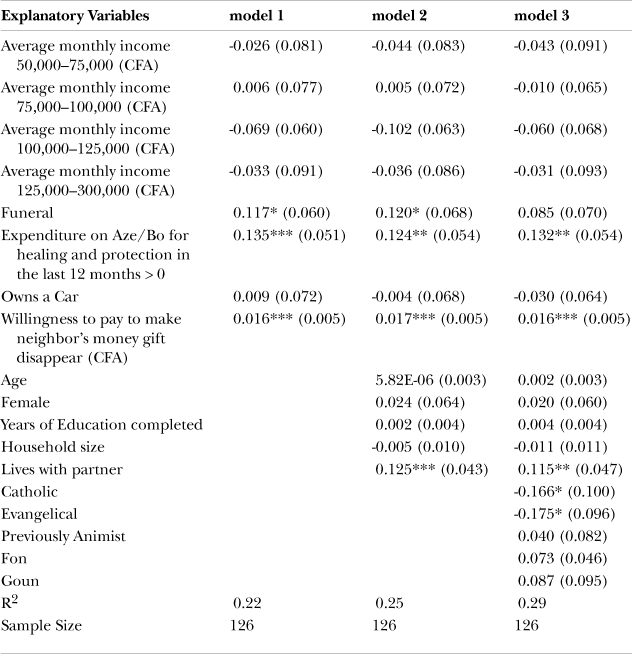
Table 3 displays the results from the linear probability models (based on OLS). We include three specifications for the purposes of robustness checks. In light of our results, we review our different conjectures. The results are robust to variations in the models presented and to permutations in the variables included. Significance was set at a 10 percent level.
LPM estimations of the probability of reporting malevolent magico-religious expenditures (in the two years prior to the survey)

Robust standard errors are reported in parenthesis; ***p < 0.01, **p < 0.05, *p < 0.1.
Characteristics of the Head of Household
The probability of making malevolent magico-religious expenditures appears to be negatively correlated with being Evangelical or Catholic. These individuals are 17.5 percent and 16.6 percent less likely to have reported an expenditure on malevolent magico-religious powers respectively. Surprisingly being “previously animist” is insignificant. These results contradict the findings of LeMay-Boucher, Noret, and Somville (Reference LeMay-Boucher, Noret and Somville2013) and our conjecture that malevolent magico-religious expenditures will be uncorrelated with all religions other than animism.
One possible explanation for the significance of an Evangelical or Catholic affiliation can be found in Platteau (Reference Platteau, Bates, Robinson, Akyeampong and Nunn2014). He posits that monotheistic religions may reduce redistributive pressures by linking individuals with “a spiritual community whose members encourage private accumulation and economic experimentation whilst providing resources such as technical knowledge, credit or labour.” Another possibility is noted by Landry (Reference Landry2015), who discusses how individuals who identify as members of a monotheistic religion may feel less need to rely on magico-religious services, as many believe “the power of god” surpasses the ability of their enemies to harm them.
However, it is important to note that, following this logic, we might have expected a negative and significant correlation with a “previously animist” identification. All individuals who were “previously animist” are now of monotheistic religions; thus, it would make logical sense that their religious conversation might have reduced the likelihood of their investing in malevolent magico-religious powers for the reasons noted by Timothy R. Landry (Reference Landry2015) and Jean-Philippe Platteau (Reference Platteau, Bates, Robinson, Akyeampong and Nunn2014). Yet, as discussed, this variable does not yield a significant result. Additionally, it is worth noting that the various correlations between previously Animist, Catholic, and Evangelical are low, at 0.1 and 0.3 respectively. However, we tried excluding all Catholics and Evangelicals who described themselves as being previously Animist from the Catholic and Evangelical variables. The results for each of these variables (previously Animist, Catholic, and Evangelical) did not change. We found no significant correlation between malevolent magico-religious expenditures and age, years of education, the female dummy variable, and either of the two ethnicities in our specifications. These findings, therefore, support our conjectures.
The lack of significance of our ethnicity variables can be explained by the fact that most of our sample are affiliated with either the Fon or Goun ethnicities (57 percent) and other smaller groups which are mostly from Southern Benin (Popo, Mina, Adja, Toffin, Houeda, Pedah) and thus share similar traditions and attitudes to magico-religious spending. Additionally, some individuals who identify with an ethnic group from another area of the country may have been settled in Abomey-Calavi (or in Southern Benin) for several years, and consequently speak Fon well and have become immersed in local traditions. Speaking Fon enables any individual from any ethnic group to access traditional religious experts (vodun priests and priests of the Fâ).
Surprisingly, household size is insignificant in every specification, although living with a partner is positive and significant in both specifications in which it is included. The probability of having reported a malevolent magico-religious expenditure appears to be 11.5 to 12.5 percent higher when a household head lives with a partner. This suggests, as expected, individuals who face greater exposure to potential conflicts are also more likely to make expenditures on malevolent magico-religious practices. Income appears to be uncorrelated with reports of malevolent magico-religious expenditures. This is in line with the notion that magico-religious services are equally accessible to the poor.
Funerals
Having made a financial contribution to a funeral in the last twelve months is positively correlated with reports of expenditures on malevolent magico-religious powers. The variable is significant in two out of the three specifications in which it is included. Individuals who have made a financial contribution to a funeral in the previous twelve months are 12 percent more likely to have also reported making an expenditure on malevolent magico-religious powers. This suggests funerals may indeed be a source of conflict which motivates an individual to invest in malevolent magico-religious powers. This result supports our third conjecture and the empirical findings of LeMay-Boucher, Noret, and Somville (Reference LeMay-Boucher, Noret and Somville2013), as well as qualitative literature suggesting funerals can cause profound familial conflict (Vidal Reference Vidal1986; Smith Reference Smith2004; Geschiere Reference Geschiere2005).
Jealousy and Egalitarian Norms
A household head’s WTP to make a portion of their neighbors’ monetary gift disappear, our proxy for jealousy of the economically successful, is positively correlated with reports of malevolent magico-religious expenditures at the 1 percent level in all three specifications. For every CFA1000 an individual claims to be willing to pay, the probability of that person’s having reported an expenditure on malevolent magico-religious powers is around 2 percent higher. WTP is significant when defined as a dummy variable rather than a continuous variable (taking value one if WTP is larger than zero and zero otherwise). Given that CFA1000 (around USD2) is a relatively small amount of money compared to declared income, this can be considered a relatively large effect.
This is in line with our third conjecture and the anecdotal evidence discussed above, which suggests jealousy in relation to other people’s economic success may be an important motive for malevolent magico-religious expenditures (Leistner Reference Leistner2014; Platteau Reference Platteau, Bates, Robinson, Akyeampong and Nunn2014; Landry Reference Landry2015). Notably, we also tried using the household heads’ declared WTP to make the same portion of their coworkers’ or their family members’ monetary gifts disappear. However, neither of these variations yielded a significant correlation with reports of malevolent magico-religious expenditures.
This does not necessarily contradict our conjecture, but rather perhaps suggests that the extent to which individuals feel jealous of other people’s economic success varies between social groups. Jealousy may be stronger toward neighbors whose tangible economic success is observable from one’s own home, while the success of a co-worker may be less obvious and obtrusive. However, admittedly, the lack of a positive correlation between jealousy of a family member’s economic success and reports of malevolent magico-religious expenditures is a little surprising. Most anthropological literature suggests such jealousies are perhaps strongest towards family (see Leistner Reference Leistner2014; O’Neil Reference O’Neil2012; Platteau Reference Platteau, Bates, Robinson, Akyeampong and Nunn2014).
We find no correlation between car ownership, our proxy for redistributive pressures, and reports of malevolent magico-religious expenditures, contradicting our fifth conjecture. A possible explanation for this is that individuals facing redistributive pressures may simply not deem malevolent magico-religious powers as a suitable means to cope with such pressures. Such individuals are already at a relatively high risk of being accused of using witchcraft or occult manipulation to achieve their wealth, and may therefore wish to avoid actions which could amplify this notion. They are also likely to feel somewhat threatened by occult forces from jealous individuals. They may, therefore, be inclined to tackle such pressures from a more defensive angle, rather than offensive angle, as confirmed by LeMay-Boucher, Noret, and Somville (Reference LeMay-Boucher, Noret and Somville2013), who used the same proxy.
The Relationship between Protective and Malevolent Uses
Finally, as conjectured, we find a strong positive correlation between expenditures on Aze and Bo for diagnosis, cure, and protection, and reported expenditures on malevolent magico-religious powers. This variable is included in the three specifications and its coefficient is significant at either the 1 or 5 percent levels. Individuals who report such expenditures are around 13 percent more likely to have also reported expenditures on malevolent magico-religious powers.
Conclusion
According to our study, personal investment in malevolent magico-religious powers is far from being the most prominent manifestation of the occult in Southern Benin. In our sample, 44 percent of household heads reported expenditures on magico-religious powers for diagnosis, cure, and protection within the previous twelve months, while only 8.7 percent reported making an expenditure on malevolent magico-religious powers over the previous two years. However, that proportion rises to 18 percent of household heads if we consider the period from 1987 to 2014. These figures may represent a lower bound estimate, as some individuals concealed such expenditures due to the sensitivity of the issue, despite our attempts to minimize such under-reporting.
Our empirical investigation revealed some results which are in line with previous findings. Firstly, income does not appear to create a barrier to access to malevolent magico-religious services. In addition, we find no significant relationship between expenditures on malevolent magico-religious powers and gender, age, ethnicity, or level of education. Nor do we find evidence that malevolent magico-religious powers act as a substitute for redistributive pressures. Contrary to the findings of LeMay-Boucher, Noret, and Somville (Reference LeMay-Boucher, Noret and Somville2013), this could indicate that individuals prefer to tackle such pressures from a defensive, rather than an offensive, angle.
Jealousy of other people’s economic success, as measured by people’s willingness to pay to make a portion of their neighbors’ money gifts disappear, appears to be a potentially important motive for personal investment in malevolent magico-religious powers. This novel proxy variable provides new empirical support for the wealth of anthropological literature which highlights the relationship between jealousy and negative occult activity at the household level (Giblin Reference Giblin2005; Leistner Reference Leistner2014).
Our results also confirm the findings of LeMay-Boucher, Noret, and Somville (Reference LeMay-Boucher, Noret and Somville2013) that potential sources of conflict within one’s extended family or social circle, as indicated by the coefficient on our proxy variable indicating if an individual has recently made a financial contribution to a funeral, may also be an important motive for such investments, further suggesting that investment in malevolent magico-religious powers is a channel through with individuals cope with adverse social situations.
It is interesting to further contextualize our results by offering two local examples of malevolent uses of magico-religious powers. Based on a small number of lengthy interviews with employees in various Beninese public institutions (ministries and other agencies), Philippe LeMay-Boucher and Charlemagne Codjo Tomavo (2015) document that a non-marginal share of interviewees have used malevolent powers in attempts to maximize their chances of either obtaining a promotion or securing a job within the administration, or believe that they have been the target of such powers in their application process. Ndolamb Ngokwey (Reference Ngokwey1994) describes perhaps one of the most illustrative contemporary examples of the malevolent use of magico-religious powers in Benin: the illness of the former President Nicephore Soglo during his 1991 presidential campaign. The public concluded he had been targeted by a chakatou, a mystical gun that penetrates the victim’s body with metallic debris, thorns, pepper, and sand. The employment of magico-religious powers to attack politicians was regarded as normal by the population. Instead, what puzzled them was Soglo’s lack of magical protection.
From fieldwork in various other West African countries, we know that the Beninese “institutions” of Aze and Bo are not widely spread across the region and are mostly concentrated in the South of Benin. In the Northern regions of Benin, where the Muslim religion is more widespread, Aze and Bo tend to be less prevalent. Consequently, our sample is only representative of Southern Benin, where a significant share of the population is Animist (either self-declared or not, and often in combination with other more traditional religions such as Christianity and various evangelical churches). We emphasize that our results may not be representative of Benin as a whole and certainly not of a wider West-African context. This is an important limitation, due to wide variations in local traditional religious beliefs and institutions across the sub-continent. It would be misleading to offer a conclusion from our sample that extends beyond the context of this study.
This work also confirms previous results related to the proportion of individuals who make expenditures on magico-religious powers for diagnosis, cure, and protection and the size of these expenditures. This is in itself a valuable empirical exercise. We find that around half of our sample made such expenditures within the twelve months prior to the questionnaire, and that these expenditures on average account for around 5 percent of all household expenditures (for the households with non-zero expenditures). This is significant and, when compared with other expenditures, the magico-religious share of the budget exceeds those dedicated to textbooks and school furniture, clothes, and water (see LeMay-Boucher, Noret, & Somville Reference LeMay-Boucher, Noret and Somville2013). We go beyond that and investigate how spending on malevolent uses compares. The anthropological literature highlights that such uses of magico-religious powers are not as widespread as for diagnosis, cure, and protection. However, no survey, to our knowledge, has provided an order of magnitude for both based on a sample of individuals of significant size. Our study shows the wide discrepancy between the two uses. Unfortunately, we were unable to measure the size of the expenditures made on malevolent uses, as interviewees were often unwilling to disclose this information.
Beyond that, our data allow us to show a positive and significant correlation between both types of expenditures. Key determinants of magico-religious spending for diagnosis, cure, and protection also correlate significantly with spending on malevolent uses of these powers (“funeral” and “lives with a partner”). Similarly, determinants which are not significantly correlated with expenditures on diagnosis, cure, and protection are also not correlated with expenditures on malevolent uses (notably gender, level of income, and education). Contrasting the two on the basis of an empirical sample has, to our knowledge, not been done before and thus offers valuable insight into such households’ expenditures.
Acknowledgments
The survey used for this study has been financed by a British Academy/Leverhulme Small Research Grant.
Appendix
Maps of the area surveyed: source google.com maps.
A: Part of West Africa; B: Lower two thirds of Benin; C: Region around Abomey Calavi.
D: Abomey Calavi and the specific area covered by our sample within the rectangle.

Questions used to create each independent variable