


Introduction
How can we explain interactions between distinct international orders? Much of the scholarship in historical international relations has revolved around documenting and examining historical international orders, the differences between them, and, to a lesser extent, their interactions. Yet, what I will call system encounters deserve more attention. Prominent accounts of such encounters, most notably that of the British embassy under George Macartney to China in 1793, have shaped a narrative of clashes between pre-formed and fixed entities whose differences are reconcilable only by conflict or convergence. More recently, scholars have begun to revisit the role of encounters in the historical evolution of the international system as a bidirectional process with the potential for mutual transformation.Footnote 1 However, how exactly international orders figure in these interactions and how these interactions figure in the (re)constitution of international orders has yet to be fully explained.
Examining the European embassies to China during the seventeenth and eighteenth centuries, this paper argues that disputes over diplomatic practices and their meaning, including the handling of official gifts and letters, courtly ritual, and the sending and receiving of embassies, should be understood as manifestations of a process whereby the differences between distinct international orders in Europe and East Asia were constituted and negotiated. Traditional approaches to international order fail to adequately account for the dynamics of system encounters and their significant contingency because they lack an appropriate theoretical apparatus for analysing system encounters at the micro level.
Disputes over the koutou, a ritual consisting of nine prostrations, constitute perhaps the most well-known aspect of the premodern European embassies to China.Footnote 2 Citing established diplomatic practices at European courts, Russian and British envoys opposed the ritual, an integral element of practices of tribute diplomacy, which led to disputes and prevented the European embassies from achieving their stated objectives. These conflicts tend to be attributed to the differences between two distinct worldviews, making the outcomes of system encounters appear as inevitable and predetermined. In doing so, scholars not only overestimate the potential of system encounters for serious conflict but also fail to account for variation in outcomes and the processes through which they are produced.
Building on a practice-relational conception of international order as configurations of relations that are simultaneously governed by and constituted through practices, this paper develops a novel explanation of rule-conflicts in system encounters as manifestations of micro-level processes through which international orders and the differences between them are constituted and negotiated in response to the problematization of established diplomatic practices. Interactions prompted actors to clarify their relevant identities as representatives of sovereign rulers engaged in ‘an affair of State’.Footnote 3 Presented with the opportunity to avoid practices of tributary diplomacy by declaring his embassy a purely commercial enterprise, the Russian envoy in 1656 responded that he was no merchant, but a representative of the tsar.Footnote 4 Clarification of actors’ relevant identities invoked established diplomatic practices as relevant to their interaction, which is evident in frequent references to practices shared with neighbouring states by both European envoys and Chinese officials. Explaining to the Russian envoy in 1676 why he could not be received by the emperor in audience before handing over the tsar’s letter to the Ministry of Rites for inspection, a Chinese official went as far as suggesting that deviation from established practices would threaten the emperor’s identity and status among other sovereigns.Footnote 5 Invoking established practices brought them into direct contact, challenging and problematizing their taken-for-granted meaning. Nowhere is this evident more clearly than in the negotiations around the koutou.
Though the koutou differed from courtly ritual at European courts,Footnote 6 it was not the ritual itself that was objectionable, but the lack of a reciprocal equivalent and thus its directional character. In 1720, a Russian envoy agreed to perform the koutou on the condition that Chinese envoys travelling to Russia would perform the same ritual at the tsar’s courtFootnote 7 and in 1793 Macartney indicated that he would be willing to perform the ritual if a high-ranking official would do the same in front of a portrait of the king.Footnote 8 The directionality of diplomatic practices also emerges as a central concern from actors’ justifications and explanations of their actions elsewhere, including the insistence of European envoys on and the rejection by Chinese officials of Chinese embassies to European courts. Thus, rather than structural differences, this paper concludes that it was the directionality of the underlying diplomatic practices that constitutes the relevant difference between the historical international orders in East Asia and Europe.
International orders exist in their concrete instantiations only in the context of system encounters. Drawing on published collections of primary sources and historiography detailing the Russian, Dutch, and British embassies to China, this paper makes several contributions to the study of historical international orders. First, this paper offers a framework for analysing the role of encounters in the historical evolution of the international orders by linking micro-level interactions to macro-social configurations. Second, this paper demonstrates the utility of practice-oriented and relational approaches for avoiding the ‘essentialism trap’, charting a way forward for the historical international relations and Global International Relations research programmes.Footnote 9 Third, by reconstructing the relevant differences between the East Asian and European international orders from their interactions, this paper demonstrates that the study of system encounters can be a valuable tool in the comparative study of historical international orders more generally. Empirically, this paper contributes to our understanding of premodern diplomatic relations between China and European polities, specifically that Macartney’s embassy in 1793 marked the end of a nearly 200-year period of repeated encounters, rather than the beginning of Sino-European diplomacy.
Following this introduction, I situate my argument in the scholarship on historical international orders. I then outline a practice-relational approach to international order. Building on this approach, the next section outlines an explanation of system encounters as a process whereby repeated moments of crisis problematise established practices and prompt actors to articulate the differences between international orders in response. The empirical part of the paper illustrates this process in the context of the Russian, Dutch, and British embassies to China between 1618 and 1816, followed by a brief discussion of how my findings compare to existing characterisations of international order in Europe and East Asia. The conclusion summarises my argument, discusses the broader implications, and identifies areas for future research.
Encounters between historical international orders
Studies of system encounters remain relatively rare in the scholarship on international order. Mainstream theories of international order are almost exclusively conceived from an implicit assumption of international order as a singular thing, rendering questions about encounters moot. Even though the existence of multiple international orders has been the historical norm, universal institutions and norms that have characterized the so-called Liberal International Order since 1945 are, to paraphrase Spruyt, being mistaken for the ontology of international order.Footnote 10
Expansion and convergence
Any discussion of system encounters necessarily begins with the recognition of the existence of multiple historical international orders and a body of works associated with what is now known as the English School. This literature examines encounters between historical international orders in the context of the global expansion of a European society of states.Footnote 11 The expansion narrative describes a ‘process of rational incorporation’, whereby non-European states were admitted to a growing society of European states by accepting its rules.Footnote 12 While Bull and Watson caution that the evolution and expansion of European international society were ‘simultaneous processes, which influenced and affected each other’,Footnote 13 Wæver writes that it is not clear whether Bull and Watson study the expansion of a European core whose code, or rules, remained essentially constant, ‘or whether these changes in extension actually entail transformations of the code’.Footnote 14 The lack of a more prominent role of non-European international orders in this process can be at least partially explained by the English School’s distinction between international system and international society, a group of independent polities ‘which not merely form a system … but also have established by dialogue and consent common rules and institutions for the conduct of their relations, and recognize their common interest in maintaining these arrangements’.Footnote 15 This distinction effectively denies international orders outside of Europe equal ontological status and any independent effect on the outcomes of encounters, as the editors and contributors refer throughout the book to European international society but non-European international systems.
Countering the narrative of inevitable European victory, scholars have pointed out that premodern encounters were characterised by European inferiority and subsequent adaptation to prevailing local rules and practices.Footnote 16 Such accounts simply present a reverse version of a process of rational adaptation, incorporation, and convergence and play down the tensions that are at the centre of this study. Similarly, while some scholars have argued that increasing contact between world regions created, at least temporarily, parallel governing arrangements prescribing divergent forms of interaction within and across international orders, nearly all of these accounts end with the eventual convergence on the Western model of international relations.Footnote 17
Conflict and coexistence
Comparative studies take different historical international orders more seriously in their own right, and, to the extent that they consider encounters between them, tend to pay more attention to questions about how the differences between them shape their interaction. Because international orders are conceived of in essentialist terms as relatively fixed and pre-existing entities, such approaches tend to emphasize conflict as the inevitable result of fundamental differences, an idea most prominently articulated in the clash of civilizations thesis.Footnote 18 This issue is particularly pronounced in the case of the European and East Asian international orders, which have been portrayed as opposite types of international order.Footnote 19 This view is central to accounts that explain the failure of the Macartney embassy in 1793 and the outbreak of the first Anglo-Chinese war in 1840 as the result of incompatible principles of international politics and cultural differences.Footnote 20
While the scholarship on diversity regimes challenges the idea that differences are a source of conflict and disorder, most of this scholarship is concerned with the internal stability of international orders rather than encounters between them, and it is not clear if and to what extent regimes developed to manage diversity internally are capable of managing external differences.Footnote 21 Though Phillips and Sharman’s observations regarding the significant compatibility between international orders is an important contribution to a field of study that has predominantly focused on differences, it is not clear how their argument applies to the more contentious interactions examined here.Footnote 22
Mutual transformation
A third iteration of this literature focuses more explicitly on contacts between international orders. Common to most is an understanding, implicit or explicit, that encounters themselves played a crucial role in the constitution and transformation of international orders. Reus-Smit and Dunne argue that the globalisation of international society was accompanied by qualitative transformations and that the European international society was itself a product of ‘diverse civilizational engagements and encounters’.Footnote 23 Individual contributions to this edited volume expand on this notion in the context of different issue areas. Welsh, for example, argues that ‘the Eurocentric system was neither stable nor mature, but in a constant state of development as a consequence of encounters with the non-European world’.Footnote 24 As Zhang puts it very eloquently in the context of Sino-European relations, ‘With the growth of European knowledge of the civilizational and imperial Other, China became increasingly an inescapable component in the European understanding of itself.’Footnote 25
Yet, the continued reliance on essentialist and substantialist conceptions of international order has greatly complicated a better understanding of how encounters are governed by distinct international orders and how they shape them in turn. Thus, much of the most recent scholarship on the topic suffers from a disconnect between encounters (micro level) and international order (macro level). As a result, Reus-Smit and Dunne acknowledge that they provide ‘no explicit theory of international social change’.Footnote 26 Similarly, while Spruyt argues that encounters between the European and non-Western international orders were bidirectional, this process is conceived primarily in terms of non-Western actors’ capacity for adaptation.Footnote 27
Scholars of historical international relations, law, and sociology have argued that key institutions of modern international order, such as sovereignty, territoriality, and certain aspects of diplomacy emerged not in Europe but in the context of imperial and colonial encounters.Footnote 28 While this scholarship provides important empirical evidence for the generative potential of encounters, it does so at the expense of an explicit theory of international order. Perhaps the most elaborate articulation of the idea of transformative interactions between international orders is Mulich’s work on change in international systems. Reconceptualising international systems as overlapping networks, Mulich argues that imperial expansion resulted in the reconfiguration of those networks by altering repertoires of practice.Footnote 29 Nevertheless, his focus remains firmly on marginal interaction, and he says little about the relational configurations themselves.
Thus, while system encounters are being increasingly recognised for their importance, they have yet to be fully unpacked. Existing studies approach system encounters with conceptions of international order that cannot appropriately account for the micro-level dynamics of encounters. Conversely, those studies that have examined the dynamics of encounters in greatest detail frequently work without an explicit theory of international order.
International order as practice
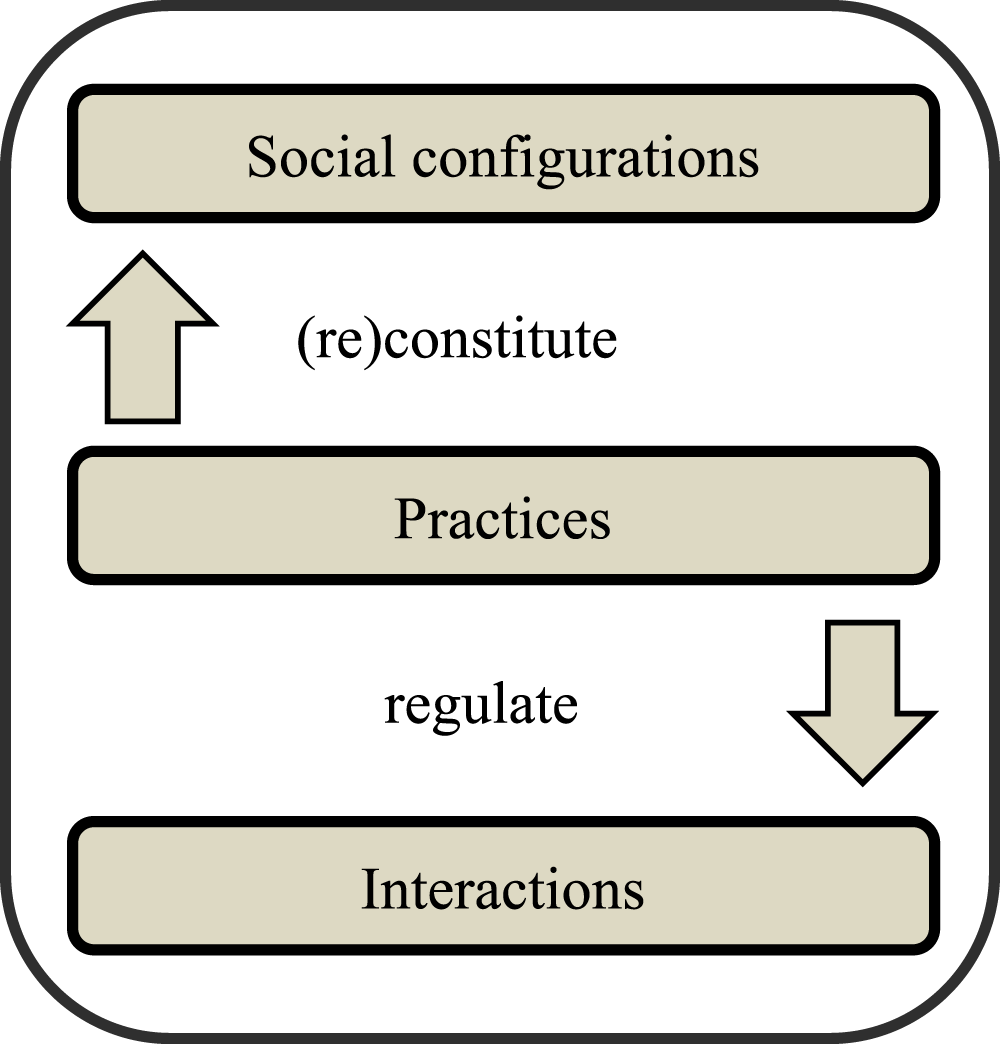
Practices, as analytical categories, have certain characteristics that make them particularly useful for studying system encounters. First, practices always have a double existence as both context-specific and general patterns of actions.Footnote 30 Applied to international order, a concept frequently criticised for being an analytically vacuous catch-all term, this double existence establishes a conceptual link between international order as an expression of system-level characteristics and the context-specific actions of relevant actors. Second, practices are simultaneously constitutive and regulative.Footnote 31 Socially meaningful identities are constituted through the repeated performance of practices. Conversely, practices derive their ‘social effectiveness’ from the shared meaning they embody, governing interaction by defining the range of socially acceptable actions.Footnote 32
I define international orders as configurations of relations among polities that are simultaneously produced through and governed by international practices (Figure 1). Specifically, I focus on diplomatic practices, the practices constitutive of polities and the relations between them as such, anchoring practices that provide the very basis or structure for interaction.Footnote 33 I do not distinguish between international system, international order, and international society, following others in their assessment that this distinction is unsustainable.Footnote 34 Despite the centrality of the distinction to the English School and its continued use, I have explained above how it denies non-Western international orders equal ontological status. The practice-relational approach presented here further reinforces the idea that all international systems are social systems.
A practice-relational approach to international order.

The idea of diplomatic practices as the anchoring practices of relations among polities is reflected in Neumann’s observation that ‘diplomacy is what states do [and] states are what diplomacy does’.Footnote 35 Similarly, Sharp has argued that ‘international relations and diplomacy may be spoken of as if they were the same thing’.Footnote 36 Though Leira expresses reservations about the transhistorical reference to ‘diplomatic practices’, Jönsson and Hall identify the constitutive dimensions of diplomacy as transhistorical rather than uniquely modern.Footnote 37 To further hedge against an anachronistic reading of premodern practices, I follow Adler and Pouliot’s recommendation to let practitioners themselves define ‘what counts’ as international practice, and justify the distinction between diplomatic practices and other forms of interaction based on how European envoys and Chinese officials conceived of their activities.Footnote 38
Among the essential dimensions of diplomacy identified by Jönsson and Hall, I will focus on diplomatic practices related to recognition and representation. While communication was, without a doubt, an important aspect of diplomacy, it was also an aspect of nearly any other form of interaction. The centrality of recognition and representation to diplomacy, moreover, is widely recognized. Pouliot and Cornut define diplomatic practices as the enactment of claims to ‘represent a given polity to the outside world’ and recognition and representation are further implied in Sharp’s notion of ‘relations of separateness’.Footnote 39
The directionality of international practices
Notwithstanding the ubiquity in global history of what we now call diplomacy, the world of orders that existed prior to the global transformations of the nineteenth century was characterized by variations in diplomatic practices. Appropriating the idea of directed and undirected ties in social network analysis,Footnote 40 I propose that we may distinguish between directional and non-directional diplomatic practices. Non-directional diplomacy entails the mutual engagement between polities through the same set of diplomatic practices. The enduring existence of status hierarchies, both historical and contemporary, can be explained by variation in the quality of diplomatic practices (e.g. the specific protocol for court ceremonies), rather than by variation in the type of practices.Footnote 41 The resulting relations are between mutuals, albeit not necessarily equals. Directional diplomatic practice, by contrast, entails the mutual engagement between polities through different practices. Directional diplomacy does not imply a one-sided relationship, but that the practices through which A engages B are different from those through which B engages A, in the sense that they embody different meanings.Footnote 42 Directional diplomatic practices create relationships that are fundamentally unequal.
Advantages of a practice-relational approach
I am not the first to propose a practice-oriented approach to international order. While most of that scholarship focuses on contemporary or more recent international orders,Footnote 43 or is conceptual in nature,Footnote 44 the approach presented here builds in important ways on Lee’s practice-oriented account of the tribute system.Footnote 45 With a few notable exceptions, such as Ringmar’s study on international orders as performances and Bank’s study of Anglo-Chinese relations from the Macartney embassy to the late nineteenth century, practice-oriented approaches have not widely been used in studying either historical international orders or encounters between them.Footnote 46
Most importantly, a practice-relational approach is capable of overcoming agent-structure and stability-change dichotomies that have traditionally plagued studies of international order.Footnote 47 Centring practices leads us away from order and stability as its central quality,Footnote 48 and towards ‘ordering’ as an ongoing process.Footnote 49 Instead of stability, we may speak of episodes of temporary stabilization in the sense of an ‘ongoing production and reproduction of social arrangements’.Footnote 50 International orders are produced and reproduced through the continuous enactment of established practices.Footnote 51 In turn, change in and transformation of international orders are the result of sustained contestation and deviation from established practices. By incorporating the mechanisms of both stabilisation and change, a practice-relational approach to international order allows for a more dynamic conception of system encounters.
System encounters as moments of crisis
International practices can be understood as manifestations of taken-for-granted views of how relations among polities are and should be organized.Footnote 52 Under normal conditions, their study is complicated by the fact that practices are carriers of implicit knowledge ‘which is rarely verbalised and is hence not easily readable from signifiers, speech, and discourse’.Footnote 53 I argue that system encounters are best understood as moments of ‘crisis and controversies’,Footnote 54 akin to Dewey’s idea of the problem-situation, in which the taken-for-granted meaning of practices is challenged.Footnote 55 In system encounters, ‘structures or routines fail to provide for what is necessary for proceeding by everyday routine’,Footnote 56 necessitating conscious reflection on the part of the practitioners.Footnote 57 System encounters are characterised by repeated mismatches between the expected and experienced social effects of practices.
The first such challenge in system encounters regards the clarification of relevant social identities and practices. Established practices not only define the limits of socially acceptable action but also define the very identity and position of actors in social configurations are dependent on their competent enactment.Footnote 58 Differences may result in the mischaracterisation of actors’ identities or the nature of their interaction, prompting actors to intervene to correct it by making explicit who they are in relation to one another and what type of interaction they are engaging in. In the case of the European embassies to China, European envoys and Chinese officials clarified their identities as representatives of sovereign rulers (as opposed to merchants) and the relevant practices as the affairs of state (as opposed to commerce).
This initial clarification of relevant identities as sovereign representatives and associated practices was an important first step in system encounters in that it invoked established diplomatic practices as the relevant systems of meaning through which actors made sense of the actions of their counterparts as well as their own. Having clarified their mutual identities as representatives of sovereign rulers engaged in affairs of state, Chinese officials and European envoys drew on diplomatic practices established among East Asian and European polities respectively to engage each other.
By invoking established diplomatic practices, actors in system encounters brought international orders into direct contact. Rather than following a logic of consequence or appropriateness, actions in system encounters follow a logic of practicality wherein knowing and doing are one and the same.Footnote 59 Mutual engagement along established diplomatic practices produced moments of crisis, which prompted actors to further justify and explain their actions as well as their pragmatic attempts to respond to such crises, thereby articulating the relevant differences between distinct international orders. Through negotiations of possible compromises specifically, actors indicate not just what they are willing to do, but why they are willing to do some things but not others.
Alternative explanations
Others have explained the dynamic and outcomes of China’s encounters with Europeans as a function of either power-political and strategic calculations or domestic politics. Unlike during the nineteenth century, it was China that set the terms of engagement in the seventeenth and eighteenth centuries.Footnote 60 Where strategic incentives existed, scholars are quick to point out that the Qing readily abandoned rigid practices of tribute diplomacy. For example, Perdue argues that shared strategic interests account for the successful negotiation of the Treaty of Nerchinsk in 1689.Footnote 61 Andrade similarly points out it was the utility of Dutch naval forces to the campaigns against Ming–loyalist resistance that earned the Dutch permission to trade in Fujian every two years, outside of the regularly scheduled tribute embassies.Footnote 62
Focusing instead on domestic politics, Banks argues that foreign relations were subordinate to domestic considerations in explaining the willingness and ability of the Qing to compromise.Footnote 63 Wills argues that domestic politics frequently were ‘the primary explanation, even the sufficient cause’ for decisions on foreign relations.Footnote 64 Both the decision to open Chinese ports for maritime trade (1684) and the Treaty of Nerchinsk (1689) coincided with the consolidation of Qing rule following the defeat of the Revolt of the Three Feudatories and the conquest of Taiwan in 1683.Footnote 65
I do not deny the importance of both strategic considerations and domestic politics. What neither the power-based accounts nor the domestic politics narrative can explain, however, is why diplomatic practices received so much attention from the actors in system encounters, why some compromises became available but not others, and why they took their specific form.
Methodology and sources
I follow an abductive approach that develops the explanation presented above from anomalous empirical observations against the backdrop of prior theoretical knowledge.Footnote 66 The choice to examine encounters between international orders in East Asia and Europe was informed by their characterisation as different, if not opposite, forms of international order, constituting a setting in which we should expect those differences to manifest clearly.Footnote 67 My choice to focus on the seventeenth and eighteenth centuries reflects an observation that European encounters with China prior to the nineteenth century are curiously missing from International Relations scholarship.Footnote 68 This period also coincides with episodes of significant transformations within the East Asian and European international orders, making questions about the role of system encounters in the constitution and negotiation of their differences all the more interesting.
This paper examines published textual sources detailing interactions between European envoys and Chinese officials.Footnote 69 These include journals composed by members of the embassies, published collections of official documents and reports, and reproductions of archival sources in the works of historians.Footnote 70 These texts, many of which fall under the category of ‘ego-documents’, are especially useful for my purposes of reconstructing the meaning of practices in system encounters because they contain the relevant individuals’ descriptions of interactions, including explanations of and justifications for their actions.Footnote 71
The analysis of practices is complicated by the fact that embodied knowledge is never directly accessible and needs to be inferred indirectly from observable actions, statements, and descriptions.Footnote 72 While scholars note that textual sources are appropriate for the study of practices that cannot be directly observed,Footnote 73 it raises questions about whether this constitutes analysis of practices or of discourse about practices.Footnote 74 I justify my use of textual sources because I consider not only their content but specifically their relation to ‘the practices necessary to produce them’.Footnote 75 This is rather straightforward in the case of documentation of European embassies in Chinese records, because such records were an important element of the administration of tributary relations, or the official depositions made by European envoys upon their return. Even travel journals require us to reflect on the context in which they were produced, specifically the fact that they would not exist, in this form, without an embassy taking place and established practices against which certain observations became legible as something worth recording.
Readers will notice that the sources from which I reconstruct the interactions between European envoys and Chinese officials are skewed towards the European perspective, a limitation I duly acknowledge.Footnote 76 Beyond the limited number of books reproducing excerpts from court records and other Chinese and Manchu sources in translation,Footnote 77 I have relied heavily on the work of historians, who have drawn on both Chinese and Manchu sources. However, Chinese records of the embassies tend to be very brief.Footnote 78 One possible explanation for the difference in the level of detail may lie, once again, in practices. For Chinese officials, the arrival of embassies was likely a routine affair, obviating the need for detailed description. The journal of Tulišen, a Qing envoy to the Torghut Khan in 1712–1715, presents a stark contrast, supporting my reasoning here.Footnote 79 His journal is very detailed, mirroring the European journals, and reflects a concern with ‘documenting the foreign’.Footnote 80
European embassies to China, 1618–1816
The early modern period (ca. 1500–1800) is an important yet understudied part of global history among scholars of international order.Footnote 81 Brook’s assertion that the seventeenth century was ‘an age of second contacts, when sites of first encounter were turned into places of repeated meeting’ is a particularly apt characterization of interactions between European polities and China during this time.Footnote 82 It was a period that witnessed deliberate and systematic efforts by European rulers to establish relations with the Chinese emperor.
Between 1618–1816, Russia, the Dutch East India Company (VOC), and Britain dispatched several embassies to China (see Table 1).Footnote 83 With the exception of the first Russian embassy in 1618, of which no records have been found in Chinese sources,Footnote 84 China treated and recorded all embassies as tribute embassies. However, the dynamics and outcomes of these interactions varied. The Russian embassies to China were in some ways both the most contentious and most successful. After a series of failed embassies in 1618, 1656, and 1676, characterised by significant disputes over diplomatic practices and occasional military clashes on their frontier, the conclusion of the Treaty of Nerchinsk (1689) marks an extraordinary success not replicated in China’s relations with any other European polities at the time.
Select Russian, Dutch, and British embassies to China and relevant events, 1618–1816.

Table 1 Long description
Two side by side columns labeled Year(s) and Event list dated embassies to China and related events. Entries begin with 1618, First Russian embassy to China, then 1654 to 1658, Second Russian embassy to China, and 1655 to 1657, First Dutch or VOC embassy to China. Dutch or VOC entries continue with 1665 to 1667, Second Dutch or VOC embassy to China, and 1685 to 1687, Third Dutch or VOC embassy to China, then 1795, Fourth Dutch or VOC embassy to China. Russian entries include 1676, Third Russian embassy to China, 1691, Fourth Russian embassy to China, and 1720 to 1721, Fifth Russian embassy to China. Other events listed are 1680, Qing delegation to Batavia, 1684, Opening of Chinese ports, 1689, Russo Chinese Treaty of Nerchinsk, 1727, Russo Chinese Treaty of Kiakhta, and 1730 to 1732, Qing embassies to Russia. British entries are 1793, First British embassy to China, and 1816, Second British embassy to China.
The Dutch embassies were less contentious because Dutch envoys performed the ceremonials required at the Chinese court, including the koutou. Nevertheless, differences between the two sides manifested in how the two sides understood the nature and purpose of embassies, limiting real achievements. Rather than being resolved by treaty, these differences became irrelevant following the opening of maritime trade in Chinese ports in 1684, after which the Dutch reverted to exclusively commercial activity in China.Footnote 85
Not unlike the Russian embassies, the two British embassies in 1793 and 1816 featured intense disputes over courtly ritual and the nature of diplomacy. Though the Qianlong emperor received Macartney in audience, the embassy’s requests were denied. A second embassy in 1816 failed over the ambassador’s refusal to adhere to practices of tribute diplomacy and marked an important turning point in Anglo-Chinese relations.Footnote 86 Thus, in all three cases, interactions produced manifestations of distinct international orders, but variation in both dynamics and outcomes demonstrates the inherent contingency of system encounters.
Clarifying the affairs of state
Encounters between European envoys and the Chinese court played an important role in clarifying who exactly they were in relation to one another and what types of relations they were engaged in. Leading the second Russian embassy to China in 1656, Fedor Isakovich BaĭkovFootnote 87 carried gifts and a letter from the tsar containing his credentials as well as a proposal to establish relations with the Chinese emperor through the exchange of ambassadors.Footnote 88 Officials from the Ministry of Rites, the imperial bureaucracy responsible for managing foreign embassies, instructed him to surrender the embassy’s gifts to the emperor in accordance with the established practices for the reception of foreign envoys, which he refused citing established custom at the Russian court.Footnote 89 The officials proposed that if Baĭkov had only come to trade, he may ‘deal with those articles as you please’.Footnote 90 But Baĭkov was not a merchant and his primary concern was not trade: ‘I am sent by my Great Sovereign to yours not for trade, but as bearer of His Majesty’s gracious letter.’Footnote 91 This distinction also mattered to the Chinese officials. When Baĭkov complained that attempts to take the embassy’s gifts amounted to robbery, Chinese officials explained that if the products were indeed gifts to the emperor, rather than merchandise, ‘we take from you the royal gracious gifts … because they were sent by your great Lord to ours’.Footnote 92
The distinction between the social identities of envoys and merchants and diplomacy and trade as their corresponding types of interaction is perhaps most surprising in the case of the Dutch envoys, of which scholars have said that they were ‘representatives of a company, not of the state’Footnote 93 and as such not beholden to the same constraints as other European envoys.Footnote 94 Yet, when Chinese officials asked the Dutch ambassador Pieter van Hoorn about trade in 1666, he stated that matters of trade were not handled by him, the ambassador, but by his second in command, and that it was not custom for envoys to participate in trade.Footnote 95 By the time of the British embassies to China in the late eighteenth and early nineteenth centuries, the distinction between the affairs of state and trade had become even more pronounced. The East India Company’s (EIC) ‘sovereign awakening’Footnote 96 prompted the state to take back control through the establishment of the Board of Control in the India Act of 1784.Footnote 97 The clear distinction between company matters and affairs of state went so far that, in 1793, Macartney sought full control over the EIC’s Canton factory for the duration of his embassy.Footnote 98
Actors not only distinguished between the activities of trade and the affairs of state, but between their personal and professional identities. Having offered to perform the koutou to receive his personal gifts, Nikolai Gavrilovich Spafarii in 1676 firmly refused doing the same for the emperor’s gifts to the tsar ‘because it is not my affair, but an affair of state’.Footnote 99 Travelling through Russia to deliver an imperial edict to the Torghuts (Kalmyk Khanate) in 1712–1715, a Qing envoy faced a similar dilemma. When the Governor of Yeniseĭsk urged Tulišen to accept some minor gifts, he declined, explaining that ‘the officers of the Chinese empire, when employed on service by their sovereign, dare not accept of the smallest present’.Footnote 100 During preliminary negotiations about trade in the context of the second Dutch embassy to China (1665–1667), van Hoorn told officials in Fuzhou that while he was willing to abide by Chinese customs, he ought not to be restricted in his duties as ambassador since in this function he represented the Dutch state ‘and would rather die than suffer it some insult’.Footnote 101 When provincial officials broached the issue of the koutou shortly after Macartney’s arrival in 1793, he told them that while he was intent to please the emperor, he had certain obligations arising from his role as ambassador and thus had to keep to ‘what might be agreeable to my own King’.Footnote 102 Van Hoorn and Macartney, like Baĭkov and Spafarii, came to China as the representatives of their sovereigns, not in their private capacity, and as such were subject to limits of socially acceptable action arising from diplomatic practices.
Invoking established diplomatic practices
When the first Dutch embassy, led by VOC merchants Peter de Goyer and Jacob de Keyser, arrived in China in 1656, they were told that ‘no Forreign Embassadours are to bow their heads before the Emperours Throne, unless they be such as are a Kin to him that sent them, without which they would have no great credit and reputation with the Emperour’.Footnote 103 Tribute diplomacy was exclusive to the domain of sovereign rulers, which posed problems for the Dutch envoys. The envoys’ explanation that ‘Holland was never Governed by any one single person, but by a select number of chiefest [States General] of the Countrey’ and that the ambassadors were acting on orders of the Governor General of Batavia, did not help the case.Footnote 104 An anomaly even in the European context, this form of government was foreign to the Chinese court.Footnote 105 Faced with the possible failure of their embassy, the envoys were ‘forced to make use of the name of the Prince of Orange, as if they had been sent by his Highness’.Footnote 106 Claiming to be envoys engaged in affairs of state was hugely consequential, as it invoked sets of established practices that would henceforth govern encounters.Footnote 107
European envoys and Chinese officials both clearly explained and justified their actions with respect to established diplomatic practices shared with neighbouring polities. In 1656, the Russian ambassador Baĭkov refused to hand over the tsar’s gifts to the Ministry of Rites prior to the imperial audience, stating that ‘all the neighboring states that are in relations with our great sovereign’ follow a practice of exchanging gifts after the presentation of their credentials during an audience.Footnote 108 With respect to the koutou, Spafarii similarly stated that ‘it was customary in all countries in the world to bow to the sovereign in the ordinary way’, by which he meant standing.Footnote 109 Wills attributes Dutch envoys’ frequent references to the ‘law of all nations’ and ‘the custom of all princes’ to European diplomatic practices.Footnote 110 Spafarii’s refusal to follow instructions to surrender the tsar’s letter and the embassy gifts to the Ministry of Rites, citing established practices at European courts,Footnote 111 was met with an explanation by Mala, a vice president of the Ministry of Rites, that ‘if the emperor now took you before him, then all the surrounding sovereigns would no longer call the emperor emperor’.Footnote 112 Not only did Mala clarify that practices governing China’s relations with neighbouring polities served as the blueprint for how the Russian embassies were understood, but he also pointed to the constitutive dimension of practices and the anticipated social effects of deviating from them. When, in 1816, Chinese officials mentioned that ambassadors from Japan and Siam performed the koutou without resistance in an effort to convince Lord Amherst to agree to the ceremony, he remarked that ‘analogies made with the courts of Portugal or Russia would have been more appropriate’.Footnote 113
It is clear from Nieuhof’s account that de Goyer and de Keyser did not actually believe that they represented the ‘King of Holland’ but invoked his name to salvage their embassy. In retrospect, the VOC authorities at Batavia as well as the envoys themselves may have wished to rethink this claim. While it ensured an imperial audience, it made the Dutch Republic ‘the first European power to be received into the tribute system’, inadvertently limiting the prospect for the primary motivation behind the Dutch embassies: trade.Footnote 114
The evidence for the reception of European embassies, including the Russian embassies, according to practices of tribute diplomacy is overwhelming.Footnote 115 The Chinese imperial court recorded all European embassies as tribute embassies.Footnote 116 Pritchard writes with respect to the British embassies, but applicable to the Russian and Dutch embassies too, ‘that the sending of a mission and the delivery of presents enrolled the sender upon the list of tribute sending nations as effectively as a performance of the kotow’.Footnote 117
Articulating differences
Wills argues that part of the reason why the Dutch failed to comply with Chinese expectations for tribute embassies was because the court had ‘done little or nothing to explain this concept to them’.Footnote 118 As manifestations of taken-for-granted views of the world, it is not clear why such practices would require an explanation in the eyes of the Chinese court. However, encounters between practices produced a mismatch between the expected and actual social effects of practices that prompted further elaborations, clarifying the relevant differences between the two international orders. Three areas are particularly instructive: courtly ritual, the exchange of gifts, and the understanding of the purpose and nature of embassies.
Though often presented as an issue of immutable and irreconcilable cultural differences, attempts to negotiate the ritual for the reception of foreign envoys at the Chinese court demonstrate that the ritual was not objectionable in and of itself, but because it lacked the reciprocal character of courtly ritual at European courts. Russian envoys in 1676 and 1720 proposed that Chinese envoys coming to Russia should perform the same ceremonies at the tsar’s court.Footnote 119 Macartney also proposed to the Imperial Legate Zhengrui that an official equal to the ambassador’s rank ‘shall perform before His Britannic Majesty’s Picture … the same ceremonies’.Footnote 120 Zhengrui rejected the proposal and Macartney declined a proposal by two lower-ranking officials willing to complete the ritual.Footnote 121
Hevia explains that this proposal was ‘incomprehensible because the ambassador of a foreign king (like the king himself) was categorically distinct from and inferior to a servant of the emperor’.Footnote 122 When the Chinese emperor dispatched envoys to invest foreign rulers with the title of ‘king’, they did not perform the ceremonies of the receiving court. Instead, the emperor’s envoys were received ceremoniously in a setting made to replicate an audience at the Chinese imperial court to administer the foreign ruler’s koutou before the imperial patent and gifts instead of performing courtly ritual before the foreign ruler.Footnote 123
Another area in which the differences between the two international orders became clear is in the exchange of gifts. Though gifts were an important aspect of both East Asian and European international relations, the practice was not equivalent.Footnote 124 For the Europeans, gift exchange was reciprocal and, though the value of a gift could establish unequal status, the meaning of a gift did not change depending on the direction in which it moved. In the context of tributary diplomacy, the meaning of a gift changed depending on the direction in which it moved. During a dispute over the meaning of the gifts carried by the Macartney embassy, Zhengrui reportedly argued that they were tribute to the emperor, whereas the embassy’s interpreters insisted that they were ‘not tributes (cong-so), but presents (sung-lo)’.Footnote 125 This exchange perfectly encapsulates Lee’s observation about the character of social relations in the tribute system, namely that ‘the meaning of A sending (as opposed to receiving) tribute to B signified that A acknowledged B’s position to be superior to that of A’.Footnote 126
Finally, much more subtle, but no less relevant, was the discrepancy in how the two sides understood the purpose and nature of embassies. Russian and British embassies sought not only to station resident ambassadors in Beijing, but such proposals were always tied to the offer for the Chinese emperor to reciprocate by stationing one of his ambassadors at the respective courts. As early as the first Russian mission to China in 1618, the Chinese emperor declared in a letter to the tsar that ‘by my custom … I neither leave my own kingdom nor allow my ambassadors or merchants to do so’.Footnote 127 On the return journey from Jehol to Canton, Sung-yun, an official assigned to the embassy, similarly explained to Macartney that China ‘never sends ambassadors to foreign countries’.Footnote 128 It becomes clear that what was lacking in the proposed exchange was the element of movement in the direction of the centre.Footnote 129
More generally, all European embassies went to Beijing expecting to negotiate with the imperial court agreements in the form of treaties. Following their imperial audience in 1656, de Goyer and de Keyser voiced concerns that ‘as yet they had done very little in their business’.Footnote 130 In 1666, van Hoorn became irritated by the fact that his compliance with courtly ritual did not result in opportunities for ‘real negotiation’.Footnote 131 Macartney similarly urged Heshen in 1793 for opportunities to ‘explain to him fully my Sovereign’s instructions to me, and to enter into negotiation upon the points contained in them’.Footnote 132 Both the Dutch and the British had made the same mistake. The letters the envoys had been given were generally kept vague, with an implicit understanding that it was their task to negotiate the details. The Chinese imperial court, however, treated them as petitions which were either granted or rejected but did not constitute a basis for negotiation. Negotiation implied a non-directional process among mutuals. The Chinese, however, ‘did not negotiate with vassals’.Footnote 133
Revisiting historical international orders in East Asia and Europe
Emerging from these disputes and subsequent explanations of the meaning of practices is an idea of two international orders whose key difference is in the nature of diplomatic practices. Encounters between European envoys and Chinese officials demonstrate that practices of tribute diplomacy, shared among East Asian polities, had a distinctly directional nature, as is evident from the refusal to send envoys abroad, the changing meaning of gifts depending on the direction in which they moved, and the treatment of letters from other sovereigns, and embassies more generally, as petitions. I am not suggesting that relations between China and other Asian polities were one-sided. However, China and its neighbours engaged each other through different practices appropriate for and constitutive of their relevant identity vis-à-vis one another.
Diplomatic practices shared among European polities, by contrast, were non-directional. They were characterized by a lack of direction, or a more symmetrical form of reciprocity, as is evident from the insistence on the mutual exchange of envoys and negotiations as a mutual process. While the specific forms of courtly ritual, the frequency of embassies, or the value of gifts all were significant to convey the relative status of a particular ruler,Footnote 134 the acts of sending and receiving embassies and gifts did not alter the identities of the sender and the receiver.
My findings constitute a refinement of existing characterizations of distinct international orders in East Asia and Europe and the differences between them, not a radical revision. The notion of asymmetrical relations among Asian polities is not new, though I argue that the concept of (a)symmetry is more static than that of directionality.Footnote 135 This paper builds, in particular, on notions of the importance of spatial movement in practices of tribute diplomacy.Footnote 136 In addition, this paper intervenes in debates about the validity of the tribute system as a tool to describe and analyse historical East Asia. The invocation of established diplomatic practices by Chinese officials, the fact that European embassies were received in the same spaces and through the same practices as tribute embassies from Korea and other Asian polities, and the explicit articulation of the meaning of these practices in response challenge the insistence by New Qing historians that the Qing employed a variety of approaches in their foreign relations and that, therefore, there was no tribute system.Footnote 137 Moreover, in contrast to culturally-essentialist conceptions of the tribute system, a practice-relational approach is perfectly compatible with the observation that compliance with the tribute system as well as the configuration of relations among China and its neighbours varied across different periods of East Asian history.Footnote 138
While the insights are doubtlessly relevant for our understanding of historical East Asia, they are perhaps even more important for revising outdated views of early modern Europe. Despite numerous challenges, the widely discredited Westphalian myth remains the only explicit model of international order in early modern Europe. Ironically, ‘It is precisely because Europe is by and large taken for granted as the centre of geographical and intellectual attention … that it remains conceptually underexplored.’Footnote 139 This paper is not intended to accomplish this task but suggests some possibilities for the renewed study of international order in early modern Europe.
Relatedly, this paper also intervenes in debates about the boundaries of European international order, specifically Russia’s position in relation to it. According to conventional accounts, Russia did not become part of a European international order until the reforms of Peter I in the early eighteenth century. Yet, a focus on diplomatic practices demonstrates that Russia had been part of European diplomatic networks much earlier.Footnote 140 This suggests further that relations between China and Russia have been unduly excluded from the scholarship on premodern Sino-European relations, with potentially dramatic implications. Conventional narratives about Sino-European relations, including that Macartney’s embassy in 1793 marks the beginning of diplomacy and that China had no treaties with European powers until the nineteenth century, are only possible because of the exclusion of the Russian embassies.Footnote 141
Conclusion
International orders exist in concrete instantiations only in the context of interactions between them. Disputes over courtly ritual and the nature of relations among sovereigns in the context of European embassies to China during the seventeenth and eighteenth centuries were not the inevitable result of incommensurable differences between pre-formed and fixed international orders in Europe and East Asia but are best understood as manifestations of a process through which the differences between them were constituted and negotiated.
My argument and findings have important implications for the study of historical international relations. First, by defining international order in a way that captures the micro-level dynamics of system encounters, this paper provides a framework for advancing efforts to reexamine and reinterpret the historical evolution of the international system as a process of mutual transformation rather than unidirectional expansion.Footnote 142 More broadly, practice-oriented and relational approaches, such as taken in this paper, offer a way out of or around the ‘essentialism trap’, which Barnett and Zarakol identify as a significant obstacle to aspirations of the Global International Relations programme.Footnote 143
Second, this paper also supports and expands on Ringmar’s claim that the examination of system encounters can be a powerful tool for the comparative study of international orders.Footnote 144 The emerging outlines of the European and East Asian international orders that can be reconstructed from the interactions in the context of the Russian, Dutch, and British embassies to China advance our understanding beyond traditional anarchy/equality-hierarchy and symmetry-asymmetry dichotomies in subtle but important ways. Because system encounters prompt actors to explain and justify their actions, similar approaches may be even more productive for examining historical international orders that are less well studied, including in Africa and the Islamicate world, and ‘problematic’ cases in which the separation between international orders, both geographically and qualitatively, is less clear.
I have shown above that the European and East Asian international orders and the relevant differences between them only took shape through interactions. The insight that differences between international orders cannot be properly understood independent from interaction has far-reaching implications for both how we think about historical encounters and contemporary question of international order. With respect to historical encounters, this paper raises questions about the extent to which the occurrence of violent conflict represents the preferred problem-solving mode of European empires, rather than the inevitable result of essential differences. With respect to contemporary questions in international politics, it challenges deterministic narratives about the inevitability of conflict over competing visions of international order.
Lastly, while Tremml-Werner and Hellman claim that prioritizing political relations as distinct from other forms of interaction imposes an ahistorical separation of roles that frequently ‘overlapped in one and the same actor’,Footnote 145 the distinction drawn between diplomacy and other forms of interactions by both European envoys and Chinese officials provides a strong rationale for the continued importance of studying diplomatic relations and international orders.Footnote 146
The explanation of system encounters and the underlying practice-relational approach to international order suggest several directions for further research into historical international orders and interactions between them. First, extending the approach and explanation to other cases would help establish what Pouliot calls its ‘validity of analytical generality’.Footnote 147 Second, a practice-oriented approach constitutes not only a useful theoretical framework, but also a powerful empirical strategy for the mapping of historical international orders. Finally, while this paper has focused on explaining the logic and dynamics of system encounters, more research is needed to explain how differences are managed, why encounters produced certain outcomes, and to what extent interactions produced feedback effects.
Video Abstract
To view the online video abstract, please visit: https://doi.org/10.1017/S0260210526102289.
Acknowledgements
For constructive comments on earlier drafts of this article, I would like to thank Ji-Young Lee, Patrick Thaddeus Jackson, Halvard Leira, Manjeet Pardesi, Dan Spinelli, Abrehet Gebremedhin, Jeffrey Hallock, and Anastassiya Perevezentseva. I also thank the participants in panels at the 2025 International Studies Association (ISA) meeting in Chicago, the 2025 ISA West meeting in Pasadena, and the Graduate Research and Development Network on Asian Security (GRADNAS) Seminar Series. Finally, special thanks to the three anonymous reviewers and the editors of the RIS for excellent feedback and guidance in this process. Any remaining errors are mine alone.


 Open access

