Introduction
Psychopathy is a personality disorder entailing features of manipulative interpersonal interactions, deficient affective experience, impulsive-irresponsible lifestyle, and antisocial behavior. Research suggests that psychopathy is strongly linked to a range of negative outcomes, including criminal behavior, substance abuse, other psychopathology, self-harm, and suicidal behavior (Skeem et al. Reference Skeem, Poythress, Edens, Lilienfeld and Cale2003; Douglas et al. Reference Douglas, Vincent, Edens and Patrick2006; Hicks et al. Reference Hicks, Vaidyanathan and Patrick2010). Traditional conceptions of psychopathy highlight two distinct symptomatic components, or factors. Factor 1 (F1) encompasses interpersonal and affective traits, such as callousness and lack of affect, and – in recent conceptions – fearless dominance, characterized by stress immunity, social potency and fearlessness, related in turn to tendencies such as narcissism, low empathy, and risk taking without fear of consequences (Benning et al. Reference Benning, Patrick, Hicks, Blonigen and Krueger2003; Hall & Benning, Reference Hall, Benning and Patrick2006; Neumann et al. Reference Neumann, Kosson, Salekin, Hervé and Yuille2007; Patrick et al. Reference Patrick, Fowles and Krueger2009). Factor 2 (F2), on the other hand represents persistent impulsive-antisocial tendencies such as boredom susceptibility, lack of planning, irresponsibility, aggressiveness, and delinquency (Hare, Reference Hare2003). Findings from research conducted over the past two decades indicate that traits associated with F1 and F2 show marked differential associations with risk factors and negative outcomes. For instance, several studies report moderate to strong positive relationships between F2 and anxiety, depression, substance abuse, self-harm, suicide, impulsivity, aggression and childhood abuse, compared with negative low or negligible relations for F1 (Skeem et al. Reference Skeem, Poythress, Edens, Lilienfeld and Cale2003; Benning et al. Reference Benning, Patrick, Blonigen, Hicks and Iacono2005; Verona, Reference Verona2005; Douglas et al. Reference Douglas, Vincent, Edens and Patrick2006; Hicks et al. Reference Hicks, Vaidyanathan and Patrick2010).
Associations of psychopathy factors 1 and 2 with borderline personality disorder (BPD)
Psychopathy as a whole exhibits co-morbidity with certain other personality disorders (e.g. narcissistic, histrionic; Hare, Reference Hare2003) and with other forms of psychopathology (e.g. internalizing disorders and substance use), but by far its most common co-morbidity is with antisocial and borderline personality disorders (ASPD, BPD; Dahl, Reference Dahl, Millon, Simonsen, Birket-Smith and Davis1998; Blackburn et al. Reference Blackburn, Logan, Donnelly and Renwick2003; Hare, Reference Hare2003; Rogers et al. Reference Rogers, Jordan and Harrison2007). The relationship with ASPD is well-established and attributable to the strong convergence between F2 and externalizing proneness – a general disposition toward impulse-related problems including child and adult antisocial behavior (Blonigen et al. Reference Blonigen, Hicks, Krueger, Patrick and Iacono2005; Patrick et al. Reference Patrick, Hicks, Krueger and Lang2005; Venables & Patrick, Reference Venables and Patrick2012). While the relationship between psychopathy and BPD, a condition characterized by unstable interpersonal relationships, affective dysregulation, impulsivity, and an unstable sense of self (APA, 2000), has been less intensively researched, certain trends are evident. Reported rates of co-morbidity between psychopathy and BPD range from 20% to 65%, depending on the type of population studied (Blackburn & Coid, Reference Blackburn and Coid1998; Blackburn et al. Reference Blackburn, Logan, Donnelly and Renwick2003), with rates typically higher for women than men (mean estimates = 32.6% v. 16.9%, respectively; Rogers et al. Reference Rogers, Jordan and Harrison2007).
However, the two factors of psychopathy – F1 and F2 – show contrasting relationships with BPD tendencies. Specifically, F2 is moderately to highly correlated with BPD tendencies (r’s range between 0.26 and 0.74), whereas correlations for F1 range from non-significant to negative (range of r’s = − 0.03 to −0.38; Edens et al. Reference Edens, Buffington-Vollum, Colwell, Johnson and Johnson2002; Warren et al. Reference Warren, Burnette, South, Chauhan, Bale, Friend and Van Patten2003; Miller et al. Reference Miller, Dir, Gentile, Wilson, Pryor and Campbell2010; Sprague et al. Reference Sprague, Javdani, Sadeh, Newman and Verona2012). Furthermore, these contrasting associations are consistent across both interview and self-report based measures of BPD tendencies (Edens et al. Reference Edens, Buffington-Vollum, Colwell, Johnson and Johnson2002; Warren et al. Reference Warren, Burnette, South, Chauhan, Bale, Friend and Van Patten2003). These differential phenotypic associations have led researchers to postulate separate etiological influences underlying F1 and F2 that account for differential associations with BPD and other clinical outcomes.
Heritability of psychopathy and BPD
One way of clarifying sources of influence underlying the co-morbidity of psychopathy and BPD tendencies is to examine the genetic and environmental overlap of these disorders in a twin study design. However, in considering etiological overlap between the two, it is important to acknowledge somewhat conflicting findings in the separate existing literatures on genetic and environmental influences contributing to each psychopathy factor and to BPD tendencies. Across studies (Blonigen et al. Reference Blonigen, Carlson, Krueger and Patrick2003, Reference Blonigen, Hicks, Krueger, Patrick and Iacono2005; Meehan & Evertsson, Reference Meehan and Evertsson2013), F1 has been shown to be influenced moderately to strongly by genetic factors (heritability estimates range between 40% and 60%), and moderately by non-shared environmental factors (20–80%). Estimates seem to vary across samples, depending on age. For example, studies with children have found non-shared environmental estimates of up to 70–80% and in some cases, there was a small contribution of shared environmental factors. On the other hand, estimates from adult studies typically show 40–60% for genes and 40–60% for non-shared environmental factors, with little to no contribution of shared environmental effects. A small but growing literature indicates that BPD tendencies are influenced roughly equally by genetic (40–50%) and non-shared environmental (50–60%) sources (Distel et al. Reference Distel, Trull, Derom, Thiery, Grimmer, Martin, Willemsen and Boomsma2008; Kendler et al. Reference Kendler, Aggen, Czajkowski, Roysamb, Tambs, Torgersen, Neale and Reichborn-Kjennerud2008, Reference Kendler, Aggen, Knudsen, Roysamb, Neale and Reichborn-Kjennerud2011). The heritability estimates for F2 vary more across studies. Some studies focusing on normal personality-based operationalizations of F2 indicate estimates similar to those for F1, i.e. similar contributions for genes and nonshared environment (Bezdjian et al. Reference Bezdjian, Raine, Baker and Lynam2011). Other work – in particular, studies that operationalize F2 features using symptom-based rather than personality-based indicators (e.g. ASPD symptoms, delinquency, aggression, other externalizing behaviors) – provide a somewhat different picture, indicating a small contribution of shared environment (Rhee & Waldman, Reference Rhee and Waldman2002).
The literature on the etiological overlap (i.e. the extent to which co-morbidity is attributable to common genetic or environmental risk factors) between BPD tendencies and psychopathy features has focused almost entirely on BPD's overlap with F2. A meta-analysis of seven family studies of BPD found that the median prevalence of ASPD in relatives of BPD probands was 7% – twice that seen in the general population (White et al. Reference White, Gunderson, Zanarini and Hudson2003). Results from quantitative genetic studies indicate that BPD and ASPD symptoms have common genetic and non-shared environmental influences (Kendler et al. Reference Kendler, Aggen, Czajkowski, Roysamb, Tambs, Torgersen, Neale and Reichborn-Kjennerud2008, Reference Kendler, Aggen, Knudsen, Roysamb, Neale and Reichborn-Kjennerud2011), even after accounting for genetic and environmental factors common to all four cluster B personality disorders (Torgersen et al. Reference Torgersen, Czajkowski, Jacobson, Reichborn-Kjennerud, Roysamb, Neale and Kendler2008). Overall, these studies provide evidence for the notion that BPD tendencies and F2 features may reflect a common dispositional liability entailing weak inhibitory control (Beauchaine et al. Reference Beauchaine, Klein, Crowell, Derbidge and Gatzke-Kopp2009; Hicks et al. Reference Hicks, Vaidyanathan and Patrick2010; Miller et al. Reference Miller, Dir, Gentile, Wilson, Pryor and Campbell2010).
On the other hand, almost nothing is known about the genetic and environmental overlap between F1 and BPD tendencies. This relationship may be particularly important to understand since the frequently reported negative association between F1 and BPD implies a protective effect of F1 on BPD tendencies. The notion of a protective effect is consistent with classic accounts of psychopathy as entailing immuneness to ‘neurotic’ or distress-related psychopathology (Lykken, Reference Lykken1957, Reference Lykken1995; Cleckley, Reference Cleckley1976; Fowles, Reference Fowles1980). Insofar as F1 includes features such as grandiose sense of self-worth and shallow affectivity that contrast with the clinical presentation of BPD, and empirical data confirm a negative association between F1 and negative emotional traits and problems after controlling for overlap with F2 (Blonigen et al. Reference Blonigen, Hicks, Krueger, Patrick and Iacono2005; Hicks & Patrick, Reference Hicks and Patrick2006), it is plausible to hypothesize that genetic and environmental influences contributing to F1 may be protective against the manifestation of BPD tendencies.
In sum, there is a need to extend previous work on the genetic and environmental overlap between psychopathy and BPD. Specifically, there is a clear need to examine whether F1 and F2 show differential genetic and environmental overlap with BPD tendencies. Evidence for a protective relationship between F1 features and BPD tendencies would add to the growing literature indicating that F1 is not entirely maladaptive and may have protective effects. The current study undertook analyses of data from a sample of adult twins recruited from the general community in order to: (1) ascertain the phenotypic overlap of BPD with psychopathy factors F1 and F2, while also testing for possible gender differences; (2) add to the literature on the univariate genetic and environmental influences of F1, F2, and BPD tendencies, and (3) examine genetic, shared, and non-shared environmental overlap between F1 and F2, F1 and BPD, and F2 and BPD. Notably, there are several different models of psychopathy (and consequently, different ways of measuring psychopathy F1, Hare, Reference Hare1991; Lilienfeld & Andrews, Reference Lilienfeld and Andrews1996; Patrick et al. Reference Patrick, Fowles and Krueger2009). However, the current study explicitly chose to conceptualize F1 as fearless dominance and F2 as disinhibitory problems and traits, as it allowed us to focus on uncorrelated components of psychopathy (Benning et al. Reference Benning, Patrick, Hicks, Blonigen and Krueger2003; Patrick et al. Reference Patrick, Fowles and Krueger2009) and how they relate to BPD. Additionally, our analyses utilized two separate, non-overlapping (e.g. item content is entirely different) measures of BPD tendencies (see below for descriptions), with consistency across results for the two BPD measures providing further support for and confidence in the findings.
Method
Participants and procedures
Participants were same-sex adult twin pairs residing in the greater Minneapolis–St. Paul metro area and born in Minnesota between the years 1971 and 1985. Records were provided by the Minnesota State Health Department. Individuals were ineligible if at the time of birth they met one or more of the following conditions: triplet or higher-order multiple birth; deceased, adopted, born out of wedlock or birth parent deceased; birth certificate missing; physical or mental disability posing limits to testing. All individuals were mailed consent forms, self-report questionnaires and asked to complete a structured interview.
The current study included 252 twin pairs for which both twins completed the assessment protocol and four individuals whose co-twin did not complete the protocol. Of the complete twin pairs, 129 were monozygotic (MZ) pairs (51.2% female) and 123 were dizygotic (DZ) pairs (50.4% female); two of the unpaired twins came from MZ pairs and two from DZ pairs. Approximately 96% of the twins were Caucasian, reflecting the ethnic composition of Minnesota for the birth years sampled. Participants ranged in age from 20 to 35 years, with a mean age of 27.46. The majority had completed high school and attended or completed some college (86.5%), 13.3% finished high school or obtained a GED but did not attend college, and 0.2% did not complete high school. For 2% of the sample, education data were missing.
Measures
Psychopathy
Psychopathy F1 and F2 were operationalized in terms of scores on the fearless dominance factor of the Psychopathic Personality Inventory (PPI; Lilienfeld & Andrews, Reference Lilienfeld and Andrews1996) and the Externalizing Spectrum Inventory (ESI; Krueger et al. Reference Krueger, Markon, Patrick, Benning and Kramer2007), respectively. Scores on the fearless dominance factor of the 187-item PPI, computed as the mean of standardized scores (z) on its Social Potency, Stress Immunity, and Fearlessness subscales (Benning et al. Reference Benning, Patrick, Hicks, Blonigen and Krueger2003), served as the index of F1 as it has been extensively validated as a measure of affective-interpersonal features of psychopathy in non-offenders (Benning, et al. Reference Benning, Patrick, Hicks, Blonigen and Krueger2003, Reference Benning, Patrick, Blonigen, Hicks and Iacono2005; Patrick et al. Reference Patrick, Edens, Poythress, Lilienfeld and Benning2006). Internal consistency reliabilities for these three subscales in the current sample were good (αs = 0.87–0.92).
The self-report based ESI assesses for the presence of disinhibitory problems and traits associated with the externalizing spectrum of psychopathology. A 100-item version (ESI-100; Hall et al. Reference Hall, Bernat and Patrick2007; Nelson et al. Reference Nelson, Patrick and Bernat2011), which yields total scores that correlate very highly (r = 0.98) with those for the full 415-item ESI (Hall et al. Reference Hall, Bernat and Patrick2007), was utilized in the current study. Items were completed using a 4-point scale (true, somewhat true, somewhat false, false). A 30-item scale index of the ESI's general disinhibition factor (Yancey et al. Reference Yancey, Venables, Hicks and Patrick2013), reflecting general proneness to externalizing proneness, served as the measure of F2. Internal consistency this scale measure in the current sample was high (α = 0.88). Prior research has demonstrated substantial convergence between F2 scores and externalizing proneness, whether indexed via symptom ratings (Patrick et al. Reference Patrick, Hicks, Krueger and Lang2005) or self-report (Blonigen et al. Reference Blonigen, Patrick, Douglas, Poythress, Skeem, Lilienfeld, Edens and Krueger2010). Additionally, scores on the 30-item ESI Disinhibition scale show strong associations with variables indicative of F2 features – including interview-assessed child and adult antisocial behavior and drug/alcohol problems (Yancey et al. Reference Yancey, Venables, Hicks and Patrick2013).
Scores on the 30-item ESI Disinhibition scale were z-score-transformed to equate metrics for the two psychopathy factors. Additionally, because mean-level psychopathy levels change throughout adulthood (Blonigen et al. Reference Blonigen, Hicks, Krueger, Patrick and Iacono2005), F1 and F2 scores were each centered at the mean age.
BPD tendencies
Two non-overlapping questionnaire inventories were used to assess for BPD tendencies: (1) the Structured Clinical Interview for DSM-IV Axis II personality disorders questionnaire (SCID-II questionnaire; First et al. Reference First, Gibbon, Spitzer, Williams and Benjamin1997), and (2) the Minnesota Borderline Personality Disorder Scale (MBPD; Bornovalova et al. Reference Bornovalova, Hicks, Patrick, Iacono and McGue2011). The SCID-II questionnaire is a self-report inventory that assesses specifically for symptoms of personality disorders as defined in DSM-IV; it includes 12 (yes/no) items that assess for the nine DSM-IV BPD criteria in terms of wordings that correspond with queries contained in the SCID-II diagnostic interview for BPD. Symptom counts were calculated by summing the 12 BPD items. In the current sample, internal consistency for this item set was adequate (α = 0.75; mean inter-item correlation = 0.21). The MBPD is a 19-item scale developed using items from the Multidimensional Personality Questionnaire (MPQ, Patrick et al. Reference Patrick, Curtin and Tellegen2002), a well-validated omnibus measure of normal personality. Bornovalova et al. (Reference Bornovalova, Hicks, Patrick, Iacono and McGue2011) reported that MBPD scores correlated strongly with interview-based diagnoses of BPD in one sample (drug users, r = 0.62) and scores on the Borderline Features scale of the Personality Assessment Inventory (PAI-BOR; Morey, Reference Morey1991) in another sample (undergraduates;, r = 0.80). Subsequent work has provided further evidence for the reliability and validity of the MBPD scale (Bornovalova et al. Reference Bornovalova, Huibregtse, Hicks, Iacono and McGue2013; Rojas et al. Reference Rojas, Cummings, Bornovalova, Hopwood, Racine, Keel, Sisk, Neale, Burt and Klump2013; in press). In the current sample, internal consistency was good (α = 0.85; mean inter-item r = 0.23). As with F1 and F2 scores, BPD scores were standardized (z-transformed) and centered at the mean age.
Results
Descriptive statistics and phenotypic correlations
Across measures of psychopathy and BPD, males had higher mean scores than females. For males, the mean and standard deviation (s.d.) (in z-score units) were as follows: F1 = 0.33 (0.90), F2 = 0.18 (1.07), SCID-II = 0.00 (0.99), and MBPD = 0.03 (1.03). For females, the mean (s.d.) scores were as follows: F1 = − 0.29 (1.00), F2 = − 0.17 (0.90), SCID-II = − 0.00 (1.01), and MBPD = − 0.02 (0.97). Among males, phenotypic correlations showed that F1 was not significantly associated with F2 (r = − 0.09, p = n.s.), but was significantly associated with SCID-II (r = − 0.24, p < 0.001) and MBPD (r = − 0.33, p < 0.001). Additionally, F2 was significantly associated with SCID-II (r = 0.51, p < 0.001) and MBPD (r = 0.48, p < 0.001) and SCID-II and MPBD were significantly associated (r = 0.50, p < 0.001) among males. For females, F1 was not significantly associated with F2 (r = − 0.12, p = n.s.) or SCID-II (r = − 0.09, p = n.s.), but was significantly associated with MBPD (r = − 0.32, p < 0.001). F2 was significantly associated with SCID-II (r = 0.51, p < 0.001) and MBPD (r = 0.62, p < 0.001) and SCID-II and MBPD were significantly associated (r = 0.49, p < 0.001).
Phenotypic relationships and gender differences
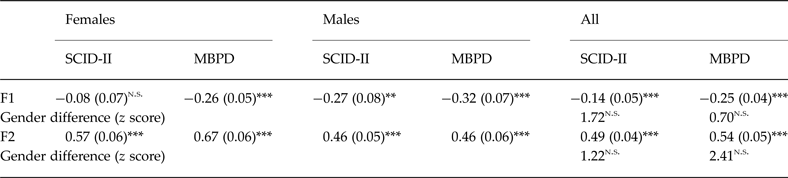
A series of mixed-level regression models estimated via generalized estimating equations were used to (a) test for gender differences in levels of F1, F2, and BPD tendencies and (b) evaluate the relationship between each psychopathy factor and BPD tendencies. These models also accounted for multiple observations (e.g. twins) clustered within a higher-order family unit (Hanley, et al. Reference Hanley, Negassa, Edwardes and Forrester2003). This technique controls for the correlation between two children within a family, since family members are likely to be correlated at higher than chance rates. We also examined gender differences in the relationships between facets of psychopathy and BPD tendencies by comparing regression coefficients in males and females using the approach described by Clogg et al. (Reference Clogg, Petkova and Haritou1995). Results indicated a significant effect of gender on both F1 [B (s.e.) = − 0.61 (0.11), p < 0.001)] and F2 [B (s.e.) = − 0.34 (0.11), p < 0.001)], with males reporting higher levels of F1 and F2. By contrast, there were no gender differences in BPD levels as reported on the SCID-II screener [B (s.e.) = − 0.01 (0.10), p = n.s.)] or the MBPD [B (s.e.) = − 0.05 (0.10), p = n.s.)]. Additionally, as shown in Table 1, F1 was negatively related to both indices of BPD tendencies, whereas F2 was positively related to BPD tendencies. A comparison of regression coefficients for F1 and F2 regressed on the SCID-II screener and MBPD across males and females did not show significant effects – indicating that the magnitude of relationship of both psychopathy factors with BPD tendencies was similar for males and females.
Univariate relationships and gender differences in relationships between F1, F2 and indices of borderline personality disorder features
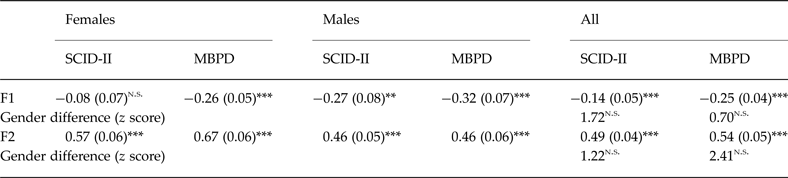
SCID-II, Structured Clinical Interview for DSM-IV Axis II personality disorders; MBPD, Minnesota Borderline Personality Disorder Scale.
Unstandardized regression coefficients [B (s.e.)] are presented.
*** p < 0.001, ** p < 0.01, n.s., non-significant.
Biometric modelingFootnote 1 Footnote †
Univariate models
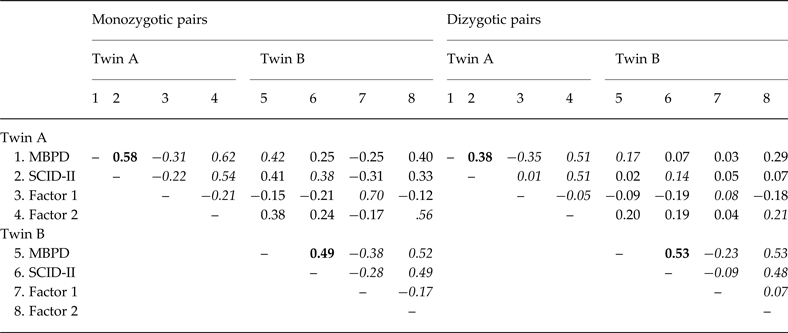
Table 2 presents the MZ and dizygotic DZ twin correlations that were used to estimate genetic and environmental influences on each phenotype. Genetic influences are inferred if the MZ correlation exceeds the DZ correlation for a given trait. Shared environmental influences are inferred if the DZ correlation is greater than half the MZ correlation. Non-shared environmental influences are inferred when the MZ correlation is <1.0. As seen in Table 2, the pattern of twin correlations suggests moderate genetic, shared environmental, and non-shared environmental influences on F2, but primarily genetic and non-shared environmental effects on F1 and each measure of BPD tendencies.
Cross-twin, cross-trait correlations (rTwinA–TwinB) for borderline personality disorder and psychopathy traits
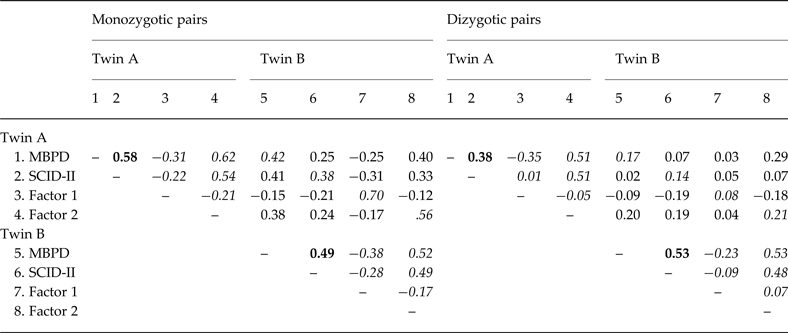
MBPD, Minnesota Borderline Personality Disorder Scale; SCID-II, Structured Clinical Interview for DSM-IV Axis II personality disorders.
In the triangular elements (e.g. Twin A columns with Twin A rows), the bold correlations are the within-trait, cross-measure (e.g. the correlation between MBPD and SCID-II); italicized correlations are the co-morbidity correlations (e.g. the correlation between MBPD and factor 2). In the rectangular elements (e.g. Twin A rows and Twin B columns), the bold and italicized correlations are the within-trait, cross-twin correlations that are used to estimate heritability (e.g. MZ>DZ correlation indicates a genetic effect). The off-diagonal elements are used to estimate genetic and environmental overlap between traits.
Correlations > 0.20 are significant at p < 0.05.
Next, we used standard biometric models to estimate the additive genetic, shared environmental, and non-shared environmental influences on each of these phenotypes, while also controlling for gender. The additive genetic component (a2) reflects the effect of individual genes summed over loci on trait variance. Shared environmental effects (c2) refer to non-genetic factors that increase similarity between members of a twin pair. Non-shared environmental effects (e2) consist of factors that contribute to differences between members of a twin pair. Measurement error is also included in the estimate of e2. Notably, preliminary analyses indicated that, in some cases, the shared environmental parameter approached zero. Thus, to find the most parsimonious model, parameters were progressively dropped and model fit was compared. Models were selected based on two indices that consider parsimony along with overall model fit: the −2 log likelihood value (−2LL) and Akaike's Information Criterion (AIC). For nested models, the difference in −2LL (which follows a χ2 distribution) can be used to determine whether retaining additional parameters significantly improves the model fit. AIC is a function of the χ2 and degrees of freedom, and penalizes the model fit for retention of unnecessary parameters. AIC is not interpreted in isolation, but rather used with the χ2 value to compare alternative models. Lower values (∆AIC > −2) are indicative of better fit (Burnham & Anderson, Reference Burnham and Anderson2004). When comparing models, a difference in AIC of 0–2 is considered weak evidence in support of the model with the lower values, a difference of 2–6 is considered positive evidence, a difference of 6–10 is considered strong evidence, and a difference >10 is considered very strong evidence (Kuha, Reference Kuha2004). All biometric analyses were conducted using the computer program OpenMx (Boker et al. Reference Boker, Neale, Maes, Wilde, Spiegel, Brick, Spies, Estabrook, Kenny, Bates, Mehta and Fox2011, Reference Boker, Neale, Maes, Wilde, Spiegel, Brick, Estabrook, Bates, Mehta, von Oertzen, Gore, Hunter, Hackett, Karch and Brandmaier2012) and were fit to the raw data using full information maximum-likelihood estimation with adjustment of parameters for missing data.
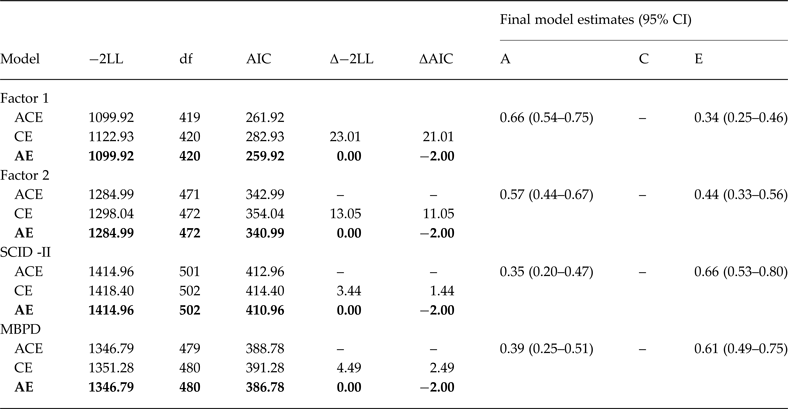
Table 3 shows the results of biometric model fitting and the final estimates of genetic and environmental contributions to each of the phenotypes. For all variables, dropping the shared environment parameter resulted in a significant improvement of model fit; as such, these models were retained. Results from the final models indicate that F1 and F2 are influenced strongly by genetic and moderately by non-shared environmental factors, whereas scores on the MBPD and SCID-II BPD measures are influenced to a moderate degree by genetic and to a strong degree by non-shared environmental factors.
Model fit statistics, twin correlations, and final estimates of genetic and environmental influences
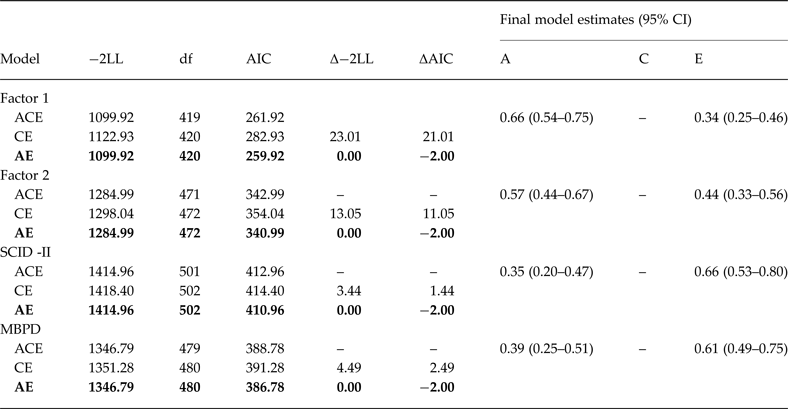
CI, Confidence interval; AIC, Akaike's Information Criterion; ACE, includes genetic, shared and non-shared environmental influences; CE, drops genetic influences and only includes shared and non-shared environmental influences; AE, drops shared environmental influences and includes only genetic and non-shared environmental influences; SCID-II, Structured Clinical Interview for DSM-IV Axis II personality disorders.
Best fitting models are given in bold.
Genetic and environmental influences on covariation between F1, F2, and BPD tendencies
Next, we estimated the extent to which genetic and environmental influences on F1 and F2 also contribute to each measure of BPD tendencies. In doing so, we also estimated the genetic and environmental overlap between F1 and F2. To do so, we fit a series of bivariate Cholesky decompositions that parsed both the variance of each phenotype and the covariance between phenotypes into their respective genetic and environmental components. These models provided for calculation of the genetic and non-shared environmental correlations between the phenotypes (Neale & Cardon, Reference Neale and Cardon1992). The magnitude of genetic and environmental correlations identifies the extent to which such influences are common to two phenotypes. As the univariate models failed to show shared environmental indices on any phenotypes, the bivariate Cholesky models were set not to estimate shared environmental correlations.
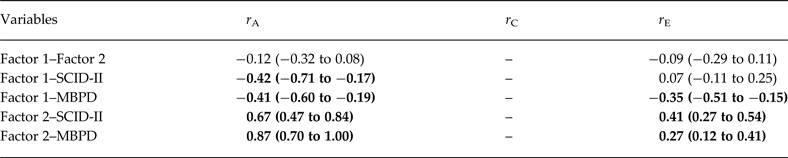
As seen in Table 4, results indicated a lack of genetic or environmental overlap between F1 and F2. Next, moderate negative genetic overlap was evident for the relationship between F1 and each measure of BPD tendencies. Additionally, F1 showed a significant negative non-shared environmental correlation with MBPD, and this correlation differed significantly from the correlation of F1 with the SCID-II BPD screener [as indexed by non-overlapping confidence intervals (CIs)]. This findings suggests that the genetic – and in the case of MBPD – non-shared environmental factors that contribute to elevations on F1 are protective against BPD tendencies, and vice versa. In contrast, F2 showed positive genetic and non-shared environmental overlap with both indices of BPD tendencies, indicating that similar genetic and non-shared environmental risk factors give rise to F2 and BPD tendencies.
Genetic and environmental correlations (95% CIs) between F1, F2, and indices of borderline personality disorder features
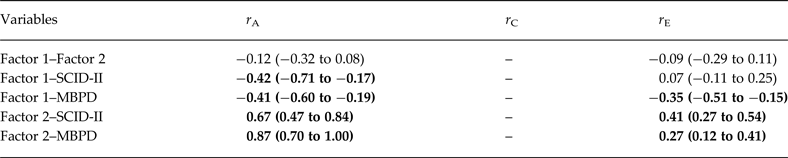
SCID-II, Structured Clinical Interview for DSM-IV Axis II personality disorders; MBPD, Minnesota Borderline Personality Disorder Scale; A, additive genetic effects with 95% confidence intervals (CIs); C, shared environmental effects; E, non-shared environmental effects.
Significant correlations (i.e. those that do not include zero in the CI) are given in bold.
Discussion
The current study sought to replicate previously documented associations (in opposing directions) for components of psychopathy with BPD tendencies. Additionally, we aimed to characterize the univariate genetic and environmental influences on each phenotype, and the extent of genetic, shared, and non-shared environmental overlap of the two psychopathy factors with one another and with BPD tendencies. Several strengths of the current study should be noted. Primarily, this study is one of the first to explore genetic and environmental overlap of F1 features and BPD tendencies. Second, largely similar results were obtained for two separate, non-overlapping measures of BPD tendencies, lending confidence to the observed associations. A further important feature of the study is that it included males and females in nearly equal numbers, allowing for the evaluation of phenotypic gender differences.
Consistent with previous research (Edens et al. Reference Edens, Buffington-Vollum, Colwell, Johnson and Johnson2002; Warren et al. Reference Warren, Burnette, South, Chauhan, Bale, Friend and Van Patten2003; Miller et al. Reference Miller, Dir, Gentile, Wilson, Pryor and Campbell2010), results at the phenotypic level indicated that F2 showed positive associations with both measures of BPD tendencies, whereas F1 showed negative associations. Furthermore, these relationships did not differ across gender, indicating that the findings are not specific either to women or men. Univariate heritabilities for F1 and BPD were also consistent with previous research (Blonigen et al. Reference Blonigen, Carlson, Krueger and Patrick2003, Reference Blonigen, Hicks, Krueger, Patrick and Iacono2005; Kendler et al. Reference Kendler, Aggen, Czajkowski, Roysamb, Tambs, Torgersen, Neale and Reichborn-Kjennerud2008, Reference Kendler, Aggen, Knudsen, Roysamb, Neale and Reichborn-Kjennerud2011; Meehan & Evertsson, Reference Meehan and Evertsson2013), and the heritability estimate for F2 was consistent with studies that have used personality-based definitions of F2 (Blonigen et al. Reference Blonigen, Hicks, Krueger, Patrick and Iacono2005). In addition, current findings indicated that F1 and F2 do not show genetic or nonshared environmental overlap, which is consistent with the notion that these components of psychopathy are uncorrelated (Patrick et al. Reference Patrick, Fowles and Krueger2009) and show distinct etiological influences. On the other hand, it is important to consider the fact that the nonshared environmental factor contains measurement error (which is appreciable in phenotypes such as the ones examined in this study). As such, the truly environmental portions may be considerably more overlapping, but that this correlation is attenuated by measurement error.
Most importantly, F1 and F2 showed differential genetic and non-shared environmental relationships with BPD tendencies. Consistent with previous work (Kendler et al. Reference Kendler, Aggen, Czajkowski, Roysamb, Tambs, Torgersen, Neale and Reichborn-Kjennerud2008, Reference Kendler, Aggen, Knudsen, Roysamb, Neale and Reichborn-Kjennerud2011; Torgersen et al. Reference Torgersen, Czajkowski, Jacobson, Reichborn-Kjennerud, Roysamb, Neale and Kendler2008; Beauchaine et al. Reference Beauchaine, Klein, Crowell, Derbidge and Gatzke-Kopp2009), F2 and BPD showed common genetic vulnerabilities and nonshared environmental risk factors. This finding links well with the broader literature on common risk factors underlying externalizing psychopathology. Indeed, previous studies report that, on a phenotypic level, features of F2 as well as BPD consistently load on and are associated with externalizing-spectrum disorders such as drug and alcohol use disorders and conduct disorder (Edens et al. Reference Edens, Buffington-Vollum, Colwell, Johnson and Johnson2002; Kendler et al. Reference Kendler, Aggen, Knudsen, Roysamb, Neale and Reichborn-Kjennerud2011). In addition, genetically informed studies indicate that both BPD and F2 show genetic overlap with externalizing disorders (Blonigen et al. Reference Blonigen, Hicks, Krueger, Patrick and Iacono2005; Kendler et al. Reference Kendler, Aggen, Knudsen, Roysamb, Neale and Reichborn-Kjennerud2011). As such, it appears likely that the overlap between F2 and BPD reflects a broad common liability to disinhibitory problems (entailing, e.g. impulsivity, weak self-control, lack of concern for consequences of behavior), with experiential factors accounting for more distinctive behavioral expressions (Krueger et al. Reference Krueger, Markon, Patrick and Iacono2005, Reference Krueger, Markon, Patrick, Benning and Kramer2007; Beauchaine et al. Reference Beauchaine, Klein, Crowell, Derbidge and Gatzke-Kopp2009).
On the other hand, the genetic factors contributing to F1 appear to be protective against BPD tendencies. This finding makes sense, given that F1 in the current study was operationalized as PPI fearless dominance, which encompasses adaptive features of stress immunity, social potency, and fearlessness along with more maladaptive tendencies toward narcissism, insensitivity, and risk-taking (Benning et al. Reference Benning, Patrick, Hicks, Blonigen and Krueger2003). As a function of this positive adaptive component, fearless dominance shows significant negative associations with internalizing forms of psychopathology and BPD tendencies, and positive associations with intelligence, wellbeing, achievement orientation and academic success, and perceived self-efficacy (Warren et al. Reference Warren, Burnette, South, Chauhan, Bale, Friend and Van Patten2003; Benning et al. Reference Benning, Patrick, Blonigen, Hicks and Iacono2005; Hall & Benning, Reference Hall, Benning and Patrick2006). Findings along these lines provide a basis for understanding why genetic and environmental influences contributing to F1 would be protective against BPD.
The results of the current study need to be considered in light of certain limitations. First, the study was cross-sectional and utilized an adult sample, and therefore conclusions cannot be advanced regarding development or causality. Given this, a clear need exists for longitudinal studies examining the co-evolution and etiological overlap between factors of psychopathy and BPD tendencies over the course of the lifespan. Second, findings of the current study are based solely on self-report instruments, and thus should be replicated using alternative approaches to assessing psychopathy and BPD. Furthermore, the sample size was relatively small for biometric modeling and findings should be replicated in larger samples. A consequence of these issues is that the CIs for the genetic and environmental correlations are quite large.
Another limitation is that findings for the two measures of BPD tendencies differed in one notable way that warrants explanation – namely, the finding of a significant negative nonshared environmental association for F1 with the MBPD measure, but not the SCID-II measure. This finding could reflect greater overlap in item content, reciprocally, between the former two measures as compared to the latter two. Most notably, scores on F1 as indexed by PPI fearless dominance include a component of stress immunity whereas scores on the MBPD measure include a component of stress reactivity. Additionally, the social potency component of PPI fearless dominance includes features of social assurance and self-confidence that appear antithetical to items of the MBPD scale reflecting alienation and lack of wellbeing. While plausible, this explanation is speculative and needs to be evaluated empirically in follow-up work.
A further limitation is that the operationalization of F1 in the current study as fearless dominance – encompassing tendencies toward dominance, emotional resilience, and venturesomeness – is considered by some to differ importantly from clinical conceptions of affective-interpersonal features of psychopathy (Malterer et al. Reference Malterer, Lilienfeld and Neumann2010; Miller & Lynam, Reference Miller and Lynam2012). In clinical accounts, particularly of juvenile or adult offenders, F1 has been considered to encompass traits such as lack of empathy and callousness, which correlate to lesser degrees with internalizing psychopathology and BPD than fearless dominance (Edens et al. Reference Edens, Buffington-Vollum, Colwell, Johnson and Johnson2002; Warren et al. Reference Warren, Burnette, South, Chauhan, Bale, Friend and Van Patten2003). These differing conceptions of F1 highlight the controversy surrounding how best to operationalize F1 psychopathy traits. For instance, F1 as measured by the Psychopathy Checklist – Revised (PCL-R; Hare, Reference Hare1991/2003) includes coverage of symptoms pertaining to deficient affective experience (lack of remorse, callousness, shallow affect) that tend to exhibit negligible associations with internalizing psychopathology (Warren et al. Reference Warren, Burnette, South, Chauhan, Bale, Friend and Van Patten2003) and only modest correlations with PPI fearless dominance (i.e. r’s ranging from 0.15 to 0.24; Malterer et al. Reference Malterer, Lilienfeld and Neumann2010; Poythress et al. Reference Poythress, Lilienfeld, Skeem, Douglas, Edens, Epstein and Patrick2010). Thus, PPI and PCL-R versions of F1 may be measuring only partially overlapping constructs.
As a final limitation, it should be noted that alternatives to the two-factor model of psychopathy have been proposed. For the interview-based PCL-R, three-factor (Cooke & Michie, Reference Cooke and Michie2001) and four-facet models (Neumann et al. Reference Neumann, Hare and Johansson2013) exist that subdivide F1 and F2 into narrower facets. The PCL-R's self-report counterpart, the Hare Self-Report Psychopathy Scale (Paulhus et al. in press), contains four factors or facets mirroring those of the Neumann et al. (Reference Neumann, Hare and Johansson2013) PCL-R model. Alternative three-factor models have also been reported for the PPI, in offenders (Neumann et al. Reference Neumann, Malterer and Newman2008) and non-offenders (Benning et al. Reference Benning, Patrick, Hicks, Blonigen and Krueger2003; see also Sellbom & Phillips, Reference Sellbom and Phillips2013), and for other self-report and informant-rating psychopathy measures (e.g. Frick et al. Reference Frick, Bodin and Barry2000; Andershed et al. Reference Andershed, Kerr, Stattin, Levander, Blaauw, Philippa, Ferenschild and van Lodensteijn2002). Differences in the number and composition of reported factors are of course a function of variations in the item content and measurement domain of inventories evaluated, the nature of samples employed in analyses (e.g. clinical or non-clinical, youth or adult, male or female), etc. A potential point of reference for reconciling differing factor models is provided by the Triarchic model (Patrick et al. Reference Patrick, Fowles and Krueger2009), which focuses on distinguishable constructs embodied in differing historic conceptions of psychopathy and instruments for assessing it (Patrick et al. Reference Patrick, Fowles and Krueger2009), namely: disinhibition, reflecting externalizing proneness; boldness, viewed as dispositional fearlessness; and meanness, conceptualized as disaffiliated agency (i.e. aggressive resource-seeking without concern for others). Although we were able to examine boldness and disinhibition in the current study, fruitful avenues for future research include exploring the meanness component of the triarchic model, as well as clarifying relations among factors or facets of differing psychopathy inventories with reference to the constructs of the Triarchic model (cf. Patrick & Drislane, Reference Patrick and Drislane2014), and in turn clarify how associations of BPD with factors/facets of particular inventories reflect their coverage of triarchic model constructs.
In sum, the current findings indicate that F2 and BPD share common genetic and environmental risk factors, whereas F1 is protective against the manifestation of BPD tendencies. Notably, the latter result is at odds with previous theories suggesting little or no etiological relationship between F1 and BPD tendencies (Beauchaine et al. Reference Beauchaine, Klein, Crowell, Derbidge and Gatzke-Kopp2009; Miller et al. Reference Miller, Dir, Gentile, Wilson, Pryor and Campbell2010), and further research will be needed to clarify this apparent inconsistency. Additionally, further work exploring the role of F1 and its differing conceptions is likely to have important implications for assessment and treatment, since its presence v. absence may influence the expression of BPD tendencies in clinically meaningful ways. We also encourage additional research directed at clarifying genetic and environmental overlap between BPD and contrasting configurations of F1 and F2 features (e.g. low F1/high F2 v. high F1/high F2), given differential relations of the two factors with BPD. Continued exploration of these distinct phenotypes will provide further insight into etiological influences on psychopathy and BPD as well as their co-morbidity.
Acknowledgements
Data for this project were collected at the University of Minnesota, with approval from the university's IRB. The work was supported by grant nos. 072850 and 089727 from NIMH.
Declaration of Interest
None.