Introduction
The past is a foreign country, they do things differently there.
(L.P. Hartley, The Go-Between, Reference Hartley1953)What a gift! Bass singer Lennart Nyberg sings songs from the native country.
(advertisement for cassettes in PRO-Pensionären, 7, 1994)In an increasingly mediatised society saturated with music we tend to forge biographical and generational links between memory and music, generating soundtracks of our lives. It is not only we ourselves who create these soundtracks; they are, in a number of ways, created for us, generating collective soundtracks that we more or less identify with. In this sense music constitutes one of the means through which social identities and categories are shaped and negotiated. During the course of the 20th century, Sweden saw the development of a new social category: the ‘pensioner’. Like other social categories, this was not only an issue of stereotyping, the establishment of social legislation or public insurances, but also a symbolic and aesthetic process in which the category came to be associated with specific dance, clothing and music.
This article discusses the interplay of music, media and memory among ‘pensioners’ in Sweden during the latter half of the 1990s. Different agents – from artists and small-scale music corporations to pensioners' organisations and care institutions – were involved, with different approaches. This also means that the formation was by no means homogeneous. On the contrary, this article shows how two different forms of music dissemination within pensioners' organisations – a cassette tape compilation and meetings with a study circle who gathered to discuss self-selected choices of music – could produce different memoryscapes. I ask how these memoryscapes relate to different levels of music distribution and how they were also incorporated within different mediascapes. They were ingredients in pensioners' organisations that both presupposed and reinforced notions of pensioners as a social and cultural collective, different from other groups in society.
In my use of the term memoryscape I will diverge slightly from earlier uses that tend to focus on the interplay and interdependency between memory and physical space (Nuttall Reference Nuttall1992, p. 39; Yoneyama Reference Yoneyama and Boyarin1994; Degnen Reference Degnen2005). The tendency has been to explore how people use physical places and landscapes in order to remember, such as in Pierre Nora's notion of the ‘milieux de mémoire’ (Nora Reference Nora1989, p. 7). In this article I conceive of memoryscape as something similar to a ‘theatre of memory’ – that is, as a way of organising memory spatially (Yates Reference Yates1966). I use the term memory in a broad, social scientific sense, referring to collective frameworks and practices that represent the past. As Maurice Halbwachs claims, even individual memory is structured by frameworks that are socially communicated, and can only be shared in socially accessible forms (Halbwachs Reference Halbwachs and Coser1992, p. 38). Memory in this sense can take on various forms, as narrative, history, ceremonial re-enactment or retro styles (White Reference White and Mitchell1981; Connerton Reference Connerton1989; Samuel Reference Samuel1994).
All memory requires selection and is constituted as much by forgetting and neglect as by that which is actually remembered, which means that an understanding of memory also requires us to reflect upon that which is not remembered (White Reference White and Mitchell1981; Trouillot Reference Trouillot1995). I have deliberately added the suffix -scape in order to tie the concept to Arjun Appadurai's (Reference Appadurai1996) notion of scapes, adding a memory axis to his model. In his book Modernity at Large, Appadurai suggests a model of global cultural flows running through a number of overlapping and interacting ‘scapes’ that form the building blocks of imagined worlds, extending Benedict Anderson's notion of imagined communities (Anderson Reference Anderson1983; Appadurai Reference Appadurai1996, p. 33). These are: ‘ethnoscape’, consisting of persons in imagined or physical movement; ‘technoscape’, the global fluid configuration of technology; ‘financescape’, or the disposition of global capital; ‘ideoscapes’, defined as the often directly political concatenations of images that have to do with ideologies of states and movements; and the ‘mediascape’ (Appadurai Reference Appadurai1996, pp. 33–7).
Mediascape refers both to the electronic capabilities to produce and disseminate information and to the images of the world created by these media. As Appadurai explains, ‘what is most important about these mediascapes is that they provide […] large and complex repertoires of images, narratives, and ethnoscapes to viewers throughout the world’ (Appadurai Reference Appadurai1996, p. 35). From these mediascapes, people can form scripts of imagined lives, both of one's own and others' in other places. My point of departure here is that among the repertoires of images, narratives and ethnoscapes, mediascapes also provide memoryscapes. In this article I will demonstrate how two mediascapes involving ‘pensioners’ suggest different memoryscapes. The interface between these ‘scapes’ might tell us important things about music, ageing and society.
This article emerges from fieldwork conducted in Sweden between April 1994 and May 2000, consisting of participant observation, in-depth interviews and media analysis.Footnote 1 The research has consistently aimed at keeping both music making and the social production of meaning in focus. This approach is rooted in a notion of music as a process that might involve a wide range of activities, from the production of sounds to listening, from arranging events to the distribution of media (Small Reference Small1998, p. 9). From the very beginning, I was looking for musical settings in which the audience in one way or another was approached in terms of ‘pensioners’. Inspired by methods developed in cultural analysis, the research process consisted in a heuristic searching guided by a theme – pensioners and music – as opposed to single-sited fieldwork (O'Dell Reference O'Dell1997). This mode of work requires the flexibility of the researcher and will lead to diverse settings and different kinds of material, requiring a combination of methodological strategies. The approach was multi-sited, following the phenomenon in question to different social arenas rather than focusing on one single site (Marcus Reference Marcus1995). Such settings could be anything from special music programmes created for nursing homes, local radio shows, music events, performance contests and concerts for elderly citizens, pensioners' choirs and music performed at political rallies with pensioners' organisations. Observations were combined with interviews with artists, entrepreneurs, organisers, staff in nursing homes, and other music makers, widely conceived.Footnote 2
Background
Sometimes the origins of social categorisations are hard to trace; at other times they are easy to pinpoint. It was in 1913 that Sweden created its first ‘pensioners’ – a socio-economic category associated with old age – through the passing of a law guaranteeing all elderly citizens a public pension insurance from the age of 67 (at a later point lowered to 65: Gaunt Reference Gaunt and Sutorius1996). Alongside the emergence of scientific disciplines such as gerontology (1903) and geriatrics (1909), this socio-economic categorisation of old age can be seen as a part of the social engineering and professionalisation typical of high modern societies (Kirk Reference Kirk1994). In the course of the 20th century the pensioner emerges as a distinct social category, attracting ever more specific cultural meanings. This can be seen, for example, in the establishment of the first pensioners' organisations around 1940, and later in the active political role of pensioners' organisations at the end of the century (Jönsson Reference Jönsson2001, pp. 64f). Another aspect of this includes the gradual fixing over time of cultural meaning: that is how ‘pensioners’ gradually became associated with specific clothing, dances and music (Ronström Reference Ronström1997; Frankel Reference Frankel1998; Hyltén-Cavallius Reference Hyltén-Cavallius2005).
In the late 19th and early 20th centuries, older individuals were approached by folklore, folklife and folk music students as living remnants of a disappearing rural culture. They were primarily regarded as the last living sources of traditional song, oral poetry, and other expressive forms, capable of delivering an ‘older material in the present’ as a mid-20th century researcher put it (Eskeröd Reference Eskeröd1947, p. 131). At this stage, they were seen more as bearers of collective folk traditions than as belonging to a separate category with a ‘music’ of their ‘own’. The idea of older members of society belonging to a ‘pensioner category’ distinguished by expressive attributes seems to develop over the 20th century. A telling example is Våra favoriter [Our Favourites], the first publicly broadcast radio show explicitly aimed at pensioners, which debuted on Swedish national radio in 1965. The show, a live studio broadcast with an invited pensioner audience (those 67 years old and over), included performances and interviews with musicians born in the late 19th and early 20th centuries, alongside audience polls on their favourite songs (hence the show's name). Judging from the critical reaction of the chairman of the largest pensioner organisation, PRO (Pensionärernas Riksorganisation, Sweden's national organisation of pensioners), this ‘exploitation’ of the ‘pensioners’ as a group through the medium of popular music attacked a core ambition in the organisation, namely the ‘cultural elevation’ of the group – an ambition that would better be served by classical music (PRO-Pensionären 1968(5), pp. 48–9; Jönsson Reference Jönsson2001). But if such ‘exploitation’ was problematic in the mid-1960s, by the 1990s it had developed into a small industry, with several local and national corporations and various entrepreneurs and artists targeting an audience comprised of people regarded as ‘pensioners’.Footnote 3 To summarise, the term ‘pensioner’ seems to have changed from a socio-economic label to a cultural category, including notions of a specific taste in music, over less than a century. A vast majority of the music directed at pensioners that I encountered during my fieldwork was music from the ‘imagined past’ of these pensioners.
Later life has historically been linked to memory. The traditional roles of elderly members of society as preservers and narrators of collective memory has given way to current popular imagery of ‘reminiscing grandparents’ and the threatening loss of memory (Minois Reference Minois1989; Blaikie Reference Blaikie1999). It therefore comes as no surprise that a large part of the music aimed at ‘pensioners’ also departs from the notion that people in later life are especially fond of memories and prefer the music of their youth. A question that then arises is what counts as the pensioners' collective memory, when it concerns such a large – and continuously growing – sector of the population (at the time of this study the actual age for retirement in Sweden was around 62–63 and the over-65 age group constituted approximately 17 per cent of the total population), cutting across individual life histories, social class, ethnicity and other important grounds for social differentiation (SOU 2003, p. 17). The cultural complexity and social and geographic mobility characteristic of late modern Sweden and many other parts of the world makes problematic the whole idea of old people as a group, sharing memories or attitudes. Or as anthropologist Haim Hazan phrases this in a discussion of ageing in modern societies, ‘cultural diversity makes problematic the identification of any human universe shared by all old people’ (Hazan Reference Hazan1994, p. 54).
Svenska favoriter: alternative media
Members of PRO, the largest pensioner organisation in Sweden with 380,000 members, receive a copy of the magazine PRO-Pensionären [The PRO-Pensioner] 10 times a year.Footnote 4 Swedish pensioner organisations can be regarded as trade unions for retired people, looking after pensioners' interests in political and economic issues, offering advice and support, and arranging leisure and educational activities involving travel, music making and dancing. In the PRO-Pensionären magazine music was most frequently portrayed in terms of a ‘shared memory’ and as a means to counter medical and social problems associated with old age (such as memory loss and isolation). Among the many advertisers found in the magazine was Svenska Favoriter [Swedish Favourites], a company producing audio-cassette compilations for old people composed of music produced in Sweden from the 1920s until 1960 (a 40-year period circumscribed by available recordings and Swedish copyright legislation). The cassettes produced in the series numbered 129 at the time of this study, containing a total of approximately 1,800 songs.
The Svenska Favoriter collection could either be bought in packages of 10 cassettes, or provided by annual subscription (sent out in packages of three cassettes, four times a year).Footnote 5 The company attracted a majority of its subscribers from the Swedish countryside, most of them being private persons and nursing homes. At the time of my interview (April 1997), the number of subscribers was approximately 500; at its peak in the late 1980s the company distributed its cassettes to around 2,000 subscribers. The manager, Ingvar Knutsson, had run the small company for 10 years, suggesting that the original idea for the cassettes emerged when he worked as a technician at the local radio station. The station had regularly received complaints from older listeners that the music played was seldom ‘for them’.
Knutsson's purpose in distributing the cassettes was to ‘bring joy to pensioners’ (interview, 17 April 1997). Advertisements for the cassettes were included in the membership magazines of the two largest pensioner organisations, PRO-Pensionären and Veteranposten, as well as in other magazines and small newspapers primarily aimed at pensioners, such as Kvällsstunden [The Evening Moment]. Svenska favoriter was originally conceived as an alternative medium intended for the elderly and its cassette configuration was chosen for its low cost, both for the company and in order to suit the economic restraints of many subscribers subsisting on pensions. If the idea had once been to deliver to the subscribers what mainstream radio no longer offered them, the cassette subscription over time entered the world of ‘eldercare’. Knutsson reported, ‘I'm now selling medicines’, referring to how medical institutions and nursing homes had contacted him to assist with their enterprises (interview, 17 April 1997). During the course of my fieldwork, I came across these cassettes in both private homes and institutional settings.
What kind of music then was deemed the right music for pensioners?Footnote 6 Knutsson commented that although the 1930s and 1940s were difficult times, composers managed to produce music that would invigorate people as opposed to what he referred to as the ‘heart and pain’ music of today. This contrast echoes an idea that I often encountered during fieldwork: an opposition between a past characterised by hardships and solidarity with a present characterised by abundance and individualism. The most dominant music I encountered in my listening through 10 of the 129 cassettes was ‘old’ Swedish popular music – accordion-based hits from the 1940s, evergreens and music from famous musicals and films. To generalise about this music, one could say that most of it showed some important common traits. Harmonies were often centred on tonic and dominant, reminiscent of Swedish broadsheet conventions and old-time dance music. Measures were usually two-fourths or three-fourths, and the lyrics were often in a high-spirited or even joking mode. Put in a historical perspective, they differ significantly harmonically from much popular music as it has evolved since the late 1950s (the copyright limits thus coinciding with more extensive aesthetic changes in Swedish popular music). Swedish musicologist Lars Lilliestam claims that older Swedish popular music was almost entirely dominated by functional harmony, while today's popular music also displays other harmonic patterns such as the 12-bar blues (Lilliestam Reference Lilliestam1998, pp. 335–6). The compositions also differ in their sound fabric due to the relative absence of electronically amplified, modified or distorted instruments, rhythmic structure, vocal treatment, and lyrically with cheerful, high-spirited, optimistic messages (something that the manager of Svenska favoriter, along with other interviewees engaged in ‘music for pensioners’, claimed to be a special reason to ‘cherish this music’ in relation to the ‘less cheerful’ current popular music). Other significant traits on a textual level are the use of national images (such as the paradigmatic small red cottage by the lake) and songs with exclusively Swedish lyrics (as opposed to Swedish popular music after the advent of rock 'n' roll, which used the English language as much as Swedish). On occasion I got the impression that music entrepreneurs, musicians and others who specialised in music targeted at an elderly audience saw them as ‘alienated’ in relation to the popular music of today.
Alongside the ‘Swedish’ music the cassettes also included exotic selections, among the most conspicuous of which were the Hawaiian and gypsy styles. Together, these exoticisms form a map of the world made up of easily distinguishable sonic key symbols: the Hawaiian style was established through the essential portamento effects of the slide-guitar, on occasion the ukulele (an instrument used popularly in Hawaiian popular music) and sound effects such as waves crashing on a shore. Lyrics for songs with titles such as ‘Flicka från Hawaii’ [‘Girl From Hawaii’], ‘En joddlare på Tahiti’ [‘A Yodeller On Tahiti’] and ‘Det var på Stranden utav Bali-Bali’ [‘It was on the shores of Bali-Bali’] often included words from a Pacific language such as ‘aloha oe’ or ‘isa lei’ and imagery involving pretty girls, waves, beaches, coral reefs and palm trees.Footnote 7 The slide-guitar, together with a slow two-fourths time, creates a soft, relaxed atmosphere backed up by double-bass, piano and strings. Harmonically, this music was still very consistent with other genres in the use of repeated tonic-subdominant-dominant patterns. Another exoticism on the cassettes might be referred to as the gypsy style; the gypsy (in Swedish, zigenare) and the traveller (tattare) were important exotic stereotypes in Swedish popular culture in the 1940s and 1950s (Svensson Reference Svensson1993, pp. 202f). Judging from the cassettes I went through, these texts mostly depict scenes of heat, passion and betrayal against a backdrop of a gypsy encampment, involving fire and wagons, with accompaniment from violin played with heavy vibrato, minor key harmonies and habanera-like rhythms.Footnote 8 These exoticisms were also part of wider transnational trends: the Hawaiian sound was introduced to Sweden from the US during the 1930s; in fact, several songs were translations of US hits, and the gypsy sound was part of a growing awareness and exoticist interest since World War II in ethnic minorities, in Sweden and elsewhere (Svensson Reference Svensson1993, pp. 202f). They organised the world in a set of easily recognisable differences where every place and every people has its own sound. In his analysis about how multiculturalism is enacted on stage, Owe Ronström (Reference Ronström1993, p. 79) refers to this phenomenon in terms of a cultural ‘mosaic’.
Following Appadurai's thinking, we are considering a mediascape consisting of three media forms: the magnetic band inside the cassette carrying the pre-recorded sound (in this case involving a varied quality); the cassette cover itself, carrying information including a song list; and sleeve notes with information covering performing artists, year of recording, logotypes and visual imagery. Another aspect of this mediascape is the magazine advertisements that add additional meanings, telling of ‘Melodies you remember!’ alongside photographs of iconic artists from the era including Ernst Rolf, Karl Gerhard and Ulla Billquist.Footnote 9
In the second half of the 1990s, the cassette, due to technological innovation and corporate will, became a vanishing music medium in Sweden as in many other industrialised countries. The cassette was superseded in Sweden and elsewhere by a new dominant medium, the CD, which was itself quickly outpaced by the Internet. However, some music did continue to be distributed on cassette: you would find not only the ‘pensioner music’ of Svenska favoriter in the cassette configuration but also music for other audiences such as children, as well as music disseminated within distinct transnational ethnoscapes (such as the Assyrian and Kurdish diasporas). A dwindling trickle of cassette versions of mainstream music (also sold on CD) was still distributed in petrol stations to meet the needs of car owners whose older vehicles were outfitted with cassette players. But the specific cassette-centred mediascapes often had little connection to those of the dominant technologies, and probably worked especially well not only due to the low costs involved but also to their exclusiveness. Cassettes were disseminated in narrow networks of entrepreneurs, magazines, organisations and public care institutions. However, as Appadurai states, these mediascapes also embody images of the world, constituting ‘horizons of meaning’ and means by which people can form scripts of ‘imagined lives’ (Appadurai Reference Appadurai1996, p. 35). In what way then might we discern a memoryscape in this mediascape?
To outline that memoryscape let us first look at the selective character of ‘memory’ on these cassettes: what kinds of music from the same time period were excluded from the cassettes? Swedish popular music of the time period covered by Svenska favoriter contained other genres that were rarely included on the cassettes. Just to mention the most obvious: the 1930s and 1940s is, for example, the period when jazz was introduced to Sweden on a large scale, and while a few jazz tunes and aesthetic elements can be heard on the cassettes, the genre is seldom represented.Footnote 10 Sweden experienced its first major wave of immigration in modern times with the post-World War II arrival of refugees from Eastern Europe and the Baltic States. In addition, the 1950s saw a significant influx of labour immigrants, primarily from Finland, but also from Italy and the Balkans, yet the musical worlds of these immigrants are not included on the cassettes. The massive public interest in Swedish folk music during the 1950s that would eventually influence both rock music and jazz in Sweden is nowhere to be found (Ramsten Reference Ramsten1992). In the latter half of the 1950s Sweden saw its first Swedish rock 'n' roll artists emerge with personas and a musical style that imitated US and UK celebrities (Brolinson and Larsen Reference Brolinson and Larsen1984, pp. 62f). But neither jazz, rock 'n' roll nor any music that can be associated with immigration or folk music are to be found in these musical compilations. If taken literally, the slogan ‘Music you remember!’ then seems to address a rather selective memory. Or is ‘remember’ here rather to be read as a request, demanding that the listener mould a very specific memoryscape?
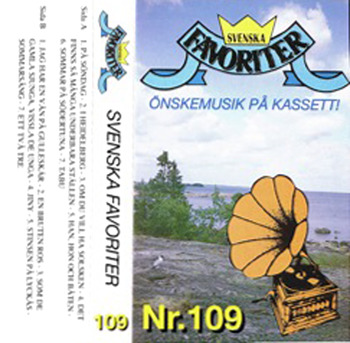
If we continue examining the ancillary media involved, the cassette sleeves are headed by the words ‘Svenska Favoriter’ (‘Swedish Favourites’; Figure 1). This has three possible interpretations: it can either refer to the music as being ‘Swedish’ and having a distinctive ‘Swedish’ quality; it can refer to the songs as being ‘from Sweden’, made, played or distributed in the country; or it can be construed as meaning favourite pieces among the general Swedish population. The national frame is additionally enhanced on the cover sleeve through the use of blue and yellow, the two colours of the Swedish flag, with the word ‘svenska’ inscribed inside a crown, a symbol of the nation's monarchy. The primary way to buy the cassettes was through subscription. This included four packages of three cassettes annually, linked thematically by a seasonal photograph with the music consequently alluding to that season (i.e. a snowy image and Christmas songs in the winter package). In the same way that a substantial number of the songs deal with paradigmatic ‘Swedish’ places (Löfgren Reference Löfgren, Ehn, Frykman and Löfgren1993, pp. 105f), these photographs show places highly identified as iconic Swedish places, such as the Iron Age grave mounds in Old Uppsala in winter and a summer view from the Baltic archipelago, views that many Swedes will readily identify as national locales.
Cassette cover of Svenska favoriter, No. 109 (photograph by Hans Kollder, scanned by the author).

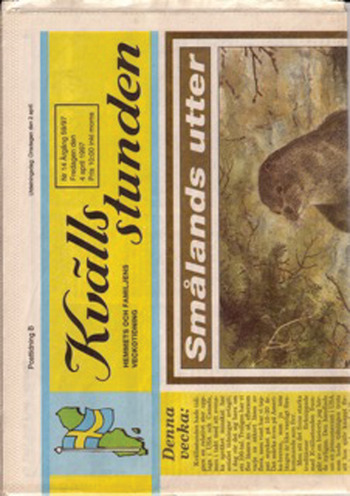
The advertisements for the Svenska favoriter cassettes were published along with other music advertisements (for cassettes and, more rarely, CDs) in the PRO-Pensionären. These other advertisements would also reinforce a national framework by using catch-phrases such as ‘Swedish favourite singers’ and ‘Songs from the native country’. By far the most successful campaign was waged by weekly paper Kvällsstunden (Figure 2), its first page headed by a title ‘Kvällsstunden’ and the words ‘The weekly paper for home and family’ in black against a blue and yellow background, with a small map of Sweden and a Swedish flag at its side.
First page of Kvällsstunden, 1997(14) (photograph by Hasse Jansson, scanned by the author).

The chief editor of Kvällsstunden, Åke Lindberg, described his newspaper as a ‘culture-nostalgic’ paper, featuring articles on virtually anything Swedish and preferably ‘old’ subjects (wildlife, flora, regions, old songs, authors, etc.), and included a large section of readers' letters (interview 29 May 1997). To sum up, the mediascape of Svenska favoriter can be construed as narrow and exclusive in relation to its clearly defined ‘elderly audience’, while at the same time claiming national validity through rhetoric and imagery. Thus, the cassettes conjure up a memoryscape with distinct spatial (regional, national and ethnic) and temporal (1920s to 1960) borders. In addition, Swedish favourites appear to be Swedish in a symbolic way, conjuring up selective manifestations of a ‘lost’ national homogeneity, unspoilt by the intensified transnational movement of sounds, ideas and people characteristic of the 20th century. Yet this is also a mediascape interpreted outside its usage. Svenska favoriter was marketed through the members' magazine of Sweden's largest pensioner organisation, and in that way offers insight into a memoryscape evoked in relation to pensioners. How then might people engaged in pensioners' activities themselves navigate mediascapes and memoryscapes in practice?
The music circle: collective memoryscaping
Study circles have over the last century been a popular form of studying in Swedish society. Administered by study associations, they are explicitly associated with political parties (e.g. ABF, The Workers' Educational Association, is associated with the Social Democratic Party Medborgarskolan; ‘the Citizen school’ is associated with the conservative party Moderaterna). During my fieldwork, the largest of the Swedish pensioner organisations all received economic support for activities from the major Swedish study associations, which in turn administer public funding for study activities of all kinds. Apart from this, some study associations had specific activities directed at pensioners, such as specially designed courses in computer and Internet literacy. In November 1999 I met a group of retired people within the conservative Medborgarskolan called Aktiva seniorer [Active Seniors] in a small industrial community in south central Sweden which I have given the name Sälgtuna.Footnote 11 This local group had focused on music listening. After making contact with the group's initiator I began attending meetings, doing so for a period of five months.
The circle met one evening every second to third week, apart from the summer months (which were sometimes defined broadly – the last meeting before summer during my stay in Sälgtuna was in April), when virtually all pensioner activities in Sweden seemed to stop and go on holiday. The number of members was small, varying between six and eight (two men and six women), and had remained stable over the five years that the circle had existed. Each meeting would be organised by a member who would be in charge of playing music as well as serving coffee, pastries and light snacks which would form an important social break in the middle of each meeting. Beginning at 7 o'clock in the evening, the meetings would finish around 10 p.m. They would each follow the same general form: listening and talking for about an hour; coffee and socialising for roughly half an hour; then one more hour of listening and talking. The meetings displayed two quite different styles of listening, the ‘classical’ and the ‘popular’, which will be elaborated shortly, labelled after the two genres which dominated. To analyse these two genres I use the concept of a ‘style of listening’ inspired by Regina Bendix's (Reference Bendix2000) discussion of an ethnography of listening, which goes hand in hand with a notion of listening as a way of musicking, taking an active part in music as process (Small Reference Small1998, p. 9). Each evening after all the participants had arrived and greeted each other, they would sit down, usually in the host's living room around a coffee table. The meetings would often go silent at this point, maybe as a sign of expectation or nervousness, or just due to a change of focus onto what was to come. As this was a study circle, the group originally followed course material in music listening (provided by Medborgarskolan) which suggested themes and focuses. However, early on the group had realised that they would do better without it. Still, there could be a didactic tone, with the host conveying some basic facts about the music, composer and/or artist to the other participants, setting a context for listening. Thus, there was often some apprehension involved, even if the members had known each other for several years.
One March meeting hosted by Britta serves as a case study to demonstrate what a meeting could be like.Footnote 12 After greetings, she welcomed us into her living room where we sat down in armchairs and a sofa around a coffee table. Britta began by playing a number of accompanied poems by Stig Berg, a local poet from Varmland in western Sweden, continuing afterwards with singer Monica Zetterlund, also from Varmland, performing ‘Ska nya roster sjunga’ (‘New voices shall sing’), a song about continuing political struggle.Footnote 13 Music played early in the meetings would often be of a serious character, engaging the listeners in the ‘classical’ style of listening.Footnote 14 This listening mode could involve physical aspects such as a leaned-back posture with closed eyes, silence, and hands placed in the lap. Engaging in this style of listening would thus open the possibility of introspection and reflection, while also closing off sight in order to concentrate more on sound and in that same act closing channels of communication within the group. However, closing your eyes in the presence of others might also be read as a sign of familiarity within the group. As the host, Britta offered short introductions to the pieces involving information on the performers, admitting that she ‘liked Varmland so much’.
After these two poetic pieces, Britta played two slow waltzes from the 1970s in a style called dansband (literally ‘dance-band’, a popular music performed at dance events with roots as diverse as US-North American country and western, Swedish broadsheets and film music). The songs were performed by singer Birgit Klåvus, who comes from the Swedish-speaking area of Finland where Britta grew up. Britta specifically asked us to listen to the beautiful ‘u’ sound of the local dialect.
Meetings would often begin with a long section of classical music, and often not move onto popular music until after the coffee break. Britta's opening clearly deviated from this unspoken rule. Her introduction to the music legitimised her choice of music by tying it to her own life history, thereby pointing to a specific reason why it would be worth listening to. Klåvus's dance-band music engaged the listeners in ‘popular listening’, which led to their upright posture, open eyes, and more or less continuous conversation throughout the song. During these two songs a recent member, Maj, initiated a conversation reflecting on the similarities of Klåvus with another Swedish singer, Barbro Hörberg, who used to play together with the son of a local grocery store owner in Sälgtuna. This led to a short exchange between the members on the location and ownership history of the grocery shop.
My first impression was that group members showed less respect for this genre than they did for music involving the ‘classical’ style of listening by talking during the song. However, when one considers that members were engaged in exchanging simultaneously individual, local and generational memories during the course of the song, popular listening appeared to be a means to collective memoryscaping. Towards the end of the discussion, Maj could map out the location of practically every single store in town at the time of her and her husband's arrival in 1947.
Britta next turned to a series of classical pieces, first a Vivaldi flute concerto and then Tchaikovsky's ‘Waltz of the Flowers’, both taken from a compilation CD of classical music (Lugna blå timmar). Sometimes introductions to classical music could be very book-like, with the host reading aloud from the CD cover booklet or from some pre-researched encyclopaedic article offering basic information on the composer's date of birth, aspects of career, most important compositions and date of death. This does not necessarily mean that the attitude towards such ‘legendary’ European classical composers was overly respectful: on the contrary, members might joke about them or give them nicknames such as ‘old Beety’ (in Swedish, gamle Beetan) when talking about Beethoven. At other times, introductions could be more personal, by placing pieces in the context of the host's or a member's own life history. Britta, for example, introduced the Tchaikovsky piece with a personal memory of seeing her daughter as a child performing a dance to the same piece in the town park. With these subjective introductions, the music came over to group members in a pre-coded way, with a special focus (for example, a personal memory, or as stimulus to listen for a dialect pronunciation sound). On this evening, Britta played more classical music, including two pieces from Bizet's Carmen and then Verdi's ‘La donna è mobile’ performed by Swedish opera tenor Nicolai Gedda.Footnote 15 This song sparked yet another conversation about instances when the members had encountered Gedda and other famous musicians on the streets of Sweden's major cities.
Following this pattern, the meetings would continue, intertwining the members' own life histories with those of musicians and composers, involving aspects of local geography and transnational travel, personal experience and researched knowledge. Meetings would often start with classical music, as this was clearly seen as ‘fine art’ within the circle (in line with widely established cultural hierarchies). At certain points, hosts would play music that had a special meaning within their specific life histories. Sometimes these meanings would be explicitly pointed out, as with the aforementioned example from Britta. At other times these meanings would surface during the later in-depth interviews with the members that formed part of my research. Over the meeting, more and more popular music would be played and the members would increasingly be involved in sharing, discussing and even negotiating memories. In popular listening, the group would engage in what folklorist Katherine Young refers to as ‘joint storytelling’, assembling a memoryscape out of different and sometimes diverging memories of places, artists and songs (Young Reference Young1987, pp. 157–85). By the end of the meeting, these memoryscapes would fade away and members would re-enter the moment. After the final piece of music had been played and discussed, the next meeting would be planned with everyone making notes in their diaries of the time and place.
The mediascape of the meetings was dominated by the dominant configuration of the CD. However, specifically meaningful pieces connected to personal past experiences might also be played from vinyl records, a residual format since roughly the late 1980s. Pieces played from cassettes were few and far between; notably, when Britta played the Klåvus song, she commented that someone had given the pre-recorded cassette to her. CDs were often compilations of classical favourites and frequently sold cheaply on labels such as Naxos, a Swedish company. At the same time they might also be highly specific music purchases after hearing music on the radio or TV, or bought with the intention to trigger a specific memory. Covers would contain imagery associated with the theme of the collection: for example, the cover of Lugna blå timmar [Calm Blue Hours] displayed a blue-tinted photo of a beautiful woman, perhaps in her thirties, wearing a silk blouse with some light transparent curtain just behind her, creating a dreamlike impression. Cover information also featured very brief details that placed famous composers in a ‘dignifying distance’, both temporally and spatially, placing them two or three centuries back, locating their origins in cities such as Vienna, Salzburg, Paris and Rome, as well as mentioning patrons, kings and local princes, with pictures of composers or photographs and maps of these cities. The only medium that signalled a ‘Swedish’ frame of reference during all the meetings I attended was a compilation of Swedish classical masterpieces. Much more common, then, were media that signalled local (such as local folk music), regional or transnational contexts.
The memoryscape generated during the meetings was thus at the same time individual and generational, as songs that were introduced with deeply personal memories would end in collective generational remembering. But it was also local and transtemporal; songs would begin in memories of specific events in specific locations, and then be included in the context of a composer's life. The musical life stories composed during the meetings would transcend individual memory, and form a platform for establishing generational memory as well as tying together autobiographical experience with the history of canonised Western art music.
Conclusion: complex memoryscapes
The notion of Swedish ‘pensioners’ had by the end of the 20th century consolidated by various means into a social and cultural category, associated not only with reminiscence but to a large extent also with a certain kind of ‘ethnic Swedishness’. As I have shown, one musical mediascape aimed at pensioners, a set of 129 cassettes involving 1,800 songs marketed as Svenska favoriter, offered a memoryscape with specific ethnic, geographical and temporal boundaries that lacked some of the significant transnational cultural flows experienced in Sweden during the 20th century – ignoring jazz, rock 'n' roll and folk music and immigrant music. Such a memoryscape made use of mass-mediated music, tunes played on the radio or by dance bands on the radio and in dance halls, and by that selection also presented a version of the past that minimised heterogeneity. In other words, such a memoryscape would be easily compatible with notions of the ‘good old days’ as a time when Sweden was not only musically simpler but also ethnically simpler and more limited. This might be understood in relation to a notion of ‘pensioners’ as an ethnically more homogeneous segment of society than younger generations. It had some basis in demographic realities, as Sweden only saw a more sizeable immigration after World War II. On the other hand, citizens with a non-Swedish background constituted a steadily growing number among Swedish pensioners in the late 1990s.
The mediascape of Svenska Favoriter formed a memoryscape that to an extent belonged to ‘everyone’ and to ‘no-one’ at the same time. It belonged to everyone in the sense of familiarity, i.e. that many elderly people in Sweden in the 1980s and 1990s had more than likely heard these songs or similar ones on the radio in the past. As an alternative medium this was music that ‘ought to have been played on the radio also in our time’, as founder Ingvar Knutsson claimed, but which to a large extent had been broadcast during the era when it was made (interview, 17 April 1997). Radio ownership was widespread during the time period, both geographically and socially, and the Swedish broadcasting monopoly used only one channel until 1955. This meant that a large majority of the population heard the same music, and thereby came to constitute what Swedish ethnologist Orvar Löfgren (Reference Löfgren, Ehn, Frykman and Löfgren1993, p. 114) has referred to as a ‘national media generation’. The other and perhaps even more important music medium of the time, the cinema, also had a pervasive impact on people's experience of popular music (Sjöholm Reference Sjöholm2003).
At the same time it was also no-one's music in the sense that the cassette compilation represents a musical ‘lowest common denominator’ that many might remember, but that necessarily follows the individual musical life trajectories of much fewer people. The resulting memoryscape of Svenska favoriter is one that displays a strangely homogeneous past, with little evidence of significant genres that were evolving during the era, such as jazz, early rock 'n' roll, folk music and the music of the growing number of immigrants in post-war Sweden. It is a memoryscape that suggests images of an ethnically homogeneous Sweden, before rock 'n' roll, before wider immigration, before the intensified intertwining of local and global characteristics of postmodernity. This harmonises well with the presence of ‘exoticisms’ that form a sonic map of a world where every place and every ethnic group has its own sound. In a broader perspective, the ‘cheerfulness’ that Ingvar Knutsson and several other interviewees cherished in the music of this period bore some resemblance to an attitude to music among my informants working with music in elder care who also tended to avoid music that more explicitly related to controversy or to social inequality.Footnote 16 In addition, the explicit national imagery of cassette sleeves and advertising can be seen as a rather awkward element in a Sweden which by the 1990s had developed a somewhat uneasy relationship to national symbols. In the context of the music included on the cassettes and the intention to construct an alternative medium, the colours, crowns and photographs might be read as a way to claim that this is what Sweden really is (or perhaps was) like.
In the music circle, hosts would point out to fellow members certain biographical or historical settings, thereby proposing a highly specific memoryscape. At other times, the work of elaborating a memoryscape out of the music in the circle would be a collaborative effort, with each member adding bits and pieces to the jigsaw of musical memory. Both these ‘listening directions’ and the collaborative memory work would together with the music establish a memoryscape that on many levels was more open than that of Svenska favoriter. Personal selection not only transcended a national frame, but also tended to become both specifically local and generational. Temporally, it would move back and forth between autobiographical time and the historical time of classical music, between individual experience and local history.
During the years of my fieldwork, I met many people working in elder care and nursing homes. Memory stimulation through a creative use of, for example, old artefacts, historical photographs or history books, was regarded not only as something that older people generally enjoy but also something that is good for their mental and emotional health. Music was often a cornerstone in such memory stimulation, in some cases functioning alongside other aesthetic activities. However, the possibility and ability of older people to take an active part in shaping the memoryscapes varied significantly, due to previous selection processes and physical and mental disability.Footnote 17 In this light, the insistence on old music for old people, on music portraying a homogenising version of history, and on a Swedish popular musical heritage becomes interesting not only as a concretisation of musical stereotypes and patronising attitudes toward the elderly, but as a way to construct ‘pensionerhood’ as a social position. It is also interesting in what it might tell us about its institutional origin. Public institutions not only deal with a society's sufferers, deviants and crises, but also constitute spaces where public ideology takes on a concrete form (Lundgren Reference Lundgren2000). If certain public institutions in late 20th century Sweden wanted their elderly subjects to reminisce about a homogeneous society free of conflict, what does this tell us about public ideology? That the public utopia of 1990s Sweden was an ethnically homogeneous society without conflicts?
Mediascapes provide people with images of life, both one's own and the imagined lives of others. If we are to understand how old age is formed in society, we need to understand the mediascapes that surround people in later life, and how these mediascapes come into use. As I have shown here, the entrepreneurs, organisations and institutions that devote themselves to an elderly audience are important forces. But equally important are those settings where elder citizens themselves navigate the mediascapes, using and producing individual, generational and historical memoryscape in collaborative contexts. Between the homogenising tendency of the cassette compilation, and the heterogeneous, ongoing memoryscaping of the music circle, we can see the continuum in which later life is constructed.
Acknowledgements
Thanks are due to Britta, Carin, Jan, Maj and Tyra for letting the author take part in their meetings in Sälgtuna.