Introduction
The aim of this article is to examine the restructuring process of care services for older people, as they have come to be commodified and regulated by the welfare state. The main discussion considers how domiciliary care services for older people have been restructured following the enactment of the Japanese Long Term Care Insurance (LTCI) Act in 2000. The article focuses specifically on how gender influences this process by analysing how Welfare Non-Profit Organisations have responded to restructuring.
The long-term care services covered by the Japanese LTCI scheme are comprehensive, including both community care and institutional care services, and are jointly financed by a social insurance system (45 per cent), tax (45 per cent) and a users’ fee (10 per cent). The scheme provides universal services to those aged 65 and over as long as they are assessed to be ‘in need of support’ (grade 1 to grade 2) or ‘in need of care’ (grade 1 to grade 5), and is characterised by broad coverage that includes people with relatively mild disabilitiesFootnote 1 (Campbell et al., Reference Campbell, Ikegami and Kwon2009).
Considering that the main reason for the delay in the development of long-term care services in Japan was an underlying assumption in social policy that the family should bear full responsibility for care of its older members, the LTCI Act, which very clearly addresses the promotion of the ‘socialisation of care work’, is a starting point for re-structuring the welfare system (Hiraoka, Reference Hiraoka, Takegawa and Lee2006). The ‘socialisation of care work’ is defined by the government in terms of the aim for the state and all citizens together to share the responsibility for caring for frail older people, in order to enable them to have autonomy at home, even without family support (Minister of Health and Welfare, 1998: 72–3). By the time of the LTCI Act's implementation, care work, which had previously been a family responsibility, came to be institutionalised and evaluated in monetary terms. A quasi-market of care provision based on welfare pluralism was created, which has promoted the participation of private companies and Non-Profit Organisations (NPOs) in public care provision. Since the Act's implementation, only private companies and NPOs have expanded their share of home care provision: from 19.5 per cent to 55.1 per cent for private companies and from 1.2 per cent to 5.6 per cent for NPOs, in the period from 2001 to 2008.Footnote 2 These NPOs, which provide domiciliary care for older people under the LTCI Act, are the focus of this study, and are referred to in this article as Welfare NPOsFootnote 3 (WNPOs). In contrast, organisations directly managed by local authorities and Social Welfare Corporations, which are considered quasi-government organisations, have seen their share of service provision decrease.
This study makes a significant contribution to current research, as it has a specific focus on the provision of domiciliary care by WNPOs in Japan. WNPOs began to be organised from the middle of the 1980s, mainly by middle-aged housewives who cared for their parents or parents-in-law without much public assistance (Morikawa, Reference Morikawa, Yamawaki, Osawa, Omori and Matsubara1998). Based on their own experiences, they provided home help services to older people and their family in communities with an ethos of mutual help (Morikawa, Reference Morikawa, Yamawaki, Osawa, Omori and Matsubara1998). This can be considered as the grass-roots response to the government policy, especially in the 1980s, which focused on family provision of care instead of on expanding public care services (Yamashita, Reference Yamashita2007). From the late 1980s, the number of WNPOs has increased steadily: in 2008, for example there were 2,407.Footnote 4 About 90 per cent of WNPOs members are women (Adachi, Reference Adachi2007), and the main service they provide is domiciliary care. Even following the Act's introduction, most of WNPOs provide services outside of the Act's rubric in order to respond to their users needs (Zenkoku Shyakai Fukushi Kyougikai, 2008), as the Act places limits on the services that can be provided under it and the number of hours of support depending on users judged levels of need. The government does not actively regulate the provision of these services or the price of them, since they are outside of the scheme.
Since the implementation of the LTCI Act, care provision by WNPOs has moved from non-regulated and voluntary based into the public system. WNPO activities used to be contradictorily termed ‘paid volunteering’, which indicated their ambiguous position. Working in WNPOs to provide services was not considered as labour in the market or an occupation, and as a result the monetary remuneration was often below the national minimum wage, and the service provision of WNPO ‘volunteers’ was not regulated. Service provision was not, however, a ‘pure’ volunteer activity, since providers received monetary remuneration for their work. With this specific characteristic of WNPOs, along with the shift into the public system, analysing changes in their domiciliary service provision gives an insight into the nature, process and outcomes of this restructuring process. In addition, the fact that the vast majority of WNPO membersFootnote 5 are middle-aged housewives, offers a valuable opportunity to explore the influence of gender on the process of restructuring care services for older people.
Domiciliary care can be considered as one of the key services which enhance older people's quality of life arising from the LTCI Act. In 2007, 16.5 per cent of older people aged 65 and over were eligible to receive services and 12.6 per cent used services (9.6 per cent for home-based care services and 3 per cent for institutional care). In other words, 76 per cent of service users received home-based care services.Footnote 6
This article starts with a brief outline of the research and a short review of the literature on care work and gender in order to provide a theoretical background for the subsequent discussion. After briefly outlining the LTCI scheme, there is an investigation of the kinds of evaluation the LTCI Act has introduced for domiciliary care, and, consequently, how this evaluation of the Act has impacted on the quasi-market of domiciliary care service provision. Next, the WNPOs evaluation and remuneration of domiciliary care services in comparison to that of the LTCI scheme is explored. This is followed by an examination of how the WNPOs’ understandings are related to the gender dimension of care work, which, subsequently, reveals why men have not enthusiastically joined them. In the conclusion it will be argued that the LTCI Act reinforced the gendered structural division of care work in which WNPOs are still predominantly run by middle-aged women, positively responding to the high demand for household care services, which are placed at the bottom of a hierarchy of care work under the LTCI Act scheme.
Research
To examine these issues, ten WNPOs providing domiciliary care services to older people in two sampled regions were the subject of fieldwork (WNPOA, B, C, D, E, F, G, H, J and K). The two regions were selected as, based on the statistical data generated, they contained the most WNPOs, thus increasing the possibility of recruiting a large and widely varied number of them for the study. WNPOs were then selected based on the length of time they had been established, their organisational size in terms of the number of members and the amount of domiciliary care service provision under the LTCI Act scheme.Footnote 7 A variety of qualitative methods were used to collect a range of data. Thirty semi-structured interviews with WNPO members at managerial and lower levels were conducted. The interviewees included directors, people at management level, members who were actively involved (active members) and members who were not so actively involved (fringe members). Field notes, overt observation, and the analysis of documentary sources were other methods used in the study. The main part of the fieldwork was conducted from July to October 2003 and follow up research was completed in October 2008.Footnote 8 In order to rationalise the presentation of quotes, the following format has been adopted: when quoting a dialogue, R is used to indicate the narrative of the researcher, and A is for respondents. The profile of an interviewee is presented in brackets at the end of each quotation.
Caring work as ‘women's work’
Feminist scholars have discussed at great length why care and/or nurturing work pay less than others. They concluded that the reason for low pay for such jobs is because they are perceived as ‘women's work’ (Bruegel, Reference Bruegel1982: 278; Beechy, Reference Beechy1987: 163). Connell (Reference Connell2002) argues that the norm and practice of consigning women to caring roles forms the basis of a gendered system that keeps reproducing the unequal power balance between men and women. In addition, Philips and Taylor (Reference Phillips and Taylor1980) claim that skill definitions are saturated with gender bias, so that women's work tends not to be considered as requiring skills. This is still true for domestic tasks, which in particular are considered as work that anybody could do without obtaining any skills or training, a view which contributes to their being undervalued (Standing, Reference Standing and Daly2001). Ungerson (Reference Ungerson2000) points out that domiciliary care services can be easily allied to the experience of the instrumental tasks of mothering and, therefore, they are seen as ‘natural’ women's labour. By closely examining the history of home-help in Japan, Morikawa (Reference Morikawa, Yamawaki, Osawa, Omori and Matsubara1998, Reference Morikawa1999) discusses how home-help services were considered as an extension of domestic work in the household, which resulted in defining ‘home-help’ as a non-professional occupation that was characterised by femininity and ‘housewifeliness’. Following on from Morikawa's research, this article aims to scrutinise how the Act's implementation, which socialised and introduced the monetary evaluation of care work for older people, restructured the social recognition of care work, but has also led to a hierarchy of care work in which there are continuing gender implications.
The division of care and domestic work
An understanding of the evaluation of domiciliary care services introduced by the LTCI Act can be achieved by examining the following two factors: firstly, the price the Act sets for domiciliary services, and, secondly, the qualifications the Act requires carers to have in order to provide domiciliary care services under the scheme.
The LTCI Act distinguishes services that provide assistance with domestic tasks from care services in domiciliary care services. Care services include help with the basic activities of daily living, such as assistance with eating, bodily functions, bathing and dressing. Services to assist with daily life provide help for essential quotidian activities, such as cooking, shopping, cleaning and laundry, for which the term ‘domestic tasks’ is used in this article in order to distinguish them from care services. Under the LTCI Act's domiciliary care provision, 47.9 per cent used care services and 43.1 per cent used services assisting with daily life (35.1 per cent used both services) in 2009 (Ministry of Health, Labour and Welfare, 2010).
The division of care and domestic tasks becomes clearer when the limitations in the level and cost of provision under the LTCI Act are examined. Under the LTCI scheme, the cost of care services is fixed at a much higher price than domestic tasks. Although there was a reform of the cost of services in 2003, the cost of domestic tasks is still almost half of that of care services. For instance, the cost of care services for one hour is ¥4,020 (about £25) and that of assisting with domestic tasks for one hour is ¥2,080 (about £15). This difference in the cost of the services implies that the Act places a greater value on care services than it does on domestic tasks.
This becomes clear when looking at the qualifications required for employment in both services. Qualification as a ‘home helper’ is required in order to provide services under the LTCI Act. The government awards this qualification after practical training, a placement and attending a number hours of lectures. However, the lectures and the training focus mostly on providing care services, and relatively few hours are spent on learning how to assist with domestic tasks.Footnote 9 This implies that the qualification of ‘home helper’ does not require skills and knowledge in order to complete domestic tasks. In other words, the LTCI Act contains the premise that the provision of domestic tasks does not require the learning of skills and knowledge.
The high demand from WNPOs for services to assist with domestic tasks
Since the costs vary, most private companies set different levels of salary for care services and domestic tasks. For example, according to the hourly rates of pay offered by one of the largest companies providing domiciliary care under the Act, rates for providing domestic tasks are between 70 per cent and 75 per cent less than that of care tasks, in accordance with the cost set by the LTCI for both services. This is likely to give incentives for carers to provide care rather than to perform domestic tasks in organisations such as this.
In this research, all WNPO directors point out that it is economically reasonable that service-providing organisations prefer to provide care than to assist with domestic tasks. However, it is worth noting that eight out of ten WNPOs have more demand from their users for assistance with domestic tasks than for care. WNPOs think that the high demand for assistance with domestic tasks is caused by the tendency for private companies to choose to provide care, and sometimes to reject the provision of domestic tasks in order to increase their profits.
A good example of research which supports this theory is Kanaya's (Reference Kanaya2003) findings based on the analysis of quantitative data obtained from a national scale survey. It clearly shows that private companies tend to make a higher proportion of care services available (Kanaya, Reference Kanaya2003: 1–23). Yamane (Reference Yamane2010) gives an additional example in a qualitative study that highlights a division of domiciliary care provision, with private companies providing care services and WNPOs providing domestic tasks. It can be inferred that the difference in payment rates for care services and domestic tasks has created a market of domiciliary care provision that makes care provision more attractive for service-providing organisations. In contrast, WNPOs provide more services to assist with domestic tasks than to assist with care, which gives less financial gain, compared with private companies who provide more care services than domestic tasks.
How do WNPOs evaluate the domiciliary care services?
The above section illustrates the effect that the LTCI Act has had on domiciliary services. However, WNPOs do have their own measures to evaluate both services based on their practical experience of service provision in the field. Regardless of the different costs for care services and domestic tasks under the LTCI Act, more than half of the WNPOs in this study pay the same rate for each service provided to their members. WNPO charges for care services are twice as high as domestic tasks, which are set by the LTCI Act scheme, but WNPOs give the same level of pay to carers for providing both services. In other words, the official cost of services does not correlate with the pay for providing them. The LTCI Act sets fees for services, but it is the service providing organisations which decide the level of pay for carers under the condition that the pay is not lower than the national minimum wage. Three-quarters of the WNPOs which provide services outside the LTCI Act scheme charge the same price for both care and domestic task services to their users, as well as the same pay for both services to their members. There is no government control over the fees and the qualifications required for workers providing services outside of the LTCI Act scheme, as was formally the case. Therefore, organisations can decide their own fees for those services.
Most WNPOs insist that providing domestic tasks demands the same, if not more work than, providing care services. The WNPO evaluation of domestic tasks is derived from the recognition that providing them often involves more intense physical and emotional work than providing care services, and this recognition is not related to the qualifications needed to provide either service.
We set the same level of remuneration for both services. Providing assistance with domestic services is hard work . . . Cleaning a house on such a hot day, or cooking is very demanding. I think care assistant services are less demanding. You just need to follow patterns. But for domestic tasks, every user has their own way of doing it. (A member of the management body of WNPO F)
Everyone can provide care services if you learn and remember the instruction manual. [For care services] users do not have so much preference. But, people have their preference for domestic tasks, such as the way of hoovering, way of cooking and so on. So providing domestic tasks is more difficult. You get techniques of doing care services and get used to providing them after a couple of months. But, providing domestic services is not like that. You need to respond to individual preferences. (An active member of WNPO A)
It could be argued that care services include complex elements, such as health and safety, so that care workers might be said to be taking on more responsibility for the life of a service user. However, according to the generally held opinions of WNPO members, providing domestic tasks is extremely demanding, often involving greater responsiveness and mental and technical flexibility than care services. They indicate that providing care services requires instrumental skills that can be learned via an instruction manual. Therefore, they think that the provision of care services involves less effort and less expectations of responding to individual needs.
The significance of the experience of being a housewife and the ability to perform domestic tasks
WNPOs claim that providing domestic tasks demands skills and experience in terms of adjusting services to each user's individual preference, completing certain domestic tasks within a limited time span and responding to users’ preferences. However, as indicated in the previous section, the qualification of ‘home helper’ does not necessarily guarantee a person's capability to provide these services. In analysing the data, it became clear that WNPOs count on women's experience as housewives.
R: Do you check how good a person is at providing domestic services?
A: Self-reporting, such as ‘do you like cooking?’ ‘do you like cleaning?’ ‘are you good at? . . . People coming here to join us have mostly been housewives. So people have got experience, so, you know it makes a difference . . . (Director of WNPO H)
After claiming that care services can be provided by following patterns and manuals, an active participant of WNPO A goes on to mention that women's experience is useful for carrying out those services:
Yes, they (young people graduated from occupational colleges) can work in institutions.Footnote 10 Working in domiciliary care service is a different story . . . Being a housewife for years makes a difference, doesn't it? The experience of being a housewife for a couple of decades makes you capable of deciding what you will cook quickly, with looking at what is left in the fridge. (An active member of WNPO A)
This research suggests that, since there is no qualification for the ability to perform domestic tasks, being a housewife is used as a means to judge a person's proficiency in this area. It can be pointed out that there is a variation in the ability to carry out household tasks. Being a housewife does not necessarily mean that a woman can flexibly provide services. Furthermore, in the labour market, being a housewife is often thought of as an employment break, which may involve a process of de-skilling. In contrast, for WNPOs, housewifery is perceived as a career. However, this way of judging a person's ability to carry out domestic work ironically leads to indirect discrimination, limiting men of all generations and young, unmarried women from participating in WNPOs.Footnote 11 The research below gives examples of the obstacles men may face:
R: Have you had any men who wanted to join your group as a provider?
A: Yes, yeah there were . . . We didn't reject him, but, well, difficult, assisting with domestic tasks is very difficult . . . He said he would do cooking from now on and master cooking. But, you know, it does not take so much time and trouble for us to cook, I mean, making normal dishes . . . Actually there was no demand for him. (Director of WNPO H)
The exclusion of men
The reasons for the unpopularity of male providers, WNPOs point out, are related to a gender norm that defines providing domiciliary care services as women's work. WNPO members point out that older people, as service recipients, have traditional views of gender roles, and feel that domestic services should be provided by women. However, it appears that it is not only service users but also the members of management bodies, both female and male, who think that male carers are not as good as female carers at providing domiciliary services. For instance, a female member of WNPO F talked about her understanding of the unpopularity of male carers among older people:
R: Why do you think there are no demands for male providers?
A: Women are better than men, of course. Women understand everything, and provide services with attention to detail. Men are not good at (such things).
In contrast to domestic tasks, some members indirectly mention that providing care work requires physical strength, particularly for service users who have severe physical disabilities or who are big and heavy. Therefore, male carers may be deemed to be suitable for providing care services. However, men still face obstacles in joining WNPOs, with different obstacles faced by different age groups of men. For instance, WNPO K has actually rejected an older man who wanted to join them, based on an assumption that there would be no demand for his services. This was because WNPO K assumed that as a man he would be unable to complete domestic tasks, and as an older person he would be unlikely to have the physical strength required to be able to provide care services for service users with severe disabilities. Although WNPO A and WNPO H mentioned a need to think about the treatment of members in their seventies, age has not yet become an obstacle for female members.
What has emerged from this study is that WNPOs do not share the view that everybody can provide domestic services without obtaining any skills or training, as expressed in the policy discourse. However, WNPO members who provide practical ‘hands on services’, make the assumption that every housewife is able to provide domestic tasks. In other words, they regard the experience of being a housewife as a means by which to judge competence in providing household care services.
A structured division of care work
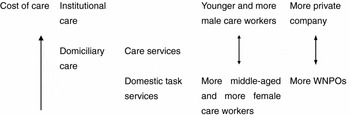
The introduction of the LTCI Act has influenced the construction of two segmented perceptions of care services. The provision of domestic task services is placed at the bottom of the occupational hierarchy in care work, requiring the least specialist skills. These services tend to be provided by middle-aged women. On the other hand, care services that cost much more than domestic tasks are recognised as work that men can also provide. According to WNPOs, this is because providing care services may require physical strength and can be undertaken by following patterns. In fact, in those institutions where virtually only care services are provided, the number of male carers had increased to 21.9 per cent of care workers in 2009, in comparison to only 8.8 per cent of domiciliary care workers (Kaigo Rodo Antei Senta, 2010). In addition, there is an age difference in both groups of care workers. The majority of institutional carers are in their twenties and thirties, while the majority of domiciliary care providers were in their fifties, with 46.8 per cent over 50 years old (Kaigo Rodo Antei Senta, 2010). There is also a clear difference in employment conditions for both types of care work. Eight out of ten institutional care workers, who tend to be young single and, increasingly men, work as full-time regular workers, while the same proportions of domiciliary care workers, who tend to be middle-aged married women, do non-regular work, such as part-time or on-call (Kaigo Rodo Antei Senta, 2010).
The care services are thus stratified, placing institutional care at the top of the hierarchy of care services cost, and domestic task services at the bottom, as shown in Figure 1. Male service providers tend to provide more care services than domestic tasks, because they have incentives to earn more than female carers (Yamane, Reference Yamane2010), and/or they are not considered sufficiently adept at providing domestic tasks, as this study found. Female service providers tend to provide more domestic task services, because they are assumed to have good skills and knowledge of them based on being a housewife, which are not verified by qualifications. The proportion of male carers has rapidly increased in institutions that offer more full-time employment opportunities and a higher salary level than domiciliary service providing organisations. Meanwhile, middle-aged married women, who work as part-time or on-call workers, dominate WNPOs.
The stratification of care services reinforced by the Japanese LTCI Act's implementation

Concluding remarks
With the implementation of the LTCI Act, the state came to play an essential role in the responsibility for the provision of care for older people, through managing its finance and regulations. Despite the anxiety of policy makers that older people and their families might not adopt this new concept, the number of users under this scheme has rapidly increased by about 142 per cent from 2000 to 2009.Footnote 12 Analysis of a ‘time use’ survey shows that the Japanese LTCI contributed to a modest reduction (nine minutes a day) of the time informal female carers spent on providing care for older people (Shikata and Tamiya, Reference Shikata and Tamiya2009). Hence, it can be seen that the family, and more precisely female family members, provide less care services for their older relatives than they used to before the implementation of the LTCI Act. In addition, care work, which had mostly been unpaid, informal and provided by women, has come to be remunerated, and to some extent professionalised, by the introduction of the LTCI Act.
However, in considering gender a more complicated picture emerges. Yamane (Reference Yamane2010) appropriately points out that with the Act's introduction, ‘home helper’ is coming to be recognised as an occupation, but the process of its formation is very strongly influenced by gender. This study has revealed that the LTCI Act contributed to reinforcing structural gendered divisions of care work: a division between institutional care and domiciliary care, care services and domestic services, and private companies and WNPOs. There is an unequal distribution of gender for each type of care work. Consequently, formal paid care provision created by the LTCI Act is, as Ungerson claims in respect of English paid care provision, clearly ‘gender skewed’ (Ungerson, Reference Ungerson2000: 625). After the LTCI Act's implementation, female family members may provide less unpaid care services in the household. However, although WNPOs, which are still predominantly run by middle-aged women, place a relatively high value on domestic task services, responding positively to the high demand for such services based on skills gained through being a housewife, these services are now placed at the bottom of a hierarchy of care work by the Act.