INTRODUCTION
Many studies have shown that macroparasites can function as effective indicators of environmental pollution, i.e. changes in their numbers within host populations have been found to be statistically associated with varying levels of contaminants in aquatic ecosystems (Lafferty, Reference Lafferty1997; Vidal-Martínez et al. Reference Vidal-Martínez, Pech, Sures, Purucker and Poulin2010). When parasites are used as bioindicators they can reflect contaminant effects at different ecological levels including the organismal, population and community levels (Schmidt et al. Reference Schmidt, Zander, Körting and Steinhagen2003a , Reference Schmidt, Zander, Körting and Steinhagen b ). Both single-host parasites (e.g. monogeneans) and multi-host parasites (e.g. trematodes, cestodes and acanthocephalans) exhibit a numerical response to pollution. In particular, differences in the abundance of multi-host parasites that are trophically transmitted can reflect changes locally in food webs (Carreras-Aubets et al. Reference Carreras-Aubets, Montero, Kostadinova and Carrasson2012). Such parasites are especially useful as bioindicators of ecosystem health since their free-living stages can be affected by even minor changes in their external environment. Parasites can be indirectly affected by contaminants if their intermediate host populations decrease in response to pollution. This can affect transmission rates of parasites and lower their prevalence in host populations.
Additionally, endohelminths can accumulate contaminants in their tissues at much higher levels compared with their hosts, demonstrating that parasites can also function as accumulation indicators (Tekin-Özan and Kir, Reference Tekin-Özan and Kir2005). Prominent among parasite groups that can significantly uptake heavy metals are acanthocephalans. Sures et al. (Reference Sures, Taraschewski and Jackwerth1994) found that the acanthocephalan Pomphorhynchus laevis infecting chub, Leuciscus cephalus, can accumulate lead (Pb) at levels 771 times greater than in the liver of its fish host and 2700 times higher than in the fish's intestine. The ability of tapeworms to bioaccumulate metals has been documented repeatedly in freshwater environments and to a lesser extent in marine ecosystems (Mendes et al. Reference Mendes, Eira, Vingada, Miquel and Torres2013)
Previously, macroparasites of Pacific sanddab (Citharichthys sordidus) from Santa Monica Bay (SMB) were studied and their potential as effect indicators of pollution was assessed (Hogue and Swig, Reference Hogue and Swig2007). We found that the larval cestode Lacistorhynchus dollfusi showed potential as a bioindicator of pollution exposure in Pacific sanddab from SMB. SMB is an important ecosystem for numerous fish species, including flatfish that use the bay as a feeding ground. The health of the bay is influenced by millions of people that share its watershed. SMB is exposed to numerous contaminants and a biomonitoring programme is in place to assist in assessing its health (Huang, Reference Huang2005). In this present study, the ability of L. dollfusi to concentrate heavy metals in its tissues compared with that of its sanddab host is examined and the potential of this cestode to function as an accumulation indicator of heavy metal pollution in SMB is discussed.
MATERIALS AND METHODS
SMB is situated within the Southern California Bight that extends from Point Conception on the Central California Coast to Cabo Colnett, Baja California, Mexico. Hyperion Treatment Plant (Hyperion) releases treated wastewater into the bay and also conducts a biomonitoring programme that includes sampling the sediments in SMB for metal pollutants. In the summers of 2003 and 2004, Hyperion sampled sediments in the bay for nine priority heavy metals [arsenic (As), cadmium (Cd), chromium (Cr), copper (Cu), Pb, mercury (Hg), nickel (Ni), silver (Ag) and zinc (Zn)]. A total of 63 Pacific sanddabs were also collected between May 2003 and December 2004 for a metal analysis study. Otter trawls carried out by the research vessel La Mer collected sanddabs from six stations in SMB. The specific collecting dates were May 2003, October 2003, November 2003 and December 2004. The trawl depth was 60 m and conducted at a speed of 3·7 km h−1 (2 knots). Trawl stations varied in their distance from the 8 km outfall pipe of Hyperion (Table 1). Stations C6, D1 and Z2 were close to the outfall pipe and stations C1, C3 and C9a were further away from the outfall pipe (see Hogue and Swig (Reference Hogue and Swig2007) for a map of the trawl stations).
Sampling stations, GPS coordinates for each station, number of fish collected per station and total number of cestodes recovered per station in SMB, CA in 2003 and 2004

Pacific sanddab had a mean length (cm) of 12·04 ± 1·10 s.d. and weight (g) of 24·83 ± 7·43 s.d. Each of the 63 Pacific sanddabs collected were infected with the plerocercoid stage of the tapeworm L. dollfusi. Prevalence of L. dollfusi was 100% (63 of 63 fish infected) and mean cestode intensity was 63·95 ± 23·54 (s.d.).
The concentration of 14 metals was determined in tissues and organs of each of the 63 fish sampled and in their cestode parasites. Cestode parasites that were removed from each fish host were pooled and this constituted the parasite sample for that host. Metals analysed were: Ag, As, Cd, Cr, Cu, iron (Fe), Hg, potassium (K), Pb, rubidium (Rb), selenium (Se), strontium (Sr), titanium (Ti) and Zn. Tissue samples were frozen prior to analysis and kept in an −80 °C freezer. Samples were weighed and digested in Teflon vessels using HNO3 in a microwave digestion system. After digestion, samples were diluted to a known volume with 1% HNO3 prepared in 18Ω water containing 10 µg L−1 of Gallium, Yttrium and Thallium. Gallium, Ytrium and Thallium were used as internal standards to correct for changes in instrumental sensitivity during ICP-MS analysis. Metal concentrations were analysed using a Perkin Elmer Elan 6100 DRC quadrupole ICP-MS using standard operating conditions. The metal content of each sample was quantified from response curves generated from a dilution series of certified metal standard solutions of known concentration. Individual analyses of the standards and samples were corrected for variations in the response for the internal standard and the content of metal in each sample was corrected for dilution and normalized for dry weight after subtraction of a reagent blank. Accuracy of analytical procedures was confirmed by the analysis of replicate samples of certified reference material, Dogfish Liver Standard (DOLT-2, National Research Council, Canada). Overall accuracy was determined to be better than 95%.
The mean concentration of metals in cestodes and the different tissues from the fish host sampled were compared using either one-way analysis of variance (ANOVA) with Tukey Kramer pairwise comparisons or Kruskal–Wallis tests (non-parametric ANOVA) with Steel-Dwass pairwise comparisons. Log transformations were done when data were not normally distributed for the one-way ANOVA analyses. A significance level of P < 0·05 was used for all statistical tests.
Bioconcentration factors (BF) were calculated for each metal analysed in fish and parasite tissue using the formula in Sures et al. (Reference Sures, Siddall and Taraschewski1999):
 $${\rm BF =} \displaystyle{{{C_{{\rm parasites}}}} \over {{C_{{\rm host \;tissue}}}}}$$
where C parasites is the metal concentration in the parasite and C host tissue is the metal concentration in the tissue of the host.
RESULTS
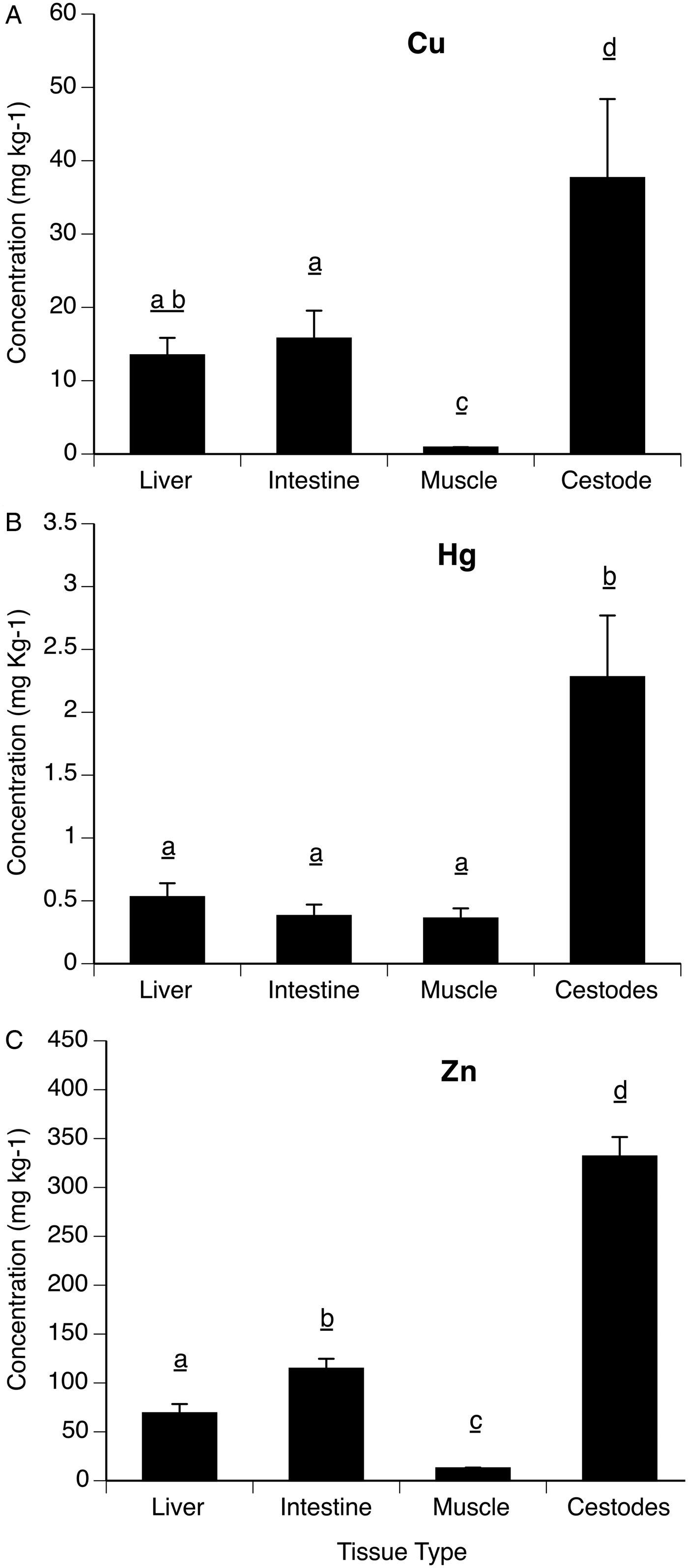
Three of the 14 metals examined were consistently higher in concentration in the parasite L. dollfusi compared with the tissues sampled from the fish host. They were Cu, Hg and Zn (Kruskal–Wallis tests, P < 0·001; Fig. 1). These three metals can be ranked from highest to lowest concentration in the cestode as follows: Zn > Cu > Hg. Levels of Zn were higher in parasites compared with fish intestine with this metal being almost 3 times higher in concentration in cestodes. Levels of Cu in L. dollfusi were 2–3 times higher than levels in the intestine and the liver of the fish, respectively. Hg concentration in the cestode was 4–5 times higher than that in fish tissues sampled.
Mean (±s.e.) concentration of three heavy metals in tissues of C. sordidus and the cestode.

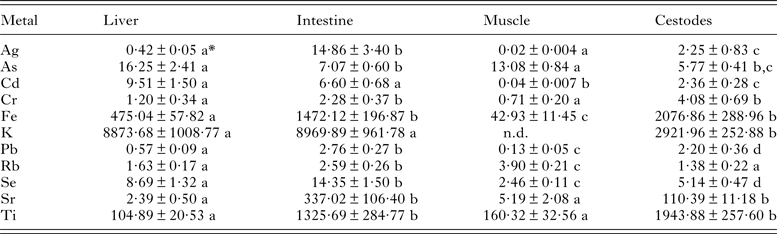
The concentration of the remaining 11 metals in fish tissue and parasites are shown in Table 2. When considering only the tissue sampled in the fish host, Pacific sanddab, most metals were present at higher concentrations in the intestine (Ag, Cu, K, Pb, Se, Sr and Zn). This was followed by the liver (As, Cd and Hg) and then by muscle (Rb). Cr, Fe and Ti were also higher in concentration in L. dollfusi but not significantly higher than all the fish tissue types sampled (Kruskal–Wallis tests for Cr and Fe, P < 0·001; one-way ANOVA for Ti, P < 0·001).
Mean (±s.e.) metal concentration (mg kg−1) in tissues of the fish C. sordidus and the cestode L. dollfusi

n.d., not determined.
* Mean values in lines with different letters (a–d) are significantly different (P < 0·05).
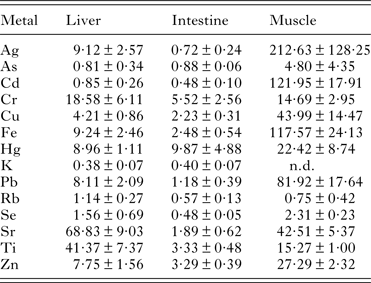
Mean BF for several of the metals indicated substantial increases in L. dollfusi compared with fish muscle, i.e. 213 times higher for Ag, 44 times higher for Cu, 118 times higher for Fe and 27 times higher for Zn (Table 3). When host liver was considered, Sr was 69 times higher and Ti was 41 times higher in the tapeworm. BF values for cestodes compared with fish intestine were much lower and ranged from <1 to 10.
Mean (±s.e.) bioconcentration factors for L. dollfusi calculated with respect to different tissues of C. sordidus

n.d., not determined.
DISCUSSION
Chemical pollution is a continual problem for marine ecosystems due to anthropogenic activities (Golestaninasab et al. Reference Golestaninasab, Malek, Roohi, Karbassi, Amoozadeh, Rashidinejad, Ghayoumi and Sures2014). The type of chemical pollution of interest in this study was heavy metal contamination, which can have adverse effects on the health of marine biota. For example, toxic metals like As, Cd and Cr can bioaccumulate in the tissues of marine fishes resulting in decreased growth, gas exchange problems and declining reproductive rates (Love et al. Reference Love, Saiki, May and Yee2013). Bioaccumulation of metals through a food web places the health of human consumers of seafood at risk as well. In SMB C. sordidus, Pacific sanddab, is an important target species in biomonitoring programmes that assess the health of the bay. Not only is the distribution and numerical abundance of this fish species in SMB an important component of the monitoring programme, but also its capacity for accumulating metals. Love et al. (Reference Love, Saiki, May and Yee2013) reported that this sanddab species can accumulate some toxic metals in its tissues at levels that may pose a health risk. As, Cd, Cr, Hg and Se exhibited concentrations in Pacific sanddab that equalled or exceeded the toxicity threshold for fish and other wildlife (Love et al. Reference Love, Saiki, May and Yee2013). In the present study, it was found that concentrations of As, Cr, Hg, Se and Zn in Pacific sanddab exceeded those reported for fish and wildlife in Hinck et al. (Reference Hinck, Schmitt, Chojnacki and Tillitt2009). Toxicity thresholds reported by Hinck et al. (Reference Hinck, Schmitt, Chojnacki and Tillitt2009) were: As (2·2–11·6 mg kg−1), Cr (1·0 mg kg−1), Hg (0·1–0·3 mg kg−1), Se (0·75–1·0 mg kg−1) and Zn (40–64 mg kg−1).
Demersal fish species like C. sordidus are excellent hosts for parasites as they consume a diverse assemblage of intermediate invertebrate hosts including crustaceans, molluscs and smaller fish. One of the most common endohelminth species infecting Pacific sanddab is the cestode L. dollfusi. Sanddabs acquire this parasite via the ingestion of a copepod intermediate host (Sakanari and Moser, Reference Sakanari and Moser1989). Prevalence of immature stages of this tapeworm in Pacific sanddab can exceed 90% (Hogue and Swig, Reference Hogue and Swig2007) and all fish used in the present study were infected with L. dollfusi. As a bottom-dweller, Pacific sanddabs are in direct contact with contaminated sediments in SMB. Kennedy (Reference Kennedy1997) proposed several criteria for the use of a fish host–parasite system as a bioindicator of pollution including the fish host being abundant and the parasite species being very common in the fish host population. Pacific sanddab was one of the ten most frequently occurring fish species collected from the bay in 2003 and 2004 (Cash et al. Reference Cash, Deets, Rounds and Roney2005). Sanddabs are also considered to be highly immobile, moving short distances in search of prey or to find more optimal habitat conditions (Rackowski and Pikitch, Reference Rackowski and Pikitch1989). This could help in better discriminating outfall from reference sites that vary in levels of contaminants in SMB.
Lacistorhynchus dollfusi was able to accumulate several heavy metals at levels that exceeded those in its host. Concentrations of Cu, Hg and Zn were significantly higher in this cestode compared with the tissues sampled its fish host, i.e. the liver, intestine and muscle. Hyperion also measured levels of Cu, Hg and Zn in sediments during the same years that Pacific sanddab were analysed for heavy metals (Huang, Reference Huang2005). Cu levels reported were much higher in SMB sediments (average of 111 mg kg−1 in 2003) compared with the levels in sanddabs (15·75 mg kg−1 in the intestine). Hg levels in cestodes (2·28 mg kg−1) were greater than those in sediments (average of 0·84 mg kg−1 in 2003); whereas levels in fish tissues were similar to those in the sediments. Levels of Zn measured in the sediments were higher (average of 164 mg kg−1 in 2003) than those in fish tissues, but less than that found in cestodes (331·72 mg kg−1). Ag, As, Cd, Cr and Pb were other priority pollutants analysed in the sediments of SMB. In comparison to sediment levels, the following metals were higher in concentration in fish tissues: Ag in fish intestine, As in fish liver and muscle and Cd in fish liver and intestine.
Endoparasites living within the fish host can accumulate both essential and non-essential elements in their tissues. Fish require metals like Cu and Zn for normal metabolism. The concentration of these metals was much higher in L. dollfusi compared with its sanddab host. Lacistorhynchus dollfusi inhabits the mesentery of Pacific sanddab that is within the body cavity of its host. Nachev et al. (Reference Nachev, Schertzinger and Sures2013) working with the adult stages of the acanthocephalan P. laevis and the larval stages of the nematode Eustrongylides sp. noted that larval parasites that live within the body cavity of the fish tend to have higher levels of essential metals compared with adult parasites that are found within the intestine. A major route of metal uptake for fish is the gills. From here metals can enter the circulatory system and be transported to the liver, where they are bound to bile complexes and subsequently secreted into the intestine.
However, metals like Hg are non-essential and detrimental to the health of the fish. The fact that L. dollfusi was able to accumulate this element at concentrations higher than that in all the host tissues sampled is a benefit, especially if the greater concentration of Hg in the cestode reduces availability of this element to the fish host. Torres et al. (Reference Torres, Eira, Miquel, Ferrer-Maza, Delgado and Casadevall2015) found that the European Hake Merluccius merluccius infected with the intestinal tapeworm Clestobothrium crassiceps presented lower levels of Pb in its tissues than hakes not infected with this cestode. It would be interesting to compare metal uptake in uninfected and infected sanddabs to see if metal levels are greater in uninfected fish.
This ability of immature and adult cestodes to uptake high levels of trace elements has been well-documented in freshwater fish hosts. The adult tapeworm Monobothrium wagneri infecting tench, Tinca tinca, contained Cd and Pb levels that were 40 and 150 times higher, respectively, than the levels in tench (Sures et al. Reference Sures, Taraschewski and Rokicki1997). The cestode Ligula intestinalis uses a bird final host where the adult stage occurs and a fish intermediate host where the immature plerocercoid stage is found. Several studies have shown that the plerocercoid stage can accumulate metals at concentrations higher than what is seen in the tissues of its fish host. Plerocercoids of this parasite infecting bleak, Alburnus alburnus, contained higher concentrations of Cu, Cr and Zn compared with the fish's muscle (Gabrashanska and Nedeva, Reference Gabrashanska and Nedeva1996). Pb, Cr and Cd occurred at levels that were 15, 6 and 2·6 times higher, respectively, than in the muscle of three species of cyprinid fish (Tenora et al. Reference Tenora, Baruš, Kráčmar and Dvořáček2000). In tench from Beyşehir Lake in Turkey, L. intestinalis was found to accumulate Cu and Zn metals (Baruš et al. Reference Baruš, Šimková, Prokeš, Peňáz and Vetešnik2012). Variability of metal concentrations in the same cestode species may be due to the age of its intermediate fish host as well as contaminant levels in the water body that the host inhabits (Tekin-Özan and Kir, Reference Tekin-Özan and Kir2005). Of the metals listed previously, Cu and Zn were elements that were also accumulated at significantly higher levels in the plerocercoid stage of L. dollfusi, approximately 44 and 27 times higher, respectively, than its host.
In comparison to freshwater ecosystems, studies are still lacking on metal accumulation in cestode parasite–fish host systems from the marine environment (Mendes et al. Reference Mendes, Eira, Vingada, Miquel and Torres2013). High metal accumulation of Cd was reported for Bothriocephalus scorpii infecting turbot, Scophthalmus maximus, from the Poland Coast (Sures et al. Reference Sures, Taraschewski and Rokicki1997). Malek et al. (Reference Malek, Haseli, Mobedi, Ganjali and MacKenzie2007) found that Cd and Pb were 278 and 332 times higher, respectively, in concentration in the tapeworm Anthobothrium sp. infecting the shark Carcharhinus dussumieri from the Persian Gulf. Golestaninasab et al. (Reference Golestaninasab, Malek, Roohi, Karbassi, Amoozadeh, Rashidinejad, Ghayoumi and Sures2014) investigated bioconcentration capacities of four cestode species infecting rays. They discovered that mean Pb concentration was significantly higher in three of the cestode species compared with the levels in ray muscle and intestine. Pb levels were 11·9, 3·29 and 39·1 times higher in the cestodes Polypocephalus sp., Tetragonocephalum sp. and Rhinebothrium sp2, respectively. In the present study, metal uptake abilities of non-adult stages of tapeworms infecting marine fish were measured. The plerocercoid stage of the cestode L. dollfusi accumulated many metals at levels that far exceeded those seen in its flatfish host, just as reported in adult tapeworms. One of the highest BF seen for this parasite was for Cd, where L. dollfusi had levels of this toxic metal that were 122 times higher than in the muscle of its fish host.
This study represents one of the few reports on metal uptake in larval tapeworms in marine fish hosts. It has been proposed that fish parasites should be incorporated into traditional biomonitoring programmes where they could serve as an early warning system of a decline in health of an ecosystem. Parasites may be a better gauge of pollution effects on fish populations when pollution levels are low or non-detectable in water (Khaleghzadeh-Ahangar et al. Reference Khaleghzadeh-Ahangar, Malek and McKenzie2011). Numerical responses to pollutants were documented previously for L. dollfusi. Its abundance in flatfish and its ability to uptake metals at higher concentrations than its host further support its consideration as a bioindicator of pollution exposure in fish hosts in SMB.
ACKNOWLEDGEMENTS
The Environmental Monitoring Division at Hyperion Treatment Plant provided the fish used in this study. I thank Zed Mason for conducting the metal analyses of animal tissue.
FINANCIAL SUPPORT
This study was supported by a grant to CC-H from California State University, Northridge.