Lone parents as workers
Over the last 20 years there has been an international trend towards the activation of lone parents (Carcillo and Grubb, Reference Carcillo and Grubb2006; OECD, 2007; Finn and Gloster, Reference Finn and Gloster2010). As a result, the question of whether lone parents are treated as mothers or workers has increasingly shifted to when they are treated as workers (Lewis, Reference Lewis2006) or, perhaps more accurately, who are treated as workers. This shift to treat (some) lone parents as workers has also taken place in Britain. The previous Labour government (1997–2010) had set itself two interlinked targets, namely to halve child poverty by 2010 and for 70 per cent of lone parents to be in employment by 2010 (see Thurley, Reference Thurley2003). Significant progress had been made towards both the child poverty and the employment target (Brewer et al., Reference Brewer, Browne and Sibieta2010 and Gregg et al., Reference Gregg, Harkness and Smith2006). However, both targets were missed despite substantial investment in benefit levels targeted at children (Brewer et al., Reference Brewer, Browne and Sibieta2010). The prospect of failing to meet both targets is likely to have contributed to the decision by the previous Labour government to shift the balance from enabling lone parents to move into work towards requiring (most) lone parents with older children to be available to work. Lone parents continue to be exempt from having to look for work if they have additional caring responsibilities, e.g. if their child is disabled or has a health impairment. The Labour government changed the Income Support regulations in 2008 (The Social Security (Lone Parents and Miscellaneous Amendments) Regulations) which meant that from November 2008 lone parents whose youngest child was aged 12 or over would no longer be eligible for Income Support (IS) and would be transferred to Jobseeker's Allowance (JSA). By October 2009 this change would apply to lone parents whose youngest child was ten or over and by November 2010 also to those whose youngest child was seven or older (Kennedy, Reference Kennedy2010). There are two main exceptions to this: lone parents who have additional caring responsibilities or who have substantial health problems are not affected by this reform. This article focuses, however, on those lone parents affected by the changes to the regulations introduced in 2008. These changes will be referred to as the 2008 welfare reform throughout the article.
Prior to the 2008 welfare reform being introduced, lone parents were able to claim IS until their youngest child reached the age of 16. This is at odds with social assistance provisions in most other countries which require lone parents to be available for work when their child is much younger (Carcillo and Grubb, Reference Carcillo and Grubb2006). Furthermore, being able to receive social assistance and therefore be a full-time parent as a lone parent can be seen as incongruous at a time when over two thirds of mothers in couples are working.
The Labour government justified the introduction of compulsion by arguing that (most) lone parents with older children should work because:
• working will have beneficial effects for lone parents and their families;
• the infrastructure, in terms of helping lone parents into work, making work pay and the availability of suitable childcare was already in place or would be during the course of 2010;
• most other countries have greater conditionality in place for lone parents already;
• the employment rate of lone mothers in other countries is much higher, as is the employment rate of mothers in couples in Britain; and
• lone parents with older children are ‘able to work’ as they are not required to look after their children full-time. (Department for Work and Pensions, 2007)
Being transferred from IS to JSA has not changed the financial situation of lone parents with older children as the rates of the two benefits are the same. However, lone parents will be required to meet a range of additional conditions, such as signing on every fortnight, be actively looking and be available for work. This means that lone parents are also at greater risk of more and more stringent sanctions (Bell, Reference Bell2009). In addition, lone parents were to be included in the flexible New Deal which contains greater conditionality for jobseekers (Department for Work and Pensions, 2007; Kennedy, Reference Kennedy2010).
However, generally the rules applying to lone parents are those applied to carers rather than jobseekers in general (Kennedy, Reference Kennedy2010), which means that some of the conditions around ‘availability for work’ and amount of work have been loosened for lone parents (Kennedy, Reference Kennedy2010; Bell, Reference Bell2009). Generally, Jobcentre staff are asked to carry out an assessment of the impact on the well-being of the child if the lone parent moves into work (Kennedy, Reference Kennedy2010). However, it has been pointed out that many of these so-called flexibilities introduced to accommodate lone parents are at the discretion of the advisor and may therefore require lone parents to state their case, which is likely to be difficult if there are language barriers, for example (CPAG, 2010).
In essence then, the main change of the reform is that lone parents, once their youngest child reaches a certain age, are no longer exempt from looking for work unless they have additional caring responsibilities or ill health.Footnote 1 In this article I am going to focus on lone parents who have been transferred from IS to JSA, that is leaving out parents who can either stay on IS because of their additional caring responsibilities or have been transferred to the Employment Support Allowance on account of a disability or impairment.
The introduction of compulsion to be available for work for (most) lone parents with older children has had a mixed reception, and a number of the previous Labour government's justifications, such as the policy infrastructure, have been challenged (Department for Work and Pensions Committee, 2008/09). The focus of this article is on whether the age of the youngest child is suitable as one of the main indicators for the ‘ability to work’ of lone parents as this aspect has received less attention than whether the infrastructure is in place in terms of childcare and employment, but is equally important for the likely success of the 2008 welfare reform.
The Coalition government (2010−) has already announced that it will extend the 2008 welfare reform so that lone parents whose youngest child is five or older will have to be available for work from early 2012 onwards (HM Treasury, Reference Treasury2010). This is in line with the overall approach of the Coalition to welfare-to-work, being a ‘continuation and intensification’ of the policies of the previous Labour government (McKay and Rowlingson, Reference McKay, Rowlingson and Bochel2011). The extension of the 2008 welfare reform will therefore be included in the analysis.
Age of child as a key selection criterion
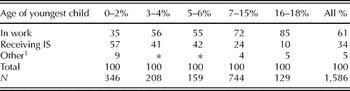
The employment rate of lone parents is higher for those with older children, as is shown in Table 1. For example, the employment rate of lone parents with children under three was 35 per cent (see Table 1 below). This compares to an employment rate of 56 per cent of lone parents whose youngest child was between three and four years old, 55 per cent for those whose youngest child is between five and six years old and 72 per cent of those whose youngest child is between seven and 15 years old.Footnote 2
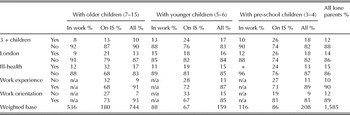
Employment status of lone parents by age of youngest child as a proportion of lone parents with children of that age

Notes: 1 The ‘other’ group consists of lone parents who are neither working one or more hours per week nor claiming IS but have other means of financial support such as maintenance payments.
* Where there are fewer than ten respondents.
Source: FACS 2005, all lone parents who are not married, not retired, not in receipt of any disability benefit that would entitle them either to stay on IS or move on to EMA, not working and claiming IS at the same time and have children under 18, weighted, own analysis.
The arguments for activating lone parents with older children seem compelling; not only do they have a higher employment rate, but older children need less physical care than younger children. Furthermore, age of child is used as a work activation criterion in most other countries (Carcillo and Grubb, Reference Carcillo and Grubb2006), usually either the age at which children start nursery or primary school (Millar, Reference Millar, Millar and Rowlingson2001).
However, it is not clear whether taking the age of the youngest child as one of the main selection criteria for lone parents to be available for work will be successful in meeting the stated aims of the reform. The age of (youngest) child has been highlighted as one of several factors influencing the non-employment of lone parents, but by no means the key driver (Bradshaw et al., Reference Bradshaw, Kennedy, Kilkey, Hutton, Corden, Earldey, Holmes and Neale1996; Holterman et al., Reference Holtermann, Brannen, Moss and Owen1999; Millar and Ridge, Reference Millar and Ridge2001). Furthermore, Lister (Reference Lister2006) makes the broader point that welfare reform is increasingly focussing on children at the expense of the welfare of parents. Gregg et al. (Reference Gregg, Harkness and Smith2006) have pointed out that the relatively high employment rate of lone parents with older children (see Table 1) may be an indication that the majority of lone parents in that group who are able to work do so and that those lone parents with older children who remain on IS do so because they are unable to move into work easily. Alternative options that have already been suggested include lowering the age of child to three and exploring the option of dividing lone parents into groups according to their work readiness with the view to tailoring both support and conditionality accordingly (Gregg, Reference Gregg2008).
Aims and objectives
The aims of this article are to examine the use of ‘age of youngest child’ as the one of the main indicators for ‘ability to work’ in the case of lone parents. The objectives are therefore to:
• examine the potential effect of the 2008 welfare reform on the overall employment rate of lone parents;
• examine the potential effect of the extension of the reform announced by the Coalition government; and
• use the concept of multiple disadvantages as an alternative indicator for ‘ability to work’.
Methodology
The analysis is set up as a policy appraisal of age of child as one of the key criteria for selecting lone parents to be available for work. This is motivated by the significance of the 2008 welfare reform, the emphasis the previous Labour government placed on ‘evidence-based policy’ to establish ‘what works’ (see Nutley and Webb, Reference Nutley, Webb, Davies, Nutley and Smith2000; Solesbury, Reference Solesbury2001; Sanderson, Reference Sanderson2002), and the availability of a substantial body of research on lone parents which argues that lone parents have different characteristics from lone parents in work (Holterman et al., Reference Holtermann, Brannen, Moss and Owen1999; Millar and Ridge, Reference Millar and Ridge2001). Policy appraisal stands here for ex-ante evaluation. It is deliberately set up as an ‘intrinsic’ evaluation, that is adopting the reasoning of the previous Labour government for the necessity of the 2008 welfare reform (Powell, Reference Powell2002) as well as the official guidance laid out in the Green Book for carrying out policy appraisals (HM Treasury, Reference Treasury2003).
In the Green Book, a policy appraisal consists of four steps: justifying action, setting objectives, appraising options and making recommendations (HM Treasury, Reference Treasury2003). The first two steps of the appraisal mentioned in the Green Book are to establish whether there is a need for policy reform and what the objectives should be. As this is an intrinsic analysis of the policy, the need for a reform and its objectives are not questioned. Instead the need for reform is taken as given and the objectives of the previous government, namely to increase the employment rate of lone parents as one key lever for reducing the child poverty rate, have been adopted for this analysis. The focus is therefore on the third and fourth steps of the policy appraisal: appraising options and making recommendations.
Appraising the policy options is done in two parts. First, the potential effect of a successful activation of this group on the employment target is examined on the basis of a number of hypothetical scenarios. Second, the central argument used to justify the activation, namely that (most) lone parents with older children are ‘able to work’ is examined in more detail on the basis of an alternative assessment of ‘ability to work’ based on the concept of multiple disadvantages (Berthoud, Reference Berthoud2003). Finally, recommendations will then be made in the discussion.
It is worth noting that this is not an appraisal of the whole reform as this is likely to be affected by overall economic climate and institutional settings (Department for Work and Pensions Committee, 2008/09) and subject to an ex-post evaluation already (Finn and Gloster, Reference Finn and Gloster2010). This does not mean, though, that an important aspect of the policy design, such as the criterion for activation, cannot be examined by itself on the basis of existing knowledge.
The analysis is based on a secondary analysis of 2005 data from the Families and Children Study (FACS). FACS is an annual cross-sectional and panel survey of all families with children in Great Britain. The sample size for lone parents is around 2000 households. Data from 2005 have been used as later waves do not contain all the required questions.
Lone parents have only been included in the analysis for this article if they have dependent children, did not give conflicting answers to key variables such as being a lone parent and being married and did not receive any of the disability benefits that would mean they would either be able to continue to receive IS or would be transferred to the Employment Support Allowance. In this article, all lone parents who were receiving Disability Living Allowance for their child have been taken out of the sample, even though in practice only those who are receiving the middle or higher rate are eligible to stay on IS. However, identifying those lone parents is difficult in FACS, and in addition the lower rate of DLA for children was received by only 6 per cent of all parents receiving DLA for their children in August 2008 (DWP 2011 Tabulation tool). Furthermore, it has not been possible to identify lone parents who have foster children in the data. However, presumably this is likely to be a small group and it should therefore not affect the results.
Some definitions
In this article, ‘being in employment’ is defined as working one hour or more per week. This is in line with the last government's definition of employment for the purpose of the employment target.
The focus in this article is on three groups of lone parents: the final target group of the 2008 welfare reform:
1 lone parents with older children: lone parents whose youngest child is between seven years and 15 years old;
2 lone parents with younger children: the extension of activation of lone parents with children aged between five and seven that has already been announced by the Coalition government; and
3 lone parents with very young children: lone parents whose youngest child is between three and four years old as the activation requirement for lone parents goes down to the age of the three (Carcillo and Grubb, Reference Carcillo and Grubb2006).
Different scenarios for meeting the employment target
As part of the policy appraisal, the potential impact of policy proposals is examined (HM Treasury, Reference Treasury2003) using a number of possible outcome scenarios. For the purpose of this analysis, two such scenarios have been chosen (see below).
1 Best-case scenario: In this scenario, we assume that 100 per cent of lone parents in the target group move into work. The question is what the effect of this would be on the overall employment rate.
2 Employment target scenario: In this scenario, the focus is on achieving the employment target, that is an overall employment rate of 70 per cent of lone parents. Therefore, the question is what proportion of lone parents in the target group would need to move into work to meet the overall employment target?
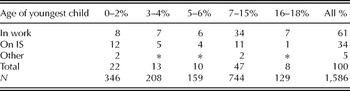
The effect of the first scenario described above is dependent on the overall size of the target group as this will determine by how much the overall employment rate of lone parents will increase if all lone parents in the target group moved into employment. In this case, 12 per cent of lone parents have older children and are receiving IS, that is are the target group (see Table 2 below). In other words, the target group of the 2008 welfare reform is a relatively small sub-group of all lone parents. This is partly due to the relatively high employment rate of this group. By comparison, if the target group was to be extended to include those whose youngest child is between five and six and who are on IS, it would rise to 22 per cent of all lone parents (see Table 2).
Employment status of lone parents by age of youngest child as proportion of all lone parents

Note: * Where there are fewer than ten respondents.
Source: FACS 2005, all lone parents who are not married, not retired, not in receipt of any disability benefit that would entitle them either to stay on IS or move on to EMA, not working and claiming IS at the same time and have children under 18, weighted, own analysis.
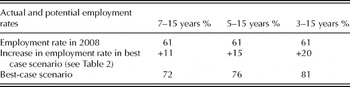
Table 3 shows the effect of the 2008 welfare reform on the overall employment rate of lone parents in the best-case scenario. The starting point for this analysis is the overall employment rate of lone parents of 61 per cent in 2005. Lone parents in the target group of the 2008 welfare reform, that is lone parents with older children who are on IS, make up 11 per cent of all lone parents (see Table 2 above). Therefore, in the best-case scenario, that is if part or all of the lone parents in the target group were to move into employment, the overall employment rate of lone parents of 61 per cent would increase by 11 percentage points and be brought up to 72 per cent (see Table 3 below). In other words, the employment target for lone parents would be exceeded in the best-case scenario.
Employment rates and increases by age of youngest child

Source: FACS 2005, all lone parents who are not married, not retired, not working and claiming IS at the same time and have children under 18, weighted, own analysis.
The extension of the target group to include lone parents with younger children (that is all lone parents whose youngest child was between five and 15) means that the overall employment rate would increase to 76 per cent in the best-case scenario. Finally, if the target group was extended to include all lone parents whose youngest child is three years old or older, the employment rate would increase to 81 per cent (all in Table 3 below).
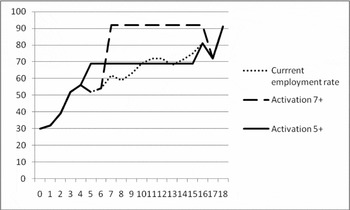
The second scenario focuses on the employment target of 70 per cent of lone parents. Therefore, in the employment target scenario the question is what proportion of the target group would need to be moved into work in order to hit the employment target. Figure 1 below shows the employment rate of lone parents by age of child in 2008 as well as the level of activation of lone parents with older and younger children that would be required in order to meet the 70 per cent overall lone parents employment target. Thus, over 90 per cent of lone parents with older children would need to move into work in order for the overall employment rate of lone parents to move up to 70 per cent (see Figure 1 below). This is due to the relatively small size of the target group as discussed above. In other words, even in the best-case scenario, the employment target would just be surpassed. Hence, almost all lone parents in this group would need to move into work in order for the employment target to be met. The extension of the target group to include lone parents whose youngest child is between five and six years old means that it would be sufficient for 69 per cent of lone parents in the target group to move into employment to reach the employment target (see Figure 1 below).
Employment target scenarios by age of child.

To summarise, the above analysis clearly demonstrates the link between the size of the target group and the level of activation required to meet particular targets. The current target group is relatively small and it would therefore require the almost complete activation of this group to reach the employment target. However, it would be sufficient for just over half of lone parents to move into employment if the target group was extended to include lone parents with younger children. Either way, this raises the questions whether lone parents in these groups are able to move into work.
Is the ‘age of child’ a good indicator for ‘ability to work’?
The main justifications for choosing age of child as one of the main identifiers for ‘ability to work’ are the reduced care needs of older children and the increase in public childcare/schooling provision. The underlying assumption seems to be that the care needs of the child are the only barrier to employment for lone parents. Yet, if ‘ability to work’ is to mean ‘ability to compete in the labour market’, then this assumption may not be quite so accurate. In the following section, what constitutes ‘ability to work’ and how it is linked with age of child will be examined in more detail.
‘Ability to work’ is assessed here on the basis of number of disadvantages in the labour market. Berthoud (Reference Berthoud2003) carried out longitudinal analysis on the risk of not being in employment based on the number of disadvantages, such as age and health. He argued that the risk of not being in employment for lone parents increases sharply with the number of disadvantages, from around 4 per cent for those not having any disadvantages to over 90 per cent for those with six disadvantages. Furthermore, he suggests that while the strength of the effect differs between disadvantages, the overall effect can be calculated by simply adding the effect of the individual disadvantages (all in Berthoud, Reference Berthoud2003). In the following analysis, the approach by Berthoud is adapted in the light of further research and additional variables being available in FACS.
Research on the characteristics of lone parents not in work presents ‘a very complete and generally consistent picture’ (Millar and Ridge, Reference Millar and Ridge2001: 147). This review of previous research identified seven key characteristics linked to not being in employment:
1. having a child under five;
2. having three or more children;
3. having a health problem;
4. not having any qualifications;
5. not having any recent work experience;
6. being a social housing tenant; and
7. not looking to move into work.
Not all of the characteristics linked to non-employment outlined above can be used for this analysis. Age of child is already part of the policy specification and has therefore not been included again. In addition, a large majority of lone parents in the target group live in rented accommodation (73 per cent of lone parents with older children on IS). Therefore, those at a particular disadvantage in the labour market are not likely to be identified using this characteristic. Instead an additional factor has been added which has emerged from the employability literature, namely the state of local labour markets (McQuaid and Lindsay, Reference McQuaid and Lindsay2002; Devins and Hogarth, Reference Devins and Hogarth2005). Due to data limitations, this has been implemented as lone parents being at a disadvantage if they are living in London. The employment rate of lone parents in London is substantially lower than elsewhere, lone parents in London are more likely to be on IS and on IS for longer periods than their counterparts elsewhere (see McKay, Reference McKay2004; O'Connor and Boreham, Reference O'Connor and Boreham2002).
Hence, the five factors included in the list of multiple disadvantages are:
• family composition: having three or more children;
• employability: not having any qualifications and not having been in work for the past two years or never having worked;
• health: either the lone parent or at least one child to have an impairment that is expected to last for at least a year and limits either the amount or kind of work the parent can engage in (but not receiving any of the benefits that would continue their eligibility for IS or EMA);
• work orientation: not looking or expecting to move into work in the next two years; and
• local labour market: living in the government region with the lowest employment rate, that is London.
The indicators of disadvantage have been set deliberately high (see Table 4). For example, impairment of either the adult or the child is defined as lasting for more than a year and affecting the ability to work and thus applies to 32 per cent of lone parents with older children on IS (see Table 4). Similarly, 32 per cent of lone parents in this group have not worked in the past two years and do not have any qualifications (see Table 4).
Characteristics of lone parents

Notes: Lone parents in the ‘other’ group are not included in the above table nor are lone parents whose youngest child is below one year old.
* Where there are fewer than ten respondents.
Source: FACS 2005, all lone parents who are not married, not retired, not in receipt of any disability benefit that would entitle them either to stay on IS or move on to EMA, not working and claiming IS at the same time and have children under 18, weighted, own analysis.
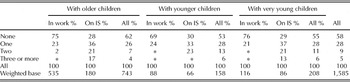
Adding the number of disadvantages highlights differences according to the employment status of lone parents (Table 5 below). For example, while 75 per cent of lone parents with older children in employment did not have any of the disadvantages identified above, this compares to only 28 per cent of those on IS. Conversely, 21 per cent of lone parents on IS with older children have two and 17 per cent three or more disadvantages. This compares to 2 per cent of those in employment. Lone parents with older children on IS have slightly higher numbers of multiple disadvantages, for example, 38 per cent have two or more disadvantages compared to 37 and 34 per cent of those with younger and pre-school children.
Number of disadvantages: lone parents by work status and age of youngest child

Notes: Looking at combinations of disadvantages, the only two correlations that are strongly significant (at the 0.01 level) are those between health and work orientation and employability and local labour market.
* Where there are fewer than ten respondents.
Source: FACS 2005, all lone parents who are not married, not retired, not in receipt of any disability benefit that would entitle them either to stay on IS or move on to EMA, not working and claiming IS at the same time and have children under 18, weighted, own analysis.
There does not seem to be much difference between the number of disadvantages of lone parents with younger and those with pre-school children on IS. Similar proportions of lone parents on IS whose youngest child is between five and six years do not have any disadvantage compared to those whose youngest child is between three and four years (30 and 29 per cent respectively). Thus, the figures in Table 5 suggest that lowering the age of the youngest child to five or even to three and over would not bring in a different group of lone parents in terms of their likelihood of being able to find employment.
However, the most striking difference across all three groups is that between those in work and those out of work, giving weight to previous analysis which has suggested that characteristics are clearly linked to non-employment in the case of lone parents. This suggests that ‘ability to work’, if measured by the number of disadvantages is not synonymous with the age of the youngest child.
Summary and conclusions
The 2008 welfare reforms introduced by the previous Labour government focused on activating lone parents based on the age of their youngest child as a key criterion. Activating lone parents is a key plank in the strategy to meet the child poverty target via an increased lone parent employment rate. The argument in support of the activation is that lone parents with older children are able to work not least because the infrastructure in terms of childcare, in-work benefits and flexible working is in place. However, when looking at the group of lone parents with older children more closely, two key aspects emerge. First, the group of lone parents with older children on IS is too small to make a substantial contribution to the employment target. In fact, it would require an almost complete activation of this group to meet the 70 per cent employment target. Second, and perhaps more importantly, the level of multiple disadvantage among this group suggests that a substantial proportion of lone parents have a high risk of not being able to move into employment.
The Coalition government has already announced that it will extend the activation of lone parents to include those whose youngest child is five or over in 2012. This will increase the size of the target group and therefore make it easier to reach the employment target even if just over two thirds of the expanded target group could be successfully moved into the labour market. However, the composition of this group is similar to that of lone parents with older children, that is just under half of lone parents with younger children have at least two disadvantages. Thus, given that Britain in 2011 is just emerging from a recession, it seems reasonable to expect only a modest increase in the employment rate of lone parents while at the same time expecting an increase in the proportion of long-term unemployed.
The level of multiple disadvantages among lone parents with older children exposes the assumption that the age of the youngest child can be equated with ability to work in the case of lone parents as incorrect and one-dimensional. It therefore supports Lister's argument that the focus on children under New Labour led to overlooking the needs of lone parents (Reference Lister2006). Furthermore, it also raises questions as to whether the infrastructure to support lone parents to move into and stay in work really is in place if those lone parents have multiple disadvantages. Are the measures in place to address the disadvantages faced by lone parents sufficient, for example the need for recent work experience in the low skilled end of the labour market or childcare for children with impairments? Finally, given that there are substantial proportions of lone parents with older children who are unlikely to move into work in the near future, the question as to what is on offer for lone parents who cannot work is newly pertinent.
Acknowledgements
I would like to thank Jane Millar and Lucinda Platt for their comments on earlier drafts of this article.
This research is based on data from the Families and Children Study 2002 to 2005 (SN4427). The data have been collected by the National Centre for Social Research. It is sponsored by the following government departments: Department for Work and Pensions (lead department), Her Majesty's Revenue and Customs, Department for Education and Skills and the Department for Transport. The data have been supplied by the Data Archive and are Crown copyright.