Influenza viral infection affected 48.8 million (11.5 million children) individuals in the United States in 2017–2018.1 Inflammatory cardiac complications, including myocarditis, pericarditis, and conduction system dysfunction, remain an important cause of mortality in patients with influenza infection. Patients with repaired CHD may be more vulnerable to inflammation-related heart block and arrhythmias. We report a case of acute circulatory collapse associated with a complete atrioventricular block and probable ventricular tachycardia and pacemaker non-capture during an Influenza B viral infection in a child with repaired CHD. Within 24 hours, atrioventricular node conduction recovered.
Case report
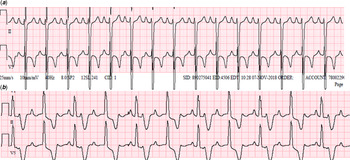
A 6-year-old female, with Fontan palliation for repair of tricuspid atresia (type 2A) and backup pacemaker was admitted after a cardiac arrest. She had been in her usual state of health with a clinic visit a week prior to the event. Her electrocardiogram showed normal sinus rhythm with first-degree atrioventricular block without pacemaker activity (Fig 1a). She had history of complete heart block at 3 years of age during transcatheter dilation of the fenestration for which a dual-chamber epicardial pacemaker was placed. However, by 6 months, she no longer required pacing. At 5 years of age, a fracture was noted in the atrial lead, and ventricular lead had increased threshold but was still retained pacing function on testing with adjustments in output. She did not require any atrial or ventricular pacing for 2 years prior to her presentation and did not have a history of ventricular ectopies. She presented after resuscitation from a syncopal episode following a prodrome of fever, cough, and rhinorrhea. She was found to be pulseless and without respirations. On presentation, her temperature was 40.1°C, an electrocardiogram showed complete atrioventricular block with a ventricular escape rate of 60 per minute and T wave changes (Fig 1b). Pacemaker interrogation of events at the time of her collapse showed ventricular pacing with no capture followed by ventricular tachycardia at a rate of at 295 bpm (Fig 2). The echocardiogram showed mild decrease in single-ventricle systolic function. She was intubated and ventilated; inotropic support was not required. Initial laboratory values revealed an elevated Troponin I (0.2 mg/ml), and evidence of Influenza B viral respiratory infection, with normal white blood cell count, no evidence of bandemia and normal serum C-reactive protein level. Within 24 hours, the atrioventricular node conduction recovered to baseline. The serum Troponin level was slightly above the normal range and single-ventricle function improved within 48 hours of presentation. Due to lack of requirement of inotropic or vasopressor support and due to improvement of ventricle function, our suspicion for myocarditis was low, and hence, neither cardiac MRI nor cardiac biopsy was performed. In discussion with her family, she had not received annual influenza prophylaxis for the last 5 years.
Electrocardiogram showing (a) baseline sinus rhythm with first-degree heart block and (b) complete heart block with atrioventricular disassociation. The atrial rate is 176 bpm. The ventricular rate is 62 bpm.

Stored pacemaker event recording from the time of her collapse indicating ventricular pacing with no capture and the onset of ventricular tachycardia at a cycle length of 350– 203 milliseconds. VHR = ventricular high rate episode.

Discussion
This case stresses the need for awareness of adverse cardiac effects of influenza, including infarction, myocarditis, pericarditis, and inflammation of the conduction system,Reference Wang, Xu and Yang2 especially among patients with repaired CHD who may be at an increased risk for fatal events. Due to potentially significant mortality and morbidities associated with the influenza virus, prophylaxis with a vaccine is recommended. Although available, the family had not sought any vaccination against influenza. Influenza-induced transient atrioventricular block as well as Brugada-like electrocardiogram changes have been previously reported in older patients (85-year-old male with diastolic dysfunction and 18-year-old healthy female), but not in patients with CHD.Reference Rivera-Guzmán, Del Olmo-Arroyo, Robles-Arías and Rodríguez-Cintrón3-Reference Kusaka, Yamakawa and Kawaura5 Influenza B infection associated with pericardial effusion is reported in a patient with primum atrial septal defect and Trisomy 21.Reference Spoto, Valeriani and Locorriere6 In a meta-analysis, influenza vaccination was associated with lower incidence of cardiovascular adverse events.Reference Udell, Zawi and Bhatt7
To our knowledge, influenza-related cardiac arrhythmias have not previously been reported among CHD patients. Patients with single-ventricle physiology may be at greater risk for rapid decompensation during complete heart block due to worsening of cardiac output from the loss of atrioventricular synchrony. The aetiology of her presenting symptoms and clinical findings are likely multifactorial with a combination of viral-related inflammatory myocardial changes causing arrhythmias, pacing thresholds changes as well as acute conduction system dysfunction.
Conclusion
Patients with CHD are intrinsically at lifelong risk to develop arrhythmias. Influenza-related cardiac complications can be fatal. In light of the current popular trend towards non-vaccination for children, prophylaxis against influenza is recommended in all children, especially in those with CHD and their families.
Acknowledgements
None.
Financial Support
This research received no specific grant from any funding agency, commercial or not-for-profit sectors.
Conflicts of Interest
None.
Ethical Standards
This case report does not involve human or animal experiments and hence the ethical standard statement should be avoided as per your author instructions.