Introduction
Seed germplasm collections maintain and preserve crop genetic diversity as safe harbours against genetic bottlenecks and as reservoirs of potentially useful traits for breeding programs. Specific accessions containing beneficial alleles can improve disease resistance, crop yield, flavour, nutritional value, etc. Ongoing research of gene function and expression in various crops likely will yield new targets for crop improvement in the future. However, genetic research and discovery is an ongoing process, so the long-term storage of seeds is critical in maintaining viability for their future use as a genetic resource. Ideally, seed collections would be stored under optimal conditions and be available at different points in the future if and when they are needed. However, seed viability is finite and decreases with age even under the best conditions, and this is due largely to changes that occur in seed chemistry over time (Garoma et al., Reference Garoma, Chibsa, Keno and Denbi2017). Oxidation disrupts cell membranes and storage lipids leading to cell damage and eventually cell death. Oilseed crops such as peanut, soybean, and rapeseed are particularly prone to the ageing effects of oxidation due to the high concentrations of storage lipids. For example, soybean mutant lines with reduced phospholipase activity showed higher seed viability after storage compared to the wildtype due to differences in changes to oil profiles during storage (Lee et al., Reference Lee, Welti, Roth, Schapaugh, Li and Trick2012). In another study of rapeseed (Brassica napus L.) accessions stored for 31 years, seed variation in fatty acid and glucosinolate composition resulted in differences in germination rate and percentage of normal seedlings (Nagel et al., Reference Nagel, Holstein, Willner and Börner2018). Similarly, seed oil composition and oxidation levels of 31-old peanut seeds significantly affected germination and normal seedling growth rates (unpublished data). In this study, freshly regenerated peanut seeds were compared to seeds from inventories kept in storage for various lengths of time to determine the effects of storage length on long-term changes to fatty acids in stored seeds.
Experimental
Peanut germplasm accessions representing unique genetic material are stored at the USDA-ARS, Plant Genetic Resources Conservation Unit (PGRCU) in Griffin, GA at −18°C. Seeds from each accession that are regenerated at different locations or in different years are stored as separate, unique inventories to avoid mixing new seeds with older ones. Based on an initial screen of the entire peanut collection, 50 accessions were initially selected for regeneration with three replicates for a separate study to determine fatty acid composition of freshly harvested seeds. Three were ultimately removed due to questions about their mixed seed coat colours and origin. From the stored germplasm, all available inventories (1–3 per accession) across a variety of regeneration years from these same accessions were sampled to compare changes in seed oil occurring with storage length (online Supplementary Table S1). Fatty acid composition analysis followed a previously published method (Wang et al., Reference Wang, Chen, Tonnis, Barkley, Pinnow, Pittman and Pederson2013). Five seeds from each seed lot were crushed together and homogenized. Oil was extracted from a small portion of mixed sample (~50 mg) and converted to fatty acid methyl esters (FAME). Fatty acid composition was determined on an Agilent 7890A gas chromatograph equipped with a DB-23 column (15 m × 0.25 mm i.d.), a flame ionization detector and an auto-sampler. Fatty acid percentages were determined by calculation of the corresponding peak area within the total peak area. Oxidation peaks were identified by mass spectrometry and comparison to retention times of pure analytical standards. Two measurements were taken for each accession inventory, and the results were averaged. Statistical significance and correlation tests were calculated using SAS version 9.4 (SAS, 2020).
Discussion
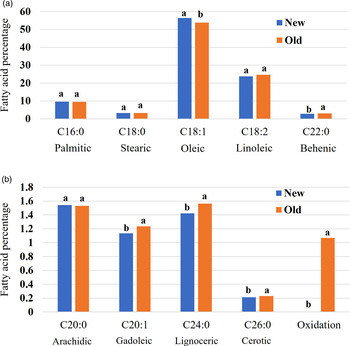
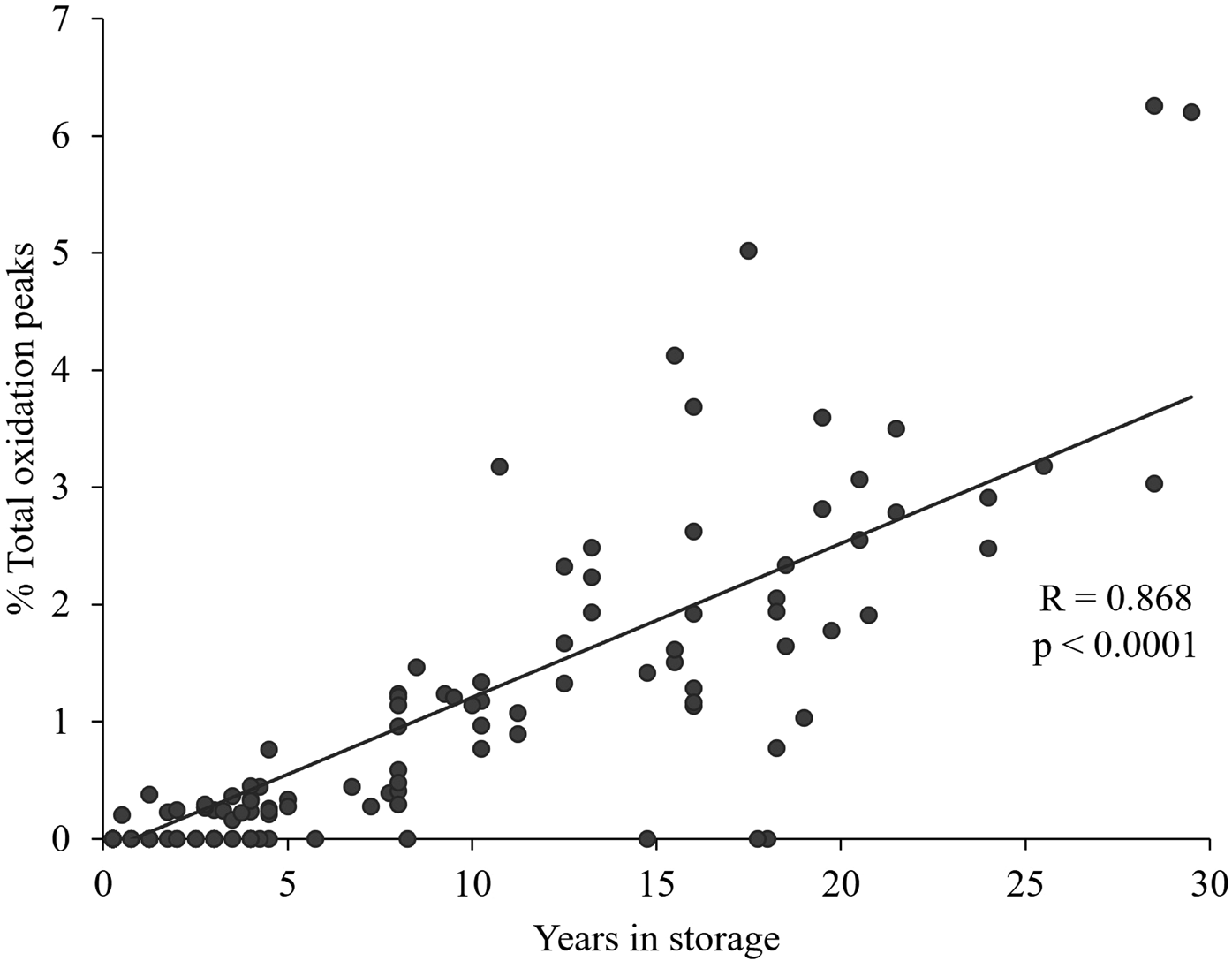
Seeds maintained in storage show a gradual reduction in germination rate over time (Tatić et al., Reference Tatić, Balešević-Tubić, Đorđević, Nikolić, Đukić, Vujaković and Cvijanovic2012; Nagel et al., Reference Nagel, Kodde, Pistrick, Mascher, Börner and Groot2016). This is an important factor to consider for germplasm banks and seed repositories in determining how long older seeds can maintain viability. To determine the effects of ageing on an important oilseed, we measured fatty acid composition of fresh and aged peanut seeds to compare profile changes and identify products that result from oil oxidation while in storage. The 114 stored inventories averaged 9.6 years in storage and ranged from 0.5 to 29.5 years prior to measurement. Significant differences were found in five of nine detected fatty acids, including oleic (18:1), gadoleic (20:1), behenic (22:0), lignoceric (24:0) and cerotic (26:0) acids indicating alterations may occur in oil composition during storage (Fig. 1(a) and (b)). More importantly, the stored seeds had significantly higher levels of oxidation products averaging more than 1% and ranging from zero up to 6.26%, while none of the fresh seeds had these compounds. Because fatty acid oxidation can result in reduced seed germination, the presence of these products can be an early indication of seed damage and reduced viability. Furthermore, there is a significant correlation (r = 0.868, P < 0.0001) between the total oxidation and the number of years in storage (Fig. 2), indicating that peanut seed oil oxidation increases approximately linearly over time.
Comparison of mean fatty acid concentration between freshly harvested and stored peanut seeds expressed as percentage of total oil. (a) Major fatty acids comprising more than 2% on average, and (b) minor fatty acid comprising less than 2% and oxidation products. Bars with different letters are significantly different.

Correlation between storage length and concentration of oxidation products in freshly harvested peanut seeds and stored seed inventories.

While the relationship is strong, there is some variation, especially in inventories that had no oxidation despite being in storage for several years. This may be due to fatty acid composition differences between accessions. Fatty acid sensitivity to oxidation and degradation is affected by saturation level (Shahidi and Zhong, Reference Shahidi and Zhong2010) with unsaturated (no double bonds in the hydrocarbon chain) and monounsaturated (one double bond) fatty acids being more resistant to oxidation than polyunsaturated (two or more double bonds) fatty acids. Some preliminary evidence from the data presented here indicates that accessions with higher monounsaturated oil content are more resistant to degradation and accumulation of oxidation products even after long-term storage. Other studies in our lab have shown that older high oleic (~75%) peanut seeds maintain higher rates of germination and normal seedling growth than their normal oleic (~50%) counterparts (unpublished data). Additional research needs to be done to verify this observation across multiple accessions.
In conclusion, the data presented here show that changes occur in peanut seed composition during storage, including differences in some fatty acids as well as the accumulation of oxidation products. Furthermore, these products increase in concentration with increasing time in storage. The relative concentration can be used as an indicator for the likelihood of germination of the seeds in the inventory.
Supplementary material
The supplementary material for this article can be found at https://doi.org/10.1017/S147926212100054X.
Acknowledgements
The authors thank Drs Brad Morris and Viktor Tishchenko for reviewing the manuscript and David Pinnow for assisting with seed sampling and preparation.