Introduction
Fish belonging to the Notopteridae are represented in lower Guinea by two species, Papyrocranus afer (Günther, 1868) and Xenomystus nigri Günther, 1868 (Roberts, Reference Roberts1992; Paugy et al., Reference Paugy, Lévêque and Teugels2003; Lavoué & Sullivan, Reference Lavoué and Sullivan2004; Stiassny et al., Reference Stiassny, Teugels and Hopkins2007). In Cameroon, P. afer is reported in the basins of Sanaga, Cross, Meme and Wouri rivers while X. nigri is only known from the latter (Stiassny et al., Reference Stiassny, Teugels and Hopkins2007). Up until now, both species were declared free of monogenean parasites (Birgi, Reference Birgi1987). In a recent parasitological survey on monogenean fish parasites from Cameroon, the gills of P. afer, which were sampled in Lake Ossa (Sanaga River basin), unexpectedly revealed the presence of a new Quadriacanthus Paperna, Reference Paperna1961 species. In the present study we describe this monogenean species for the first time and its probable origin is discussed.
Materials and methods
Collection and examination of fish hosts and monogeneans
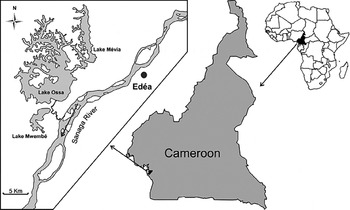
Lake Ossa (3°45′–3°53′N; 9°58′–10°04′E, and 8 m above sea level) is located 20 km to the west of the city of Edéa and 30 km from the Atlantic Ocean (Kossoni, Reference Kossoni2003). According to Wirrmann (Reference Wirrmann1992), Wirrmann et al. (Reference Wirrmann, Bertaux and Kossoni2001) and Kossoni (Reference Kossoni2003), Lake Ossa is in fact composed of several lakes, reaching a total surface of about 3800 ha. This system presents three main lakes: Mevia, which is located in the north, Ossa in the middle and Mwembe in the south. Ossa and Mevia, which are the two largest lakes, communicate through a short channel, while Mwembe is isolated. In the south-eastern part, Lake Ossa and Lake Mwembe communicate with the Sanaga River by a sinuous outlet (fig. 1).
Map to show the geographical location and hydrography of Lake Ossa.

Specimens of P. afer (n= 19) were caught using hook-lines or gill-nets during the long dry season (December to February 2011). They were dissected immediately on the shore after fishing. The gill arches were isolated by two incisions, one ventral and another dorsal, then preserved in a 25-ml scintillation vial, and maintained at − 15°C in a portable Engel fridge–freezer until examination. Each fish carcass was marked and kept in 10% formaldehyde. In the laboratory, monogenean parasites that were tenaciously attached to the gill filaments were first dislodged using an entomology needle mounted on a mandrel (Bilong Bilong, Reference Bilong Bilong1995), then transferred individually into a drop of ammonium picrate–glycerin (a mixture described by Malmberg, Reference Malmberg1957) on a microscope slide. The preparations were covered with a cover slip and after 24 h they were sealed with Glyceel (made after Bates, Reference Bates1997).
Morphometrics
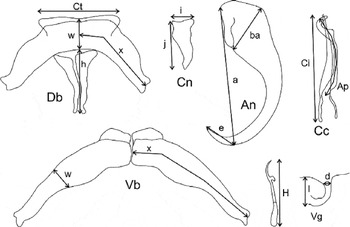
The drawings of the sclerotized pieces of the haptor and of the copulatory complex were carried out using the camera lucida of a microscope Wild M.20 (Wild, Heerbrugg, Switzerland) and Corel Draw X4 software (ver 14.0.0.701; Corel Corporation, www.corel.com/); their measurements and numbering were carried out following Gussev (Reference Gussev, Bychovskaya–Pavlovskaya, Gussev, Dubinina, Izymova, Smirnova, Sokolovskaya, Shtein, Shul'man and Epsthein1962) modified by N'Douba et al. (Reference N'Douba, Lambert and Euzet1999) (fig. 2). These measurements are given in micrometres (μm) as follows: mean (minimum value–maximum value). Type specimens are deposited in the Royal Museum for Central Africa, Tervuren (RMCA); and the Muséum National d'Histoire Naturelle, Paris (MNHN) as indicated, remaining specimens have been kept in the collection of the Laboratoire de Parasitologie et d'Écologie, University of Yaoundé I, Yaoundé, Cameroon.
Morphometrics of Quadriacanthus spp. used in this study are based on Gussev (Reference Gussev, Bychovskaya–Pavlovskaya, Gussev, Dubinina, Izymova, Smirnova, Sokolovskaya, Shtein, Shul'man and Epsthein1962) and modified by N'Douba et al. (Reference N'Douba, Lambert and Euzet1999). (An) Anchor: a, length; ba, base width; e, point length; (Cc) copulatory complex: Ap, accessory piece length; Ci, cirrus length; (Cn) cuneus: i, width; j, length; (Db) dorsal bar: Ct, centre length; h, median process length; w, width; x, length; (H) hooklet length; (Vb) ventral bar: w, width; x, length; (Vg) vagina: l, length; d, diameter.

Results
Quadriacanthus euzeti n. sp. Nack, Pariselle & Bilong Bilong
Taxonomic summary
-
Type host. Papyrocranus afer (Günther, 1868).
-
Site. Gills.
-
Type locality. Lake Ossa, Cameroon (03°45′–03°53′N; 9°58′–10°04′E).
-
Type specimens. Holotype no. 37 782 and paratypes no. 37 783 RMCA; paratype no. HEL515 MNHN.
-
Material studied. Sixteen individual adult parasites
-
Parasitic indices. Number of fish infected = 14; prevalence = 73.7%; mean intensity = 8 (1–17).
-
Etymology. Named in honour of our mentor, the late Professor Louis Euzet.
Description
The anatomy of this ancyrocephalid parasite corresponds to the diagnosis of Quadriacanthus given by Paperna (Reference Paperna1961) and amended by Kritsky & Kulo (Reference Kristky and Kulo1988): body divisible into cephalic region, trunk, peduncle, haptor. Tegument thin, smooth. Two bilateral, terminal cephalic lobes; four pairs of head organs; cephalic glands unicellular, comprising two bilateral groups postero-lateral to pharynx. Ocellae present or absent; granules usually scattered in cephalic area, anterior trunk. Mouth subterminal, midventral; pharynx muscular, glandular; oesophagus short; two intestinal caeca, confluent posterior to gonads. Gonads intercaecal, overlapping; testis dorsal to ovary. Vas deferens looping left intestinal caecum; seminal vesicle a dilation of vas deferens, lying diagonally to left of midline in anterior trunk; two prostatic reservoirs, one C-shaped, wrapping around second. Copulatory complex comprising basally articulated cirrus, accessory piece. Oviduct short; uterus delicate; vagina sinistral; seminal receptacle intercaecal, ventral to anterior end of ovary; vitellaria well developed, dispersed in two bilateral bands coextensive with intestinal caeca; common vitelline duct anterior to seminal receptacle. Haptor armed with dorsal and ventral pairs of anchors, dorsal and ventral bars, posterior muscular pad between bars, 14 pairs of hooklets with ancyrocephaline distribution. Anchors with cuneus; ventral bar comprising two components articulating medially; dorsal bar with bilateral arms, expanded mid-region. Hooklets pair IV with elongate dilated proximal shank; pairs I and III usually with short proximal dilation of shank; pairs II, V, VI and VII lacking dilated shank. Parasites of siluriform fish of Africa and Asia. Type species, host and locality: Quadriacanthus clariadis Paperna, Reference Paperna1961, from Clarias lazera Cuvier and Valenciennes, Lake Galilee, Israel.
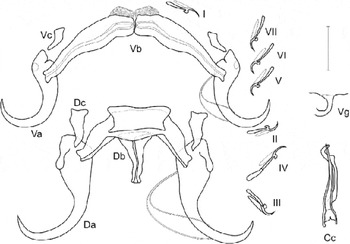
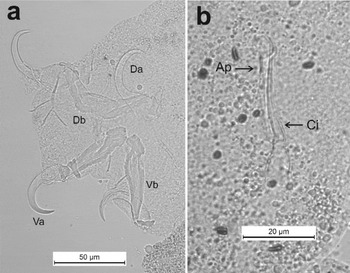
Adults of Q. euzeti (figs 3 and 4) measure 630 (560–700) total length, haptor included, and 81.7 (70–90) width at the level of ovary. No ocelles, but many pigmented granules dispersed on the border of the pharynx measuring 37.5 (35–40) in diameter. Haptor wider than the rest of the body, 90 (80–100) in length and 100 (90–110) in width, armed with: four anchors (two dorsal and two ventral) each of them with a triangular cuneus and a thick filament, two transverse bars (one dorsal and one ventral). Dorsal anchors without differentiated guard and shaft, thick curved blade: a, 50.5 (49–53); ba, 14.6 (13–16); e, 9.4 (8–11). Cuneus: i, 8 (7–9); j, 18.2 (17–20). Dorsal transverse bar – a main piece (widely open V) associated with a posterior funnel-shaped sclerite and an anteriorly overlapping trapezoidal piece: Ct, 23 (22–24); x, 32.3 (31–33); w, 15 (14–16); h, 24 (22–27). Ventral anchors smaller than dorsal ones: a, 37.5 (33–40); ba, 12 (10–13); e, 13.7 (11–14). Cuneus: I, 4.5 (4–5); j, 11 (10–12). Ventral transverse bar formed of two articulated equal components: x, 53 (52–54); w, 11.5 (10–13). Fourteen hooklets arranged in seven symmetrical pairs are all similar, except those from the second and the fourth pairs, which are smaller (larval size) and larger, respectively. Hooklet pair I, 16.5 (16–17); II, 13.5 (13–14); III, 16.5 (16–17); IV, 24.5 (23–27); V, 16.5 (16–17); VI, 16.5 (16–17); VII, 16.5 (16–17). Tubular cirrus with flared base: Ci, 38 (36–40). Accessory piece attached to the base of the cirrus, ending with a distal hook: Ap, 27 (25–28). Short and funnel-shaped sclerotized vagina only observed in 10 individuals: l, 17 (16–18); d, 2.5 (2–3).
Sclerotized parts of Quadriacanthus euzeti n. sp. Nack, Pariselle & Bilong Bilong: Cc, copulatory complex; Da, dorsal anchor; Db, dorsal bar; Dc, dorsal cuneus; I–VII, hooklets; Va, ventral anchor; Vb, ventral bar; Vc, ventral cuneus; Vg, vagina. Scale bar = 20 μm.

Photomicrographs of hard parts of Quadriacanthus euzeti n. sp. (a) Haptor: Da, dorsal anchor; Db, dorsal bar; Va, ventral anchor; Vb, ventral bar; (b) copulatory complex: Ap, accessory piece; Ci, cirrus.

Differential diagnosis
Among the species of Quadriacanthus already described, Quadriacanthus euzeti n. sp. is close to Q. levequei Birgi, Reference Birgi1988 and Q. nyongensis Birgi, Reference Birgi1988, based on the morphology of the male copulatory complex. However, it is distinguished from these two species by the size of the sclerotized pieces of haptor and/or copulatory complex, of the hooklets, of the ventral and dorsal anchors, and of the ventral and dorsal transverse bars, which are all generally smaller than in either of these two species (Birgi, Reference Birgi1988). These observations allow us to assert that the parasite of P. afer is a new species.
Discussion
Before the finding and description of this new monogenean species, all Quadriacanthus species were reported only from Siluriformes and Perciformes hosts. Among Siluriformes, these parasites infect fish belonging to Bagrus Bosc, 1816 (Bagridae) (Paperna, Reference Paperna1979), Clarias and Heterobranchus (Clariidae) (Paperna, Reference Paperna1979; Shotter, Reference Shotter1980; Long, Reference Long1981; El-Naggar & Serag, 1986; Birgi, Reference Birgi1988; Kristky & Kulo, Reference Kristky and Kulo1988; Douëllou & Chishawa, Reference Douëllou and Chishawa1995; N'Douba et al., Reference N'Douba, Lambert and Euzet1999; N'Douba & Lambert, Reference N'Douba and Lambert2001). Among Perciformes, Paperna (Reference Paperna1973, Reference Paperna1979) noticed the presence of Q. tilapiae Paperna, Reference Paperna1973 on Tilapia esculenta (syn. Oreochromis esculenta) (Cichlidae); this could be the result of sample contamination, as this is the only report of a Quadriacanthus specimen on a cichlid host. The description of Q. euzeti n. sp. from P. afer: (1) broadens the host spectrum of Quadriacanthus to a new family (Notopteridae) and a new order (Osteoglossiformes); and (2) leads us to consider this parasitism as the result of a lateral transfer from Clariidae or Bagridae host species, since in Lake Ossa these fish live in sympatry with P. afer (Vivien, Reference Vivien1991; Roberts, Reference Roberts1992; Stiassny et al., Reference Stiassny, Teugels and Hopkins2007). This recent or ancient lateral transfer could have been promoted by ecological and ethological changes (Combes, Reference Combes1990; Bilong Bilong, Reference Bilong Bilong1995). For instance, in the same environment, a species of Scutogyrus Pariselle & Euzet, 1995, another genus of monogenean parasites usually recognized as specific to the mouthbreeder cichlid fish assigned to Oreochromis Günther, 1889 and Sarotherodon Rüppel, 1852, has recently and unexpectedly been described from Tilapia (Coptodon) mariae (Pariselle et al., Reference Pariselle, Bitja Nyom and Bilong Bilong2013). The second species of Notopteridae reported in Cameroon, X. nigri, is rare (Vivien, Reference Vivien1991) and was not captured during our research to reveal whether or not it hosts monogenean parasites.
Acknowledgements
This is publication ISE-M 2015-108 SUD.
Conflict of interest
None.