Introduction
Tinnitus (an abnormal sensation of noise) affects up to 15 per cent of adults, with 3 per cent requiring clinical support and increasing presentation to primary care.Reference Martinez, Wallenhorst, McFerran and Hall1 Annually, tinnitus is associated with one million UK general practitioner consultations, £750 million in healthcare costs (0.6 per cent of public health spending) and societal costs of £2.7 billion.Reference Stockdale, McFerran, Brazier, Pritchard, Kay and Dowrick2
Internal auditory meatus (IAM) magnetic resonance imaging (MRI) is the ‘gold standard’ to detect acoustic neuroma,Reference Fortnum, O'Neill, Taylor, Lenthall, Nikolopoulos and Lightfoot3 also known as vestibular schwannoma. These are usually indolent slow-growing tumours; they typically present with asymmetric hearing loss, but are also associated with non-pulsatile tinnitus. When additional neurological features are present, central pathologies such as stroke, multiple sclerosis or space-occupying lesions warrant consideration.
There is uncertainty regarding which clinical indications should trigger imaging to identify acoustic neuroma. The probability of acoustic neuroma in asymmetric sensorineural hearing loss cases is around 1 per cent, with an even lower likelihood when tinnitus alone is present.Reference Sweeney, Carlson, Shepard, McCracken, Vivas and Neff4 When targeted to asymmetric sensorineural hearing loss, around 100 scans are required for 1 acoustic neuroma diagnosis, with a cost per diagnosis of at least £11 000.Reference Basu, Youngs and Mitchell-Innes5 A significant proportion of acoustic neuromas either regress or do not go on to cause harm.Reference Mackeith, Kerr and Milford6 Management has shifted away from intervention, and 69 per cent are now managed conservatively with observation.Reference Mackeith, Kerr and Milford6 Within an ageing population (where small acoustic neuromas are more common), the utility of diagnosis is questionable. For the minority who receive surgical intervention, benefit is not guaranteed, as many (sometimes the majority, depending on baseline severity) continue with similar or worse symptoms of tinnitus or hearing loss.Reference Trakolis, Ebner, Machetanz, Sandritter, Tatagiba and Naros7–Reference Kameda, Shono, Hashiguchi, Yoshida and Sasaki10
Specialist imaging strategies are extrapolated to primary care for numerous reasons, including earlier disease detection and more efficient pathways (e.g. improved decision-making at the first out-patient appointment) or to enable management in primary care without referral.
Whilst diagnostics are often evaluated in specialist settings, primary care has different dynamics, including lower disease prevalence. Lower prevalence results in lower predictive value of either tinnitus or asymmetric hearing loss in primary care to identify acoustic neuroma, decreasing diagnostic yield and increasing scans (and cost) per diagnosis.
Incidental findings are demonstrated in 41–48 per cent of IAM MRI scans,Reference Hoekstra, Prijs and Van Zanten11,Reference Papanikolaou, Khan and Keogh12 of which the vast majority are benign. These may generate anxiety and healthcare cascades, which is concerning, considering the bi-directional relationship between psychological well-being and tinnitus.Reference Cima, Mazurek, Haider, Kikidis, Lapira and Noreña13 It is unclear what aggregate benefits or harms occur from IAM imaging in primary care.
There is continued growth of primary care imaging, with commissioners purchasing additional imaging capacity to meet growing demands, despite concerns over the unintended consequences and disutility of traditionally specialist diagnostics introduced to this setting.Reference Sajid, Frost and Paul14 Guidelines for the diagnosis of acoustic neuroma highlight over-testing and low diagnostic yield, yet none comment on the setting of care. We found no primary care appraisal of IAM MRI to support its widespread use in this setting and no quantification of low-value cascades. This evaluation served to assess the utility and ‘value’ of general practitioner requested IAM MRI, both benefits and harms, to inform local pathway development and commissioning arrangements.
Methods
The two local diagnostic suppliers provided activity data for IAM MRI scans for a two-year period (January 2017 to December 2018) across three National Health Service (NHS) clinical commissioning groups. Primary care records were reviewed by practice staff in this observational evaluation of routinely collected data (a retrospective study of prospectively collected data). The IAM MRI scans were reviewed consecutively to avoid sampling bias. For a 95 per cent confidence interval (CI) of sampling error of 10 per cent or less, the minimum sample size was set at 97 cases. For inclusion, records needed to include the initial MRI request, the results and at least 12 months’ follow-up records.
The presenting symptoms, results, diagnostic yield (change in diagnosis), therapeutic yield (change in treatment based on diagnosis) and associated healthcare utilisation, including unintended cascades, were all captured. Specialist referrals were recorded temporally as pre-MRI, peri-MRI (organised at the same clinical encounter as the MRI request) or post-MRI.
The UK Royal College of Radiologists guidelines suggest that IAM MRI is a resource-intensive ‘specialised investigation’ only to be undertaken after discussion with radiologists or according to locally agreed protocols.15 The MRI requests were audited against established guidelines by the regional diagnostics clinical lead, and categorised as likely, unclear or unlikely indicated. Guidelines from the American Academy of Otolaryngology,Reference Tunkel, Bauer, Sun, Rosenfeld, Chandrasekhar and Cunningham16 Congress of Neurological Surgeons and American Association of Neurological Surgeons,Reference Sweeney, Carlson, Shepard, McCracken, Vivas and Neff4 European Academy of Otology and Neuro-otology,Reference Waterval, Kania and Somers17 and UK National Institute for Health and Care Excellence (NICE)18 all share the sentiment of reducing imaging overuse in patients with a low likelihood of disease. The NICE guidelines suggest considering imaging for asymmetric hearing loss, unilateral tinnitus, or bilateral tinnitus with additional neurological features. As NICE guidelines were not published during the study period, we referenced against established guidelines; that is, unilateral tinnitus, significant asymmetric sensorineural hearing loss, or asymmetric hearing with localising features.19 The Royal College of Radiologists recommend an audit for tinnitus character, as MRI is indicated for non-pulsatile tinnitus only.20 Statistics were computed in Microsoft Excel with Analysis ToolPak, using ‘Wald method’ two-tailed 95% confidence intervals for proportion point estimates.
Results
The overall volume of IAM MRI scans during the two years was low compared with other MRI requests, with 21.5 per cent of practices requesting no such scans, suggesting that many general practitioners refer to secondary care rather than direct-access imaging (Table 1). There was wide variation amongst those who accessed imaging, ranging from 1.0 IAM MRI scans to 101.0 IAM MRI scans per 10 000 registered patients at the highest-requesting practice. This 100-fold variation in requesting rate reflects unwarranted variation in care.
Population imaging data

MRI = magnetic resonance imaging; CCG = clinical commissioning group
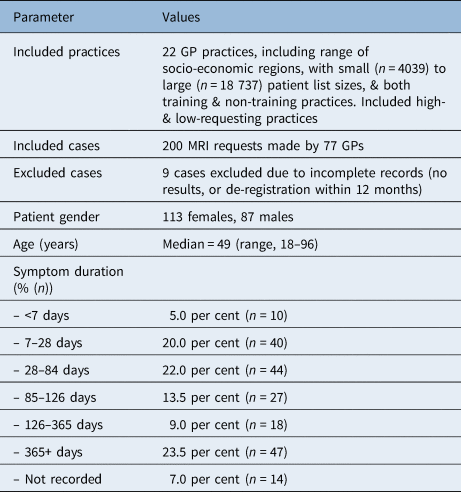
We reviewed scans from both high- and low-requesting practices (Table 2), achieving what was felt to be an adequately powered sample size of 200 scans to give a 95 per cent CI sampling error of 7 per cent or less.
Sample characteristics

GP = general practitioner; MRI = magnetic resonance imaging
Alignment with guideline indications
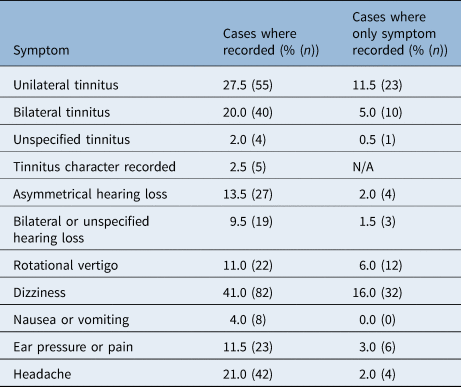
There was occasional discrepancy between clinical records and radiology requests. Clinical records were focused upon as most contemporaneous and likely to be accurate, with symptoms described in Table 3.
Presence of symptoms amongst imaged patients

N/A = not applicable
Some patients had previously been evaluated by ENT services but had re-presented for the same issue. This highlights the chronicity of such symptoms; 23.5 per cent of cases (95 per cent CI ± 5.9 per cent, n = 47) had a history longer than one year.
Only 33 per cent of IAM MRI scans (95 per cent CI ± 6.5 per cent, n = 66) were deemed likely to be indicated. Of the 13.5 per cent of patients who presented with asymmetric hearing (95 per cent CI ± 4.7 per cent, n = 27), 10 demonstrated asymmetric sensorineural hearing loss on audiometry.
A dedicated brain MRI was reported in 76.5 per cent of cases (95 per cent CI ± 5.9 per cent, n = 153). In 65 per cent of cases (95 per cent CI ± 6.7 per cent, n = 129), brain imaging was requested by the general practitioner, and in 12 per cent (95 per cent CI ± 4.5 per cent, n = 24) it was added by the radiology department. The IAM MRI scan was requested by a general practitioner in 76 per cent of cases (95 per cent CI ± 5.9 per cent, n = 152) and added by radiology in 24 per cent (95 per cent CI ± 5.9 per cent, n = 48); of these, only nine cases appeared to be indicated according to guidelines.
Tinnitus character was only recorded in 2.5 per cent of cases (95 per cent CI ± 2.2 per cent, n = 5), in keeping with evidence of low recognition amongst general practitioners.Reference El-Shunnar, Hoare, Smith, Gander, Kang and Fackrell21 In two of these three cases, character was noted as pulsatile, suggesting vascular or middle-ear abnormalities, for which computerised tomography is indicated rather than MRI.Reference Vattoth, Shah and Curé22
Magnetic resonance imaging results
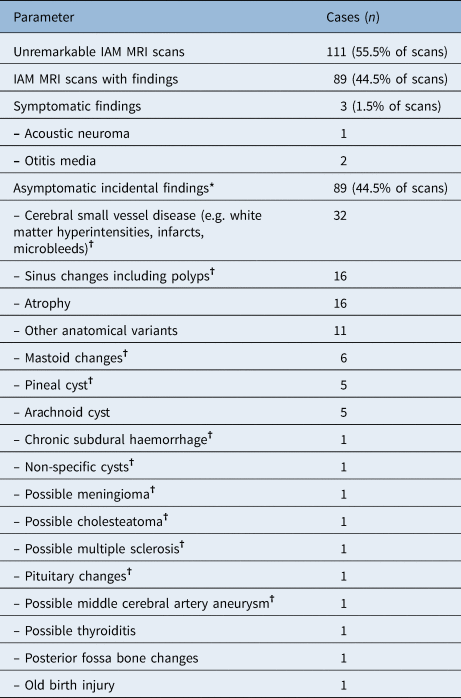
Table 4 outlines the MRI results. One acoustic neuroma was identified, representing a diagnostic yield of 0.5 per cent (95 per cent CI ± 1.0 per cent, n = 1). The acoustic neuroma was in a patient without tinnitus, previously diagnosed with asymmetric sensorineural hearing loss, who had already been referred to ENT prior to his MRI. This patient developed complete hearing loss following surgery; this is in keeping with literature reports of hearing preservation in 58 per cent of cases after intervention.Reference Coughlin, Willman and Gubbels8
MRI findings

*More than one incidental finding was present in some scans. †Findings that led to cascades of further specialist referrals. MRI = magnetic resonance imaging; IAM = internal auditory meatus
Two cases of middle-ear effusion in patients with bilateral hearing loss only, who had already started appropriate treatment, demonstrate why asymmetric sensorineural hearing loss is a recommended criterion to indicate acoustic neuroma investigation.
Incidental findings were demonstrated in 44.5 per cent of cases (95 per cent CI ± 6.9 per cent, n = 89). As a consequence of incidental findings, 18.0 per cent of imaged patients (95 per cent CI ± 5.3 per cent, n = 36) underwent cascades, including: low-value overdiagnosis and overtreatment burden, referrals to neurology, neurosurgery or ENT, or further imaging. All cascade referrals resulted in discharge, with no significant pathology found or change in management. One patient suffered a panic attack, in keeping with literature reports of MRI claustrophobic distress in 1 per cent of cases.Reference Hoekstra, Prijs and Van Zanten11
Associated referrals
In 35.5 per cent of cases (95 per cent CI ± 6.7 per cent, n = 71), there were no other associated specialist referrals. However, eight of these patients suffered unintended cascades as a result of incidental overdiagnosis, including contentious treatment burden or unnecessary repeat imaging.
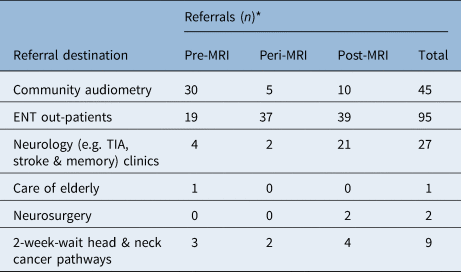
Table 5 outlines the 179 referrals, including 134 to secondary care specialists, for the 64.5 per cent (95 per cent CI ± 6.7 per cent, n = 129) majority of patients. Some patients had more than one referral. There were nine fast-track ‘two-week-wait’ suspected cancer referrals, of which seven were for audiological symptoms, despite not qualifying for such pathways. Two cancer pathway referrals were triggered by incidental benign findings on imaging, resulting in no change in management.
Associated general practitioner referrals

*There were a total of 179 referrals. Ten specialist referrals were to the private sector and 124 were to National Health Service providers; there were 134 specialist referrals in total (community audiology was not counted as a specialist referral). MRI = magnetic resonance imaging; TIA = transient ischaemic attack
For the 66 indicated MRI cases, there were 48 specialist referrals. Only 10.5 per cent of patients (95 per cent CI ± 4.2 per cent, n = 21) were appropriately imaged to rule out acoustic neuroma, with no additional specialist utilisation.
For patients seen in secondary care, there was no immediate access to MRI results from different providers, with patients subsequently recalled or re-scanned.
Discussion
Imaging requests
Patients present to primary care with more undifferentiated symptoms and earlier in their history. In this study, only 33 per cent of IAM MRI scans (95 per cent CI ± 6.5 per cent, n = 66) confirmed to established guideline indications. When acoustic neuroma was suspected, imaging of the brain rather than IAM was often selected. Patient requests for imaging were rarely noted; ordering patterns more likely reflect clinician heuristics than patient demand. Low recognition of tinnitus character and poor guideline compliance are in keeping with the literature as a primary care learning need.Reference El-Shunnar, Hoare, Smith, Gander, Kang and Fackrell21 Variation in how radiology providers vet requests was also apparent.
Investigation of dizziness was the commonest spurious use of IAM MRI. Retrocochlear pathology is not a primary suspicion in dizziness. Whilst neuroimaging can rule out infarction, the head impulse, nystagmus and test of skew (‘HiNTS’) clinical examination has superior sensitivity.Reference Muncie, Sirmans and James23 More importantly, central neurological pathology associated with dizziness would demand same-day referral to acute services rather than out-patient imaging with a turnaround time of weeks.
Magnetic resonance imaging findings
Only one acoustic neuroma was diagnosed, in a patient who had already been referred to ENT prior to MRI; this represents a diagnostic yield of 0.5 per cent (95 per cent CI ± 1 per cent, n = 1). Incidental findings were demonstrated in 44.5 per cent of IAM MRI scans (95 per cent CI ± 6.9 per cent, n = 89), in keeping with the existing literature.Reference Hoekstra, Prijs and Van Zanten11,Reference Papanikolaou, Khan and Keogh12 Incidental findings triggered cascades in 18.0 per cent of cases (95 per cent CI ± 5.3 per cent, n = 36), including further specialist referrals (with no ultimate change in management) for 15.5 per cent of all imaged patients (95 per cent CI ± 5 per cent, n = 31). Incidental findings may generate more cascades when identified in primary care, a setting with less expertise in advanced imaging along with access to numerous referral pathways.
Cerebral small vessel disease was the most prevalent incidental finding; this is important in the context of an ageing population, where up to 95 per cent of patients may demonstrate such changes.Reference Das, Regenhardt, Vernooij, Blacker, Charidimou and Viswanathan24 Some of these patients were referred to secondary care, and some were immediately started on hypertensive or statin therapy. Radiological cerebral small vessel disease may be a risk for future stroke or cognitive decline; however, many will never develop any symptoms. The evidence is mixed, and it is unclear whether treatment of asymptomatic cerebral small vessel disease is beneficial, particularly in the elderly.Reference Das, Regenhardt, Vernooij, Blacker, Charidimou and Viswanathan24,Reference Mok and Kim25 Whilst the negative psychological effects of disease labels could not be fully captured, in four cases, records documented that asymptomatic patients were distressed at being informed of cerebral small vessel disease.
Structural changes, noise exposure and psychological factors all work synergistically to trigger tinnitus, which has a bi-directional relationship with neuro-emotional circuitry.Reference Jang and Yi26–Reference Carpenter-Thompson, Schmidt, McAuley and Husain29 Tinnitus is associated with mental health symptoms,Reference Krog, Engdahl and Tambs30 noted in this cohort, and around 75 per cent of episodes might relate to emotional stress rather than cochlear pathology.Reference Han, Lee, Kim, Lim and Shin31 Over-medicalising, or anxiety-provoking incidental diagnoses and unnecessary referrals, is especially harmful considering that distress may already play a causative role in tinnitus amongst emotionally vulnerable patients.
Referral to specialist services
Studies show that approximately 23–37 per cent of primary care patients with tinnitus are referred to specialist services.Reference El-Shunnar, Hoare, Smith, Gander, Kang and Fackrell21,Reference Hall, Láinez, Newman, Sanchez, Egler and Tennigkeit32 Whilst one economic model, based on a variety of sources, suggested that 56 per cent of these patients are ultimately referred.Reference Stockdale, McFerran, Brazier, Pritchard, Kay and Dowrick2 Our sample of only imaged cases may not reflect all tinnitus patients presenting to primary care, so they cannot be directly compared. Nonetheless, 65.1 per cent of the 106 tinnitus patients in this cohort (95 per cent CI ± 9.1 per cent, n = 69) were referred to specialist services, with mostly unremarkable imaging findings. These results do not support a commonly held assumption that the availability of direct-access imaging reduces general practitioner specialist referrals. Of 164 patients in whom the general practitioner felt there was nothing of clinical relevance on imaging, 63.2 per cent (95 per cent CI ± 7.3 per cent, n = 107) were still referred to specialists, demonstrating that a ‘normal’ test does not necessarily avoid specialist referral and the further support needed beyond a test for those with persisting symptoms.
Of all imaged patients, 64.5 per cent (95 per cent CI ± 6.7 per cent, n = 129) were still referred to secondary care. It is unclear whether direct-access advanced imaging is helpful when patients are also referred to a secondary care specialist capable of organising such tests when necessary. In the vast majority of patients, the community-organised MRI was not available at their consultant review, and regardless of imaging results, only some patients can be discharged after a single appointment. Furthermore, additional MRI capacity for general practitioner requested imaging represents an increased cost pressure beyond the largely fixed supply of specialist imaging. The pre-hospital scans for these patients, with near-zero therapeutic yield, would seem to represent little utility for primary care management or for patient outcomes.
Only 10.5 per cent of imaged patients (95 per cent CI ± 4.2 per cent, n = 21) were appropriately scanned according to guidelines and received no additional referrals. Based on reference prices,Reference Stockdale, McFerran, Brazier, Pritchard, Kay and Dowrick2 an MRI expenditure of £26 000 (200 scans × £130) for this cohort effectively ruled out possible acoustic neuroma in 21 cases without specialist input, whilst generating 31 low-value specialist referral cascades as a result of incidental findings. Unfettered MRI access generates greater out-patient costs through incidental cascades than it saves through appropriately ruling out acoustic neuroma without referral.
Of all imaged patients, 35.5 per cent (95 per cent CI ± 6.7 per cent, n = 71) required no specialist referral. We could assume that the absence of general practitioner requested imaging may have resulted in all these cases being referred onwards. In this sector, primary care MRI represents additional scanning supply procured beyond the largely bottle-necked secondary care capacity. Remembering that 31 cascade referrals were generated through incidental findings, the additional cost pressure of £26 000 primary care MRI scans could have conceivably reduced by approximately only £4880 ((71 − 31) × £122, based on national tariff prices33) in secondary care referrals. This scenario, however, requires considerable unindicated and clinically ineffective use of advanced diagnostic imaging. Furthermore, not all patients who were referred would necessarily have received IAM MRI in specialist care, and many patients imaged in the community were re-scanned by secondary care. It is therefore highly unlikely that general practitioner imaging access represents any cost-containment benefit for commissioners.
Because hospital out-patient capacity is fixed, even if some referrals are reduced, savings are not released, as out-patient capacity is consumed by other demand. Supplying general practitioners with direct-access imaging represents an additional cost pressure. The clinical threshold for a non-invasive and easily accessible test is likely to be lower than that required for a general practitioner to trigger a specialist referral. It is therefore likely that general practitioners will order more scans than they would have otherwise referred to specialists. It is unclear how many more specialist referrals would have occurred in the absence of direct-access MRI and whether the added cost of such (mostly inappropriate) imaging warrants a potential small referral reduction, particularly with so many low-value cascades.
Referral efficiency from pre-hospital diagnostics was rarely realised, as community-delivered MRI scans were often unavailable at a patient's specialist consultation because of fragmented services lacking digital integration. Therefore, further specialist follow up beyond the initial appointment was often still required.
Benefit versus harm
The diagnostic yield from this primary care strategy was 0.5 per cent. Given that as few as 31 per cent of acoustic neuromas receive intervention,Reference Mackeith, Kerr and Milford6 645 (1 ÷ (0.005 × 0.31)) individuals are imaged in primary care to identify 1 acoustic neuroma candidate for intervention. This diagnostic strategy therefore costs approximately £83 850 (645 × £130) to achieve therapeutic yield.
There is a wide range of interventional procedures available for acoustic neuromas, each with varying associated risks.Reference Starnoni, Giammattei, Cossu, Link, Roche and Chacko34 Studies show that between 42 and 58 per cent of patients may see benefit in tinnitus or hearing preservation following surgery.Reference Coughlin, Willman and Gubbels8,Reference Kameda, Shono, Hashiguchi, Yoshida and Sasaki10,Reference Kohno, Shinogami, Yoneyama, Nagata, Sora and Sato35 With the most optimistic improvement rate of 58 per cent, we can therefore postulate that only 0.09 per cent (0.5 per cent × 31 per cent × 58 per cent) of patients undergoing IAM MRI in primary care stand to benefit clinically. This means that 1111 (1 ÷ 0.0009) primary care patients need to be imaged for 1 patient to achieve a clinical improvement from treatment. The cost of this diagnostic strategy equates to £144 430 (1111 × £130) per benefitting patient. Even without factoring in the cost of surgical or radiosurgical interventions, the diagnostic spend alone would exceed UK incremental cost-effectiveness thresholds of £20 000 to £30 000 per quality-adjusted life year, considering that the gain in quality-adjusted life years from surgery or radiosurgery above conservative treatment is thought to be often minimal.Reference Gait, Frew, Martin, Jowett and Irving36,Reference Zygourakis, Oh, Sun, Barani, Kahn and Parsa37
The one case of acoustic neuroma in this cohort had already been referred to ENT prior to his MRI, so there is no evidence that general practitioner access to imaging results in an improved diagnostic yield, or sensitivity, compared with usual general practitioner care without imaging.
Incidental findings were seen in 44.5 per cent of imaged patients (95 per cent CI ± 6.9 per cent, n = 89), and 18.0 per cent of imaged patients (95 per cent CI ± 5.3 per cent, n = 36) suffered as a result of overdiagnosis. This included negative labelling with conditions such as small vessel disease, and its associated treatment burden of unclear benefit, and the unnecessary cascades of referrals or further investigations, with no change in management. This means only approximately five patients need to be imaged for one to experience negative consequences of overdiagnosis. Such iatrogenic harms of psychological distress and anxiety, financial or insurance implications, as well as healthcare burden on patients may not be immediately tangible to clinicians. The psychological distress caused by being informed of incidental intra-cranial structural abnormalities is particularly important, considering the bi-directional relationship between tinnitus and mental health.
Strengths and limitations
We were able to audit a significant consecutive sample of IAM MRI scans over a two-year period across a large primary care population and a wide array of practices and clinicians, with mixed demographics, likely reflective of UK general practice. Only nine cases were excluded because of incomplete records, minimising any sampling or attrition bias. Adequate sample size provided an acceptable CI for sampling error. The rates of positive and incidental findings, as well as claustrophobia, were consistent with previous literature. There were no other published data on IAM MRI in primary care for comparison.
Primary care records provide robust data on associated healthcare utilisation across different secondary care services and sectors; however, they may not reflect all real-world symptoms. We could not capture patient-orientated outcomes or quality-of-life data, focusing instead on healthcare utilisation. We could not quantify the potential reassurance from scans with unremarkable findings, or the potentially enduring psychological harm associated with incidental findings and their cascades. We were unable to capture the full range of potential negative consequences of tests across physical, psychological, social, financial, treatment burden and dissatisfaction domains.Reference Korenstein, Chimonas, Barrow, Keyhani, Troy and Lipitz-Snyderman38
Only one evaluator, the regional clinical lead, reviewed the indications for scanning, which could introduce measurement bias. ‘Appropriateness’ of imaging can be subjective, and certain patient neurological features may not have been documented in clinical records. Despite such potential limitations, the low proportion of requests meeting guidelines provides a convincing signal regarding a problem of unindicated imaging overuse.
We did not have a comparator group without MRI access, to contrast management decisions and cascades. We considered comparing rates of ENT secondary uses service (SUS) data against IAM MRI referral rates. However, whilst around a quarter of practices requested no IAM MRI scans, the volume of IAM MRI scans was too small to expect a detectable difference in ENT referrals, as audiological symptoms represent only a small proportion of total ENT referrals.Reference Jacups and McConnon39,Reference Mahalingam, Seymour, Pepper, Tostevin and Oakeshott40
Specialist referrals triggered by incidental findings have a clear temporal causal relationship to patient MRI. Patients undergoing direct-access imaging may reflect those with confounding factors, representing a more complex group than most patients attending primary care with tinnitus. Whilst we therefore cannot comment on whether imaging itself is related to a higher rate of specialist ENT referral, this evaluation certainly shows no evidence to support the assumption that primary care direct access to imaging reduces specialist referrals.
Implications for practice
Imaging guidelines do not comment on the setting of care, and this evaluation is the first to highlight IAM imaging challenges in the low-prevalence and more undifferentiated primary care landscape. General practitioners can refer onward and do not require the high-sensitivity diagnostic strategy of specialist settings. The IAM MRI diagnostic yield for acoustic neuroma was only 0.5 per cent, at a cost of approximately £26 000 per diagnosis. Considering that only 31 per cent of neuromas are resected, and only some of these achieve clinical improvement, this would place the cost per therapeutic yield of this general practitioner diagnostic strategy well above UK cost-effectiveness thresholds. Factoring in surgical complications, it is thought that there is no significant quality-adjusted life year gain from surgery or radiotherapy compared with conservative management of small-to-medium (1–20 mm) acoustic neuromas, and so a diagnostic strategy for such conditions presents no cost utility.Reference Gait, Frew, Martin, Jowett and Irving36
It is debatable whether unilateral, non-pulsatile tinnitus alone warrants imaging. A systematic review found that less than 1 per cent of acoustic neuromas present with unilateral tinnitus alone, and that tinnitus correlates more with hearing loss than acoustic neuroma per se.Reference Sweeney, Carlson, Shepard, McCracken, Vivas and Neff4 Studies argue against imaging unilateral tinnitus, suggesting that acoustic neuroma can be reliably and more cost-effectively identified by asymmetric sensorineural hearing loss audiometric protocols.Reference Hoekstra, Prijs and Van Zanten11,Reference Chatrath, Frosh, Gore, Nouraei and Harcourt41,Reference Bhargava, Coyle, Wong, Masood and Qayyum42 In view of the harms of over-testing, the 2020 NICE guideline committee recommended to ‘consider’ but not ‘offer’ imaging for unilateral tinnitus. It is unclear what impact this semantic advice will have, considering the current ubiquitous unindicated imaging overuse.
Education is resource-intensive, with limited reach and mixed long-term effects.Reference Cadogan, Browne, Bradley, Cahill, Knottnerus and Pop43,Reference Fryer and Smellie44 System changes, such as amending electronic and paper request forms,Reference Goldzweig, Orshansky, Paige, Miake-Lye, Beroes and Ewing45 may more effectively limit IAM MRI to proven asymmetric sensorineural hearing loss (asymmetry of more than 15 dB at any frequency has shown 100 per cent sensitivity and 29 per cent specificity for acoustic neuromaReference Obholzer, Rea and Harcourt46). Based on this evaluation, these changes could avoid over 90 per cent of current general practitioner requested IAM MRI scans as well as resource savings from avoidable cascades as a result of incidental findings. The commissioning of UK audiometry providers would require review, as many currently exclude patients with unilateral tinnitus or asymmetric hearing loss. Readily available bedside tuning fork tests have limited sensitivity, potentially as low as 67 per cent,Reference Bayoumy and De Ru47 to detect asymmetric sensorineural hearing loss and are not consistently used.Reference El-Shunnar, Hoare, Smith, Gander, Kang and Fackrell21 However, tinnitus alone has a very low prevalence for acoustic neuroma (less than 1 per cent), and therefore negative tuning fork tests may provide an acceptable negative predictive value in this scenario for watchful waiting rather than immediate imaging, particularly for those with a low level of impairment. Because of the poor specificity of tuning fork tests for asymmetric sensorineural hearing loss, as low as 60 per cent,Reference Kelly, Li and Adams48 their positive predictive value to indicate imaging is poor, and audiometry first would still be advisable to reliably identify asymmetric sensorineural hearing loss prior to imaging.
• Imaging tinnitus without asymmetric hearing loss provides less than 1 per cent diagnostic yield, with even smaller therapeutic yield, as most neuromas are managed conservatively.
• Only 33 per cent of general practitioner scans for retrocochlear pathology appeared congruent with guideline indications.
• 64.5 per cent of imaged patients were still referred to secondary care, highlighting additional support beyond tests required for ongoing symptoms.
• A cascade yield of low-value investigations, treatments or referrals was seen in 18 per cent, due to incidental findings seen in 44.5 per cent.
• Fewer than 1 in 1000 patients imaged in primary care may benefit through surgery, whilst 1 in 5 may suffer ineffective or harmful cascades.
• In primary care, IAM MRI could be restricted to those with proven asymmetric sensorineural hearing loss, or shifted to audiologist-led settings for a more beneficial and cost-effective wider therapeutic offer than conventional surgical pathways.
Aside from ruling out rare acoustic neuroma, the most therapeutic offer, including psychological therapies, to support habituation to often chronic symptoms may be best accessed through non-surgical audiovestibular services.Reference Stockdale, McFerran, Brazier, Pritchard, Kay and Dowrick2 Such audiologist-led care is likely to be more clinically and cost-effective than general practitioner requested imaging and traditional surgical ENT referral,Reference Stockdale, McFerran, Brazier, Pritchard, Kay and Dowrick2 which has low diagnostic and therapeutic yield, with greater iatrogenic disease labelling and unintended cascades. Whilst variation exists amongst audiology and tinnitus services in the UK,Reference Hoare, Gander, Collins, Smith and Hall49,Reference Gander, Hoare, Collins, Smith and Hall50 it may be reasonable to reduce commissioned general practitioner IAM MRI capacity and more effectively re-invest in audiologist-led diagnostic pathways, with strict scanning protocols and expertise in interpreting advanced imaging, for the high burden of audiovestibular complaints in primary care.Reference Abbas, Smith and Trinidade51 Further research should focus on capturing wider domains of quality of life following IAM MRI, including psychological and financial consequences, to understand the net benefit versus harm of imaging patients with a very low likelihood of serious disease.
Conclusion
What benefit could direct-access IAM MRI offer primary care? Regarding acoustic neuroma detection, first-line audiometry for asymmetric sensorineural hearing loss may be more appropriate to identify those with a higher probability of disease. For patient reassurance, evidence suggests that tests alone, including neuroimaging, are not anxiolytic in the long term.Reference Van Ravesteijn, Van Dijk, Darmon, Van de Laar, Lucassen and Olde Hartman52,Reference Rolfe and Burton53 Referral efficiency from pre-hospital diagnostics is limited by fragmented services which lack digital integration. Regarding reduction of referrals, the majority of imaged cases are still referred to specialist services, even with a ‘normal’ MRI scan. Imaged patients had a higher, rather than lower, rate of specialist referral than that demonstrated in studies of usual general practitioner care. Only 10.5 per cent of cases were appropriately imaged without additional referrals. Any marginally earlier acoustic neuroma diagnosis (in 0.5 per cent of patients) is eclipsed by a higher rate of patient harm and further costs through incidental findings in 44.5 per cent of cases, generating low-value disease labels and cascades of healthcare utilisation in 18 per cent.
Less than 0.1 per cent of patients undergoing IAM MRI in primary care stand to achieve any clinical improvement through identification and subsequent surgical treatment of acoustic neuroma. Therefore, more than 1000 primary care scans are necessary for 1 patient to benefit. There was no evidence that such patients would not be identified via onward referral in routine care without MRI access. However, as many as around one in every five who undergo IAM MRI in primary care suffers harm through low-value structural disease labels and associated treatment burden, or unnecessary further referrals and investigations, with no obvious clinical benefit. Such a low number needed to harm is concerning. Considering clinical effectiveness and patient safety, with a national NHS focus on protecting individuals from avoidable harm, it is vital for policy-makers to improve current IAM imaging pathways.
Competing interests
None declared